ISSN(Online): 2320-9801
ISSN (Print): 2320-9798
I
nternational
J
ournal of
I
nnovative
R
esearch in
C
omputer
and
C
ommunication
E
ngineering
(An ISO 3297: 2007 Certified Organization)
Vol. 3, Issue 5, May 2015
The Cloud Computing: A Systematic Review
Mohammad Oqail Ahmad, Dr.Rafiqul Zaman Khan
Research Scholar, Department of Computer Science, Aligarh Muslim University, Aligarh, U.P, India Associate Professor, Department of Computer Science, Aligarh Muslim University, Aligarh, U.P, India
ABSTRACT: These days, the Cloud Computing is probably the most considerable technology in the IT sector. It is broadly made use to deliver services well over the internet for both low priced and technical motives. Cloud Computing support virtualization technique over the internet to meet the stretchy demand of the users with less interaction by having service provider. For that reason users are progressively engaging toward this trend. In this paper, we presented brief review of Cloud Computing; it also includes comparative study between Cloud Computing, Distributed, Utility, Cluster, and Grid Computing and also three deployment model and service model. This paper also lay out brief discussion of the main characteristics of cloud computing, benefits, challenges and its applications.
KEYWORDS: Cloud Computing, SaaS, PaaS, IaaS, Distributed Computing, Utility Computing, Cluster computing, Grid Computing.
I. INTRODUCTION
ISSN(Online): 2320-9801
ISSN (Print): 2320-9798
I
nternational
J
ournal of
I
nnovative
R
esearch in
C
omputer
and
C
ommunication
E
ngineering
(An ISO 3297: 2007 Certified Organization)
Vol. 3, Issue 5, May 2015
II. EVOLUTION OF CLOUD COMPUTING
Cloud Computing (CC) is a new terminology given to a evolution of distributed computing, utility computing and grid computing etc. Several organizations are getting to interest to use cloud computing over period of time, but CC has come into existence with the invention of ARPANET by J.C.R.Licklider in 1960's.
In early 1990, cloud was actually use in commercial purpose to support large ATM Network. Beginning of the 21st century, cloud computing solutions and products had begun to seem on the market, however totally focus at this time frame was on Software as Services [27].
In 2002, Amazon.com performed a most important part in the formation of cloud computing if improving their data and delivering access to their personal system by method of Amazon Web Services on utility computing manner [27]. It is donation of some of the scientific study to develop an explanation of the cloud computing and Youseffetal. were among the first person to deliver you understanding of cloud computing and its elements[2]. These people mentioned that cloud computing is a combination of a few innovative as well as all previous principles in a large amount of research fields like distributed, utility, cluster and grid computing and additionally virtualization. Based on Youseff et al. “cloud computing can be seen as a new computing standard which permits consumers to actually transient make use of computing facility all over the network, provided being a resource through third party provider towards probably more than one stages of abstraction” (Youseff et al. 2008) [2].
In July 2010, OpenStack is collectively launched by Rackspace Hosting and NASA, which guide to organizations present cloud computing services operating on traditional hardware [27].
On March 1, 2011, IBM SmartCloud platform was introduced by IBM to help Smarter World. Cloud Computing is a crucial portion among the several elements of the Smarter Computing foundation [27].
On June 7, 2012, Oracle Cloud was launched by Oracle, while its elements are continue to development phase and proposing users to became the first provider users to access combined set of IT frameworks, such as Infrastructure (IaaS), Platform (PaaS), and Software (SaaS) layers [27].
There are various computing technologies involved in the evolution of cloud computing on which comparative study are done below:
1) Distributed Computing 2) Utility Computing 3) Cluster Computing 4) Grid Computing 5) Cloud Computing
S.No Feature Distributed
Computing
Utility Computing
Cluster Computing
Grid Computing
Cloud Computing 1
Virtualization Yes Some form of
virtualization Half Half Essential
2
Scalability Yes: Resources
and users Yes No
Half:
Nodes and sites
Yes: Nodes, sites and hardware
3
Standardization and Interoperability Yes
Standardized on backup policies
Virtual Interface Architecture (VIA)-based
Some Open Grid Forum standards
Web Services (SOAP and REST)
4
User Management Distributed Centralized Centralized
Decentralized and also virtual organization (VO)-based
Centralized or can be delegated to third party
5 Size 100s or 1000s 100s 100s 1000s 100s to 1000s
6
Pricing of Services Limited
Utility pricing rather than flat-rate
Limited, not open market
Dominated by public good or privately assigned
Utility pricing, discounted for larger
ISSN(Online): 2320-9801
ISSN (Print): 2320-9798
I
nternational
J
ournal of
I
nnovative
R
esearch in
C
omputer
and
C
ommunication
E
ngineering
(An ISO 3297: 2007 Certified Organization)
Vol. 3, Issue 5, May 2015
7 Resource
Management Distributed Distributed Centralized Distributed
Centralized/Dist ributed
8
Operating System Windows / Linux
Linux through Windows and Solaris
Windows /
Linux Any standard Hypervisor
9
Capability
Based on Consumption of Services
Based on a service provisioning
Stable and guarantee
Varies, but high Provisioned on demand
10
Control Decentralized Centralized Centralized Decentralized Centralized(dat
a centre)
11
Failure Management
Limited (often failed minor part of the task which recovered by replication method). Limited Limited (often failed tasks/applicatio ns are restarted). Limited (often failed tasks/applicatio ns are restarted). Strong support for failover and data replication. VMs can be simply migrated from one node to other.
12 Ownership Multiple Single Single Multiple Single
13 Speed High bandwidth High bandwidth High bandwidth Low bandwidth High bandwidth
14 Security Traditional password based login Traditional password based login Traditional password based login Public/private key pair based authentication
Each
user/application is provided with a virtual machine.
15
Composition Standards PC and
Server
Standards PC
and Server Standards PC
High-end Servers
Standards PC, Servers and NAC
16 Privacy High level Service level Medium level Medium level High level
17
Transparency Yes Yes Yes No, low Yes, high but
optional 18 Application Geographically dispersed, e-commerce including e-banking Business model Science, Business, and Data centers Collaborative Scientific and HPC Web applications and Content delivery 19 Examples WWW others Internet and Intranet Google, Amazon 2008 ARCnet, VAXcluster and Beowulf Cluster
GIMPS, SETI Amazon EC2
20
Future
Utility, Cluster, Grid and Cloud Computing
Grid and Cloud Grid Computing Cloud Computing Next generation of Computing
Table1: Comparative study of Cloud Computing with Distributed, Utility, Cluster and Grid Computing
III.OVERVIEW OF CLOUD COMPUTING
A. Definition of Cloud Computing
ISSN(Online): 2320-9801
ISSN (Print): 2320-9798
I
nternational
J
ournal of
I
nnovative
R
esearch in
C
omputer
and
C
ommunication
E
ngineering
(An ISO 3297: 2007 Certified Organization)
Vol. 3, Issue 5, May 2015
The use of the “cloud” makes references to the two essential concepts.
Abstraction
The concept of abstraction in cloud computing means hide the information about the system implementation from consumers and designers. Programs and data located on physical systems that are uncertain, supervision of systems is to contact out to others, and access by consumers is everywhere [14].
Virtualization
The concept of virtualization means to refers to something is not real but it acts as real. It is basically used to increase computing efficiency and utilize maximum hardware resources of the system.
B. Characteristics of Cloud Computing
Cloud computing expose five key characteristics as stated by NIST (National Institute of Standards and Technology).
On-demand self-service
Consumer wants computing resources from service provider without the need for human interaction then cloud service provider provides service to consumer according to required.
Broad network access
The resources are available over network can be allowed to globally access by using the different devices such as desktop, laptop, mobile etc.
Resource pooling
Cloud resources are pooled by service provider and then they are shared to serve different users. These resources are released by some consumer and can be serve to other consumer as needed.
Rapid elasticity
Computing capability of cloud resources can be ample flexible to provisioned, in number of cases, it allows programs automatically scale utilization in both cases rapidly scale up and rapidly scale down as need. Consumer are able easily obtained in any number at any time and often appear to be unlimited.
Measured service
Cloud system automatically measured, controlled and confirmed of utilized service by both service provider and consumer for providing transparency and accountability. Cloud computing platforms utilize a metering skill that will automatically manage as well as enhance resource utilize. All of this is executed towards some stage of abstraction commensurate to the form of service [7]. These types of services involve active user account, storage space, internet speed, processing etc.
C. Service Model of Cloud Computing
ISSN(Online): 2320-9801
ISSN (Print): 2320-9798
I
nternational
J
ournal of
I
nnovative
R
esearch in
C
omputer
and
C
ommunication
E
ngineering
(An ISO 3297: 2007 Certified Organization)
Vol. 3, Issue 5, May 2015
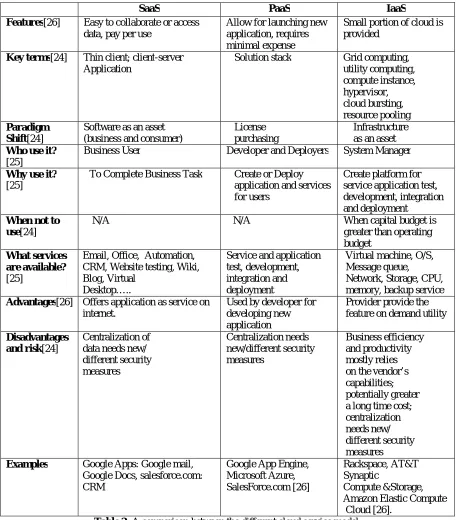
Cloud Software as a Service(SaaS)
Software as a Service (SaaS) is a service model, in which software application is made for customers and hosted by the vendor are accessible for clients on demand over the network. Customers do not have necessary to installed copy of software on the desktop, laptop or any other client devices.
Pros of IaaS are as follow [2]:
Provides products for documenting online such as Microsoft office. Software available in for short term manner.
Technique available for fast delivering the technology.
Broad application of services available online such as face book, twitter, Hotmail etc.
It uses programming interfaces which provide implementation between different Tools of software.
Cloud Platform as a Service (PaaS)
Platform as a Service (PaaS) make it possible for customer to established computing platform to develop and host application. Customers can establish their own small scale organization than larger scale can be able to handle. The cloud provider provides the underlying cloud infrastructure such as operating system, servers, or storage which is not accessible by the customer.
Pros of PaaS are as follow [2]: Pay per use
No need of installing or downloading software for users.
Concurrent users can access the application due to shared architecture.
Provide same integrated platform for develop, deploy and test so it reduce development and maintenance cost.
Provides reliability and security.
Cloud Infrastructure as a Service (IaaS)
It offers cloud infrastructure, client using this infrastructure for established their own operating system and cloud provider manage the system's CPU, memory and processing. Client can configure and maintain all what it takes in cloud. IaaS is combination of both public and private infrastructure or can be obtained as individual. For IT resources IaaS will provide a new consumption model as compare to SaaS and PaaS the IaaS is growing rapidly [8].
Pros of IaaS are as follow [2]:
Multiple customers can access on a same hardware resources. Fully scalable
ISSN(Online): 2320-9801
ISSN (Print): 2320-9798
I
nternational
J
ournal of
I
nnovative
R
esearch in
C
omputer
and
C
ommunication
E
ngineering
(An ISO 3297: 2007 Certified Organization)
Vol. 3, Issue 5, May 2015
It provides the resources as a service. It allows dynamic scaling.
SaaS PaaS IaaS
Features[26] Easy to collaborate or access data, pay per use
Allow for launching new application, requires minimal expense
Small portion of cloud is provided
Key terms[24] Thin client; client-server Application
Solution stack Grid computing, utility computing, compute instance, hypervisor, cloud bursting, resource pooling
Paradigm Shift[24]
Software as an asset (business and consumer)
License purchasing
Infrastructure as an asset
Who use it?
[25]
Business User Developer and Deployers System Manager
Why use it?
[25]
To Complete Business Task Create or Deploy application and services for users
Create platform for service application test, development, integration and deployment
When not to use[24]
N/A N/A When capital budget is
greater than operating budget
What services are available?
[25]
Email, Office, Automation, CRM, Website testing, Wiki, Blog, Virtual
Desktop…..
Service and application test, development, integration and deployment
Virtual machine, O/S, Message queue, Network, Storage, CPU, memory, backup service
Advantages[26] Offers application as service on internet.
Used by developer for developing new application
Provider provide the feature on demand utility
Disadvantages and risk[24]
Centralization of data needs new/ different security measures
Centralization needs new/different security measures
Business efficiency and productivity mostly relies on the vendor’s capabilities; potentially greater a long time cost; centralization needs new/ different security measures
Examples Google Apps: Google mail, Google Docs, salesforce.com: CRM
Google App Engine, Microsoft Azure, SalesForce.com [26]
Rackspace, AT&T Synaptic
Compute &Storage, Amazon Elastic Compute
Cloud [26].
ISSN(Online): 2320-9801
ISSN (Print): 2320-9798
I
nternational
J
ournal of
I
nnovative
R
esearch in
C
omputer
and
C
ommunication
E
ngineering
(An ISO 3297: 2007 Certified Organization)
Vol. 3, Issue 5, May 2015
D. Deployment Model of Cloud Computing
It is related to the location and management of cloud system. NIST recognize four kinds of deployment models in cloud computing and they are:
Public Cloud
The infrastructure of public cloud is made available for the general public where the resources are provided over internet and any users can access from the cloud, it is owned by the cloud vendor [18]. The public cloud infrastructure is not visible for the customer where the infrastructure is hosted.
Private Cloud
The infrastructure of private cloud is made available only for specific organization and not for other organization. It means resources available in private cloud can be access by internal users, anyone within the organization but users outside of that organization cannot access. Commercial data are fully maintained as well as infrastructures of private cloud are entirely taking care by the organization itself [18]. Private cloud a lot more protected when we compare with the public cloud.
Hybrid Cloud
The infrastructure of hybrid cloud is combination of more than one cloud such as public, private or community cloud. Critical data can hosted by organization on private cloud and data by having pretty less security relates to public cloud [7].
Community Cloud
The infrastructure of public cloud is deployed for several organizations and not for specific organization but support specific community or interested group. It means organizations that have similar policies, objectives and targets or belongs to specific community, build a shared cloud datacenter that can be used by all of the members [19][20]. It is based on the faith between all the members in community cloud, which can walked through their mutual benefits [20].
Attribute Public Private Hybrid Community
Cost of building the datacenter on service[20]
No initial cost but most expensive in long term
High initial cost but minimum long-term cost
Medium initial cost Various depends on the number of cooperative
Virtualization[28] Utilization efficiency benefits via server virtualization Utilization efficiency benefits via server virtualization Utilization efficiency benefits via server virtualization
Utilization efficiency gains through server virtualization
Infrastructure controllability and flexibility[20]
Limited configuration
Full (H/W and S/W)
Full over the private part and limited for the public part
High but limited by the community policies
Accessibility[28] Widespread accessibility
Limited accessibility
Medium accessibility
Depend on number of cooperative
Operation and maintenance cost[20]
Lowest Highest Weighted average Highest
Space [28] Require no space
dedicated for data center
Require largest amount of space dedicated for data center
Require moderate amount of space dedicated for data center
Require amount of space depends on the
number of cooperative dedicated
for data centre
Size of datacenter[20]
~50,000 server ~50,000 server Less than private cloud
15,000 more than private cloud but much less than public cloud
Workload[28] Suited for handling large spikes in workload
Not suited for handling large spikes in workload
Suited for handling large spikes in workload
ISSN(Online): 2320-9801
ISSN (Print): 2320-9798
I
nternational
J
ournal of
I
nnovative
R
esearch in
C
omputer
and
C
ommunication
E
ngineering
(An ISO 3297: 2007 Certified Organization)
Vol. 3, Issue 5, May 2015
Level of trust[20] Lowest Highest Medium High
Ownership[20] IaaS Customer IaaS vender owns
public part and consumer owns the in-house part
Share between the cooperative
Table 3: A comparison between the different cloud deployment model.
E. Benefits of Cloud Computing
Reduced Cost
Organizations want to reduce the cost of managing and maintaining has to shift toward the resources of cloud computing vendor. Using cloud provider services, organization keep their applications up to date on their systems free without having to purchase and install[9][11].
Flexibility
The main reason of popularity of cloud computing is flexibility, due to this users have ability to access data anywhere and anytime such as from home, on holiday in the world. If user is off-line want to access data, user can connect through virtual office, quickly and easily. The devices which are applicable include laptop, desktop, smart phone etc. with internet connection [9][10].
Availability and Reliability
Availability of cloud resources is high because it is up to vender available on 24x7 and more reliable chances of failure are minimal and immediate response to disaster recovery. From anywhere one can login and access the information.
Simplicity
Simplicity offers a user does not require training or have technical sound to work on a cloud, with little knowledge of hardware and software can use the cloud resources [13].
Greener
The cloud computing is naturally a green technology since it enable resource sharing among users thus not requiring large data centers that consumes a large amount of power[19].Users can get anything from cloud at anytime and anywhere[11].
Centralized
Because the system is centralized, you can easily apply patches and upgrades. This means your users always have access to the latest software versions [12].
Mobility
Users of cloud do not require to carry their personal computer, because they can access own documents anytime anywhere[19].
Unlimited Storage Capacity
Cloud computing support unlimited data storage capacity, so it offers virtually unlimited storage of data. Users can store approximately hundreds of petabytes ( a million gigabytes) compared to own computer's current capacity can be 500 GB or 1 TB, so do not require to panic about your data[10][15].
F. Challenges of Cloud Computing
Security
There is in reality that security challenge has been a major obstruction in the influencing cloud computing acceptance[16]. Without hesitation, moving your records, running your software on someone else's hard disk using someone else's CPU appears daunting to many[17]. Well-known security challenges in the cloud computing are: confidentiality, integrity, privacy, accountability, phishing and so on [7]. Regarding to a 2009 IDC Survey, security was graded as the greatest aspect for retaining back organizations from implementing it[16].
Services Delivery and Billing
ISSN(Online): 2320-9801
ISSN (Print): 2320-9798
I
nternational
J
ournal of
I
nnovative
R
esearch in
C
omputer
and
C
ommunication
E
ngineering
(An ISO 3297: 2007 Certified Organization)
Vol. 3, Issue 5, May 2015
Load balancing
Load balancing is challenging task, when the failure some of its parts during the service providing. Load balancing would be put in action duration of the service when the failure some of its parts. Its component would be regularly watched and often one will became nonresponsive, at that time load balancer is up on and balance the load of that nonresponsive part and do not send traffic to it.
Transferability
If cloud customers want to migrate from one cloud to another cloud that is from one hosting provider to another have to face more problems. It's not easy to migrate to other hosting provider because of migration process will take time to transfer files, which indirectly your business in off line for some time/days.
Ownership
Once data has been moved to the cloud, some people panic that they might lose some of their rights or are unable to protect the rights of their users. A large number of cloud providers are dealing this challenge along with well created user-sided agreements. That said, users would be wise to seek advice from their favorite legal representative. Users never claim to service provider who use in their provision of service and forms any kind of ownership over your data [19].
IV.APPLICATION OF CLOUD COMPUTING
A. Development & Test
The cloud customer can develop and test their complete production on demand in the cloud. Developers can save their time and expanse over traditional development and testing scenarios, that allows developers to quicker handoff from design to function. It also provide the patterns towards about iterative active development, the opportunity to trial and able to move out quick competitive differentiator with the cloud [12].
B. Cloud-Based Anti-Spam and Anti-Virus Services
A number of organizations utilize cloud services which typically perform anti-spam sorting and deliver you antivirus services. Even if majority of services are hosted by the organization inwardly, they can be easily positioned in your organization based on cloud situation.
C. IT Education and Research
IT field is swiftly heading in the direction of Cloud Computing, because it supports multiple types of cloud deployment (public, private hybrid, or community), multiple models of application programming and extensible framework enabling educators/researchers to develop their own programming model and application schedule [23].Due to above platform provided by cloud computing, software industry also concentrating in shifting from developing applications for PCs to Data centers.
V. CONCLUSION
In this paper, we have surveyed of cloud computing, discussed its vital principles, non-exhaustive vision of the main aspects forming a cloud system, evolution and comparative study with distributed, utility, cluster and grid computing, outstanding characteristics as well as pros and cons. Cloud computing technology is still evolving, we desire these work may give a much better knowledge of the design challenges of cloud computing, and mark the way for more research in this realm.
REFERENCES
1. M.Peter and G. T, The NIST definition of Cloud Computing. 2009.
2. Rajleen Kaurand and Amanpreet Kaur, ”A Review Paper on Evolution of Cloud Computing, its Approaches and Comparison with Grid Computing”, (IJCSIT) International Journal of Computer Science and Information Technologies, Vol. 5 (5) , 2014, 6060-6063
3. Dr. Rahul Malhotra and Price Jain. "An EMUSIN techniques and it component in a cloud computing environment", IJCTT, August, 2013 4. NIST, “National Institute of Standards and Technology," [Online]. Available: www.nist.gov. [Accessed August 2013].
5. https://gigaom.com/2008/02/28/how-cloud-utility-computing-are-different/ 6. http://sites.force.com/appexchange/home
7. Evwiekpaefe, Abraham E. and Fiyinfoluwa Ajakaiye, "The Trend and Challenges of Cloud Computing: a Literature Review", International Letters of Social and Humanistic Sciences(ILSHS),5 (2014) 13 -20
8. Er. RamanjeetKaur, "A Review of Computing Technologies: Distributed, Utility, Cluster, Grid and Cloud Computing", ISSN:2277 128X,Volume 5, Issue 2, Feb 2015
ISSN(Online): 2320-9801
ISSN (Print): 2320-9798
I
nternational
J
ournal of
I
nnovative
R
esearch in
C
omputer
and
C
ommunication
E
ngineering
(An ISO 3297: 2007 Certified Organization)
Vol. 3, Issue 5, May 2015
10. http://cloudcomputingadvices.com/cloud-computing-advantages-disadvantages
11. KiranYadav,"Role of Cloud Computing in Education", International Journal of Innovative Research in Computer and Communication Engineering,Vol. 2, Issue 2, February 2014
12. Neeraj Chopra, tanvirsingh and AmitKumar, "Cloud Computing : A Review ", IJCST Vol: 3, Issue 3, July-Sep 2012 13. http://www.verio.com/resource-center/articles/cloud-computing-benefits/
14. C.C.Bible, W.Publishing, and J. Wiley, Barrie Sosinsky
15. http://leverhawk.com/what-is-cloud-computing-tutorial-2012120519
16. Omotunde A.A, Awodele O, Kuyoro S. O, and Ajaegbu C., "Survey of Cloud Computing Issues at Implementation Level", Journal of Emerging Trends in Computing and Information Sciences, ISSN 2079-8407Vol. 4, No. 1 Jan 2013.
17. Kuyoro S. O., Ibikunle F. and Awodele O., "Cloud Computing Security Issues and Challenges", International Journal of Computer Networks (IJCN), Volume (3) : Issue (5) : 2011
18. K.Kavitha," Study on Cloud Computing Model and its Benefits, Challenges", International Journal of Innovative Research in Computer and Communication Engineering (An ISO 3297: 2007 Certified Organization)Vol. 2, Issue 1, January 2014
19. Suriya Begum and Dr. Prashanth C.S.R, "Review of Load Balancing in Cloud Computing", IJCSI International Journal of Computer Science Issues, Vol. 10, Issue 1, No 2, January 2013.
20. Mohammad Hamdaqa and Ladan Tahvildari, "Cloud Computing Uncovered: A Research Landscape", Advanced in Computers, ISSN: 0065-2458, VOL. 86, 2012.
21. Qi Zhang, Lu Cheng, Raouf Boutaba, "Cloud computing: state-of-the-art and research challenges", J Internet Serv Appl (2010) 1: 7–18DOI 10.1007/s13174-010-0007-6.
22. http://cloudtweaks.com/2012/08/top-five-challenges-of-cloud-computing/
23. Rajkumar Buyya and Karthik Sukumar, "Platforms for Building and Deploying Applications for Cloud Computing", CSI Communications, ISSN 0970, Volume No.35, Issue N. 01, May 2011.
24. Sumit Khurana and Anmol Gaurav Verma, "Comparison of Cloud Computing Services Models: SaaS, PaaS,IaaS", IJECT Vol No.4, Issue No. 3, June 2013
25. [25]. Dimpi Rani and Rajiv Kumar Ranja, "A Comparative Study of SaaS, PaaS, and IaaS in Cloud Computing", IJARCSSE 4(6),June 2014. 26. [26]. Ashish Kumar, "World of Cloud computing and Security", International Journal of Cloud Computing and Services Science (IJ-CLOSER),
pp. 53~58 ISSN: 2089-3337,Vol.1, No.2, June 2012, 27. http://en.wikipedia.org/wiki/Cloud_computing
28. Fei Hu, MeikangQiu, jiayin Li, Travis Grant, Draw Tylor, Seth McCaleb, Lee Butler and Richard Hamner, "A Review on Cloud Computing: Design Challenges in Architecture and Security", Journal of Computing and Information Technology-CIT 19, 2011, 1, 25-55
BIOGRAPHY
Dr. Rafiqul Zaman Khan, received his B.Sc Degree from G.M.J.P Rohilkhand University, Bareilly, M.Sc and M.C.A from A.M.U. Aligarh and Ph.D (Computer Science) from Jamia Hamdard University, New Delhi. He has 21 years of Teaching Experience of various reputed International and National Universities viz King Fahad University of Petroleum & Minerals (KFUPM), K.S.A; Ittihad University (IU), U.A.E; Pune University, Pune; Jamia Hamdard University, New Delhi; and A.M.U, Aligarh. He worked as a Head of the Department of Computer Science at Poona College, University of Pune and Chairman of the Department of Computer Science, AMU, Aligarh. His Research Interest includes Parallel & Distributed Computing, Gesture Recognition, Expert Systems, IPv6 Security & Cloud Computing. He has published about 56 research papers in International Journals/Conferences. Number of students completed their PhD under his supervision. Dr. Khan is the Member of Advisory/Editorial Board of number of International Journals.