Formulate Competent Decision Making in Data
Mart using Fuzzy Optimization Technique
A. Prema1 A.Pethalakshmi2
1
Research Scholar, Department Of Computer Science, Research And Development Centre,Bharathiar University,
Coimbatore,Tamilnadu,India,
2
Associate Professor, MVM Government Arts College, Dindigul,Tamilnadu,India
Abstract: Data Martix raising as one of the most recent areas in big business. Data mart (local data warehouse) is chosen to achieve strategic decision making for executives to earn more profit. A premeditated ETL (Extract, Transform and Load) function reside in data mart within the focus on specific dataware house information. In this paper, we have projected decision making methodologies to increase the sales promotion in data mart and located best decision making method by using fuzzy optimization technique.
Keywords: Data mart, ETL, Decision making, Decision making methodology and Fuzzy optimization technique.
1. INTRODUCTION:
As we survive in an era of scientific development, technical innovation and earlier advancement in modern computing, with great interest utmost care is taken in this paper to help aspiring academic and analysis methodologies in data mart [24]. A data mart collects data on a specific subject area such as sales or production or accounts or Human Resource management or customer information. An operational data store is an updatable set of integrated data used for enterprise- wide strategic decision making. It consists of live data, not snapshots, and has least history retained. The most significant profit of data mart is a single view of data, whose result is more accurate information and it enables better decision making. Modern businesses face many new challenges because of the vast amount of connectivity brought upon by advances in computer technology. Even small companies can generate large amounts of customer data, sales information, or inventory details on a daily basis. In a world of terabytes upon terabytes of data there is a very real need to make sense of the raw data in order to make informed decisions about their business. Making sense of this raw data can be a monumental task without the right tools. There are many different tools for business intelligence such as Data Mining, OLAP, and Data Warehousing, but there is a crucial component at the foundation of Business Intelligence. The crucial components are ETL (Extraction, Transformation, and Loading) tools. ETL tools are important for Business Intelligence because the result is only as accurate as the fed input. ETL is one of the most important bases one must cover when evaluating any Business Intelligence tool. ETL tool is used to simplify the process of migrating data,
standardize the method of data migration, and store all data transformation logic as Meta data. This paper proposes preeminent decision making method using decision making methodologies (such as Markov decision model, decision analysis criteria and decision matrix )and fuzzy optimization technique in sales data mart.
Section 2 of this paper deals with related work done in Data Mart, Extract, Transformation and Loading. Section 3, explains an actual process of Extract, Transform and Load, Section 4, explains the proposed work, in section 5, Experimental analysis and results are given, and finally, section 6 presents a conclusion of this paper.
2. RELATED WORKS:
Li Jain conquered the week points of traditional Extract, Transform and Load tool’s architecture and proposed a three layers architecture base on metadata. That built ETL process more flexible, multipurpose and efficient and finally they designed and implemented a new ETL tool for drilling data ware house. A systematic review method was proposed to identify, extract and analyze the main proposals on modeling conceptual ETL processes for Data Warehouse. The main proposals were identified and compared based on the features, activities and notation of ETL processes and concluded the study by reflecting on the approaches being studied and providing an update skeleton for future study [7].
information from various databases into a single database. A data mart contains data from a particular business area and multiple data marts can form a data warehouse. Data marts are the cornerstones of the enterprise, and each unique knowledge data mart is maintained by the divisional or departmental group. The motives for building a data mart are specified below [14].
a) Improves end- user response time
b) Creates collective view by a group of users c) Provides ease of creation
d) Easy access to frequently need data
e) Lower cost than implementing a full Data warehouse
Daniel Fasel demonstrates the uses of a fuzzy data ware house approach to support the fuzzy analysis of the customer performance measurement. The potential of the fuzzy data warehouse approach is illustrated using a concrete example of customer performance measurement of hearing instrument manufacture. A few for combining fuzzy concepts with the hierarchies of data ware house have been proposed. A method of summary can be guaranteed using this approach and the data ware house concepts can retain flexibility. Using a fuzzy approach in data ware house concepts improves information quality for the company. It provides broader possibilities to create indicators for customer performance measurement as in the example given of a hearing instrument manufacturer. The proposed approach does not include fuzzy linguistic concepts directly in to the hierarchical structure of dimension or into fact tables of the data ware house model and also explains how the fuzzy concepts can be aggregated over dimensions without having to redefined the fuzzy sets in every degree of granularity [17]. Visualization should provide easy understanding of the results for fuzzy queries in the fuzzy data ware house Owen Kaser et al., in “The lito project data ware houses with Literature” describe to apply the business intelligence techniques of the data warehousing and OLAP to the domain of text processing. A literary data ware-house is the conventional corpus but its data stored and organized in multidimensional stages, in order to promote efficient end user queries. This work improves the query engine, ETC process and the user interfaces. The extract, transform, load stage retains the information which are built by the data ware house. The overall idea of applying OLAP to literary data is promising. The initial custom engine is slow for production use but until more optimization is attempted, its promise is unclear [21].
A concrete ETL service framework was proposed and talked about metadata management service, metadata definition services, ETL transformation rules service, process definition service etc [3]. Two heuristic algorithms with greedy characteristics were proposed to reduce the execution cost of an ETL workflow [10]. Lunan Li has recommended to intensively manage ETL by metadata repository and makes metadata easier to understand; therefore metadata management becomes more direct, simple and centered. Numeric values of a classical data warehouse can be difficult to understand for business users,
or may be interpreted incorrectly. Therefore, for a more accurate interpretation of numeric values, business users require an interpretation in meaningful non- numeric terms. However, if the transition between terms is crisp, true values cannot be measured and smooth, transition between classes cannot take place [1]. At last, definition method and related algorithms of ETL rules are designed and analyzed. A data mart contains data from a particular business area and multiple data marts can form a data warehouse [5]. ETL is an authoritative meta data based process that extracts the data from source system and loads into the data warehouse and this process improves overall data quality and report ability.
Radhakrishnan and Sreekanth proposed a web based framework model for representing the extraction of data from one or more data sources and use transformation business logic and load the data within the data warehouse. This is good starting point for gathering information in the exiting documentation for the system and also researching for ETL phase in web based scenario modeling in distributed environment which provides an effective decision results for various organization [22]. The models of the entire ETL process using UML because these structural and dynamic properties of an information system at the conceptual level are more natural than the naive approaches. It is more flexible and is used to support trading corporation, banks, financial and human resource management system of an organization at various levels. The future direction of this paper includes analyzing multimedia information sources automating mechanisms for ETL process.
James F. Brule’s “Fuzzy Systems – tutorial” demonstrates the fuzzy system is an alternative to traditional notions of set membership and logic that has its origin in ancient Greek philosophy and its applications are the leading edge of artificial intelligence and it presents the foundation of fuzzy systems with formal mathematics[18]. It is used in many applications such as information retrieval system, a navigation system for automatic cars, a predictive fuzzy logic controller for automatic operation of trains, and laboratory water level controllers for ROBOT are welders, feature definition controllers for ROBOT vision, graphics controller for automated police sketchers and more. Fuzzy systems including fuzzy logic and fuzzy set theory provide a rich and meaningful addition to standard logic. The mathematics generated by theories is consistent; a fuzzy logic may be a generalization of classic logic. Many systems may be modeled and event replicated with the help of fuzzy systems.
It describes the process of translating business data and prose into a dimensional model. It has several advantages, such as users can make more intuitive and easy to understand queries in a natural language. Defining fuzzy dimensions allows the user to describe the facts with abstract human concepts which are actually more realistic [20]. The fuzzy dimensions also allow more flexible and interesting filtering of the facts. We have demonstrated that fuzzy measures used with fuzzy aggregation operators allow the user to better understand his business and data ware house measures.
D. Ashok Kumar and M. C. Loraine explained modern electronic health records are designed to capture and render vast quantities of clinical data during the health care prone. Utilization of data analysis and data mining methods in medicine and health care is sparse. Medical data is one of the heavily and categorical type data. A Dichotomous variable is type of categorical variable which is binary with categories zero and one. Binary data are the simplest form of data used for medical database in which close ended questions can be used. It is very efficient based on computational efficiency and memory capacity to represent categorical type data. Data mining technique called clustering is involved here for dichotomous medical data due to its high dimensional and data scarcity. Usually the binary data clustering is done by using 0 and 1 as numerical value. The clustering is performed after transforming the binary data into real by wiener transformation. The proposed algorithm in this paper can be usable for large medical and health binary data bases for determining the correction are the health disorders and symptoms observed [16].
Christ Sophie et al., focus that in the field of human resources there is a growing trend towards moving from activity based functions to a more strategic, business oriented role. The data mart defined on the HR information needs is the best solution to meet the objectives [15]. The main purpose of this paper is to explain how the SAS system can be used in top of SAP R/3 HR, and obtain real business benefits on a very short time. It is also based on the practical experience at the Belgian Gas and electricity provider. The structure of this paper first explained the business functions that cover shortcomings of the system. The solution to short comings is explained and business objectives for the date mart are discussed. Finally this paper explains the project approach and focuses on the specific attention points when building a data mart. It provides end to end solution and data management facilities possible to deliver quick results to the end users.
Jeremy, Andeas et al., have built powerful data marts that require minimal administration and are simple to change. This may seem like an impossible goal to anyone who has been involved in the usual complexity but there are a number of simple, practical concepts and methodologies that have been employed and tested over many years of successful data ware house implementation that are repeatable and are easy to understand [19]. For the purposes of data ware housing ETL is used to pull data from business systems into a database that is designed for analysis and reporting. Building data mart and ETL
processes involves large volumes of complex business data and the easiest outcome is complexity. Lack of results are expected the easiest outcome of the more resources. It is also used to achieve powerful results in a short amount of time that is useful to users and fulfills the core requirement of effective visibility in to their complex business data. Fuzzy union and intersection are used to take optimal solution[25].
3. EXTRACT,TRANSFORM AND LOAD (ETL):
Extract, Transform and Load (ETL) is a process that involves extracting data from product source, transforming it through encoded business rules to fit business needs, and loading it into the data warehouse from where reports are generated. One can customize the ETL jobs to suit your specific business requirements. The three data base functions are combined into one tool that automates the process to pull data out of one database into another database [2]. The Testing of ETL mainly deals with how, from, when, what and where we carry in our data base.All tables except the reference table are transferred to the Data warehouse using an ETL process [8]. Many of the tables are split into smaller tables in order to expedite queries. The ETL process [15] includes designing a target, mapping sources to target, extracting data from sources, transforming data for the target, scheduling and monitoring processes, and managing the Business Intelligence environment.
The ETL tools [17] were created to improve and facilitate data warehousing. ETL eliminates the step of loading the text files into intermediate storage, saving significant space and time. The ETL process consists of the following steps: 1. Initiation 2. Build reference data 3. Extract from sources 4. Validate 5. Transform 6. Load into stages tables 7. Audit reports 8. Publish 9. Archive 10. Clean up.
Figure 1: ETL Diagram [23] Benefits of an ETL [16] Tool are given below: a) To Simplify the process of migrating data
c) To Reduce cost and effort associated with building interfaces
d) To Standardize the method of data migration
e) To Enable Users, Managers and architects to understand, review, and modify the various interfaces. The ETL tools [17] were created to improve and facilitate data warehousing. ETL eliminates the step of loading the text files into intermediate storage, saving significant space and time. The ETL process consists of the following steps: 1. Initiation 2. Build reference data 3. Extract from sources 4. Validate 5. Transform 6. Load into stages tables 7. Audit reports 8. Publish 9. Archive 10. Clean up.
4. PROPOSED WORK:
We have presented decision making methodologies for making decision effectively to increase the sales promotion in sales data mart and suggested best decision making model by using fuzzy optimization technique. We scrutinized three decision making approaches namely
Markov decision model, decision analysis criteria and decision matrix method. Finally, we used fuzzy union and intersection to choose right decision making method. In Fuzzy Logic, intersection, union and complement are defined in terms of their membership functions. The most commonly used method for fuzzy union is to take the maximum. That is, given two fuzzy sets A and B with
membership functions µA(x) and µB(x)
The most commonly adopted t-norm is the minimum. That is, given two fuzzy sets A and B with membership functions
µA(x) and µB(x)
This integrated perception progresses better decision making for sales promotion in sales data mart. This model is verified through some sample records.
I.DECISION MATRIX:
Table 1:Decision analysis matrix of sales[23]
Places Weight I1 I2 I3 I4 I5 I6 Total
Rating Score Rating Score Rating Score Rating Score Rating Score Rating Score P1 0.17 0.3 0.051 0.2 0.034 0.1 0.017 0.4 0.068 0.5 0.085 0.6 0.102 0.357
P2 0.17 0.1 0.017 0.4 0.068 0.2 0.034 0.3 0.051 0.6 0.102 0.5 0.085 0.357
P3 0.17 0.2 0.034 0.3 0.051 0.3 0.051 0.1 0.017 0.4 0.068 0.5 0.085 0.306 P4 0.17 0.4 0.068 0.1 0.017 0.4 0.068 0.2 0.034 0.3 0.051 0.1 0.017 0.255 P5 0.17 0.3 0.051 0.2 0.034 0.5 0.085 0.1 0.017 0.4 0.068 0.6 0.102 0.357 P6 0.17 0.5 0.085 0.5 0.085 0.6 0.102 0.3 0.051 0.2 0.034 0.1 0.017 0.374
Total 0.306 0.289 0.357 0.238 0.408 0.408
RANK 4 5 3 6 1 1
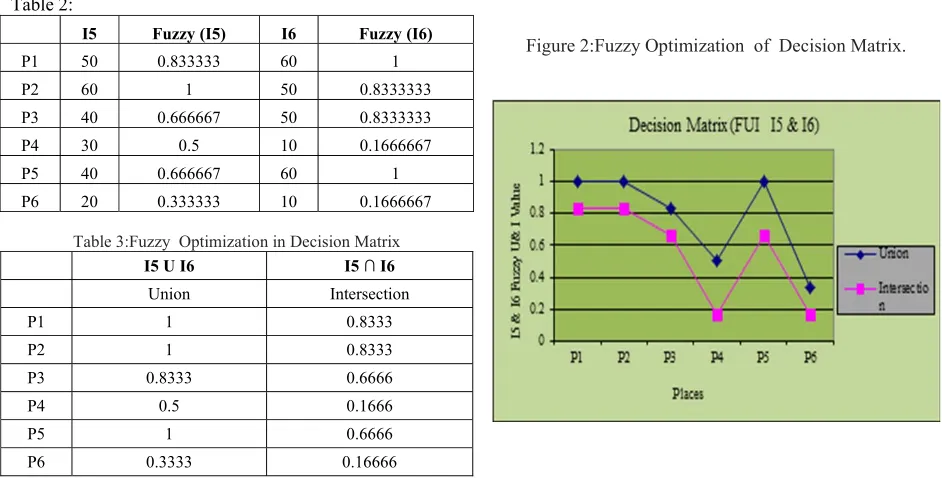
From the output of the Decision Matrix, we take I5 and I6 for finding the fuzzy values of these items.
Table 2:
Table 3:Fuzzy Optimization in Decision Matrix
I5 U I6 I5 ∩ I6
Union Intersection
P1 1 0.8333
P2 1 0.8333
P3 0.8333 0.6666
P4 0.5 0.1666
P5 1 0.6666
P6 0.3333 0.16666
Figure 2:Fuzzy Optimization of Decision Matrix. I5 Fuzzy (I5) I6 Fuzzy (I6)
P1 50 0.833333 60 1
P2 60 1 50 0.8333333
P3 40 0.666667 50 0.8333333
P4 30 0.5 10 0.1666667
P5 40 0.666667 60 1
P6 20 0.333333 10 0.1666667
))
(
),
(
max(
)
(
x
Ax
Bx
AUB
))
(
),
(
min(
)
(
x
Ax
Bx
B
A
II. MARKOV DECISION MODEL:
Markov process helps to identify a specific state of system being studied using the State transition relationship.(Sales quantities in terms of 1000)
Table 4:
Places /
Items I1 I2 I3 I4 I5 I6
P1 30 20 10 40 50 60
P2 10 40 20 30 60 50
P3 20 30 30 10 40 50
P4 40 10 40 20 30 10
P5 30 20 50 10 40 60
P6 50 50 60 30 20 10
The concept of Markov analysis decision tree is used to find out maximum movement of sales quantity in particular places, which has produced the following feasible results.
Table 5:
Place Item P1 I1 P2 I4 P3 I2 P4 I3 P5 I5 P6 I6
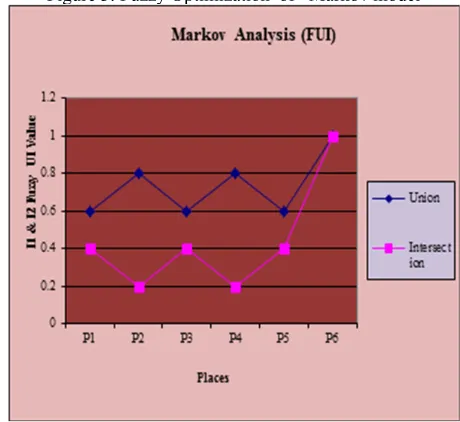
From the output of Markov analysis, ,we take I1 and I2 for finding the fuzzy value of these Items
Table 6
I1 Fuzzy (I1) I2 Fuzzy (I2)
P1 30 0.6 20 0.4
P2 10 0.2 40 0.8
P3 20 0.4 30 0.6
P4 40 0.8 10 0.2
P5 30 0.6 20 0.4
P6 50 1 50 1
Table 7:
Fuzzy Optimization in Markov Analysis
I1 U I2 I1 ∩ I2
Union Intersection
P1 0.6 0.4
P2 0.8 0.2
P3 0.6 0.4
P4 0.8 0.2
P5 0.6 0.4
P6 1 1
Figure 3: Fuzzy Optimization of Markov model
III. DECISION ANALYSIS CRITERIA.
Decision analysis consists of five criteria’s namely Minimum decision criteria ,Maximum criteria, Hurwitz criteria, Laplacian criteria and Mini-Max Regret decision analysis criteria and it is used to make better decision making . It provides the movement of sales to the particular places based on the decision analysis criteria[24]
Table 8:[24]
Places /
Items I1 I2 I3 I4 I5 I6
P1 30 20 10 40 50 60
P2 10 40 20 30 60 50
P3 20 30 30 10 40 50
P4 40 10 40 20 30 10
P5 30 20 50 10 40 60
P6 50 50 60 30 20 10
Table 9
Criterion /
Places P1 P2 P3 P4 P5 P6
Minimum 10 10 10 10 10 10 Maximum 60 60 50 40 60 60
Hurwitz 35 35 30 25 35 35
Laplacian 52.5 52.5 45 37.5 52.5 55
Table 10: With the help of this table, the sales manager can take decision to increase the sales promotion in a particular place.
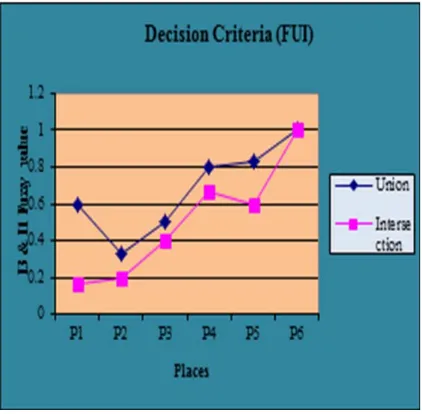
Table11:From the output of Decision Criteria we take I3 and I1 for finding the fuzzy value of these Items.
Places Maximum (sales) Minimum(sales)
P1 10 50
P2 10,20 50
P3 20,30,10 50
P4 10 40
P5 20,10 50
P6 10 30
I3 Fuzzy (I3 I1 Fuzzy (I1
P1 10 0.166667 30 0.6 P2 20 0.333333 10 0.2 P3 30 0.5 20 0.4 P4 40 0.666667 40 0.8 P5 50 0.833333 30 0.6 P6 60 1 50 1 II. Decision criteria.( I3 and I1)
Table 12: Fuzzy Optimization in Decision Criteria I3 U I1 I3 ∩ I1
Union Intersection
P1 0.6 0.1666 P2 0.3333 0.2
P3 0.5 0.4
P4 0.8 0.6666 P5 0.8333 0.6
P6 1 1
Figure 4: Fuzzy Optimization of Decision analysis criteria.
5.EXPERIMENTAL ANALYSIS AND IMPLEMENTATION
RESULT:
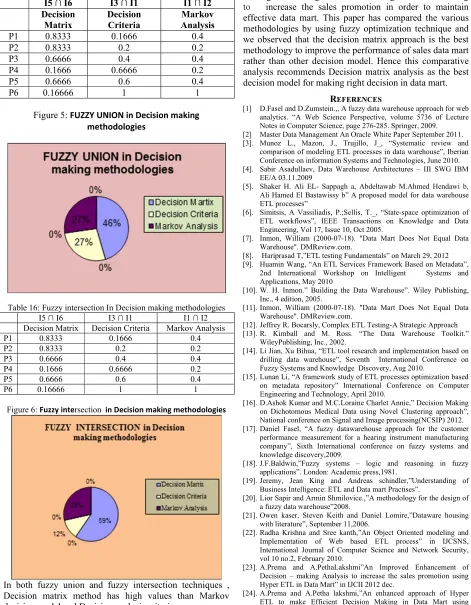
In this paper we evaluate fuzzy union and fuzzy intersection techniques and hence find which decision model is used to take an effective decision making. The calculations are tabulated as follows.
Table 13:
FUZZY OPTIMIZATION TECHNIQUES IN DECISION MAKING METHODOLOGIES Items /
Places
I5 U I6 I5 ∩ I6 I3 U I1 I3 ∩ I1 I1 U I2 I1 ∩ I2 Decision Matrix Decision Criteria Markov Analysis
Union Intersection Union Intersection Union Intersection
P1 1 0.8333 0.6 0.1666 0.6 0.4
P2 0.8333 0.8333 0.3333 0.2 0.8 0.2
P3 0.8333 0.6666 0.5 0.4 0.6 0.4
P4 0.5 0.1666 0.8 0.6666 0.8 0.2
P5 1 0.6666 0.8333 0.6 0.6 0.4
P6 0.3333 0.1666 1 1 1 1
Table 14:FUZZY UNION in Decision making methodologies
I5 U I6 I3 U I1 I1 U I2
Decision Matrix Decision Criteria Markov Analysis
P1 1 0.6 0.6
P2 0.8333 0.3333 0.8
P3 0.8333 0.5 0.6
P4 0.5 0.8 0.8
P5 1 0.8333 0.6
Table 15: FUZZY INTERSECTION In Decision making methodologies
Figure 5: FUZZY UNION in Decision making methodologies
Table 16: Fuzzy intersection In Decision making methodologies I5 ∩ I6 I3 ∩ I1 I1 ∩ I2 Decision Matrix Decision Criteria Markov Analysis
P1 0.8333 0.1666 0.4
P2 0.8333 0.2 0.2
P3 0.6666 0.4 0.4
P4 0.1666 0.6666 0.2
P5 0.6666 0.6 0.4
P6 0.16666 1 1
Figure 6: Fuzzy intersection in Decision making methodologies
In both fuzzy union and fuzzy intersection techniques , Decision matrix method has high values than Markov decision model and Decision analysis criteria.
6. CONCLUSION:
This Paper suggests the design of ETL with decision making methodologies to formulate right decision making
to increase the sales promotion in order to maintain effective data mart. This paper has compared the various methodologies by using fuzzy optimization technique and we observed that the decision matrix approach is the best methodology to improve the performance of sales data mart rather than other decision model. Hence this comparative analysis recommends Decision matrix analysis as the best decision model for making right decision in data mart.
REFERENCES
[1] D.Fasel and D.Zumstein.,, A fuzzy data warehouse approach for web analytics. “A Web Science Perspective, volume 5736 of Lecture Notes in Computer Science, page 276-285. Springer, 2009. [2] Master Data Management An Oracle White Paper September 2011. [3]. Munoz L., Mazon, J., Trujillo, J_, “Systematic review and
comparison of modeling ETL processes in data warehouse”, Iberian Conference on information Systems and Technologies, June 2010. [4]. Sabir Asadullaev, Data Warehouse Architectures – III SWG IBM
EE/A 03.11.2009
[5]. Shaker H. Ali EL- Sappagh a, Abdeltawab M.Ahmed Hendawi b, Ali Hamed El Bastawissy b” A proposed model for data warehouse ETL processes”
[6]. Simitsis, A Vassiliadis, P.;Sellis, T._, “State-space optimization of ETL workflows”, IEEE Transactions on Knowledge and Data Engineering, Vol 17, Issue 10, Oct 2005.
[7]. Inmon, William (2000-07-18). "Data Mart Does Not Equal Data Warehouse". DMReview.com.
[8]. Hariprasad T,”ETL testing Fundamentals” on March 29, 2012 [9]. Huamin Wang, “An ETL Services Framework Based on Metadata”,
2nd International Workshop on Intelligent Systems and Applications, May 2010
[10]. W. H. Inmon.” Building the Data Warehouse”. Wiley Publishing, Inc., 4 edition, 2005.
[11]. Inmon, William (2000-07-18). "Data Mart Does Not Equal Data Warehouse". DMReview.com.
[12]. Jeffrey R. Bocarsly, Complex ETL Testing-A Strategic Approach [13]. R. Kimball and M. Ross. “The Data Warehouse Toolkit.”
WileyPublishing, Inc., 2002.
[14]. Li Jian, Xu Bihua, “ETL tool research and implementation based on drilling data warehouse”, Seventh International Conference on Fuzzy Systems and Knowledge Discovery, Aug 2010.
[15]. Lunan Li, “A framework study of ETL processes optimization based on metadata repository” International Conference on Computer Engineering and Technology, April 2010.
[16]. D.Ashok Kumar and M.C.Loraine Charlet Annie,” Decision Making on Dichotomous Medical Data using Novel Clustering approach”, National conference on Signal and Image processing(NCSIP) 2012. [17]. Daniel Fasel, “A fuzzy datawarehouse approach for the customer
performance measurement for a hearing instrument manufacturing company”, Sixth International conference on fuzzy systems and knowledge discovery,2009.
[18]. J.F.Baldwin,”Fuzzy systems – logic and reasoning in fuzzy applications”. London: Academic press,1981.
[19]. Jeremy, Jean King and Andreas schindler,”Understanding of Business Intelligence: ETL and Data mart Practises”.
[20]. Lior Sapir and Armin Shmilovice.,”A methodology for the design of a fuzzy data warehouse”2008.
[21]. Owen kaser, Steven Keith and Daniel Lomire,”Dataware housing with literature”, September 11,2006.
[22]. Radha Krishna and Sree kanth,”An Object Oriented modeling and Implementation of Web based ETL process” in IJCSNS, International Journal of Computer Science and Network Security, vol 10 no.2, February 2010.
[23]. A.Prema and A.PethaLakshmi”An Improved Enhancement of Decision – making Analysis to increase the sales promotion using Hyper ETL in Data Mart” in IJCII 2012 dec.
[24]. A.Prema and A.Petha lakshmi,”An enhanced approach of Hyper ETL to make Efficient Decision Making in Data Mart using Decision Analysis Criteria, IJAIEM July 2013
[25.] Kankana Chakrabarthy “Fuzzy union and intersection of fuzzyset”
I5 ∩ I6 I3 ∩ I1 I1 ∩ I2 Decision
Matrix Decision Criteria Analysis Markov
![Figure 1: ETL Diagram [23]](https://thumb-us.123doks.com/thumbv2/123dok_us/7832766.1297951/3.612.313.550.455.642/figure-etl-diagram.webp)