E
ffi
cient Collision Attack Frameworks for RIPEMD-160
Fukang Liu1,6, Christoph Dobraunig2,3, Florian Mendel4, Takanori Isobe5,6, Gaoli Wang1?, and Zhenfu Cao1?
1 Shanghai Key Laboratory of Trustworthy Computing, East China Normal University, Shanghai, China
[email protected],{glwang,zfcao}@sei.ecnu.edu.cn
2 Graz University of Technology, Austria 3 Radboud University, Nijmegen, The Netherlands
4 Infineon Technologies AG, Germany
5 National Institute of Information and Communications Technology, Japan 6 University of Hyogo, Japan
Abstract. RIPEMD-160 is an ISO/IEC standard and has been applied to
gen-erate the Bitcoin address with SHA-256. Due to the complex dual-stream struc-ture, the first collision attack on reduced RIPEMD-160 presented by Liu, Mendel and Wang at Asiacrypt 2017 only reaches 30 steps, having a time complexity of 270. Apart from that, several semi-free-start collision attacks have been published for reduced RIPEMD-160 with the start-from-the-middle method. Inspired from such start-from-the middle structures, we propose two novel efficient collision at-tack frameworks for reduced RIPEMD-160 by making full use of the weakness of its message expansion. Those two frameworks are called dense-left-and-sparse-right (DLSR) framework and sparse-left-and-dense-dense-left-and-sparse-right (SLDR) framework. As it turns out, the DLSR framework is more efficient than SLDR framework since one more step can be fully controlled, though with extra 232memory complexi-ty. To construct the best differential characteristics for the DLSR framework, we carefully build the linearized part of the characteristics and then solve the cor-responding nonlinear part using a guess-and-determine approach. Based on the newly discovered differential characteristics, we provide colliding messages pairs for the first practical collision attacks on 30 and 31 (out of 80) steps of RIPEMD-160 with time complexity 235.9and 241.5respectively. In addition, benefiting from the partial calculation, we can attack 33 and 34 (out of 80) steps of RIPEMD-160 with time complexity 267.1 and 274.3respectively. When applying the SLDR framework to the differential characteristic used in the Asiacrypt 2017 paper, we significantly improve the time complexity by a factor of 213. However, it still can-not compete with the results obtained from the DLSR framework. To the best of our knowledge, these are the best collision attacks on reduced RIPEMD-160 with respect to the number of steps, including the first colliding message pairs for 30 and 31 steps of RIPEMD-160.
Keywords:hash function, RIPEMD-160, start-from-the-middle, collision attack, collision
1
Introduction
A cryptographic hash function is a function which takes arbitrary long messages as input and output a fixed-length hash value. Traditionally, such a cryptographic hash function has to fulfill the three basic requirements of collision resistance, preimage resistance and second preimage resistance in order to be considered secure. Most stan-dardized hash functions, like SHA-1, SHA-2, HAS-160, or RIPEMD-160 are based on the Merkle-Damgård paradigm [3,22] which iterates a compression function with fixed-size input to compress arbitrarily long messages. Furthermore, the aforementioned hash functions have in common that their compression function is built by utilization of addi-tions, rotaaddi-tions, xor and boolean functions in an unbalanced Feistel network. This way of designing hash functions has been greatly threatened, starting with a series of results as well as advanced message modification techniques by Wang et al. [28,29,30,31].
Before Wang et al. proposed a series of collision attacks on MD-SHA hash family, there existed substantial efforts to analyze the security of MD-SHA hash functions. Historically, the start-from-the-middle structure was first exploited by den Boer et al. at Eurocrypt 1993 to break the compression function of MD5 [6]. Later at FSE 1996, Dobbertin applied the start-from-the-middle approach to break full MD4 [7]. Since the target is the hash function rather than the compression function, the initial value must be consistent with its definition of the primitive, which is costly under the start-from-the-middle structure. To overcome this obstacle, Dobbertin introduced a connecting phase to connect the correct initial value with the starting point in the middle by exploiting the property of the round boolean function and the freedom of message words [7]. As will be shown, our SLDR framework is almost the same with Dobbertin’s structure to break MD4. Moreover, the neutral bits introduced by Biham and Chen [1] at Crypto 2004 serve as an important tool to analyze MD-SHA hash family as well till now. A message bit is neutral up to stepnif flipping this bit does not influence the differential characteristic conditions up to stepnwith a high probability. Due to the low diffusion of SHA-0/SHA-1’s step functions, there exist many neutral bits up to a few steps.
dif-ference propagation and also presented how to add extra conditions for RIPEMD-160 to ensure the modular difference propagates correctly.
The very first theoretical collision attack on full SHA-1 was achieved by Wang et al. at Crypto 2005 [29], which required about 269calls to SHA-1’s compression function. However, practical collisions were still out-of-reach. After a decade’s effort, Stevens et al. presented the first practical collision of full SHA-1 at Crypto 2017 [25]. In that work, Stevens et al. utilized the SHA-1 collision search GPU framework [13] and the speed-up techniques such as neutral bits and boomerangs and finally found the practical collision of SHA-1. Boomerangs were introduced by Joux and Peyrin at Crypto 2007 [12] to speed up the collision search for SHA-1. It consists in carefully selecting a few bits that are all flipped together in a way that this effectively flips only one state bit in the first 16 steps, and therefore the diffusion of uncontrollable changes is greatly slowed down.
The RIPEMD family can be considered as a subfamily of the MD-SHA-family, since, for instance, RIPEMD [2] consists of two MD4-like functions computed in par-allel with totally 48 steps. The security of RIPEMD was first put into question by Dob-bertin [8] and a practical collision attack on it was proposed by Wang et al. [28]. In order to reinforce the security of RIPEMD, Dobbertin, Bosselaers and Preneel [9] pro-posed two strengthened versions of RIPEMD in 1996, which are RIPEMD-128 and RIPEMD-160 with 128/160 bits output and 64/80 steps, respectively. In order to make both computation branches more distinct from each other, not only different constants, but also different rotation values, message expansions and boolean functions are used for RIPEMD-128 and RIPEMD-160 in both of their branches.
Due to the complicated structure of the dual-stream 128 and RIPEMD-160, collision attacks on the two primitives progressed slowly. For RIPEMD-128, a practical collision attack on 38 steps was achieved at FSE 2012 with a new struc-ture [19]. Later, a practical collision attack on 40 steps was achieved at CT-RSA 2014 [26]. A break-through was made at Eurocrypt 2013, when Landelle and Peyrin employed the start-from-the-middle approach to break the compression function of full RIPEMD-128 [14]. As for RIPEMD-160, no collision attack was presented before Asiacrypt 2017 [16]. However, several results of semi-free-start collision attacks on the com-pression function of RIPEMD-160 were obtained with the start-from-the-middle ap-proach [17,21], only one of them started from the first step and the remaining started from the middle, further showing the difficulty to cryptanalyze the collision resistance of RIPEMD-160. In the work of [21], a partial calculation to ensure that more uncon-trolled bit conditions hold was also introduced with a few statements. Later, a thorough discussion was presented at ToSC 2017 [27].
characteristics and therefore is very time-consuming. This motivates us to come up with two efficient collision attack frameworks.
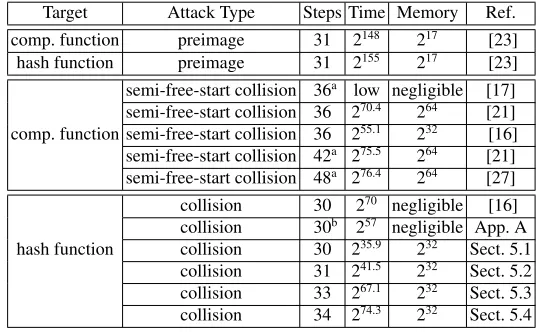
Since 3 does not provide the 160-bit digest and the first collision of full SHA-1 has been presented [25], as an ISO/IEC standard, RIPEMD-160 is often used as a drop-in replacement of SHA-1 and therefore worth analyzing. For instance, RIPEMD-160 and SHA-256 have been used to generate the Bitcoin address. For completeness, we list some related work of RIPEMD-160 in Table 1.
This paper is organized as follows. The preliminaries of this paper are introduced in Section 2, including some notations, description of RIPEMD-160, start-from-the-middle structure to find collisions, single-step message modification, and how to esti-mate the probability of the uncontrolled part. In Section 3, the details of the two effi -cient collision attack frameworks are explained. Then, we will show how to construct suitable differential characteristics for the DLSR framework and report the newly dis-covered 30/31/33/34-step differential characteristics in Section 4. The application of the frameworks to the differential characteristics is shown in Section 5. Finally, our paper is summarized in Section 6.
Table 1: Summary of preimage and collision attack on RIPEMD-160. Target Attack Type Steps Time Memory Ref.
comp. function preimage 31 2148 217 [23] hash function preimage 31 2155 217 [23]
comp. function
semi-free-start collision 36a low negligible [17] semi-free-start collision 36 270.4 264 [21] semi-free-start collision 36 255.1 232 [16] semi-free-start collision 42a 275.5 264 [21] semi-free-start collision 48a 276.4 264 [27]
hash function
collision 30 270 negligible [16] collision 30b 257 negligible App. A collision 30 235.9 232 Sect. 5.1 collision 31 241.5 232 Sect. 5.2 collision 33 267.1 232 Sect. 5.3 collision 34 274.3 232 Sect. 5.4 a An attack starting at an intermediate step.
b Based on the differential characteristic in [16].
best collision attacks on reduced RIPEMD-160 with respect to the number of steps, including the first practical attack. Specifically, the contribution of this paper can be summarized as follows.
• Two novel efficient collision attack frameworks for reduced RIPEMD-160 are pro-posed. The DLSR framework is much more efficient than SLDR framework since one more step can be fully controlled, though with extra 232memory complexity.
• With a guess-and-determine technique, new 30/31/33/34-step differential character-istics of RIPEMD-160 are discovered, whose left branch is dense and right branch is linear and sparse.
• By applying the DLSR framework to the newly discovered 30-step and 31-step dif-ferential characteristics, practical collision attacks on 30 and 31 steps of RIPEMD-160 are achieved. The instances of collision are provided as well.
• With the partial calculation technique that fully exploits the property of the round boolean function of RIPEMD-160 and the differential characteristic conditions, we introduce a clever way to dynamically choose the value of free message words under the DLSR framework. Thus, based on the newly discovered 33-step and 34-step differential characteristics, we can mount collision attack on 33 and 34 steps of RIPEMD-160 with time complexity 267.1and 274.3respectively.
• Applying the SLDR framework to the discovered 30-step differential characteristic of Liu, Mendel and Wang [16], we improve the collision attack on 30 steps of RIPEMD-160 by a factor of 213.
2
Preliminaries
In this section, several preliminaries of this paper will be introduced.
2.1 Notation
For a better understanding of this paper, we introduce the following notations.
1. ,≪,≫,⊕,∨,∧and¬represent respectively the logic operation:shift right, rotate left, rotate right, exclusive or, or, and, negate.
2. andrepresent respectively the modular addition and modular substraction on 32 bits.
3. M =(m0,m1, ...,m15) and M0=(m00,m01, ...,m015) represent two 512-bit message blocks.
4. KljandKrjrepresent the constant used at the left and right branch for round j. 5. Φl
j andΦ r
j represent respectively the 32-bit boolean function at the left and right
branch for round j. 6. sl
iands r
irepresent respectively the rotation constant used at the left and right branch
during stepi.
7. π1(i) and π2(i) represent the index of the message word used at the left and right branch during stepi.
8. Xi,Yi represent respectively the 32-bit internal state of the left and right branch
9. Vjrepresent the (j+1)-th bit ofV(Vcan beXi,Yi,Qi,F...), where the least
signif-icant bit is the 1st bit and the most significant bit is the 32nd bit. For example,Xi0
represents the least significant bit ofXi.
10. Vp∼q(0≤q<p≤31) represents the (q+1)-th bit to the (p+1)-th bit of the 32-bit
wordV(Vcan beXi,Yi,Qi,F...). For example,X1i∼0represents the two bitsX
1
i and
X0
i ofXi.
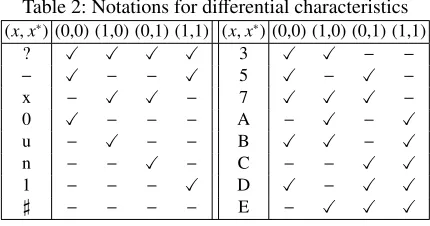
Moreover, we adopt the concept of generalized conditions in [5]. Some related no-tations for differential characteristics are presented in Table 2.
Table 2: Notations for differential characteristics (x,x∗
) (0,0) (1,0) (0,1) (1,1) (x,x∗
) (0,0) (1,0) (0,1) (1,1)
? X X X X 3 X X − −
− X − − X 5 X − X −
x − X X − 7 X X X −
0 X − − − A − X − X
u − X − − B X X − X
n − − X − C − − X X
1 − − − X D X − X X
] − − − − E − X X X
•
xrepresents one bit of the first message andx∗
represents the same bit of the second message.
2.2 Description of RIPEMD-160
RIPEMD-160 is a 160-bit hash function that uses the Merkle-Damgård construction as domain extension algorithm: the hash function is built by iterating a 160-bit compres-sion functionHwhich takes as input a 512-bit message blockMiand a 160-bit chaining
variableCVi:
CVi+1=H(CVi,Mi)
where a message to hash is padded beforehand to a multiple of 512 bits and the first chaining variable is set to the predetermined initial valueIV, that isCV0=IV. We refer to [9] for a detailed description of RIPEMD-160.
The RIPEMD-160 compression function is a wider version of RIPEMD-128 and is based on MD5, but with the particularity that it consists of two different and almost independent parallel instances of it. We differentiate the two computation branches by left and right branch. The compression function consists of 80 steps divided into 5 rounds of 16 steps each in both branches.
Initialization The 160-bit input chaining variableCViis divided into five 32-bit words
following way:
X−4=h≫0 10, X−3=h≫4 10, X−2=h≫3 10, X−1=h2, X0=h1.
Y−4=h≫0 10, Y−3=h≫4 10, Y−2=h≫3 10, Y−1=h2, Y0=h1.
Particularly,CV0corresponds to the following five 32-bit words:
X−4=Y−4=0xc059d148,X−3=Y−3=0x7c30f4b8,X−2 =Y−2=0x1d840c95,
X−1=Y−1=0x98badcfe,X0 =Y0 =0xefcdab89.
Message Expansion The 512-bit input message block is divided into 16 message word-smiof size 32 bits. Each message wordmiwill be used once in every round in a
per-muted orderπfor both branches.
Step Function At roundj, the internal state is updated in the following way.
LQi=X≪i−510Φ
l
j(Xi−1,Xi−2,Xi≪−310)mπ1(i)K
l j,
Xi= X≪i−410(LQi)≪s
l i,
RQi=Yi≪−510Φ
r
j(Yi−1,Yi−2,Yi≪−310)mπ2(i)Krj,
Yi= Yi≪−410(RQi)≪s
r i,
wherei=(1, 2, 3, ..., 80) and j=(0, 1, 2, 3, 4). The details of the boolean functions and round constants for RIPEMD-160 are displayed in Table 3. The other parameters can be found in the specification [9].
Table 3: Boolean Functions and Round Constants in RIPEMD-160
Round j φl j φ
r
j K
l
j K
r
j Function Expression 0 XOR ONX 0x00000000 0x50a28be6 XOR(x,y,z) x⊕y⊕z 1 IFX IFZ 0x5a827999 0x5c4dd124 IFX(x,y,z) (x∧y)⊕(¬x∧z) 2 ONZ ONZ 0x6ed9eba1 0x6d703ef3 IFZ(x,y,z) (x∧z)⊕(y∧¬z) 3 IFZ IFX 0x8f1bbcdc 0x7a6d76e9 ONX(x,y,z) x⊕(y∨¬z) 4 ONX XOR 0xa953fd4e 0x00000000 ONZ(x,y,z) (x∨¬y)⊕z
Finalization A finalization and a feed-forward is applied when all 80 steps have been computed in both branches. The five 32-bit words h0
variable are computed in the following way.
h0
0=h1X79Y≪ 10 78 ,
h0
1=h2X≪7810Y≪ 10 77 ,
h0
2=h3X≪7710Y≪ 10 76 ,
h0
3=h4X≪7610Y80,
h04=h0X80Y79.
2.3 Start-from-the-middle Structure
The start-from-the-middle structure was first used to break the compression function of MD5 [6]. However, when applying such a structure to find collisions, an extra phase is essential to match the correct initial value. Historically, Dobbertin was the first to use it to find real collisions [7]. In order to match the correct initial value of MD4, Dob-bertin introduced a connecting phase in the framework. Exploting the property of the boolean function and the freedom degree of message words, Dobbertin could achieve a connection with a very low cost. Due to the high cost once there is no efficient approach to achieve a connection, the start-from-the-middle structure is generally applied to find semi-free-start or free-start collisions, which do not require the match with the prede-fined initial value. Although such a structure has been used to find collisions in [10,15], the situation is much simpler than Dobbertin’s work [7]. Specifically, since the length of the middle part is short, only a few message words are fixed [10,15] and the connection can be achieved trivially.
Formally, suppose there arerconsecutive internal statess1,s2, ...,srto be
connect-ed, which are updated with the messages wordsmw1,mw2, ...,mwr respectively. In [7],
one ofmw1,mw2, ...,mwris fixed so as to extend the length of the middle part. Therefore,
an efficient approach to solve it is non-trivial. For the start-from-the-middle structure used in [10,15] to find real collisions, none ofmw1,mw2, ...,mwr are fixed in order to
obtain a solution of the middle part. In this situation, they could achieve connection trivially when computing from the first step, i.e. obtain the value ofmwi according to
the already computedsi,si−1, ...,si−r. However, the length of the middle part is
great-ly limited, thus leaving more uncontrolled conditions in such a situation. Or else, the authors made a tradeoffand finally determined not to consider the complex situation.
2.4 Single-step Message Modification
Since only single-step message modification [28] will be used in this paper, we give a brief description of it. Generally, single-step message modification can ensure all the conditions in the first round for most MD-SHA-like hash functions. The implied reason is that the message words are used for the first time in the first round. Therefore, the attackers can randomly choose values for the internal states while satisfying the condi-tions in the first round, i.e. randomly choose values for the free bits of internal states. Then, the corresponding message words can be computed according to the already fixed internal states in the first round. For the sake of clearness, we take the step function of RIPEMD-160 as instance.
Suppose the following pattern represents the conditions onXi.
Xi=-11- ---- ---- -1-- 1--- n-un -u-- --11.
Then, we can first choose a random value forXiand then correct it in the following way
to ensure the conditions on it hold.
Xi ←Xi∧0xfffff9ff,
Xi ←Xi∨0x60048243.
If there are two-bit conditions onXi, we then check them and correct them. Suppose
X4
i = X
4
i−1 is one two-bit condition, we first check whether X 4
i = X
4
i−1 holds. If it does not hold, we simply flipX4
i. In this way, all conditions onXican hold. Finally, we
compute the corresponding message word to updateXiwithXi,Xi−1, ...,Xi−5. The above description of single-step message modification is different from the original one [28], but the implied idea is the same.
2.5 Propagation of Modular Difference
At Asiacrypt 2017, theoretical calculation of the probability of the step function of RIPEMD-160 was described by introducing the influence of the propagation of modu-lar difference [16]. The complete description of the calculation procedure is complex. Generally, the authors divided the problem into two parts. The first part is to calculate the characteristics ofQi(LQi/RQifor the left/right branch) which satisfies an equation
like (Qic0)≪s=Qi≪sc1(c0andc1are constants) to ensure the correct propagation of modular difference. Then, they calculate the probability that the bit conditions on the internal state (Xi/Yifor left/right branch) hold under the condition thatQisatisfies the
equation (Qic0)≪s=Q≪i sc1. In other words, they considered the dependency
be-tween the bit conditions and the propagation of modular difference and this obviously is a more accurate assumption.
with probability p and there areq bit conditions on the corresponding internal state (Xi/Yifor left/right branch), then the final probability isp×2−q. According to our
exper-iments, such an assumption is reasonable and almost consistent with the experiments. Calculating the probability (Qic0)≪s=Q≪i sc1can be found in Daum’s Ph.D thesis [4], which was well illustrated in [16] with the help of a table. Due to the space limitation, we refer the readers to Table 3 in [16].
3
E
ffi
cient Collision Attack Frameworks
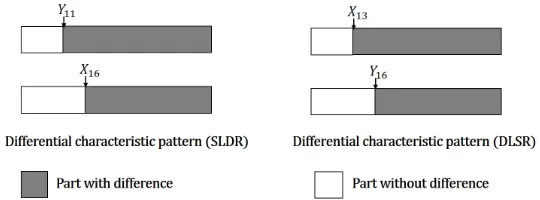
In this section, we will present the details of the two efficient collision attack frame-works. Both frameworks aim at ensuring as many conditions as possible in an efficient way for specific strategies to construct differential characteristics. For the SLDR frame-work, the differential characteristic is constructed by inserting a difference at the mes-sage wordm15, which is used to update the last internal state in the first round on the left branch. Moreover, the differential characteristic on the left branch should be linear and sparse. For the DLSR framework, the differential characteristic is constructed by inserting difference at the message wordm12, which is used to update the last internal state in the first round on the right branch. In addition, the differential characteristic on the right branch should be linear and sparse. For both frameworks, the linear and sparse branch remains fully probabilistic. The differential characteristic patterns for SLDR and DLSR framework are depicted in Fig. 1.
Fig. 1: Illustration of the differential characteristic patterns for both frameworks
3.1 SLDR Collision Attack Framework
Sincem15is firstly used to updateY11, for the strategy to build differential characteris-tic by inserting difference only atm15 and making the left branch sparse at Asiacrypt 2017 [16], the following two observations can be obtained.
Observation 1.There is no condition on Yi(1≤i≤8).
Observation 2.The first internal state with difference on the right branch is Y11.
When considering the difference propagating to Y12, we are actually considering the
the bits (pi,pi+1, ...,pj) with difference in Y11are flipped by adding conditions Y
pi
10 =1,
Ypi+1
10 =1, ..., Y
pj
10 =1when constructing the differential characteristic, there will not be
conditions on Y9either.
The above two observations motivate us to consider the start-from-the-middle struc-ture to find collisions. Therefore, we carefully investigated the message expansion on the right branch and finally found an efficient collision attack framework for such a strategy to construct differential characteristics.
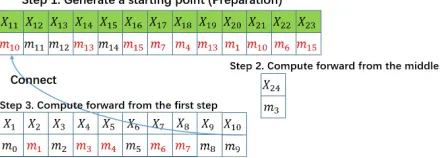
The overview of SLDR attack framework is illustrated in Fig. 2. Such a framework contains 4 steps, as specified below and illustrated in Fig. 3.
Fig. 2: Overview of SLDR collision attack framework for RIPEMD-160
Fig. 3: Specification of SLDR collision attack framework for RIPEMD-160. Message words in red at Step 1 and Step 3 represent their values will be fixed.
Step 1: Fix the internal states located in the middle part fromY10 toY19, which can be easily finished via single-step message modification since onlym3 is used twice to update the internal states. Specifically, randomly choose values forYi
(10 ≤ i ≤ 18) while keeping their conditions hold via single-step message modification since (m3,m12,m6,m11) are used for the first time. Then, we reuse
m3 to compute Y19 and check its condition. If the condition does not hold, choose another solution ofYi(10≤i≤18) and repeat until we find a solution
ofYi(10≤i≤19). We call a solution ofYi(10≤i≤19) a starting point.
Step 2: Apply single-step message modification to ensure the conditions onYi(20 ≤
Step 3: Randomly choose values for the free message words m14 andm9. Compute from the first step untilY5. Then achieve connection inY10, whose correspond-ing message wordm6has been fixed in the starting point. The costly condition
Y7 =0 is used to ensureY10is irrelevant toY8, which can be satisfied by con-suming the freedom degree ofm2.
Y7 =0.
Y6 =((Y7Y3≪10)≫ 15
(m11K0r))⊕(Y5∨Y4≪10).
m2 =(Y6Y2≪10)≫ 15
(ONX(Y5,Y4,Y3≪10)Y≪ 10
1 K
r
0). Y9 =((Y10Y6≪10)≫
7
(Y5≪10m6K0r))⊕0xffffffff.
Y8 =((Y9Y5≪10)≫ 7
(Y4≪10m13K0r))⊕(Y7∨Y6≪10),
m4 =(Y8Y4≪10)≫5(ONX(Y7,Y6,Y5≪10)Y3≪10K0r).
Computem15,m8,m1,m10 to achieve connection inYi (11 ≤ i ≤ 14). More
specifically,m15is computed byYi(6≤i≤11),m8is computed byYi(7≤i≤
12),m1is computed byYi(8≤i≤13) andm10is computed byYi(9≤i≤14).
Step 4: All message words have been fixed after connection. Then we verify the prob-abilistic parts in both branches. If they do not hold, return Step 2 until we find colliding messages. The degree of freedom is provided bym0,m5,m7,m9,m13 andm14.
Such a general framework can ensure all the bit conditions onYi(10 ≤ i ≤ 23)
trivially, which is almost impossible via multi-step message modification once the con-ditions are dense. However, more attention should be paid when applying it to a specific differential characteristic. In this framework,Y7is fixed to zero to achieve an efficient connection inY10, thus resulting inRQ11=Y≫
sr
11
11 . If the differential characteristic con-ditions onY11always makeRQ11fail to satisfy its corresponding equation, this frame-work cannot be applied directly. Although we can fix some bits ofY7to one to solve it, this will influence the success probability of connection. Therefore, when constructing the differential characteristic, such a bad case should be considered and avoided.
3.2 DLSR Collision Attack Framework
Now, we consider an opposite strategy to construct differential characteristics by in-serting difference only atm12 and making the right branch sparse. In this way,X13 is the first internal state with difference. To propagate the difference inX13 toX14, we are actually propagating the difference ofX13 ⊕X12⊕X11≪10. Since there is no difference inX11 orX12 and it is an XOR operation, there will be always conditions onX11 and
X12. However, there will not be conditions onXi(1≤i≤10). This also motivates us to
consider the start-from-the-middle approach.
The overview of DLSR framework is shown in Fig. 4. The attack procedure can be divided into four steps as well, as illustrated in Fig. 5.
Fig. 4: Overview of DLSR collision attack framework for RIPEMD-160
Fig. 5: Specification of DLSR collision attack framework for RIPEMD-160. Message words in red at Step 1 and Step 3 represent their values will be fixed.
twice to update the internal states. If there are too many bit conditions onX23, we can firstly fix the internal states from X12 toX23 via single-step message modification since all the corresponding message words (m7,m4,m13,m1,m10,
m6 andm15) are used for the first time. Then, we compute X11 by using Xi
(12≤i≤16) andm15. At last, we check the conditions onX11and the modular difference ofX15. If they do not hold, choose another solution ofXi(12≤i≤
23) via single-step message modification and repeat until we can find a solution for the starting pointXi(11≤i≤23). After a starting point is fixed, we have
to achieve connection in five consecutive internal states Xi (11 ≤ i ≤ 15).
However,m10andm13have been already fixed. Thus, an efficient approach to achieve connection inX11andX14is quite important and non-trivial.
To achieve connection inX14, we pre-compute a solution setS for (X9,X10) according to the following equation by exhausting all possible values ofX9. For eachX9, compute the correspondingX10and storeX9in a two-dimensional array withX9⊕X10 denoting the row number. Both the time complexity and memory complexity of the pre-computation are 232.
X14 =X10≪10(XOR(X13,X12,X11≪10)X9≪10m13K0l)≪
7.
Step 2: Apply single-step message modification to ensure the conditions onX24since its corresponding message wordm3is not fixed in the starting point and is used for the first time. We have to stress that we have considered the influence of the propagation of modular difference and have added extra bit conditions to control its correct propagation with probability 1.
fol-lows. First, we calculate the value ofvar.
var=((X11X7≪10)≫ 14
(X≪6 10m10K0l))⊕X≪ 10 8 .
Second, find solutions of (X9,X10) fromSwhich satisfyX9⊕X10 =var. The corresponding solutions are stored in the row numberedvar. In this way, each solution of (X9,X10) will ensure the connection in X11 andX14. At last, com-putem8andm9as follows to ensureX9andX10can be the computed value for connection. Since there are 232 valid pairs of (X9,X10) in Sandvaris a ran-dom 32-bit variable, we expect one solution of (X9,X10) for a randomvaron average.
m8 =(X9X5≪10)≫ 11
(XOR(X8,X7,X6≪10)X≪ 10
4 K
l
0).
m9 =(X10X6≪10)≫13(XOR(X9,X8,X7≪10)X5≪10K0l).
Computem11,m12 andm14 to achieve connection inX12,X13andX15. Specif-ically, m11 is computed by Xi (7 ≤ i ≤ 12), and m12 is computed by Xi
(8≤i≤13), andm14is computed byXi(10≤i≤15).
Step 4: All message words have been fixed after connection. Then we verify the prob-abilistic part in both branches. If they do not hold, return Step 2 until we find colliding messages. The degree of freedom is provided bym0,m2,m3andm5.
However, observe that there will be difference in X13 andX14 when inserting dif-ference atm12. Therefore,LQ13 =(X13X9≪10)≫6andLQ14=(X14X10≪10)≫7have to satisfy their corresponding equations to ensure the correct propagation of modular difference. SinceX9andX10cannot be controlled, we have to verify whetherLQ13and
LQ14 satisfy their corresponding equations when obtaining a solution of (X9,X10). A way to reduce the verifying phase is to filter the wrong pair of (X9, X10) in the pre-computing phase. However, we cannot expect one solution of (X9,X10) for a random varanymore. In other words, whatever the case is, the influence of the correct propaga-tion of modular difference ofX13andX14must be taken into account when estimating the success probability.
Therefore, under our DLSR framework, except the modular difference ofX13 and
X14, all the conditions onXi(11≤i≤24) can hold trivially with an efficient method,
which sometimes is almost impossible with multi-step message modification or at least very time-consuming and requires sophisticated manual work, especially when the ditions are dense in the second round. For the dense left branch, since there is no con-dition onXi (1 ≤ i ≤ 10), we only need focus on the the uncontrolled conditions on
internal statesXi(i≥25) and the modular difference ofX13andX14. Thus, to construct the best differential characteristic for this framework, there should be minimum active bits inXi(i ≥23) and the modular difference ofX13andX14 should hold with a high probability. Moreover, to select the best differential characteristic from many discovered candidates, we only need to analyze the probability of the conditions on Xi(i ≥25),
3.3 Comparison
Under the SLDR framework, we can only control untilY23 by adding an extra costly conditionY7=0 to achieve efficient connection. For the DLSR framework, we can con-trol untilX24 by consuming extra 232 memory to achieve efficient connection. Hence, the SLDR framework has the obvious advantage of having no memory requirement. However, when there is sufficient memory available, there is a great advantage to lever-age the DLSR framework, since we can control the internal state until the 24th step. In other words, one more step can be fully controlled with the DLSR framework, thus having the potential to leave fewer uncontrolled conditions. It should be noted that the number of steps that can be controlled highly depends on the message expansion. Thus, we rely on the specifics of RIPEMD-160’s message expansion and extend to more steps as well as find an efficient approach to achieve connection in the complex situation.
A direct application of the SLDR framework to the 30-step differential characteris-tic in [16] will improve the collision attack by a factor of 211. With a partial calculation technique, two more uncontrolled bit conditions can be controlled. Thus, the collision attack on 30 steps of RIPEMD-160 is improved to 257. Actually, the 30-step differential characteristic in [16] is not perfect under our SLDR framework since there are three bit conditions onY9. Although the three bit conditions can be eliminated by generating a new differential characteristic withObservation 2 taken into account, the time com-plexity is still too high. As will be shown, we can attack 30 steps of RIPEMD-160 with time complexity 235.9 under the DLSR framework. Therefore, considering its improv-ing factor, we decided not to generate a new differential characteristic for the SLDR framework and we refer the readers to Appendix A for the details of the improvement for the collision attack at Asiacrypt 2017 [16]. The source code to verify the correct-ness of the SLDR framework is available athttps://github.com/Crypt-CNS/ Improved_Collision_Attack_on_Reduced_RIPEMD-160.git.
Actually, not only the framework but also the characteristic of the fully probabilistic branch has influences on the final effect of the collision attack. Taking the two factors into consideration, we finally determined to utilize the DLSR framework.
4
Di
ff
erential Characteristics
As stated in the previous section, to construct the best differential characteristic for the DLSR framework, the uncontrolled part should hold with a high probability. To achieve this, according to the boolean function IFX used in the second round on the left branch, we have to control that there are a few active bits inXi(i≥23) so that the number of bit
conditions onXi(i≥25) is minimal. Suppose we will analyze the collision resistance
of t steps of RIPEMD-160. According to the finalization phase of the compression function of RIPEMD-160, to achieve a minimal number of active bits inXi(i≥23), it
is better to let only one ofYt−1,Yt−2,Yt−3,Yt−4have differences and∆Yt=0. In this way,
only one ofXt,Xt−1,Xt−2,Xt−3has differences and∆Xt−4=0.
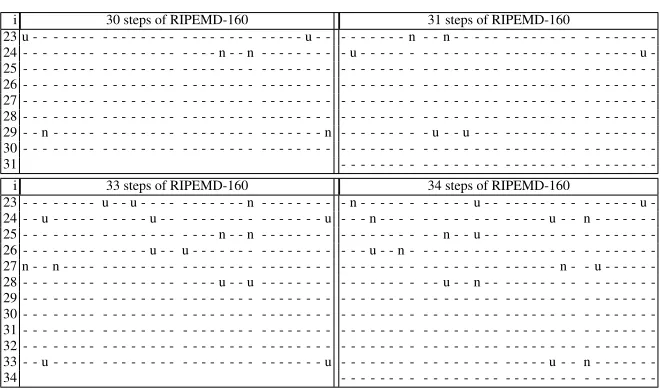
Then, we construct the sparse characteristics on the left branch starting fromX23for 30/31/33/34 steps of RIPEMD-160, which are displayed in Table 4.
Table 4: Sparse characteristics on the left branch
i 30 steps of RIPEMD-160 31 steps of RIPEMD-160
23 u u n n 24 n n u u 25 26 27 28 29 n n u u 30 -31
-i 33 steps of RIPEMD-160 34 steps of RIPEMD-160
23 u u n n u u 24 u u u n u n 25 n n n u 26 u u u n 27 n n n u 28 u u u n 29 30 31 32 33 u u u n -34
-At last, we utilize a search tool [11,18,19,20,21] to solve the nonlinear characteristic located at Xi(11≤ i≤22) based on a guess-and-determine technique [5]. To choose
the best nonlinear characteristic from many candidates, we only need focus on the con-ditions onXi(i≥25), consisting of the number of bit conditions and the probability of
the correct propagation of the modular difference, as well as the probability thatLQ13 andLQ14satisfy their corresponding equations. The best 30-step, 31-step, 33-step and 34-step differential characteristics for RIPEMD-160 that we eventually determined are displayed in Table 11, Table 12, Table 13 and Table 14 respectively. To save space, we only list the uncontrolled two-bit conditions located at the fully probabilistic right branch andXi(i≥25), which cannot be denoted by generalized conditions. The two-bit
conditions located atXi(11≤i≤24) as well as the equations to ensure the correct
prop-agation of modular difference ofXi(15≤i≤24) are not listed in the four tables since
all these conditions can hold trivially under the DLSR framework. In addition, from the differential characteristics and the corresponding starting points in next section, it is not difficult to extract all these information.
If we construct characteristic for 32 steps of RIPEMD-160 in a similar way, there will be many bit conditions inXi(i≥23), which is even greater than that of 33 steps.
This is because ∆X28 , 0 and ∆X29 , 0. Therefore, for the attack with high time
complexity, we only provide the results for more steps.
imme-diately. Therefore, for each characteristic in Table 11, Table 12, Table 13 and Table 14, we also present the corresponding total uncontrolled probability in these tables, consist-ing of the number of bit conditions on the right branch andXi(i≥25), as well as the
equations to ensure the correct propagation of modular difference on the right branch and ofX13,X14 andXi (i ≥25). The probability estimated in these four tables
repre-sents the success probability to find the collision when the DLSR framework is directly applied to the differential characteristics.
For the best 34-step differential characteristic given in Table 14, a direct application of the DLSR framework is infeasible since it is beyond the birthday attack. However, by benefiting from the partial calculation, which fully exploits the property of the round boolean function and the existing differential characteristic conditions, we significantly improve this probability. Such a technique will be also used to improve the collision at-tack on 31 and 33 steps of RIPEMD-160. The details will be explained in next section. It should be noted that the effect of partial calculation highly depends on the existing differential characteristic conditions. Therefore, when selecting differential characteris-tics from many candidates, we actually have taken the effect of partial calculation into account as well.
5
Application
5.1 Practical Collision Attack on 30 Steps of RIPEMD-160
By applying the DLSR framework to the discovered 30-step differential characteristic in Table 11, we can mount collision attack on 30 steps of RIPEMD-160 with time complexity 235.9and memory complexity 232. It should be noted that there are sufficient free bits inm0,m2,m3 andm5 to generate a collision. The collision is displayed in Table 5. For completeness, the starting point can be found in Table 7.
5.2 Collision Attack on 31 Steps of RIPEMD-160
According to Table 12, the time complexity to mount collision attack on 31 steps is 242.5 if the DLSR framework is directly applied. However, we can make it slightly better with partial calculation technique by using the property of the boolean function IFX. This is based on the following observation.
Table 5: Collision for 30 steps of RIPEMD-160
M 1fbb5316 8ad15821 bf04a498 b85ed58f 4d2d28f6 977b64cd 8c7769dc 961cce16
9d7a5bc6 f6519d38 37316e69 206d429 2f451be9e748e57f 5c73a141 e753c86
Table 6: Collision for 31 steps of RIPEMD-160
M 3d604874ff13f724 d60f43b4 c02645eb a9df768c 172f15dc d8cfa4bb edb8f36f
c898dd5e 71c62ade d13c6647 bfa932ef fc2b5325fc5c01e5 5f7658c8 e5e50cc1
M03d604874ff13f724 d60f43b4 c02645eb a9df768c 172f15dc d8cfa4bb edb8f36f c898dd5e 71c62ade d13c6647 bfa932ef fc2bd325fc5c01e5 5f7658c8 e5e50cc1 hash value 5244127c c976d649 362154bb 59070fc 8e5212e1
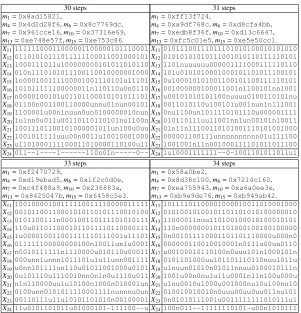
Table 7: Starting points for differential characteristics
30 steps 31 steps
m1=0x8ad15821, m1=0xff13f724,
m4=0x4d2d28f6,m6=0x8c7769dc, m4=0xa9df768c,m6=0xd8cfa4bb,
m7=0x961cce16,m10=0x37316e69, m7=0xedb8f36f,m10=0xd13c6647,
m13=0xe748e57f,m15=0xe753c86. m13=0xfc5c01e5,m15=0xe5e50cc1.
X1111111100011000001100000101110001X1101011100111011101010100010101010
X1201101010111011111100011001000101X1201010101010111001010110111110101
X131000111011u100000000101011010110X131101nuuuuuu000001111000111110110
X14010n1110101011100110010000001000X14101u0101010001000101101011100101
X151n000100111100001001110101u11101X150u100010101001100101100111110101
X16101011111100000011n110110u0n0110X16001000000100011001n1100101nn1001
X17n0000100101u01101100010101011101X17u00101010101100nuuuu0100110101nu
X1801100n001100110000unnu01nun00101X180011010110u100101u001nun1n111001
X191100001u00n1nuun0un0100000010nunX190nu1100un1011110101110u000001111
X201u1nn0u011u00110110110101nu1100nX20010110111uu11001nn1un00101n10011
X2110011101100101000001011un100u0uuX2101n11n11100110101001110101001000
X221001011111uuu00n0011u10010001000X22000001100111unnnnnnnnnn01u111100
X23u1101000111100011010000110100u11X231001001n11n001000111101011011100
X24011--1----1---110n01n---0--X241u10001111111--0-1001101011011u1
33 steps 34 steps
m1=0xf2470729, m1=0x58a0be2,
m4=0xd19ebad5,m6=0x1f2c0d0e, m4=0x8d38c100,m6=0x7214c160,
m7=0xc4f488a9,m10=0x236883a, m7=0xea755943,m10=0xa6a0ee3e,
m13=0x8425047b,m15=0x6458c5e3. m13=0xb9e9de76,m15=0xb949ab42.
X1110010000100111110011110000011111X1110111101100001000010011010001000
X1200101100110001010110101110010100X1201010010100101101101010100000010
X130101100111n000100110111101010111X1311000011nuu110100100010100010101
X14110u0110110001011011110110000111X14110n0000000101101000100100100000
X151u000010011001111110111001u11101X150n001011110001101101110000u000n0
X16011111100000000100n10011un1u0001X16000000110010010001n0111u00uu0110
X17n0010111111n1110000u010110u00011X17u00100010110100n0uuu101n1000101n
X18000unn1unnn1011101u1u11unn001111X180101101000uu101101110110nuu1011u
X19u0nn101111un110u01011001000u0101X19u1nuun01010n01011nnuu0100010111n
X200u101110u1110010nn0n1n0u1110u011X201001u00n0nu1u11u0001n11n100u000u
X21n1n110000uu1u10100n1000n010001unX21u1nu0010u1000u001000nu10u100nu10
X220100unn0101011110001111nunnnu0unX22010010010010n0uuu00uu0uu011nu101
X2300110111u11u10101101010n00100001X230n01010111001u0011111111010111u1
Observation 3.LetF=X25X24⊕X25X23≪10, then
Fi=
X24i (X24i =Xi23−10)
X24i (X25i =1)
Xi−10 23 (X
i
25=0).
Note thatX26 is updated by the free message wordm0 andXi (21 ≤ i ≤ 24) can be
fully controlled. AlthoughX25 cannot be controlled and unknown, we can use partial calculation to ensure several bit conditions onX26hold.
Specifically, consider the 31-step differential characteristic in Table 12. We write
X25,X24,X≪2310in binary as follows for a better understanding. Consider the following calculation ofF, we can know several bits of F if the conditions onX25 hold, where
adenotes that the bit value is possible to be determined by carefully choosing values of X24 and X23, andb denotes that the bit value cannot be determined with existing differential characteristic conditions.
X25 =10-- ---- ---- ---- ---- ---- ---- -10-.
X24 =1u10 0011 1111 1--0 -1-0 1-01 0--- --u1.
X23≪10 =n001 0001 1110 1-11 01-- ---0 ---- -n-1.
F =10bb 00b1 111b 1aab a1aa aaab aaaa aaa1.
Consider the calculation ofsum0=X21≪10Kl1after adding four bit conditions onX21. In this way, the higher 12 bits ofsum0are constant.
X21≪10 =0110 1010 0110 010- 0--0 0-01 n1-n ---0.
K1l =0101 1010 1000 0010 0111 1001 1001 1001.
sum0 =1100 0100 1110 bbbb bbbb bbbb bbbb bbb1.
Then, we consider the calculation ofsum1=sum0m0by pre-fixing the pattern ofm0 as follows.
sum0 =1100 0100 1110 bbbb bbbb bbbb bbbb bbb1.
m0 =0-11 110- ---- ---- ---- ---- ---- ----.
sum1 =0b00 00bb bbbb bbbb bbbb bbbb bbbb bbbb.
Next, we consider the calculation ofsum2=sum1Fas follows.
sum1 =0b00 00bb bbbb bbbb bbbb bbbb bbbb bbbb.
F =10bb 00b1 111b 1aab a1aa aaab aaaa aaa1.
sum2 =1bbb 0bbb bbbb bbbb bbbb bbbb bbbb bbbb.
At last, consider the calculation ofX26after adding three extra bit conditions onX22.
X26 =X≪2210(FX≪ 10
21 K
l
1m0)≪
12=X≪10
22 sum≪ 12 2 .
sum≪2 12 =bbbb bbbb bbbb bbbb bbbb 1bbb 0bbb bbbb.
X≪2210 =11un nnnn nnnn n0-u ---- 0000 01-1 10-1.
Therefore,X1126 =1 can hold with probability 1. In the same procedure to perform the partial calculation, if we choose the following pattern ofm0,X2611 =1 can always hold as well.
m0 =0100 000- ---- ---- ---- ---- ---- ----.
It should be noted thatm0is randomly chosen at the third step when applying the DLSR framework. Therefore, with our partial calculation, we can choose the value for
m0 in a clever way to have the condition X1126 = 1 always hold. Therefore, the time complexity of a collision attack on 31 steps of RIPEMD-160 is improved to 241.5.
According to the above analysis, it is not difficult to observe that such an approach to make only one bit condition hold is costly since at least 6 bits of m0 have to be fixed. In the case when there are sufficient free bits in the free message words, such a method is feasible. However, when the success probability is low, we have to carefully consume the degree of freedom. As will be shown in the collision attack on 33/34 steps of RIPEMD-160, we dynamically choose a value form0 to save the degree of freedom. Moreover, partial calculation will show its significant effect to decrease the time complexity when attacking 33 and 34 steps of RIPEMD-160.
Verification.Both the correctness of the framework and the partial calculation are fully verified. The collision for 31 steps of RIPEMD-160 is displayed in Table 6 and the corresponding starting point is provided in Table 7.
5.3 Collision Attack on 33 Steps of RIPEMD-160
If we directly apply the DLSR framework to the discovered 33-step differential charac-teristic in Table 13, the time complexity is 271.6and the memory complexity is 232. With the partial calculation, we can choosem0 in a clever way to ensure more uncontrolled bit conditions hold.
WriteX25,X24,X≪10
23 in binary according to Table 13 as follows for a better under-standing. Thus, several bits ofF =X25X24⊕X25X23≪10 can be known if the conditions onX25hold based onObservation 3.
X25 =-11- ---- ---- -1-- 1--- n--n ---- --11.
X24 =11u0 10-- 0--1 1u01 0001 01-1 1110 0--u.
X23≪10 =1u10 --1- 0-01 0n00 100- 0100 1-01 1-u1.
F =1110 aaaa 0aa1 b10b 000a 01a0 1abb baa1.
Consider the calculation ofX26,
X26=X22≪10(FX≪ 10
21 K
l
1m0)≪12.
From this starting point, the following information can be extracted.
F∧0xfffc0000=1110 1011 0101 b100 0000 0000 0000 0000.
X21≪10K1l =0100 1110 1100 0011 1001 0010 1111 1010.
Then, we add some extra conditions onm0 to ensure that there is always a carry from the 20th bit to 21stbit when calculatingF X≪10
21 K
l
1m0. The reason why there is a carry is as follows. Suppose sum3 = X21≪10K1l m0. Whenm0 satisfies such a pattern, sum193 ∼18 = 112. SinceF18 = 1, there will be always carry from the 20th bit when calculatingFsum3.
F∧0xfffc0000=1110 1011 0101 b100 0000 0000 0000 0000.
X21≪10K1l =0100 1110 1100 0011 1001 0010 1111 1010.
m0=---- ---- ---- 101- ---- ---- ---- ----.
Therefore,
(F∧0xfff00000)((X21≪10K1l)∧0xfff00000)0x100000=0x3a200000.
Moreover, to ensure that the modular difference ofX26can hold with a probability close to 1, we add an extra bit condition X926 = 1. The reason can be found in the following calculation ofLQ≪2612 =X26X22≪10. In this way,LQ3126∼30=002can hold with probability 1, thus resulting (LQ26 0x407fff7e)≪12 = LQ≪2612 0xfff7e408 holds with a probability close to 1.
X26 =---1 ---- ---- -u-- u--- 1010 1--- ----.
X22≪10 =1011 ---- 0--- -nun nnu0 un0- 0-un n010.
LQ≪2612 =---- ---- ---- ---- ---- 00-- ---- ----.
After the above preparation, we give a complete description of how to choosem0 in a clever way to ensure the bit conditions on the lower 12 bits ofX26. After choosing values forX24via single-step message modification and computing the corresponding
m3, we will determine the value ofm0according to the following procedure.
step 1: Randomly choose values for the lower 12 bits ofX26 while keeping the condi-tions on this part hold.
step 2: Compute the lower 12 bits ofX26X22≪10. Then, the higher 12 bits ofLQ26are known.
step 3: Based onLQ26 =m0FX21≪10K1l, we can compute the higher 12 bits ofm0 since the higher 12 bits ofLQ26andFX≪2110K1l as well as the carry from the 20-th bit are all known. The remaining free bits ofm0are set to a random value.
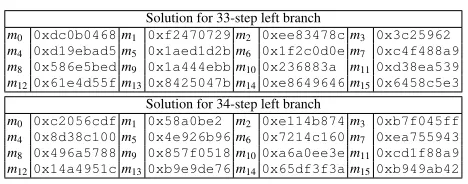
Verification.Our program has verified the correctness of the above optimizing strat-egy of partial calculation. Moreover, due to the low time complexity of the left branch after applying such a strategy, we can find a group solution of message words to ensure the dense left branch as shown in Table 8.
Table 8: Solution of dense left branch
Solution for 33-step left branch
m0 0xdc0b0468m1 0xf2470729m2 0xee83478cm3 0x3c25962
m4 0xd19ebad5m5 0x1aed1d2bm6 0x1f2c0d0em7 0xc4f488a9
m8 0x586e5bedm9 0x1a444ebbm100x236883a m110xd38ea539
m120x61e4d55fm130x8425047bm140xe8649646m150x6458c5e3 Solution for 34-step left branch
m0 0xc2056cdfm1 0x58a0be2 m2 0xe114b874m3 0xb7f045ff
m4 0x8d38c100m5 0x4e926b96m6 0x7214c160m7 0xea755943
m8 0x496a5788m9 0x857f0518m100xa6a0ee3em110xcd1f88a9
m120x14a4951cm130xb9e9de76m140x65df3f3am150xb949ab42
5.4 Collision Attack on 34 Steps of RIPEMD-160
The best 34-step differential characteristic is displayed in Table 14. A direct applica-tion of the DLSR framework to this differential characteristic is infeasible since the uncontrolled part holds with probability 2−81.4. Fortunately, we can exploit the partial calculation ofX26as above to ensure a lot of bit conditions onX26hold. Different from the 33-step differential characteristic where the lower 12 bits ofX26 can be controlled with probability 1, only the higher 20 bits of X26 can be controlled with probability 2−2 for the discovered 34-step differential characteristic. However, there are a lot of conditions on the higher 20 bits ofX26. Therefore, there is a great advantage if exploit-ing such a strategy even though it succeeds with probability 2−2. The details will be explained in the following, which share many similarities with the procedure for the 33-step differential characteristic.
LetF=X25X24⊕X25X23≪10. We writeX25,X24,X23≪10in binary according to Table 14 as follows. Thus, many bits ofFcan be controlled by properly choosing values for the free bits ofX24andX23.
X25 =---1 ---- --n- -u0- ---- 00-1 1--- ----.
X24 =100n 011- -111 111- -10- -u00 n10- -111.
X23≪10 =001u -01- 1-11 -101 011- u1-n -1-- ----.
F =b0b0 ab1a aa11 a10a a1ba 11a0 01aa aaaa.
Consider the calculation ofX26,
X26=X22≪10(FX≪ 10
21 K
l
1m0)≪ 12.
Observe that there are only two possible values for the lower 20 bits of F depending onX13
25 after setting values forX24 andX23 properly. Moreover,X≪ 10
21 K
l
are all constants after a starting point is found. Therefore, it is feasible to have a clever choice of the lower 20 bits ofm0rather than in a random way to ensure the conditions on the higher 20 bits ofX26. To explain more precisely, we firstly present the starting point of the 34-step differential characteristic in Table 7.
From this starting point, the following information can be extracted.
F∧0x000fffff=0000 0000 0000 1101 01b1 1100 0101 0111.
X21≪10K1l =0110 1100 1001 1101 1001 0100 1110 0100.
Therefore, (FX21≪10Kl
1)∧0x000fffffcan only take two possible values, which
are0xaf13band0xb113b.
Moreover, it should be observed that the modular difference ofX26holds with a very low probability of 2−3.1. Therefore, adding extra bit conditions to control the modular difference is vital as well. We add four extra bit conditionsX2631=1,X2630=X2220,X2926 =0 andX2627 =0, all of which are located at the higher 20 bits ofX26. The reason can be found in the following calculation of LQ≪12
26 = X26 X≪ 10
22 . In this way,LQ 19∼16
26 =
00002can hold with probability 1, thus resulting (LQ260xe06be)≪12 =LQ≪2612
0xe06be000holds with probability 1.
X26 =1-0u 0-n- --00 -11- ---- ---- -1-- ----.
X22≪10 =1-n0 uuu0 -uu0 uu01 1nu1 01-1 00-0 --0-.
LQ≪2612 =0000 ---- ---- ---- ---- ---- ---- ----.
Since we are trying to control the higher 20 bits ofX26, the influence of the carry from the 12th bit must be taken into account when calculatingX22≪10 LQ≪2612. The carry behaves randomly sincem0is random and the higher 12 bits ofFX≪2110K1l are random. However, sinceX221∼0 =012, there is a bias that there is no carry from the 12thbit. Therefore, in the implementation, we always assume there is no carry, which holds with probability slightly higher than 2−1.
After the above preparation, we give a complete description of how to choosem0in a clever way to ensure the 10 bit conditions on the higher 20 bits ofX26. After choosing values forX24via single-step message modification and computing the corresponding
m3, we will determine the value ofm0in the following procedure.
step 1: Randomly choose values of the higher 20 bits ofX26 while keeping the 10 bit conditions on this part hold.
step 2: Compute the higher 20 bits ofX26X22≪10by assuming there is no carry from the 12thbit. Then, the lower 20 bits ofLQ
26are known.
step 3: Based onLQ26 =m0FX21≪10Kl1, we can compute the lower 20 bits of
m0since the lower 20 bits ofLQ26 andFX≪2110K
l
1 are known. Randomly choose one value of the 20 bits ofFX≪10
21 K
l
1from the two possible values and compute the corresponding lower 20 bits ofm0. The remaining free bits of
m0are set to a random value.
is improved to 281.4−9.1+2=274.3. It should be noted that there are sufficient free bits in
m0,m2,m3andm5to generate a collision even thoughm0is not fully random anymore. Specifically, it is equivalent to fixing 10 bits ofm0.
Verification.The above partial calculation to ensure 10 bit conditions on the higher 20 bits ofX26has been verified with the program, which is consistent with our estimated success probability 2−1−1=2−2. In addition, we also found a solution for the dense left branch as shown in Table 8.
Experiment Details The verification is briefly described above. To make this paper more complete, we give a relatively detailed description of our experiments. For the efficiency of the search, we store the solutions for (X9,X10) in RAM. However, due to the memory limit of our PC (Linux system) or Linux server, we could only store 228 solutions for (X9,X10) in a two-dimensional dynamic array in RAM for one program, thus resulting that the success probability of connection becomes 2−4.
Therefore, for our DLSR framework, we count the total timesT1to start from Step 2 (where we start choosing another random values for free message words) and the total timesT2 to start verifying the probabilistic partXi(i ≥ 25) andYj(j ≥ 14) after the
connection succeeds. It is found thatT1/T2 =17, which is consistent with the success probability of connection. Obviously, it is expected that the total number of attempts to find the collision isT2when all the 232solutions can be stored in RAM for one program. To find the collision for 30 steps of RIPEMD-160 in this paper,T2 =0x4c11e4a5 andT1/T2 =17. To find the collision for 31 steps of RIPEMD-160 in this paper,T2=
0xfa3bab4a47andT1/T2=17.
Note that the estimated probability to find the collision for 30/31 steps of RIPEMD-160 is 2−35.9 and 2−41.5 when all the 232 solutions can be stored in RAM. Therefore, according the value ofT2, we believe that the estimated probability is reasonable. Sim-ilar experiments have been conducted for the collision attack on 33 and 34 steps of RIPEMD-160. The source code can be found athttps://github.com/Crypt-CNS/ DLSR_Framework_RIPEMD160.
6
Conclusion
Acknowledgements We thank the anonymous reviewers of CRYPTO 2019 for their insightful comments and suggestions. Fukang Liu and Zhenfu Cao are supported by National Natural Science Foundation of China (Grant No.61632012, 61672239). In addition, Fukang Liu is also supported by Invitation Programs for Foreigner-based Researchers of the National Institute of Information and Communications Technolo-gy (NICT). Takanori Isobe is supported by Grant-in-Aid for Scientific Research (B) (KAKENHI 19H02141) for Japan Society for the Promotion of Science. Gaoli Wang is supported by the National Natural Science Foundation of China (No. 61572125) and National Cryptography Development Fund (No. MMJJ20180201).
References
1. Eli Biham and Rafi Chen. Near-collisions of SHA-0. In Matthew K. Franklin, editor, Ad-vances in Cryptology - CRYPTO 2004, 24th Annual International CryptologyConference, Santa Barbara, California, USA, August 15-19, 2004, Proceedings, volume 3152 ofLNCS, pages 290–305. Springer, 2004.
2. Antoon Bosselaers and Bart Preneel, editors. Integrity Primitives for Secure Information Systems, Final Report of RACE Integrity Primitives Evaluation RIPE-RACE 1040, volume 1007 ofLNCS. Springer, 1995.
3. Ivan Damgård. A design principle for hash functions. In Gilles Brassard, editor,Advances in Cryptology - CRYPTO ’89, 9th Annual International Cryptology Conference, Santa Barbara, California, USA, August 20-24, 1989, Proceedings, volume 435 ofLNCS, pages 416–427. Springer, 1989.
4. Magnus Daum.Cryptanalysis of Hash functions of the MD4-family. PhD thesis, Ruhr Uni-versity Bochum, 2005.
5. Christophe De Canni`ere and Christian Rechberger. Finding SHA-1 characteristics: General results and applications. In Xuejia Lai and Kefei Chen, editors,Advances in Cryptology -ASIACRYPT 2006, 12th International Conference on the Theory and Application of Cryptol-ogy and Information Security, Shanghai, China, December 3-7, 2006, Proceedings, volume 4284 ofLNCS, pages 1–20. Springer, 2006.
6. Bert den Boer and Antoon Bosselaers. Collisions for the compressin function of MD5. In Tor Helleseth, editor,Advances in Cryptology - EUROCRYPT ’93, Workshop on the The-ory and Application of of Cryptographic Techniques, Lofthus, Norway, May 23-27, 1993, Proceedings, volume 765 ofLNCS, pages 293–304. Springer, 1993.
7. Hans Dobbertin. Cryptanalysis of MD4. In Dieter Gollmann, editor,Fast Software Encryp-tion, Third International Workshop, Cambridge, UK, February 21-23, 1996, Proceedings, volume 1039 ofLNCS, pages 53–69. Springer, 1996.
8. Hans Dobbertin. RIPEMD with two-round compress function is not collision-free.J. Cryp-tology, 10(1):51–70, 1997.
9. Hans Dobbertin, Antoon Bosselaers, and Bart Preneel. RIPEMD-160: A strengthened ver-sion of RIPEMD. In Dieter Gollmann, editor,Fast Software Encryption, Third International Workshop, Cambridge, UK, February 21-23, 1996, Proceedings, volume 1039 ofLNCS, pages 71–82. Springer, 1996.
11. Maria Eichlseder, Florian Mendel, and Martin Schl¨affer. Branching heuristics in differential collision search with applications to SHA-512. In Carlos Cid and Christian Rechberger, editors,Fast Software Encryption - 21st International Workshop, FSE 2014, London, UK, March 3-5, 2014. Revised Selected Papers, volume 8540 ofLNCS, pages 473–488. Springer, 2014.
12. Antoine Joux and Thomas Peyrin. Hash functions and the (amplified) boomerang attack. In Alfred Menezes, editor,Advances in Cryptology - CRYPTO 2007, 27th Annual International Cryptology Conference, Santa Barbara, CA, USA, August 19-23, 2007, Proceedings, volume 4622 ofLNCS, pages 244–263. Springer, 2007.
13. Pierre Karpman, Thomas Peyrin, and Marc Stevens. Practical free-start collision attacks on 76-step SHA-1. In Rosario Gennaro and Matthew Robshaw, editors,Advances in Cryptology - CRYPTO 2015 - 35th Annual Cryptology Conference, Santa Barbara, CA, USA, August 16-20, 2015, Proceedings, Part I, volume 9215 ofLNCS, pages 623–642. Springer, 2015. 14. Franck Landelle and Thomas Peyrin. Cryptanalysis of full RIPEMD-128. In Thomas
Jo-hansson and Phong Q. Nguyen, editors,Advances in Cryptology - EUROCRYPT 2013, 32nd Annual International Conference on the Theory and Applications of Cryptographic Tech-niques, Athens, Greece, May 26-30, 2013. Proceedings, volume 7881 ofLNCS, pages 228– 244. Springer, 2013.
15. Ga¨etan Leurent. Message freedom in MD4 and MD5 collisions: Application to APOP. In Alex Biryukov, editor,Fast Software Encryption, 14th International Workshop, FSE 2007, Luxembourg, Luxembourg, March 26-28, 2007, Revised Selected Papers, volume 4593 of
LNCS, pages 309–328. Springer, 2007.
16. Fukang Liu, Florian Mendel, and Gaoli Wang. Collisions and semi-free-start collisions for round-reduced RIPEMD-160. In Tsuyoshi Takagi and Thomas Peyrin, editors,Advances in Cryptology - ASIACRYPT 2017 - 23rd International Conference on the Theory and Appli-cations of Cryptology and Information Security, Hong Kong, China, December 3-7, 2017, Proceedings, Part I, volume 10624 ofLNCS, pages 158–186. Springer, 2017.
17. Florian Mendel, Tomislav Nad, Stefan Scherz, and Martin Schl¨affer. Differential attacks on reduced RIPEMD-160. In Dieter Gollmann and Felix C. Freiling, editors,Information Security - 15th International Conference, ISC 2012, Passau, Germany, September 19-21, 2012. Proceedings, volume 7483 ofLNCS, pages 23–38. Springer, 2012.
18. Florian Mendel, Tomislav Nad, and Martin Schl¨affer. Finding SHA-2 characteristics: Search-ing through a minefield of contradictions. In Dong Hoon Lee and Xiaoyun Wang, editors,
Advances in Cryptology - ASIACRYPT 2011 - 17th International Conference on the Theory and Application of Cryptology and Information Security, Seoul, South Korea, December 4-8, 2011. Proceedings, volume 7073 ofLNCS, pages 288–307. Springer, 2011.
19. Florian Mendel, Tomislav Nad, and Martin Schl¨affer. Collision attacks on the reduced dual-stream hash function RIPEMD-128. In Anne Canteaut, editor,Fast Software Encryption -19th International Workshop, FSE 2012, Washington, DC, USA, March 19-21, 2012. Revised Selected Papers, volume 7549 ofLNCS, pages 226–243. Springer, 2012.
20. Florian Mendel, Tomislav Nad, and Martin Schl¨affer. Improving local collisions: New at-tacks on reduced SHA-256. In Thomas Johansson and Phong Q. Nguyen, editors,Advances in Cryptology - EUROCRYPT 2013, 32nd Annual International Conference on the Theory and Applications of Cryptographic Techniques, Athens, Greece, May 26-30, 2013. Proceed-ings, volume 7881 ofLNCS, pages 262–278. Springer, 2013.
22. Ralph C. Merkle. One way hash functions and DES. In Gilles Brassard, editor,Advances in Cryptology - CRYPTO ’89, 9th Annual International Cryptology Conference, Santa Barbara, California, USA, August 20-24, 1989, Proceedings, volume 435 ofLNCS, pages 428–446. Springer, 1989.
23. Chiaki Ohtahara, Yu Sasaki, and Takeshi Shimoyama. Preimage attacks on the step-reduced RIPEMD-128 and RIPEMD-160. IEICE Transactions, 95-A(10):1729–1739, 2012. 24. Marc Stevens. Fast collision attack on md5. Cryptology ePrint Archive, Report 2006/104,
2006. https://eprint.iacr.org/2006/104.
25. Marc Stevens, Elie Bursztein, Pierre Karpman, Ange Albertini, and Yarik Markov. The first collision for full SHA-1. In Jonathan Katz and Hovav Shacham, editors,Advances in Cryptology - CRYPTO 2017 - 37th Annual International Cryptology Conference, Santa Barbara, CA, USA, August 20-24, 2017, Proceedings, Part I, volume 10401 ofLNCS, pages 570–596. Springer, 2017.
26. Gaoli Wang. Practical collision attack on 40-step RIPEMD-128. In Josh Benaloh, editor,
Topics in Cryptology - CT-RSA 2014 - The Cryptographer’s Track at the RSA Conference 2014, San Francisco, CA, USA, February 25-28, 2014. Proceedings, volume 8366 ofLNCS, pages 444–460. Springer, 2014.
27. Gaoli Wang, Yanzhao Shen, and Fukang Liu. Cryptanalysis of 48-step RIPEMD-160.IACR Trans. Symmetric Cryptol., 2017(2):177–202, 2017.
28. Xiaoyun Wang, Xuejia Lai, Dengguo Feng, Hui Chen, and Xiuyuan Yu. Cryptanalysis of the hash functions MD4 and RIPEMD. In Ronald Cramer, editor,Advances in Cryptology -EUROCRYPT 2005, 24th Annual International Conference on the Theory and Applications of Cryptographic Techniques, Aarhus, Denmark, May 22-26, 2005, Proceedings, volume 3494 ofLNCS, pages 1–18. Springer, 2005.
29. Xiaoyun Wang, Yiqun Lisa Yin, and Hongbo Yu. Finding collisions in the full SHA-1. In Victor Shoup, editor,Advances in Cryptology - CRYPTO 2005: 25th Annual International Cryptology Conference, Santa Barbara, California, USA, August 14-18, 2005, Proceedings, volume 3621 ofLNCS, pages 17–36. Springer, 2005.
30. Xiaoyun Wang and Hongbo Yu. How to break MD5 and other hash functions. In Ronald Cramer, editor, Advances in Cryptology - EUROCRYPT 2005, 24th Annual International Conference on the Theory and Applications of Cryptographic Techniques, Aarhus, Denmark, May 22-26, 2005, Proceedings, volume 3494 ofLNCS, pages 19–35. Springer, 2005. 31. Xiaoyun Wang, Hongbo Yu, and Yiqun Lisa Yin. Efficient collision search attacks on SHA-0.
In Victor Shoup, editor,Advances in Cryptology - CRYPTO 2005: 25th Annual International Cryptology Conference, Santa Barbara, California, USA, August 14-18, 2005, Proceedings, volume 3621 ofLNCS, pages 1–16. Springer, 2005.
A
Application of the SLDR Framework
A direct application of this framework to the 30-step differential characteristic in [16] will improve the collision attack by a factor of 211. The constraints on RQ
i and the
starting point are displayed in Table 9 and Table 10 respectively.
Observe thatm14is randomly chosen in the SLDR framework and used to update
Y25. When the starting point is extended toY20,sum0 =Y20≪10K1r =0xf45c8129
is constant. Let F = IFZ(Y24,Y23,Y22≪10) = (Y24VY22≪10)⊕(Y23VY22≪10). Adding six extra bit conditions on Y23 (Y2326∼24 = 0002) and Y22 (Y2216∼14 = 0002) will make
F26∼24 = 000
2. Then, adding four bit conditions onm14 (m2614∼23 = 10002) will make
RQ26∼25
can always hold. Since all the newly added conditions can be fully controlled under this framework, two more probabilistic bit conditions are controlled, thus improving the collision attack by a factor of 213 in total. A solution for the dense right branch is as follows:m0 = 0x284ca581,m1 = 0x55fd6120,m2 = 0x694b052c,m3 =
0xd5f43d9f,m4 = 0xa064a7c8,m5 = 0xb9f7b3cd, m6 = 0x1221b7bb,
m7=0x42156657,m8=0x121ecfee,m9=0xce7a7105,m10 =0xf2d47e6f,
m11=0xf567ac2e,m12=0x20d0d1cb,m13=0x9d928b7d,m14=0x5c6ff19b,
m15=0xc306e50f.
Table 9: Starting point for the differential characteristic presented at Asiacrypt’17
Y1001110000001111110100000010001010Y161111n1uu000n1n110001n1111nuuuuuu
Y11101101110000110110010000000nuuuuY171u10111un110111100u10unnn0nnn011
Y12nuuuuuuuuuuuuuuuu0n0n00100001100Y18010010000n1011111n00001001000001
Y130unn1uu0111110100nuunn11011011unY191u000101100100100101001000011101
Y14010000111111111110nu101011nu1111Y20000000010110011000000nu110101100
Y15000010111100u1u11010000u11010101
Table 10: Information ofRQi
Equation: (RQiin)≪shift= RQ≪shift
i out
i shift in out Pr. i shift in out Pr.
11 8 0x1000000 0x1 1a
26 7 0x1000800 0x80040000≈2−1 12 11 0x15 0xa800 0.999 27 12 0x7ffc0000 0xbffff800≈2−1.4 13 14 0x6ffba800 0xea001bff≈2−1 28 7 0x0 0x0 1 24 11 0xffffff00 0xfff800000.999 29 6 0xc0000000 0xfffffff0≈2−0.4 25 7 0x80000 0x4000000 ≈2−0.02 30 15 0x10 0x80000 0.999
aThe conditionY
7=0 makes it hold with probability 1.
B
Di
ff
erential Characteristics
Table 11: 30-Step differential characteristic
∆m12=−215
i X π1(i) Y π2(i)
1 - - - 0 - - - 5
2 - - - 1 - - - 14
3 - - - 2 - - - 7
4 - - - 3 - - - 0
5 - - - 4 - - - 9
6 - - - 5 - - - 2
7 - - - 6 - - - 11
8 - - - 7 - - - 4
9 - - - 8 - - - 13
10 - - - 9 - - - 6
11 - - - 0 - - - 10 - - - 15
12 - - 1 - - - 11 - - - 8
13 - - - u - - 0 - - - 12 - - - 1
14 - - - n - 1 - - - 1 - - - 13 - - - 0 - - - 10
15 - n 0 0 0 - - - - 1 - 1 0 0 0 0 1 0 0 1 - 1 - - 0 1 u 1 - - - - 14 - - - 1 - - - 3
16 - 0 1 0 1 1 1 - 1 1 - 0 - - - 0 1 1 n 1 - - - - 0 u 0 n 0 1 1 0 15 - - - u - - - 12
17 n - - - - 1 - 0 1 0 - u - - - - 1 1 0 0 0 1 0 1 0 1 0 1 1 - - - 7 - - - 6
18 0 - - 0 0 n - 0 1 1 0 0 1 1 0 0 0 0 u n n u - - n u n - - 1 0 1 4 - - - 1 - - - 11
19 - 1 0 0 0 0 1 u 0 0 n - n u u n 0 u n 0 1 0 0 - 0 0 0 - - n u n 13 - - - 1 - - - 3
20 - u - n n - u 0 1 1 u 0 0 1 1 0 1 1 0 1 1 0 - 0 1 n u 1 1 0 0 n 1 u - - - 7
21 - - - - 1 1 0 1 1 - 0 - - - - 0 - - - 1 0 1 - u n 1 0 0 u 0 u u 10 - - - 0
22 1 0 - - - u u u - - n 0 - - 1 u 1 0 - 1 0 0 - - 0 0 0 6 1 - - - 0 13 23 u - - - 0 0 1 - 1 1 0 0 0 1 - - 1 0 0 0 - 1 - - - u - - 15 1 - - - 1 5 24 0 1 1 - - 1 - - - - 1 - - - 1 1 0 n 0 - n - - - 0 - - 3 - - - u n - - - 10
25 - - - 0 0 - 0 0 - - - 12 - - - 14
26 - - - 0 - - 1 - - - 0 - - - 0 - 0 1 - - - 15
27 - - - 9 - - - 1 - 1 1 - - - 8
28 - - - 5 - - - u - u n - - - 12
29 - - n - - - n 2 - - - 4
30 - - - 14 - - - 9 Other uncontrolled bit X29
28=X1927,X280 =X2227. conditions on the left branch
Other uncontrolled bit Y31
18=Y3117,Y229 =Y219,Y2620=Y2520,Y2619=Y2519. conditions on the right branch
Modular difference
(RQ160xffff8000)≪6=RQ≪1660xffe00000. Pr. : Negligible. (RQ280xffff8000)≪7=RQ≪2870xffc00000. Pr. : Negligible. (LQ130xffff8000)≪6=LQ≪1360xffe00000. Pr. : Negligible. (LQ140x200000)≪7=LQ≪1470x10000000. Pr.=2
−0.1. (LQ250x458)≪7=LQ≪2570x22c00. Pr. : Negligible. (LQ260xfffdc200)≪12=LQ≪26120xdc200000.Pr.=2
−0.3. (LQ270x24000000)≪15=LQ≪27150x1200. Pr.=2
−0.3. (LQ280xffffee00)≪9=LQ≪2890xffdc0000. Pr. : Negligible. (LQ290x240000)≪11=LQ≪29110x20000001. Pr.=2