Structural Damage Diagnosis and Prediction Using Machine
Learning and Deep Learning Models: Comprehensive Review
of Advances
Amir Mosavi
School of Built the Environment, Oxford Brookes University, Oxford OX30BP, UK [email protected]
Abstract: The loss of integrity and adverse effect on mechanical properties can be concluded as attributing miro/macro-mechanics damage in structures especially in composite structures. Damage as a progressive degradation of material continuity in engineering predictions for any aspects of initiation and propagation, requires to be identified by a trustworthy mechanism to guarantee the safety of structures. Beside the materials design, the structural integrity and health are usually prone to be monitored clearly. One of the most powerful method for detection of damage is machine learning (ML). This paper presents the state of the art of ML methods and their applications in structural damage and prediction. Popular ML methods are identified and the performance and future trends are discussed.
Keywords: damage detection; machine learning; principal component analysis; composites; micromechanics of damage; continuum damage mechanics
Acronyms
ANN Artificial neural network ELM Extreme learning machine ML Machine learning
SVM Support vector machine WNN Wavelet neural networks DL Deep learning
ARIMA Autoregressive integrated moving average FFNN Feed-forward neural networks
MLP Multi layered perceptron DT Decision tree
RSM Response surface methodology BPNN Back propagation neural network CM Centroid mean
ANFIS Adaptive neuro fuzzy inference system ANP Analytic network process
RF Random forest
NRTL Non-random two-liquid RNN Recurrent neural network PLS Partial least squares DA Discriminant analysis
PCA Principal component analysis LDA Linear discriminant analysis SVR Support vector regression LS Least-squares
SB Sparse Bayesian
MCDM Multi criteria decision making GP Genetic programming
MLR Multi linear regression
SWARA Step-wise Weight Assessment Ratio Analysis MOORA Multi Objective Optimization by Ratio Analysis FFNN Feed-forward neural networks
MLP Multi layered perceptron DT Decision tree
RSM Response surface methodology BPNN Back propagation neural network CM Centroid mean
ANFIS Adaptive neuro fuzzy inference system ANP Analytic network process
RF Random forest
PCA Principal component analysis LDA Linear discriminant analysis SVR Support vector regression LS Least-squares
SB Sparse Bayesian
MCDM Multi criteria decision making GP Genetic programming
MLR Multi linear regression
SWARA Step-wise Weight Assessment Ratio Analysis MOORA Multi Objective Optimization by Ratio Analysis
1. Introduction
Structural damage diagnosis and prediction are of utmost importance in various scientific and engineering applications (Cha, Choi, Suh, Mahmoudkhani, & Büyüköztürk, 2018; Chen et al., 2019; Finotti, Cury, & Barbosa, 2019). Second paragraph on general damage detection methods and drawback to those methods (Hong et al., 2019; Huang & Wang, 2018; Jang, Lee, Park, & Baek, 2018; Kan et al., 2017; Krummenacher, Ong, Koller, Kobayashi, & Buhmann, 2018; Wang, Hu, & Zhai, 2018; Z. Zhang et al., 2019). Third paragraph on machine learning suitability and importance of machine learning and deep learning methods on this application (H. Li et al., 2019; Y. Z. Lin, Nie, & Ma, 2017; F. Ni, Zhang, & Chen, 2019; Patala, 2019; Pu, Apel, Liu, & Mitri, 2019; Quaranta et al., 2019). Fourth paragraph of this paper’s contribution and the need for a comprehensive review. (Gordan, Razak, Ismail, & Ghaedi, 2017, 2018) reviews the general application of artificial intelligence methods including soft computing, data mining, optimization methods etc. However, there is a gap in research for a focused and comprehensive review on machine learning and deep learning models (S. Ren, Chen, Li, Chen, & Li, 2018; Salehi, Das, Biswas, & Burgueño, 2019).
and machine learning algorithms, indicates that deep learning, along with the ensemble and hybrid machine learning methods are the future of data science. Further comparative studies report that deep learning models and hybrid machine learning models often outperform conventional machine learning models. Figure 1 represents the rapid rise in the applications of various deep learning methods during the past five years. Deep learning methods are fast evolving for higher performance. Literature includes adequate review papers on the progressing algorithms in particular application domains, e.g., renewable energy forecasting, cardiovascular image analysis, resolution imaging, radiology, 3D sensed data classification, 3D sensed data classification, multimedia analytics, sentiment classification, text detection, transportation systems, activity recognition in radar, hyperspectral, medical ultrasound analysis, image cytometry, and apache spark. However, a simplified list of deep learning methods has not been communicated so far. Thus, there is a gap in research in introducing the deep learning methods and summarize the methods and application in a brief, yet communicative paper. Consequently, this paper aims at providing a comprehensive list of the most popular deep learning methods and their notable applications. In every section, one deep learning method is introduced, and the notable applications related to that method are listed. The description of each deep learning method and the function of each building block is explained.
2. Survey methodology
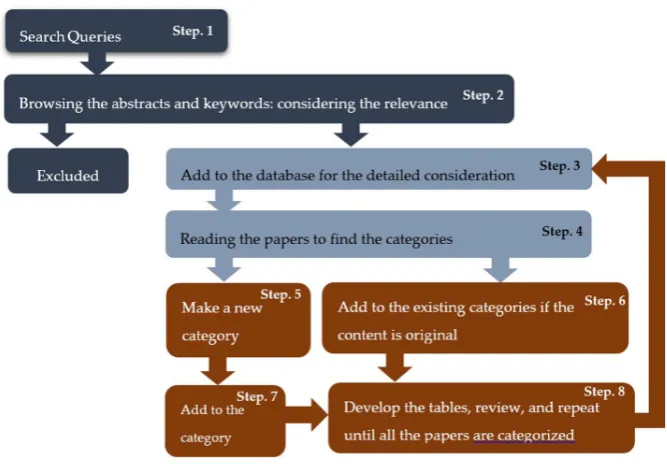
The research methodology follows a comprehensive and structured workflow based on a systematic database search and cross-reference snowballing. The flowchart of the research methodology is presented in figure 1. The method is considered as a modified version of review proposed by Easterby-Smith et al. (2015). In the first step the search queries explore the Thomson Reuters Web-of-Science and Elsevier Scopus databases. In the second step the abstract and keywords of the identified articles are browsed to identify the relevant literature and exclude the irrelevant ones. In step three the database of the relevant articles is created. In step four, the article is carefully read, and the category of the application is identified accordingly. In this step the expert-based knowledge and the initial preferences would influence the number and the type of the categories. In step five we decide on generating a new category and export the article in a new table of application domain or pass the article to step six where a category would host an article in its table. Once a category is created for a new article, in step seven, we pass that article to that category. In step eight we save the content of our database in various categories, update the content of the tables, and review the papers. This workflow will be repeated until sorting out all the papers.
3. Machine learning methods
The survey methodology classifies the machine learning methods in seven groups, i.e. ANN-based, SVM-based, Tree-based models, Ensembles, Bayesians, Logistic regressions, and Neuro-Fuzzy. The last group is deep learning which has been considered separately. The notable papers have been reviewed in individual classes.
3.1 ANN
ANN can prepare general frameworks for analyzing damaged induced materials. Due to the fact that artificial neural networks have various applications such as accurate
prediction of complex material behavior, it could be applied for damage detection and structural integrities in corresponding multiple-variable problems.
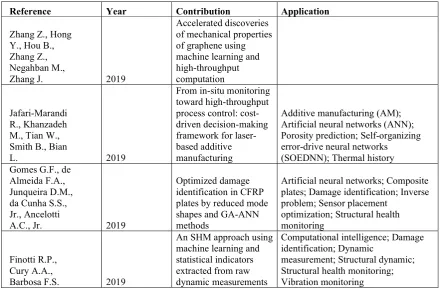
Table 1. Notable ANN-based models for structural damage diagnosis and prediction
Reference Year Contribution Application
Zhang Z., Hong Y., Hou B., Zhang Z., Negahban M.,
Zhang J. 2019
Accelerated discoveries of mechanical properties of graphene using machine learning and high-throughput
computation
Jafari-Marandi R., Khanzadeh M., Tian W., Smith B., Bian
L. 2019
From in-situ monitoring toward high-throughput process control: cost-driven decision-making framework for laser-based additive manufacturing
Additive manufacturing (AM); Artificial neural networks (ANN); Porosity prediction; Self-organizing error-drive neural networks (SOEDNN); Thermal history Gomes G.F., de
Almeida F.A., Junqueira D.M., da Cunha S.S., Jr., Ancelotti
A.C., Jr. 2019
Optimized damage identification in CFRP plates by reduced mode shapes and GA-ANN methods
Artificial neural networks; Composite plates; Damage identification; Inverse problem; Sensor placement
optimization; Structural health monitoring
Finotti R.P., Cury A.A.,
Barbosa F.S. 2019
An SHM approach using machine learning and statistical indicators extracted from raw dynamic measurements
Computational intelligence; Damage identification; Dynamic
Pu Y., Apel D.B., Liu V.,
Mitri H. 2019
Machine learning methods for rockburst prediction-state-of-the-art review
Artificial neural network; Burst liability; Deep learning; Rockburst prediction; Support vector machine
Wong E.W.C.,
Kim D.K. 2018
A simplified method to predict fatigue damage of TTR subjected to short-term VIV using artificial neural network
Artificial neural network; Current; Fatigue damage; Riser; Top-tensioned riser; Vortex-induced vibration
Nie W., Zhao Z.Y., Goh A.T.C., Song M.K., Guo W.,
Zhu X. 2018
Performance based support design for horseshoe-shaped rock caverns using 2D numerical analysis
Artificial neural network;
Convergence confinement method; Rock cavern; Support design
Gedik N. 2018
Least squares support vector mechanics to predict the stability number of rubble-mound breakwaters
Least squares support vector mechanics; Particle swarm optimization; Rubble-mound breakwater; Stability number Rezaniaiee
Aqdam H., Ettefagh M.M.,
Hassannejad R. 2018
Health monitoring of mooring lines in floating structures using artificial neural networks
Damage diagnosis; Finite element method; Mooring lines; Radial basis neural networks; Structural health monitoring; Uncertainty
Cha Y.-J., Choi W., Suh G., Mahmoudkhani S., Büyüköztürk
O. 2018
Autonomous Structural Visual Inspection Using Region-Based Deep Learning for Detecting Multiple Damage Types
Wang Z., Hu
M., Zhai G. 2018
Application of deep learning architectures for accurate and rapid detection of internal mechanical damage of blueberry using hyperspectral transmittance data
Convolutional neural networks; Fruit quality detection; Hyperspectral transmittance image; Internal mechanical damage detection; Machine learning
Krummenacher G., Ong C.S., Koller S., Kobayashi S.,
Buhmann J.M. 2018
Wheel Defect Detection with Machine Learning
artificial neural networks; Machine learning; pattern analysis; railway accidents; railway safety; statistical learning; supervised learning; support vector machines; wavelet transforms
AminShokravi A., Eskandar H., Derakhsh A.M., Rad H.N.,
Ghanadi A. 2018
The potential application of particle swarm optimization algorithm for forecasting the air-overpressure induced by
Gordan M., Razak H.A., Ismail Z.,
Ghaedi K. 2018
Data mining based damage identification using imperialist competitive algorithm and artificial neural network
Artificial neural network; Damage detection; Data mining; Hybrid algorithm; Imperial competitive algorithm; Structural health monitoring
Ghritlahre H.K.,
Prasad R.K. 2018
Exergetic performance prediction of a roughened solar air heater using artificial neural network
Artificial neural network; Exergy analysis; Learning algorithm; Multi-layer perceptron; Solar air heater Rojas-Moraleda
R., Valous N.A., Gowen A., Esquerre C., Härtel S., Salinas L.,
O’Donnell C. 2017
A frame-based ANN for classification of hyperspectral images: assessment of mechanical damage in mushrooms
Artificial neural networks; Frame-based classification; Imaging spectroscopy; Mechanical damage; Salient point detectors
Lin Y.-Z., Nie Z.-H., Ma
H.-W. 2017
Structural Damage Detection with Automatic Feature-Extraction through Deep
Learning
Çalık A., Yıldırım S.,
Tosun E. 2017
Estimation of crack propagation in polymer electrolyte membrane fuel cell under vibration conditions
Artificial neural network; Crack propagation; Mechanical vibration; Polymer electrolyte membrane fuel cell
Tan Z.X., Thambiratnam D.P., Chan T.H.T., Abdul
Razak H. 2017
Detecting damage in steel beams using modal strain energy based damage index and Artificial Neural Network
Artificial Neural Network; Damage index; Damage location; Damage prediction; Damage scenarios; Damage severity; Failure prevention; Modal strain energy; Vibration based technique Samareh H., Khoshrou S.H., Shahriar K., Ebadzadeh M.M., Eslami
M. 2017
Optimization of a nonlinear model for predicting the ground vibration using the combinational particle swarm optimization-genetic algorithm
Artificial neural network; Blasting; Genetic algorithm; Geo-mechanics properties of rock mass; Ground vibration; Particle swarm optimization
Gordan M., Razak H.A., Ismail Z.,
Ghaedi K. 2017
Recent developments in damage identification of structures using data mining
Artificial neural network; Data mining technique; Genetic algorithm; Principal component analysis; Structural damage detection
Choi C.K., Kim
J.S., Yoo H.H. 2016
Identification of location and size of a defect in a structural system
employing active external excitation and hybrid feature vector components in HMM
diagnosis; Hidden Markov model (HMM); Structural system
Bissacot A.C.G., Salgado S.A.B.,
Balestrassi P.P., Paiva A.P., Zambroni Souza
A.C., Wazen R. 2016
Comparison of neural networks and logistic regression in assessing the occurrence of failures in steel structures of transmission lines
Artificial neural networks; Fall of metal structures; Logistic regression; ROC curves; Transmission lines
Guruprasad R.,
Behera B.K. 2015
Comparative Analysis of Soft Computing Models in Prediction of Bending Rigidity of Cotton
Woven Fabrics ANFIS; ANN; Bending rigidity; BPNN; GANN
Alves V., Cury A., Roitman N., Magluta C.,
Cremona C. 2015
Structural modification assessment using supervised learning methods applied to vibration data
Damage assessment; Learning algorithms; Pattern recognition; SHM; Symbolic data
Güneyisi E.M., Mermerdaş K., Güneyisi E.,
Gesoğlu M. 2015
Numerical modeling of time to corrosion induced cover cracking in reinforced concrete using soft-computing based methods
Experimental database; Modeling; Reinforced concrete; Steel reinforcement corrosion; Time to cover cracking
Harish N., Mandal S., Rao
S., Patil S.G. 2015
Particle Swarm Optimization based support vector machine for damage level prediction of non-reshaped berm breakwater
Berm breakwater; Damage level; Non-reshaped; PSO-SVM; SVM
Meruane V., Ortiz-Bernardin
A. 2015
Structural damage assessment using linear approximation with maximum entropy and transmissibility data
Linear approximation; Maximum-entropy principle; Structural damage assessment; Supervised learning algorithms
Gomes, de Almeida, Junqueira, da Cunha, & Ancelotti, 2019; Gordan et al., 2017, 2018; Güneyisi, Mermerdaş, Güneyisi, & Gesoğlu, 2015; Guruprasad & Behera, 2015; Harish, Mandal, Rao, & Patil, 2015; Jafari-Marandi, Khanzadeh, Tian, Smith, & Bian, 2019; Krummenacher et al., 2018; Y. Z. Lin et al., 2017; Meruane & Ortiz-Bernardin, 2015; Nie et al., 2018; Pu et al., 2019; Rezaniaiee Aqdam, Ettefagh, & Hassannejad, 2018; Rojas-Moraleda et al., 2017; Samareh, Khoshrou, Shahriar, Ebadzadeh, & Eslami, 2017; Tan, Thambiratnam, Chan, & Abdul Razak, 2017; Wang et al., 2018; Wong & Kim, 2018; Z. Zhang et al., 2019)
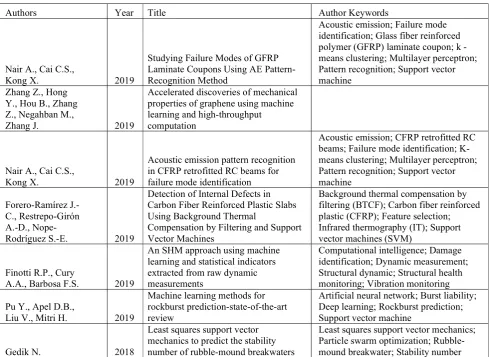
Table. 2 Notable Support vectors (SVM) models
Authors Year Title Author Keywords
Nair A., Cai C.S.,
Kong X. 2019
Studying Failure Modes of GFRP Laminate Coupons Using AE Pattern-Recognition Method
Acoustic emission; Failure mode identification; Glass fiber reinforced polymer (GFRP) laminate coupon; k -means clustering; Multilayer perceptron; Pattern recognition; Support vector machine
Zhang Z., Hong Y., Hou B., Zhang Z., Negahban M.,
Zhang J. 2019
Accelerated discoveries of mechanical properties of graphene using machine learning and high-throughput
computation
Nair A., Cai C.S.,
Kong X. 2019
Acoustic emission pattern recognition in CFRP retrofitted RC beams for failure mode identification
Acoustic emission; CFRP retrofitted RC beams; Failure mode identification; K-means clustering; Multilayer perceptron; Pattern recognition; Support vector machine
Forero-Ramírez J.-C., Restrepo-Girón A.-D.,
Nope-Rodríguez S.-E. 2019
Detection of Internal Defects in Carbon Fiber Reinforced Plastic Slabs Using Background Thermal
Compensation by Filtering and Support Vector Machines
Background thermal compensation by filtering (BTCF); Carbon fiber reinforced plastic (CFRP); Feature selection; Infrared thermography (IT); Support vector machines (SVM)
Finotti R.P., Cury
A.A., Barbosa F.S. 2019
An SHM approach using machine learning and statistical indicators extracted from raw dynamic measurements
Computational intelligence; Damage identification; Dynamic measurement; Structural dynamic; Structural health monitoring; Vibration monitoring
Pu Y., Apel D.B.,
Liu V., Mitri H. 2019
Machine learning methods for rockburst prediction-state-of-the-art review
Artificial neural network; Burst liability; Deep learning; Rockburst prediction; Support vector machine
Gedik N. 2018
Least squares support vector mechanics to predict the stability number of rubble-mound breakwaters
Lin T.-K. 2018
An edge-feature-description-based scheme combined with support vector machines for the detection of vortex-induced vibration
Edge feature description; Hybrid vision-based method; Support vector machines; Vortex-induced vibration
Krummenacher G., Ong C.S., Koller S., Kobayashi S.,
Buhmann J.M. 2018
Wheel Defect Detection with Machine Learning
artificial neural networks; Machine learning; pattern analysis; railway accidents; railway safety; statistical learning; supervised learning; support vector machines; wavelet transforms Rojas-Moraleda
R., Valous N.A., Gowen A., Esquerre C., Härtel S., Salinas
L., O’Donnell C. 2017
A frame-based ANN for classification of hyperspectral images: assessment of mechanical damage in mushrooms
Artificial neural networks; Frame-based classification; Imaging spectroscopy; Mechanical damage; Salient point detectors
Yi Q., Wang H., Guo R., Li S.,
Jiang Y. 2017
Laser ultrasonic quantitative recognition based on wavelet packet fusion algorithm and SVM
Dimension reduction; Laser ultrasonic; Quantitative recognition; SVM classification; Wavelet packet fusion Alves V., Cury A.,
Roitman N., Magluta C.,
Cremona C. 2015
Structural modification assessment using supervised learning methods applied to vibration data
Damage assessment; Learning algorithms; Pattern recognition; SHM; Symbolic data
Lu S., Jiang M., Sui Q., Sai Y., Jia
L. 2015
Damage identification system of CFRP using fiber bragg grating sensors
CFRP structural damage identification; Fiber bragg grating; Multi-class C-support vector classification; One-class support vector machines; Principal component analysis
Harish N., Mandal S., Rao S., Patil
S.G. 2015
Particle Swarm Optimization based support vector machine for damage level prediction of non-reshaped berm breakwater
Berm breakwater; Damage level; Non-reshaped; PSO-SVM; SVM
SVM have gained popularity in modeling the damage. (Alves et al., 2015; Finotti et al., 2019; Forero-Ramírez, Restrepo-Girón, & Nope-Rodríguez, 2019; Gedik, 2018; Harish et al., 2015; Krummenacher et al., 2018; T. K. Lin, 2018; Lu, Jiang, Sui, Sai, & Jia, 2015; Nair, Cai, & Kong, 2019a, 2019b; Pu et al., 2019; Rojas-Moraleda et al., 2017; Yi, Wang, Guo, Li, & Jiang, 2017; Z. Zhang et al., 2019)
Tree-based models;
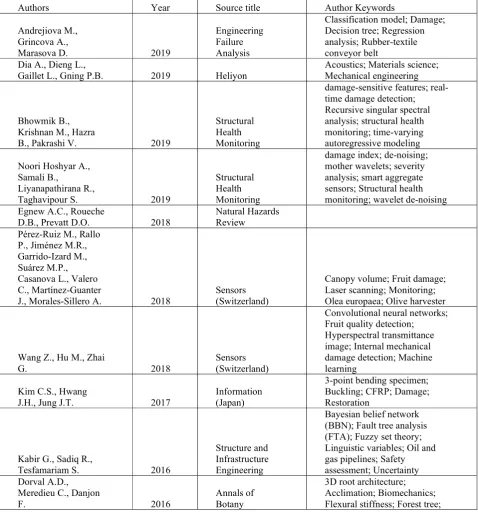
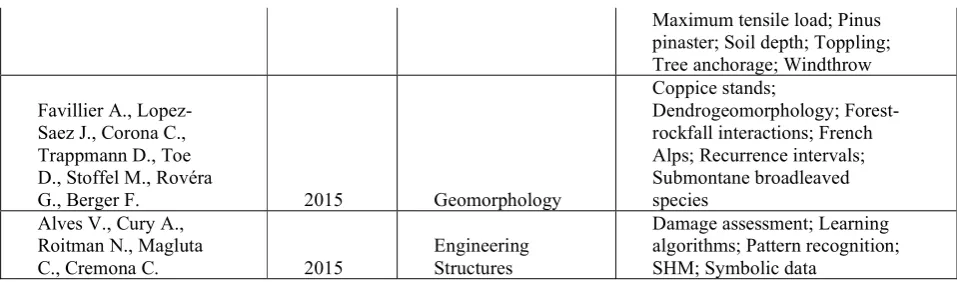
Table 3. Notable tree-based models
Authors Year Source title Author Keywords
Andrejiova M., Grincova A.,
Marasova D. 2019
Engineering Failure Analysis
Classification model; Damage; Decision tree; Regression analysis; Rubber-textile conveyor belt
Dia A., Dieng L.,
Gaillet L., Gning P.B. 2019 Heliyon Acoustics; Materials science; Mechanical engineering
Bhowmik B., Krishnan M., Hazra
B., Pakrashi V. 2019
Structural Health Monitoring
damage-sensitive features; real-time damage detection; Recursive singular spectral analysis; structural health monitoring; time-varying autoregressive modeling
Noori Hoshyar A., Samali B.,
Liyanapathirana R.,
Taghavipour S. 2019
Structural Health Monitoring
damage index; de-noising; mother wavelets; severity analysis; smart aggregate sensors; Structural health monitoring; wavelet de-noising Egnew A.C., Roueche
D.B., Prevatt D.O. 2018
Natural Hazards
Review
Pérez-Ruiz M., Rallo P., Jiménez M.R., Garrido-Izard M., Suárez M.P., Casanova L., Valero C., Martínez-Guanter
J., Morales-Sillero A. 2018 Sensors (Switzerland)
Canopy volume; Fruit damage; Laser scanning; Monitoring; Olea europaea; Olive harvester
Wang Z., Hu M., Zhai
G. 2018
Sensors (Switzerland)
Convolutional neural networks; Fruit quality detection; Hyperspectral transmittance image; Internal mechanical damage detection; Machine learning
Kim C.S., Hwang
J.H., Jung J.T. 2017
Information (Japan)
3-point bending specimen; Buckling; CFRP; Damage; Restoration
Kabir G., Sadiq R.,
Tesfamariam S. 2016
Structure and Infrastructure Engineering
Bayesian belief network (BBN); Fault tree analysis (FTA); Fuzzy set theory; Linguistic variables; Oil and gas pipelines; Safety assessment; Uncertainty Dorval A.D.,
Meredieu C., Danjon
F. 2016
Annals of Botany
Maximum tensile load; Pinus pinaster; Soil depth; Toppling; Tree anchorage; Windthrow
Favillier A., Lopez-Saez J., Corona C., Trappmann D., Toe D., Stoffel M., Rovéra
G., Berger F. 2015 Geomorphology
Coppice stands;
Dendrogeomorphology; Forest-rockfall interactions; French Alps; Recurrence intervals; Submontane broadleaved species
Alves V., Cury A., Roitman N., Magluta
C., Cremona C. 2015
Engineering Structures
Damage assessment; Learning algorithms; Pattern recognition; SHM; Symbolic data
(Alves et al., 2015; Andrejiova, Grincova, & Marasova, 2019; Bhowmik, Krishnan, Hazra, & Pakrashi, 2019; Dia, Dieng, Gaillet, & Gning, 2019; Dorval, Meredieu, & Danjon, 2016; Egnew, Roueche, & Prevatt, 2018; Favillier et al., 2015; Kabir, Sadiq, & Tesfamariam, 2016; Kim, Hwang, & Jung, 2017; Noori Hoshyar, Samali, Liyanapathirana, & Taghavipour, 2019; Pérez-Ruiz et al., 2018; Wang et al., 2018; Z. Zhang et al., 2019)
Table. 4 Notable ensembles models including it includes boosting and bagging for making ensembles
Authors Title Year Author Keywords
Mayer A.E., Mayer P.N.
Evolution of pore ensemble in solid and molten aluminum under dynamic tensile fracture: Molecular dynamics simulations
and mechanical models 2019
Aluminum melt; Dynamic tensile fracture; High-rate stretching; Mechanical model; Molecular dynamics; Solid aluminum Uzay C., Geren N.,
Boztepe M.H., Bayramoglu M.
Bending behavior of sandwich structures with different fiber facing types and
extremely low-density foam cores 2019
ANOVA; Failure modes; Flexural properties; Sandwich structures; Ttree-point bending
Panettieri E., Leclerc G., Jumel J., Guitard J.
Mixed-mode crack propagation tests of composite bonded joints using a dual-actuator load frame – Constant and
variable G II /G I conditions 2018
Composite bonded joints; Debonding; Dual-actuator system; Fracture toughness; Mixed-mode
Wang Z., Hu M., Zhai G.
Application of deep learning architectures for accurate and rapid detection of internal mechanical damage of blueberry using hyperspectral
transmittance data 2018
Convolutional neural networks; Fruit quality detection; Hyperspectral transmittance image; Internal mechanical damage detection; Machine learning
Fakih M.A., Mustapha S., Tarraf
Detection and assessment of flaws in
friction stir welded joints using ultrasonic 2018
J., Ayoub G., Hamade R.
guided waves: experimental and finite element analysis
Structural health monitoring; Weld inspection
Froustey C., Naimark O.B., Panteleev I.A., Bilalov D.A., Petrova A.N.,
Lyapunova E.A. Multiscale structural relaxation and adiabatic shear failure mechanisms 2017 adiabatic shear; dynamic loading; microdefects
Tanırcan G., Alçık H., Beyen K.
Reliability of MEMS accelerometers for instrumental intensity mapping of
earthquakes 2017
Li J., Zhang J.
Adaptive Multiscale Noise Control Enhanced Stochastic Resonance Method Based on Modified EEMD with Its
Application in Bearing Fault Diagnosis 2016
Yu J.-B., Lu X.-L., Zong W.-Z.
Wafer defect detection and recognition based on local and nonlocal linear discriminant analysis and dynamic
ensemble of gaussian mixture models 2016
Gaussian mixture model (GMM); Manifold learning; Pattern recognition; Semiconductor manufacturing; Wafer defect Sokovikov M.,
Bilalov D., Oborin V., Chudinov V., Uvarov S., Bayandin Y.,
Naimark O. Structural mechanisms of formation of adiabatic shear bands 2016
Dynamic loading; Microdefects; Numerical modeling; Plastic strain localization
Ren Y.-C., Weng P.
Structural damage detection based on
improved Hilbert-Huang transform 2015
Damage detection; Ensemble empirical mode decomposition; Hilbert-huang transform; Instantaneous frequency Ovid'Ko I.,
Sheinerman A., Skiba N., Krasnitiskiy S., Smirnov A.
Twin boundary migration and nanocrack generation in ultrafine- grained materials
with nanotwinned structure 2015
Cracks; Defects; Fracture; Modeling; Nanotwinned materials; Plastic deformation; Yield strength
Table 5. Notable Bayesians Models
Authors Year Author Keywords Title
Sha G., Radzieński M., Cao M.,
Ostachowicz W. 2019
Bayesian data fusion; Damage growth monitoring; Damage localization; Relative natural frequency change; Severity estimation
A novel method for single and multiple damage detection in beams using relative natural frequency changes
Chattopadhyay P., Mondal S., Ray A., Mukhopadhyay
A. 2019
Dynamic Data-Driven Combustor Design for Mitigation of Thermoacoustic Instabilities
Yang D.Y.,
Frangopol D.M. 2018 Bayesian network; crack growth; decision-making; Fatigue; influence diagram; life-cycle
Evidence-based framework for real-time life-cycle management of fatigue-critical details of structures
Ye D., Hong G.S., Zhang Y., Zhu K., Fuh
J.Y.H. 2018
Additive manufacturing; Deep belief networks; Defect detection; Fast Fourier transform
Defect detection in selective laser melting technology by acoustic signals with deep belief networks
Ebrahimian H., Astroza R., Conte J.P.,
Papadimitriou C. 2018
Bayesian method; direct differentiation method; joint parameter and input estimation; nonlinear finite element model; output-only system identification; structural health monitoring
Bayesian optimal estimation for output-only nonlinear system and damage
identification of civil structures
Wu X., Zeng X., Huang J., Song
H.-Q. 2017
Bayesian network; Finite element analysis; Reliability growth; Solid rocket motor; Structure optimization
Research on Tail Structure Optimization for Solid Rocket Motor
Liu Y., Shuai Q.,
Zhou S., Tang J. 2017 Damage prognosis; finite element methods (FEMs); hierarchical Bayesian model; Markov
chain Monte Carlo (MCMC) method; structural health monitoring
Integration of Physical Model Prediction and Bayesian Estimation
Ni Y., Lu X., Lu
W. 2017
Bayesian; High-rise building; Modal
identification; Shaking table test; Vibration test
Operational modal analysis of a high-rise multi-function building with dampers by a Bayesian approach
Ebrahimian H., Astroza R., Conte J.P., de
Callafon R.A. 2017
Bayesian inference; Gradient-based
optimization; Model updating; Nonlinear finite element model; Nonlinear system identification; Uncertainty quantification
Nonlinear finite element model updating for damage identification of civil structures using batch Bayesian estimation
Kabir G., Sadiq R., Tesfamariam
S. 2016
Bayesian belief network (BBN); Fault tree analysis (FTA); Fuzzy set theory; Linguistic variables; Oil and gas pipelines; Safety assessment; Uncertainty
A fuzzy Bayesian belief network for safety assessment of oil and gas pipelines
Yazdanipour M.,
Pourgol-Mohammad M. 2016
Bayesian approach; Crack length distribution; Fatigue crack growth; Probabilistic modeling; Propagation of uncertainty
Stochastic fatigue crack growth analysis of metallic structures under multiple thermal-mechanical stress levels
Seuba J., Deville S., Guizard C.,
Stevenson A.J. 2016
Ceramics; Mechanical properties; Mechanical reliability; Porous materials; Weibull
The effect of wall thickness distribution on mechanical reliability and strength in unidirectional porous ceramics
Alves V., Cury A., Roitman N., Magluta C.,
Cremona C. 2015
Damage assessment; Learning algorithms; Pattern recognition; SHM; Symbolic data
Baneen U.,
Guivant J.E. 2015
Bayesian; Curvature mode shapes; Damage detection; Kernels; Plate-type structure.
A 2D Bayesian approach for damage detection in plate-type structures
(Chattopadhyay, Mondal, Ray, & Mukhopadhyay, 2019; Ebrahimian, Astroza, Conte, & de Callafon, 2017; Ebrahimian, Astroza, Conte, & Papadimitriou, 2018; Kabir et al., 2016; Liu, Shuai, Zhou, & Tang, 2017; Y. Ni, Lu, & Lu, 2017; Seuba, Deville, Guizard, & Stevenson, 2016; Sha, Radzieński, Cao, & Ostachowicz, 2019; Wu, Zeng, Huang, & Song, 2017; Yang & Frangopol, 2018; Yazdanipour & Pourgol-Mohammad, 2016; Ye, Hong, Zhang, Zhu, & Fuh, 2018)
Logistic regressions
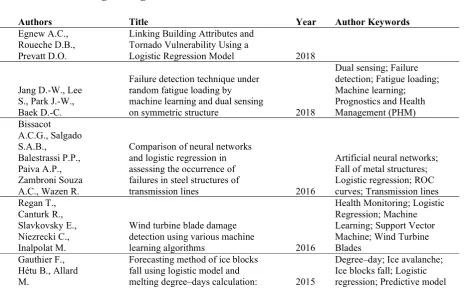
Table 6. Notable logistic regressions
Authors Title Year Author Keywords
Egnew A.C., Roueche D.B., Prevatt D.O.
Linking Building Attributes and Tornado Vulnerability Using a
Logistic Regression Model 2018
Jang D.-W., Lee S., Park J.-W., Baek D.-C.
Failure detection technique under random fatigue loading by machine learning and dual sensing
on symmetric structure 2018
Dual sensing; Failure detection; Fatigue loading; Machine learning; Prognostics and Health Management (PHM) Bissacot
A.C.G., Salgado S.A.B.,
Balestrassi P.P., Paiva A.P., Zambroni Souza A.C., Wazen R.
Comparison of neural networks and logistic regression in assessing the occurrence of failures in steel structures of
transmission lines 2016
Artificial neural networks; Fall of metal structures; Logistic regression; ROC curves; Transmission lines Regan T.,
Canturk R., Slavkovsky E., Niezrecki C., Inalpolat M.
Wind turbine blade damage detection using various machine
learning algorithms 2016
Health Monitoring; Logistic Regression; Machine Learning; Support Vector Machine; Wind Turbine Blades
Gauthier F., Hétu B., Allard M.
Forecasting method of ice blocks fall using logistic model and
melting degree–days calculation: 2015
a case study in northern Gaspésie, Québec, Canada
Zhang W., Shen S., Basak P., Wen H., Wu S., Faheem A., Mohammad L.N.
Development of predictive models for initiation and propagation of field transverse
cracking 2015
Wazen R.N., Fernandes T.S.P., Aoki A.R., De Souza W.E.
Evaluation of the susceptibility of failures in steel structures of
transmission lines 2013
Dropped structures; Logistic regression; Metallic
structures; Rough sets; Transmission lines
(Bissacot et al., 2016; Egnew et al., 2018; Gauthier, Hétu, & Allard, 2015; Jang et al., 2018; Regan, Canturk, Slavkovsky, Niezrecki, & Inalpolat, 2016; Wazen, Fernandes, Aoki, & De Souza, 2013; W. Zhang et al., 2015)
Neuro-Fuzzy
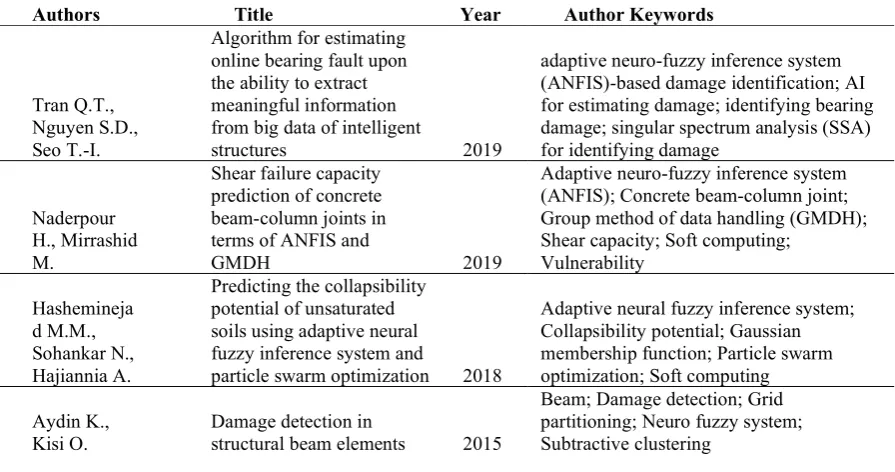
Table 7. Notable ANFIS models
Authors Title Year Author Keywords
Tran Q.T., Nguyen S.D., Seo T.-I.
Algorithm for estimating online bearing fault upon the ability to extract meaningful information from big data of intelligent
structures 2019
adaptive neuro-fuzzy inference system (ANFIS)-based damage identification; AI for estimating damage; identifying bearing damage; singular spectrum analysis (SSA) for identifying damage
Naderpour H., Mirrashid M.
Shear failure capacity prediction of concrete beam-column joints in terms of ANFIS and
GMDH 2019
Adaptive neuro-fuzzy inference system (ANFIS); Concrete beam-column joint; Group method of data handling (GMDH); Shear capacity; Soft computing;
Vulnerability
Hashemineja d M.M., Sohankar N., Hajiannia A.
Predicting the collapsibility potential of unsaturated soils using adaptive neural fuzzy inference system and
particle swarm optimization 2018
Adaptive neural fuzzy inference system; Collapsibility potential; Gaussian membership function; Particle swarm optimization; Soft computing
Aydin K.,
Kisi O. Damage detection in structural beam elements 2015
using hybrid neuro fuzzy systems
Guruprasad R., Behera B.K.
Comparative Analysis of Soft Computing Models in Prediction of Bending Rigidity of Cotton Woven
Fabrics 2015
ANFIS; ANN; Bending rigidity; BPNN; GANN
Nanda J., Das L.D., Das S., Das H.C.
Influence of multi-transverse crack on
cantilever shaft 2015
adaptive neuro-fuzzy inference system; experimental analysis; mode shape; multiple cracks; natural frequency; shaft; Vibration
[No author name available]
3rd International Conference on Civil Engineering and Transportation, ICCET
2013 2014
[No author name available]
2013 International Conference on Mechanical and Electronics
Engineering, ICMEE 2013 2013
[No author name available]
2013 2nd International Conference on Manufacture Engineering, Quality and Production System,
ICMEQP 2013 2013
Adoko A.C., Gokceoglu C., Wu L., Zuo Q.J.
Knowledge-based and data-driven fuzzy modeling for
rockburst prediction 2013
ANFIS; Mamdani fuzzy inference system; Prediction modeling in rock engineering; Rockburst; Takagi-Sugeno fuzzy inference system
(Adoko, Gokceoglu, Wu, & Zuo, 2013; Aydin & Kisi, 2015; Guruprasad & Behera, 2015; Hasheminejad, Sohankar, & Hajiannia, 2018; Naderpour & Mirrashid, 2019; Nanda, Das, Das, & Das, 2015; Tran, Nguyen, & Seo, 2019)
Conclusions
methods have been identified as the most popular deep learning method. The description of each deep learning method and the function of each building block of them is explained.
References
Adoko, A. C., Gokceoglu, C., Wu, L., & Zuo, Q. J. (2013). Knowledge-based and data-driven fuzzy modeling for rockburst prediction. International Journal of Rock Mechanics and Mining Sciences, 61, 86-95. doi:10.1016/j.ijrmms.2013.02.010
Alves, V., Cury, A., Roitman, N., Magluta, C., & Cremona, C. (2015). Structural modification assessment using supervised learning methods applied to vibration data.
Engineering Structures, 99, 439-448. doi:10.1016/j.engstruct.2015.05.003
AminShokravi, A., Eskandar, H., Derakhsh, A. M., Rad, H. N., & Ghanadi, A. (2018). The potential application of particle swarm optimization algorithm for forecasting the air-overpressure induced by mine blasting. Engineering with Computers, 34(2), 277-285. doi:10.1007/s00366-017-0539-5
Andrejiova, M., Grincova, A., & Marasova, D. (2019). Failure analysis of the rubber-textile conveyor belts using classification models. Engineering Failure Analysis, 101, 407-417. doi:10.1016/j.engfailanal.2019.04.001
Aydin, K., & Kisi, O. (2015). Damage detection in structural beam elements using hybrid neuro fuzzy systems. Smart Structures and Systems, 16(6), 1107-1132. doi:10.12989/sss.2015.16.6.1107
Bhowmik, B., Krishnan, M., Hazra, B., & Pakrashi, V. (2019). Real-time unified single- and multi-channel structural damage detection using recursive singular spectrum
analysis. Structural Health Monitoring, 18(2), 563-589.
doi:10.1177/1475921718760483
Bissacot, A. C. G., Salgado, S. A. B., Balestrassi, P. P., Paiva, A. P., Zambroni Souza, A. C., & Wazen, R. (2016). Comparison of neural networks and logistic regression in assessing the occurrence of failures in steel structures of transmission lines. Open Electrical and Electronic Engineering Journal, 10, 11-26. doi:10.2174/1874129001610010011
Çalık, A., Yıldırım, S., & Tosun, E. (2017). Estimation of crack propagation in polymer electrolyte membrane fuel cell under vibration conditions. International Journal of Hydrogen Energy, 42(36), 23347-23351. doi:10.1016/j.ijhydene.2017.02.119
Chattopadhyay, P., Mondal, S., Ray, A., & Mukhopadhyay, A. (2019). Dynamic Data-Driven Combustor Design for Mitigation of Thermoacoustic Instabilities. Journal of Dynamic Systems, Measurement and Control, Transactions of the ASME, 141(1). doi:10.1115/1.4040210
Chen, G., Li, T., Chen, Q., Ren, S., Wang, C., & Li, S. (2019). Application of deep learning neural network to identify collision load conditions based on permanent plastic deformation of shell structures. Computational Mechanics, 64(2), 435-449. doi:10.1007/s00466-019-01706-2
Choi, C. K., Kim, J. S., & Yoo, H. H. (2016). Identification of location and size of a defect in a structural system employing active external excitation and hybrid feature vector components in HMM. Journal of Mechanical Science and Technology, 30(6), 2427-2433. doi:10.1007/s12206-016-0502-1
Dia, A., Dieng, L., Gaillet, L., & Gning, P. B. (2019). Damage detection of a hybrid composite laminate aluminum/glass under quasi-static and fatigue loadings by acoustic emission technique. Heliyon, 5(3). doi:10.1016/j.heliyon.2019.e01414
Dorval, A. D., Meredieu, C., & Danjon, F. (2016). Anchorage failure of young trees in sandy soils is prevented by a rigid central part of the root system with various designs. Annals of Botany, 118(4), 747-762. doi:10.1093/aob/mcw098
Ebrahimian, H., Astroza, R., Conte, J. P., & de Callafon, R. A. (2017). Nonlinear finite element model updating for damage identification of civil structures using batch Bayesian estimation. Mechanical Systems and Signal Processing, 84, 194-222. doi:10.1016/j.ymssp.2016.02.002
Ebrahimian, H., Astroza, R., Conte, J. P., & Papadimitriou, C. (2018). Bayesian optimal estimation for output-only nonlinear system and damage identification of civil structures. Structural Control and Health Monitoring, 25(4). doi:10.1002/stc.2128 Egnew, A. C., Roueche, D. B., & Prevatt, D. O. (2018). Linking Building Attributes and
Tornado Vulnerability Using a Logistic Regression Model. Natural Hazards Review, 19(4). doi:10.1061/(ASCE)NH.1527-6996.0000305
Fakih, M. A., Mustapha, S., Tarraf, J., Ayoub, G., & Hamade, R. (2018). Detection and assessment of flaws in friction stir welded joints using ultrasonic guided waves: experimental and finite element analysis. Mechanical Systems and Signal Processing, 101, 516-534. doi:10.1016/j.ymssp.2017.09.003
Favillier, A., Lopez-Saez, J., Corona, C., Trappmann, D., Toe, D., Stoffel, M., . . . Berger, F. (2015). Potential of two submontane broadleaved species (Acer opalus, Quercus pubescens) to reveal spatiotemporal patterns of rockfall activity. Geomorphology, 246, 35-47. doi:10.1016/j.geomorph.2015.06.010
Forero-Ramírez, J. C., Restrepo-Girón, A. D., & Nope-Rodríguez, S. E. (2019). Detection of Internal Defects in Carbon Fiber Reinforced Plastic Slabs Using Background Thermal Compensation by Filtering and Support Vector Machines. Journal of Nondestructive Evaluation, 38(1). doi:10.1007/s10921-019-0569-6
Froustey, C., Naimark, O. B., Panteleev, I. A., Bilalov, D. A., Petrova, A. N., & Lyapunova, E. A. (2017). Multiscale structural relaxation and adiabatic shear failure mechanisms.
Physical Mesomechanics, 20(1), 31-42. doi:10.1134/S1029959917010039
Gauthier, F., Hétu, B., & Allard, M. (2015). Forecasting method of ice blocks fall using logistic model and melting degree–days calculation: a case study in northern Gaspésie, Québec, Canada. Natural Hazards, 79(2), 855-880. doi:10.1007/s11069-015-1880-x Gedik, N. (2018). Least squares support vector mechanics to predict the stability number of
rubble-mound breakwaters. Water (Switzerland), 10(10). doi:10.3390/w10101452 Ghritlahre, H. K., & Prasad, R. K. (2018). Exergetic performance prediction of a roughened
solar air heater using artificial neural network. Journal of Mechanical Engineering, 64(3), 195-206. doi:10.5545/sv-jme.2017.4575
Gomes, G. F., de Almeida, F. A., Junqueira, D. M., da Cunha, S. S., Jr., & Ancelotti, A. C., Jr. (2019). Optimized damage identification in CFRP plates by reduced mode shapes and GA-ANN methods. Engineering Structures, 181, 111-123. doi:10.1016/j.engstruct.2018.11.081
Gordan, M., Razak, H. A., Ismail, Z., & Ghaedi, K. (2017). Recent developments in damage identification of structures using data mining. Latin American Journal of Solids and Structures, 14(13), 2373-2401. doi:10.1590/1679-78254378
Gordan, M., Razak, H. A., Ismail, Z., & Ghaedi, K. (2018). Data mining based damage identification using imperialist competitive algorithm and artificial neural network.
Latin American Journal of Solids and Structures, 15(8). doi:10.1590/1679-78254546 Güneyisi, E. M., Mermerdaş, K., Güneyisi, E., & Gesoğlu, M. (2015). Numerical modeling
of time to corrosion induced cover cracking in reinforced concrete using soft-computing based methods. Materials and Structures/Materiaux et Constructions, 48(6), 1739-1756. doi:10.1617/s11527-014-0269-8
Guruprasad, R., & Behera, B. K. (2015). Comparative Analysis of Soft Computing Models in Prediction of Bending Rigidity of Cotton Woven Fabrics. Journal of The Institution of Engineers (India): Series E, 96(2), 167-174. doi:10.1007/s40034-014-0047-8
Harish, N., Mandal, S., Rao, S., & Patil, S. G. (2015). Particle Swarm Optimization based support vector machine for damage level prediction of non-reshaped berm breakwater.
Applied Soft Computing Journal, 27, 313-321. doi:10.1016/j.asoc.2014.10.041
Hasheminejad, M. M., Sohankar, N., & Hajiannia, A. (2018). Predicting the collapsibility potential of unsaturated soils using adaptive neural fuzzy inference system and particle
swarm optimization. Scientia Iranica, 25(6A), 2980-2996.
Hong, S., Nomura, K. I., Krishnamoorthy, A., Rajak, P., Sheng, C., Kalia, R. K., . . . Vashishta, P. (2019). Defect Healing in Layered Materials: A Machine Learning-Assisted Characterization of MoS2 Crystal Phases. Journal of Physical Chemistry Letters, 10(11), 2739-2744. doi:10.1021/acs.jpclett.9b00425
Huang, C., & Wang, Z. (2018). Simplified model for estimating the punching load and deformation of RC flat plate based on big data mining. Journal of Intelligent and Fuzzy Systems, 35(1), 445-459. doi:10.3233/JIFS-169602
Jafari-Marandi, R., Khanzadeh, M., Tian, W., Smith, B., & Bian, L. (2019). From in-situ monitoring toward high-throughput process control: cost-driven decision-making framework for laser-based additive manufacturing. Journal of Manufacturing Systems, 51, 29-41. doi:10.1016/j.jmsy.2019.02.005
Jang, D. W., Lee, S., Park, J. W., & Baek, D. C. (2018). Failure detection technique under random fatigue loading by machine learning and dual sensing on symmetric structure.
International Journal of Fatigue, 114, 57-64. doi:10.1016/j.ijfatigue.2018.05.004 Kabir, G., Sadiq, R., & Tesfamariam, S. (2016). A fuzzy Bayesian belief network for safety
assessment of oil and gas pipelines. Structure and Infrastructure Engineering, 12(8), 874-889. doi:10.1080/15732479.2015.1053093
Kan, C. D., Chen, W. L., Lin, C. H., Wang, J. N., Lu, P. J., Chan, M. Y., & Wu, J. T. (2017). Handmade Trileaflet Valve Design and Validation for Pulmonary Valved Conduit Reconstruction Using Taguchi Method and Cascade Correlation Machine Learning Model. IEEE Access, 6, 7088-7099. doi:10.1109/ACCESS.2017.2782686
Kim, C. S., Hwang, J. H., & Jung, J. T. (2017). A study on the cost-effective reliability centered maintenance of running gear system for rolling stock. Information (Japan), 20(5), 3649-3656. Retrieved from https://www.scopus.com/inward/record.uri?eid=2-s2.0-85035014723&partnerID=40&md5=3f2b2e640ace0ebfae306fec2a8db6f1
Krummenacher, G., Ong, C. S., Koller, S., Kobayashi, S., & Buhmann, J. M. (2018). Wheel Defect Detection with Machine Learning. IEEE Transactions on Intelligent Transportation Systems, 19(4), 1176-1187. doi:10.1109/TITS.2017.2720721
Li, H., Kafka, O. L., Gao, J., Yu, C., Nie, Y., Zhang, L., . . . Liu, W. K. (2019). Clustering discretization methods for generation of material performance databases in machine learning and design optimization. Computational Mechanics, 64(2), 281-305. doi:10.1007/s00466-019-01716-0
Li, J., & Zhang, J. (2016). Adaptive Multiscale Noise Control Enhanced Stochastic Resonance Method Based on Modified EEMD with Its Application in Bearing Fault Diagnosis. Shock and Vibration, 2016. doi:10.1155/2016/1485412
Lin, T. K. (2018). An edge-feature-description-based scheme combined with support vector machines for the detection of vortex-induced vibration. International Journal of Innovative Computing, Information and Control, 14(3), 833-845. Retrieved from
Lin, Y. Z., Nie, Z. H., & Ma, H. W. (2017). Structural Damage Detection with Automatic Feature-Extraction through Deep Learning. Computer-Aided Civil and Infrastructure Engineering, 32(12), 1025-1046. doi:10.1111/mice.12313
Liu, Y., Shuai, Q., Zhou, S., & Tang, J. (2017). Prognosis of Structural Damage Growth Via Integration of Physical Model Prediction and Bayesian Estimation. IEEE Transactions on Reliability, 66(3), 700-711. doi:10.1109/TR.2017.2713760
Lu, S., Jiang, M., Sui, Q., Sai, Y., & Jia, L. (2015). Damage identification system of CFRP using fiber bragg grating sensors. Composite Structures, 125, 400-406. doi:10.1016/j.compstruct.2015.02.038
Mayer, A. E., & Mayer, P. N. (2019). Evolution of pore ensemble in solid and molten aluminum under dynamic tensile fracture: Molecular dynamics simulations and mechanical models. International Journal of Mechanical Sciences, 157-158, 816-832. doi:10.1016/j.ijmecsci.2019.05.023
Meruane, V., & Ortiz-Bernardin, A. (2015). Structural damage assessment using linear approximation with maximum entropy and transmissibility data. Mechanical Systems and Signal Processing, 54, 210-223. doi:10.1016/j.ymssp.2014.08.018
Naderpour, H., & Mirrashid, M. (2019). Shear failure capacity prediction of concrete beam-column joints in terms of ANFIS and GMDH. Practice Periodical on Structural Design and Construction, 24(2). doi:10.1061/(ASCE)SC.1943-5576.0000417
Nair, A., Cai, C. S., & Kong, X. (2019a). Acoustic emission pattern recognition in CFRP retrofitted RC beams for failure mode identification. Composites Part B: Engineering, 161, 691-701. doi:10.1016/j.compositesb.2018.12.120
Nair, A., Cai, C. S., & Kong, X. (2019b). Studying Failure Modes of GFRP Laminate Coupons Using AE Pattern-Recognition Method. Journal of Aerospace Engineering, 32(4). doi:10.1061/(ASCE)AS.1943-5525.0001015
Nanda, J., Das, L. D., Das, S., & Das, H. C. (2015). Influence of multi-transverse crack on cantilever shaft. International Journal of Damage Mechanics, 24(7), 1047-1069. doi:10.1177/1056789514560916
Ni, F., Zhang, J., & Chen, Z. (2019). Zernike-moment measurement of thin-crack width in images enabled by dual-scale deep learning. Computer-Aided Civil and Infrastructure Engineering, 34(5), 367-384. doi:10.1111/mice.12421
Ni, Y., Lu, X., & Lu, W. (2017). Operational modal analysis of a high-rise multi-function building with dampers by a Bayesian approach. Mechanical Systems and Signal Processing, 86, 286-307. doi:10.1016/j.ymssp.2016.10.009
Nie, W., Zhao, Z. Y., Goh, A. T. C., Song, M. K., Guo, W., & Zhu, X. (2018). Performance based support design for horseshoe-shaped rock caverns using 2D numerical analysis.
Engineering Geology, 245, 266-279. doi:10.1016/j.enggeo.2018.09.007
Ovid'Ko, I., Sheinerman, A., Skiba, N., Krasnitiskiy, S., & Smirnov, A. (2015). Twin boundary migration and nanocrack generation in ultrafine- grained materials with nanotwinned structure. WSEAS Transactions on Applied and Theoretical Mechanics, 10, 204-212. Retrieved from https://www.scopus.com/inward/record.uri?eid=2-s2.0-84934758396&partnerID=40&md5=ab0c37cb2398b07261444aa546dd644e
Panettieri, E., Leclerc, G., Jumel, J., & Guitard, J. (2018). Mixed-mode crack propagation tests of composite bonded joints using a dual-actuator load frame – Constant and variable G II /G I conditions. Engineering Fracture Mechanics, 202, 471-486. doi:10.1016/j.engfracmech.2018.09.015
Patala, S. (2019). Understanding grain boundaries – The role of crystallography, structural descriptors and machine learning. Computational Materials Science, 162, 281-294. doi:10.1016/j.commatsci.2019.02.047
Pérez-Ruiz, M., Rallo, P., Jiménez, M. R., Garrido-Izard, M., Suárez, M. P., Casanova, L., . . . Morales-Sillero, A. (2018). Evaluation of over-the-row harvester damage in a super-high-density olive orchard using on-board sensing techniques. Sensors (Switzerland), 18(4). doi:10.3390/s18041242
Pu, Y., Apel, D. B., Liu, V., & Mitri, H. (2019). Machine learning methods for rockburst prediction-state-of-the-art review. International Journal of Mining Science and Technology. doi:10.1016/j.ijmst.2019.06.009
Quaranta, G., Lopez, E., Abisset-Chavanne, E., Duval, J. L., Huerta, A., & Chinesta, F. (2019). Structural health monitoring by combining machine learning and dimensionality reduction techniques. Revista Internacional de Metodos Numericos para Calculo y Diseno en Ingenieria, 35(1). doi:10.23967/j.rimni.2018.12.001
Regan, T., Canturk, R., Slavkovsky, E., Niezrecki, C., & Inalpolat, M. (2016). Wind turbine blade damage detection using various machine learning algorithms.
Ren, S., Chen, G., Li, T., Chen, Q., & Li, S. (2018). A deep learning-based computational algorithm for identifying damage load condition: An artificial intelligence inverse problem solution for failure analysis. CMES - Computer Modeling in Engineering and Sciences, 117(3), 287-307. doi:10.31614/cmes.2018.04697
Ren, Y. C., & Weng, P. (2015). Structural damage detection based on improved Hilbert-Huang transform. Zhendong yu Chongji/Journal of Vibration and Shock, 34(18), 195-199. doi:10.13465/j.cnki.jvs.2015.18.033
Rezaniaiee Aqdam, H., Ettefagh, M. M., & Hassannejad, R. (2018). Health monitoring of mooring lines in floating structures using artificial neural networks. Ocean Engineering, 164, 284-297. doi:10.1016/j.oceaneng.2018.06.056
Salehi, H., Das, S., Biswas, S., & Burgueño, R. (2019). Data mining methodology employing artificial intelligence and a probabilistic approach for energy-efficient structural health monitoring with noisy and delayed signals. Expert Systems with Applications, 135, 259-272. doi:10.1016/j.eswa.2019.05.051
Samareh, H., Khoshrou, S. H., Shahriar, K., Ebadzadeh, M. M., & Eslami, M. (2017). Optimization of a nonlinear model for predicting the ground vibration using the combinational particle swarm optimization-genetic algorithm. Journal of African Earth Sciences, 133, 36-45. doi:10.1016/j.jafrearsci.2017.04.029
Seuba, J., Deville, S., Guizard, C., & Stevenson, A. J. (2016). The effect of wall thickness distribution on mechanical reliability and strength in unidirectional porous ceramics.
Science and Technology of Advanced Materials, 17(1), 128-135. doi:10.1080/14686996.2016.1140309
Sha, G., Radzieński, M., Cao, M., & Ostachowicz, W. (2019). A novel method for single and multiple damage detection in beams using relative natural frequency changes.
Mechanical Systems and Signal Processing, 132, 335-352. doi:10.1016/j.ymssp.2019.06.027
Sokovikov, M., Bilalov, D., Oborin, V., Chudinov, V., Uvarov, S., Bayandin, Y., & Naimark, O. (2016). Structural mechanisms of formation of adiabatic shear bands.
Frattura ed Integrita Strutturale, 10(38), 296-304. doi:10.3221/IGF-ESIS.38.40 Tan, Z. X., Thambiratnam, D. P., Chan, T. H. T., & Abdul Razak, H. (2017). Detecting
damage in steel beams using modal strain energy based damage index and Artificial Neural Network. Engineering Failure Analysis, 79, 253-262. doi:10.1016/j.engfailanal.2017.04.035
Tanırcan, G., Alçık, H., & Beyen, K. (2017). Reliability of MEMS accelerometers for instrumental intensity mapping of earthquakes. Annals of Geophysics, 60(6). doi:10.4401/ag-7501
Tran, Q. T., Nguyen, S. D., & Seo, T. I. (2019). Algorithm for estimating online bearing fault upon the ability to extract meaningful information from big data of intelligent structures. IEEE Transactions on Industrial Electronics, 66(5), 3804-3813. doi:10.1109/TIE.2018.2847704
Uzay, C., Geren, N., Boztepe, M. H., & Bayramoglu, M. (2019). Bending behavior of sandwich structures with different fiber facing types and extremely low-density foam cores. Materialpruefung/Materials Testing, 61(3), 220-230. doi:10.3139/120.111311 Wang, Z., Hu, M., & Zhai, G. (2018). Application of deep learning architectures for accurate
and rapid detection of internal mechanical damage of blueberry using hyperspectral transmittance data. Sensors (Switzerland), 18(4). doi:10.3390/s18041126
Wong, E. W. C., & Kim, D. K. (2018). A simplified method to predict fatigue damage of TTR subjected to short-term VIV using artificial neural network. Advances in Engineering Software, 126, 100-109. doi:10.1016/j.advengsoft.2018.09.011
Wu, X., Zeng, X., Huang, J., & Song, H. Q. (2017). Research on Tail Structure Optimization for Solid Rocket Motor. Tuijin Jishu/Journal of Propulsion Technology, 38(12), 2822-2829. doi:10.13675/j.cnki.tjjs.2017.12.022
Yang, D. Y., & Frangopol, D. M. (2018). Evidence-based framework for real-time life-cycle management of fatigue-critical details of structures. Structure and Infrastructure Engineering, 14(5), 509-522. doi:10.1080/15732479.2017.1399150
Yazdanipour, M., & Pourgol-Mohammad, M. (2016). Stochastic fatigue crack growth analysis of metallic structures under multiple thermal-mechanical stress levels.
Materials and Design, 95, 599-611. doi:10.1016/j.matdes.2016.01.110
Ye, D., Hong, G. S., Zhang, Y., Zhu, K., & Fuh, J. Y. H. (2018). Defect detection in selective laser melting technology by acoustic signals with deep belief networks. International Journal of Advanced Manufacturing Technology, 96(5-8), 2791-2801. doi:10.1007/s00170-018-1728-0
Yi, Q., Wang, H., Guo, R., Li, S., & Jiang, Y. (2017). Laser ultrasonic quantitative recognition based on wavelet packet fusion algorithm and SVM. Optik, 149, 206-219. doi:10.1016/j.ijleo.2017.08.105
Yu, J. B., Lu, X. L., & Zong, W. Z. (2016). Wafer defect detection and recognition based on local and nonlocal linear discriminant analysis and dynamic ensemble of gaussian mixture models. Zidonghua Xuebao/Acta Automatica Sinica, 42(1), 47-59. doi:10.16383/j.aas.2016.c150311
Zhang, W., Shen, S., Basak, P., Wen, H., Wu, S., Faheem, A., & Mohammad, L. N. (2015) Development of predictive models for initiation and propagation of field transverse cracking. In: Vol. 2524. Transportation Research Record (pp. 92-99): National Research Council.