International Journal of Research (IJR)
e-ISSN: 2348-6848, p- ISSN: 2348-795X Volume 2, Issue 06, June 2015Available at http://internationaljournalofresearch.org
Available online:http://internationaljournalofresearch.org/ P a g e | 311
Implementation of Proficient Technique for Fire
Detection and Prevention using Optical Flow Estimation
1
Dr.B.Paulchamy;
2N.Rathan;
3B.Hakkem &
4A.Venkatesh
1 Professor &Head, Dept of ECE, Hindusthan Institute of Technology, Coimbatore-32. 2,3,4Assistant Professors ,Dept of ECE ,Hindustan Institute of Technology, India.
1Mobile:9629183233, EmailId: [email protected]
Abstract
Computational vision-based flame detection has drawn significant attention in the past decade with camera surveillance systems becoming ubiquitous. Where as many discriminating features, such as colour, shape, texture, etc., have been employed in the literature. This paper proposes a set of motion features based on motion estimators. The key idea consists of exploiting the difference between the turbulent, fast, fire motion, and the structured, rigid motion of other objects. Since classical optical flow methods do not model the characteristics of fire motion (e.g., non-smoothness of motion, non-constancy of intensity), two optical flow methods are specifically designed for the fire detection task: optimal mass transport models fire with dynamic texture, while a data-driven optical flow scheme models saturated flames. Then, characteristic features related to the flow magnitudes and directions are computed from the flow fields to discriminate between fire and non-fire motion. The proposed features are tested on a large video database to demonstrate their practical usefulness. Moreover, a novel evaluation method is proposed by fire simulations that allow for a controlled environment to analyze parameter influences, such as flame saturation, spatial resolution, frame rate, and random noise.
Keywords: Fire detection; optical flow; optimal mass transport; video analytics
1. INTRODUCTION
Detecting the break-out of a fire rapidly is vital forprevention of material damage and human casualties.This is a particularly serious problem in situations of congestedautomobile traffic, naval ships, and heavy industry.Traditional point-sensors detect heat or smoke particles andare quite successful for indoor fire detection. However theycannot be applied in large open spaces such as hangars, ships or forests. This paper presents a video-detectionapproach geared toward these scenarios where point-sensors may fail. In addition to covering wide viewing range video cameras capture data from which additional information canbe extracted; for example the precise location, extent, and rateof growth. Surveillance cameras have recently become pervasively installed by governments and businesses for applications like license plate recognition and robbery deterrence. Reliablevision-based fire detection can feasibly take advantage of theexisting infrastructure and significantly contribute for publicsafety with little additional cost.
International Journal of Research (IJR)
e-ISSN: 2348-6848, p- ISSN: 2348-795X Volume 2, Issue 06, June 2015Available at http://internationaljournalofresearch.org
Available online:http://internationaljournalofresearch.org/ P a g e | 312 computed features as inputand make
decision outputs regarding the target’s presence.Supervised machine-learning-based classification algorithmssuch as neural networks (NN) are systematically trained ona data set of features and ground truth.Computer vision concepts are ofteninspired by human vision. A comprehensive and elegantdescription of the human perception of fire was presented bythe 16th century French poet Du Batas: ―Bright-flaming, heat-full fire, the source of motion.‖
Since classical optical flow methods are based on assumptions,e.g., intensity constancy and flow smoothness, which are notmet by fire motion, we derive two optical flow estimatorsspecifically designed for the detection of fire; optimal masstransport exploits the dynamic texture
of flames, whereasa
non-smoothmodification of classical optical flow modelssaturated flames with no dynamic texture. Second, a new setof optical flow features is presented for fire detection; thesefeatures characterize magnitude and directionality of motionvectors[1]. Third, thorough analysis on real and synthetic datais performed; it demonstrates the features’ ability to reliablydetect fire while rejecting non-fire, rigidly moving objects.
2. LITERATURE REVIEW
Nicholas True, San Diego Gilman Drive, La Jolla, et..al, proposed,that Automatic fire detection devices have been around since the first smoke alarm was invented by Francis Upton in 1890. After further technological advances in the mid 1960s reduced the price of smoke detectors, these devices started showing up in buildings all over the world, becoming the ubiquitous and essential devices that they are today. However, automated fire detection devices such as smoke detectors have some significant limitations which make them useless in many important situations.
YasarGuneriSahinet..al, proposed the main idea presented in this paper is to utilize animals with sensors as Mobile Biological Sensors (MBS). The devices used in this system are animals which are native animals living in forests, sensors that measure the temperature and transmit the location of the MBS, access points for wireless communication and a central computer system which classifies animal actionsMartinez-de Dios J.R., B. C. Arrue and A. Olleroet..al,This paper proposes a new distributed intelligent systemfor reliable forest-fire detection based on the integrationof information from several distributed sensors andsources of information.The paper summarizes some results obtained in thecontext of the project ―Distributed EnvironmentalDisaster Information and Control Systems‖ funded by the TelemetricApplication Program of the DGXIII,Commission of the European Communities.DEDICS is designed to be adapted to a wide range ofdisasters. However, its first application is concernedwith forest fires, which constitute one of the mostfrequent and difficult types of environmental disaster insome countries. Prevention and control support in DEDICS is based on a sensor network.The paper first studies the state of art of existing automatic forest-fire detection systems and their mainconstraints.
3. PROPOSED METHODOLOGY
Theproposed method for the detection and prevention of fireovercomes all the existing fire detection method. This method deals with the detection of fire by the ordinary surveillance camera. This method is the most effective and it detects the fire early and prevents it before it becoming large.
SOFTWARE DESCRIPTION
International Journal of Research (IJR)
e-ISSN: 2348-6848, p- ISSN: 2348-795X Volume 2, Issue 06, June 2015Available at http://internationaljournalofresearch.org
Available online:http://internationaljournalofresearch.org/ P a g e | 313 method. This method deals with the
detection of fire by the ordinary surveillance camera. This method is the most effective and it detects the fire early and prevents it before becoming large[2].
Computational vision-based flame detection hasdrawn significant attention in the past decade with camerasurveillance systems becoming ubiquitous. Whereas many discriminatingfeatures, such as color, shape, texture, etc., havebeen employed in the literature, this paper proposes a set ofmotion features based on motion estimators. The key idea consistsof exploiting the difference between the turbulent, fast, firemotion, and the structured, rigid motion of other objects. Sinceclassical optical flow methods do not model the characteristicsof fire motion (e.g.,
non-smoothness of motion, non-constancy ofintensity), two optical flow methods are specifically designed forthe fire detection task: optimal mass transport models fire withdynamic texture, while a data-driven optical flow scheme modelssaturated flames. Then, characteristic features related to the flowmagnitudes and directions are computed from the flow fieldsto discriminate between
fire and non-fire motion. The
International Journal of Research (IJR)
e-ISSN: 2348-6848, p- ISSN: 2348-795X Volume 2, Issue 06, June 2015Available at http://internationaljournalofresearch.org
Available online:http://internationaljournalofresearch.org/ P a g e | 314
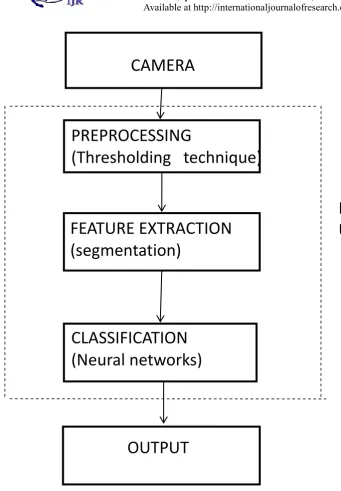
Figure 1: Flow chart OPTICAL FLOW ESTIMATION
The optical flow approach has emerged as a major technique for estimating the motion of the object in image sequences. However, the results obtained by most optical flow techniques are poor because they areadversely affected by large illumination changes and by motion discontinuities. Recently however, there havebeen two trends in the development of optical flow algorithms. One has emphasized higher accuracy; theother faster implementation. These two
trends have been independently pursed[4], without addressing theaccuracy vs. efficiency trade-off .The optical-flow computation consists of the estimation of the apparent 2D movement field in the image sequence, as introduced by Horn and Schunck. In this way, each pixel has an associated velocityvector.
This technique can be combined with several segmentation techniques in order to improve its accuracy or to implement object tracking. Many strategies for optical-flow computation have
CAMERA
PREPROCESSING
(Thresholding technique)
FEATURE EXTRACTION
(segmentation)
CLASSIFICATION
(Neural networks)
OUTPUT
International Journal of Research (IJR)
e-ISSN: 2348-6848, p- ISSN: 2348-795X Volume 2, Issue 06, June 2015Available at http://internationaljournalofresearch.org
Available online:http://internationaljournalofresearch.org/ P a g e | 315 beenpublished.Among these methods, the
gradient-based and the correlation-based approaches are the two mostcommonly used techniques.
Optical flow estimators, on the other hand, transform the image sequence into estimated motion fields, allowing a more insightful extraction of features. Classical optical flow algorithms are analysed in for the recognition of various dynamic textures[5].
A naive approach to the vision-based detection is to use a supervised machine learning algorithm trained directly on intensity values in the image. This approach will undoubtedly underperform because the classification complexity increases exponentially with the dimensionality of the problem, which in this case is equal to the number of pixels. Further, the computational cost and the amount of training data required become prohibitively large. Instead, feature extraction is employed by incorporating prior information (known physical properties of the problem or human intuition) for the purpose of reducing the problem dimensionality.
The optical flow computations in Section II do not reducedimensionality, as the two
M×Nimages determine the values of the M
・ N, 2D, optical flow vectors. This transformation is an intermediate step that provides a data set from which motion features can be extracted more intuitively than would be possible from the original image. To do so, we pursue a region-based as opposed to a pixel-based approach. Whereas the pixel-wise approach classifies each pixel, the region-wise approach aims to classify a region as a whole by analyzingthe set of all pixel values in that region.
IMPLEMENTATION OF IMAGE PRE-PROCESSING
We are now in a position to test the effect of image pre-processing on the
system performance. We present a range of pre-processing techniques, which may affect the EER of the system, when applied to fire images prior to recognition.
The image processing methods fall into four main categories:
colour normalisation methods statistical methods
convolution methods
combinations of these methods. These methods are used to produce a single scalar value for each pixel.
INTENSITY: INTENSITY NORMALISATION
We use a well-known image intensity normalisation method, in which we assume that, as the intensity of the lighting source increases by a factor, each RGB component of each pixel in the image is scaled by the same factor[6]. We removed he effect of this intensity factor dividing by the sum of the three colour components.
𝑅𝑛𝑜𝑟𝑚,𝐺𝑛𝑜𝑟𝑚 ,𝐵𝑛𝑜𝑟𝑚 = 𝑅
𝑅+𝐺+𝐵 , 𝐺 𝑅+𝐺+𝐵 ,
𝐵
𝑅+𝐺+𝐵 . ……… …………. (1)
Since the pixels of the resulting image have equal intensity, summing the three colour channels would result in a blank image. Therefore, to create an image with single scalar values for each pixel w ecan either take a single colour channel or sum just the red and green components
GREY WORLD: GREY WORLD NORMALISATION
International Journal of Research (IJR)
e-ISSN: 2348-6848, p- ISSN: 2348-795X Volume 2, Issue 06, June 2015Available at http://internationaljournalofresearch.org
Available online:http://internationaljournalofresearch.org/ P a g e | 316
𝑅𝑛𝑜𝑟𝑚,𝐆𝑛𝑜𝑟𝑚 ,𝐵𝑛𝑜𝑟𝑚 = 𝑁𝑟
𝑟1+𝑟2+⋯𝑟𝑁, 𝑁𝑔 𝑔1+𝑔2+⋯𝑔𝑁,
𝑁𝑏
𝑏1+𝑏+⋯𝑏𝑁 …..… ……..(2)
COMPREHENSIVE:
COMPREHENSIVE COLOUR IMAGE NORMALISATION
We use an algorithm proposed by Finlayshown3, which normalises an image for variations in both lighting geometry and illumination colour. The method involves the repetition of intensity normalisation followed by grey world normalisation (as described above), until the resulting image reaches a stable state (i.e. the change in pixel values from one cycle to another is sufficiently small).
HSV HUE: STANDARD DEFINITION OF HUE
The hue of an image is calculated using the standard hue definition, such that each pixel is represented by a single scalar value H.
𝐻 =
cos−1 1 𝑟−𝑔 2 + 𝑟−𝑏
𝑟−𝑔 𝑟−𝑔 + 𝑟−𝑏 𝑔−𝑏 . ………(3)
BGI HUE: HUE THAT IS INVARIANT TO BRIGHTNESS AND GAMMA
Finlayson and Schaefer introduce a definition of hue that is invariant to brightness (the scaling of each colour channel by a constant factor) and gamma (raising the colour channels to a constant power)4, which are often caused by variations in scene environment and capture equipment[8].
𝐻 =
tan−1 log 𝑟 −log 𝑔
log 𝑟 +log 𝑔 −2 log 𝑏 ………..…. (4)
NOISE REMOVABLE TECHNIQUE De-noising plays a vital role in the field of the image pre-processing. It is often
a necessary to be taken, before the image data is analyzed. It attempts to remove whatever noise is present and retains the significant information, regardless of the frequency contents of the signal. It is entirely different content and retains low frequency content. De-noising has to be performed to recover the useful information. In this process much concentration is spent on, how well the edges are preserved and, how much of the noise granularity has been removed. The main of an image-denoising algorithm is then to reduce the noise level, while preserving the image features. In wavelet domain, the noise is uniformly spread throughout the coefficients, while most of the image information is concentrated in the few largest coefficients.
EVALUATION PARAMETERS
Hard Thresholding
Hard thresholding can be defined as follow:
𝐷 𝑈,𝜆 =𝑈𝑓𝑜𝑟𝑎𝑙𝑙ǀ𝐷ǀ >𝝀
=0 otherwise…...……(5)
Hard threshold is a "keep or kill" procedure and is more intuitively appealing. The transfer function of the Hardthresholding is shown in the figure. Hard thresholding may seem to be natural[9]. Hard thresholding does not even work with some algorithm such as GCV
procedure. Sometimes pure noise
coefficients may pass the hard threshold and appear as annoying ―blips‖in the output.
Soft Thresholding
Soft thresholding can be defined as follow:
D (U, λ) =sgn (U) max (0, |U|- λ)……….…(6)
International Journal of Research (IJR)
e-ISSN: 2348-6848, p- ISSN: 2348-795X Volume 2, Issue 06, June 2015Available at http://internationaljournalofresearch.org
Available online:http://internationaljournalofresearch.org/ P a g e | 317 structures in hard thresholding can
overcome by soft thresholding. Now a days, wavelet based denoising methods have received a greater attention. Important features are characterized by large wavelet coefficient across scales, while most of the timer scales[10].
Feature extraction
Following the Figure below from left to right, with a description of the proposed algorithm. Section II derives two optical flow formulations tailored to the fire detection task: the first is the optimal mass transport (OMT) optical flow for modelling dynamic textures such as fire, and the second is a non-smooth optical flow model for rigid motion. Section III describes the features extracted from the optical flow fields for classification. Those features include quantities related to the flow magnitude and the flow directions. Section IV adds the auxiliary concepts of candidate regions and proposes to train a neural net (NN) for fire detection. Finally, test results on real and synthetic data from fire simulations are presented in Section V for qualitative and quantitative analysis[20].
Figure 2:Feature Extraction
The Proposed firedetection
algorithm. The paper’s focus is put on
the feature extraction block, where two optical flow fields (OMT and NSD) are computed in parallel from which the 4D feature vector is built.
A comprehensive survey of optical flow since the pioneering papers by
Horn/Schunck and Lucas/Kanade from 1981 is beyond the scope of this. However, the short introduction in Section II-A, should suffice to understand the issues of classical optical flow when applied to fire detection[11]. To ameliorate these issues, Sections II-B and II-C propose the use of two novel optical flow estimations— Optimal Mass Transport (OMT) and Non-Smooth Data (NSD)—that are specifically developed for the fire detection task.
4. CLASSICAL OPTICAL FLOW
Optical flow estimation computes correspondence between pixels in the current and the previous frame of an image sequence. Central to most approaches in establishing this correspondence is the assumption of intensity constancy: moving objects preserve their intensity values from frame to frame[19]. This assumption leads to the optical flow constraint
𝑑
𝑑𝑡𝐼= 𝐼𝑥𝑢+𝐼𝑦𝑣+𝐼𝑡 =
International Journal of Research (IJR)
e-ISSN: 2348-6848, p- ISSN: 2348-795X Volume 2, Issue 06, June 2015Available at http://internationaljournalofresearch.org
Available online:http://internationaljournalofresearch.org/ P a g e | 318 anisotropic. The optical flow constraint
remains central to all those advances[12]. Optimal Mass Transport (OMT) Optical Flow
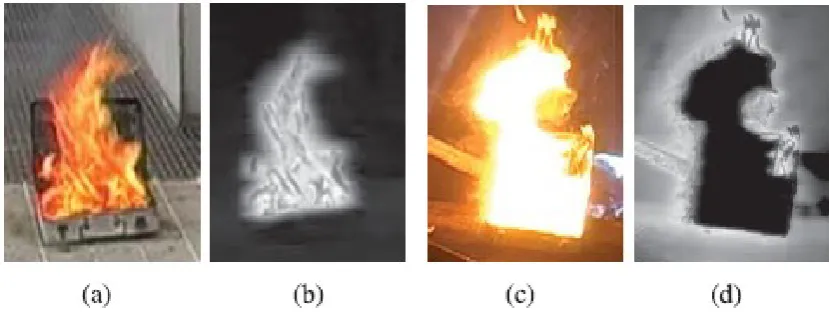
Classical optical flow models based on brightness constancy, (d/dt) I = 0, are inadequate to model the appearance of fire for two reasons. First, fire does not satisfy the intensity constancy assumption[14], since rapid (both spatially and temporally) change of intensity occurs in the burning
process due to fast pressure and heat
dynamics. Second, smoothness
regularization may be counter-productive to the estimation of fire motion, which is expected to have a turbulent, i.e., non-smooth, motion field.
The optical flow problem is posed as a generalized mass—representing image intensity I—transport problem, where the data term enforces mass conservation[18].
Figure 3:(a) and (c): Original images. (b) and (d): Respective generalized mass (black - 0, white - 1).Fire texture is preserved; saturated regions are
assigned as low mass.
Non-Smooth Data (NSD) Optical Flow Under unfavourable lighting conditions, especially in closed spaces, fire blobs are likely saturated, thus violating OMT’s assumption that dynamic texture is present in fire. Nevertheless, these blobs have
boundary motion, which may be
characterized by another type of optical flow estimation[17]. A novel optical flow energy functional called Non-Smooth Data optical flow (NSD) and tailored to saturated fire blobs is proposed the choice of the data term being the optical flow constraint is justified because pixel saturation trivially implies intensity constancy. Also, the NSD is explicitly chosen to be non-smooth since saturated fire blobs are expected to have non-smooth boundary motion. The norm of
International Journal of Research (IJR)
e-ISSN: 2348-6848, p- ISSN: 2348-795X Volume 2, Issue 06, June 2015Available at http://internationaljournalofresearch.org
Available online:http://internationaljournalofresearch.org/ P a g e | 319 produces a binary image[15]. A pixel has the
value one if it belongs to the object; otherwise it is zero. Segmentation is the operation at the threshold between low-level image processing and image analysis. After segmentation, it is known that which pixel belongs to which object. The image is parted into regions and we know the discontinuities as the boundaries between the regions.
Segmentation refers to the process of partitioning a digital image into multiple segments like sets of pixels, also known as super pixels. Image segmentation is typically used to locate objects and boundaries in images. More precisely, image segmentation is the process of assigning a label to every pixel in an image such that pixels with the same label share certain visual characteristics. The result of image segmentation is a set of segments that collectively cover the entire image, or a set of contours extracted from the image. Each of the pixels in a region is similar with respect to some characteristic or computed property such as colour, intensity, or texture. Due to the importance of image segmentation a number of algorithms have been proposed, but based on the image that is inputted the algorithm should be chosen to get the best results. In this paper the author gives a study of the various algorithms that
are available for colour images, text and gray scale images
Classification is the process of classifying the result from the feature extraction for the output. Thus getting more number of different result from its feature extraction for analysing the result in various form.We are using a neural network system for this classification
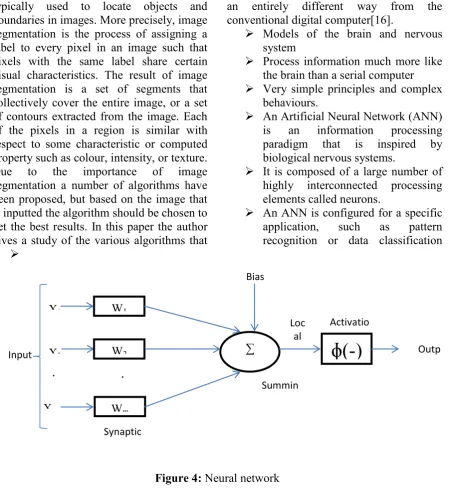
Work on artificial neural networks, commonly referred to as neural networks, has been motivated right from its inception by the recognition that the brain computes in an entirely different way from the conventional digital computer[16].
Models of the brain and nervous system
Process information much more like the brain than a serial computer Very simple principles and complex
behaviours.
An Artificial Neural Network (ANN) is an information processing paradigm that is inspired by biological nervous systems.
It is composed of a large number of highly interconnected processing elements called neurons.
An ANN is configured for a specific application, such as pattern recognition or data classification
Figure 4: Neural network Bias
b
Synaptic weights
W1
W2
Wm
∑
ɸ(-)
Xm X2 X1
Loc al Fiel
d V
Activatio n
function Outp
ut y Summin
g function Input
signal
.
.
.
International Journal of Research (IJR)
e-ISSN: 2348-6848, p- ISSN: 2348-795X Volume 2, Issue 06, June 2015Available at http://internationaljournalofresearch.org
Available online:http://internationaljournalofresearch.org/ P a g e | 320 5. RESULT AND DISCUSSION
Thus the optical flow estimation is the main method used fire detection in video. By the characteristics of the fire, it estimate the getting input image with MATLAB coding in three stage of pre-processing feature extraction, classification with neural network system . From this output can be concluding accurately. With this method the fire is detected in the initial stage and it can be prevented by the easier and safer method.
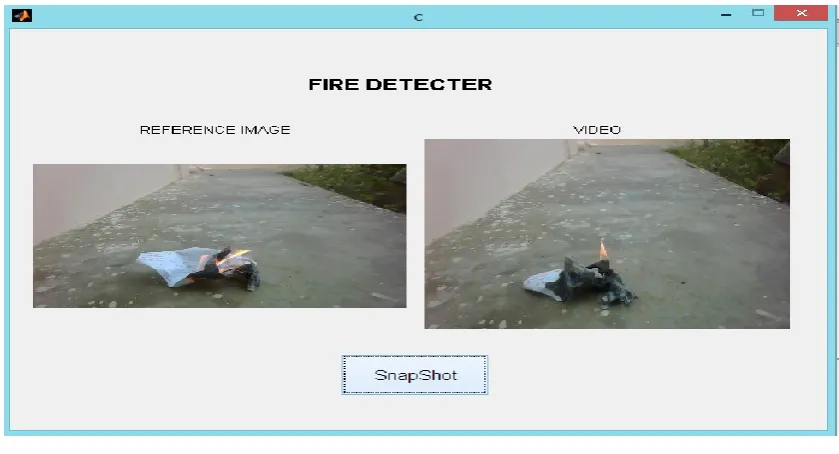
Figure5: Fire image
Figure 6: Result obtained after fire
Initially non fire image should be captured using camera. It would be act as a reference image. Camera should continuously focus the area.If any fire obtain in a particular area, the camera suddenly change the reference image otherwise there will be no change in it .thus it finally give result as a fired image or non fired image.
Bias b
Synaptic weights
W1
W2
Wm
∑
ɸ(-)
Xm X2 X1
Loc al Fiel
d V
Activatio n
function Outp
ut y Summin
g function Input
signal
.
.
.
International Journal of Research (IJR)
e-ISSN: 2348-6848, p- ISSN: 2348-795X Volume 2, Issue 06, June 2015Available at http://internationaljournalofresearch.org
Available online:http://internationaljournalofresearch.org/ P a g e | 321 6. CONCLUSION
The very interesting dynamics of flames have motivated the use of motion estimators to distinguish fire from other types of motion. Two novel optical flow estimators, OMT and NSD, have been presented to overcome insufficiencies of classical optical flow models when applied to fire content. The obtained motion fields provide useful space,which defines motion features. These features reliably detect fire and reject non-fire motion, as demonstrated on a large dataset of real videos. Little false detectionis observed in the presence of significant noise, partial occlusions, and rapid angle change. In an experiment using fire simulations, the discriminatory power of the selected features is demonstrated to separate fire motion from rigid motion. The controlled nature of this experiment allows for the quantitative evaluation of parameter changes. Key results are the need for a minimum.
7. REFERENCES
[1] G. du Bartas, La Sepmaineou Creation du Monde Paris.,1578 France: Michel Gadoulleauet Jean Febvrier,. [2] T. Çelik and H. Demirel,2009―Fire detection in video sequences using a genericcolor model,‖ Fire Safety J., vol. 44, no. 2, pp. 147–158
[3] P. Borges and E. Izquierdo.,May 2010 ―A probabilistic approach for vision-basedfire detection in videos,‖ IEEE Trans. Circuits Syst. Video Technol., vol. 20, no. 5,pp. 721–731.
[4] C. Ho.,2009 ―Machine vision-based real-time early flame and smoke detection,‖ Meas. Sci. Technol., vol. 20, no. 4, p. 045502.
[5] G. Marbach, M. Loepfe, and T. Brupbacher.,2006 ―An image processing
technique for fire detection in video images,‖ Fire Safety J., vol. 41, no. 4, pp. 285–289.
[6] C. Liu and N. Ahuja.,2004―Vision based fire detection,‖ in Proc. Int. Conf. Pattern Recognit., vol. 4, pp. 134–137.
[7] J. Zhao, Z. Zhang, S. Han, C. Qu, Z. Yuan, and D. Zhang.,2011―SVM based forestfire detection using static and dynamic features,‖ Comput. Sci. Inf.Syst., vol. 8, no.3, pp. 821–841.
[8] B. Toreyin, Y. Dedeoglu, U. Gudukbay, and A. Cetin.,2006 ―Computer vision based method for real-time fire and flame detection,‖ Pattern Recognit.Lett., vol.27, no. 1, pp. 49–58.
[9] B. Ko, K. Cheong, and J. Nam.,2009 ―Fire detection based on vision sensor and support vector machines,‖ Fire Safety J., vol. 44, no. 3, pp. 322–329.
[10] S. Verstockt, A. Vanoosthuyse, S. Van Hoecke, P. Lambert, and R. Van de Walle.,2010 ―Multi-sensor fire detection by fusing visual and nonvisual flame Features,‖ in Proc. 4th Int. Conf. Image Signal Process, pp. 333–341
[11] W. Phillips, III, M. Shah, and N. da Vitoria Lobo.,2002 ―Flame recognition in video,‖ Pattern Recognit.Lett., vol. 23, nos. 1–3, pp. 319–327.
[12] Y. Habibo˘glu, O. Günay, and A. Çetin.,2011―Covariance matrix-based fire and Flamedetection method in video,‖ Mach. Vis. Appl., vol. 23, no. 6, pp. 1–11.
[13] S. Fazekas and D.
Chetverikov.,2007 ―Analysis and
International Journal of Research (IJR)
e-ISSN: 2348-6848, p- ISSN: 2348-795X Volume 2, Issue 06, June 2015Available at http://internationaljournalofresearch.org
Available online:http://internationaljournalofresearch.org/ P a g e | 322
[14] D. Chetverikov and R.
Péteri.,2005―A brief survey of dynamic texture description and recognition,‖ in Proc. Int. Conf. Comput. Recognit. Syst.,pp. 17–26.
[15] S. Fazekas, T. Amiaz, D. Chetverikov, and N. Kiryati.,2009 ―Dynamic texture detection based on motion analysis,‖ Int. J. Comput.Vis., vol. 82, no. 1, pp. 48–63.
[16] D. Chetverikov, S. Fazekas, and M.
Haindl.,2011―Dynamic texture as
foreground Andbackground,‖ Mach. Vis. Appl., vol. 22, no. 5, pp. 741–750.
[17] Y. Chunyu, F. Jun, W. Jinjun, and Z. Yongming.,2010―Video fire smoke
detection using motion and color features,‖ Fire Technol., vol. 46, no. 3, pp. 651–663.
[18] B. Lucas and T. Kanade.,1981―An iterative image registration technique with anapplication to stereo vision,‖ in Proc. Int. Joint Conf. Artif. Intell., vol. 2,pp. 674–679.
[19] P. Saisan, G. Doretto, Y. Wu, and
S. Soatto.,2001―Dynamic texture
recognition,‖ In Proc. Conf. Comput. Vis. Pattern Recognit., vol. 2.pp. 58–63.