Analysis of Image Compression & Encryption Techniques
SALIGANTI UMAMAHESH,
Embedded System Trainer, Somarouthu Technologies, Hyderabad, Telangana, India
Abstract: The continuous growth of mobile,
desktop and wired and wireless digital
communication technologies has made the
extensive use of the images unavoidable.
The basic characteristics of image like
transmission rate, bandwidth, redundancy,
bulk capacity and co-relation among pixels
makes basic compression algorithms
mandatory. The research exploration in the
field of image compression is huge. In this
research paper we investigate the
performance evolution of basic compression
algorithms and encryption techniques on
image data. We are adopting RLE (Lossless)
compression and its modified version of
algorithm, named K-RLE (Lossy) and AES
(block cipher) for encryption. The basic and
proposed system architecture, design,
complexity, and performance could be
analyzed and compare using MATLAB &
VHDL Language, which is the quick tool to
estimate performance of the system.
Keywords: KRLE, image compression,
lossy, Lossless, AES Encryption Technique,
VHDL, MATLAB
1. INTRODUCTION
The rapid growth of multimedia and
networking technologies gives rise to
numerous multimedia applications such as
mobile, desktop, internet and video
surveillance, satellite communication and
webcams, consequently multimedia
transmission has become a challenge issue.
Due to the unique characteristics of real time
image data such as large data size, high
bandwidth and stringent real time
requirements. The researchers have been
forcing to use the proper image compression
algorithm to enhance the overall
performance (compression ratio, saving
percentage, compression time, entropy and
code efficiency) of the system should be
selected carefully for real time image
transmission. Image compression is
specialized discipline of electronic
attention on account of its applicability to
various fields. Image compression is art of
representing information in compact form
rather than it's original. Using the image
data compression method, the size of
particular image file can be reduced.
Compressed image transmission economizes
bandwidth, computation and
transmission--power, cost, and latency and therefore
ensures cost-effectiveness during
transmission. the application areas for such
compression today range from mobile, TV
and broadcasting of HD-TV up to very high
quality applications such as professional
digital video recording or digital cinema /
large screen digital imagery and so on this as
lead to enhanced interest in developing tools
an algorithms for very low bit rate image
coding and image quality [2].
1.1 IMAGE
An image is essentially a 2-D signal
processed by the human visual system. The
signals representing images are usually in
analog form. However, for processing,
storage and transmission by computer
applications, they are converted from analog
to digital form. A digital image is basically a
2- Dimensional array of pixels. Each pixel
has intensity value and location address.
Images form the significant part of data,
particularly in remote sensing, biomedical
and video conferencing applications.
1.2 IMAGE COMPRESSION
The purpose of compression is to
code the image data into a compact form,
minimizing both the number of bits in the
representation, and the distortion caused by
the compression .the importance of image
compression is emphasized by the huge
amount of data in raster images, a typical
gray-scale image of 512 x 512 pixels, each
represented by 8bits, contains 256 kilobytes
of data. With the color information, the
number of bytes is tripled. The video images
of 25 frames per second, even a one second
color film requires approximately 19
Megabytes of Memory. To handle and
process the above said data representation
definitely one has to think of how to
represent in terms of the encoded data the
method is called compression, obliviously
this technique becomes mandatory for any
kind of present day digital image data
processing
Till now many scientists, research
scholars, Engineers proposed many data
compression algorithms that compress
almost any kind of data, In that the best
know are the family of ZIV-Lempel
algorithms. If the method is lossless they
retain all the information of the compressed
data, they doesn't take advantage of the 2-D
nature of the image data. Only small portion
of the data space can be saved by a lossless
compression method. now a day's lossy
techniques are widely used in image
compression, because they produce high
compression ratio and saving ratio, of course
there may be image quality degradation
when reproduction of original image from
compressed image, however the image
quality could be improved by selecting the
appropriate compression technique /
algorithm based on the application
requirements In lossy compression, always
there would be tradeoff between the bit rate
and the image quality.
A common characteristic of most images is
that the neighboring pixels are correlated
and therefore contain redundant information.
Two fundamental components of
compression are redundancy and
irrelevancy. Redundancy reduction aims at
removing duplication from signal source.
Irrelevancy reduction omits parts of the
signal that will not be noticed by the signal
receiver. There are three types of
redundancies, they are spatial redundancy
means correlation among neighboring pixel
values, and coding redundancy is used when
less than optimal code words are used,
spectral redundancy means correlation
between color planes and temporal
redundancy means correlation between
adjacent frames. Image compression
techniques reduce the number of bits
required to represent an image by taking
advantage of these redundancies. An inverse
process called decompression is applied to
the compressed image data to get the
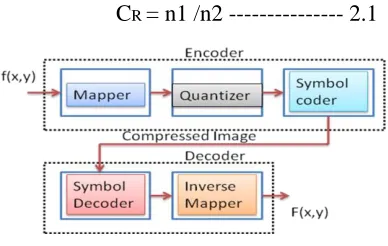
reconstructed image. The two main distinct
structural blocks of typical image processing
system are an encoder and a decoder as
shown in figure 1. Image f(x,y) is fed into
the encoder, which creates a set of symbols
form the input data and uses them to
represent the image. If we let n1 and n2
denote the number of information carrying
units( usually bits ) in the original and
encoded images respectively, the
quantified numerically via the compression
ratio.
CR = n1 /n2 --- 2.1
Figure 1
As shown in the figure 1, the encoder is
responsible for reducing the coding,
interpixel and psychovisual redundancies of
input image. In first stage, the mapper
transforms the input image into a format
designed to reduce interpixel redundancies.
The second stage, quantizer block reduces
the accuracy of mapper’s output in
accordance with a predefined criterion. In
third and final stage, a symbol decoder
creates a code for quantizer output and maps
the output in accordance with the code.
These blocks perform, in reverse order, the
inverse operations of the encoder’s symbol
coder and mapper block. As quantization is
irreversible, an inverse quantization is not
included in the figure 1.
The typical parameters, which are used to
measure performance of the lossy image
compression techniques / algorithms.
Compression Ratio is the ratio between the
size of the compressed file and the size of
the source file.
Compression Factor is the inverse of the
compression ratio. That is the ratio between
the size of the source file and the size of the
compressed file.
Saving Percentage calculates the shrinkage
of the source file as a percentage.
SP = (size before compression – size after
compression) / size before compression
Compression Time
Time taken for the compression and
decompression should be considered
separately. Some applications like
transferring compressed video data, the
decompression time is more important,
while some other applications both
compression and decompression time are
equally important. If the compression and
decompression times of an algorithm are
less or in an acceptable level it implies that
the algorithm is acceptable with respective
high speed computer accessories this factor
may give very small values and those may
depend on the performance of computers or
machines.
ENCRYPTION PROCESS:
The selective application of
technological and related procedural safe
guards is an important responsibility of
every Federal organization in providing
adequate security to its electronic data
systems. This project specifies a
cryptographic algorithm, the Advanced
Encryption Standard (AES) which may be
used by Federal organizations to protect
sensitive data. Protection of data during
transmission or while in storage may be
necessary to maintain the confidentiality and
integrity of the information represented by
the data.
Data encryption (cryptography) is utilized in
various applications and environments. The
specific utilization of encryption and the
implementation of the AES will be based on
many factors particular to the computer
system and its associated components. In
general, cryptography is used to protect data
while it is being communicated between two
points or while it is stored in a medium
vulnerable to physical theft. Communication
security provides protection to data by
enciphering it at the transmitting point and
deciphering it at the receiving point. File
security provides protection to data by
enciphering it when it is recorded on a
storage medium and deciphering it when it
is read back from the storage medium. In
this the key must be available at the
transmitter and receiver simultaneously
during communication.
In the existed design the
security method uses Asymmetric
Cryptography technique which provides
different keys to sender and receiver to
transfer the information. The transferred
information is stored in the memory unit for
further using it or for further processing
using EEPROM and RAM. An AMBA bus
is used to provide communication between
the connected devices. A microcontroller is
used to provide the patters for transmission
through crypto unit.
In the proposed design the
security method uses symmetric
Cryptography technique which provides
same keys to sender and receiver to transfer
the information for reducing the design
stored in the memory unit for further using it
or for further processing using low cost
buffer element. A transmission cable is used
to provide communication between the
connected devices. Control logic is used to
provide the patters for transmission through
crypto unit.
3.0 IMAGE COMPRESSION
TECHNIQUES
The image compression techniques
are broadly classified into two categories,
they are: Lossless techniques and Lossy
techniques. In our research work we
consider one lossy compression (K-RLE)
and one lossless compression algorithms
(RLE) on a standard Leena image data file
(512x512x8).we evaluate the performance
of these algorithms by calculating or
measuring the typical parameters discussed
in the above section.
3.1 LOSSLESS COMPRESSION
TECHNIQUE
In lossless compression techniques,
the original image/data can be perfectly
recovered from the compressed (encoded)
image/data. These are also called noiseless
since they do not add noise to the signal
(image).It is also known as entropy coding
since it use statistics or decomposition
techniques to eliminate or minimize
redundancy. Lossless compression is used
only for a few applications with stringent
requirements such as medical imaging and
sensor data processing, In our research
work we consider the basic lossless
compression technique named as Run
Length Encoding (RLE), earlier researchers
implemented the RLE compression
algorithm on low cost, low power tinny
embedded systems (based on 8bit/16bit
microcontrollers) using ALP and respective
EC programming for slowly varying sensor
data for wired and wireless sensor networks
(WSN) [4]. Even they evaluated the
performance of RLE on Reconfigurable
FPGA Architecture for above said
applications [5]. Probably no one analyzed
design exploration of image data
compression using RLE. In our research
work we analyze and evaluate the
performance of RLE compression algorithm
for image data applications based on
MATLAB EDA Tools
The Idea behind this algorithm is, If a
data item d occurs n consecutive times in
the input data we replace the n
occurrences with the single pair nd.
Run-Length Encoding (RLE) is a basic
compression algorithm. It is very useful
in case of repetitive and slowly varying
data items.
This is most useful basic compression
algorithm on data that contains many
such runs: for example, relatively simple
graphic images such as icons, line
drawings, and grayscale images.
Which is a lossless data compression
algorithm used for slowly varying sensor
and image data.
It is not useful with files that don't have
many runs as it could double the file
size.
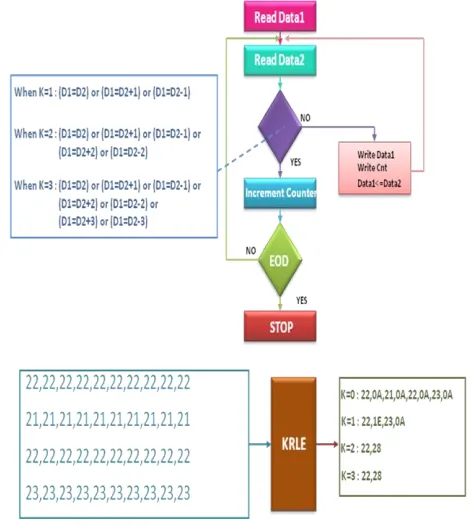
3.1.2 Flow Chart for Run Length
Encoding:
Figure 2
3.2 LOSSY COMPRESSION
TECHNIQUE
Lossy schemes provide much higher
compression ratios than lossless schemes.
Lossy schemes are widely used since the
quality of the reconstructed images is
adequate for most applications .By this
scheme, the decompressed image is not
identical to the original image, but
reasonably close to it.
3.2.1 Run Length Encoding with K -
Precision:
The idea behind this new proposed
algorithm is this: let K be a number, a data
item d or data between d+K and d-K occur n
replace the n occurrences with the single
pair nd. We introduce a parameter K which
is a precision.
If K = 0, K-RLE is RLE. K has the
same unit as the dataset values, in
this case degree.
K-RLE is a lossy compression
algorithm.
This algorithm is lossless at the user
level because it chooses K
considering that there is no
difference between the data item d,
d+K or d-K according to the
application.
3.2.2 Flow Chart for Run Length
Encoding with K - Precision:
Figure 3
REFERENCES:
[1] jayavrinda vrindavanam, saravanan chandran and gautam k.mahanti, 2012, A survey of image compression methods, IJCA.
[2] S.R Koditvwakku and u.s. amarasinghe , comprasion of lossless data compression algorithms for text data, IJCSE, vol 1 no 4 410 – 425.
[3] B.subramanyan, vivek.m.chhabria and T.G sankar babu, 2011, image encryption based on aes key expansion, IEEE
[5] Wail s.elkilani, hatem m.abdul – kadar, 2009, performance of encryption techniques for real time video streaming, IEEE
[6] K.Arshak, E.jafer, D.mcdonagh and c.s.ibala, 2007, modelling and simulation of wireless sensor system for health monitoring using HDL and simulink mixed enviroment, IET computer. digital tech vol 1. No 5, September.
PROFILE:
I, Saliganti Umamahesh completed my PG in the stream of VLSI & Embedded System. Currently working as embedded system trainer in Somarouthu Technologies,