International Journal of Pharmaceutical Sciences Review and Research Page 127
Seema Saini1, Samta1*, A. C. Rana1, and Sumit Gupta2
1
Rayat Institute of Pharmacy, Railmajra, Ropar - 144533, Punjab, India
2
Ranbaxy Laboratories Ltd, Gurgaon- 122001, Haryana, India.
*Corresponding author’s E-mail: [email protected]
Accepted on: 04-04-2011; Finalized on: 06-07-2011. ABSTRACT
This aim of the present study was to optimize the formulation of fast dissolving films made of pullulan polymer. The films formed from solvent casting method and subsequent evaporation of solvent resulted in pullulan forming a circular film. Pullulan was used as film forming agent due to excellent film forming property. PEG, propylene glycol, glycerine were used as plasticizers. Increasing pullulan concentration in formulation resulted in thick films as compared to lower concentration of same. Thickness of the film was controlled by adjusting the concentration of polymer. Higher concentration of polymer and plasticizer results in increase in-vitro disintegration time and in-vitro dissolution time of films. PEG forms white colored films i.e. translucent films. Films containing glycerin takes longer time to dry than films containing propylene glycol. Lower concentration of pullulan and propylene glycol showed optimum performances.
Keywords: Fast dissolving films, Pullulan, Solvent casting, PEG, Propylene glycol, Glycerine, In-vitro disintegration time, In-vitro
dissolution time.
INTRODUCTION
Recent developments in the technology have presented viable dosage alternatives from oral route for pediatrics, geriatric, bedridden, nauseous or noncompliant patients. Pharmaceutical companies and consumers alike have embraced OTFs as a practical and accepted alternative to traditional OTC medicine forms such as liquids, tablets, and capsules.1, 2
OTFs are typically the size of a postage stamp and disintegrate on a patient's tongue in a matter of seconds
for the rapid release of one or more APIs.3 The use of film-forming polymers in dissolvable films has
attracted considerable attention in medical and nutraceutical applications.4
In the recent study work has been reported for fast dissolve oral-films that employ pullulan polymer and various plasticizers. Optimization of concentration of polymer and plasticizer has been reported. Pullulan is a water soluble, neutral linear polysaccharide consisting of α–1, 6-linked maltotriose residues. It is a fungal exopolysaccharide produced from starch by Aureobasidium pullulans.5
MATERIALS AND METHODS
Materials
Pullulan (water soluble polymer) was obtained from Hayashibra Co., Ltd, Okayama, Japan. PEG 300 (plasticizer) was obtained from SD Fine Chem. Ltd, Mumbai. PEG 400 (plasticizer) was obtained from Thermo fisher scientific India Pvt. Ltd, Mumbai. Propylene glycol (plasticizer) was obtained from Merck Specialties Pvt Ltd, Ambernath. Purified water was used as a solvent. All ingredients were of analytical grade.
Methods
Film formation
Films were formed using solvent-casting method. Different concentration solutions of Pullulan polymer were prepared. And then required amount of plasticizer (PEG300, PEG400, Propylene glycol, glycerin) was added if required. Solutions were kept in sonicator to remove air bubbles. Then the solutions were transferred to Petri plates in duplicate in equal amounts. Petri plates were kept in oven at desired temperature to dry the films. When dried, the films were cut into strips of required size (2x3 cm) and evaluated for thickness, in-vitro disintegration time and in-vitro dissolution time.6
Thickness was measured using screw gauze. In-vitro disintegration time and in-vitro dissolution time of strips was determined visually in glass dish of 25ml distilled water with swirling every 10sec. Disintegration time is the time when the strip starts to break or disintegrates. Dissolution time is the time when the strip completely dissolves.7
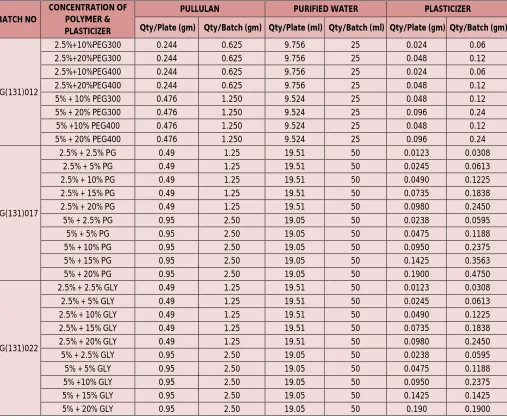
Table 1, 2 shows formulation of various batches of films SG(131)001,005,012,017,022. 5-25% w/w solution of pullulan forms flexible films.8 Plasticizers are used in concentration of 0-20% w/w of dry polymer weight.9, 10
RESULTS AND DISCUSSION
Films formed were transparent, clear, shiny, homogenous and smooth.
Typical strips or films will be between 10-50 mm wide, and 10-50 mm long and weigh 20-100 mg.11
Maximum dissolution time for fast dissolving films is 60sec and thickness 20-70µm.12
OPTIMIZATION OF FORMULATION OF FAST DISSOLVING FILMS MADE OF PULLULAN POLYMER
Films formed of pullulan and with plasticizer were transparent except formed with PEG as films formed were translucent i.e. white colored films. PEG reacts with pullulan forming white precipitates.
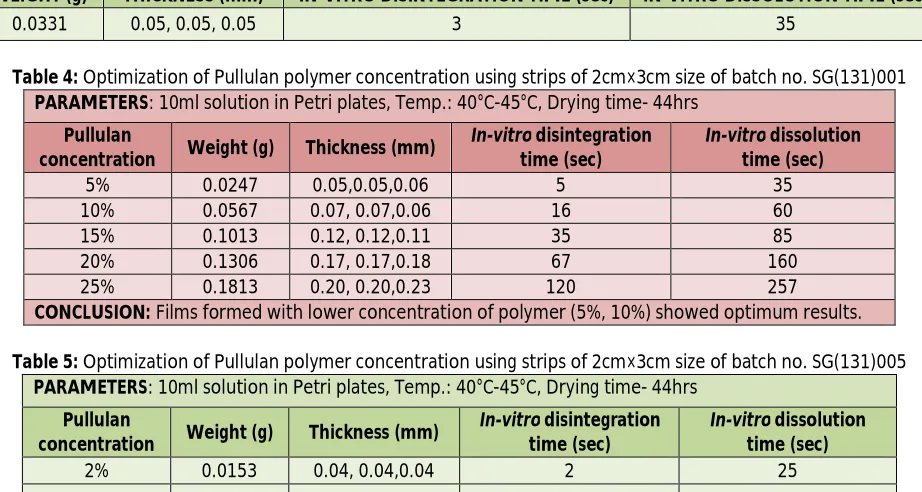
Table 3 shows the evaluation parameters of marketed strip Listerine.
Table 4, 5, 6, 7, 8 compares the evaluation parameters of various batches SG (131)001, 005,012,017,022.
Table 1: Formulation of films of batch no. SG (131)001, SG(131)005
BATCH NO. CONCENTRATION OF POLYMER
PULLULAN PURIFIED WATER
Qty/Plate (gm) Qty/Batch (gm) Qty/Plate (ml) Qty/Batch (ml)
SG(131)001
5% 0.480 2.500 9.520 50
10% 0.910 5.000 9.090 50
15% 1.300 7.500 8.700 50
20% 1.670 10.000 8.330 50
25% 2.000 12.500 8.000 50
SG(131)005
2% 0.196 0.500 9.804 25
2.5% 0.244 0.625 9.756 25
5% 0.476 1.250 9.524 25
7.5% 0.698 1.875 9.302 25
10% 0.909 2.500 9.091 25
Table 2: Formulation of films of batch no. SG (131)012, SG (131)017, SG(131)022
BATCH NO
CONCENTRATION OF POLYMER & PLASTICIZER
PULLULAN PURIFIED WATER PLASTICIZER
Qty/Plate (gm) Qty/Batch (gm) Qty/Plate (ml) Qty/Batch (ml) Qty/Plate (gm) Qty/Batch (gm)
SG(131)012
2.5%+10%PEG300 0.244 0.625 9.756 25 0.024 0.06
2.5%+20%PEG300 0.244 0.625 9.756 25 0.048 0.12
2.5%+10%PEG400 0.244 0.625 9.756 25 0.024 0.06
2.5%+20%PEG400 0.244 0.625 9.756 25 0.048 0.12
5% + 10% PEG300 0.476 1.250 9.524 25 0.048 0.12
5% + 20% PEG300 0.476 1.250 9.524 25 0.096 0.24
5% +10% PEG400 0.476 1.250 9.524 25 0.048 0.12
5% + 20% PEG400 0.476 1.250 9.524 25 0.096 0.24
SG(131)017
2.5% + 2.5% PG 0.49 1.25 19.51 50 0.0123 0.0308
2.5% + 5% PG 0.49 1.25 19.51 50 0.0245 0.0613
2.5% + 10% PG 0.49 1.25 19.51 50 0.0490 0.1225
2.5% + 15% PG 0.49 1.25 19.51 50 0.0735 0.1838
2.5% + 20% PG 0.49 1.25 19.51 50 0.0980 0.2450
5% + 2.5% PG 0.95 2.50 19.05 50 0.0238 0.0595
5% + 5% PG 0.95 2.50 19.05 50 0.0475 0.1188
5% + 10% PG 0.95 2.50 19.05 50 0.0950 0.2375
5% + 15% PG 0.95 2.50 19.05 50 0.1425 0.3563
5% + 20% PG 0.95 2.50 19.05 50 0.1900 0.4750
SG(131)022
2.5% + 2.5% GLY 0.49 1.25 19.51 50 0.0123 0.0308
2.5% + 5% GLY 0.49 1.25 19.51 50 0.0245 0.0613
2.5% + 10% GLY 0.49 1.25 19.51 50 0.0490 0.1225
2.5% + 15% GLY 0.49 1.25 19.51 50 0.0735 0.1838
2.5% + 20% GLY 0.49 1.25 19.51 50 0.0980 0.2450
5% + 2.5% GLY 0.95 2.50 19.05 50 0.0238 0.0595
5% + 5% GLY 0.95 2.50 19.05 50 0.0475 0.1188
5% +10% GLY 0.95 2.50 19.05 50 0.0950 0.2375
5% + 15% GLY 0.95 2.50 19.05 50 0.1425 0.1425
International Journal of Pharmaceutical Sciences Review and Research Page 129 Table 3: Evaluation parameters of marketed strips (LISTERINE)
WEIGHT (g) THICKNESS (mm) IN-VITRO DISINTEGRATION TIME (sec) IN-VITRO DISSOLUTION TIME (sec)
0.0331 0.05, 0.05, 0.05 3 35
Table 4: Optimization of Pullulan polymer concentration using strips of 2cm×3cm size of batch no. SG(131)001 PARAMETERS: 10ml solution in Petri plates, Temp.: 40°C-45°C, Drying time- 44hrs
Pullulan
concentration Weight (g) Thickness (mm)
In-vitro disintegration
time (sec)
In-vitro dissolution
time (sec)
5% 0.0247 0.05,0.05,0.06 5 35
10% 0.0567 0.07, 0.07,0.06 16 60
15% 0.1013 0.12, 0.12,0.11 35 85
20% 0.1306 0.17, 0.17,0.18 67 160
25% 0.1813 0.20, 0.20,0.23 120 257
CONCLUSION: Films formed with lower concentration of polymer (5%, 10%) showed optimum results.
Table 5: Optimization of Pullulan polymer concentration using strips of 2cm×3cm size of batch no. SG(131)005 PARAMETERS: 10ml solution in Petri plates, Temp.: 40°C-45°C, Drying time- 44hrs
Pullulan
concentration Weight (g) Thickness (mm)
In-vitro disintegration
time (sec)
In-vitro dissolution
time (sec)
2% 0.0153 0.04, 0.04,0.04 2 25
2.5% 0.0262 0.05, 0.05,0.04 3 30
5% 0.0330 0.06, 0.06,0.05 5 38
7.5% 0.0420 0.07, 0.07,0.08 7 42
10% 0.0550 0.07, 0.08,0.08 11 60
CONCLUSION: Films formed with lower concentration of polymer (5%, 10%) showed optimum results.
Table 6: Optimization of plasticizer (PEG) concentration using strips of 2cm×3cm size of batch no. SG(131)012 PARAMETERS: 10ml solution in Petri plates, Temp.: 50°C-55°C, Drying time- 30hrs
Pullulan & plasticizer
concentration Weight (g) Thickness (mm)
In-vitro disintegration
time (sec)
In-vitro dissolution
time (sec)
2.5% + 10% PEG300 0.0259 0.05,0.05,0.06 4 18
2.5% + 20% PEG300 0.0309 0.06,0.07,0.08 5 29
2.5% + 10% PEG400 0.0262 0.06, 0.04,0.05 4 19
2.5% + 20% PEG400 0.0335 0.07, 0.08,0.10 6 33
5% + 10% PEG300 0.0488 0.07, 0.07, 0.08 6 30
5% + 20% PEG300 0.0881 0.11, 0.11, 0.11 20 120
5% + 10% PEG400 0.0516 0.07, 0.08, 0.09 21 140
5% + 20% PEG400 0.1002 0.12, 0.11, 0.11 25 160
CONCLUSION: Films formed were translucent i.e. white colored films.
Table 7: Optimization of plasticizer (PEG) concentration using strips of 2cm×3cm size of batch no. SG(131)017 PARAMETERS: 20ml solution in Petri plates, Temp.: 50°C-55°C, Drying time- 35hrs
Pullulan & plasticizer
concentration Weight (g) Thickness (mm)
In-vitro disintegration
time (sec)
In-vitro dissolution
time (sec)
2.5% + 2.5% PG 0.0253 0.04, 0.04,0.04 3 28
2.5% + 5% PG 0.0301 0.06, 0.05,0.05 4 36
2.5% + 10% PG 0.0380 0.05, 0.06,0.06 5 45
2.5% + 15% PG 0.0406 0.06, 0.05,0.07 6 59
2.5% + 20% PG 0.0437 0.07, 0.08,0.07 8 65
5% + 2.5% PG 0.0600 0.08, 0.09,0.10 10 65
5% + 5% PG 0.0653 0.08, 0.11,0.10 12 70
5% + 10% PG 0.0880 0.11, 0.12,0.11 16 80
5% + 15% PG 0.1109 0.13, 0.12,0.11 18 92
5% + 20% PG 0.1334 0.14, 0.12,0.13 21 100
Table 8: Optimization of plasticizer (PEG) concentration using strips of 2cm×3cm size of batch no. SG(131)017 PARAMETERS: 20ml solution in Petri plates, Temp.: 50°C-55°C, Drying time- 38hrs
Pullulan & plasticizer
concentration Weight (g) Thickness (mm)
In-vitro disintegration
time (sec)
In-vitro dissolution
time (sec)
2.5% + 2.5% GLY 0.0302 0.06, 0.07,0.09 4 36
2.5% + 5% GLY 0.0453 0.05, 0.06,0.07 4 38
2.5% + 10% GLY 0.0490 0.08, 0.07,0.07 8 55
2.5% + 15% GLY 0.0570 0.08, 0.07,0.06 9 65
2.5% + 20% GLY 0.0600 0.06, 0.08,0.12 10 70
5% + 2.5% GLY 0.0585 0.08, 0.08,0.08 10 60
5% + 5% GLY 0.0623 0.09, 0.08,0.08 10 65
5% +10% GLY 0.0700 0.09, 0.10,0.10 13 80
5% + 15% GLY 0.0780 0.11, 0.11,0.10 15 110
5% + 20% GLY 0.0888 0.12, 0.13,0.12 15 124
International Journal of Pharmaceutical Sciences Review and Research Page 131 Weight
By increasing the concentration of pullulan, the weight of strips also increases. Lower concentration is optimum for films. Thickness
Oral strips should be thin so that they easily dissolve in mouth. It is clear from tables as concentration of polymer increases thickness of films also increases. So lower concentration of polymer was selected for further experiments with plasticizer.
In-vitro Disintegration Time and In-vitro Dissolution
Time
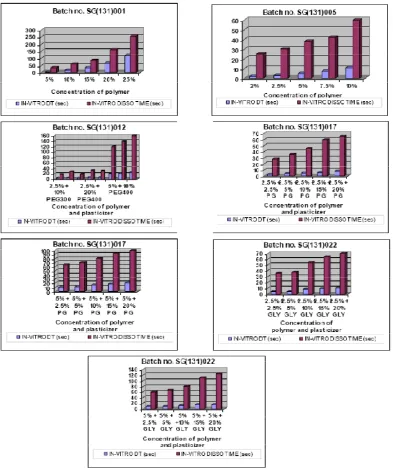
Figure 1 graphically represents the in-vitro disintegration and dissolution time of all batches. Higher concentration of polymer and plasticizer results in increase in in-vitro disintegration and dissolution time. Lower concentration of polymer and plasticizer was selected for the formulation of fast dissolving films.
CONCLUSION
The study illustrated that concentration of polymer and plasticizer had a significant effect on formulation of oral strips. Optimization of formulation promoted to determine the influence of concentration of polymer and plasticizer. Circular films were obtained by increasing the amount of solution in Petri plates i.e. 10 ml to 20 ml. Increasing pullulan concentration resulted in formation of thick films as compared to lower one. Lower concentration of polymer and plasticizer showed optimum performances. Propylene glycol shows best results as compared to other plasticizers.
REFERENCES
1. Malke M., Shidhaye S., Kadam V.J., Formulation and evaluation of Oxacarbazine fast dissolve tablets, Ind J Pharm Sci., 69, 2007, 211-214.
2. Frey, Film Strips and Pharmaceuticals, Pharma Mfg & Packag Sourcer, 2006, 92–93.
3. Vondrak B., Barnhart, Scott, Dissolvable Films:
Dissolvable Films for Flex Product Format in Drug Delivery, Pharma tech, 2008, 1-5.
4. Corniello C., Quick-Dissolve Strips: From Concept to Commercialization, Drug Deliv. Tech., 6(2), 2006, 68-71.
5. Leduy A., Zajic J.E., Luong J.H.T., Pullulan In: Encyclopedia of Polymer Science and Engineering, 2nd Edition, Edited by H.F. Mark et al., Wiley & Sons, NewYork, 1988, 650.
6. Arya Arun, Chandra Amrish, Sharma Vijay, Pathak Kamla, Fast Dissolving Oral Films: An Innovative Drug Delivery System and Dosage Form, Int. J. Chem. Tech Res., 2(1), 2010, 576-583.
7. Chien M.J., Tirol G., Chien C., Schmitt R., Film forming polymers in Fast-Dissolve oral films, Poster presented at the 2006 Annual Meeting and Exposition of the American Association of Pharmaceutical Scientist, Oct. 29–Nov. 2, 2006, 1-5.
8. Dixit R.P., Puthli S.P., Oral strip technology: overview and future potential, Journal of Controlled Release, 139, 2009, 94-107.
9. Price J.C., Polyethylene glycol In: Rowe R.C., Sheskey P.J., Owen S.C. (Eds.) Handbook of Pharmaceutical Excipients, Pharmaceutical press, London, 2006, 545–550.
10. Owen S.C., Weller P.J., Propylene glycol In: Rowe R.C., Sheskey P.J., Owen S.C. (Eds.) Handbook of Pharmaceutical Excipients, Pharmaceutical press, London, 2006, 624-626.
11. Donald K., Joseph C., Tom K., Rapidly dissolving edible strips for treating obesity, US 2004/0180077 AI, Sept 16, 2004.
12. Verena Garsuch. Preparation and characterization of fast-dissolving oral films for pediatric use [dissertation]. Düsseldorf, Heinrich-Heine University, 2009, 13.