1225 | P a g e
Adapted A* Algorithm for the Shortest Path Problem
with Position-Based Learning Effects
Mr. N.Mahendra
1,
Mrs. Chokkakula Devi
21,2
Assistant Professor,
Dept.of CSE, WISTM, Pendurthy, Visakhapatnam,A.P (India)
ABSTRACT
The shortest path problems (SPPs) with learning effects (SPLEs) have numerous potential and intriguing
applications. In any case, in the meantime they are exceptionally unpredictable and have not been contemplated
much in the writing. In this pape0072, we demonstrate that learning impacts make SPLEs totally not quite the
same as SPPs. An adjusted A* (AA*) is proposed for the SPLE issue under examination. In spite of the fact that
worldwide optimality infers neighborhood optimality in SPPs, it isn't the situation for SPLEs. . As all sub paths
of potential most brief arrangement ways should be put away amid the pursuit procedure, a search graph is
embraced by AA* instead of a search tree utilized by A. Monotonicity and consistency of the heuristic elements
of AA* are re-imagined and the relating properties are analyzed . Consistency and monotonicity connections
between the heuristic elements of AA* and those of A* are investigated Their effects on proficiency of looking
systems are hypothetically investigated and tentatively assessed.
Key Words: A* Search, Optimality, Learning Effect, Shortest Path.
I.
INTRODUCTION
1226 | P a g e
The shortest path problem is the problem of finding a path between two veracities or nodes in a graph such that sum of weights of its constituent edges are minimized. Shortest path problems (SPPs) are widespread in practical applications (e.g., logistics, transportation, robot path planning[4,5], vehicle routing[6], no-wait flow shop scheduling[7], etc.). SPP consists of finding the shortest path from the source node to the sink node in a graph. Generally, the distance, time or price of traversing of each arc is called cost. There are a large number of paths in the graph.
The shortest path is the one with the minimum total cost. Traditionally, costs of all arcs are assumed to be known in advance and the SPP is called static SPP (SSPP)[6]. However, there area lot of dynamic SPP (DSPP) in practical systems in which the cost of each arc changes according to some factors (e.g., traffic status and learning experiences). Though there are a lot of studies on DSPPs (especially in traffic systems), the DSPP problem with learning experiences or effects (SPLEs) has not been considered yet. In practice, costs of arcs in a path usually change with learning experience or “learning effect”[8]. Learning effect was first observed by
Wright[9]. Nowadays, there are a lot of topics associating with learning effects. The SPPs in robot soccer matches (robot space exploration, robot rescue in hostile environments, etc.) are typical DSPP problems with learning experiences in which robots obtain learning experiences through interaction with environments using reinforcement learning. More experiences imply shorter possible paths robots can find. In logistic systems, there are a lot of items to be sent to different distribution centers. Finding optimal paths for all items is a typical SPP problem. Workers become more and more experienced after they do the pick-up and drop-down operations many times, which reduces the costs (times for transporting items) as a result of the learning effects. The no-wait flow shop scheduling problem is another typical example. The processing time of a job becomes shorter if it is scheduled later in a sequence because the worker is more and more proficient in the setup, cleaning, operation, control, or maintenance of the machines. The shortest path problem is a problem of finding the shortest path or route from a starting point to a final destination. Generally, in order to represent the shortest path problem we use graphs. A graph is a mathematical abstract object, which contains sets of vertices and edges. Edges connect pairs of vertices. Along the edges of a graph it is possible to walk by moving from one vertex to other vertices. Depending on whether or not one can walk along the edges by both sides or by only one side determines if the graph is a directed graph or an undirected graph. In addition, lengths of edges are often called weights, and the weights are normally used for calculating the shortest path from one point to another point. In the real world it is possible to apply the graph theory to different types of scenarios. Experience-based learning describes processing times by “S”-shaped functions which includes three phases namely Inception
stage, Learning stage and development stage. The cost on each arc in the SPLE changes with its position in the path.
II.
METHODOLOGY
1227 | P a g e
to the time performance of A*. The A* algorithm usually outperforms other traditional exact algorithms for SPPs [12]. Recently, many variants of A* have been presented for SSPPs, such as new approach to multiobjective (NAMOA*) [13], explicit estimation search [14], and short-sighted probabilistic planner [15]. Though there are many A* algorithms for DSPPs, most of them are for irregular ones (i.e., arc costs change stochastically). The one-to-all DSPP (finding the shortest paths between a start node to all the other nodes in a graph) for a given departure time can be transformed into an SSPP [16]. Adapted A* algorithm is used to find the shortest path from the start node to some other node but also some other subpaths need to be put in the list of solution paths to be explored. AA* for the SPLE is a best-first heuristic search algorithm.
AA* starts the search process with the start node n0. Initially,n0 is set as the only node in the search graph SG
and the sub path tuple (n0, g, fl(n0, 0)) is introduced into the list OPEN.
In every iteration, AA* selects the path P with the smallest fl (randomly select one to break ties if there are any),
which is determined by gl +hl. Each successor of P is expanded by deleting P from OPEN and moving the corresponding g from Gop to Gcl. At the same time, a backward pointer is established from each successor to the last node of P in order to show the optimal path in the final search graph.
Three operations are carried out.
PRUNE is performed if there are dominations FILTER is performed if there are some bad path(s)
Otherwise, ENTER is performed by inserting the tuples of Otherwise, ENTER is performed by inserting the tuples of P` into both Gop(ni) and OPEN. The process isrepeated until OPEN is empty, i.e., no path can be
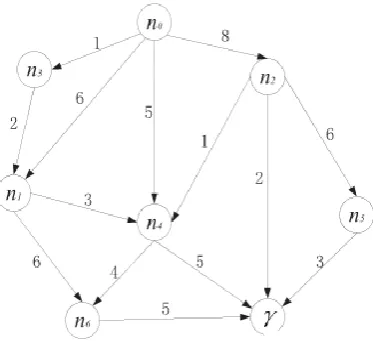
expanded. The shortest paths from the start node to thegoal nodes are constructed by backtracking from SG. AA* algorithm, a labeled directed graph is shown in the figure 1, where n0 is the start node and γ is the only goal
node. The graph contains 8 nodes and 14 arcs. Because no cycle is included on the path from the start node n0 to Ѓ , there are at most ρ = min{8 − 1, 14}= 7 arcs. The learning effect factor α takes a value of −0.2. C is initialized as +∞. c(n,γ) is the cost of arc (n,γ) if it exists in G, otherwise it is +∞. In the graph G without
learning effects, the heuristic value h is defined as
In the graph G with learning effects, the heuristic value hl(n) = ρα ×h is used to evaluate the value of . hl is
1228 | P a g e
Fig.1 Figure showing the sample Graph
Table 1. Table showing the Heuristic Function
n
n
0n
1n
2n
3n
4n
5n
6γ
h(n)
3
5
2
4
5
3
5
0
h
l(n)
2.033
3.338
1.335
2.710
3.388
2.033
3.388
0
AA* is applied to the example[18], and show the operations PRUNE, FILTER, and the updating operations on Gop and Gcl sets and on OPEN.
AA* records the nondominated sub paths in the search graph. While similar to NAMOA* [17], there are several differences between them.
1.AA* is for a single objective while NAMOA* is for multiple objectives, i.e., AA* returns the shortest solution paths while NAMOA* gives the optimal Pareto solution set.
2.Along one optimal solution path, all the elements of g increase simultaneously in NAMOA* whereas it is not the case in AA*.
3.NAMOA* considers the static SPPs but AA* deals with the regular dynamic shortest path version.
III.
RESULTS AND DISCUSSIONS
1229 | P a g e
is that the longest path has s1 × s2 nodes. The algorithm is implemented using the Linux OS and java and the results are shown in the diagrams from 2 to 6.
Fig.2. Figure showing the start of a local host Fig.3. Graph showing the Packet delivery
ratio
Fig.4. Figure showing the initial nodes Fig.5. showing the Initializing path between nodes
1230 | P a g e
IV.
CONCLUSION
In this paper, we have considered the SPLE, of which each arc cost changes dynamically. The cost of an arc in a path is determined by a function of the arc’s position in the path because of the learning effects. The shortest
sub paths in SPLE have been demonstrated to be unnecessary sub paths of the final shortest path, which is different from the case in SPP without learning effects. The AA* method has been proposed for SPLE problems. A search graph rather than a search tree is adopted to store candidates because there would be more than one candidate sub path for the final shortest path.
With two assumptions, AA* has been proven to be admissible. The efficiency of AA* is influenced by the heuristic function with consistency and monotonicity properties which are similar to the consistent or monotone properties in the A*. Though it is difficult to analyze the consistency of a heuristic function directly, it can be done by judging the consistency of heuristic functions for graphs without learning effects. A closer to (less than) admissible and consistent heuristic function’s real value implies less paths to be expanded. Experimental
results illustrate that AA* algorithms are far faster than the backtracking method. Though computation times of AA* algorithms increase fast with the size of the problems, the increase in cpu times are far less than those of enumerative search methods. In addition, a tighter heuristic function with monotonicity and consistency with respect to the real cheapest cost results in faster AA* algorithms. For the future, SPLE problems with experience-based or sum-of-processing-time-based learning effects are promising topics.
REFERENCES
[1.] Abramson, N. and Kuo, F.F. Computer-Communication Networks. Prentice-Hall, Englewood Cliffs, N.J., 1975.
[2.] Baran, P. On distributed communications. Rand Corp. Memo RM-3420-PR, Aug. 1964
[3.] Rustin, R. (Ed.) Computer Networks (Proc. Courant Computer Sci. Symp. 3, December 1970), Prentice-Hall, Englewood Cliffs, N.J., 1970.
[4.] N. Mathew, S. L. Smith, and S. L. Waslander, “Planning paths for package delivery in heterogeneous multirobot teams,” IEEE Trans. Autom.Sci. Eng., vol. 12, no. 4, pp. 1298–1308, Oct. 2015.
[5.] P. Brass, I. Vigan, and N. Xu, “Shortest path planning for a tethered robot,” Comput. Geometry, vol. 48, no. 9, pp. 732–742, 2015.
[6.] M. Gendreau, G. Ghiani, and E. Guerriero, “Time-dependent routing problems: A review,” Comput. Oper. Res., vol. 64, pp. 189–197,Dec. 2015.
[7.] P. J. Kalczynski and J. Kamburowski, “On no-wait and no-idle flow shops with makespan criterion,” Eur. J. Oper. Res., vol. 178, no. 3, pp. 677–685, 2007.
[8.] D. Biskup, “Single-machine scheduling with learning considerations,”Eur. J. Oper. Res., vol. 115, no. 1, pp. 173–178, 1999.
1231 | P a g e
[10.]P. E. Hart, N. J. Nilsson, and B. Raphael, “A formal basis for the heuristic determination of minimum cost paths,” IEEE Trans. Syst. Sci. Cybern., vol. 4, no. 2, pp. 100–107, Jul. 1968.
[11.]E. W. Dijkstra, “A note on two problems in connexion with graphs,” Numerische Mathematik, vol. 1, no. 1, pp. 269–271, 1959.
[12.]I. Chabini and S. Lan, “Adaptations of the A* algorithm for the computation of fastest paths in
deterministic discrete-time dynamic networks,” IEEE Trans. Intell. Transp. Syst., vol. 3, no. 1, pp. 60–74, Mar. 2002.
[13.]L. Mandow and J.-L. P. de la Cruz, “Multiobjective A* search with consistent heuristics,” J. ACM, vol. 57, no. 5, 2010, Art. no. 27.
[14.]J. T. Thayer and W. Ruml, “Bounded suboptimal search: A direct approach using inadmissible estimates,” in Proc. 22nd Int. Joint Conf. Artif. Intell. (IJCAI), Barcelona, Spain, 2011, pp. 674–679.
[15.] F. W. Trevizan and M. M. Veloso, “Depth-based short-sighted stochastic shortest path problems,” Artif. Intell., vol. 216, pp. 179–205, Nov. 2014.
[16.] S. E. Dreyfus, “An appraisal of some shortest-path algorithms,” Oper Res., vol. 17, no. 3, pp. 395–412, 1969.
[17.]L. Mandow and J.-L. P. de la Cruz, “Multiobjective A* search with consistent heuristics,” J. ACM, vol. 57, no. 5, 2010, Art. no. 27.
[18.]Yamin Wang, Xiaoping Li, and Rubén Ruiz, “An Exact Algorithm for the Shortest Path Problem With Position-Based Learning Effects” ,IEEE TRANSACTIONS ON SYSTEMS, MAN, AND