1114 | P a g e
A Comprehensive Evaluation of Used Foundry Sand in
Concrete Applications
Salim.P.M
1, Dr.Seshadri Sekhar.T
2, Dr.B.S.R.K.Prasad
31
Research Scholar, Civil Engineering Department, GITAM University, Hyderabad (India)
2
Professor and Dean, NICMAR, Hyderabad (India)
3
HOD, Civil Engineering Department, GITAM University, Hyderabad (India)
ABSTRACT
The management of solid industrial waste is of big global concern nowadays. The majority of the industries are
not interested in the treatment and safe disposal of the industrial waste due to its high cost involvements to
reduce the toxic and other chemical contents to a safer level before dumping over to land. In this context the
disposal of waste foundry sand is of prime importance due to the big volume produced from the foundries all
over the world. Foundry sand which is basically high quality silica sand is disposed of after the initial use for
least benefitted land filling usage causing environmental and other ecological impacts. For infra structure
developments there needs buildings, bridges,roads and other structures and concrete plays a vital role in these
civil construction activities.The mother earth is over exploited for the procurement of construction materials for
development works.It is high time to think of alternative materials particularly from the industrial waste
products for construction activities for preserving the natural resources to the future generations too. It was
inferred that about 20 to 30 percent of replacementof fine aggregate to used foundry sand gave good results in
most of the applications. Thus used foundry sand can be economically utilized as a partial or full replacement to
fine aggregates for concrete or mortar making and thereby reducing the usage of fresh fine aggregates and to
minimize the exploitation of natural resources to a minimum balanced state with reduced ecological impact.
Keywords:
Used foundry sand, masonry blocks, workability, compressive strength, water permeability
I.
INTRODUCTION
The management of solid industrial waste is of big global concern nowadays. The majority of the industries are
not interested in the treatment and safe disposal of the industrial waste due to its high cost involvements to
reduce the toxic and other chemical contents to a safer level before dumping over to land. In this context the
disposal of used foundry sand is of prime importance due to the big volume produced from the foundries all
over the world. The availability of natural sand is diminishing day by day and manufactured sand are widely
used for all construction related applications which involves the exploitation of natural rock deposits to an
uncontrolled manner. Here used foundry sand can be effectively utilized as a partial or full replacement of
natural sand or manufactured sand. Used foundry sand is a byproduct of the metal casting industries generated
1115 | P a g e
Depending upon the type of binders used waste foundry sand or used foundry sand can be classified into greensand and chemically bonded sand. In green sand the binder used is bentonite whereas in chemically bonded sand
it is mainly of organic system. Due to the chemicals present in the binder the used foundry sand the disposal of
used foundry sand in for land filling may cause adverse environmental and ecological impacts. So the used
foundry sand should be used for other beneficial applications to reduce its adverse effects.
Foundry industry is declared as a “Red Category Industry” for discharging hazardous substance in the
environment. But due to high treatment cost, foundry industries are not much interested to invest on safe
disposal of used sand. As per the present disposal practices used foundry sand which is dumped on baron land
can not be recovered.The used foundry sand can be efficiently utilized in the production of concrete thereby
eliminating the environmental problems associated with it. The other adavantage of using used foundry sand in
making concrete is of saving of natural resources like river sand which is in threat of depletion as well as the
natural rock deposits for the production of manufactured sand to a considerable extent and thereby saving the
total construction cost. In this study the usage of used foundry sand for different applications in cement concrete
for various purposes is elaborated.
II.
USED FOUNDRY SAND FOR APPLICATIONS IN CEMENT CONCRETE
Used foundry sand can be effectively utilised in the production of concretes of different grades and
characteristics. A number of researches were conducted on concretes with different grades with different
proportions of used foundry sand. Some significant research excerpts are described below.
A. Low Strength Concrete
Several research findings were published on low strength concrete with partial replacement of fine aggregates
with used foundry sand. C. G. Konapure and D. J. Ghanate conducted experiment on the effect of industrial
waste foundry sand as fine aggregate on M 20 and M 30 grades concrete[1]. The resuls showed that the
compressive strength ,flexural strength and split tensile strength increases up to 20% replacement and decreases
when the percentage replacement increases further.
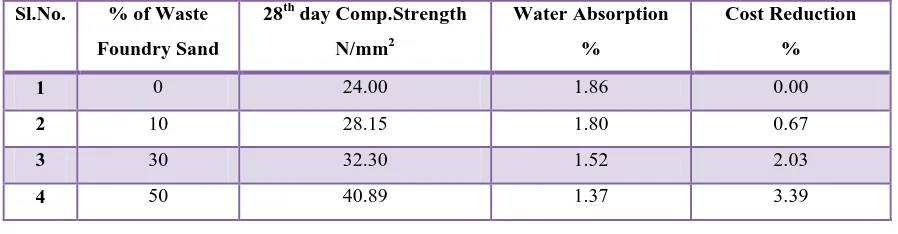
Dushyant.R.Bhimani et al. conducted studies on M-20 grade concrete with partial replacement of fine aggregate
with used foundry sand[2].They found that compressive strength increases with percentage increase in used
found. The water absorption in this case is decreasing with the increase in percentages of used foundry sand. A
comparative data is shown in Table.1.
Table 1.Comparative Data for M-20 Concrete with Used Foundry Sand
Sl.No. % of Waste
Foundry Sand
28th day Comp.Strength
N/mm2
Water Absorption
%
Cost Reduction
%
1 0 24.00 1.86 0.00
2 10 28.15 1.80 0.67
3 30 32.30 1.52 2.03
1116 | P a g e
Source:Dushyant.R.Bhimani et al.(2013)B. Medium Strength Concrete
Used foundry sand can be further utilised for making medium strength concrete. Several researches were
conducted in this respect also.Sohail M., Abdul Wahab and Arfath Khan M. conducted study on the mechanical
properties of concrete by replacing sand with waste foundry sand [3]. In this investigation they have described
M-30 concrete with different percentages of waste foundry sand. Further they concluded that up to 70% addition
of waste foundry sand can give sufficient strength properties.
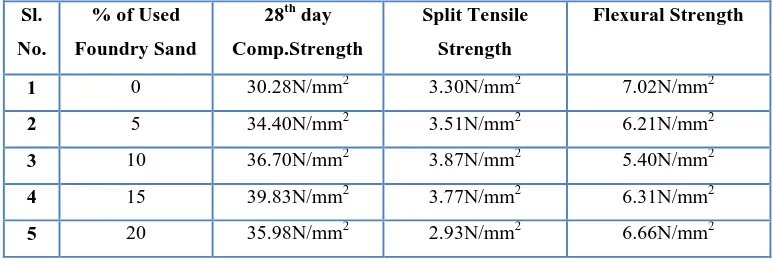
Ravindra N. Patil, Praveen. R. Mehetre and Kailash T. Phalak investigated cement concrete properties
incorporating waste foundry sand [4]. In this research they have elaborated the properties of M-30 concrete
incorporating waste foundry sand in different proportions. The results showed that compressive strength of
concrete increases with increase in percentage of waste foundry sand as compare to normal concrete. It was
maximum for 15 % replacement. Split tensile strength increases with increase in percentage of waste foundry
sand up to 10 % replacement after that it decreases. Flexural strength was decreased with increase in percentage
of used foundry sand. A comparative data of mechanical properties is shown in Table 2.
Table 2. Comparative Data for M-30 Concrete with Used Foundry Sand.
Sl.
No.
% of Used
Foundry Sand
28th day
Comp.Strength
Split Tensile
Strength
Flexural Strength
1 0 30.28N/mm2 3.30N/mm2 7.02N/mm2
2 5 34.40N/mm2 3.51N/mm2 6.21N/mm2
3 10 36.70N/mm2 3.87N/mm2 5.40N/mm2
4 15 39.83N/mm2 3.77N/mm2 6.31N/mm2
5 20 35.98N/mm2 2.93N/mm2 6.66N/mm2
Source: Ravindra N. Patil et al.(2015)
C. High Strength Concrete
High strength concrete can also be prepared with the used foundry sand in partial replacement of fine aggregate.
Notable researches were conducted on this area also.Vijayakumar.Y.M and Thejas.H.K conducted study on
strength characteristics of normal strength concrete and high strength concrete using used foundry sand as a
replacement for fine aggregate [5]. From the study it is inferred that workability of concrete with used foundry
sand decreases with increase in percentage of used foundry sand. Compressive strength and split tensile strength
increases up to a certain percentage adoption of used foundry sand and then tends to decrease with further
1117 | P a g e
Table 3. Comparative Data for M-60 Concrete with Used Foundry SandSl.
No.
% of Waste
Foundry Sand
Slump 28th day
Comp.Strength
SplitTensile
Strength
1 0 22 mm 70.74 N/mm2 4.74 N/mm2
2 10 18mm 69.76 N/mm2 4.27 N/mm2
3 20 20 mm 69.26 N/mm2 4.91N/mm2
4 30 16 mm 69.94 N/mm2 3.90 N/mm2
5 40 16 mm 68.70 N/mm2 4.64 N/mm2
6 50 10 mm 68.00 N/mm2 3.57 N/mm2
Source: Vijayakumar.Y.M et al.(2015)
D. High Performance Concrete
High-performance concrete is concrete having desired properties and uniformity that cannot be obtained
routinely using only traditional constituents and normal mixing, placing, and curing practices .These concretes
have very good workability, high early strength and good mechanical properties.In high performance concrete
also the used foundry sand in partial replacement of fine aggregate can be utilized. Several researches were
conducted on this area also.Seshadri Sekhar.T and Salim P.M.conducted experimental study on high
performance concrete with partial replacement of fine aggregate with used foundry sand [6]. It is found that up
to 30% of fine aggregate can be replaced with used foundry sand for the manufacture of high performance
concrete.
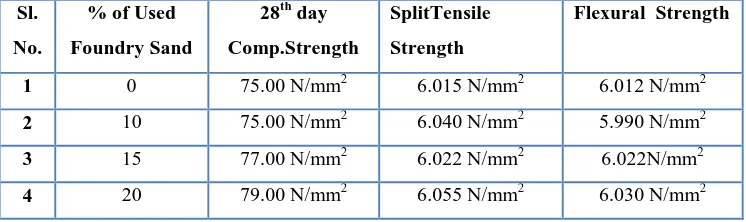
M.Ranjitham, B.Piranesh and A.Vennila also conducted Experimental Investigation on High Performance
Concrete with Partial Replacement of fine aggregate by Foundry Sand with cement by Mineral
Admixtures[7].From the test results it is inferred that Foundry sand substitution generally results in favourable
outcomes and is highly recommended for all HPC mixes. The results from this research are shown in Table 4.
Table 4. Comparative Data for High Performance Concrete with Used Foundry Sand
Sl.
No.
% of Used
Foundry Sand
28th day
Comp.Strength
SplitTensile
Strength
Flexural Strength
1 0 75.00 N/mm2 6.015 N/mm2 6.012 N/mm2
2 10 75.00 N/mm2 6.040 N/mm2 5.990 N/mm2
3 15 77.00 N/mm2 6.022 N/mm2 6.022N/mm2
4 20 79.00 N/mm2 6.055 N/mm2 6.030 N/mm2
1118 | P a g e
III. USED FOUNDRY SAND FOR APPLICATIONS IN GEO POLYMER CONCRETE
Used foundry sand can be utilized in the production of geo polymer concrete also. Researches in this field are
promising ones for the production of eco friendly concretes. Many research findings are available regarding the
usage of used foundry sand in the manufacture of geo polymer concretes. Thaarrini Janardhanan and
Venkatasubramani Ramasamy conducted experiments to find out the Properties of Foundry Sand, Ground
Granulated Blast Furnace Slag and Bottom Ash Based Geo polymers under Ambient Conditions [8].From the
study it concluded that Geopolymer concrete specimens with lower concentrations of alkaline liquids can be
satisfactorily used for structural grade concretes even with lower densities. Geopolymer concrete incorporating
Bottom ash and GGBFS using Foundry sand as partial replacement for river sand emerge as a sustainable and
eco-friendly building material in the years to come.
Jerusha Susan Joy and Mini Mathew conducted experimental study on geo polymer concrete with partial
replacement of fine aggregate with used foundry sand [9].The test results showed that the workability of the
sample decreased with increase in foundry sand content. The mix with 15% replacement of fine aggregate gives maximum strength.A comparative data is shown in Table 5.
Sl.
No.
% of Used
Foundry Sand
3 day
Comp.Strength
7 day
Comp.Strength
28th day
Comp.Strength
1 0 18.22 N/mm2 18.67 N/mm2 19.11 N/mm2
2 5 19.11 N/mm2 19.33 N/mm2 19.78 N/mm2
3 10 19.56 N/mm2 20.22 N/mm2 20.44 N/mm2
4 15 20.67 N/mm2 20.89 N/mm2 21.33 N/mm2
5 20 20.00 N/mm2 20.22 N/mm2 20.67 N/mm2
6 25 19.68 N/mm2 20.00 N/mm2 20.44 N/mm2
Source: Jerusha Susan Joy et al.(2015)
IV. USED FOUNDRY SAND FOR COMMERCIAL PRODUCTS
A. Solid Masonry Blocks
Used foundry sand can be effectively utilised for the production solid masonry blocks to a greater extent.
Mahima Ganeshan,Sreevidya.V and Salim .P .M. conducted experiments on the use of waste foundry sand as a
replacement for fine aggregate in high strength solid masonry blocks[10].It is found that incorporation of waste
foundry sand increases the strength of blocks and optimum percentage of replacement was found between 20 to
30 %.Also From the test results obtained it is evident that ordinary concrete blocks can be made high strength by
using waste foundry sand and thereby it can be used in construction of shear walls, load bearing walls, infill
1119 | P a g e
V. CONCLUSION
Use of used foundry sand in concrete increases the strength of concrete. Hence it can be adeptly used in mass
production of concrete. If waste foundry sand are used in construction activities near the foundries, it may also
help in reducing total cost of construction.Waste foundry sand can be effectively utilised as a partial
replacement to fine aggregates in concrete for use in the construction activities of infrastructure developments.
Disposal of Foundry sand in structural landfills can hence be minimised thereby reducing the pollution due to
seepage in nearby ground water. The use of waste foundry sand in making concrete can not only eliminate the
problems of waste management and environmental impacts but also substantially boost up the sustainable
developmental activities by way of reducing the consumption of natural resources with lesser energy
requirements. In the present arena used foundry sand is only beneficially used as a replacement of fine aggregate
in concrete and related products. Still wider horizons are open for research for finding out other applications.
For achieving this a collective effort from the researchers, academia, and industrialists for resorting and
promoting to alternative building materials particularly from the industrial wastes for sustainable development
that meets the needs of the present without compromising the ability of future generations to meet their needs.
REFERENCES
[1].C. G. Konapure and D. J. Ghanate. “Effect of Industrial Waste Foundry Sand as Fine Aggregate on
Concrete,” International Journal of Current Engineering and Technology, vol.5, no.4, pp.2782-2786, Aug.,
2015.
[2].Dushyant.R.Bhimani, Jayeshkumar Pitroda and Jayadevbhai.J.Bhavsar. “Used Foundry Sand: Opportunities
for Development of Eco Friendly Concrete,” IJAET, vol. 4, no 1, pp.63-66, Jan.-March., 2013.
[3].Sohail M., Abdul Wahab and Arfath Khan M. “A Study on the Mechanical Properties of Concrete by
Replacing Sand with Waste Foundry Sand,” International Journal of Emerging Technology and Advanced
Engineering, vol. 3, no 11, pp.83-88, Nov., 2013.
[4].Ravindra N. Patil, Praveen. R. Mehetre and Kailash T. Phalak. “Cement Concrete Properties Incorporating
Waste Foundry Sand,” International Journal on Emerging Trends in Technology , vol.2, no.1, pp.221-225,
April, 2015.
[5].Vijayakumar.Y.M and Thejas.H.K. “Study on Strength Characteristics of NSC and HSC Using Used Foundry
Sand as a Replacement for Fine Aggregate,” International Journal of Informative and Futuristic Research,
vol.2, no.8, pp.2596-2605, April, 2015.
[6].Seshadri Sekhar,T and Salim P.M. “Experimental Study on High Performance Concrete with Used Foundry
Sand in Partial Replacement of Fine Aggregates,” Indian Concrete Journal, vol.90, no.10, October, 2016
[7].M.Ranjitham, B.Piranesh and A.Vennila. “Experimental Investigation on High Performance Concrete with
Partial Replacement of Fine Aggregate by Foundry Sand with Cement by Mineral Admixtures,”
1120 | P a g e
[8].Thaarrini Janardhanan and Venkatasubramani Ramasamy. “Properties of Foundry Sand, Ground Granulated
Blast Furnace Slag and Bottom Ash Based Geo polymers under Ambient Conditions,” Periodica
Polytechnica Civil Engineering, pp.1-10, 2015. DOI: 10.3311/PPci.8014
[9].Jerusha Susan Joy and Mini Mathew. “Experimental Study on Geo Polymer Concrete with Partial
Replacement of Fine Aggregate with Used Foundry Sand,” International Journal of Advanced Technology in
Engineering and Science, vol.3, no.1, September, 2015.
[10].Mahima Ganeshan, Sreevidya.V and Salim .P .M. “Waste Foundry Sand as a Replacement for Fine
Aggregate in High Strength Solid Masonry Blocks,” International Journal of Innovative Research in Science,