461 |
P a g e
Soil Stabilization using Rice Husk
Prof. Mahadeva M
1, Dr. D L Venkatesh Babu
2, Sharmila H C
31
Assistant Professor, Department of Civil Engineering,
Shri Pillappa College of Engineering, Bangalore (India)
2
Professor and Head, Department of Civil Engineering,
A C S College of Engineering, Bangalore (India)
3
Assistant Professor, Department of Civil Engineering,
Dr. S M C E, Bangalore (India)
ABSTRACT
India has a total road network of about 4.7million kilometres. 53 percent of the total road network is paved. The
budgeted amount spent over roads is Rs.14, 90,925 Croce. The durability and serviceability of pavements
depend mainly on strength of sub grade, which can be enhanced by ground improvement techniques. The field
of ground improvement by the use of waste rice husk ash for this purpose. India is one of the world's largest
producers of rice. This paper therefore takes the review of the effect of rice husk ash on the properties of soil
related to pavement such as Optimum Moisture Content (OMC), Maximum Dry Density (MDD) and California
Bearing Ratio (CBR).
In India the soil mostly present is Clay, in which the construction of sub grade is problematic. In recent times
the demands for sub grade materials has increased due to increased constructional activities in the road sector
and due to paucity of available nearby lands to allow excavate fill materials for making sub grade. In this
situation, a means to overcome this problem is to utilize the different alternative generated waste materials,
which cause not only environmental hazards and also the depositional problems. Keeping this in view
stabilization of weak soil in situ may be done with suitable admixtures to save the construction cost
considerably. The present investigation has therefore been carried out with agricultural waste materials like Rice
Husk Ash (RHA) which was mixed with soil to study improvement of weak sub grade in terms of compaction
and strength characteristics. Silica produced from rice husk ashes have investigated successfully as a pozolanic
material in soil stabilization.
Due to various construction development projects undertaken all over the world there is a substantial increase in
the production of waste materials rice husk. Which create disposal problems. Rice husk waste is produced in
large quantity in rice husk mills and is disposed in open land. Therefore use of rice husk in foundation of
buildings and in road constructions to improve bearing capacity of soil and to reduce the area of open land
needed for its disposal and to preserve environment through resource conservation.
I. INTRODUCTION
Civil engineering projects located in areas with soft or weak soils have traditionally incorporated improvement
462 |
P a g e
the most common application being in the construction of road and pavements, where the main objective is toincrease the strength or stability of soil and to reduce the construction cost by making best use of the locally
available materials. Over the times, rice husk ash is the materials used for stabilizing soils. Thus the use of
Agricultural waste (such as rice husk ash -RHA) will considerably reduce the cost of Construction and as well
reducing the environmental hazards they cause. Rice husk is an agricultural waste obtained from milling of rice.
About 108 tons of rice husk is Generated annually in the world. Hence, use of RHA for upgrading of soil should
be encouraged.
Because expansive clays are characterized by excessive compression, dispersion, collapse, low shear strength,
low bearing capacity, and high swell potential, such soils are unsuitable for road sub grade layer construction.
Expansive clays usually experience large volume changes depending on the amount of water contained in the
soil voids. Such soils can form deep cracks in drier seasons and expand dramatically when wet. Such instability
affects the strength performance of soil as a construction material.
Volume changes involving shrinkage and swelling cause deformation of the road surface, whereas increased
moisture content in 0expansive clay soils significantly reduces soil bearing strength. Soils with low-bearing
capacity can be strengthened economically for building purposes through the process of “soil stabilization”
using different types of stabilizers.
III. SOIL STABILIZATION..?
Soil stabilization is the process of improving its geotechnical properties of soil. Soil stabilization involves the
use of stabilizing agents (binder materials) in weak soils to improve its geotechnical properties such as
compressibility, strength, permeability and durability. The components of stabilization technology include soils
and or soil minerals and stabilizing agent or binders, soil stabilization aims at improving soil strength and
increasing resistance to softening by water through bonding the soil particles together.
IV. TYPES OF SOIL STABLIZATION
The Types can be achieved in two ways, namely;1. Mechanical stabilization
2. Chemical stabilization
Mechanical stabilization
Under this category, soil stabilization can be achieved through physical process by altering the physical nature
of native soil particles by either induced vibration or compaction or by incorporating other physical properties
such as barriers and nailing. Mechanical stabilization is not the main subject.
Chemical stabilization
Under this category, soil stabilization depends mainly on chemical reactions between stabilizer (cementations
463 |
P a g e
is the fundamental of this review and, therefore, throughout the rest of this report, the term soil stabilization willmean chemical stabilization.
Through soil stabilization, unbound materials can be stabilized with cementations materials (cement, lime, fly
ash, bitumen rice husk ash or combination of these). The stabilized soil materials have a higher strength, lower
permeability and lower compressibility than the native soil.
V. STABILIZATION METHODS
The method can be achieved in two ways, namely;
(1) In situ stabilization and
(2) ex-situ stabilization.
In–Situ Stabilization
The method involves on site soil improvement by applying stabilizing agent without removing the bulk soil.
This technology offer benefit of improving soils for deep foundations, shallow foundations and contaminated
sites. Planning of the design mix involves the selection and assessment of engineering properties of stabilized
soil and improved ground. The purpose is to determine the dimensions of improved ground on the basis of
appropriate stability and settlement analyses to satisfy the functional requirements of the supported structure
(Keller Inc.). The technology can be accomplished by injection into soils a cementations material such cement
and lime in dry or wet forms. The choice to either use dry or wet deep mixing methods depend among other
things; the in-situ soil conditions, in situ moisture contents, effectiveness of binders to be used, and the nature of
construction to be founded. Depending on the depth of treatment, the in situ stabilization may be regarded as
either deep mixing method or mass stabilization.
Parts of wet mixing tool showing injection of slurry into the soil
Ex-Situ Stabilization
The technology involves dislodging of the soils and or sediments from the original position and moves to other
place for the purpose of amendment. These can be encountered in dredging of river channel and Ports. The main
464 |
P a g e
to maintain or deepen navigation channels for the safe passage of ships and boats (US EPA, 2004). Offsitetreatment of the sediment can be done in confined disposal facilities (CDF) and then be used or disposed at
designated site. Method of removal, means of transportation, availability of treatment location, disposal site or
demand for reuse is key factors to consider when planning for ex-situ stabilization (Miller and Miller, 2007;
PIANC, 2009). Treatment of sediments in CDF falls under ex-situ mass stabilization method, which can be
accomplished in several ways depending on natural of sediments and water contents.
Ex-situ for on-site use stabilization (mixing in place of contaminated dredged materials)
VI. SCOPE AND OBJECTIVES
This study was oriented towards improving the strength of soil by using locally available agricultural and cattle
waste to reduce the construction cost. The different stabilizing agents are used Rice husk ash (RHA).The present
study was undertaken with the following objectives:
1. To explore the possibility of using rural waste materials like RHA, in soil stabilization.
2. To investigate the chemical and physical properties of stabilizing agents and there suitability.
3. To investigate the physical and engineering properties of natural soil and stabilized soil by adding
2.5%,5%,7.5%,10% and 12.5% of ash in soil.
4. To compare the thickness of the pavement for maximum value of soaked CBR obtained for stabilized soil
with soaked CBR value of natural soil.
VII. LITERATURE REVIEW
Koteswara et al. (2011) used rice husk ash, lime and gypsum as additives to the expansive soil which resulted
in considerable improvement in the strength characteristics of the expansive soil. It was found that rice husk ash
can potentially stabilize the expansive soil solely (or) mixed with lime and gypsum. The utilization of industrial
wastes like RHA, lime and gypsum is an alternative to reduce the construction cost of roads particularly in the
rural areas. It was observed that the liquid limit of the expansive soil has been decreased by 22% with the
465 |
P a g e
by 88% with the addition of 20% RHA + 5% lime. The unconfined compressive strength of the expansive soilhas been increased by 548% with addition of 20% RHA+5% lime + 3% gypsum after 28 days curing.
Mtallib and Bankole (2011) carried out experimental study on lime stabilized lateritic soils using rice husk ash
as admixture. The index property tests classified the soils as (A-7-6) under the AASHTO soil classification
scheme. Index and geotechnical properties tests conducted on the soil containing lime and rice husk ash
combinations showed significant improvement in properties. The Atterberg limits were significantly altered
with lime and rice husk ash combination; the plasticity of the soils were significantly reduced from 18.10 to 6.70
for sample A and 26.6 to 5.92 for sample B at 6 % lime and 12.5% RHA combination. In terms of compaction
characteristics, addition of lime and rice husk ash decreased the maximum dry density and increased the
optimum moisture content. At 8% lime and 12.5% RHA, the values of MDD for samples A and B were 1.27 and
1.22 Mg/m3 respectively. The California bearing ratio values peaked at 50% unsoaked values for 8 % lime and
10 % RHA combinations for sample A while that of sample B was 30% at 6% lime and 12.5% RHA
combinations. This paper presents the results of experimental study carried out on three different soils improved
with different percents of rice husk ash.
Brooks (2009) made a trial to upgrade expansive soil as a construction material using rice husk ash and fly ash,
which are waste materials. Remolded expansive clay was blended with RHA and fly ash and strength tests were
conducted. The potential of RHA-fly ash blend as a swell reduction layer between the footing of a foundation
and subgrade was studied. In order to examine the importance of the study, a cost comparison was made for the
preparation of the sub-base of a highway project with and without the admixture stabilizations. Stress-strain
behavior of unconfined compressive strength showed that failure stress and strains increased by 106% and 50%
respectively when the fly ash content was increased from 0 to 25%. When the RHA content was increased from
0 to 12%, unconfined compressive stress increased by 97% while CBR improved by 47%. Therefore, an RHA
content of 12% and a fly ash content of 25% were recommended for strengthening the expansive sub grade soil.
A fly ash content of 15% was recommended for blending into RHA for forming a swell reduction layer because
of its satisfactory performance in the laboratory tests.
Yadu et al. (2011) presented the laboratory study of black cotton soil stabilized with fly ash (FA) and rice husk
ash (RHA). The samples of these soils were collected from a rural road located in Raipur of Chhattisgarh state.
The soil was stabilized with different percentages of FA (i.e., 5, 8, 10, 12, and 15%) and RHA (i.e., 3, 6, 9 11,
13, and 15%). The Atterberg limits, specific gravity, California bearing ratio (CBR), and unconfined
compressive strength (UCS) tests were performed on raw and stabilized soils. Results indicated that addition of
FA and RHA reduces the plasticity index (PI) and specific gravity of the soil.
Rao., Pranav , Anusha et.al (2012) has conducted a detailed study on expansive soils with the addition of RHA,
lime and gypsum on properties of expansive soil such as Atterberg’s limits, compaction, strength, CBR and free
swell index. It was observed that the liquid limit of the expansive soil has been decreased by 22% and Free
Swell Index by 88% with the addition of 20% RHA+5% Lime. The improvement of 548% in UCS and
remarkable increase in CBR value was also observed on addition of 20% RHA+5% lime + 3% Gypsum. Roy
466 |
P a g e
moisture content, maximum dry density, California bearing Ratio (CBR) and Unconfined Compressive Strength(UCS). The paper studied the soft soil which was identified as clay of high plasticity (CH) according to IS Soil
Classification System. It had very low CBR value (1.46) and UCS was found to be 70 KN/m2. The soil was
required to be stabilized before doing any construction work. After the study it was revealed that, treatment with
RHA and a small percentage of cement showed a general decrease in the Maximum Dry Density (MDD) by
10% and increase in Optimum Moisture Content (OMC) by 15% with increase in the RHA content. There was
also an improvement in the un-soaked CBR (106% at 10% RHA content) compared with the CBR of the natural
soil. A similar trend was obtained for UCS. The UCS value was at its peak at 10% RHA (90.6% improved). For
maximum improvement in strength, soil stabilization using 10% RHA content with 6% cement is recommended
as optimum amount for practical purposes.
VIII. METHODOLOGY
The laboratory tests were carried out first on the natural soil which include liquid limit, plastic limit, plasticity
index, specific gravity, compaction and UCS. Specimens for Unconfined compressive strength (UCS) tests are
prepared at the Optimum moisture contents (OMC) and Maximum dry densities (MDD). Further a series of
laboratory tests were conducted on BC Soil mixed with Rice Husk Ash in various percentages i.e.5% 10% 15%,
20%, 25% and 30% by weight of dry soil. For the above different proportions, tests are carried out to observe
the changes in the properties of soil i.e. maximum dry density, optimum moisture content, and unconfined
compressive strength of soil.
467 |
P a g e
CBR Test ApparatusIX. RESULTS AND DISCUSSION
The effect of solid wastes namely Rice husk ash in alluvial soil and clay soil on the variation of index properties,
compaction characteristics, shear strength and CBR values were analyzed. From the results the following
conclusion may be drawn.
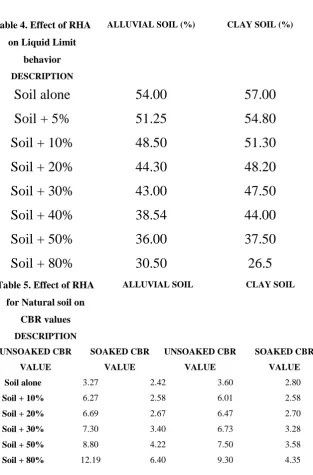
1. The liquid limit and the FSI of the soil decreased steeply with the increase in the % of RHA .In case of
alluvial soil the liquid limit decreased from a value of 59% to 19.2% for the same quantum of addition of RHA.
The decrease in the free swell Index was from 59% to 13.6%. The shrinkage limit of soil increased to 23.7 and
24.2% respectively for alluvial soil and clay soil from 12% initially for virgin soil.
2. The Maximum dry density increased from 16.39KN/m3 to 20.95kN/m3 in case of addition of 80% RHA to
alluvial soil the soil. The maximum and minimum dry density of alluvial soil is 21.8kN/m3 and 18.4kN/m3
respectively. The Optimum moisture content decreased steeply with % RHA 17.8% to 13.25%. The Optimum
moisture content decreased steeply with 80% RHA for clay soil from 17.89% to 13.25% and maximum dry
density increased from 16.39kN/m3 to 19.5kN/m3.
3. The undrained cohesion value of soil mixed with alluvial soil decreased from 60kN/m2 to 20 kN/m2 and
angle of internal fraction value increased from 17°5' to 39°. The undrained cohesion value of the soil mixed with
RHA for clay soil decreased from 60 kN/m2 to 30 kN/m2 and angle of internal friction value increased from
17°5' to 38°.
4. The unsoaked CBR value of the soil increased from 3.2% to 12% whereas soaked CBR value from 2.4% to
6.4% only in the case of addition of RHA to alluvial soil. The unsoaked CBR value in the case of addition of
468 |
P a g e
Table 5. Effect of RHAfor Natural soil on
CBR values
DESCRIPTION
ALLUVIAL SOIL CLAY SOIL
UNSOAKED CBR VALUE
SOAKED CBR VALUE
UNSOAKED CBR VALUE
SOAKED CBR VALUE
Soil alone 3.27 2.42 3.60 2.80
Soil + 10% 6.27 2.58 6.01 2.58
Soil + 20% 6.69 2.67 6.47 2.70
Soil + 30% 7.30 3.40 6.73 3.28
Soil + 50% 8.80 4.22 7.50 3.58
Soil + 80% 12.19 6.40 9.30 4.35
CONCLUSIONS
From the results of this study, the following conclusions can be downed:
i. The soft soil is identified to be clay of high plasticity (CH) according to IS Soil Classification System. It has
very low CBR-value (1.46) and unconfined compressive stress (70 KN/m2). The soil is required to be stabilized
before doing any construction work.
ii. Treatment with RHA shows a general decrease in the MDD and increase in OMC with increase in the RHA
content.
iii. There is also an improvement in the unsoaked CBR (106% at 10% RHA content) compared with the CBR of
the natural soil.
Table 4. Effect of RHA
on Liquid Limit
behavior
DESCRIPTION
ALLUVIAL SOIL (%) CLAY SOIL (%)
Soil alone
54.00
57.00
Soil + 5%
51.25
54.80
Soil + 10%
48.50
51.30
Soil + 20%
44.30
48.20
Soil + 30%
43.00
47.50
Soil + 40%
38.54
44.00
Soil + 50%
36.00
37.50
469 |
P a g e
iv. A similar trend is obtained for UCS. The UCS value is at its peak at 10% RHA (90.6% improved).v. For maximum improvement in strength, soil stabilization using 10% RHA content with 6% cement is
recommended as optimum amount for practical purposes.
BIOGRAPHAICAL DATA: