615 | P a g e
ANALYSIS OF PILED RAFT FOUNDATION USING
PLAXIS 2D ON SOFT SOIL
Mohd Rizwan Hasan
1, V.K.Arora
2 1M.Tech Student, Department of Civil Engineering, NIT Kurukshetra, Haryana (India)
2Professor, Department of Civil Engineering, NIT Kurukshetra, Haryana (India)
ABSTRACT
Recent years, a lot of urbanization is taking place as a result many high rise buildings are constructed and due
to scarcity of land, structures are built on soft soils using pile foundation which becomes very costly. So apart
from conventional method now geotechnical engineers are going for piled raft foundation in which load from
super structure is shared by raft mainly and pile act as settlement reducers. Raft alone has adequate bearing
capacity and reduces differential settlement but undergo excessive settlement, so to overcome this problem piles
along with raft are used as piled raft foundation to have adequate bearing capacity and reduce the settlement
within allowable limits. It is also an economical method as compared to conventional pile foundation. In present
study experimental and numerical analysis has been studied on plain raft and piled raft of different
configurations The model tests include the use of unpiled raft and piled raft of three configurations namely 1x1,
2x2 and 3x3 with varying slenderness ratio of 23, 30 and 37 and thus studying load settlement behaviour for
different configuration of piled raft foundation experimentally and comparing them with numerical modelling
using PLAXIS 2D. The results proved that ultimate load has increased and the settlement has reduced.
Parametric study showed that reduction in settlement takes place due to increase in pile length as well as with
increase in number of piles. This study is useful to decide various parameters required to design piled raft
foundation economically.
Keywords: Piled Raft Foundation, Settlement, Soft Soil, PLAXIS 2D.
I. INTRODUCTION
Foundation is a structural part of a building on which a building stands. Foundation transmits and distributes its
own load and imposed loads to the soil in such a way that the load bearing capacity of the “foundation bed” is
not exceeded. Mainly, three well known foundation option to transfer heavy structural loads (1) raft foundations,
where loads are transferred to the ground via a foundation raft, (2) pile foundations, where loads are transferred
to deeper bearing layers, and (3) piled raft foundations, at which the loads are partially transferred by piles and
partially by raft.
In many countries, piled-raft foundations have been used to support different types of structures in different
types of soils. In particular, the use of piled-raft foundations in Europe is more common than any other region.
In the past, they were used to support structures in certain types of soil. Nowadays, they are used in many types
of soil. Piled-raft foundations have been used as foundations to support many types of structures such as bridges,
616 | P a g e
increasing the bearing capacity of the foundations. Such advantages are attributed to the contribution of the raftto the load carrying capacity and to the efficient use of the piles to reduce the settlement.
1.1. Objectives
The purpose of this study is to assess the settlement of pile raft foundation by varying pile length and number of
pile keeping other parameters constant and analysing numerically by finite element method. The objectives of
the present study are:
i. Investigate the behaviour of square piled raft models on soft clay by varying the length and number of piles.
ii. Study the load settlement behaviour of unpiled raft and piled raft experimentally.
iii. Observe the settlement behaviour of piled rafts using simulation studies by PLAXIS 2D.
iv. Comparing the result obtained experimentally and by numerical simulation.
II. METHODOLOGY
Due to the complexity of piled-raft system, and due to lack of rational solution, the design of piled-raft
foundations relies on numerical modelling using techniques such as finite element. This study is directed to
develop a numerical model capable to analyse the problem stated and to identify the parameters governing their
performance. The model developed was based on the finite element technique and accounts for the complex
interaction factors such as pile-to-pile, pile-to-raft, raft-to-raft and pile-to-soil. The results produced by the
present model were validated by experimental results. In the present study, investigation was performed to study
the load settlement behaviour of square piled raft under vertical loads. The load was applied at the top of pile
raft with the help of jack. The behaviour of piled raft with different configuration such as 1x1, 2x2 and 3x3 were
studied with varying number of pile and pile length of 140 mm, 180 mm and 220 mm . The spacing between
piles were kept as 4d in each case where d is diameter of the pile for testing. Test were conducted in laboratory
and later compared with numerical analysis using Plaxis 2D.
2.1. Material Used
2.1.1. Soil
The clay used for foundation medium was collected at a depth of 1.5m from the ground level at Dayalpur
village in Kurukshetra, Haryana. The collected sample was cleaned, air dried and oven dried for laboratory
investigations. The index and engineering properties of clay were determined according to IS specifications and
the results are tabulated in Table 2.1.
Table 2.1 Properties of clay
S. No Properties Results
1 Specific gravity 2.59
2 Free Swell Index 33.33%
3 Liquid Limit (wl) 51%
4 Plastic Limit (wp) 24.5%
5 Plasticity Index (Ip) 26.5%
617 | P a g e
7 Optimum Moisture Content 22.7%
8 Maximum dry density 1.64 g/cc
9 Unconfined compressive
strength (qu)
141.21 KN/m2
10 Cohesion (Cu) 70.6 KN/m2
2.1.2. Model Unpiled Raft
Model raft used in the experimental study was square rafts of size 100 mm x 100 mm with a thickness of 6 mm.
The raft was made of mild steel with smooth surface.
2.1.3. Model Piled Raft
In piled raft model, the size of raft is the same as that of unpiled raft and pile groups consisting of single pile (1
x 1), four piles (2 x 2) and nine piles (3 x 3), are arranged in square pattern. The spacing between piles is kept as
4d for all groups. Solid steel piles of diameter 6mm and of lengths 140 mm, 180 mm and 220 mm which
represents the l/d ratio of 23, 30 and 37 was used in the experimental study. The dimensions of model Piled Raft
Foundation (PRF).
2.1.4. Model Test Tank
A rectangular test tank was fabricated using mild steel material with dimensions (LxBxD) of 600 mm x 600 mm
x 600 mm. The size of the model tank was chosen based on the size of model footing so that there will be no
interference between the walls of the tank and the failure zone around the piled raft system.
2.2. Preparation of Foundation Medium
The air dried and pulverized clay sample was thoroughly mixed with a water content of 20% by weight. The
mixed soil was then placed in tank in 10 equal layers and each layer was compacted with required number of
blows calculated from the relation of compaction energy, volume of sample, weight of hammer, height of fall
and number of layers. The total number of blows applied on the clay layer was found to be 200. The density of
foundation medium was 1.5g/cc.
2.3. Loading Setup
The model tank was placed in the loading set up. A 1000kg proving ring was used to measure the load applied
on the foundation system. Two dial gauges placed diagonally opposite to each other with 0.01mm sensitivity
was used to measure the settlement. After each increment, the load was maintained constant till the settlement
was constant. After the settlement was complete, the next increment was applied and the process continued till
the piled raft started settlement is close to 10 mm as during analysis settlement which is 10% of the width of raft
was taken.
III. RESULTS AND DISCUSSION
The present work was carried out to study the load-settlement behavior of model raft and model piled raft on
618 | P a g e
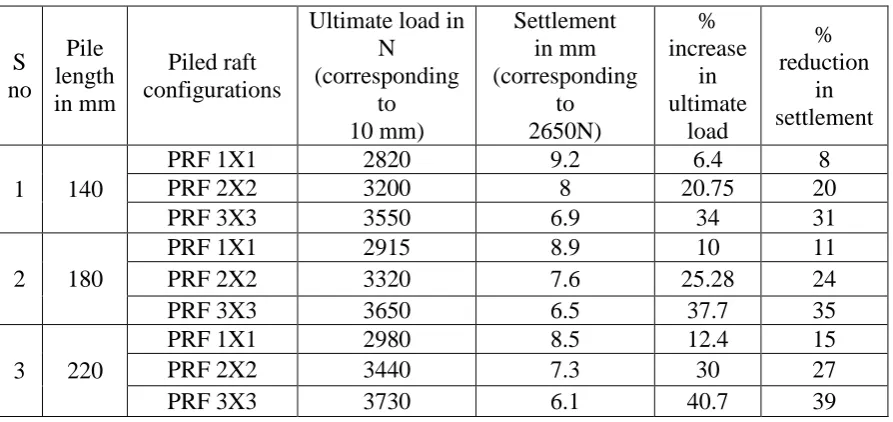
length varied as 140mm, 180mm and 220mm. Discussions were made on the effect of length of the pile, pilegroups on the ultimate load as well as settlement of the piled raft. Comparisons were made with that of unpiled
raft and reported. The prescribed load corresponding to 10 mm settlement which is 10% of the width of raft was
taken for this analysis. The ultimate load was obtained as per Terzaghi’s failure criteria and from the plot, the
ultimate load was found to be 2650 N with corresponding settlement of 10 mm.
Table 3.1 Ultimate load and settlement values from Experiment
S
no
Pile
length
in mm
Piled raft
configurations
Ultimate load in
N
(corresponding
to
10 mm)
Settlement
in mm
(corresponding
to
2650N)
%
increase
in
ultimate
load
%
reduction
in
settlement
1
140
PRF 1X1
2820
9.2
6.4
8
PRF 2X2
3200
8
20.75
20
PRF 3X3
3550
6.9
34
31
2
180
PRF 1X1
2915
8.9
10
11
PRF 2X2
3320
7.6
25.28
24
PRF 3X3
3650
6.5
37.7
35
3
220
PRF 1X1
2980
8.5
12.4
15
PRF 2X2
3440
7.3
30
27
PRF 3X3
3730
6.1
40.7
39
Table 3.1. Comparison of settlement values from experimental and numerical analysis
Footing models Pile length in mm Experimental values settlement in mm Numerical values settlement in mm
1 Unpiled
raft - 10 9.4
2 Piled
raft 140
1X1 9.2 8.6
2X2 8 7.7
3X3 6.9 6.7
3 Piled
raft 180
1X1 8.9 8.4
2X2 7.6 7.2
3X3 6.5 6.3
4 Piled
raft 220
1X1 8.5 8.1
2X2 7.3 7.1
3X3 6.1 5.8
Table 3.2 shows the settlement of unpiled raft and piled raft of all tested models obtained from experimental
study and numerical analysis. Results showed that the settlement values from numerical analysis is slightly
lesser than that obtained from experimental study but are very close to the observed values.
IV. CONCLUSIONS
The study has been undertaken to investigate the behaviour of raft and piled raft model footing placed on soft
619 | P a g e
The ultimate load for unpiled raft was found to be 2650 N and increased to 2820N, 2915 N, and 2980 N
respectively for piled raft with single pile of length 140 mm, 180 mm and 220 mm.
The ultimate load increased to 3200 N, 3320 N, and 3440 N respectively for piled raft with 2X2 pile
configuration of length 140 mm, 180 mm and 220 mm.
The ultimate load increased to 3550 N, 3650 N, and 3730 N respectively for piled raft with 3X3 pile
configuration of length 140 mm, 180 mm and 220 mm.
The addition of small number of piles beneath the raft increases the ultimate load of piled raft, and this
enhancement effect increases with increase in number of piles as well as with increase in l/d ratio.
Settlement reduces with increase in length and number of piles. The percentage reduction in settlement was
found to be significant when the number of piles increased from 1 to 9 in each piled raft configuration.
Numerical simulation using PLAXIS 2D reported settlement values which are very close to the experimental
results.
REFERENCES
[1] A.Z. Elwakil, W.R. Azzam (2015), “Experimental and numerical study of piled raft System”, Alexandria
Engineering Journal , sciencedirect.
[2] Brinkgreve R.B.J (2006). Plaxis, Finite Element Code for Soil and Rock Analyses, user manual. Delft
University of Technology & Plaxis b.v, The Nederlands. Balkema, Rotterdam.
[3] Clancy, P. and Randolph, M. F. (1993), an approximate analysis procedure for piled raft foundations. Int. J.
Numer. Anal. Meth. Geomech. 17: 849–869. doi:10.1002/nag.1610171203.
[4] Gopinath, B., Juneja, A. (2010)"Numerical Modelling of Piled Raft Foundation in Soft Clays"Indian
Geotechnical Conference.
[5] Hameedi, M. K (2011), “Experimental and Theoretical Study for Piled Raft Foundation in Soft Clay”,
Unpublished M.Sc. Thesis, Building and Construction Engineering Department, University of Technology,
Baghdad, Iraq .
[6] Hardik.G.Moradiya, Parth.R.Chhaya, Anuj.K.Chandiwala (2014) "A Review On Analysis Of Piled Raft
Foundation For Building" International Journal of Advance Engineering and Research
Development,Volume 1,Issue 12.
[7] H.S.W Chow , “Behaviour of Piled Rafts with Piles of Different Lengths and Diameters under Vertical Loading” ASCE.
[8] H. Sommer, P. Wittmann, P. Ripper (1985) Piled raft foundation of a tall building in Frankfurt clay P roc.
11th Int. Conf. on SMFE, San Francisco, vol. 4, Balkema, Rotterdam , pp. 2253-2257.
[9] Jaymin.D.Patil (2013) "A study on piled raft foundation" International Journal of Engineering Research &
Technology (IJERT), ISSN: 2278-0181, Vol. 2 Issue 8.
[10] Karim H.H , Al Qaussy M.R , Hameedi M.K 2012.“Numerical Analysis of Piled Raft Foundation on