GlobalIlluminators
FULL PAPER PROCEEDING
Multidisciplinary StudiesFull Paper Proceeding MISG-2014, Vol. 1, 12-28
ISBN: 978-969-9948-21-3
*All correspondence related to this article should be directed to Azizah , P olytechnic State of Sa ma rinda, Indonesia and Research Scholar Email: [email protected]
© 2014 The Authors. P ublished by Global Illuminators . This is an open access article under the CC BY -NC-ND license (http://creativecommons.org/licenses/by -nc-nd/4.0/)
P eer-review under responsibility of the Scientific & Review co mmittee of MISG-2014. MIS G-14
Do risk management, internal control and corporate reputation positively
impact on firm value? A panel data econometric analysis and policy
implications
Azizah
1*and Sardar M.N.Islam
21Business Administration department,The Polytechnic State of Samarinda, Indonesia and Research Scholar,
2
Victoria Institute of Strategic Economic Studies (VISES) Victoria University, Melbourne, Australia
Abstract
Corporate governance has grown in importance due to the poor financial state of affairs of many companies in the past decade. Good corporate governance is perceived to increase firm value because it may help to reduce agency problems and build investors‘ confidence. Moreover, it is perceived that good corporate governance not only reduces the risk of fraud and corporate collapse, but also creates wealth by improving the financial performance. However, despite many studies on corporate governance founding a positive r elationship between corporate governance and corporate performance, none has studied the impacts of the following three elements of corporate gov ernance: risk management, internal control and corporate reputation on firm value in an integrated way. This research examines the impacts of these elements of corporate governance such as: risk management, internal control and corporate reputation on firm performance. The refore, the objective of this paper in to investigate (1) the relationships between risk management, internal control, corporate reputation and firm performance collectively in an investigated model and (2) the relationships between this three elements of corporate governan ce and firm performance separately for each element in a separate model ( such as the relationship between (a) risk management and firm performance , (b) internal control and firm performance, (c) corporate reputation and firm performance .Data analysis adopts the econometric model presented in the ST ATA program using secondary data resources. Overall results show that all three elements of corporate governance positively impact firm performance. This finding has significant corporate policy and strategy implications.
© 2014 The Authors. P ublished by Global Illuminators . This is an open access article under the CC BY -NC-ND license (http://creativecommons.org/licenses/by -nc-nd/4.0/)
P eer-review under responsibility of the Scientific & Review co mmittee of MISG-2014.
Keywords― Corporate Governance, risk management, internal control, corporate reputation, firm performance.
Introduction
Corporate governance has grown in importance due to the poor financial state of affairs of many companies in the past decade. Good corporate governance is perceived to increase firm value because it may help to reduce agency problems and build investor‘s confidence (Ulhøi 2007). Moreover, it is perceived that good corporate governance not only reduces the risk of fraud and corporate collapse, but also creates wealth by improving the financial performance (Plessis, McConvill & Bagaric 2005). However, despite many studies on corporate governance having found a positive relationship between corporate governance and corporate performance (Bauer, Guenster & Otten 2004; Black, BS, Jang & Kim 2006; Go mpers, Ishii & Metrick 2003a; Klapper & Love 2004), none have studied the impacts of corporate governance on risk management, internal control and corporate reputation on firm value in an integrated way.
Interna tional Conference on Mul tidisciplina ry Innova tion for Sus tainability and Growth (MISG- 2014)
13
The Organisation for Economic Cooperation and Development (OECD) suggests that the essential elements of good corporate governance are risk management and internal control (Mallin 2001). The key role of risk management is to help to achieve accountability (Spira & Page 2003), and good internal control will influence financial control and financial reporting quality which helps to strengthen the accountability of the board to shareholders, as well as to avoid fraud in the companies (Spira & Page 2003). Moreover, an audit committee, as one aspect of internal control, is said to improve company performance (Turley & Zaman 2004). Hay et. al (2008) suggest that good internal control shows strong corporate governance.
There is also evidence that corporate reputation is another variable, which is correlated to risk management and internal control may improve firm value (Ljubojevic & Ljubojevic 2008). Good reputation is perceived to increase company value and reduce costs of capital by boosting inv estor confidence (Mallin 2001). Good reputation can be thought of as accumulation of good management practises and performances undertaken by the firm‘s management. Investors can be more confident of the future performance of a firm, if that firm has a good reputation. Good reputation also has a correlation with good corporate governance (Ljubojevic & Ljubojevic 2008). It could be an indicator that a firm has implemented good corporate governance, as good corporate governance is arguably to be about ethical management practises (Rezaee 2009).
As the impacts of these crucial business factors (risk management, internal control and corporate reputation) on firm value have not been previously studied in an integrated framework in the existing literature, and as it is expected that these factors may have some significant impacts on firm value, this paper aims to investigate the relationship between these three important elements of corporate governance with respect to firm value in an integrated way. This paper argues that research on good corporate governance needs to consider the impact of three new factors (risk management, internal control and corporate reputation) in improving firm value. In addition, the following specific tasks will be performed to achieve the main aim of the study to analyse the specific effects on risk management, internal control and corporate reputation on firm value:
1. to observe the impact of internal control on firm value; 2. to investigate the effect of risk management on firm value; 3. to observe the impact of reputation on firm value; and
4. to formulate corporate governance and business strategies from the results of this stu dy
Corporate governance practices differ between countries, as regulations and economic conditions differ. This research will take Indonesia as a case study. As a developing country, Indonesia‘s corporate governance has remained weaker compared to developed countries, such as US and UK. A corporate governance code of conduct was enacted in Indonesia in 2006 to help improve governance practices.
This paper will be structured into five parts: the next section will discuss in detail the contribution of the study followed by the literature review. The hypothesis development will be elaborated in section 3 followed by the data and variables. Results and discussion are presented in section 6
Contribution of study
This study will e xtend the literature in the area of corporate governance by adding more knowledge about, and giving evidence regarding the impact of three aspects of corporate governance: internal control, risk management, and corporate reputation on firm value. This research will assess how these factors improve firm value. There have been previous studies that are focused on the relationship between corporate governance and firm value, but none of the research was focused on the importance of risk management, internal control and corporate reputation.
This study will contribute to the knowledge of how the importance of mechanisms of good corporate governance could help to create firm value. Furthermore, this study also will improve our understanding regarding the process of firm value creation. Considering the fact that the enhancing firm value is the ultimate goal of firm, investigations into some new factors contributing to value creation will improve the literature in the area of corporate governance and corporate finance.
As an instance of the originality of this study in the policy and strategy area, this study will help to formulate corporate governance and business strategies, especially in the area risk management, internal control and reputation, on the basic of the study of the relationship between these variables and firm value.
Literature Review and Hypothesis Development
Interna tional Conference on Mul tidisciplina ry Innova tion for Sus tainability and Growth (MISG- 2014)
14
Corporate governance and firm performanceA good corporate governance system is argued to have a positive impact on the effectiveness of a firm, which influences competitiveness, structure of capital and labour markets (Maher & Andersson 1999). Furthermore, good corporate governance also improves investor trust, helps to protect minority shareholders and creates good relationships between workers, creditors and stakeholders. It is an essential requirement for sustained economic growth according to Maher & Anderson (1999) who suggest that a good corporate governance framework secures the benefit association due to controlling shareholders as direct monitors and controlling activities expenses of other stakeholders (Maher & Andersson 1999).
Good corporate governance also contributes to rising firm value by reducing agency costs in companies (McKnight & Weir 2009). Good corporate governance with shareholder rights will influence better management, thus enhancing shareholder wealth and increasing firm performance (Chugh, Meador & Meador 2010). Corporate governance from a shareholder perspective has four standard methods of assessment: first, independent and transparent board members are very important to evaluation. Second, the shareholders have equal voting rights to elect the full board each year, have the right to an independent nominating committee and even have the right to sell the companies to outside parties. The third is that there should be transparency in financial reports including good internal control. The final method is having an independent committee to decide management compensation and compensation also being determined by performance (Chugh, Meador & Meador 2010).
Corporate governance, Risk Management, and Performance
Business cannot be separated from risk. Therefore, risk management is a tool for minimising risk and this is an objective. Risk management can be described as ―the process by which organisations methodically address the risk attaching to their activities with the goal of achieving sustained benefit within each activity and across the portfolio of all activities.” (Collier 2009, p. 45). The Treasury Board of Canada Secretariat (2001) also describes risk management as ―a systematic approach to setting the best course of action under uncertainty by identifying, assessing, understanding, acting, on and communicating risk issues.‖ Another definition, by the International Organization for Standard (ISO), of risk management includes how to manage risk and consider the implications of risk (Collier 2009). Risk management is a business practice to enhance value in the firm (Leautier 2007).
Risk management can increase value through three aspects: first it provides financial flexibility at minimum cost by protecting difficulties in finance and creating interest for investors in the business. Financial flexibility is the ability of a firm to finance an investment in an operation when experiencing cash flow problems. Financial flexibility also encourages the goal of value creation. Financial flexibility can increase the value of a firm by 10 to 20 per cent. Secondly, risk management can enhance capital allocation and performance management for controlling activity management through transparency of managerial performance and control in the firm. Finally, operational flexibility, operational and strategy can be leveraged by risk management (Leautier 2007). Leautier also explains that leverage has implications for increasing value by 20 to 35 per cent in a firm. Previous studies have shown that the value of firms has increased steadily with good practice of risk management (Leautier 2007).
The Institute of Chartered Accountants has described risk as an event that affects the performance of a firm (Collier 2009). Avoidance of risk is thus essential to managing risk in order to reduce the probability of a negative impact for the company. Enterprise risk management (ERM) is the process and method of ho w to implement the goals in an organization (Collier 2009). The elements of risk management are listed in ERM, which are: id entifying; assessing; determining; and monitoring. COSO has issued an ERM framework by defining risk management as influenced by human resources in an organization. COSO has developed eight models for ERM which are interconnected
First is the internal environment: how to manage internal risk in an organisation as well as its management philosophy. Second, is the objective setting: how to make strategy so the goals of the organisation can be achieved; furthermore, how to classify what influences the goals including internal and external factors. The next stage is a judgement about risk analysis, taking into account the possible risks that could occur. The risk response is management control activity to reduce risk. Control activities are essential in an organisation and also information and communication and monitoring. COSO also defines ERM:―A process, affected by an entity‘s board of directors, management and other personnel, applied in a strategy setting and across the enterprise, designed to identify potential events that may affect the entity, and manage risk to be within its risk appetite, to provide reasonable assurance regarding the achievement of entity objectives.‖ (Collier 2009).
Interna tional Conference on Mul tidisciplina ry Innova tion for Sus tainability and Growth (MISG- 2014)
15
organisation and the environment. ERM becomes a fundamental approach to risk in organisations. Sarbanes-Oxley (SOX), the Turnbull committee and Basel 2 suggest that the concept of risk management is changing in the global information economy.
COSO ERM frameworks consist of several components: internal condition; goal formulation; event identification; risk assessment and response; control and monitoring activities; and communication activities (Calder 2008). Liebenberg and Hoy (2003) argue that risk management potentially increases firm value by minimising inefficiencies, promoting capital efficiency, and reducing earnings volatilit y and expected cost of external capital as well as regulatory scrutiny. Bierc (2003) mentions that ERM can be developed and pursued with substantial key drivers to influence the success and value of corporations (Lai et al. 2010). Crouhy et al. (2006) and Belmont (2004) claim that the ERM framework will create benefits, tangible or intangible, such as improving firm reputation, smoothing earning expectation, increasing management confidence, clarifying decision making processes and governance procedures, and stimulating corporate entrepreneurship (Belmont 2004; Crouhy, Galai & Mark 2006). The empirical research gives evidence that ERM is able to make a firm more profitable, which then reduces the possibility of financial distress (Pagach & Warr 2010).
Risk management has a correlation with business performance, reducing financial cost and thereby increasing profit. Smith and Stulz (1985), present empirical evidence that risk management can assist in reducing taxes. This evidence has been supported by Dolde (1995) who finds a positive and significant relationship between taxes. Nance et al. (1993) and Mian (1996) also find that statistically there has been a significant positive relationship between tax credits and the use of risk management instruments.
In the UK, it is perceived that risk management is an integral part of corporate governance. The Turnbull Committee and the Comprehensive Performance Assessment (CPA) have recognized that internal control demands excellent risk- management practices; therefore the CPA must be applied in the local authority agenda (Collier 2009). Risk management is crucial for corporate governance due to three reasons: first, risk management will influence directors in managing the operations of the firm; second, failures of risk have great impact for the company, such as personal liability; lastly, managing risk is important to reduce costs in the firm (Farrar 2005). Moreover, previous research has found that the relationship between risk management and corporate performance is significantly positive, through investment innovation (Andersen 2008). Additionally, the effectiveness of risk management can decrease corporate collapse by reducing the total cost of capital; therefore, investment economics improve (Andersen 2008). Risk management can create investor confidence in long term investment due to stable cash flow. Hence the hypothesis 2 of this study is presented as follows:
H-1: As risk management is a part of corporate governance and expected to reduce cost of capital, risk management has a positive impact on performance
Corporate governance, Internal Control and Performance
Internal control is a philosophy of management and operating style that includes all policies and procedures adopted by management to assist in achieving the firm‘s objective (Adams, Grose & Leeson 2004). Internal control is important for corporate governance, to ensure the proper running of a corporation and to improve efficiency. Another definition of internal control by the Committee of Sponsoring Organisations (COSO) of the Tread Way Commission (Calder & Watkins 2008) describes internal control as the board of directors controlling activity management and human resources. This control is designed to provide reasonable assurance regarding the achievement of objectives based on the following categories: effectiveness and efficiency of operations; reliability of financial reporting; and compliance with applicable laws and regulations. Calder (2008) divides internal control into five elements: control of the environment; assessment of risk; control of activities; information and communication; and monitoring. Other scholars conceptualise internal control as a system that consists of specific policies and procedures designed to provide management with reasonable assurance, in order to achieve the firm‘s goals and objectives (Lawrence, Minutti-Meza & Vyas 2010).
Interna tional Conference on Mul tidisciplina ry Innova tion for Sus tainability and Growth (MISG- 2014)
16
COSO has described internal control as consisting of five components: first, it is essential to control the environment in the organisation, including management style, society and ethical value in the firm. Secondly, it is important how the organisation manages risk to achieve its goals. The third is activity controls which are the policies and procedure to ensure the companies achieve their objectives. Information and communication for external and internal reporting are crucial, in the firm, for informed business decision making. The last element is monitoring to assess the quality of the system‘s performance over time which can be done through ongoing monitoring activities, separate evaluations or both (Choong 2009). Internal control is the key to goal achievement; therefore companies have to have good internal control.
The Sarbanes-Oxley Act (2002) suggests that internal control is part of corporate governance (Choong 2009). Herath and Freeman suggest in corporate governance analysis that one of the causes of corporate collapse is a lack of internal control (Herath & Freeman 2012). Chugh et al. also mention that shareholders should have good financial reports that are transparent and show good internal control (Chugh, Meador & Meador 2010). Chugh et al summarise in the literature that a company that has greater shareholder rights will have higher value because, firstly, good information in financial reports, including transparency, assures shareholders, therefore, that legal action taken by a minority will decrease cost. Secondly, it is essential to have an independent committee. Third, a shareholder orientation in a company ensures transparency of financial and effective internal control (Chugh, Meador & Meador 2010). As internal control is a part of corporate governance, it can be predicted that internal control has a positive correlation with performance. Hence, the hypothesis one of this study is formulated as follows:
H-2: As internal control is a part of corporate governance and increases investor‘s confidence, internal control has a positive influence on performance
Corporate governance, Corporate Reputation, and Performance
Corporate reputation is an intangible asset that is a value driver and provides competitive advantage in firm performance (Iwu-Egwuonwu 2011). The essential wealth of many companies is tied up in their intangible assets. In recent years companies have focused on intangible assets as the major value driver: 70 to 85 per cent of the focus is on tangible assets (Hand & Lev 2003). There are many intangible assets such as reputation, brand, intellectual capital, corporate culture, goodwill and the quality of management systems. Many companies have become aware of the advantages of being concerned with developing and maintaining a q uality reputation.
Good corporate governance enhances the quality of corporate reputation, which in turn enhances the financial performance and market value of the organisation involved. Furthermore, Ljubojevic and Ljubojevic (2008) suggest that corporate governance is recognised as necessary for maintaining the attractive investment climate that is characteristic of highly reputable and competitive companies (Ljubojevic & Ljubojevic 2008). One of the most critical strategic and enduring assets of any corporation is a good reputation. A good reputation positively impacts on a firm‘s performance (Hammond & Slocum 1996). According to accounting literature, a good corporate reputation creates an enormous amount of wealth and goodwill.
A good reputation has a positive relationship with performance. Prior studies have shown empirical evidence that corporate reputation has a positive correlation with superior earnings quality (Tan 2008). Tan also finds that has helped in producing superior total sales in Chinese public companies (Tan 2008).
Moreover, Chung and Schneeweis (2003) suggest that a firm‘s reputation and the price of its product are the same as the value of the firm. They also found that UK and US firms that have a better reputation outperform those in the low ranks of reputation, in terms of return on total equity (Chung, Wright & Kedia 2003). Another study argues that investors make abnormal returns when they purchase stocks of firms with a significant reputation (Brammer, Brooks & Pavelin 2006). Assets in the firm such as goodwill are a necessary asset because of their reputation - enhancing activities. Black (1999) suggests that intangibles such as firm reputation contribute to firm stock - market value. Good corporate reputation significantly improves firm performance (Ghose, Ipeirotis & Sundararajan 2009)
Corporate reputation relates to strategy value in the company (Dierickx & Cool 1989). Moreover, prior research suggests that corporate reputation has a positive impact on financial performance (Schultz, Mouritsen & Gabrielsen 2001). Some empirical studies have also found that value creation has been influenced by corporate reputation (Vergin & Qoronfleh 1998). Regression analysis also shows that the relationship between stock market and reputation is positive (Srivastava et al. 1997). A good reputation will also maintain and increase share value (Jones, Jones & Little 2000).
Interna tional Conference on Mul tidisciplina ry Innova tion for Sus tainability and Growth (MISG- 2014)
17
De Castro et al. (2006) suggest that corporate reputation can be compartmentalised into three main areas: managerial reputation; financial reputation; and product reputation. As an intangible asset, corporate reputation also creates an essential strategic competitive benefit by reducing competitors, creating mobility barriers, charging premium prices, reducing operating costs and attracting talent (Caves & Porter 1977; Fombrun 2008; Vergin & Qoronfleh 1998). Enhanced corporate reputation , which is called creative capitalism by Bill Gates, serves as a governance model because for a company required to make big profit it is then easy to give incentives to the employees, thus they have incentive recognition in the organisation leading to a good reputation and enhance patronage among customers (Hemphill 2010). Previous research suggests that corporate reputation reflects customer trust and trust of other stakeholders, therefore making employees more productive and increasing benefits (Rose & Thomsen 2004). Hence the hypothesis 3 of the study is:
H-3: Corporate reputation has a positive relationship with performance
.
Conceptual Framework and Variables
As discussed above, it is clear that there is a positive relationship between corporate governance and firm performance (Plessis, McConvill & Bagaric 2005). Based on the literature, corporate governance instruments can be divided into two mechanisms: external and internal. This study will e xa mine the influence of the internal mechanisms, i.e. risk management, internal control and corporate reputation on firm value. The conceptual framework of the study is depicted in graph 1 below.
Internal Control Risk Management
Risk Disclosure
Leverage
Financial Performance
Tobin’s Q
Return on Assets (ROA) Audit Committee
Board of Director
Audit Type
Auditor Change
Corporate Reputation: Bond Rating
Control Variables
Firm Size
Interna tional Conference on Mul tidisciplina ry Innova tion for Sus tainability and Growth (MISG- 2014)
18
This study uses two measures of risk management which are risk disclosure and leverage. What is essential for companies: to give more information on the risk and become more credible, therefore will influence investment decisions. Modern portfolio theory argues that improving risk disclosure would in turn enable investors to deal more effectively with risk diversification (Solomon et al. 2000). Solomon et al (2000) also argued that improving the risk disclosure is related to the essential information in corporate governance. Good corporate governance has a positive impact on firm performance. Based on the evidence in the UK companies, risk disclosure becomes more important information so the investor can know if the firm is a going concern or a failure (Solomon et al. 2000). In this study twelve dimensions are employed in measuring the risk disclosure index. These twelve are taken from financial instrument risk disclosure under IFRS from 2011 and 2012. The dimensions are:
1. Method of measuring credit risk exposure
2. Adequate description of how credit risk management occurs including providing a clear linkage between the quantitative data and qualitative description
3. Maximum credit exposure
4. Aging schedule for past due amounts
5. Maturity analysis derivative liabilities
6. Sensitivity Analysis
7. Impairment method and inputs disclosed
8. A description of the financial effect of the extent to which collateral and other credit enhancements
9. Maturity analysis derivative liabilities due
10. Disclosure of the exposure market risk
11. Sensitivity analysis for market risk
12. Counterparty concentration profile `
Leverage is the second proxy from risk management. Leverage will increase stock price for two reasons: firstly, as interest expenses are deductible, firms will pay less tax which then decreases the cost of capital and ultimately increases firm value. Secondly, based on signalling theory, the availability of debt provides positive information to the market that the firm requests money for funding the prospective investment. However, the level of debt will increase their uncertain level, and the use of debt will increase the cost of capital hence a firm should look for an optimum level of debt or optimum capital (Ross 1977). The Theory of the optimum capital structure is related to the Weighted Average Cost of Capital (WACC). The optimal mix of debt and the equity is affected by WACC turn down (reduced) with leverage because of the interest tax shield. If the capital structure increases it is possible bankruptcy will increase and as a result, the rate of return equity holder will also be higher. According to Modigliani – Miller‘s theory, the cost of capital increases the same as leverage increases (Choong, kk 2009). Good quality companies can issue more debt than low quality ones due to the issue of debt to a higher probability of default due to the debt servicing costs which represent a costly outcome for firm insiders. This theory argued the highest performing firms, those having the more profitable investments, acquire more debt, therefore a positive relationship should exist between leverage and firm performance (Ross 1977; Weill 2001). Therefore, the hypothesis 1 of this study could be broken down into two hypotheses which are:
H1.a Risk disclosure has a positive impact on firm performance
H1.b Leverage has a positive impact on firm performance
In measuring internal control, seven indicators are used which are: audit committee, audit committee independence, audit committee financial expertise, big4 auditor firm, audit change, number independence board, and size board. According to the theory and principle of corporate governance, an audit committee is necessary due to its creating efficiency in the company financial reporting (Farrar 2005) . An audit committee structure includes four elements:
Interna tional Conference on Mul tidisciplina ry Innova tion for Sus tainability and Growth (MISG- 2014)
19
1. Consists only of non executive directors
2. Consists of a majority of independent directors
3. Is chaired by an independent chair, who is not the chair of the board
4. Has at least three members
Auditor committee measures follow the definition adopted from Sarbanes Oxley Act (SOX) section 407. The measurements use three aspects which are: firstly, the number of audit committee members is referring to the expertise and experience in financial accounting and non-accounting non-financial experience; secondly, the number of audit committee independence. The number of audit committee independence is relevant to disclosure when the auditor has a strong economic bond between client and auditor. Thirdly, the number of audit committee should have financial expertise. The financial expert should be qualified including: the understanding of generally accepted accounting principles (GAAP) and financial statements; understanding the general principle of accounting, experiences in of auditing and accounting issues generally; understanding about the procedure of internal control and the function of audit committee. As some previous studies argue, there is no relationship between non audit fee and auditor independence due to the auditor putting more consideration into keeping their reputation and high quality audit. Internal control and number of audit committee should have financial expertise.
The board of directors is crucial to supervise the managerial function. Shareholders vote for the board to take action on their behalf to monitor the top management. The managerial function of board directors is referring to decisions of management and how to implement strategy and then related to the agency problem (Rezaee 2009). A previous study suggests that the quality of internal control is a function of the quality of the control environment as well as the board of directors and the audit committee (Krishnan 2005). Previous research into this issue employs two variables for measuring board of directors.
The variables followed by Zhang, Zhou (2007) are the number of board independence and board size. The effectiveness of board directors will be good firm value throug h the increasing activities following share price decline. Besides that, the effective monitoring by board directors can improve firm performance through reducing agency cost. According to agency theory, the function of the board is to protect the interest of the principal owners (Hillman & Dalziel 2003). Furthermore, the board director can increase shareholder value by controlling management (Denis & McConnell 2003). Moreover, previous studies argue that monitoring board director could influence agency cost through cost reduction so as to improve firm performance (Fama 1980; Mizruchi 1983; Zahra & Pearce II 1989).Following Zhou (2007), this study employs two measures of board of director characteristics which are boards‘ independence and size of the board.
Independent boards contain the board members who come from outside or the directors who don‘t have a relationship either with for controlling shareholders, managers or board of directors (ghofar 2013) .The independent boards have no relationship with managers; their duty is to monitor managers in the firm independently, from outside the firm. According to Duchin, the importance of the independent board is to protect the shareholder interest (Duchin, Matsusaka & Ozbas 2010) Additionally, the independent board could reduce the agency problems between shareholders and management by monitoring the role of the board.
Board size is the essential core in corporate governance to influence the firm performance in the companies. Jensen suggests that the companies do not need to have a lot directors of the board, with a maximum of eight or nine members (Jensen 1993). Lipton and Lorsch also argue that limitation of boards makes them more effective in decision making and controlling of CEO, rather than a large board which can be slower in discussion and goal achievement due to creating coordination and communication problems (Lipton & Lorsch 1992). The empirical evidence about large boards size relates to the economic theory, about decision making and social psychology theory leading to a variety of opinion (Cheng 2008). The large board size thus has a negative impact on firm performance due to the fact that problems will be increased.
Interna tional Conference on Mul tidisciplina ry Innova tion for Sus tainability and Growth (MISG- 2014)
20
Louis suggests that The Big 4 audit provides better quality of audit compared to the non-Big 4, due to more resources (Louis 2005).
On the other hand, non Big4 firms have some benefit in another area: for instance, merger and acquisition. Moreover, non-Big 4 firms have better-quality in terms of the local markets and have a good relationship with local business for the long term. In contrast, non-Big 4 auditors are not significant toward increasing the capital of reputation in the firm. Meanwhile, Big 4 auditors will influence auditor reputation capital of risk, therefore increasing earning quality because the investor protection environment becomes stronger (Francis & Wang 2008). Basu suggests that firms which are audited by the Big 4 show that earning conservatism is increasing in the stickiness of countries‘ investor protection environment (Basu 1997).
A company which has an auditor change is described as having internal control problems (Young 2003). In this study the measurement used a dummy variable. 1 refers to the company that has had the auditor change, while 0 is related to non-auditor change.
Hence the hypothesis 2 of this study could be broken down into seven hypotheses which are:
H2a: Audit committee has a positive impact on firm performance
H2b: Number of audit committee independence has a positive impact on firm performance
H2c: Number of audit committee with financial expertise has positive impact on firm performance
H2d: Big 4 auditor has a positive impact on firm performance
H2e: The Auditors change has a positive impact on firm performance
H2f: The number of independent member of a board has a positive impact on firm performance
H2g: Size of board has a positive impact on firm performance
As elaborated before, a good reputation will increase the confidence of investors to make more investments; therefore leading to increased firm value. In measuring the corporate reputation, this study uses a proxy of bond rating. This measure provides valuable information for potential investors about the quality and marketability of bonds issued to help support them in making investment decisions (Brealey 2014). The rating is issued by rating agencies such as Moody‘s, Standard & Poor‘s (S&P) and Fitch rating. The bond rating measures provided by Moody‘s standard and Poor‘s and Fitch use the symbol AAA (triples A) for the highest standard bonds. Moreover, they continue the double AA and only A for progressively lower standard bonds. This rating is important for the information transmission of the debt market as well as to make the investors trust in their business and to increase the pricing financial obligation (Becker & Milbourn 2008). Investors will consider the companies‘ reputation for honesty and accurate rating. The Pefindo rating also used symbols as follows:
Symbols
Rating Symbols Rating
AAA 1 B+ 14
AA+ 2 B 15
AA 3 B- 16
AA- 4 CCC+ 17
A+ 5 CCC 18
A 6 CCC- 19
A- 7 CC+ 20
BBB+ 8 CC 21
BBB 9 CC- 22
BBB- 10 C+ 23
BB+ 11 C 24
BB 12 C- 25
Interna tional Conference on Mul tidisciplina ry Innova tion for Sus tainability and Growth (MISG- 2014)
21
In this research the dependent variable is financial performance measured by Tobin‘s Q and Return on Asset ( ROA), while the independent variables are risk management, internal control and corporate reputation.
Tobin‘s Q is measured by Equity market value + Liabilities book value)/(Equity book value + Liabilities book value . ROA is measured by Earnings/Total assets.
Data and Methodology
Sample and data source
The sample of the study was 36 listed companies in the Indonesian Stock Exchange for the period 2007 until 2012.Therefore the sample included 214 firm year observations. The number of the sample is limited because the companies for our sample must have had bond rating available over the study period. We started the period from 2007 because the data of corporate governance was only available in that period. The new policy of corporate governance was released in 2006 and the practice of corporate governance started in 2007.
The data were collected from annual reports available from the Indonesian Stock Exchange website and the company‘s website. Meanwhile, bond rating data were taken from the credit rating Indonesia (PT PEFINDO) website at www.pefindo.com.
Econometric Model
The econometric models of the study are presented as follows:
Model 1 and 2 (Integrity variables: risk management, internal control, corporate reputation)
𝐹𝑃𝑖𝑡 = 𝛼 + 𝛽1𝑅𝐷𝑖𝑡+ 𝛽2𝐿𝑒𝑣𝑖𝑡+ 𝛽3𝑁𝐴𝐶𝑖𝑡+ 𝛽4𝑁𝐴𝐶𝐼𝑖𝑡+ 𝛽5𝑁𝐴𝐶𝐹𝐸𝑖𝑡+ 𝛽6𝑁𝐼𝐵𝑖𝑡+ 𝛽7𝑆𝐵𝑖𝑡+ 𝛽8𝐵𝑖𝑔4𝑖𝑡+ 𝛽9𝐴𝑈𝐶𝑖𝑡 + 𝛽10𝐵𝐷𝑅𝑋𝑖𝑡+ 𝑈𝑖𝑡
Model 3 and 4 (individual independent variable: risk management)
𝐹𝑃𝑖𝑡 = 𝛼 + 𝛽1𝑅𝐷𝑖𝑡+ 𝛽2𝐿𝑒𝑣𝑖𝑡+ 𝑈𝑖𝑡
Model 5 and 6 (Individual independent variable: internal control)
𝐹𝑃𝑖𝑡 = 𝛼 + 𝛽1𝑁𝐴𝐶𝑖𝑡+ 𝛽2𝑁𝐴𝐶𝐼𝑖𝑡+ 𝛽3𝑁𝐴𝐶𝐹𝐸𝑖𝑡+ 𝛽4𝑁𝐼𝐵𝑖𝑡+ 𝛽5𝑆𝐵𝑖𝑡+ 𝛽6𝐵𝑖𝑔4𝑖𝑡+ 𝛽7𝐴𝑈𝐶𝑖𝑡+ 𝑈𝑖𝑡
Model 7 and 8 (Individual independent variable: corporate reputation)
𝐹𝑃𝑖𝑡 = 𝛼 + 𝛽1𝐵𝐷𝑅𝑋𝑖𝑡+ 𝑈𝑖𝑡
Where the Dependence variables are either Tobin‘s Q or return on asset (ROA) Independent Variables are risk disclosure (RD), Leverage (Lev), Number of audit committee (NAC), Number of audit committee independence (NACI), Number of the audit committee who has financial expertise (NACFE), Number of independence board members (NIB), Size of board(SB), Big4 (1: Companies use Big 4 for audit and 0: companies not used Big 4 for audit ), AUC Dummy Variable (1: Auditor change, 0: No auditor change), Bond rating (BDR), Error term (µ)
Interna tional Conference on Mul tidisciplina ry Innova tion for Sus tainability and Growth (MISG- 2014)
22
Result and Discussion
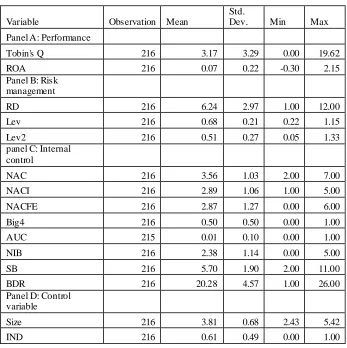
The descriptive Statistics result can be seen in table 1 below.
Table 1. Descriptive Statistics Results
Variable Observation Mean
Std.
Dev. Min Max
Panel A: Performance
Tobin's Q 216 3.17 3.29 0.00 19.62 ROA 216 0.07 0.22 -0.30 2.15 Panel B: Risk
management
RD 216 6.24 2.97 1.00 12.00 Lev 216 0.68 0.21 0.22 1.15
Lev2 216 0.51 0.27 0.05 1.33 panel C: Internal
control
NAC 216 3.56 1.03 2.00 7.00
NACI 216 2.89 1.06 1.00 5.00
NACFE 216 2.87 1.27 0.00 6.00
Big4 216 0.50 0.50 0.00 1.00
AUC 215 0.01 0.10 0.00 1.00
NIB 216 2.38 1.14 0.00 5.00
SB 216 5.70 1.90 2.00 11.00
BDR 216 20.28 4.57 1.00 26.00 Panel D: Control
variable
Size 216 3.81 0.68 2.43 5.42
IND 216 0.61 0.49 0.00 1.00
From Table 1 above can be noted some important characteristics of the Indonesian data. First, the Indonesian firms tend to have big size of board directors but are small in the number of independent boards. Second, most of independent audit committee members have financial expertise, while most of the non-independent audit committee members have no financial expertise.
Interna tional Conference on Mul tidisciplina ry Innova tion for Sus tainability and Growth (MISG- 2014)
23
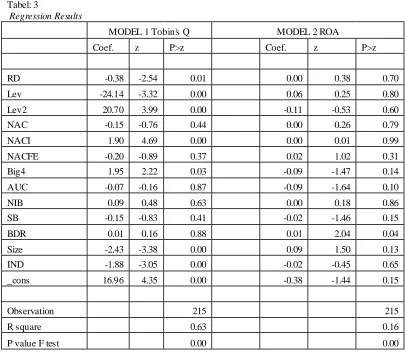
The regression results are presented in table 3 below.
Tabel: 3
Regression Results
MODEL 1 Tobin's Q MODEL 2 ROA
Coef. z P>z Coef. z P>z
RD -0.38 -2.54 0.01 0.00 0.38 0.70
Lev -24.14 -3.32 0.00 0.06 0.25 0.80
Lev2 20.70 3.99 0.00 -0.11 -0.53 0.60 NAC -0.15 -0.76 0.44 0.00 0.26 0.79
NACI 1.90 4.69 0.00 0.00 0.01 0.99
NACFE -0.20 -0.89 0.37 0.02 1.02 0.31 Big4 1.95 2.22 0.03 -0.09 -1.47 0.14
AUC -0.07 -0.16 0.87 -0.09 -1.64 0.10
NIB 0.09 0.48 0.63 0.00 0.18 0.86
SB -0.15 -0.83 0.41 -0.02 -1.46 0.15
BDR 0.01 0.16 0.88 0.01 2.04 0.04
Size -2.43 -3.38 0.00 0.09 1.50 0.13
IND -1.88 -3.05 0.00 -0.02 -0.45 0.65
_cons 16.96 4.35 0.00 -0.38 -1.44 0.15
Observation 215 215
R square 0.63 0.16
P value F test 0.00 0.00
Table :4
a regression Results models with one explanatory variable- risk management, internal control and reputation on Tobin’s Q
Variables/Proxies Model 3 (TQ) Model 5 (TQ) Model 7 (TQ)
Risk management: Coef Z P>Z Coef Z P>Z Coef Z P>Z
RD -0.18 -1.15 0.251
Lev -18.47 -3.56 0
lev2 18.502 5.2 0
Internal Control:
NAC -0.36 -1.23 0.22
NACI 2.061 3.63 0
NACFE -0.18 -0.84 0.4
Big4 2.078 2.38 0.02
AUC -0.14 -0.4 0.69
NIB 0.008 0.03 0.98
SB -0.19 -0.77 0.44
Reputation:
Interna tional Conference on Mul tidisciplina ry Innova tion for Sus tainability and Growth (MISG- 2014)
24
Table 4b
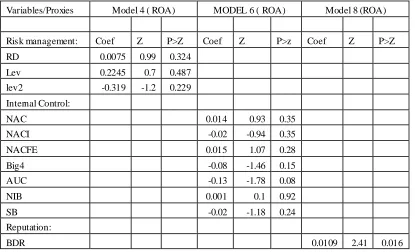
regression Results models with one explanatory variable- risk management, internal control and reputation on return on asset (ROA)
Variables/Proxies Model 4 ( ROA) MODEL 6 ( ROA) Model 8 (ROA)
Risk management: Coef Z P>Z Coef Z P>z Coef Z P>Z
RD 0.0075 0.99 0.324
Lev 0.2245 0.7 0.487 lev2 -0.319 -1.2 0.229
Internal Control:
NAC 0.014 0.93 0.35
NACI -0.02 -0.94 0.35
NACFE 0.015 1.07 0.28
Big4 -0.08 -1.46 0.15
AUC -0.13 -1.78 0.08
NIB 0.001 0.1 0.92
SB -0.02 -1.18 0.24
Reputation:
BDR 0.0109 2.41 0.016
Based on Table 3 of Model 1, it can be seen that p value of risk disclosure is 0.01 which means that risk disclosure has an impact on firm performance measured by Tobin‘s Q. However, the coefficient is negative which shows that the higher the disclosure, the lower the Tobin‘s Q. This result is not consistent with the proposed hypothesis. Some reasons could be used as explanations of the result. First, in Indonesia setting risk disclosure is not considered as an important factor for investors in doing investment activities. The World Bank (2010) has reported that one weakness of Indonesian corporate governance is low quality of disclosure. This low quality of disclosure may result in lower confidence of investors toward information disclosed in annual reports , hence in doing investment activities, investors tend to rely on other information. Second, as the quality of disclosure is low, risk management disclosure does not contain information.
A similar result is also shown by the relationship between leverage and performance. It is found that leverage has a negative relationship with performance with p-value is 0.00 and the coefficient is negative. This negative relationship is supported by Balakrishnan & Fox (1993) and Gleason, Mathur & Mathur (2000) who found that leverage has a negative impact on firm performance, as, based on the Agency theory, the increasing financial debt will increase the agency cost due to diverging interests among shareholders and debt holders, which may result in a moral hazard problem (Jensen & Meckling 1976; Weill 2001). The high leverage will also increase the risk of bankruptcy. The risk of bankruptcy will be considered as high risk which threatens the value of the firm.
Interna tional Conference on Mul tidisciplina ry Innova tion for Sus tainability and Growth (MISG- 2014)
25
The number of board independence is also found to have a relationship with performance. This result is consistent with previous study such as research conducted by Ghofar (2013) and Bhagat and Black (2001), and Yermack (1996), as a high level of control by an independent board will be not beneficial to the company, as they may restrain managers in doing aggressive investments and being more innovative (Gani & Jermias 2006; ghofar 2013). The independent board is argued to implement more control and monitoring towards manager activities which will reduce the innovativeness of managers. However, it should be noted that the relationship between independence of boards and firm performance is still inconclusive (Kim & Lim 2010).
It can be seen from Table 3 model1 that corporate reputation as measured by bond rating has no relationship with performance. This result is consistent with study conducted by Ederington (1993) who also found no relationship between reputation and performance. Ederington (1993) e xplained that the no relationship result is caused as market or investors do not react to the rating of bond, but they will react as the bonds rating of a firm changes. Hence, the bond rating itself is not relevant to firm value, but the change of the bond rating status will have a positive or negative impact on performance/firm value.
As explained before, this study uses two measures of performance which are Tobin‘Q and ROA. Most of the results using ROA as a measure of performance showed no relationship between independent variables and dependent variable except for bond rating. It can be seen from Model 2 that bond rating has significant impact on firm performance. This result is consistent with the theory of finance which suggests that a firm with a good credit rating tends to achieve higher ROA, hence maintain its long term firm sustainability and vice versa Brealy (2014)
This result implies that Tobin‗s Q is more appropriate to measure performance due to the fact that Tobin‘s Q could measure the value of investment in the future and it reflects the growth opportunities. ROA is a more short -term oriented measure, hence long-term factors such as corporate governance measures may not be observed clearly to influence ROA.
According to Yermack (1996), Tobin‘s Q is used to measure the effectiveness of corporate governance in order to value the board performance. Gompers, Ishii and Metrick (2003b) a lso suggest that a firm which has a strong shareholder value might increase performance with the rise of Tobin‘s Q. Previous researchers used Tobin‘ Q as a dependent variable to determine the relationship between corporate governance and the financial market (Agrawal & Knoeber 1996; Claessens & Djankov 1999). Tobin‘s Q is effective for measuring the performance of a firm on corporate governance mechanisms (Wiwattanakantang 2000).
To analyse the specific effect on risk management, internal control and corporate reputation on firm value. We also conduct (run) as some separate regression for each corporate governance elements. The results are presented in the Table 4a and 4b. Base on Table 4a risk management in general significant impact in Tobin‘s Q but not for return on asset (ROA). The little different is risk disclosure not significant in Table 3 and significant in model 1. The result internal control is the same of all models. Bond rating overall has significant impact on firm performance. This different with Table 3 model 1 bond rating not significant .However, because the three models is significant we conclude that bond rating positive impact on firm performance.
Therefore an integrated model where risk management, internal control and corporate reputation are included in a desirable modelling strategy compared to specific modelling item deliver a different results which might influence different implication
Conclusion and implication
In general, this study has provided evidence for a strong but negative relationship between risk management and performance, as well as mixed the relationships (positive or negative) relationships between internal control and performance. However, this study provides an evidence for a positive significant or non -significant the relationship between corporate reputation and performance.
It is found that leverage, number of independent audit committee and audit quality has a strong relationship with performance. The results could awaken the firms and regulators to strengthen their risk management and internal control in order to increase firm value. The contribution of risk management and internal control could not be considered as trivial in increasing performance, as both are important to reduce cost of capital and increase investor‘s confidence.
Interna tional Conference on Mul tidisciplina ry Innova tion for Sus tainability and Growth (MISG- 2014)
26
References
Adams, K, Grose, R & Leeson, D 2004, Internal control & corporate governance, second edn, Pearson Education Australia, , Sydney, Australia.
Agrawal, A & Knoeber, CR 1996, 'Firm performance and mechanisms to control agency problems between managers and shareholders', Journal of Financial and Quantitative Analysis, 31(3), 377-97.
Andersen, TJ 2008, 'The Performance Relationship of Effective Risk Management:< i> Exploring the Firm-Specific Investment Rationale</i>', Long Range Planning, 41( 2), 155-76.
Balakrishnan, S & Fox, I 1993, 'Asset specificity, firm heterogeneity and capital structure', Strategic Management Journal,14,(1), 3-16.
Basu, S 1997, 'The conservatism principle and the asymmetric timeliness of earnings< sup> 1</sup>', Journal of accounting and Economics, 24,(1), 3-37.
Bauer, Guenster, N & Otten, R 2004, 'Empirical evidence on corporate governance in Europe: The effect on stock returns, firm value and performance', Journal of Asset Management, 5,( 2), 91-104.
Becker, B & Milbourn, T 2008, Reputation and competition: evidence from the credit rating industry, Harvard Business School.
Belmont, DP 2004, Value Added Risk Management in Financial Institutions: Leveraging Basel II and Risk Adjusted Performance Management, Hoboken, NJ.
Black, BS, Jang, H & Kim, W 2006, 'Does corporate governance predict firms' market values? Evidence from Korea', Journal of Law, Economics, and Organization,22( 2) 366.
Black, E, Carnes, TA & Richardson, VJ 1999, 'The market valuation of firm reputation', Working Paper.
Brammer, S, Brooks, C & Pavelin, S 2006, 'Corporate social performance and stock returns: UK evidence from disaggregate measures', Financial Management, 35,( 3), 97-116.
Brealey, M, Allen 2014, Principle of corporate finance, New York. Brealy, M, Allen 2014, Principle of Corporate Finance, New York.
Calder, A 2008, Corporate Governance: A Practical Guide to the Legal Framework s and International Codes of Practice, Kogan Page Ltd, United Kingdom, USA.
Calder, A & Watkins, S 2008, IT governance: A Manager's Guide to Data Security and ISO 27001/ISO 27002, Kogan Page Ltd, United Kingdom ,USA.
Caves, RE & Porter, ME 1977, 'From entry barriers to mobility barriers: Conjectural decisions and contrived deterrence to new competition', The Quarterly Journal of Economics, 91, pp. 241-61.
Cheng, S 2008, 'Board size and the variability of corporate performance', Journal of Financial Economics,. 87,( 1), 157-76.
Choong 2009, Issues in Accounting and Finance Research: Quantitative Approach Perspective, UniPrint, Melbourne, Australia.
Choong, kk 2009, Issue in accounting and finance research, UniPrint Pty Ltd, Melbourne,Australia.
Chugh, LC, Meador, JW & Meador, MW 2010, 'Corporate Governance: Shareholder Rights And Firm Performance',
Journal of Business & Economics Research (JBER), vol. 8, no. 9.
Chung, Wright, P & Kedia, B 2003, 'Corporate governance and market valuation of capital and R&D investments',
Review of Financial Economics,12,( 2), 161-72.
Chung, SY, Eneroth, K & Schneeweis, T 2003, 'Corporate reputation and investment performance: The UK and US experience', Research in International Business and Finance, vol. 17, pp. 273–91.
Claessens, S & Djankov, S 1999, 'Ownership concentration and corporate performance in the Czech Republic',
Journal of Comparative Economics, 27,( 3), 498-513.
Collier, P 2009, Fundamental Risk Management For Accountant and Managers : tool and Tehnique, Burlington. Crouhy, M, Galai, D & Mark, R 2006, The Essentials of Risk Management, McGraw-Hill Professional, New
York,USA.
de Castro, GM, López, JEN & Sáez, PL 2006, 'Business and social reputation: Exploring the concept and main dimensions of corporate reputation', Journal of business ethics, 63,( 4), pp. 361-70.
Denis, DK & McConnell, JJ 2003, 'International corporate governance', Journal of Financial and Quantitative Analysis, 38,( 1), 1-36.
Dierickx, I & Cool, K 1989, 'Asset stock accumulation and sustainability of competitive advantage', Management science, 12, 1504-11.
Dolde, W 1995, 'Hedging, leverage and primitive risk', Journal of Financial Engineering, vol. 4, no. 2, pp. 187-216. Doyle, J, Ge, W & McVay, S 2007, 'Determinants of weaknesses in internal control over financial reporting', Journal
of accounting and Economics,44,( 1), 193-223.
Duchin, R, Matsusaka, JG & Ozbas, O 2010, 'When are outside directors effective?', Journal of Financial Economics, 96,(2), 195-214.
Fama, EF 1980, 'Agency Problems and the Theory of the Firm', The Journal of Political Economy, pp. 288-307. Farrar, JH 2005, Corporate Governance: Theories, Oxford University Press, South Melbourne,Victoria.
Interna tional Conference on Mul tidisciplina ry Innova tion for Sus tainability and Growth (MISG- 2014)
27
Francis, JR & Wang, D 2008, 'The Joint Effect of Investor Protection and Big 4 Audits on Earnings Quality around the World*', Contemporary Accounting Research, 25( 1), 157-91.
Gani, L & Jermias, J 2006, 'Investigating the effect of board independence on performance across different strategies',
The International Journal of Accounting, 41( 3), 295-314.
ghofar, A 2013, 'Analysis of the determinants and effectiveness of corporate governance: A contigency theory approach', Doctor of Bussiness Administration thesis, Victoria University.
Ghose, A, Ipeirotis, P & Sundararajan, A 2009, 'The dimensions of reputation in electronic markets', NYU Center for Digital Economy Research Working Paper No. CeDER-06-02.
Gleason, KC, Mathur, LK & Mathur, I 2000, 'The interrelationship between culture, capital structure, and performance: evidence from European retailers', Journal of Business Research, 50( 2), 185-91.
Goh, JC & Ederington, LH 1993, 'Is a bond rating downgrade bad news, good news, or no news for stockholders?',
The journal of finance,48,( 5), 2001-8.
Gompers, P, Ishii, J & Metrick, A 2003a, 'Corporate governance and equity prices', Quarterly Journal of Economics, 118( 1), 107-55.
—— 2003b, 'Corporate governance and equity prices', The Quarterly Journal of Economics,. 118, ( 1), 107-56. Hammond, SA & Slocum, JW 1996, 'The impact of prior firm financial performance on subsequent corporate
reputation', Journal of business ethics, 15( 2), 159-65.
Hand, JRM & Lev, B 2003, Intangible Assets: Values, Measures and Risk s, Oxford University Press, USA.
Hemphill, T 2010, 'The ―creative capitalism‖ corporate governance model: How radical an approach to modern capitalism?', International Journal of Law and Management,5( 2),110-23.
Herath, SK & Freeman, SE 2012, 'Corporate governance: a research analysis', African Journal of Accounting, Auditing and Finance,1,(1), 87-100.
Hillman, AJ & Dalziel, T 2003, 'Boards of directors and firm performance: Integrating agency and resource dependence perspectives', The Academy of Management Review, pp. 383-96.
Iwu-Egwuonwu, RC 2011, 'Corporate reputation and firm performance: Empirical literature evidence', International Journal of Business and Management, 6( 4), 197.
Jensen, MC 1993, 'The modern industrial revolution, exit, and the failure of internal control systems', The journal of finance, 48( 3), 831-80.
Jensen, MC & Meckling, WH 1976, 'Theory of the firm: Managerial behavior, agency costs and ownership structure',
Journal of Financial Economics, 3( 4), 305-60.
Jones, GH, Jones, BH & Little, P 2000, 'Reputation as reservoir: Buffering against loss in times of economic crisis',
Corporate Reputation Review, 3(1),. 21-9.
Kim, H & Lim, C 2010, 'Diversity, outside directors and firm valuation: Korean evidence', Journal of Business Research, 63(3), 284-91.
Klapper, LF & Love, I 2004, 'Corporate governance, investor protection, and performance in emergin g markets',
Journal of Corporate Finance, 10( 5), 703-28.
Krishnan, J 2005, 'Audit committee quality and internal control: An empirical analysis', The Accounting Review,80(2), 649-75.
Lai, FW, Azizan, A, Samad, A & Fazilah, M 2010, 'A theoretical appraisal of value maximizing enterprise risk management', International Journal of Accounting Information Science and Leadership,3,( 6).
Lawrence, A, Minutti-Meza, M & Vyas, D 2010, 'Relation between Internal Control over Financial Reporting and Internal Control over Operations: Evidence from Privacy Breaches'.
Leautier, To 2007, Corporate Risk Management for Value Creation: A guide to Real Life Applications.
Lipton, M & Lorsch, JW 1992, 'A modest proposal for improved corporate governance', The Business Lawyer, pp. 59-77.
Ljubojevic, C & Ljubojevic, G 2008, 'Building Corporate Reputation through Corporate Governance', Management, 3( 3), 221-33.
Louis, H 2005, 'Acquirers‘ abnormal returns and the non-Big 4 auditor clientele effect', Journal of accounting and Economics, 40( 1), 75-99.
Maher & Andersson, T 1999, 'Corporate governance: effects on firm performance and economic growth', Paris: OCDE.
Mallin, C 2001, 'Corporate governance and the bottom line', Corporate Governance: An International Review, 9.( 2), 77-8.
McKnight, PJ & Weir, C 2009, 'Agency costs, corporate governance mechanisms and ownership structure in large UK publicly quoted companies: A panel data analysis', The Quarterly Review of Economics and Finance, 49( 2) ,139-58.
Mian, SL 1996, 'Evidence on corporate hedging policy', Journal of Financial and Quantitative Analysis, 31( 3). Mizruchi, MS 1983, 'Who controls whom? An examination of the relation between management and boards of
directors in large American corporations', Academy of Management Review, pp. 426-35.
Nance, DR, Smith Jr, CW & Smithson, CW 1993, 'On the determinants of corporate hedging', Journal of Finance, pp. 267-84.
Interna tional Conference on Mul tidisciplina ry Innova tion for Sus tainability and Growth (MISG- 2014)
28
Plessis, J, McConvill, J & Bagaric, M 2005, 'Principles of Contemporary Corporate Governance', Cambridge University Press, ISBN-10, vol. 521617839, p. 24.
Rezaee, Z 2009, Corporate Governance and Ethics, John Wiley & Sons,Inc, Hoboken,NJ.
Rose, C & Thomsen, S 2004, 'The impact of corporate reputation on performance Some Danish evidence', European Management Journal, 22,( 2), 201-10.
Ross, SA 1977, 'The determination of financial structure: the incentive-signalling approach', The Bell Journal of Economics, pp. 23-40.
Schultz, M, Mouritsen, J & Gabrielsen, G 2001, 'Sticky reputation: Analyzing a ranking system', Corporate Reputation Review, 4,(1), 24-41.
Schwaiger, M 2004, 'Components and parameters of corporate reputation –an empirical study', Schmalenbach Business Review, 56,(1), 46-71.
Smith, CW & Stulz, RM 1985, 'The determinants of firms‘ hedging policies', Journal of Financial and Quantitative Analysis,20( 4), 391-405.
Solomon, JF, Solomon, A, Norton, SD & Joseph, NL 2000, 'A conceptual framework for corporate risk disclosure emerging from the agenda for corporate governance reform', The British Accounting Review, 32( 4), 447-78.
Spira, LF & Page, M 2003, 'Risk management: the reinvention of internal control and the changing role of internal audit', Accounting, Auditing & Accountability Journal,16( 4), 640-61.
Srivastava, RK, McInish, TH, Wood, RA & Capraro, AJ 1997, 'Part IV: How do reputations affect corporate performance?: The value of corporate reputation: Evidence from the equity markets', Corporate Reputation Review,1, no. 1, pp. 61-8.
Suryanah, S 2004, 'Analisis hubungan board governance dengan penciptaan nilai perusahaan: studi kasus perusahaan -perusahaan tercatat di BEJ'.
Tan, H 2008, 'Does the reputation matter? Corporate reputation and earnings quality', 4,( 008), 53-9.
Turley, S & Zaman, M 2004, 'The corporate governance effects of audit committees', Journal of Management and Governance, 8,( 3), 305-32.
Ulhøi, JP 2007, 'Revisiting the principal‐agent theory of agency: comments on the firm‐level and cross‐national embeddedness theses', Journal of Organizational Behavior,28,( 1), 75-80.
Vergin, RC & Qoronfleh, MW 1998, 'Corporate reputation and the stock market', Business Horizons, 41, ( 1), 19-26. Weill, L 2001, 'Leverage and corporate performance: A fron tier Efficiency Analysis on European Countries',
Discussion papers, Institut d’Etudes Politiques.
Wiwattanakantang, Y 2000, 'The ownership structure, capital structure and performance of Thai firms', Department of Economics, Hitotsubashi University.
Yermack, D 1996, 'Higher market valuation of companies with a small board of directors', Journal of Financial Economics, 40( 2), 185-211.
Young, B 2003, 'Corporate governance and firm performance: Is there a relationship?', Ivey Business Journal,. 68, (1),1-5.
Zahra, SA & Pearce II, JA 1989, 'Boards of directors and corporate financial performance: A review and integrative model', Journal of management, 15, ( 2), 291-334.
Zhang, Y, Zhou, J & Zhou, N 2007, 'Audit committee quality, auditor independence, and internal control weaknesses',