c
Owned by the authors, published by EDP Sciences, 2016
Recent results from the strong interactions program of
NA61/SHINE
Szymon Pulawski1,a
1Institute of Physics, University of Silesia, Katowice, Poland
Abstract.The NA61/SHINE experiment studies hadron production in hadron+hadron,
hadron+nucleus and nucleus+nucleus collisions. The strong interactions program has
two main purposes: study the properties of the onset of deconfinement and search for the signatures of the critical point of strongly interacting matter. This aim is pursued by per-forming a two-dimensional scan of the phase diagram by varying the energy/momentum
(13A-158A GeV/c) and the system size (p+p, Be+Be, Ar+Sc, Xe+La) of the collisions.
This publication reviews recent results from p+p, Be+Be and Ar+Sc interactions.
Mea-sured particle spectra are discussed and compared to NA49 results from Pb+Pb collisions.
The results illustrate the progress towards scanning the phase diagram of strongly inter-acting matter.
1 The NA61/SHINE facility
The layout of the NA61/SHINE detector [1] is presented in Fig. 1. It consists of a large acceptance
hadron spectrometer with excellent capabilities in charged particle momentum measurements and identification by a set of five Time Projection Chambers as well as Time-of-Flight detectors. The high resolution forward calorimeter, the Projectile Spectator Detector, measures energy flow around the beam direction, which in nucleus-nucleus reactions is primarily a measure of the number of spectator (non-interacted) nucleons and is thus related to the centrality of the collision. An array of beam detectors identifies beam particles and measures precisely their trajectories. Primary and secondary hadron as well as ion beams are used by the experiment.
2 Particle ratios in inelastic p+p collisions and inverse slope parameter T
The excellent particle identification based on the Time-off-Flight (ToF) and energy loss (dE/dx)
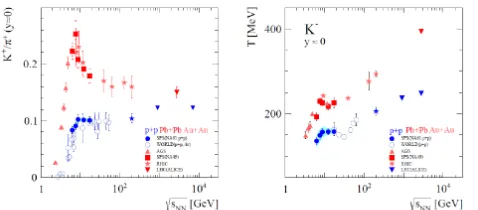
mea-surements allows to calculate the ratio of yieldsK+/π+. The energy dependence of the K+/π+
ra-tio at midrapidity for inelastic p+p interactions and central Pb+Pb/Au+Au collisions is presented in
Fig. 2 (left). The NA61/SHINE data suggest that even in inelastic p+p interactions the energy
de-pendence of the K+/π+ ratio exhibits rapid changes in the SPS energy range. However, the horn
structure [2] observed in central Pb+Pb collisions is reduced to a step. Data obtained beyond the SPS
energy range, namely at RHIC and LHC [3–7], continue the trend seen at the SPS.
Figure 1.Schematic view of the NA61/SHINE detector system.
Figure 2. Energy dependence of theK+/π+ratio (left) and of the inverse slope parameter T ofK−transverse
mass spectra (right) in p+p interactions compared to Pb+Pb and Au+Au collisions.
The inverse slope parameters T forπ, K and p of the spectra of transverse massmT =
p2 T+m2
were fitted in inelastic p+p reactions. Fig. 2 (right) presents the energy dependence of T for K−in
p+p collision. The NA61/SHINE results from inelastic p+p collisions exhibit rapid changes like those
observed in central Pb+Pb interactions. World data for p+p and Pb+Pb/Au+Au reactions are plotted
for a comparison and were taken from Refs. [6, 8–10].
The dependence of the mean pion multiplicity divided by the mean number of wounded nucleons (participants) as function of collision energy, the so called kink plot, is shown for inelastic p+p, Ar+Sc
and A+A interactions in Fig. 3. The pion multiplicityπin the SPS energy range increases faster in central Pb+Pb than in p+p collisions. The two dependencies cross at about 40AGeV/c. For high
SPS energies results from Ar+Sc reactions follow the Pb+Pb trend while for low SPS energies Ar+Sc
follows the p+p tendency. The situation is opposite for Be+Be collisions.
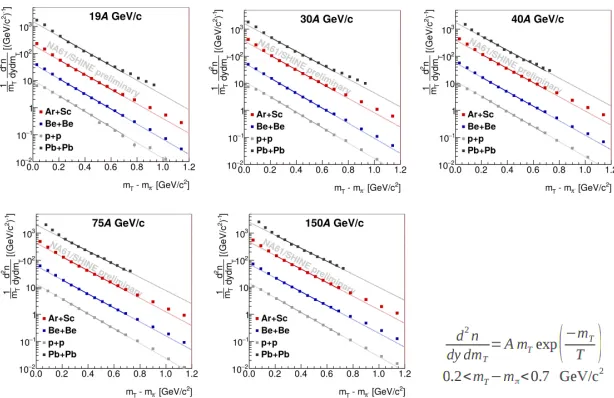
Spectra of transverse massmT−m0ofπ−mesons in Ar+Sc are shown and compared to
measure-ments for p+p, Be+Be, and Pb+Pb collisions in Fig. 4. Spectra in p+p reactions are exponential. A
concave shape is observed in Pb+Pb, Ar+Sc and Be+Be collisions. The shape difference between
Figure 1.Schematic view of the NA61/SHINE detector system.
Figure 2. Energy dependence of theK+/π+ratio (left) and of the inverse slope parameter T ofK−transverse
mass spectra (right) in p+p interactions compared to Pb+Pb and Au+Au collisions.
The inverse slope parameters T forπ, K and p of the spectra of transverse massmT =
p2 T+m2
were fitted in inelastic p+p reactions. Fig. 2 (right) presents the energy dependence of T for K−in
p+p collision. The NA61/SHINE results from inelastic p+p collisions exhibit rapid changes like those
observed in central Pb+Pb interactions. World data for p+p and Pb+Pb/Au+Au reactions are plotted
for a comparison and were taken from Refs. [6, 8–10].
The dependence of the mean pion multiplicity divided by the mean number of wounded nucleons (participants) as function of collision energy, the so called kink plot, is shown for inelastic p+p, Ar+Sc
and A+A interactions in Fig. 3. The pion multiplicityπin the SPS energy range increases faster in central Pb+Pb than in p+p collisions. The two dependencies cross at about 40AGeV/c. For high
SPS energies results from Ar+Sc reactions follow the Pb+Pb trend while for low SPS energies Ar+Sc
follows the p+p tendency. The situation is opposite for Be+Be collisions.
Spectra of transverse massmT−m0ofπ−mesons in Ar+Sc are shown and compared to
measure-ments for p+p, Be+Be, and Pb+Pb collisions in Fig. 4. Spectra in p+p reactions are exponential. A
concave shape is observed in Pb+Pb, Ar+Sc and Be+Be collisions. The shape difference between
p+p and A+A reactions is attributed to transverse collective flow in A+A.
Figure 3. Mean pion multiplicity divided by the mean number of wounded nucleons as function of collision
energy, the so called kink plot, for inelastic p+p, Ar+Sc and A+A interactions. The Fermi variableF≈s0NN.25was
used as energy measure.
Figure 4. Spectra of transverse massmT−m0 ofπ−mesons in Ar+Sc compared to p+p, Be+Be, and Pb+Pb
collisions.
3
Λ
spectra in p+p interactions
The transverse momentum distributions ofΛhyperons shown in Fig. 5 (left) are for inelastic p+p
col-lisions at a beam momentum of 40 GeV/c. The yields are corrected for acceptance and for losses due
to the topological and track selection cuts. Integration and extrapolation of the transverse momentum distributions provide the data points for the distributions of rapiditydn/dyand the Feynman variable dn/dxF. The Feynman variable distribution ofΛhyperons produced in inelastic p+p reactions at
40 GeV/c is shown in Fig.5 (right).
TheΛcross-section produced in inelastic p+p interactions at 40 GeV is presented in Fig. 5 (left).
Results are shown as function of transverse momentum in rapidity intervals. Fig. 5 (right) depicts the dependence of theΛproduction cross-section as function ofxF together with the extrapolation line
(GeV/c) T p 0 0.4 0.8 1.2 1.6 2 (mb/(GeV/c)) T
/dydp σ 2 d 0.5 1 (-1.25;-0.75) ∈ y
0 0.4 0.8 1.2 1.6 2 0.5
1 (0.25;0.75)
∈
y (GeV/c)
T p 0 0.4 0.8 1.2 1.6 2 (mb/(GeV/c)) T
/dydp σ 2 d 0.5 1 (-0.75;-0.25) ∈ y
0 0.4 0.8 1.2 1.6 2 (mb/(GeV/c)) T
/dydp σ 2 d 0.5 1 (0.75;1.25) ∈
y (GeV/c)
T p 0 0.4 0.8 1.2 1.6 2 (mb/(GeV/c)) T
/dydp σ 2 d 0.5 1 (-0.25;0.25) ∈ y (GeV/c) T p 0 0.4 0.8 1.2 1.6 2 (mb/(GeV/c)) T
/dydp σ 2 d 0.5 1 (1.25;1.75) ∈ y 0 0
Figure 5.Λproduction cross section in p+p interactions at 40 GeV/c beam momentum. Left:pTdistributions in rapidity intervals. The lines are the result of fits to the experimental points. Right:pT integrated cross-section as function ofxF. The dotted line was used to extrapolate to the totalΛyield.
Extrapolation of thexFdistributions into the unmeasured region provides estimates of theΛyields.
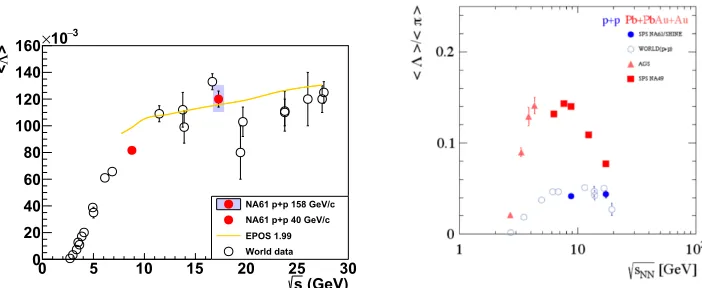
The corresponding multiplicities (average yields per event) are compared to world data in Fig. 6 (left) as function of center-of-mass energy√sNN. The NA61 data follow the trend set by the world data and
at the same time reduce the uncertainties of the yields significantly at the two energies analysed by NA61. Above√sNN=19 GeV the experimental data have large errors and lie consistently below the
EPOS model calculation. It is desirable to obtain new experimental data in this energy range. Below 10 GeV EPOS seems to overpredictΛyields. However, this model is not meant to provide reliable
results at this energy and below. The ratioΛ/πis shown in Fig. 6 (right) as function of √sNN.
The presented NA61/SHINE results agree with the world data. Measurements in A+A collisions at
the AGS and by NA49 show a different behaviour than that observed in p+p reactions.
(GeV) s
0 5 10 15 20 25 30
> Λ < 0 20 40 60 80 100 120 140 160×10−3
NA61 p+p 158 GeV/c NA61 p+p 40 GeV/c EPOS 1.99 World data
(GeV/c) T p 0 0.4 0.8 1.2 1.6 2 (mb/(GeV/c)) T
/dydp σ 2 d 0.5 1 (-1.25;-0.75) ∈ y
0 0.4 0.8 1.2 1.6 2 0.5
1 (0.25;0.75)
∈
y (GeV/c)
T p 0 0.4 0.8 1.2 1.6 2 (mb/(GeV/c)) T
/dydp σ 2 d 0.5 1 (-0.75;-0.25) ∈ y
0 0.4 0.8 1.2 1.6 2 (mb/(GeV/c)) T
/dydp σ 2 d 0.5 1 (0.75;1.25) ∈
y (GeV/c)
T p 0 0.4 0.8 1.2 1.6 2 (mb/(GeV/c)) T
/dydp σ 2 d 0.5 1 (-0.25;0.25) ∈ y (GeV/c) T p 0 0.4 0.8 1.2 1.6 2 (mb/(GeV/c)) T
/dydp σ 2 d 0.5 1 (1.25;1.75) ∈ y 0 0
Figure 5.Λproduction cross section in p+p interactions at 40 GeV/c beam momentum. Left:pTdistributions in rapidity intervals. The lines are the result of fits to the experimental points. Right:pTintegrated cross-section as function ofxF. The dotted line was used to extrapolate to the totalΛyield.
Extrapolation of thexFdistributions into the unmeasured region provides estimates of theΛyields.
The corresponding multiplicities (average yields per event) are compared to world data in Fig. 6 (left) as function of center-of-mass energy√sNN. The NA61 data follow the trend set by the world data and
at the same time reduce the uncertainties of the yields significantly at the two energies analysed by NA61. Above √sNN=19 GeV the experimental data have large errors and lie consistently below the
EPOS model calculation. It is desirable to obtain new experimental data in this energy range. Below 10 GeV EPOS seems to overpredictΛyields. However, this model is not meant to provide reliable
results at this energy and below. The ratioΛ/πis shown in Fig. 6 (right) as function of √sNN.
The presented NA61/SHINE results agree with the world data. Measurements in A+A collisions at
the AGS and by NA49 show a different behaviour than that observed in p+p reactions.
(GeV) s
0 5 10 15 20 25 30
> Λ < 0 20 40 60 80 100 120 140 160×10−3
NA61 p+p 158 GeV/c NA61 p+p 40 GeV/c EPOS 1.99 World data
Figure 6.Left:Λmultiplicity in p+p interactions as function of √sNNtogether with world data and results from calculations with the EPOS model. Right: mean multiplicity ofΛhyperons divided by the meanπmultiplicity.
Acknowledgments
This work was supported by the Polish Ministry of Science and Higher Education (grants 667/
N-CERN/2010/0, NN 202 48 4339 and NN 202 23 1837), the Polish National Center for Science
(grants 2013/11/N/ST2/03879, 2014/12/T/ST2/00692, and 2015/18/M/ST2/00125),
References
[1] N. Abgrallet al.,JINST 9, P06005, (2014) [2] C. Altet al.,Phys. Rev. C 77, 024903, 2008
[3] M. Gazdzicki and D. Roehrich,Z. Phys. C 65, 215, 1995 [4] M. Gazdzicki and D. Roehrich,Z. Phys. C 71, 55???64, 1996 [5] I. Arseneet al.,Phys. Rev. C 72, 014908, 2005
[6] K. Aamodtet al.,Eur. Phys. J. C 71, 1655, 2011 [7] B. Abelevet al.,Phys. Rev. Lett. 109, 252301, 2012
[8] M. Kliemant, B. Lungwitz and M. Gazdzicki,Phys. Rev. C 69, 044903, 2004 [9] B.I. Abelevet al.,Phys. Rev. C 79, 034909, 2009