A Novel Algorithm For Generation Rescheduling Based
Congestion Management
Pawan C. Tapre
1, Dr. Dharmendra kumar Singh
2Dr. Sudhir Paraskar
3Department of Electrical Engineering, CVRU, Ph.D. Scholar, Bilaspur (C.G.), (India)
Department of Electronics Engineering, Associate Professor,CVRU, Bilaspur (C.G.),(India)
Department of Electrical Engineering, Professor SSGMCE, Shegaon(M.S.), (India)
ABSTRACT
The practitioners and researchers has received considerable attention solving complex optimization problems with metaheuristic algorithms during the past decade. Many of these algorithms are inspired by various phenomena of nature. One of the promising solutions for secure and continuous power flow in the transmission line is rescheduling based congestion management approach but the base problem is rescheduling cost.. To solve the congestion with minimized rescheduling cost , a new population based algorithm, the Lion Algorithm (LA), is introduced in this paper . The basic motivation for development of this optimization algorithm is based on special lifestyle of lions and their cooperation characteristics. Based on some benchmark Lion Algorithm (LA) is compared with the existing conventional algorithms such as Particle Swarm Optimization (PSO), Genetic Algorithm (GA), Artificial Bee Colony (ABC), and Firefly (FF) by analyzing the convergence, cost, and congestion. In IEEE 30 bus system experimental investigation is carried out and the obtained results by the proposed algorithm LA (Lion Algorithm) in comparison to the other algorithms used in this paper.
Keywords: Rescheduling; congestion management; Optimization algorithm; LA
I.
INTRODUCTION
To solve complex problems[2] in research field nature-inspired computing [1] intends with uncertainty, only based on natural inspiration[3], imprecise and high conflicts, partially true. A nature-inspired computing [4] is bio-inspired computing, starts emerging from the day of nature‟s behavior is be executed for solving real life problems [5].
In all the emerging fields[8],[9] the application of the bio-inspired optimization algorithm are going to used. 1970 [6], [7] . Evolutionary algorithms and Swarm intelligence is two category of the bio-inspired optimization algorithm[10],[11]. A new search algorithm called as Lion‟s Algorithm(LA) is proposed based on social behavior in this paper . Strongest mammal in the world is Lion due to its unique social behavior. On the basis of the behavior the Lion‟s algorithm is formulated to search for optimal solution in a huge search space.
Based on lion‟s unique social behavior a novel optimization algorithm Lion Algorithm (LA) is introduce in this paper.. to solve a minimization problem a simple LA model was proposed [12] in this paper. Hence, the main contributions of the paper is as follows:
To solve large scale system problem we studies the performance competency o the algorithm.
solve the objective model in such a way that, the congestion management is accomplished.
To accomplish congestion management, adaptive searching behaviour and swarm intelligence are incorporated with LA. The rest of the paper is organized as follows Section II gives literature review, Section III Inspiration, Section IVgives the
model of rescheduling based congestion management, Section V gives the steps of the lion algorithm , Section VI gives the
results and discussion and Section VII gives the references.
II.
LITERATURE REVIEW
The features and challenges of the literature review are analysed. It reveals the significance of adopted stochastic search
methodologies for congestion management in a deregulated electrical market. Those meta-heuristic methods include Firefly
algorithm [13],[14], PSO[15],[16] , and ALO [17] algorithm. Although these aforementioned algorithms are applied for
congestion management, it needs to adopt significant improvements to meet the challenges yet. Firefly algorithm is a
reliable, secure and inexpensive algorithm, however, in some cases; it gets struck into local minima. Moreover, the
parameters of the algorithm are independent of time and memory power is very low. Subsequently, PSO algorithm is highly
utilized for reducing the cost of rescheduling of generators and it has the ability to handle the congestion management under
small and large networks with less computational time, but the premature convergence is a leading issue under this
algorithm. On the other hand, ALO requires only less number of fitness evaluations which provides effective convergence;
however, it may cause complexity in solving discrete problems. Therefore, it is essential to maintain the congestion
management in a deregulated electrical environment through the implementation of an effective optimization algorithm.
III.
INSPIRATION
Lions are the most socially inclined species which display high levels of cooperation and antagonism [18] and strong sexual dimorphism in both social behavior and appearance. The lion has two types of social organization: residents and nomads. Pride [19] is a group of residents lion. Group of about five females, their cubs of both sexes, and one or more than one adult males is called Pride. Due to sexual maturity the young males are excluded from their birth pride. Nomads is the second types of organizational, who move either in pairs or singularly. A lion may switch their lifestyles; residents may become nomads and vice versa.[19].
Lions typically hunt together with other members of their pride. Coordinated group hunting brings a greater probability of success in lion hunts. The male lions and some of lionesses usually stay and rest while waiting for the hunter lionesses to return from the hunt. Lions do mate at any time of the year, and the females . A lioness may mate with multiple partners when she is in heat [20] . In nature, male and female lions mark their territory and else-where, which seems a good place with urine.
In this work in order to an optimization algorithm, some characters of lions are mathematically modeled. In this algorithm initial population, referring to as a specified size is formed by the lions. There are few lions other than the resident lion in this population which are turned as no made lions. Percentage of the prides members consist of the female and the rest are males while this male is nomade lion is vice versa.
The Nomade lion also has to move around in search of space randomly to find a better plane for themselves. Sometimes, there can be a case where overpowered by the nomad lions, the resident males are driven out of the pride, turning the nomad lions into resident lions. There are a few females lions who tend to immigrate from one pride to another, and also change their lifestyles to turn to be Nomads and vice versa in the course of evolution. The weak way die or be killed by another lion due to many other factors and rules of the nature.
IV.
MODEL OF RESCHEDULING BASED CONGESTION MANAGEMENT
A. Congestion Cost
The cost of rescheduling is defined here as congestion cost as mentioned in eq. (1)
C
C
P
j
D
jP
Gj
n
N j G j total g
/
))$
(
)
(
(
(1)where,
C
totalrefers to the cumulative cost of modifying the active power output ($/n),g
j
j
N
C
:
1
,
2
,
,
andD
j refer to price bids for incremental power and decremental power in $/MWnbyjth GENCO,
P
G(
j
)
andPG(j) are the active power increment of the generator(MW) and active power decrement of the generator(MW) respectively.B. Constraints:
The minimization of rescheduling cost has to be formulated as constrained minimization function.
Consider PG:0jNg(MW), where PGdenotes the change in power generated by MW for a cost of )
( PG
f in $ for Gthgeneration unit. The minimization function can be defined as
g N j G G G P j P f S 1 * minarg (3)
The constraints given below.
(i) Generation capacity constraint:
PGmin PG PGmax (4)
where, PG refers to the quantity of active power that is generated in MW,PGmin and
max
G
P
denotes the minimum and maximum quantity generated in MW.(ii) Real power balance constraints:
01
PD TL
g N
j
G P P
P (5)
Where,
P
PD andP
TL denote the power demand and transmission losses in MW.(iii) Stability Limits:
V
Gmin
V
G
V
Gmax (6)
minG
G
Gmax (7)
P
G2
Q
G2
(
S
Gmax)
2 (8)In eq. (6) and (7),
V
Gmin,
V
Gmax
and
max min
,
GG
are voltage and angle limits that define voltage stabilityfrom the generator.
P
G2,Q
G2denotes the power flow in MVA andS
Gmaxrepresents maximum power flow limit.(iv) Ramp up limits:
For equal up and down rescheduling costs, the ramp limits can be defined as
PGmin PGPGmax (10)
where,
P
Gminand
P
Gmaxare changes in minimum and maximum quantity generated in MW.C. Objective Model:
The cost of
f
P
g forj
thgeneration unit is defined as the sum of cumulative cost for rescheduling and the violation level on the voltage of the respective transmission line. The cost function to define the rescheduling strategy is given below.f
Pg CtotalPprofileCprofilePconstraintsCconstraints (11)Where,
P
constraints andP
profiledenote the penalty cost imposed on violating the constraints and voltage profile, respectively.V.
STEPS OF THE PROPOSED LION ALGORIHTM
In recent days, LA-based rescheduling strategy is a advanced optimization algorithm, which is based on social behaviour of lions, has become popular. Hence, this paper adopts LA to solve the objective model, as given in eq. (11) and so the congestion can be minimized.
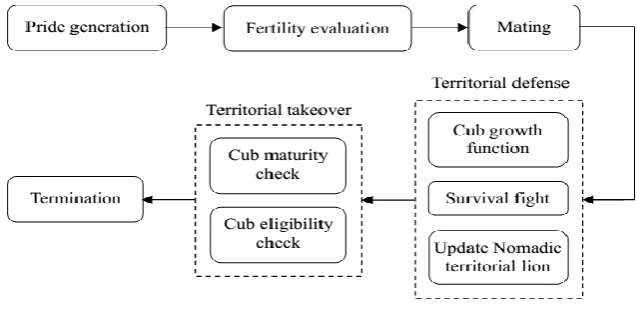
The description of the steps of LA algorithm as illustrated in fig.2 is explained below. 1. Pride Generation
2. Fitness Evaluation 3. Fertility Evaluation 4. Mating
5. Territorial Defence 5a.Cub growth function 5b Survival fight
5c. Update Nomadic territorial lion 6. Territorial Take over
6a Cub maturity check 6b Cub eligibility Check 7. Termination
Step 1:PrideGeneration: From existing ssolutions, some solution is derived which are known as Cubs and a solution to be determined is known as Lion.. There are two arbitrarysolutions which are initiated from Pride one is male and other is
female. For generating a unique solution pride generation is responsible.
Step 3: Evaluation of Fertility: First, the fitness of male lion, female lion and nomad lion are determined.The algorithm 1 shows the pseudo code of fertility evaluation. By inspecting the fertility of both lion and lioness, the convergence problem
that arrived at the local optima is evaluated.
Step 4:Mating: Mating is generally process in which new best solutions is derived from the existing solutions. It includes crossover and mutation for deriving new solutions.
Step 5: Territorial Defence :
(a)Cub growth function: In this step, the generated cubs are allowed to random mutation with the mutation level. If the old cubs are lesser than the newly muted cub, then the old cubs are replaced by newly muted cubs.
(b)Territorial Defence: Territorial defence is the process in whichwe evaluating the existing solution and newlygenerated solution . Also in this process if new solution is better than existing solution we replacing existing solution by new solution
The pseudo code of territorial defence is illustrated in algorithm 2.
Step 6: Territorial Takeover: The best male and female solutions which derived is known as territorial takeover.. The pseudo code of territorial takeover is shown in algorithm 3.
ALGORITHM 1: PSEUDO CODE OF FERTILITY EVALUATION
Input: Lmale,Lfemale, freference,Strate and Lrateg
Output: Lmale, Lfemale, freference, Strate and Lrateg
// Lmale Evaluation
If freferencef
Lmale1 rate g rate g L L else
Reset Lrateg
male referenceL f
f
End if
// Lmale Evaluation If Strate is not adequate
Set fc
u and fc
g to zero Do
Compute Lfemale
1 fc c f
g g
If f
Lfemale
f Lfemale
1 c f u female female L L
Reset Strate
ALGORITHM 2: PSEUDO CODE OF TERRITORIAL DEFENCE
Obtain nomad coalition
Choose Lenomad
If Lenomad wins
nomad e male
L L
Eliminate Lenomad from the nomadic world Kill Lmcuband Lfcub
Reset age(cubs)
Defence result1
Else
Update nomad coalition
Defence result0
End if
Till gfc reaches gfc
max
T
ABLE–I
Generation Limits And Cost Coefficents Of IEEE 14 Bus System
VII.RESULTS AND DISCUSSION
A. Experimental Setup
The implementation of proposed rescheduling based congestion management is developed in the working platform of
MATLAB. The experimentation is carried out in IEEE benchmark test bus systems such as IEEE 14 bus system. The system
consists of loads, capacitor banks, transmission lines, and generators. Here in IEEE 14 bus system, three GENCOs are
connected. Accordingly, Table I show the generation limits and cost coefficients of the IEEE 14 bus system. Moreover, the
performance of LA-based rescheduling strategy is compared with other conventional rescheduling techniques such as
PSO-based rescheduling strategy, GA-PSO-based rescheduling strategy, ABC-PSO-based rescheduling strategy, and FF-PSO-based rescheduling
strategy using convergence analysis, cost analysis, and congestion analysis.
B.
Convergence Analysis
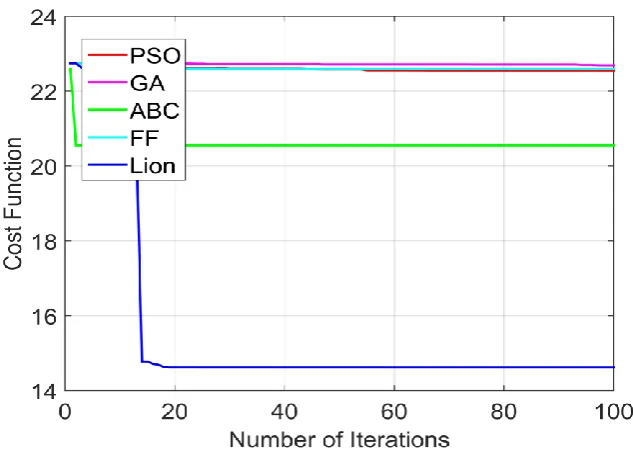
The convergence analysis of the proposed optimal congestion management technique and conventional techniques from various bus systems are shown in fig 2. The convergence of all the techniques is analysed by the ability to minimize the cost function in correspondence with the number of iterations. In the rescheduling process performed for IEEE 14 bus system, the rescheduling cost incurred by LA is extremely lesser than the conventional algorithms such as PSO, GA, ABC and FF. Initially, the cost function is found to be at peak level and as the number of iteration increases, the rescheduling cost incurred by LA gets minimized. Moreover, the rescheduling strategy with minimized cost is observed at the last iteration, i.e., 100th iteration. From the convergence analysis on IEEE Fourteen (IEEE-14) bus system, it is observed that the rescheduling cost minimization occurred by LA is 28% better than ABC and 35% better than the other conventional methods PSO, GA, and Firefly respectively.
As a result, it is concluded that the performance level of LA in rescheduling process is exceeding abundantly when compared with the existing congestion management techniques.
ALGORITHM 3: PSEUDO CODE OF TERRITORIAL TAKEOVER.
Input: Lmale Lmcub LfemaleLfcub Strate
Iff
Lmale f Lmcub
cub m male
L L
End if female old
L L
If f
Lfemale
Lfcubcub f female
L L
If LfemaleLold
Clear Strate
Fig 2 Demonstration of convergence analysis by PSO,GA,ABC,FF
and Lion Algorithm LA from IEEE- 14 bus systems
C.
StatisticaReport
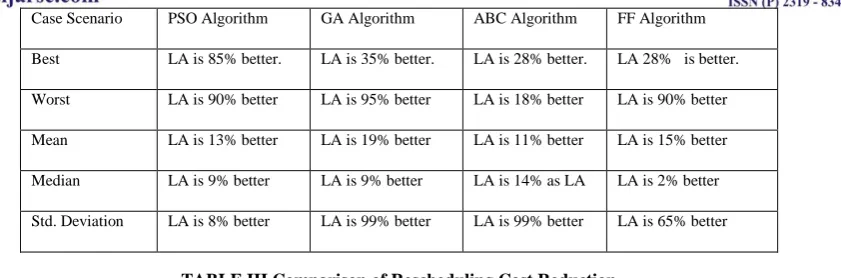
Table II show the statistical reports on the minimized rescheduling cost obtained from LA-based rescheduling strategy and other conventional rescheduling algorithms. The statistical parameters include best case, worst case, mean performance, median performance and the standard deviation (also referred as Std in the Tabulations) between the mean and the individual performances. Table II show comparison of rescheduling cost reduction in percentage by LA With Conventional methods From IEEE 14 Bus System.
TABLE-II Stastical Report On Rescheduling Cost Reduction By La With Convetional
Methods From IEEE 14 Bus System
Generator
number Pi
min
(MW) Pi
max
(MW) ai
($/MWhr) bi
($/MWhr) ci
($/hr)
1 10 160 0.005 2.450 105.00
2 20 80 0.005 3.510 44.100
3 20 50 0.005 3.890 40.600
TABLE III Comparison of Rescheduling Cost Reduction
in Percentage By LA With Conventional Method From IEEE 14 BuS System
All together we can finalize that the rescheduling cost minimization by LA-based rescheduling strategy is more effective when compared to the other conventional methods.
D.
Cost Analysis
Table IV and Table V summarizes the congestion cost, compensation cost and final cost incurred by LA-based rescheduling strategy and other existing algorithms from IEEE 14 bus systems. On the basis of comparison, it is found that LA is better than GA, PSO & ABC Algorithms.
TABLE IV. Cost Analysis Of Rescheduling Cost Incurred By La With Conventional Methods From IEEE 14 Bus System
TABLE V. Comparison In Percentage of LA With Other Algorithm
From IEEE 14 Bus System
E.
Congestion Analysis
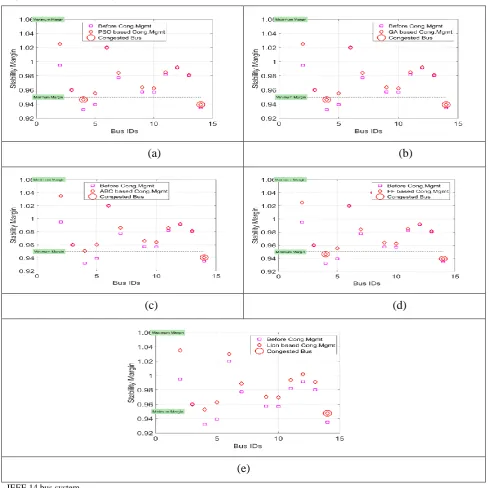
The congestion analysis of the proposed optimal congestion management technique and conventional techniques from two bus systems IEEE 14 bus system are shown in fig.3.
Case Scenario PSO Algorithm GA Algorithm ABC Algorithm FF Algorithm
Best LA is 85% better. LA is 35% better. LA is 28% better. LA 28% is better.
Worst LA is 90% better LA is 95% better LA is 18% better LA is 90% better
Mean LA is 13% better LA is 19% better LA is 11% better LA is 15% better
Median LA is 9% better LA is 9% better LA is 14% as LA LA is 2% better
Std. Deviation LA is 8% better LA is 99% better LA is 99% better LA is 65% better
Methods Congestion cost ($) Compensation cost ($) Final cost ($)
PSO
14.495
805.59
22.551
GA
14.48
821.06
22.691
ABC
9.3972
1115.3
20.55
FF
14.495
809.47
22.589
LA
2.5485
1206.5
14.614
Name of
Algorithm
GA Based Rescheduling
Strategy
GA Based
Rescheduling Strategy
PSO Based Rescheduling
Strategy
ABC Based
Rescheduling Strategy
Fig. 3 Demonstration of congestion analysis by PSO,GA,ABC,FF and LA from IEEE bus systems (a),(b),(c),(d),(e) from
IEEE 14 bus system
Fig.3(a), fig.4(b), fig.4(c), fig.4(d) and fig.4(e) explains how the corresponding congestion management techniques
performed from IEEE 14 bus system to minimize the congestion that occurred in buses. Initially, below the minimum
margin, there are two congested buses and fig.(a), (b), (c), (d) represents the congestion management by PSO, GA, ABC, and
FF, in such a way that congestion is recovered. However, it is not so effective when compared to congestion management
technique LA as shown in fig. (e), LA makes a drastic change by which the congested buses are reduced from two to one.
Here the efficiency of LA is higher than the other conventional methods. Thus we can say that LA leads the position in terms
of performance while comparing with the other techniques.
VI.
CONCLUSION
In recent years, generation rescheduling is the technique adopted to provide power system security and continuous power supply without congestion in the transmission line. However, rescheduling of the generator is
(a)
(b)
(c)
(d)
one of the congestion management approaches, which also raises the challenge of minimizing the rescheduling cost. In the view of that, rescheduling cost was minimized in this paper by exploiting LA algorithm and, further the performance was compared with the conventional algorithms such as PSO, GA, ABC, and FF respectively. This comparison was substantiated by analysing the convergence, cost, and congestion mitigation of the entire algorithms. Thus, it is concluded that the performance of the LA-based rescheduling strategy is superior to the existing conventional methods by minimized rescheduling cost in computation.
REFERENCES
[1] Rozenberg, G., Bck, T., Kok, J., 2011,”Handbook of Natural Computing in Springer Publishing Company 1st Ed.
[2] Liu.J, Tusi K.C. 2006, “Toward nature-inspired computing,” University of Michigan Press, Aaa Arbor. [3] Zhang J., 2009, “Advances in Fuzzy Method for Natural Computing,” IEEE Ninth International Conference
on Hybrid Intelligent Systems 2p18-23
[4] Shadbolt, N., 2004. Nature-inspired computing,” IEEE journal on Intelligent Systems 19(1), p. 2-3.
[5] Souza, J.G., Costa J.A.F., 2009, “ Unsupervised data clustering and image segmentation using natural computing techniques, „IEEE International Conference on System, Man and Cybernetics p. 5045-5050. [6] Rechenberg,I.,1973 Evolutionstrategie :Optimierung Technisher System each Prinzipien des Biologischen
Evolution Fromman Hozlboog Verlag, Stuttgart, (German)
[7] Holland, J.H.,1975, “Adaptation in natural and artificial systems,” University of Michigan Press, Aaa Arbor. [8] Bongard, J.,2009, “Biologically Inspired Computing ,” IEEE Computer Journal 42940,p 95-98.
[9] Forbes, N., 2000, “Biologically Inspired Computing,” Computing in Science & Engineering 2(6), p. 83-87. [10] David, E.G. 1989, “Genetic Algorithm in Search Optimization and Machine Learning, ” Addison
Wesley, p 41 n,
[11] Storn, R. 1996. "On the usage of differential evolution for function optimization," Biennial Conference of the North American Fuzzy Information Processing Society (NAFIPS),p 519
[12] B.R. Rajakumar, “Lion Algorithm for Standard and Large Scale Bilinear System Identification: A Globle Optimization Based on Lion‟s Social Behaviour.
[13] Md Sarwar and Anwar Shahzad Siddiqui, "Anefficient particle swarm optimizer for congestion management in deregulated electricity market ", Journal of Electrical Systems and Information Technology, vol. 2, no. 3, pp.269–282,December 2015.
[14] Sadhan Gope, Arup Kumar Goswami, Prashant Kumar Tiwari and Subhasish Deb, "Rescheduling of real power for congestion management with integration of pumped storage hydro unit using firefly algorithm", International Journal of Electrical Power & Energy Systems, vol. 83, pp. 434-442, December 2016. [15] Sumit Verma and V. Mukherjee, "Firefly algorithm for congestion management in deregulated
environment", Engineering Science and Technology, an International Journal, vol.19, no.3, pp. 1254-1265, September 2016.
[17] S. Verma and V. Mukherjee, "Optimal real power rescheduling of generators for congestion management using a novel ant lion optimiser," IET Generation, Transmission & Distribution, vol. 10, no. 10, pp. 2548-2561, 2016.
[18] Mccomb, K, et al. Female lions can identify potentially infanticidal males from their roars. Proc. R. Soc. Lond. Ser B: Biol. Sci. 1993;252 (1333)59–64.
[19] Schaller GB. The Serengeti lion: a study of predator–prey relations.Wildlife behavior and ecology series. Chicago, Illinois, USA: University of Chicago Press; 1972.
[20] S.B., Hrdy, 7 Empathy, polyandry, and the myth of the coy female, Conceptual Issues in Evolutionary Biology, 2006: p. 131.
[21] B.R. Rajakumar , “The Lion‟s Algorithm : A New Nature-Inspired Search Algorithm.