467 | P a g e
RAT TRAP BOND MASONRY
Aditya Joshi
1, Krunal Rakholiya
2, Jay Rangani
3, Harshal Gangode
4,
Mateen Khan
5, M. V. Rao
6, Gaurav Ahire
7, Kalyani Sarode
81,2,3,4,5
Student, Dept. of civil engineering, Sandip Polytechnic, (India)
6,7,8
Proff., Dept. of civil engineering, Sandip Polytechnic, (India)
ABSTRACT
The need of alternative building technologies and materials has arisen in the past few years. Fortunately, there are many such options available at our disposal which when used in suitable combinations can save huge amounts of money and hence can result in affordable construction costs. One such building technique is the use of ‘RAT TRAP BOND’ masonry.
Contrary to other technologies, this amazing building technology is not new to us. RTB was first introduced in India in 1970, by renowned Architect Sir Laurie Baker. Since then, it has been used in many Government buildings and small village panchayats. In this modern age, we have overlooked this extremely useful technology which, while providing the same strength to the walls also saves us time and labor and also material cost to the extent of about 23% when compared with a standard 230mm brick masonry wall.
In this project we have outlined the importance of RTB technology along with the construction details and also provided some comparative calculations to highlight the savings that can be achieved against the conventional solid brickwork.
Keywords: Affordable Housing, Cost Effective Construction Technology, Design And Construction
I INTRODUCTION
1.1 History of Indian Construction Industry
Construction Industry is as old as human race. Primitive people built shelters from naturally available vegetation and caves.
The period from 1950 to mid 60's witnessed the government playing an active role in the development of these services and most of construction activities during this period were carried out by state owned enterprises and supported by government departments. In the first five-year plan, construction of civil works was allotted nearly 50 per cent of the total capital outlay.
468 | P a g e
(NBCC), Rail India Transportation and Engineering Services (RITES), Engineers India Limited (EIL), etc.) and private sector (M N Dastur and Co., Hindustan Construction Company (HCC), Ansals, etc.).
In India Construction has accounted for around 40 per cent of the development investment during the past 50 years. Around 16 per cent of the nation's working population depends on construction for its livelihood. The Indian construction industry employs over 3 crore people and creates assets worth over -20,000 crores.
It contributes more than 5 per cent to the nation's GDP and 78 per cent to the gross capital formation. Total capital expenditure of state and central govt. will be touching X8,02,087 crores in 2011-12 from d,43,587 crores (1999-2000).
The share of the Indian construction, sector in total gross capital formation (GCF) came down from 60 per cent in 1970-71 to 34 per cent in 1990-91. Thereafter, it increased to 48 per cent in 1993-94 and stood at 44 per cent in 1999-2000. In the 21 st century, there has been an increase in the share of the construction sector in GDP and capital formation.
1.2 Current Scene
The Indian construction industry comprises 200 firms in the corporate sector. In addition to these firms, there are about 1,20,000 class A contractors registered with various government construction bodies. There are thousands of small contractors, which compete for small jobs or work as sub-contractors of prime or other contractors. Total sales of construction industry have reached 42,885.38 crores in 2004-05 from 221,451.9 crores in 2000-01.
The Indian real estate sector has rebounded strongly in the post crisis environment, supported by an innate, robust appetite for housing, and other favorable economic and sector drivers. The main economic drivers are sustained high levels of output growth and rising disposable incomes, which are fuelling an era of consumerism. Within the real estate sector, an expanding middle-class population and rapid urbanization rates, coupled with supportive policy measures, are the key factors driving growth.
Consequently, a significant level of demand is estimated to exist across segments in the Indian real estate market, waiting to be tapped and monetized.
Table 1: Demand Projections for Top 7 Cities
Residential 4.25 Million Units Office 240 Million Sq. Ft. Retail 161 Million Sq. Ft. Hospitality 78 Million Room Nights Source : Cushman & Wakefield, Aranca Research
469 | P a g e
cumulative residential demand stands at 4.25 million units. Tier I cities like Mumbai and the National Capital Region (NCR) are expected to account for 40% of this additional demand. Mumbai is forecasted to register the highest cumulative demand growth of 23%, with the NCR ranking second at 20%.
In Tier 1 cities, a large influx of migrants is causing housing demand to surge. The rapid urbanization and modernization has effected in a socio-cultural shift which is providing an additional fillip to housing demand in India.
1.3 Looming Housing Shortage
Despite these blooming facts, we have seen a steady decline in the sales/production ratio and large number of residential units have been remaining vacant in the cities. So, what could be the reason for this drop-down in the sales of real estate properties? A closer look at the market and zooming in the depths reveals some very disturbing facts. Growing concentration of people in urban areas has resulted in an increase in the number of people living in slums and squatter settlements. Skyrocketing prices of land and real estate in urban areas have induced the poor and the economically weaker sections of the society to occupy the marginal lands typified by Poor housing stock, congestion and obsolescence. It is apparent that substantial housing shortage looms in Urban India and a wide gap exists between the demand and supply of housing, both in terms of quantity and quality.
According to a report submitted by a technical committee to the Ministry of Housing and Urban Poverty Alleviation (MHUPA), India's urban housing shortage is estimated at nearly 18.78 million households in 2012. Besides those living in obsolescent houses, 80 percent of these households are living in congested houses and are in requirement of new houses. The report also highlights that nearly one million households are living in non-serviceable katcha houses, while over half a million households are in homeless conditions.
Fig. 1: Urban Housing Shortage in India in 2012
470 | P a g e
II THE CONCEPT OF AFFORDABLE HOUSING
2.1 Defining Affordable Housing:
Affordability', per se, is a nonspecific term, the meaning of which changes with the context being considered. As a result, there is no fixed definition of affordable housing that can be applied uniformly across the world. The definition and scope of affordable housing is greatly contingent on a country/region's level of economic development and income levels.
According to a report on Making Urban Housing Work in India, affordability in the context of urban housing means provision of 'adequate shelter' on a sustained basis, ensuring security of tenure within the means of the common urban household.
According to MHUPA in 2008, affordable housing for various segments is defined by size of the dwelling and housing affordability derived by the household income of the population.
2.2 Need For Affordable Housing:
Housing is one of the basic need of an individual and not all of them do have shelter for their survival. In India alone around 27 MILLION UNITS of housing has been traced to be in shortage. In depth maximum of the population who lack housing are the ECONOMICALLY WEAKER SECTIONS and the MIDDLE CLASS. There is a dire need for the country to patch up this large POPULATION. If we fail to manage with HOUSING and SHELTER within this population, the shortage is sure to increase to 38 million units by 2030. A radical change is the need of an hour! Though PROVIDING SHELTER to millions is a pretty tough and a huge task, there should be a remedy for this solution! Affordable housing is a term we use for residential units in India's urban areas which are affordably priced with respect to households that fall within a specific limited :-come range. There is no single set of parameters to define what an affordable housing unit should cost in India. This is because the pricing and feasibility to developers of affordable housing is a function of the city, location within the city, type of project being built and also the construction technology employed.
In India, it is appropriate to judge the affordability of a home on three broad parameters - the monthly income of prospective buyers from the target segment, the size of the home and, of course, its price. There is another element that should be mentioned, namely the target clientele itself. We tend to look at the word 'affordable' solely in terms of the LIG (lower income group) segment. For this segment, affordable housing would mean 200-300 square foot dwellings priced at between 7-12 lakh. But what about people who earn more than the average factory labourer but still cannot afford to buy a decent 1 BHK flat of 300-450 square feet within ten to fifteen kilometers of their workplaces? They too need affordable housing - housing appropriately priced for the middle class. The home buyers in this segment can afford to buy flats in the price range of Rs. 30-35 lakh via home loans.
Obviously, they expect a certain standard of living, comforts and facilities for this expense. However, but even such flats are hard to come by in our larger cities.
471 | P a g e
population lives in urban locations. Distressingly, a closer look at a city like Mumbai reveals that over 50% of its citizens live in slums. Mumbai's slums occupy less than 4% of the land available in the city.
Despite everything being said on the matter, the shortage of affordable housing in India is getting worse instead of better. The country's urban population of 285 million has multiplied itself by five over the last half century. It is projected that it will continue to increase at this fast pace, and that 50% of all Indians will be living in urban areas by the end of the next three decades. So, if the shortage for housing for the lower income segment stands at 25 million today and there is no increase in the pace of supply of affordable housing launches, what will this figure look like in 30 years?
Let us look at the situation from a real estate market point of view. There is, in fact, a gigantic market for affordable housing in India. Currently, it is valued at anything between Rs. 5-10 trillion. What is really being done to address this huge market - especially the one constituted by the ever-growing middle class? There are ne(t to no government incentives for projects with flats in the Rs. 20-25 lakhs bracket.
The population growth in India's rural areas in the present decade is around 18%, and over 30% in the urban areas. This pattern of urbanization is seen as encouraging, since it seems to indicate that India will attain the global urbanization standard average in the course of the next decade. However, it is also true that this upsurge in our cities' population is putting available civic structures like public transport, water supply, drainage, sewerage and obviously the supply of housing under severe pressure. This raises the question - how are India's real estate developers addressing the problem of insufficient infrastructure in and around their projects in the main cities? The fact is, they can't do much.
Fig. 2: Affordable housing shortage in India
2.3 How Can A House Be Made Affordable:
Now, the very first question that may arise from this discussion is that how on earth could we make a house affordable in this age of skyrocketing prices for consumers? One thing is clear, the land prices are touching heavens and we have no control whatsoever on the hike rate.
But we have other things in our reach. How? The answer is very simple.
472 | P a g e
Which, while being simple to procure on one hand are also functionally sound to be used in construction. Interestingly, many of these materials and techniques are extremely eco-friendly and much cheaper than our normal construction materials and methods. The result being a simple, eco-friendly and cost-effective solution to housing problem, especially for the urban masses. Following is the list of some these extremely useful materials and techniques.
III RAT TRAP BOND MASONRY
The rat trap bond is a masonry technique, where the bricks are used in a way which creates a cavity within the wall, while maintaining the same wall thickness as for a conventional brick masonry wall. While in a conventional English bond or Flemish bond, bricks are laid flat, in a Rat trap bond, they are placed on edge forming the inner and outer face of the wall, with cross bricks bridging the two faces. The main advantage of Rat-trap bond is reduction in the number of bricks and mortar required as compared to English/ Flemish bond because of the cavity formed in the wall. The cavity also makes the wall more thermally efficient. This also reduces the embodied energy of brick masonry by saving number of bricks and the cement-sand mortar. It is suitable for use, wherever one-brick thick wall is required. Since its original dissemination in Kerala in the 1970sby architect Laurie Baker, rat trap bond has been extensively used in every category of building from large institutional complexes, community buildings. Government offices/village panchayats, individual homes both for high income and middle income and also in government supported EWS housing programs. The following figure shows the basic layout difference in the traditional English/ Flemish Bond Masonry methods Vs Rat Trap Bond Masonry.
Fig.3: Various Bonds in Brick Masonry
3.1 Construction Details
473 | P a g e
Chart 1: How chart fin- Rat Trap Bond Masonary Construction Process
3.2 Benefits & Issues
1. By adopting this method of masonry, you can save on approx. 20-35% less bricks and 30-50% less mortar; also this reduces the cost of a 9 inch wall by 20-30 % and productivity of work enhances.
474 | P a g e
3. Rat trap bond wall is a cavity wall construction with added advantage of thermal comfort. The interiors remain cooler in summer and warmer in winters.
4. Rat-trap bond when kept exposed, create aesthetically pleasing wall surface and cost of plastering and painting also may be avoided.
5. Rat trap bond can be used for load bearing as well as thick partition walls. 6. All works such as pillars, sill bands, window and tie beams can be concealed.
7. The walls have approx. 20% less dead weight and hence the foundations and other supporting structural members can suitably be designed, this gives an added advantage of cost saving for foundation. 8. Virgin materials such as bricks, cement and steel can be considerably saved upon by adopting this
technology. It will also help reduce the Embodied Energy of virgin materials and save the production of Green House Gases into the atmosphere.
9. In case for more structural safety, reinforcement bars can be inserted through the cavity till tile foundation.
There are some issues though which have to be dealt with or kept in mind before commencement of construction work during the planning stage. These are mentioned below:
1. Service's installations should be planned during the masonry construction if not exposed.
2. It is most suited where good quality bricks with straight and sharp edges are available -better avoided when good quality and uniform size bricks are not available
3. If the mason is not skilled enough, cement mortar can get wasted by falling into the wall cavity. 4. Needs pre-planning in case of concealed electrical conduiting because chasing brickwork, like in
conventional practice, is not possible. However, this can be taken care of by identifying location of wiring and plumbing in the design and planning stage, so that solid courses of brickwork may be provided in masonry where the conduits will run.
3.3 Performance Validation
Rat trap bond can be very easily adapted for earthquake/seismic strengthening i.e. provision of horizontal tie bands and vertical reinforcement in the brickwork cavity.
The rat trap bond technique has been validated by the Department of Civil Engineering, Anna University Chennai. The results conclude that "the rat-trap bond wall can be safely used for low cost housing having 2 storey with short span not exceeding 4.2 m and with storey height not exceeding 3 m, using bricks of minimum compressive strength 50 kg/cm2 with cement mortar 1:3.
475 | P a g e
IV DESIGN AND CONSTRUCTION
Rat-trap bond masonry can be used to construct a small double storeyed residential building in load bearing construction, using the specific construction details which are followed in this technique. The principal requirement for rat-trap brickwork is the availability of good quality bricks.
4.1 The Guiding Principle
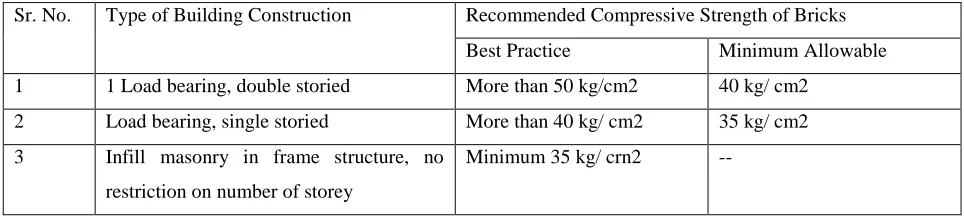
The following can be taken as guiding principle for strength of bricks for Rat-trap brickwork:
The data presented here is for Short Span not exceeding 4.2 meters, and Roof/ Floor Loads as per IS 875.
Table 2: The Strength Requirement Guide
Sr. No. Type of Building Construction Recommended Compressive Strength of Bricks Best Practice Minimum Allowable 1 1 Load bearing, double storied More than 50 kg/cm2 40 kg/ cm2
2 Load bearing, single storied More than 40 kg/ cm2 35 kg/ cm2 3 Infill masonry in frame structure, no
restriction on number of storey
Minimum 35 kg/ crn2 --
4.2 The Criteria for Selection of Bricks
• Although regional variations in the size of bricks are inevitable, the acceptable sizes for the bricks (in the Indian context) are — Length 220-250 mm, Width 100-115inm and Height 65- 75mm.
• The brick should be rectangular with straight and sharp edges.
• It is important that there should be uniformity in the brick size, so that the brickwork can be designed and constructed in a modular pattern and has good strength and finish.
For mortar, the cement-sand proportion depends on the quality of the brick and the building design which determines the load on the masonry. As a guiding principle, a 1:5 (cement:sand) mortar is recommended for compressive strength of brick not less than 50kg/cm2 and 1:4, if the strength is between 35-50 kg/cm2. A thickness of 1/2" is recommended for the mortar joints, however, a slight reduction in the thickness of vertical joints is allowable because the contact area is much smaller at the side of the brick than at the bottom and top. Care must be taken to ensure that the entire vertical joint is filled with mortar; otherwise the brick masonry wall will be prone to leakages.
As per design principles of conventional masonry, the corners and the openings represent the weak areas in masonry and should be designed for adequate strength, depending on factors like building design and the seismic
476 | P a g e
4.3 Modular Design
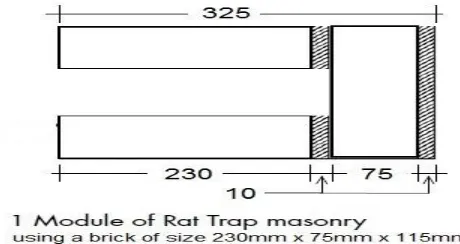
To ensure maximum advantage of the technique, it is preferable that the masonry is designed in a modular pattern at the design stage itself, after the prevailing brick size available for use has been ascertained. For best rat-trap brickwork, there should be no half bricks/ quarter bricks used in brickwork, unlike their common use in
conventional brickwork. This will disturb the staggering of joints in rat-trap brickwork and affect the integrity of brickwork.
Fig. 4: 1 Module of Rat trap Bond Masonry
477 | P a g e
V COST ANALYSIS, ADVANTAGES AND COMPARISION
5.1 The Cost Breakup:
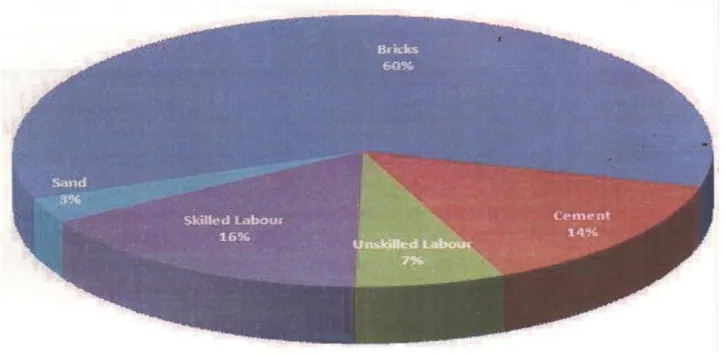
Following is a general cost breakup of a brick masonry built in Rat Trap Bond.
Fig. 6: Cost Breakup
As we can see the major component of the cost involved in the construction is the cost of bricks i.e. about 60 %, followed with Skilled Labour (16%) and then Cement (14%).
Hence, the saving in the required quantity of bricks attained in this masonry technique goes a long way in achieving cost-effective housing solution to the public.
5.2 Labour, Material & Cost Savings:
For having a general idea of the savings that can be obtained on a normal basis by switching from conventional brickwork to Rat Trap Bond Masonary technique is given below.
Following assumptions are made for the given calculations: 1. Number of Storey : 2
2. Plinth Area : 100 Sq.m 3. Total Brickwork : 70 Cu.m 4. Class of Bricks used : Class I
5. Sand Grading : Moderately Coarse/ Not too fine 6. Mortar Ration : 1:4
478 | P a g e
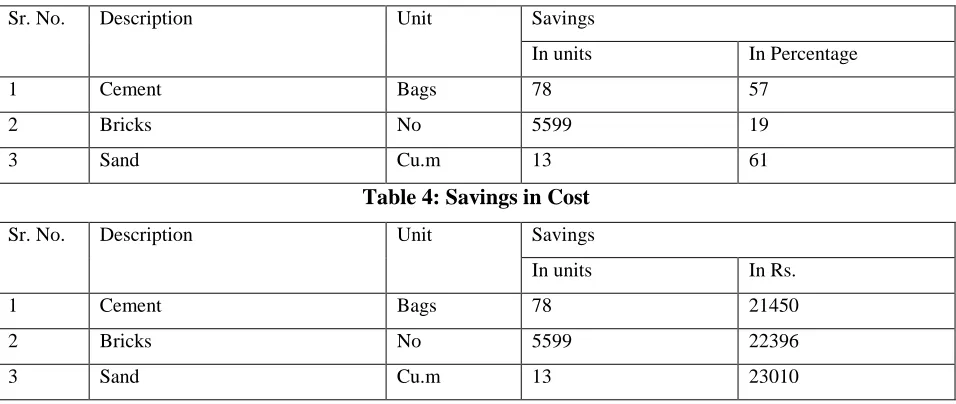
Table 3: Savings in Materials
Sr. No. Description Unit Savings
In units In Percentage 1 Cement Bags 78 57
2 Bricks No 5599 19 3 Sand Cu.m 13 61
Table 4: Savings in Cost
Sr. No. Description Unit Savings
In units In Rs. 1 Cement Bags 78 21450 2 Bricks No 5599 22396 3 Sand Cu.m 13 23010
5.3 Embodied Energy Saving
Embodied Energy is the sum of all the energy required to produce any goods or services, considered as if that energy was incorporated or 'embodied' in the product itself. The concept can be useful in determining the effectiveness of energy-producing or energy-saving devices, or the "real" replacement cost of a building, and, because energy-inputs usually entail greenhouse gas emissions, in deciding whether a product contributes to or mitigates global warming. One fundamental question is: does the device produce more energy or save more energy than it took to make it? Embodied energy is an accounting method which aims to find the sum total of the energy necessary for an entire product life-cycle. Determining what constitutes this life-cycle includes assessing the relevance and extent of energy into raw material extraction, transport, manufacture, assembly, installation, disassembly, deconstruction and/or decomposition as well as human and
480 | P a g e
Comparison And Advantages Of Rat Trap Bond Advantages:-
1) By adopting this method of masonry, you can save on- approx. 20-35% less bricks and 30-50% less mortar; also this reduces the cost of a 9 inch wall by 20-30% and productivity of work enhances.
2) For 1 m3 of rat trap bond, 470 bricks are required compare to conventional brick wall where a total of 550 bricks are required.
3) Rat trap bond when kept exposed, create aesthetically pleasing wall surface and cost of plastering and painting also may be avoided.
4) Rat trap bond can be used for load bearing as well as thick partition walls.
5) Rat trap bond wall is a cavity wall construction with added advantage of thermal comfort. The interior remain cooler in summer and warmer in winters.
Cost Saving
Material saving per m3: Rat trap bond VS. Convention) brickwork • 1.11 bags(57% saving) = Rs 288/m3
saving in cement cost. • 80 nos. of bricks(20% saving) = Rs 576 saving in brick cost. • 40.18 m3 less sand (61% saving) = Rs 13/m3 saving.
VI CONCLUSION
Housing is the basic need and right of all human beings. During our ages, due to tremendous rise in property market rates, the dream of common middle class and lower income group people remains a dream, as the reality of non-affordability is bitterly painful. Many efforts at governmental levels have failed to alleviate the problems of the common people's housing shortage which continues to grow at an alarming rate. The shortage we see today is not about housing itself, it's actually about `Affordable Housing'
Fortunately enough, the solution to affordable housing shortage (especially urban) is within our reach. We cannot control the hikes in the land rates, but Endeavour to minimize the costs of construction by switching to some simple, cost-effective building materials and technologies. One such solution is the use of Rat-Trap Bond Masonry Technique.
It's simple, and easy to construct and effects into an overall savings of about 23 % in the costs in comparison to conventional brick work, while also reducing its impact on the environment by achieving a huge saving in the embodied energy consumption.
We think that this is the need of the hour that our governments take up this issue on war-foot level and promote and subsidize as much as possible the use of such green, environment-friendly and cost-effective technologies.
481 | P a g e
REFERENCES
1. http://en.wikipedia.org/wiki/Embodied_energy
2. VikraState of the Low-Income Housing Market -Encouraging Progress & Opportunity to Realize Dreams of Millions - Aditya Agarwal, m Jain and Ashish Karamchandani Monitor Deloitte Report, July 2013 3. Affordable housing in India: Budding, Expanding, Compelling- IBEF Report, July 2012
4. http://www.bmtpc.org/topics.aspx?mid=356&Mid1=365 — Rat trap Bond Walling Technique Details 5. http ://sepindia.org/ihd-sep/ceeef-technologies/rat-trap-bond-a-masonry-technique/
6. http://www.ruralhousingnetwork.in/technical/rat-trap-bond/Introduction
7. Bridging the Urban Housing Shortage in India: A Joint Study by NAREDCO & KPMG
8. Construction-of-an-Ecofriendly-Building-using-Green-Building-Approach: A research Paper by Ashish Kumar Parashar, Rinku Parashar, International Journal of Scientific & Engineering Research, Volume 3, Issue 6, June -2012