Electronic Theses and Dissertations Theses, Dissertations, and Major Papers
2014
Gender, Class and Curriculum at W.D. Lowe Technical Secondary
Gender, Class and Curriculum at W.D. Lowe Technical Secondary
School, 1923-1973: A Study in Continuity and Change
School, 1923-1973: A Study in Continuity and Change
Kael Rodrique Sharman University of Windsor
Follow this and additional works at: https://scholar.uwindsor.ca/etd
Recommended Citation Recommended Citation
Sharman, Kael Rodrique, "Gender, Class and Curriculum at W.D. Lowe Technical Secondary School, 1923-1973: A Study in Continuity and Change" (2014). Electronic Theses and Dissertations. 5212.
https://scholar.uwindsor.ca/etd/5212
Gender, Class and Curriculum at W.D. Lowe Technical Secondary School, 1923 – 1973: A Study in Continuity and Change
By
Kael R. Sharman
A Dissertation
Submitted to the Faculty of Education in Partial Fulfillment of the Requirements for
the Degree of Doctor of Philosophy at the University of Windsor
Windsor, Ontario, Canada 2014
By
Kael R. Sharman
APPROVED BY:
__________________________________________________ R. Heap, External Examiner
University of Ottawa
__________________________________________________ P. Milne
Department of History, University of Windsor
__________________________________________________ D. Hutchison
Faculty of Education, Brock University
__________________________________________________ C. Greig
Faculty of Education, University of Windsor
__________________________________________________ D. Stanley
Faculty of Education, University of Windsor
__________________________________________________ L. Glassford, Advisor
I hereby certify that I am the sole author of this dissertation and that no part of this dissertation has been published or submitted for publication.
I certify that, to the best of my knowledge, my dissertation does not infringe upon anyone’s copyright nor violate any proprietary rights and that any ideas, techniques, quotations, or any other material from the work of other people included in my dissertation, published or otherwise, are fully acknowledged in accordance with the standard referencing practices. Furthermore, to the extent that I have included
copyrighted material that surpasses the bounds of fair dealing within the meaning of the Canada Copyright Act, I certify that I have obtained a written permission from the copyright owner(s) to include such material(s) in my dissertation and have included copies of such copyright clearances to my appendix.
I dedicate my dissertation work to my biggest supporter, my daughter, Tessa Marie
It has been an honour to have had such a wonderful committee; your hours of reading, thoughtful feedback, and patience are an inspiration.
I want to especially thank Gayle Tait and Tanya Brogan. All of your help with the tedious details and words of encouragement have helped me out so much along the way.
I owe many thanks to so many people who helped me find sources, gather my data, and put all the pieces together—your time and consideration of my work is most appreciated.
Thank you to the many participants who enthusiastically shared their stories and time. I am grateful for the support of many of my colleagues who include: members of CHEA who provided information and feedback; students in my program who offered valuable feedback during coursework, and colleagues at work who provided encouragement and even read entire chapters. I am honoured by your thoughtful consideration of my work.
Abstract...iv
Dedication...v
Acknowledgments...vi
List of Tables...ix
List of Figures...x
List of Appendices...xi
List of Abbreviations, Symbols and Nomenclature...xii
Chapter 1 : Situating an Historical Inquiry of WDLTS within Social, Political, Cultural and Theoretical Contexts and within the Body of Literature ... 1
Statement of the Problem ... 1
Background ... 2
Purpose of the Study ... 4
Terms ... 5
Rationale ... 5
Significance ... 8
Methodology: Feminist Stand Point Theory ... 9
Research Questions ... 17
Method: Historian's Craft ... 18
Literature Review ... 23
Summary ... 36
Chapter 2: Vision into Reality, The Years of Growth, 1913-1929 ... 46
Historical and Geographical Context ... 47
Political Context ... 50
F.P. Gavin's Vision for Technical Education ... 55
Chapter 3: The Lowe Years, 1930 – 1945 ... 80
Accommodating the Growing Population of the School ... 81
Student Participation and Influence at the School ... 93
The Loss of Two Founders of the School ... 97
Memories of Mr. Lowe ... 100
Concluding Remarks about Lowe's Influence ... 104
Chapter 4: From Chaos to Closure, 1945 – 1973 ... 111
Leadership Change, 1946 - 1959 ... 112
Extra-curricular Activities & the loss of Commercial Studies ... 117
Technical Changes in the Economy & Education ... 122
A Post-Secondary Technical College ... 124
The TVTAA & Robarts Plan ... 127
Attempt at Student Power & Pride in Stand-Alone Schools in Windsor ... 135
The Strike ... 138
The Combined Effect of Local and Broader Changes: WDLTS Closes ... 149
Chapter 5: The Rise and Fall of “Lowe Tech” ... 160
The Rise of WWTS/WWVS ... 163
The Fall of WDLVS/WDLTS ... 167
Future Considerations for Research and Policy ... 172
Bibliography...179
Table 1: Application of Historical Thinking Concepts & Guideposts...19
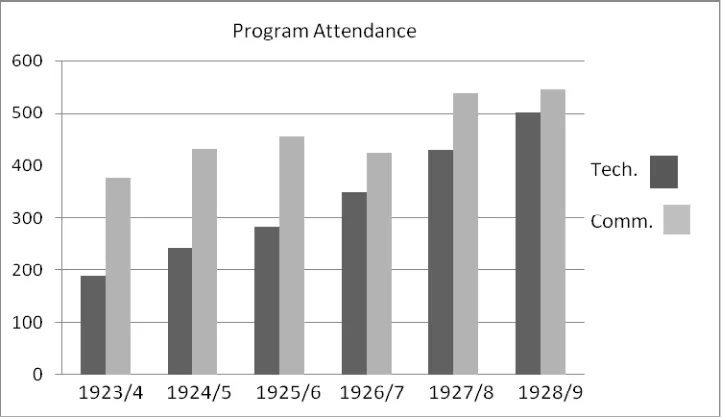
Table 2: Average attendance per year by program...68
Table 3: Average attendance per year according to gender...68
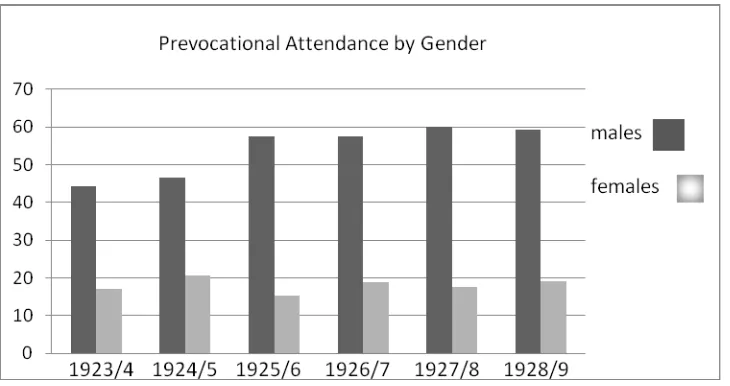
Table 4: Average attendance per year in the prevocational program by gender...69
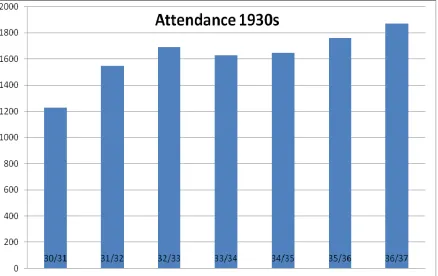
Table 5: WWVS Attendance from 1930/31 to 1936/37...88
Table 6: Average attendance at Lowe by grade, 1945-1966...116
Table 7: W.D. Lowe School Population, 1945-1968...119
Table 8: Attendance by Gender & Curriculum, 1945-1958...121
Table 9: Attendance by Grade, 1945-1966...129
Table 10: Attendance by Grade at Commerce, 1959-1966...130
Table 11: Comparison of Enrolment by Gender...160
Figure 2: W.D. Lowe...60
Figure 3: Blue Print of WWTS...62
Figure 4: WDLTS Auditorium...63
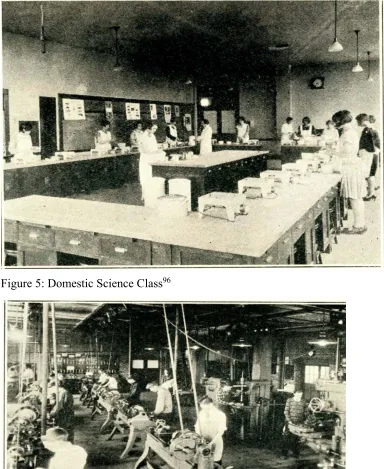
Figure 5: Domestic Science Class...71
Figure 6: Machine Shop...71
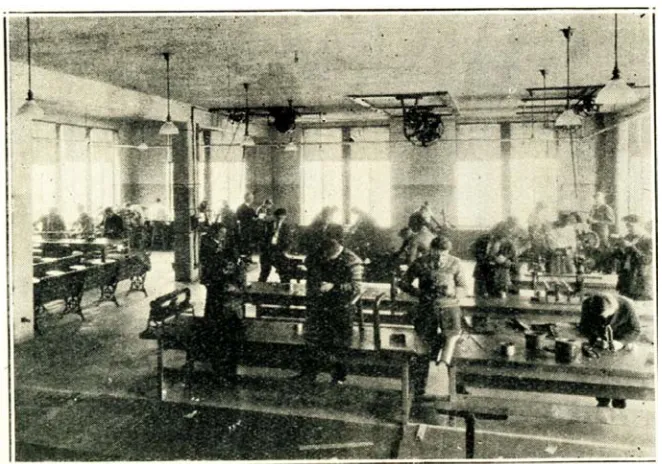
Figure 7: Classroom...72
Figure 8: Shop Class...72
Figure 9: Sewing Class...73
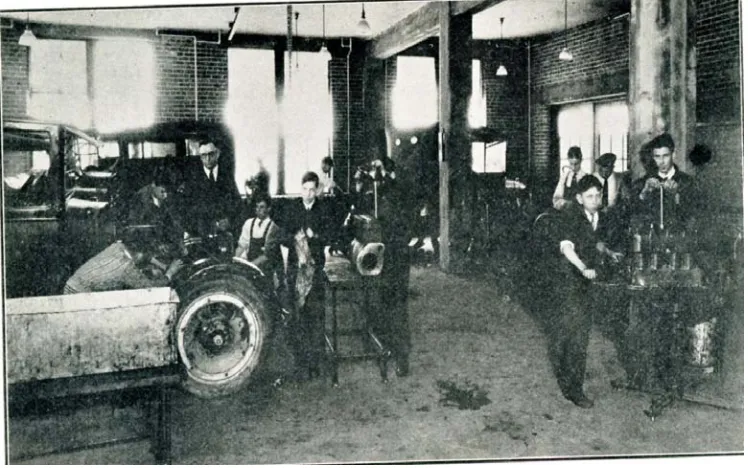
Figure 10: Automotive Class...73
Figure 11: First Aid Class...74
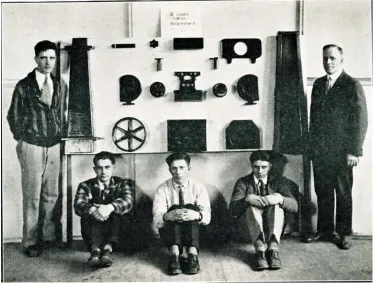
Figure 12: Shop Display...74
Figure 13: W. D. Lowe School, 2010...111
Figure 14: Cheerleaders & Rifle Team...120
Figure 15: A Political Cartoon...122
Figure 16: Lowe Students in Class at UAW Hall...141
Figure 17: Paid advertisement in the Towers, 1947-1948...146
Figure 18: Paid advertisement in the Towers, 1951-1952...147
Figure 19: Excerpt from William Hands Vocational School Pamphlet...150
Figure 20: Honour Role Pins & Metal Bookends...165
Appendix A: W.D. Lowe Technical School Questions...191
Appendix B: Letter of Information...196
Appendix C: Research and Ethics Board Approval Letter...198
List of Abbreviations, Symbols, Nomenclature
WWTS - Windsor Walkerville Technical School
WWVS -Windsor Walkerville Vocational School
WDLVS -W.D. Lowe Vocational School
WDLTS -W.D. Lowe Technical School
CAAT- Colleges of Applied Arts and Technology
Chapter 1: Situating an Historical Inquiry of WDLTS within Social, Political, Cultural and Theoretical Contexts and within the Body of Literature
One’s gender or social origin was not always a clear predictor of behaviour. That Canadians of all varieties could favour and fear educational change, admire and admonish educational authorities was as true in the past as it is in the present. That officials and teachers could be both insightful and incompetent—and everything in between—was, and is, equally evident. Historians who are able to paint both the broad canvas (social structure) and the individual portraits (human experiences and responses) will especially advance the historiographical art, as will those scholars who are best able to hear their subjects in their own voices in
their own times. -Paul Axelrod1
As Windsor, Ontario, emerged as an automotive production centre in the early twentieth-century, technical secondary education was openly embraced by the community. W.D. Lowe Technical School (WDLTS) began as Windsor Walkerville Technical School (WWTS) in 1923 to meet the growing demand for skilled workers in specialized parts production for the automotive industry. The founder of technical secondary education in Windsor, F.P. Gavin, proposed that a day school would also be a preventative measure to correct deficits reflected in the increasing numbers of adults attending night school. The name of the school changed four times in the course of its fifty-year history, an indicator of adaptations the school made to its function, purpose, and meaning in the community. The social, political, and economic contexts are identified as influencing factors in the school’s establishment, name changes, curriculum, and eventual closure. This study is an analysis of how and why WDLTS changed during the course of its history. The effects the changing context had on WDLTS over a fifty-year period provide insight into why this
well-supported stand-alone technical school was closed, yet other stand-alone vocational schools remained.
Statement of the Problem
schools are generally associated with working-class jobs and skills, and as such, are
devalued in comparison with other secondary schools. Hierarchies of social power are also perpetuated within technical and vocational schools via departments and curriculum that focus on work associated with gender. It is not enough to say that schools merely reflect the social structures of our society and are, therefore, not responsible for the continued social segregation. Educational policy makers have made, and do make conscious choices to institutionalise social power hierarchies and therefore have been and are very much responsible for creating the ways in which the structures of our educational system
perpetuate oppression on the basis of class and gender. This study seeks understanding for the purpose of informing educational policy in the future. The intent of this study is to understand how gender and class have functioned in the establishment, adaptation, change, and eventual closing, of W.D. Lowe as a technical school, within a fifty-year context of federal and provincial agreements that shaped it. This understanding can be applied to current educational trends that seek to serve marginalized populations of students in specialized schools.
Background
Technical secondary schools in Ontario emerged from local pressure in urban centres such as Toronto, where the municipal councils saw fit to offer technical education on its own for 13 years, before succumbing to the overwhelming financial demands that came with this type of education. The popularity of the Toronto Technical School in Ontario in the first few years of the twentieth-century convinced the province to support high schools with multiple purposes, including vocational training.2 Education was facing growing pressure to change in the face of industrialization and urbanization, state
opposed this position, warning that multiple programs would lead to an unfortunate and unnecessary division of students.6 This debate illustrated the concerns of the day. On the one hand, high schools were too narrowly focused drawing only students destined for university. On the other hand there was worry that expanding the curriculum might detract from the schools capacity to function as an agent of social equalization.
The curriculum was expanded, and the change was lead by John Seath, Ontario’s superintendent of education, who revised regulations in 1904 to recognize no fewer than seven different high school programs: general, commercial, manual training, household science, agriculture, university matriculation, and normal-school entrance.7 Positive public reaction to these new programs in urban centres such as Toronto made further formal support undeniable.8 The provincial government in Ontario offered support via legislation in 1911. Even with provincial funding, technical schools were still slow to emerge in many cities due to the high cost required for initial start-up, such as buildings and equipment. It was not until federal support was provided through the Technical Education Act in 1919 that capital costs and the purchase of shop equipment were covered adequately enough to convince towns like Windsor to build stand-alone technical schools. According to
educational statistics for the 1920s, Windsor was not alone. When WWTS opened its doors in 1923, there were 15 other technical day schools in the province.9 Federal support of technical education had put the finishing touch on all that was required to convince urban centres in Ontario to begin offering technical education. According to statistics from the Ontario minister of education’s annual report, in 1918, just before federal support of technical education was passed, there were only 11 technical day schools. By 1929, there were 47. Technical school students by 1929 made up more than 1/3 of the secondary student population in Ontario: 26,720 day students attending technical schools, while the secondary student population was 66,953.10
depress the value of skilled labour and technical school programs. Once again the expense of technical education proved to be beyond what municipalities, the province, and the federal government were willing to invest in secondary public education. A new kind of education was on the horizon: technical colleges that could offer new equipment and training for the computer age. As technical shop classrooms became antiquated, the federal government announced it would no longer fund technical education at the secondary level and instead focus its attention on post secondary education, and the worst fears predicted by John Watson in the 1904 High School debate came to fruition – technical high schools were transformed into educational ghettos. After 1967, when federal support for technical
secondary education ended, the spaces remained – empty shells of the promise of opportunity turned into segregation.13 Even after three decades of criticism, many stand-alone vocational secondary schools remain. Since the criticism has generally claimed that stand-alone secondary schools have segregated and stigmatized technical students. The continued existence of stand-alone technical schools do not serve the promise of respect for diversity in public education, but rather the traditional image of the academic high school.
Purpose of the Study
An historical analysis of W.D. Lowe Technical School (WDLTS, originally called the Windsor-Walkerville Technical School) illuminates the issues of power that attend stand-alone technical, vocational, and commercial secondary schools and their
corresponding curriculums associated with class and gender. Looking at issues of power over the school’s fifty-year history will provide insight for any decision to establish or continue stand-alone schools for specialized student populations not traditionally well served in public high schools.14
Gender and social class are at the heart of past and continuing concerns with technical and vocational education.15 As such, the purpose of this study is also to
understand the significance of gendered institutions in the past, what meanings they held, and how they functioned to maintain the social order or promote its change.16 Social class is a primary consideration in this study, as it is a defining feature of technical and
construction.18 Gender is ever present in our social lives, based on perceived differences between the sexes, including differences in power.19 Since WDLTS has a student body divided by gender and drawn from working-class neighbourhoods, investigating WDLTS over a fifty-year period of considerable change to technical education policy serves this purpose well.
Terms
The terms technical and vocational will be used in this study; these terms can have
different meanings depending on the time period. In the early twentieth-century these terms were often used interchangeably. In the Technical Training Act, 1919, the federal
government used the word vocational as an umbrella term for schools and programs that
offered practical skills that would prepare students for work after secondary school. After 1919, the term technical referred to specific vocational programs that involved learning
practical skills and the theoretical and scientific basis upon which those skills were to be understood and applied. The meaning of these two terms changed after the Robarts Plan (1962) and unprecedented amounts of federal funding, including the Technical &
Vocational Training Assistance Act (TVTAA, 1960), converged in the province of Ontario to bring about a more segregated and hierarchical system of programming. Beginning in the 1960s, vocational and technical became increasingly associated with the social value of
their respective associated skills. Technical is deemed more specific and more highly
skilled, whereas vocational has more association with special education. Composite school – A regular academic high school with a vocational wing.
Stand-alone school – A school built and equipped for students to focus 50% of their studies on vocational, commercial, or technical education.
Another set of terms that require clarification are the names of the school, which changed four times over the course of its fifty-year life span:
Windsor Walkerville Technical School (WWTS), 1923 - 1935: This name reflects early use of the term technical as the type of education involving specific skills for the new
Windsor Walkerville Vocational School (WWVS), 1935 - 1945: The switch to the term
vocational as an umbrella term adhered to federal criteria for funding. Domestic science,
industrial art, and commercial studies were also taught at WWVS; hence the umbrella term
vocational was taken on.
W.D. Lowe Vocational School (WDLVS), 1945-1959: This name change reflects the honouring of the school’s one and only principal up to that point – William Duff Lowe. The term vocational is maintained for the reasons cited above.
W.D. Lowe Technical School (WDLTS), 1959-1973: This name change distinguished the school from the special vocational schools that had recently been opened, reflecting
awareness that the word vocational was now linked with programs seen as less
academically challenging.
Rationale
This study will begin to fill gaps in the literature, in seeking to understand not only class oppression, gender oppression, or the story of one school, but also historical trends in a community over a fifty-year period. The result will be a better understanding of how one stand-alone technical school morphed in response to changing social-historical conditions, into something quite different. The literature to date on stand-alone technical and
vocational schools offers a firm understanding of issues of class and the effects of early educational reforms on girls. There is room, however, for a better understanding of stand-alone technical schools and the impact they had on students with multiple locations at the margins of education. With a wealth of knowledge from the historical research that has been conducted thus far, we can appreciate that students at technical schools are students at the margins of education and girls and other minorities who attend these schools are at the margins of the margins. Equity and social stigma are pressing issues for these secondary schools, and the methodological tools exist to appreciate the social complexity of how and why stand-alone vocational schools have historically developed and persist.
as a source of social problems.20 While the creation of the school itself reflected issues of class, the curriculum offered within the school illustrated gender divisions found in labour. The amalgamation of the Border Cities (Ford City, Ojibway, Riverside, Sandwich,
Walkerville, and Windsor) in 1935 which eliminated the technical school board in 1935, created a more centralized decision-making body for WDLTS and hence principals had less direct power in the school.21 The delayed federal commitment to technical education and the implementation of the Robarts Plan and the TVTAA created a highly segregated and hierarchical secondary system in urban Ontario. Further, technological changes occurring in the tool, die, and mould industry beginning in the 1950s, created a demand for classrooms that could prepare students for automated design and assembly at the same time that Colleges of Applied Arts and Technology came into being.22 New technical colleges created a new hierarchy in technical training and skills. With automation came a new conceptual differentiation between high and low technology; this created unfortunate associations for the school referred to as “Lowe Tech.” Local tool, die, and mould makers found it increasingly difficult to compete in a market flooded with automated designers. As a result, the creative design talents of local tool and mould makers were often exploited in a global market economy, making it difficult to compete. These are among the multiple factors that came together and contributed to the establishment, maintenance, and eventual closure of WDLTS. This study offers a detailed look at the multitude of factors which impacted not only one technical school and its staff and students, but the entire school board.
Lessons from the analysis of WDLTS’s history can be applied to current trends in education. Serving highly diverse populations within public secondary education has been a primary challenge for several decades.23 In the name of catering to a broader populace, secondary education has added curriculum associated with the perceived goals of its increasingly diverse pupils. As documented in the pages and chapters that follow, result of this change has been that stand-alone technical schools have reflected and actively
influencing factors that shaped its establishment, maintenance, and closure, while in turn considering the influence that this one school had on its community, will illustrate the point.
WDLTS is a prime candidate to start this dialogue, as it was founded before any negative associations with vocational education were created.24 WDLTS also withstood a myriad of challenges in the form of social, political, and ideological changes that drastically altered the original vision into a form of education that would have been unrecognizable to its founders. The story of WDLTS offers valuable insight into the site of struggle for value and pride in work performed by teachers and students, and into the continuing struggles that are a legacy of schools like WDLTS.
Significance
Feminist historical research on technical and vocational high schools such as WWTS/WDLTS helps scholars conceive how these schools challenge the status quo in some ways and perpetuate it in others. As the literature review will demonstrate, for several decades criticism has accumulated of vocational education based on social class and its influence on young girls. An analysis focused on gender remains a gap in the literature. Recent research contends that technical and vocational secondary education influenced a small minority of students, and that the presence of working-class students in high schools and collegiate institutes confounds any contention that stand-alone vocational schools posed significant barriers to students.25 The present study will take a step toward filling an existing gap in the literature and presenting a counterargument to recent claims that the numbers of students affected were insignificant.
and others are emerging. What does their separate status say about our public education system?
The benefit of this study is the contribution it can make to informing current trends toward specialized schooling. It is important that current decisions to cater to specialized groups of students not traditionally served well in public secondary schools are informed by past practices. While historical and social contexts change, the fundamental question of whether the very system in which students have existed on the margins can offer them equitable separate educational space remains. The results of this study should be considered by all stakeholders in separate schools designed to cater to minority students. This study can offer new qualitative understanding about the number of students affected by the segregated spaces of vocational schools. Indeed, by the very fact that stand-alone schools created segregated spaces in which some students existed, these schools also created an absence in regular high schools and collegiate institutes. In the context of compulsory attendance laws, vocational schools served many students who might not otherwise have attended school, but also ensured that the influx of students would not disrupt traditional academic schools. The problem was not only the presence of students within vocational schools but the absences stand-alone schools created in other schools within its boundaries.
Methodology
increasing inequities. Historians such as MichaelKatz, whose career has spanned the decades in question, attest to the continuity of social problems and the changes that it has demanded in the practice of doing history. Katz reflects on the changes to historiography, noting that
The same problems persist [but] the historical context has undergone dramatic change; scholarship on key topics has experienced substantial revision; and my own reading of the literature and subsequent research has led me to new interpretations...Like most writers on poverty in the late 1980s, I did not realize how hegemonic the conservative story of welfare and poverty had become...This exciting historiography links community action to both the civil rights movement and to gender.26
Katz’s sentiments indicate that these new links brought a more nuanced understanding of power to his work. Katz’s latest work has been informed by critiques of second-wave feminist notions of gender as a category of analysis that speaks to all women:
“conventional ideas about how the world is ordered lay smashed and in need of
redefinition. These ideas included work, race, family, city and nationality.”27 Changes to feminist perspectives began with the notion of situated knowledge28 also known as
standpoints.29 This conceptual framework served to complicate lived experience of gender. Judith Lorber explains, “feminist social science has devised research designs and
methodologies that have allowed the standpoints of oppressed and repressed women throughout the world to come to the forefront, and which reflect increasingly sophisticated intersectional analyses of class, racial ethnicity, religion, and sexuality.”30
Intersectional analysis investigates a concrete topic, finding the combined effects of race, class, gender, sexuality, and nation where before only one or two interpretive
categories would have been used.31 The practice of intersectionality as a methodology takes into consideration the complexity of life.32In keeping with current research on
masculinities, this research considers gender as a construct that goes beyond the traditional binary, more in keeping with the complexity of lived experience. Gender is various,
particularly with regard to hegemony. The making and contestation of hegemony in historically changing gender orders is a process of enormous importance for which we continue to need conceptual tools.34 Intersectionality provides these tools, since it emphasizes an understanding that is not exclusively or even primarily preoccupied with categories, identities, or subjectivities, but with political and structural inequalities.35 Intersectionality helps reveal how power works in diffuse and differentiated ways through the creation and deployment of overlapping identity categories.36 Intersectionality is concerned with the way things work rather than with who people are.37 In particular, McCall suggests that intercategorical complexity is an approach to intersectionality that provisionally adopts existing analytical categories to document relationships of inequality among social groups and changing configurations of inequality along multiple and
conflicting dimensions.38 I have used intersectionality for understanding issues of power and inequity related to stand-alone technical and vocational schools.
Feminist standpoint theory provides a conceptual framework for understanding both my position as researcher, and the approach used to analyze the changes that occurred at W.D. Lowe Technical School. A standpoint arises when an individual recognizes and challenges cultural values and power relations that contribute to subordination or
oppression of particular groups. Feminist standpoints are developed through intellectual struggles to recognize, analyze, and contest broad power relations that account for the subordination felt by girls and women in the activities they are expected to pursue. A feminist standpoint is an intellectual achievement that reflects and necessarily entails political consciousness. In the following account of my experience as a vocational student (1984-1987), a women’s studies student (1992-1999), a vocational teacher (2002-2004), and eventually a researcher of vocational education (2003-2006; 2008-current), illustrates both the social location that situates my knowledge and the process by which I arrived at a feminist standpoint.
Feminist standpoint theory is concerned with productions of knowledge and practices of power.39 Such a theory is appropriate for a previous vocational student and vocational teacher now researching technical and vocational schools in the same
vocational schools and my current status as researcher gives me an insider/outsider status. Because I have had to negotiate education from a marginal position, I have had insider access to interpretive frames and forms of empirical evidence not available to researchers from outside.40 This insider access does not automatically qualify as an epistemic
advantage. On the one hand, marginalized subjects can develop an awareness of the dynamics of oppression that more privileged subjects do not have to develop.41 On the other, my status as a teacher with access to educational opportunities and sources of information allowed me to search for ways to understand, explain, and take action against the oppression I experienced. So I was also able to access outsider knowledge, which brings with it contextualizing information and theoretical frameworks that offer analytical skills and explanatory tools. Thus, this research both contributes to larger dialogues about vocational schools’ roles in the communities they intend to serve and functions as a part of my quest to understand the oppressions I witnessed and experienced in such a community.
Using my own standpoint to produce research rooted in personal experience has particular meaning for fostering agency and bringing about social change. As I reflect on my experiences—particularly the contrast between my experience as a vocational student and the glorious local lore of Lowe Tech—I know that reflection has shaped my questions and query, and I accept that influence and seek to make it explicit throughout my analysis. This is not simply a personal story; what I intend in the personal account below is to make explicit the factors that shape who I am as a moral agent. Feminist researchers must, by necessity, become social theorists and account for the emergence of our own reflexivity. Following Judith Butler, I want the reader to know that I understand my own position in the research process and the conditions under which my morality has emerged:
My personal experiences as a vocational student are the seeds of my critical question, my need to find answers, and my desire to understand both whether change is possible and what that change might look like.
As a former vocational student in the 1980s, and as a teacher twenty years later, I struggle with how my past may have influenced my view of technical and vocational education. In light of my understanding of knowledge and subjectivity, I question how I can possibly remain objective in this particular study. Although I can reflect on and make visible my own multiple locations and ideological positions, I understand that such
reflection carries no epistemological guarantees, as it is an imperfect, partial, and endlessly deferred process. Just as I explicitly document my research methods, I can make explicit my specific personal knowledge and use that explicitness as strong objectivity.43 By “minding the gap between my methodological desires and my [research] practices,” I can be “trustworthy” in what I relay about gender and class at WDLTS.44 “Self-conscious partiality” is a necessary condition of being heard to make rational knowledge claims, setting up a knowledge that owns its specificity rather than making impossible claims to universality or objectivity.45 Unlike any other researcher I know of in this body of literature, I can claim direct experience as a student in a vocational school. But like any responsible researcher. I also begin my research with a literature review. Through the interplay of my insider and outsider perspectives, supportable rational knowledge claims emerge.
Contradictions: The lore of “Lowe Tech” and my personal experience as a vocational student
My working-class family valued education that offered marketable skills, which is why I grew up hearing all about how great W.D. Lowe Technical School was. I heard about the positive outcomes of many of the graduates, including three of my uncles. My family assumed that the newer local vocational schools would offer the same potential and
opportunity. If they provided such great opportunities though, why did it seem like students were coerced into attending the vocational schools that succeeded WDLTS? Once I was there, I found that the school was a far cry from the positive stories I had heard about W.D. Lowe Technical School, but I had no understanding at that time of the divide that had been socially constructed between technical and vocational education. This early disconnect between local educational lore and personal experience gave rise to my current research. I wondered what had happened in education to change how stand-alone technical and/or vocational schools were viewed.46 This same discord has provided a critical lens.
Transfer Student
from elementary school had a devastating impact on my sense of self-efficacy. Not only was I being sent to a socially rough-and-tumble school midway through the year, but I was also left to assume that I was not even capable of completing elementary school, and this transfer was presented as the best case scenario for my success.
The margins have margins—gender divisions between subject areas within the vocational school
Once I started attending vocational school in 1984, I became acutely aware of fine distinctions between the students there. These distinctions suddenly held great importance. We had branded ourselves as “stupid,” after experiencing the grade eight transfer process, but we had that in common. That very commonality though made it all the more important to construct a social hierarchy that served to reassure some students (and perhaps the teachers too) that they had value, even if that process further devalued the “others.” Not only were there gender divisions between shop classes due to gender associations with particular types of labour, but there were also contradictions between the vocational high school culture—which held back young men who violated those gender divisions—and workplace cultures that valued those same men over their women coworkers. For example, I remember a male hairdressing student returned from the bathroom one day, visibly shaken and upset. Two boys who were also in the bathroom had physically assaulted him. Boys in the hairdressing program were ostracized, yet that same male friend of mine held
considerably different social currency in the workplace culture of salons by virtue of his status as male and gay. My employer was a gay male and “out” to everyone in the salon, as well as his clients. He made no effort to conceal that status; indeed it was an asset to him, and his clients seemed to love it. Those boys that broke allegiance with gender scripts and entered hair dressing were ostracized within the vocational school—but those same boys were held in much higher esteem within some salons than gender-conforming (“straight-acting”) boys or any girls. This experience made me aware of just how crucial the
Returning to a Vocational School
After graduating from the Bachelor of Education program in 2000, I worked for two years as a cosmetology teacher at a vocational school. I was anxious to walk once again into the doors of a vocational school. This school was not that far from the school I had attended as a vocational student, and had since closed down. This vocational school was not much different, the “hard” shop classes drew mostly male students, and the first cosmetology class I taught included only two boys. I introduced myself to my class, explaining that I too had once been a cosmetology student at a vocational school. I joked that it was a long time ago and passed around some of the old yearbooks from Shawnee Secondary School that were being stored at the school I was teaching at. The students commented on how hairstyles had changed, and many students were able to identify aunts, uncles, and parents in the yearbooks that were circulating around. That’s when I realized that many of these students were from my old neighborhood, and were second—even third—generation vocational students. This school, like the school I attended, had been built in the late 1960s and drew its students from the same poor neighbourhoods as my school, from the same families. This school, like the one I attended, did not have a glowing reputation, yet the schools’ programs and demographics remained intact and seemingly unchanged. Why?
The Search for Answers: Researching the History of Technical Education in Ontario
Once amalgamated into the public school system, stand-alone technical schools were accepted in principle but were slow to emerge in many urban settings due to the large amount of funding they required for start-up equipment and maintenance. Between the years 1919 and 1967 the federal government helped to fund technical and vocational programs. This funding allowed for much needed equipment and materials required to run shop classrooms. Federal funding for technical and vocational education came to an abrupt end, and, after that, the quality of tools and materials in these programs suffered greatly. Although many vocational programs in Ontario have closed down, many stand-alone vocational schools remain.47 In light of the struggles to maintain adequate funding to ensure quality programming materials, it seems clear that these schools persist because they serve a function in the communities that built them. As I think back on my own
experiences as a student and as a teacher, I am struck by how those experiences contrast with what I was told about an older technical school—W.D. Lowe. The impetus for this work is the need to understand these conceptual and material shifts. Windsor once had a technical school that students would proudly say they went to, a school that was built with pride, yet it was closed while others, not so prestigious, remained, and while even more were opened. Although WDLTS ceased to exist as a technical school, it remained open as a secondary school. Two vocational schools were built in its absence: the school I went to as a student and the school I taught at two decades later. In the early 1970s another vocational school was built in the county and it is still in operation as of 2014. As a once struggling vocational student, and later, a vocational teacher, I am haunted by the seeming
contradiction between the closing of a school deemed to be a success48, and the persistence in its absence of three schools that represent a diluted and devalued version of the past. Why?
Research Questions
1. What factors explain both the establishment of the Windsor-Walkerville Technical School in 1923 and the demise of W.D. Lowe Technical School as a stand-alone, elite technical school in 1973?
2. What political, social and cultural factors contributed to changing curriculum at WWTS/WDLTS from 1923 to 1973?
3. In what ways did the local social, political, and cultural context influence the formal and extra-curricular programs at WWTS/WDLTS?
4. How did the prevailing attitudes and assumptions about gender impact the evolution of WWTS/WDLTS?
To answer these questions in a way that contributes to broader educational-history knowledge and better future policy decisions requires tools that make historical methods transparent and systematic. The business of knowledge production is necessarily both a problem-specific and an open-ended process. In the field of historical research,
understanding the historical thinking concepts outlined by Peter Siexas make the analytical work done by historians explicit and more transparent. Historical thinking concepts will be addressed in the following methods section.
Methods – Historian’s Craft
The historian’s craft is the way a researcher identifies historical events in the past and weaves critical analyses of primary and secondary evidence into a cohesive whole—a story that has human meaning. Those critical skills, explicitly stated, are what Peter Siexas calls
Historical Thinking Concepts. The Historical Thinking Project has identified six distinct
but closely interrelated concepts. Thinking historically entails:
1. Establishing historical significance
2. Using primary source evidence
3. Identifying continuity and change
4. Analyzing cause and consequence
5. Taking historical perspectives, and
Although each one of these concepts has relevance to the study at hand, the concepts of continuity and change and of cause and consequence have been most useful. The discord I felt between the stories I have heard of Lowe Tech and my student experience at vocational school, set the stage for identifying the change that had occurred in education, and I wanted to understand the causes and consequences of that change. The research questions, which are heavily focused on causation, serve as the basis upon which to identify significant points in the school’s history, significant documents about the school, and in the case of authors with power, significant decisions about the school that brought about change. Historical perspective-taking is also a concept used when trying to understand why and how people in the past made the decisions they did, or trying to understand their role in influencing change. The recommendations for future research and educational policy reflect this study’s ethical dimensions, suggesting how the research results can be used to inform schooling in order to be more equitable. Although much of what historians do is unseen intellectual work, that makes it all the more important to understand the process of analysis. In the chart below, the historical thinking concepts, along with the explanations for how those concepts guide historical research, are listed. Included in the right column is a list of how the guideposts have been applied in this research.
Application of Historical Thinking Concepts & Guideposts
Guideposts Application to Current Research
Significance -events, people have significance if they resulted in a change, with deep consequences for people over a long period of time.
- my research questions and analysis focuses on who brought about change at WWTS/WWVS/WDLVS/WDLTS?
Evidence -asking good questions of a source can help it yield evidence.49
- develop research questions for documented turning points that shaped the function and purpose of the school with respect to gender and class.
documents, yearbooks, student artifacts, news articles, and questionnaire responses.50
Continuity
& Change -turning points are moments when the process of change shifts in direction or pace.
-progress and decline are the evaluation of change over time. Depending on the impact of change progress for one may be decline for another.
-periodization helps us organize our thinking about continuity and change. It is a process of interpretation by which we decide which events or
developments constitute a period of history.
- what influenced the changes known to have taken place at the school, for example changes to the school name, student strikes, economic and
legislative changes?
- the discrepancies between the lore of Lowe Tech and personal experience of vocational schools are starting points to evaluating progress and decline.51
- finding the major turning points in the school’s history will point to the boundaries and limits that will constitute a period in the school’s history and organize the narrative accordingly.
Cause &
Consequence -change is driven by multiple causes, and results in multiple
consequences. These create a complex web of interrelated short-term and long-term causes and consequences.
-events result from the interplay of two types of factors. 1) historical actors who took action; 2) social, political, economic, and cultural conditions.
- the generation of unintended consequences.
- events in history were not inevitable.
- documents must be considered from multiple locations, such as: student groups, school memos, school board minutes, municipal bylaws,
professional associations, provincial legislation, federal commissions and legislation.
-these documents have to be situated in their multiple locations of creation and application.
-the interaction of events and people in different locations. For example the Technical and Vocational Training and Assistance Act, created by the federal government, with the provincial reorganization of
programming known as the Robarts Plan.
interpretations of contemporary concepts and policies.
Historical Perspective Taking
-avoid presentism
-actors are best understood when context is considered
-make inferences based on evidence
-consistency of meaning for terms such as technical and vocational cannot be assumed.
-attitudes about gender and class are imbedded in the beliefs and values of that time period.
-I have to use the documents found to understand the meaning of technical
and vocational at the time, as well as
assumptions held by historical agents regarding gender and class.
-multiple perspective are considered in this research through a variety of sources that represent the views of students, teachers, principals,
administration, representatives of the department of education and the federal government.
Ethical Dimension
-understanding history can help us make informed judgements about current issues
-the notion of separate space is a contested concept in feminism. Can stand-alone technical and vocational spaces utilize this contested
understanding to improve policy and practice about marginalized students in education today?
Table1: The Historical Thinking Concepts and Guideposts were developed by Peter Siexas and Tom Morton52
Why is an historical approach fitting for this research?
allow for an explanation of how and why the interaction between curriculum change and gender occurred over a long period of time.
Indeed, historical approaches can capture patterns of social change over long periods of time, perhaps even identifying cause-and-effect relationships.53 Identifying, locating, and interpreting information relevant to these patterns of social change requires skills applied in a systematic way, ways that historical thinking concepts make explicit.
Historical investigation is appropriate to describe how and why WWTS opened,
functioned locally, changed during its fifty-year lifespan, and eventually ceased to exist as a technical school. Finding out how and why this technical school existed, changed, and ceased to exist would contribute to how we contend with current concerns about vocational high schools and other specialized separate spaces.
One of the major changes that occurred at WDLTS was gender shifts in the student population. As such, some recommendations from historians of gender can be useful. Joan Scott54 recommends that gender historians ask the following questions: what is the
legitimizing function of gender, and what are the many ways in which it works? What is at stake in proclamations that invoke gender to explain or justify their positions? How have social institutions incorporated gender into their assumptions and organizations? As industrial capitalism unfolded, how did it alter class relations and shift gender relations?
As most of the questions previously posed illustrate, to pursue meaning in the history of WDLTS, we need to address the individual as well as the social organizations, and
articulate the nature of their interrelationships, because both are important to understanding how gender works and how change occurs. It is a given that the historian must interpret all primary resources within the social and political context in which they were created. For the historian concerned with issues of gender, this means considering gender as a primary way of signifying relationships of power in its historical context. As an historian interested in a technical and vocational secondary school, I need to understand the role gender has played in establishing, changing, and eventually closing WDLTS. The study spans a fifty-year period from 1923 to 1973, and as such requires an appreciation of conceptual
In the literature review that follows, the major works that have contributed to understanding technical and vocational education in Canada will be presented and
discussed for what they tell us about stand-alone secondary schools; important gaps in the literature will be identified.
Literature Review
Technical and vocational secondary schools in Ontario have existed for over a century.56 These schools slowly evolved from a variety of isolated educational visions inspired by economic and social upheaval. A variety of educational reforms began in the late nineteenth century as a result of industrial reorganization that had lasting implications for urban social life. The industrial revolution not only changed relations in the workplace, but had a profound ripple effect on the social fabric of working-class culture. Conceptions of childhood and gender roles were forever changed by the disintegration of craft culture, small-scale production, and apprenticeship.57 The effects of these changes were visible on urban streets, and they roused public alarm that inspired educational reform.58
Several early reform efforts, such as mechanics’ institutes, domestic science programs, manual training, industrial schools, and technical schools, evolved in isolation from each other for well over three decades. These isolated efforts morphed into a more unified challenge to education as support coalesced from private benefactors, municipal leaders, provincial governments, and eventually the federal government. Once these efforts evolved into unified programs and schools with a supporting curriculum, job training was relocated from the factory or shop floor to the school.59 Although the transition was made, the institutionalization of job training was a contentious issue. These schools were
Stand-alone schools in particular stood out in this matter as a “separate and specialized curriculum for some students, one that ostensibly respected the democratic principle of public schooling while maintaining gender, race, and class inequalities.”62 We know from previous research on technical and vocational secondary schools that the local settings in which these schools were established have shaped their structures and functions and hence the degree to which the specialized curriculum served democratic principles or social inequality. Influencing the structure and functions of a vocational school through time and space are local combinations of economic climate and corresponding social issues, in combination with how education is used locally to meet economic and social demands.63 Regardless of the reason behind the local support, when funds became available, most urban centres in Ontario took advantage of the opportunity.
In 1919 the federal government committed a total of 10 million dollars over a ten year period to aid provinces in their technical secondary education programs.64 Urban interest in technical education had prompted Ontario to provide provincial support in 1911 under the Industrial Education Act.65 With many technical schools already in place, Ontario was primed to take full advantage of the federal funds. “More than one-quarter of all
Ontario high school students were studying in the vocational programs offered by forty-two high schools on the eve of the Depression.”66 The difficult economic times however saw federal and provincial funds wane, yet ironically “the socio-economic dislocations of that decade reinforced the perceived need for vocational training while also supporting certain national goals through both the curriculum and the developing extra-curriculum.”67 “By the mid-1920s, vocational education had been accepted as a legitimate function of secondary schooling in most provinces.”68 WDLTS emerges in this context of a firm commitment to technical education, a commitment that remained strong for most of its fifty-year run as a technical secondary school in Windsor, Ontario.
Literature on the Contextual Influences
Although Canada’s commitment to technical education is far from unique,
meta-analyses done on vocational education, Aaron Benavot sought to explain the reasons for the establishment and decline of this type of education in several industrialised countries.69 Benavot’s research summarized technical education in sociological terms, using three categories to explain why vocational education emerged in many societies.70 Each category will be described briefly.
The first category is the technical-functional approach. From this perspective,
technical education is explained as simply an outgrowth of, and adaptation to, the economic demands of industrialized workplaces. The second category is the
progressive-integrationist explanation, which posits that technical education socializes new citizens and
the working-class to conform to middle-class values and culture. The third and final category is a neo-Marxist perspective that views technical education as a class-based
solution invented by those with capitalist interests. According to the neo-Marxist perspective, the introduction of technical education was an attempt to support the consolidation of corporate capitalist power.
Benavot’s categories help to build an understanding of the various motives behind technical education in Western Democracies. However, these stand-alone schools still exist and research specific to Canada suggests that the explanations behind their presence are not so neatly categorized, but may be more aptly described, as suggested earlier, as a result of complex and changing balance of all these categories together, at any given time or place.
With regard to why technical and vocational schooling has declined, Benavot explains the trend using enrolment statistics, and ideological changes in several countries.71 The conclusion he draws is that shifting perspectives about the role of education have included “shunning differentiated education”72 and thus, vocational education has declined. These schools, however, still exist in many cities within Canada, and the debate continues as to their role and function. Recent research from Canada concedes that there is no one overarching reason why technical schools have emerged and continue to exist.73
require more than provincial coffers would allow. The decline of vocational schools in the last four decades has been due to the absence of federal funding, which was reallocated to post-secondary institutions. Later research supports both Benavot’s and Stamp’s
conclusions.
In 1991, Lyons, Randhawa, and Paulson suggested that the lack of consistent federal initiatives for technical education contributed to its socially devalued status. According to this research, what hampered continued national support for vocational education were the constitutional issues surrounding responsibility for education.
Regardless of who is formally responsible for funding education, there are also more deep-seated issues about what kind of education is valued. Historically, Canadians have “valued academic education more than manual,” and our lack of initiative for implementing a national system of education that properly funds vocational classrooms that are
“challenging and worthwhile, not just a ticket to second-class status” is at the root of why vocational schools are not thriving.75
This explanation of federal funding is extended by Taylor,76 who indicated that federal funding of technical schools and secondary programs was prompted by capitalist crises. Her analysis includes a comparison of two capitalist crises during the late 1800s and the 1970s and continues to the present. Taylor, like previous researchers, examines the variety of motivations behind educational reforms which implemented vocational
education.77 Her analysis presumed that educational change resulted from the struggles of different stakeholders for control of knowledge, social mobility, and power, as originally proposed by Michael Apple.78 She concludes that during the first period of industrial crises from 1868-1911, capital simply wanted the federal government to reduce training costs and fulfil labour force requirements. The second capitalist crisis extends from the 1970s to the present, and includes education as a complicit partner in building support for free
enterprise.79 In conclusion, Taylor proposes that public pressure is required to stress the need for transparent policy procedures and practices.
the “the rise and decline of vocational education” are “second-class,” and in the absence of adequate federal policy procedures and funding are “differentiated” as such. The emerging trend within Canada since the 1990s is that education has become more differentiated.80 With the recent emergence of historical case studies in the literature, we are beginning to understand the specific ways in which these schools are differentiated within their local community contexts, regardless of the intentions behind the policies and legislation that made the schools possible.
Case Studies of Technical and Vocational Schools
The first provisions for technical schools in Ontario began as a Toronto city by-law in 1890.81 With the power to open a school via new provincial legislation, Toronto found a way to fund the project. Without much debate, the profits from a previous strike and public take-over of the street car railway were used to fund the new school. A technical school board was established and the Toronto Technical School was opened on December 7, 1891. The response from students exceeded all of the Toronto city council’s expectations and its success had direct influence on provincial legislation for technical education. However, subsequent legislation changed the TTS.82 The original intention of the Toronto Technical School was to offer education that would ensure the value of workers through an emphasis on science in the curriculum.83 This vision became secondary as cost efficiency became a priority for the Toronto city council. The original vision also became secondary as the province began to see TTS as a potential part of the public school system. As a result, divisions on the city council and within the technical school board were exacerbated by legislation in 1897 that placed demanding conditions on the city’s resources. Unable to withstand the demands at both the local and provincial level, the Toronto Technical School was integrated into the public school system, and it lost its unique vision.
power hierarchy would be stopped. The promoters of the TTS envisioned educational space in which the needs of working-class students were a primary concern. The struggle for education that offered both theoretical knowledge and physical skills is significant for understanding the role of the TTS in technical education in Ontario. Later case studies suggest that the purpose and vision of vocational and technical high schools continued to be a site of contestation in the local communities in which they emerged.
In an intensive study of the history of educational reforms and changes in London, Ontario, Goodson and Dowbiggin suggest that the technical school in London was hotly debated and continued to be an issue as long as the school had access to sufficient funds and supporters who sought to create a status for the school equal to that of the collegiate institutes. 84 Establishing technical education in London, Ontario, was a struggle due to the differing views and objectives of reformers within the educational bureaucracy, union organizations, the local Canadian Manufacturers Association, and the industrial and commercial bourgeoisie. Goodson and Dowbiggin85 state that the local fears and concerns were no different than those that exist in the broader history of the struggle to establish vocational education. They reach the conclusion that educational reforms were intended to create a diversity of options for a new, diverse group of students, but that diversity in the curriculum was acceptable only as long as it “would have the effect of perpetuating and legitimating class differences, that is, exploiting the capacity of educational systems to invest in social distinctions with cultural meanings.”86 In two subsequent studies conducted on the Central Technical School in London, Goodson and Anstead utilize this
understanding of vocational education in London, Ontario to understand the struggles at the level of everyday functioning and practices within the Central Technical and Commercial School.87
emerges again in another study on the Central Technical School carried out by Goodson and Anstead which focused on the experiences of everyday life at the school.90 This study is primarily interested in how students negotiated the structures of their school day. What stands out in the data is that senior male students enrolled in technical courses had the most control and power over the conditions of their education. The case of the Central Technical and Commercial High School suggests that gender in technical and vocational secondary schools needs to be investigated further.
The most recent case study of a vocational school was conducted by Freeman, who investigated three historical periods in one vocational school’s forty-year history, from the 1960s to 2006.91 Freeman found that vocational schools carried inherent contradictions, serving both as agents of equality and as a perpetrator of social reproduction.92 Similar to the findings of Alison Taylor,93 Freeman notes that current policy trends in Canada that seek to cater to diversity seem to be extending the lives of these stand-alone vocational schools and justifying their “differentiated” and “second-class” status as a necessity both for the system and the students.94 But from what we know from the work of Goodson and Anstead this differentiation carries with it the threat of gender and class inequity.95 These in-depth case studies are important for understanding how and why vocational education gets constructed along the lines of class and gender in one local context. We need to understand some of the perplexing problems for girls who attend vocational schools. Work by Lehmann asks: why is it that girls have broken down barriers in every aspect of
education except within the skilled trades?96 After nearly four decades of inquiry that includes gender and class as defining features of technical education, we are now in a position to conceptualize how gender, class, and curriculum have contributed to the educational barriers that are still an issue today. Perhaps the very social categories themselves are the issue.
Literature on Gender and Class as It Relates to Curriculum
The remainder of this literature review will discuss research focused on gender and class as it relates to curriculum. The research has been arranged according to three
Although this review has been done to demonstrate the role of gender and class, each theme also demonstrates gaps in the literature, which justifies the need for a case study that
combines gender, class and curriculum at a predominantly male school.
Domestic Science: A Need for Case Studies Focusing on Gender as a System
The literature on domestic science indicates that this subject, offered in many technical high schools in Ontario from the early 1900s well into the 1940s, was controversial. The first technical school, the Toronto Technical School, established domestic science in 1897, as a girls’ analogue to technical shop classes for boys. This curriculum reflected a new economy that tended to de-skill all aspects of labour, even labour in the home. The following literature on domestic science illustrates a need to go beyond analyses of curriculum geared to girls; the literature cries out for critical analysis of technical shops that prepared mostly working-class boys for male-dominated industries. Following feminist social historian Joan Scott’s lead, educational historians must present technical school curriculum as a whole, influenced by a system of gender relations.97
One of Ontario’s strongest proponents of domestic science was Adelaide Hunter Hoodless; beginning with Robert Stamp in 1977, Hoodless’s efforts and domestic science in general came under increasing historical scrutiny. Stamp critiqued progressive reforms because they used education as a way to socialize girls according to an “ideal” notion of women’s “god-given” domestic roles. The same documents analyzed by Stamp were reinterpreted by Diana Pederson in 1983; she notes that the letters, speeches, and pleas for educational change were produced for a specific audience. Pederson proposes that Hoodless strategically created these texts for an audience of men in the roles of school board trustees, government officials, and philanthropists, to whom she was appealing for funding. This was not the only point of Stamp’s research that elicited a critique.
would destroy the sanctity of the middle-class home. Terry Crowley poses yet another explanation for the timely introduction of domestic science.99 According to Crowley, political differences may have stalled the introduction of domestic science at the secondary level.100 Hoodless’s alliance a with conservative government and those in education who supported manual training set her up against proponents of technical schools such as labour organizations, as well as those in education defending the academic status of high schools. The contention between Hoodless’s ideas of reform and those behind technical education slowed official changes.
The literature thus far demonstrates that educational reforms at the turn of the century were complex. This complexity is emphasized in the work of Ruby Heap, who carried out a case study of domestic science programs at the Toronto Technical School.101 Heap’s work acknowledges the ideological influence of progressive reformers, but sheds new light on the potential for resistance in a context where a local community is united for the purpose.102 At the Toronto Technical School, a diverse group of girls and women sought education in domestic science. Supported with statistics, Heap illustrates that not only young girls, but also married, widowed, divorced, separated, and deserted women attended the school.103 Further, due to the addition of a fourth-year matriculation course, girls and women who graduated from the Toronto Technical School could attend domestic science courses at the University of Toronto, presenting yet another option for girls.