ABSTRACT
KERKHOFF VESSA, SHEA NICOLE. Designing Global Futures: A Mixed Methods Study to Develop and Validate the Teaching for Global Readiness Scale. (Under the direction of Dr. Hiller Spires).
Our world is increasingly interconnected economically, environmentally, politically, technologically, and socially. In response, leaders have called for more global education in our K-12 schools. Current global readiness frameworks put forward by the US Department of Education, Partnership for 21st Century Skills, and others are widely used; however, they are not empirically grounded and tested. This study took steps towards an empirically validated construct of teaching for global readiness.
policies and practices for global readiness education. This study addresses the need for the teaching for global readiness scale, shares related research, describes the development of the instrument, evaluates the validity and reliability of the instrument, and considers the
Designing Global Futures: A Mixed Methods Study to Develop and Validate the Teaching for Global Readiness Scale
By
Shea Nicole Kerkhoff Vessa
A dissertation submitted to the Graduate Faculty of North Carolina State University
in partial fulfillment of the requirements for the degree of
Doctor of Philosophy
Curriculum and Instruction
Raleigh, North Carolina 2016
APPROVED BY:
_______________________________ _______________________________
Dr. Hiller Spires Dr. Jessica DeCuir-Gunby
Committee Chair
_______________________________ _______________________________
Dr. Shaun Kellogg Dr. Duarte Morais
BIOGRAPHY
Shea Kerkhoff earned her B.S. in English Education from Ball State University and M.Ed. in International Education Policy and Management from Vanderbilt University. She taught high school English for seven years, including Wake County Public Schools in North Carolina (NC) and District of Columbia Public Schools. Currently, she serves as 4 the World's Education Director and teaching assistant at North Carolina State University, where she pursued her Ph.D. in Curriculum and Instruction with a focus in Literacy. In these roles she has led two alternative spring break trips of NCSU students and faculty to Belize and Guatemala for service learning. Shea serves as the adviser to the student chapter of 4 the World at NCSU. In 2014 as a research assistant with North Carolina Department of Public Instruction, Shea helped create the Global Ready School Rubric. Shea worked with the Global Education team to design the method, analyze the findings, and present the final document. As a graduate assistant at NCSU, Shea taught Reading Print and Digital Texts Across the Disciplines and was part of the Disciplinary Literacy for Deeper Learning
ACKNOWLEDGEMENTS
First and foremost, I would like to thank my advisor Dr. Hiller A. Spires. You have taught me so much, from how to conduct research to how to eat squirrel fish. You have a unique gift for challenging people to do more than they thought possible and supporting them to accomplish their dreams. Thank you for always taking time to teach me.
I would also like to thank my committee. Dr. Duarte Morais, your work has made my work possible, as well as the work of numerous others. Dr. Jessica Decuir-Gunby, you are a triple threat – teacher, researcher, and leader. Dr. Ruie Pritchard, thank you for taking the time to close read my papers and give me such meaningful feedback. Dr. Shaun Kellogg, thank you for giving me time during your busy days to show me what I needed to know.
Thank you to my family and friends who have supported me through this process. To my favorite teacher, my husband, you are my rock. To my mother-in-law, you have always encouraged me to make a difference in this world. Your support means the world to me. To my mom and dad, thank you for your unconditional love and unconditional support.
Everything I am I owe to you. To my son Gavin, thank you for letting me read A First Course in Factor Analysis as your bedtime story for so many months. You all are appreciated more than I can say.
TABLE OF CONTENTS
LIST OF TABLES ... vi
LIST OF FIGURES ... vii
CHAPTER 1 – INTRODUCTION ... 1
Context of the Problem ... 2
Purpose Statement and Research Questions ... 3
Methods Overview ... 4
Theoretical Framework ... 5
Subjectivity statement ... 5
Worldview paradigm ... 6
Content theories ... 7
Summary of Chapter ... 12
CHAPTER 2 – REVIEW OF LITERATURE ... 13
Literature Review Process ... 14
Necessity of Global Readiness Education ... 15
Global citizenship ... 18
Multiliteracies ... 21
Teaching for Global Readiness ... 22
Educational cosmopolitanism ... 25
Pedagogy of multiliteracies ... 30
Barriers ... 36
How to get there ... 37
Summary of Chapter ... 38
CHAPTER 3 – METHODS ... 41
Research Design ... 42
Qualitative Phase ... 44
Participants ... 45
Data collection ... 49
Data analysis ... 49
Validity and reliability ... 52
Quantitative Phase ... 53
Instrument development ... 54
Sample ... 63
Data analysis ... 65
Validity and reliability ... 67
Ethical Considerations ... 73
Summary of Chapter ... 73
CHAPTER 4 – QUALITATIVE FINDINGS ... 74
Situated Practice ... 74
Integrated Global Learning ... 77
Transactional Experiences ... 84
Summary of Findings ... 88
CHAPTER 5 – QUANTITATIVE RESULTS ... 90
Preliminary Data Analysis ... 90
Exploratory Factor Analysis ... 92
Confirmatory Factor Analysis Results ... 98
Internal Consistency ... 104
Summary of Results ... 104
CHAPTER 6 – DISCUSION AND CONCLUSIONS ... 108
Synthesis of Qualitative and Quantitative Findings ... 108
Implications for Research, Policy, and Practice ... 115
Conclusion ... 120
REFERENCES ... 121
APPENDICES ... 147
Appendix A: Sequential Exploratory Mixed Methods Design Diagram ... 148
Appendix B: Recruitment Emails ... 149
Appendix C: Interview Protocol ... 152
Appendix D: Global Citizenship Scale Example Items ... 153
Appendix E: Content Validity Trial Results ... 154
Appendix F: Informed Consent Form for Research ... 168
Appendix G: Operational Definitions for Content Validity Trial ... 173
Appendix H: Early and Late Respondents Comparison ... 174
Appendix I: Stata Output of Results ... 175
Appendix J: Polychoric Correlation Results ... 185
Appendix K: Teaching for Global Readiness Scale ... 196
LIST OF TABLES
Table 2.1 Frameworks of Global Citizenship ...19
Table 2.2 Frameworks of Global Education ...24
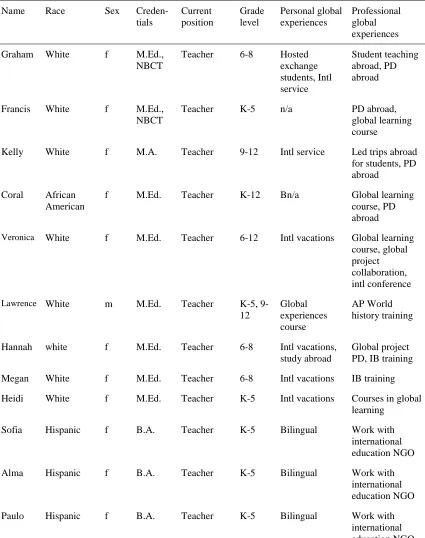
Table 3.1 Table of Participants for the Exploratory Qualitative Interviews ...46
Table 3.2 Themes, Categorical Codes, and Nodes from Qualitative Analysis ...50
Table 3.3 Potential Items for the Teaching for Global Readiness Scale ...56
Table 3.4 Additional Potential Items Added to the Teaching for Global Readiness Scale ...63
Table 3.5 Table of Quantitative Participants ...70
Table 5.1 Factor Loadings from Exploratory Analysis ...96
Table 5.2 Item-to-Factor Statistics from Confirmatory Factor Analysis ...100
Table 5.3 Goodness of Fit Statistics for Measurement Model...102
Table 5.4 Reliability Statistics for Teaching for Global Readiness Scale ...104
LIST OF FIGURES
Figure 1.1 Definition of Global Readiness ...8
Figure 1.2 Teaching for Global Readiness Theoretical Framework ...9
Figure 3.1 Teaching for Global Readiness Mixed Methods Scale Development Design Diagram...42
Figure 3.2 Themes and Categorical Codes for the Construct Teaching for Global Readiness ...52
Figure 3.3 Four Cognitive Processes Used in Responding to Survey Items ...60
Figure 3.4 Instrument Development Design Process ...67
Figure 5.1 Scree Plot of Eigenvalues ...92
Figure 5.2 Standardized Factor Loadings for the Four-Factor Confirmatory Factor Analysis...103
CHAPTER 1 – INTRODUCTION
Globalization has become a major issue in the field of education (e.g., Apple, 2011; Delores et al., 1996; Suarez-Orozco, 2001). Our world is increasingly interconnected economically, environmentally, politically, technologically, and socially (Mansilla &
Jackson, 2011; Merryfield, 2008; Pike, 2015). In response to globalization, education leaders have called for more global education in our K-12 schools (Gardner, 2009; Reimers, 2009; Stewart, 2007). In 2012, the United States Department of Education (USDOE) issued a report entitled Succeeding Globally through International Education and Engagement that included the following goal: “Increase the global competencies of all U.S. students, including those from traditionally disadvantaged groups” (p. 5). This means that in addition to being college, career, and civics ready, all students should be “global ready.” The report defined
global competencies as “21st century skills applied to the world” (USDOE, 2012, p. 5). Twenty-first century skills include collaboration, communication, and problem solving (Partnership for 21st Century Skills [P21], 2014), so applied to the world means
cross-cultural collaboration, cross-cross-cultural communication, and solving global problems. Reaching this goal requires instruction focused on global readiness for all K-12 students.
readiness of US graduates has increased (e.g., National Governors Association & Council of Chief State School Officers, 2010).
Context of the Problem
Comprehensive global education may help students access the global job market and solve global social issues. To address the need for global education, internationalizing preservice teacher education has become a growing focal point in teaching and research (e.g., Jennings, 2006; Merryfield, 2000; Quazada, 2005; Zhao, 2010). Much of the literature focuses on increasing global competence of preservice teachers. However, research about teaching practices that lead to global readiness at the K-12 level has been slow to evolve (Cushner, 2012; Parkhouse et al., 2015). After a review of the literature on internationalizing preservice teacher education and global education at the K-12 level, my theoretically
grounded definition of global ready is global citizens with the multiliteracies necessary in the 21st century to participate, collaborate, and work in a global society.
In October of 2014, the Partnership for 21st Century Skills (P21) announced the Framework for Global Education. The framework, written by VIF International (formerly, Visiting International Faculty), sets standards for global ready teaching and learning in every subject for every grade K-12. While this framework is conceptually sound, it is not
Purpose Statement and Research Questions
The purpose of the study was two-fold. The primary purpose was to validate the construct of teaching for global readiness. The secondary purpose was to develop a scale that collects an array of data on teaching practices that promotes students’ global readiness. The purpose of this exploratory sequential design was first to examine a small sample
qualitatively and then to determine whether the qualitative findings generalize to a large sample. The first phase of the study was a qualitative exploration of what it means for inservice teachers to prepare their students to participate, collaborate, and work
internationally. Interview data were collected from a maximum variation sample of expert teachers and teacher educators from the Global South (e.g., Belize) and East (e.g., China) as well as North and West (e.g., U.S.). The Global South and East represent the developing world that receives aid from the U.S. as well as the emerging economies that are perceived as economic competitors with the U.S.
Because validated instruments to assess teaching for global readiness did not exist, an instrument was developed based on the qualitative views that emerged from the data. From this initial exploration, the qualitative findings were used to develop measures that can be administered to a large sample. Themes from interview data were developed into an instrument so that a series of hypotheses about teachers’ practices related to teaching for global readiness can be tested. In the second phase, quantitative data on teaching for global readiness were collected from 630 public school K-12 teachers in the U.S. The purpose of the study determines the research questions, which include:
● What do global education experts believe are the components of teaching for global readiness at the K-12 level?
● What are the factors of the teaching for global readiness construct?
Methods Overview
The research questions act as the hub of the research design and determine what methods should be used to acquire the knowledge needed (Clark & Badiee, 2010; DeCuir-Gunby, 2008; Onwuegbuzie & Mallette, 2011). Because no empirical model or scale existed at the time of the study to measure teaching for global readiness, this study aimed to define and measure teaching for global readiness using a sequential exploratory mixed methods design (Creswell & Clark, 2011; DeCuir-Gunby, 2008). A QUAL quan approach was taken. The qualitative portion was emphasized because the quantitative process stems from the qualitative process. The sequential exploratory approach is considered best practice for theory and scale development in the social sciences (Benson & Clark, 1982; Clark & Watson, 1995; DeCuir-Gunby, 2008; Vogt, King, & King, 2004). This study is classified as
sequential mixed methods because one method builds upon the other method (Creswell & Clark, 2011). A mixed methods study draws on the strengths of both qualitative (i.e., participant perspectives) and quantitative (i.e., the ability to generalize) methods in order to include both in meta-inferences (DeCuir-Gunby, 2008; Johnson & Turner, 2003).
Theoretical Framework
A researcher’s beliefs, assumptions, and knowledge – whether intentional or not – shape her investigations (Crotty, 1998; Lincoln & Guba, 2000). As Guba and Lincoln (1994) point out, “What can be known is inextricably intertwined with the interaction between a particular investigator and a particular object or group” (p. 110). Because of this, it was important to examine and acknowledge the theories I subscribed to that shaped this study. My theoretical framework for global education comprised three parts: subjectivity statement, worldview paradigm, and substantive content theories (see DeCuir-Gunby & Schutz, in press).
Subjectivity statement. My strong belief in the importance of global education
stemmed from my experiences in international development work and K-12 public classroom teaching. In these roles, I saw the effects of globalization both at home and abroad as well as the effects of education reform on education quality.
When I went to high school, the only high-stakes test was the SAT. We took the Indiana standardized examination (I-Step) every few years, but it did not affect our grades, our graduation, our school’s funding or our teachers’ job status. When I began teaching in 2001, the use of state tests began to change. The attention paid to high-stakes tests increased rapidly and teachers were often blamed when students failed to perform well on these tests. I believed that the purpose of my class was to teach students to think for themselves, to
pursued a master’s degree in international education policy where I learned about
accountability policies in education, market-based educational reforms, and education for social cohesion.
After receiving my master’s degree, I traveled internationally, working in Ghana, Kenya, Myanmar, India, Belize, and Guatemala. With my graduate supervisor, I have also worked in China and with Chinese teachers in the U.S. My professional international travel and personal travel throughout Europe and the Americas have taught me about other cultures, about myself, and about the world. Through international travel, I have grown more
personally and professionally than from any other experiences, and I believe more strongly than ever that global awareness is a vital component to a person’s education.
Worldview paradigm. My research is shaped by pragmatism and epistemological
that knowledge is contextual, I developed a model of teaching for global readiness for the U.S. context. Because I value multiple perspectives, I interviewed expert teachers from around the world and from different experiences to hear their perspectives on global education in the U.S. Next, I will discuss the specific content theories that inform this project.
Content theories. Part of education in a democratic society is to promote a literate citizenry. The U.S. has long promoted traditional literacy and national citizenship education. But the U.S. is changing. Our students will potentially face new technologies, new cultures, and new challenges that will change continuously. Manfra and Spires (2013) stated, “The world’s knowledge-and-innovation environment favors those who have global awareness and competence, strong communication capacity, the ability to collaborate to solve unfamiliar problems, and the ability and flexibility to adapt well to new challenges” (p. 390). In a democratic global information society, global readiness includes national citizenry and traditional literacy in addition to global citizenship and multiliteracies. Figure 1.1
Figure 1.1. Definition of global readiness.
According to Banks (2008) and the New London Group (1996), tensions in the field of education exist between local and global, private and public, and tradition and innovation, among others. These tensions suggest that students must develop a way to negotiate being open to the new, while remaining critically reflective of the present. Students can develop a multiplicity of literacies: critical literacy (McLaughlin & DeVoogd, 2004; Street, 2003); multimodal literacy (Jewitt & Kress, 2003); multilingual literacy (Cope & Kalantzis, 2009); and new social practices, skills, and dispositions needed for new literacies (Leu, Kinzer, Coiro, Castek, & Henry, 2013; New London Group, 1996). They can develop global competence, a sense of social responsibility, and engagement in global civic issues (Morais & Ogden, 2011). When students socially engage as global citizens, they are embracing a cosmopolitan identity (Hansen, 2010a; Wahlström, 2014).
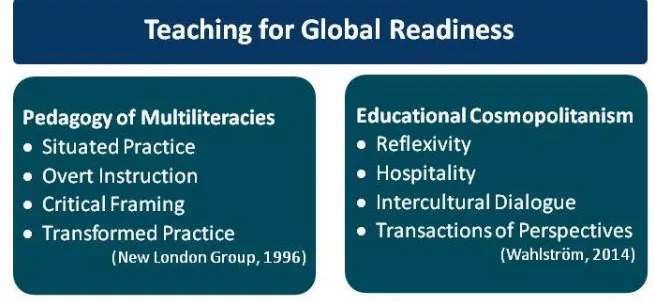
My theoretical framework for teaching for global readiness is built upon Figure 1.1 and is composed of educational cosmopolitanism (Hansen, 2010a; Spector, 2014) as the
Global
Citizenship Multiliteracies
theory of global citizenship education, and pedagogy of multiliteracies (New London Group, 1996) as the theory of 21st century instruction. Figure 1.2 summarizes the theoretical
framework of this study. Pedagogy of multiliteracies embraces what Gee (1999) called the “social turn” and Mills (2010) called the “digital turn” in education. In addition to embracing the social and the digital, Beck and Sznaider (2006) call for a “cosmopolitan turn” in
education. Pedagogy of multiliteracies and educational cosmopolitanism theories are
compatible because together they address the three modern “turns” in education and because they address different components of the study. Cosmopolitanism is a way of looking at the world or a belief system. Educational cosmopolitanism is a normative theory, meaning that it explains how teachers should make decisions, and a methodological theory, meaning that it helps educational researchers make design decisions (Wahlström, 2014). Pedagogy of multiliteracies is a theory of instruction, meaning that it is based on observation and describes how to help students grow (Bruner, 1966).
Educational cosmopolitanism. The definition of cosmopolitanism is contested as it is used differently in various fields. This was not problematic for the study because
according to Hansen (2010b), a single view of cosmopolitanism would be “limiting” (p. 152). As it stands, disciplines emphasize different aspects (i.e., political, ethical, moral, critical) and multiple views reflect the very nature of the term. For the purpose of this study, Hansen’s (2008) educational cosmopolitanism provided the theoretical foundation.
Wahlström (2014) conceptualized educational cosmopolitanism as having four dimensions: reflexivity, hospitality, intercultural dialogue, and transactions of perspectives. Reflexivity emphasizes the critical component of cosmopolitanism and hospitality emphasizes the ethical (Spector, 2014). Teachers grounded in educational cosmopolitanism teach critical global citizenship, which uses inquiry and critical literacy in order to change systems of inequality (Andreotti, 2007; Delanty, 2012; Wright & Andreotti, 2014) and embraces ethics whereby people care for human lives whether those lives are local, national, or global in relation (Appiah, 2006; Nussbaum, 1996, Wahlström, 2014).
Cosmopolitan is an ancient Greek word that literally translates to citizen of the world
(Appiah, 2006; Hansen, 2010a). This citizenship does not displace local or national
across the world are united in a global community with shared universal values while at the same time recognizing and respecting differences (Appiah, 2006; Hansen, 2010a; Wright & Andreotti, 2014; Rizvi, 2008). The theory also acknowledges the diversity within a culture and encourages dialogue as part of learning (Appiah, 2006; Hansen, 2010a).
Pedagogy of multiliteracies. The second theory that informed my study was
pedagogy of multiliteracies (New London Group, 1996). Pedagogy requires meaning making situated in the connections between “doing something and being someone” (Gabel, 2002, p. 180). Thus, the concept of multiliteracies shares cosmopolitanism’s way of being and adds a way of doing in the classroom. This pedagogy aligns with the changing ideas of identity, culture, and citizenship in the 21st century (Kim & Slapac, 2015). Pedagogy of multiliteracies was conceptualized by a group of prominent literacy scholars who met in New London to discuss the current state and the future of literacy pedagogy. Their collective analysis was that the world had become more locally diverse and globally connected, that the workplace now valued multiskilled workers, and that information and communication
technologies were producing a variety of multimodal texts. They agreed that a monolingual, monocultural literacy pedagogy should not be taught anymore and coined the term
through the learning (New London Group, 1996). These two theories will be described in more depth in chapter two.
Summary
Today’s students are being called to graduate global ready. A global ready graduate
is defined as a global citizen with the multiliteracies necessary in the 21st century to
CHAPTER 2 – REVIEW OF LITERATURE
Today’s world is increasingly interrelated and interconnected (Friedman, 2006; Mansilla & Jackson, 2011; Merryfield, 2008; Stewart, 2007). In addition to global interconnectedness, increased migration has led to more diversity in our schools (Apple, 2006; Banks, 2008; New London Group, 1996; Suarez-Orozco, 2001; Zhou, 2010). The effects of a quickly changing society on teaching and learning are central issues in the field of education today (Spring, 2008). Many researchers have suggested that students must develop new literacies, new competencies, and new ways of thinking to be ready for college, career, and civic life in this global knowledge society (Andreotti, 2010; Gee, 2008;
Lankshear & Knobel, 2003; Street, 2003).
Teachers are in a position to prepare the 21st century student to be ready to participate and work in a locally diverse and globally interconnected society (New London Group, 1996; Zhao, 2010). Global education aims to prepare students for college, career, and civic life in a global society (Dagenais, 2003); however, some have criticized US schools for omitting of global education from the curriculum (Barker, 2000; Friedman, 2006; Haywood & Siaya, 2001). What our students may need in order to communicate and interact in today’s globally-interconnected information society are both multiliteracies and global citizenship. Together, these concepts form the construct global readiness. Presently, NAFSA Association for International Education, North Carolina (NC) State Board of Education, VIF
readiness is not just for world language teachers or for social studies teachers; all K-12 teachers hold the potential to promote global readiness (Durtka et al., 2002; Smith, 2002).
Literature Review Process
Although many authors in the field of education have spotlighted and empirically analyzed teaching 21st century skills (e.g., Cope & Kalantzis, 2000; Lankshear & Knobel, 2003; Leu, 2001), fewer studies have empirically analyzed how to teach for global readiness (Parkhouse et al., 2015; Van Hoof & Verbeeten, 2005), especially at the K-12 level (c.f. Learn NC, 2014; Mansilla & Gardner, 2007). Questions regarding the connection between traditional education and global education in contemporary society remain. In particular, how are 21st century literacies interrelated with global citizenship in the professional literature? For shifts in learning to occur, shifts in teaching must precede. The second question examined within this discussion is, what pedagogy will promote global readiness (i.e., global citizenship in addition to multiliteracies) in our students? These unresolved questions guided my literature review.
My goals were twofold: (a) examine empirically validated constructs of global citizenship; and (b) synthesize the research on teaching K-12 global education in the 21st century. In searching for relevant literature, I utilized several education databases (e.g., ERIC, Academic Search Complete, Google Scholar) and the footnote method, using references in the articles I read to find more research (Shanahan, 2001). I used the search phrases global citizenship, global competenc*, global read*, global-read*, global education, cosmopolitanism, new literac*, multiliteracies, 21st century literac*, teaching, instruction,
I reviewed the literature inside and outside of the U.S. context because there were not many empirical studies. Educating for global readiness is considered a goal for teachers worldwide (Darling-Hammond, 2010; Gundara, 2000; Reimers, 2010; Tye, 2014). However, one’s definition of global readiness is shaped by one’s historical, social, and cultural context (Deardorff, 2006). For example, Baumgratz (1995) claimed that the European view is different than the U.S. view in that the paradox of global citizenry and global competition is more apparent in Europe. Therefore, I needed to contextualize the review to the U.S. because global readiness is tied to culturally-situated values and beliefs, so when reviewing literature from Europe, Canada, and Australia, I read critically for possible contextual differences. To analyze and synthesize, I conducted a thematic content analysis (Braun & Clarke, 2006). Keeping the questions in the forefront, I read the studies, highlighted key quotes and wrote notes in the margins. Then, I generated initial codes across the data and gathered like data by comparing and contrasting codes to identify themes. Next, I reviewed the themes for internal homogeneity and external heterogeneity, reviewing the articles to make sure the themes were comprehensive yet supported (Braun & Clarke, 2006).
Necessity of Global Readiness Education
Much of the conceptual literature on global education is a synthesis of research from higher education or business fields on why global education is imperative in the 21st century. Researchers assert that global education is needed because globalization has flattened the world economy, the demands on the workforce are changing, global migration is higher than in the past, and the climate is changing (Hansen, 2010a; Mansilla & Jackson, 2011).
global social issues. In this section I will first synthesize the research on the changing job market and then the globalization of social issues.
In the past, education in America focused on reading, writing, and arithmetic-- specifically reading print texts, writing that is formal and academic, and calculating arithmetic –in order to prepare students for work in an industrialized society. However, research indicates that work life has changed (Gardner, 2009; Levy & Murnane, 2004, 2007). Work life in the 21st century for the middle class job market includes gathering and analyzing information, communicating using technology, and solving problems (Gardner, 2009; Leu, Kinzer, Coiro, Castek, & Henry, 2013; Levy & Murnane, 2004, 2007; New London Group, 1996). Research indicates that work includes being able to think creatively and critically as well as communicate and collaborate interculturally (Deardorff, 2006; New London Group, 1996). According to Committee for Economic Development (2006) reports, the US
workforce has a shortage of globally competent individuals. Hayward and Siaya (2001) surveyed over 1000 US adults and 500 high school seniors about global education.
According to their study, 93% agreed that the workforce needs to be able to collaborate with people from different cultures, 90% agreed that global education would help them work with people of other cultures, and 88% said it would give them a competitive edge in the work force. The general public, as well as students, saw that intercultural collaboration would be part of their future work lives and believed that global education is important.
potential to teach students about culture. Students may gain international perspectives, deeper appreciation of other countries and cultures, and knowledge of diverse societies’ contributions (Black & Duhon, 2006; Bremer, 2006; Hadis, 2005; Suarez-Orozco, 2007; Van Hoof & Verbeeten, 2005). Empirical studies have found ethnocentrism is reduced (Union & Green, 2013), stereotypes are reduced, and respect for other cultures is increased (Besnoy, Maddin, Eisenhardt, & Steele, 2015). Not only do students have the potential to learn about other cultures, they can learn about American culture as well (Myers & Eberfors, 2010; Smiles, 2001). When students observe other cultures, they may see other ways of knowing and doing. Comparison and contrast can help students identify their own cultural beliefs, values, and customs. Global education holds promise to promote important interpersonal skills, such as cross-cultural communication and collaboration (Akande & Slawson, 2000; Lindsay & Davis, 2013; Sussmuth, 2007) as well as intrapersonal skills, such as identity clarification (Banks, 2008; Hull, Stornaiuolo & Sahni, 2010).
21st century advocates for desired civic actions may require the use of communication technology and other tools that did not exist even a few years ago or that have yet to be imagined (Leu et al., 2013; New London Group, 1996; Partnership for 21st Century Skills, 2014). To solve the global issues of today, students may need to develop the same skills described above for today’s workforce (Gardner, 2009). Future graduates may need to be both globally competent and multiliterate in order to be successful as they use technology to work and interact with culturally and geographically diverse people (New London Group, 1996; West, 2010). Global citizenship and multiliteracies combine to form the construct global readiness.
Global citizenship. As cosmopolitanism is translated as citizen of the world, the word
citizen must be defined in order to understand what cosmopolitanism really means. A foundational document in the field is by Hanvey (1982). Hanvey’s definition and structure “has probably influenced the global education movement more than any other one document” (Merryfield, 1997, p. 3). A second highly influential conceptual framework is that by
Mansilla and Jackson (2011) from the Asia Society, a highly regarded nonprofit for global education.
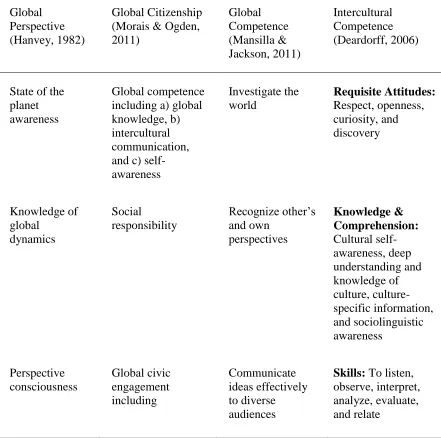
K-12 research because of its apparent relevance to people of all ages. The dimensions of global citizenship, or the related terminology, are listed in 2.1. (For full discussion of related terminology see Sinicrope, Norris, & Watanbe, 2007).
Table 2.1.
Frameworks of Global Citizenship
Global Perspective (Hanvey, 1982)
Global Citizenship (Morais & Ogden, 2011) Global Competence (Mansilla & Jackson, 2011) Intercultural Competence (Deardorff, 2006)
State of the planet awareness
Global competence including a) global knowledge, b) intercultural communication, and c) self-awareness Investigate the world Requisite Attitudes: Respect, openness, curiosity, and discovery Knowledge of global dynamics Social responsibility Recognize other’s and own perspectives Knowledge & Comprehension: Cultural self-awareness, deep understanding and knowledge of culture, culture-specific information, and sociolinguistic awareness Perspective consciousness Global civic engagement including Communicate ideas effectively to diverse audiences
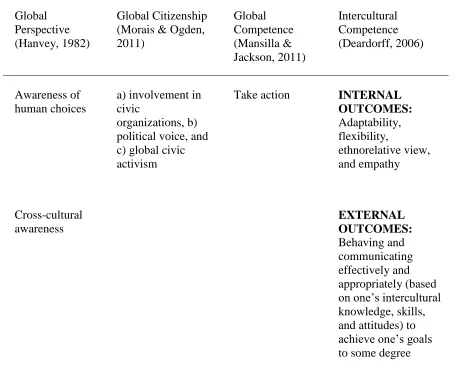
Table 2.1. (Continued)
Global Perspective (Hanvey, 1982)
Global Citizenship (Morais & Ogden, 2011) Global Competence (Mansilla & Jackson, 2011) Intercultural Competence (Deardorff, 2006) Awareness of human choices
a) involvement in civic
organizations, b) political voice, and c) global civic activism
Take action INTERNAL
OUTCOMES: Adaptability, flexibility, ethnorelative view, and empathy Cross-cultural awareness EXTERNAL OUTCOMES: Behaving and communicating effectively and appropriately (based on one’s intercultural knowledge, skills, and attitudes) to achieve one’s goals to some degree
students participate in their community and act on issues of local and global importance (Morais & Ogden, 2011).
Multiliteracies. In addition to global citizenship, research suggests that students develop multiple new literacies to be ready for college, career, and civic life in the global 21st century (Coiro, Knobel, Lankshear, & Leu, 2008). Reading and writing today involve new text-types (e.g., hyperlinked text, nonlinear navigation); new skills (e.g., key word searching, reading across modes); and new dispositions (e.g., critical stance, contributing information to text). This has led researchers to broaden the definition of literacy to include the new
literacies needed for digital texts and multimodal systems of communication that are widely used on the Internet and other communication technologies (ICTs). Different researchers refer to this theory as new literacies (e.g., Leu et al., 2013), New Literacy Studies (e.g., Street, 2003), and multiliteracies (e.g., New London Group, 1996).
dimension of cross-cultural communication (Kress, 2012). In addition, the importance of inquiry skills and critical reading skills increased with the increase of ICTs (Leu et al., 2013). Research suggests that online literacy requires students to identify a problem or research question, locate reliable sources both online and offline, read through a critical lens, construct knowledge by synthesizing information from multiple sources, and communicate using the appropriate mode(s) (Leu, 2002; Lonsdale & McCurry, 2004; Manfra & Spires, 2013).
Research indicates that while students have adapted to hyperlinks and nonlinear reading, they have not as readily adapted to the critical component essential for internet research and comprehension (Coiro, 2003; Lankshear & Knobel, 2011; Leu et al., 2013; Spires & Estes, 2002). Critical literacy is “to read not only the word but also the world” (Friere, 1969, as cited in McLaughlin & DeVoogd, 2004, p. 52). As students engage in critical literacy, they analyze the words and also the political and cultural assumptions the author is making (Luke & Freebody, 1999; Street, 2003). Hull, Stornaiuolo, & Sahni (2010) add that in addition to being politically and culturally alert, readers must be morally and ethically alert to their definition of critical literacy. This suggests that students make judgments about texts and society.
Teaching for Global Readiness
Global readiness education holds potential to help students become cross-cultural communicators and active global citizens (Ladson-Billings, 2005). In order to reach this potential, Andreotti (2006) advocates for critical, not “soft,”global citizenship education. By
Feminists and scholars of color have long advocated critical pedagogy that leads to
transformation (Banks, 2008). Critical pedagogy goes beyond preparing students for college, career and civic life, by also preparing them to understand, challenge, and dismantle current hierarchical systems and systems of oppression (O’Connor & Zeichner, 2011).
Some theories of global critical pedagogy stem from multicultural education (Lantz & Davies, 2015). The Globally Competent Teaching Continuum (GCTC) was developed with qualitative methods to synthesize literature and interviews with over 100 expert
teachers (Learn NC, 2014; Parkhouse, Glazier, Tichnor-Wagner, & Cain, 2015). The GCTC builds on Bank’s (1993, 2004, & 2008) model of multicultural education and Gay’s (2002) and Ladson Billings’s (1995) theories of culturally responsive teaching. A second example of a global teaching framework that stems from social studies education is Merryfield, Lo, Po, and Kasai (2008). Merryfield’s research on globally minded teachers has spanned over three decades. Two theories of teaching global education that stem from environmental studies are posited by Bottery (2006) and Earth Council (2002). These theories advocate awareness and care for the earth in addition to awareness of other cultures and care for other peoples. From the field of literacy came the pedagogy of multiliteracies (New London Group, 1996) to account for the multifaceted nature of instruction in a global knowledge society and from multiple disciplines came cosmopolitanism.
Table 2.2.
Frameworks of Global Education
Global Education (Bottery, 2006) Earth Council Framework (2002) Educational Cosmopoli-tanism (Wahlström, 2014) Globally Competent Teaching (Learn NC, 2014) Global Education (Merryfield et al., 2008) Pedagogy of Multiliteracies (New London Group, 1996) Ecological and political awareness. Respect and care for the community of life.
Hospitality. Dispositions:
Empathy and valuing multiple perspectives. Promoting equity worldwide. Knowledge of interconnectedness. Situated practice. Epistemological provisionality. Ecological integrity. Intercultural dialogue. Knowledge: Understanding of global conditions and current events, ways world is interconnected, intercultural communication. Examine multiple perspectives with an open mind
Overt instruction.
Support public good and public accountability.
Social and economic justice.
Reflexivity. Experiential understanding of multiple cultures. Facilitate cross-cultural experiential learning. Critical framing. Professional self-reflection. Democracy, nonviolence, and peace Transactions of perspectives. Skills: Communicate in multiple languages.
Inquiry into global issues. Transformed practice. Affirmation and acceptance. Integrate content-aligned explorations of the world.
Teach about power and social justice.
Emotional literacy. Facilitate intercultural and international conversations. Confront stereotypes and over- simplification. Cooperation and collaborative problem-solving.
Educational cosmopolitanism. Cosmopolitanism is an orientation to the world that helps one reconcile apparent paradoxes. One modern paradox described by researchers is the global homogenization of culture with simultaneous fracturing of local cultures by increasing migration and production of subcultures (Kim & Slapac, 2015; New London Group, 1996). Research indicates that classrooms around the world are becoming more diverse as global immigration increases. Today, the U.S. is home to a near-record 12.9% foreign-born
residents, according to the latest census (US Census, 2011). These residents may bring with them their home culture while trying to integrate into American life. As teachers move beyond superficial knowledge of their multicultural students’ past and present circumstances, they may become conscious of bias based on perceived power differentiation between the U.S. and students’ home countries (Escamilla, Aragon & Fránquiz, 2009; Ogaz, 2000). As Apple (2011) states:
Superficial knowledge [of students’ cultures] may not be much better than no
knowledge at all. It may also paint a picture of parents and youth as passive ‘victims’ of global forces, rather than as people who are active agents continually struggling both in their original nations and regions and here in the United States to build a better life for themselves, their communities, and their children. (p. 223)
Cosmopolitanism does not advocate for a cosmopolitan identity to replace national or ethnic identities as if identity was a “zero-sum conception” (Kymlicka, 2004, p. xiv; see also Dolby, 2004). Instead, the theory explains how people today often hold multiple identities (Nussbaum, 1996; Noddings, 2010a) and those identities may constantly shift and change (Wahlström, 2014). This corroborates empirical research on K-12 students’ multiple identities across national borders, such as Palestinian-American (Abu El-Haj, 2007),
Vietnamese American (Nguyen, 2008), South Asian-American (Maira, 2004), and Mexican-American (Valenzuela, 2013). Ladson-Billings (2004) states that people “move back and forth across many identities, and the way society responds to these identities either binds people to or alienates them from the civic culture” (p. 112). Following this line of reasoning, people may participate in both their ethnic culture and the national culture while also
associating with a global culture (McIntosh, 2005; Noddings, 2005) or cosmopolitan identity (Banks, 2008; Rizvi, 2008). These identities are fluid and may change in composition over time (Wahlström, 2014).
Likewise, cosmopolitanism is not a dualistic framework that sees curriculum as either about the nation or the world. Instead from a cosmopolitan view, the communities around the world are seen as interconnected and interrelated. As Rizvi (2008) explains, “This does not mean ignoring local issues, but to understand them within the broader context of the global shifts that are reshaping the very nature of localities” (p. 21). In this way, teachers do not replace teaching about the local for teaching about the global, but instead show how the local is already global (Asia Society, 2015; Appiah, 2006; North Carolina State Board of
Wahlström (2014) proposed a framework for educational cosmopolitanism “on the ground” with four parts: reflexivity, hospitality, intercultural dialogue, and transactions of
perspectives.
Reflexivity. There is tension in the literature between the old and new. Some
theorists embrace the new homogenization of culture and some resist the loss of indigenous cultures (Beck, 2006; Wahlström, 2014). Cosmopolitanism works for the continuation of indigenous knowledge and cultural traditions while also questioning in a reflexive cycle old traditions that might inhibit the construction of new knowledge useful to the contemporary life (Hansen, 2010a). Appiah (2006) reconciles this tension by scrutinizing change for signs of coercion by hegemonic social factions. Political or economic coercion is not accepted in cosmopolitanism; however, communities are free to change as part of the normal progression of life. In this way, culture, like identity, is not viewed as static and museumified, but as dynamic and constantly renegotiated.
Hospitality. Helping students to develop hospitable outlooks is not easy. Gough
(2014) describes the challenge in curriculum and instruction: “The practical challenge is how to perform an ethics of inclusion rather than a politics of exclusion” (p. 90, emphasis
challenge of balancing diversity and unity through their curriculum and instruction. As Banks (2008) asserts, “Unity without diversity results in hegemony and oppression; diversity without unity leads to Balkanization and the fracturing of the nation-state” (p. 133).
Teachers have the potential to discuss with students the relationships and the tensions in loyalties to the local, the regional, the national, and the global (Delanty, 2006; Delores, 1998; Gough, 2014; Hawkins, 2014).
Intercultural dialogue. The tension described above between resisting and accepting
change can be viewed as an ethical question in education because blanket tolerance does not work in a classroom. Cosmopolitanism provides a normative ethical theoretical lens
(Wahlström, 2014). In other words, the theory provides criteria for deciding what is right and wrong. While tolerance for differing beliefs is encouraged in cosmopolitanism, universal normative values are also encouraged (Appiah, 2006). We do not have to tolerate all
Transactions of perspective. Likewise, the understanding that cultures change should
be tolerated. As students engage in intercultural dialogue, they learn from each others’ perspectives. Through transactions with other individuals and with their cultures, people accept new ways of thinking or new ways of doing. Hansen (2011) explains that teachers can give students experiences of “reflective openness to the new fused with reflective loyalty to the known” (p. 86). Cultures progress, but engaged citizens do not adopt change blindly. As students consider different perspectives and practices, they engage in critical analysis and reflexivity of their own culture as well as other cultures. In transactional learning
experiences, students interact with others, sharing ideas and perspectives in a way that requires a give and take from both parties. Cosmopolitan educators promote equality.
Transactions of perspective and reflexivity are key parts of educational cosmopolitanism that students can utilize to create their futures (Hansen, 2010a; Wahlström, 2014).
world, such as perspective-taking, empathy, reflection, collaboration, and problem-solving. In summary, a critical global citizen utilizes self-reflexivity, intercultural dialogue, and critical inquiry to create a more just social future.
Pedagogy of multiliteracies. Multiliteracies theory embraces culture as dynamic in
the same way that cosmopolitanism does (Street, 2003). I have chosen pedagogy of
multiliteracies to ground the theory of instruction because it was birthed from globalization, while culturally responsive teaching (Gay, 2002) and culturally relevant pedagogy (Ladson-Billings, 1994) in the U.S. sprang from the civil rights movement and therefore much of the research using culturally responsive pedagogy in the US is based on multicultural and racial identities at the local or national level. However, both educational cosmopolitanism and pedagogy of multiliteracies share a critical frame with culturally responsive and relevant teaching. Educational cosmopolitanism and pedagogy of multiliteracies are compatible theories when used together in global education research (e.g., Hawkins, 2015; Hull & Stornaiuolo, 2014; Vasudevan, Kerr, Hibbert, Fernandez, & Park, 2014).
The purpose of education according to pedagogy of multiliteracies theory is for students to be able to fully and equitably participate in social, public, and economic life (New London Group, 1996). To do this, pedagogy utilizes diversity as a resource not as a barrier or a deficit to quality education (Kim & Slapac, 2015).
To address the diverse needs of students and build upon their knowledge and resources, New London Group proposed pedagogy of multiliteracies with four dimensions:
● critical framing, and ● transformed practice.
These four dimensions will now be explained.
Situated practice. Situated practice means that learning is relevant, authentic, and
social. This pedagogy makes learning relevant by considering the community, both in the classroom and the larger society within which the learning is taking place. This involves leveraging the texts and topics students are excited or concerned about to build learning conditions that are relevant to students’ lives outside of school. Martens et al. (2015) found that carefully selecting global literature during read aloud time in an elementary school was associated with students “developing richer understandings of themselves as complex cultural beings, a deeper appreciation of others and diverse perspectives in the world, and a perception of themselves as capable problem-solvers who take action” (p. 617). In addition to relevant content, situated practice involves authentic inquiry-based learning experiences and collaborative learning opportunities for students to work together to construct knowledge in ways that build 21st century skills (Al-Maamari, 2014; Lindsay & Davis, 2013; Spires, Chang, Bot, & Himes, 2015).
Teachers create communities of practice where students feel secure, can take risks, and trust the other members of the community. Each community of practice includes an expert, the teacher or a peer who has already mastered the objective or practice (Cope & Kalantzis, 2009). This pedagogy recognizes the rich cultural heritages that students bring with them to school, capitalizing on students’ diverse expertise as resources to the
that while situated practice is important for learning motivation, it is not enough to bring students to mastery. Students need awareness of their learning and of the historical, political, and cultural context of their experiences. Following this line of reasoning, this pedagogy includes overt instruction and critical framing in addition to creating a community of learners.
Overt instruction. Overt instruction is not direct instruction of rules for a bounded
system, but rather instruction of knowledge as being situated and contextual in practice. Teachers are overt about patterns across systems, and show students how to “act flexibly and adaptably to context” (New London Group, 1996, p. 79). Teachers overtly provide
connections to students’ prior knowledge, active scaffolding to help students apply what they know to the new context, and assessment of growth. The most emphasized part of overt instruction is to give students an awareness of their knowledge, their meta-knowledge. For example, teachers communicate with students that the academic language they will encounter in textbooks is different from the everyday language people use (Gee, 2008). These
Overt instruction of micro—or local literacies—and macro—or broader cultural literacies—can possibly help students as they use technology in collaborative learning situations with peers in other countries (Stornaiuolo & LeBlanc, 2014; Street, 2003). Literacy is seen by prominent theorists as social practices that differ across academic communities or social cultures (Gee, 2008; Street, 2003). Students can learn to become aware of and respectful of difference in their audiences, who may have immediate access to their text productions but may be from a different part of the world. Through a cosmopolitan identity, students are shown the moral stance of text production and consumption (Hull & Stornaiuolo, 2014).
These first two dimensions, situated practice and overt instruction, are based on social learning theory (Vygotsky, 1978). Vygotsky theorized that students can achieve more by learning with a teacher or more capable peer than they can learn independently. The next dimension is based on critical social and critical literacy theories.
Critical framing. When employing pedagogy of multiliteracies, students’ diverse
cultural experiences and perspectives are valued as resources. Educators who advocate a critical frame practice critical analysis of the systems within and outside of the classroom to interrupt assumptions, ensure that cultural barriers are broken down, and that differences are seen as resources. They also teach students to think critically and to inquire using critical literacy (Kalantzis & Cope, 2001; Hull, Stornaiuolo, & Sahni, 2010; Morrell, 2002).
Teaching through a critical lens gives opportunities for students to see familiar things in a strange light, in other words, to look from multiple perspectives outside of their norms.
2004) by questioning the authority of the author/speaker within the content curriculum while also modeling respectful dialogue—or in the words of cosmopolitanism, hospitable dialogue
(Hull, Stornaiuolo, & Sahni, 2010). Just as cosmopolitanism does not tolerate injustice, pedagogy of multiliteracies emphasizes that the goal of education is “not to produce docile, compliant workers but rather for students to develop the capacity to speak up, to negotiate, and to be able to engage critically with the conditions for their working lives” (New London Group, 1996, p. 66). Critique of multiliteracies considers the theory text-centric (Leander & Boldt, 2013); however, a broad understanding of critical framing expands it from critical literacy to a form of critical pedagogy. Critical framing provides students the tools to tear down systems of inequality and design new, equitable systems.
Transformed practice. Transformed practice involves both the transformation of
resources and the transformation of students. In transformed practice, students become designers. Students learn what designs are available, integrate and juxtapose the
pre-existing, and redesign to adapt to new contexts. Students are able to transfer what they learn in one situation and apply it, in a new way, to the situation in front of them (Cope &
Kalantzis, 2009). This ability is crucial for the quickly changing society in which we now live (Mills, 2006). Leander and Boldt describe transformation of the students:
This view is in congruence with cosmopolitanism. Hansen (2010a) describes a cosmopolitan approach to teaching as “drawing them [students] into cultural creativity as they learn to do more than mimic the tried and the known, but rather to engage it dynamically with the unfamiliar” (p. 20). Also in congruence with cosmopolitanism, the New London Group emphasizes the reflective manner, learned through overt instruction and critical framing, in which transformed practices should occur.
In order for this pedagogy to take hold, some researchers suggest that teachers
embrace epistemological pluralism (Andreotti, 2009; Kim & Slapac, 2015). Epistemological pluralism recognizes knowledge as being constructed by people within a context and
acknowledges multiple rationalities. When what was to be learned in school was stable and rule-bound, positivist epistemology could suffice, but pedagogy of multiliteracies emphasizes that knowledge and learning are socially constructed, fluid, and contextual. Following this assertion, the most important thing a teacher can teach students is not a body of knowledge but how to question and design new possibilities. A shift from positivism to pluralism also moves away from one correct or standard academic discourse to allowing multiple competing and complementary discourses to shape the school experience. Criticism of pedagogy of multiliteracies contests the documents authorization of nontraditional discourses in school, namely affective and embodied discourses (Leander & Boldt, 2013). A shift to
they live in continue to change. Most importantly, students have the potential to design the global future that they desire.
Barriers. While many tout the goal of teaching for global readiness to be peace and global stability (Reimers, 2009), some view global education curricula as neoliberal,
controversial, or overly political (Schukar, 1993). By its social and cultural nature, global education is subject to different political ideologies (Cross & Molnar, 1994; Lantz & Davies, 2015). Even when teachers have strong beliefs for teaching global education, they still may not practice what they believe (Rapoport, 2010).
The literature has indicated that the interaction between beliefs and practices is complex (Pajares, 1992). A variety of constraints may result in teachers’ inabilities to enact their beliefs about education. Limited time, resources, and budgets are barriers to teachers engaging in meaningful global education in their classrooms (Merryfield, 2008; Pike, 2015; Schukar, 1993). If teachers believe in global education, they must learn not only the content but also the processes of global education, such as how to teach controversial topics and conflict resolution (Schukar, 1993). As Allen (2013) states, “Because of the many
On the other hand, one cannot teach for global readiness without being global ready oneself. This is because, if a teacher facilitates an interaction between two peers and the peers learn cross-cultural communication from each other as a byproduct, then the learning was a byproduct and not an outcome of the teaching. According to pedagogy of
multiliteracies, there must be a more capable person to scaffold the learner. Teachers cannot presume that there will be capable peers in every class that can scaffold the learning of other peers. However, the teacher should expect each class to learn cross-cultural communication skills. Therefore, the teacher must have metaknowledge about culture and communication in order to scaffold cross-cultural communication and the cosmopolitanism dimension of intercultural dialogue.
How to get there. According to empirical studies, professional development abroad
coupled with cultural immersion and critical reflection, whether short term tourism or
extended teaching assignments, positively impacted teachers’ classroom practices of teaching for global readiness. My synthesis of the research suggests that after professional
development abroad, teachers perceived greater connections with students and parents, a shift from deficit mindset, increased flexibility and reflexivity, and deeper learning through first-hand experience.
Participants in professional development abroad consistently perceived deeper learning and better understanding than could have been achieved at home (Alfaro &
traveled to India previously and Japan for the study, articulated, “Experience is the truest and deepest teacher....While I certainly have been met with challenge and hardship, I have grown monumentally each time I have taken the risk to explore myself within another country” (p. 115). While Kruger et al. (2009) was not a research article, data were shared that
corroborated this theme. While in South Africa an in-service teacher wrote, “I had to travel half way around the world to begin to understand the issues of racism in the United States” (p. 160). This visceral experience allowed the participant to gain a more in-depth
understanding of what life is like for people in other countries and how politics plays a part. Teachers reported translating their cultural experiences and critical insights into more authentic experiences for their students back inside the classroom. After teaching abroad, educators reported introducing authentic cultural experiences for their students (Quezada & Alfaro, 2007; Cook, 2009), including students’ cultures in the curriculum (Zhao, Meyers, & Meyers, 2009), and “decentering” the U.S. from the curriculum (Patterson, 2013, p. 107). Participants recreated experiences for students so that students could learn different ways of living. One participant expressed her motivation for sharing these experiences with her students: “It is integral that I introduce students to other cultures and other methods of thinking. Our kids need to be flexible, creative, and compassionate” (Cook, 2009, p. 118). One participant reported utilizing the critical reflection pedagogical strategy from his professional development with his own students in the classroom (Quezada & Allen, 2007). Beyond their own classroom, participants reached other students by founding after school clubs (Cook, 2009) and developing curriculum for their district (Evans, 2004).
Global readiness includes the literacies, competencies, and dispositions students need in order to participate, collaborate, and work effectively and peacefully with anyone in the world from anywhere in the world. Students must be both multiliterate and global citizens. As Hansen (2010a) described, we must “reside in the conjunction and” (p. 23). If our students are going to solve the major problems of the world, our students must embrace the
and. They must critically reflect on the past and design a new social future. Both
educational cosmopolitanism and pedagogy of multiliteracies empower students to design and create their own social future through critical literacy. Both are open to change and see culture as constantly evolving. Educators must work through the tensions to allow for old
and new; local and global; private and public; particular and universal; and receptivity and
resistance. There will be times when U.S. teenagers decide to wear H&Mand eat sushi, but that does not make them less Cherokee or less American. It merely makes them part of the global system. Students will have to navigate this global system by knowing the ethical times to fight against oppression and the times for tolerance and peace. There will be times when critically investigating and coming to an understanding of inequality inside a system will challenge local social cohesion, but only in the short term. In the long term, it is systems of inequality that are the true threat to peace. History shows that the more equity in societies, the more social cohesion (Heyneman, 2002; 2005).
CHAPTER 3 – METHODS
Global education is a response to the demands of a globalized world, where economics, migration, and technology have no boundaries (Hansen, 2010a; Mansilla & Jackson, 2011; Merryfield, 2000; Pike, 2015). Education leaders are calling for teaching in K-12 schools for global readiness to prepare students, not for a global future, but a global today (North Carolina State Board of Education, 2013). Sound teaching is grounded in empirical research, but currently there is a lack of research at the K-12 level. Research has measured undergraduate students in global education programs using cultural competence scales, such as Intercultural Behavioral Assessment Indices (Ruben, 1976); Assessment of Intercultural Competence (Chen & Starosta, 2000; Fantini, 2000); Cross Cultural
Adaptability Inventory (Kelley & Myers, 1992); Intercultural Sensitivity Inventory (Bhawuk & Brislin, 1992); and the Intercultural Development Inventory (Hammer, Bennett &
Wiseman, 2003), among others.
teaching for global readiness for in-service teachers. This scale development project was intended to fill this gap.
Research Design
In order for research to be valid, the instruments employed must be valid (American Psychological Association, 2014). As Hinkin (1998) states, “It is crucial that the measures on these survey instruments adequately represent the constructs under examination” (p. 1). I used a sequential exploratory mixed methods design (QUAL quan) to develop the
teaching for global readiness scale and utilized established psychometric standards
(American Psychological Association, 2014; Benson & Clark, 1982). The qualitative portion was conducted first and held a primary position because the quantitative portion was
dependent on the qualitative data. The qualitative phase consisted of the divergent phase and the first round of the convergent phase (Cronbach, 1982). The quantitative segment
consisted of the final rounds of the convergent phase. The purpose of the divergent phase was to consider multiple perspectives. The purpose of the convergent phase was to simplify the construct by looking at the common practices across participants. Figure 3.1 displays the sequence. A full design diagram is in Appendix A.
Figure 3.1. Teaching for global readiness mixed methods scale development design diagram. QUAL
collect data
Develop an instrument
QUAL analyze data
quan collect data
quan analyze data
This study answered five research questions. The overarching question for this study was How can we operationalize teaching for global readiness?
There were four sub-questions for this study.
● What did global education experts believe were the components of teaching for global readiness at the K-12 level? (QUAL)
● What are the factors of the construct teaching for global readiness? (quan)
● Are the themes about teaching for global readiness from the qualitative findings generalizable to a sample of a population of K-12 teachers? (MM)
● To what extent did the quantitative results confirm the qualitative findings? (MM)
Because these questions ask “what” and “how,” a mixed methods approach was selected, as this type of inquiry is well-matched for answering “what” and “how” types of questions (Creswell & Clark, 2011). The rationale for the mixed methods design is described next followed by sections describing the procedures and rationale for the qualitative phase and then the procedures and rationale for the quantitative phase.
Mixed methods research is becoming more widely used in the social sciences as it combines the strengths of both qualitative and quantitative methods (DeCuir-Gunby, 2008; Johnson & Onwuegbuzie, 2004). Although mixed methods is defined by researchers in different ways. Johnson, Onwuegbuzie, and Turner (2007) conducted a study to move toward consensus on a definition. Their concluding definition states:
(e.g., use of qualitative and quantitative viewpoints, data collection, analysis, inference techniques) for the broad purposes of breadth and depth of understanding and corroboration. (p. 123)
Mixed methods researchers collect a variety of data types and use different analysis techniques so that the amalgamation minimizes any weaknesses inherent in singular
traditions (DeCuir-Gunby, 2008; Onwuegbuzie & Johnson, 2006). Specifically, mixed methods are well-suited for instrument design (Benson & Clark, 1982; DeCuir-Gunby, 2008; Vogt, King, & King, 2004). Together the quantitative and qualitative samples provide the narratives and the numbers to produce breadth and depth of data. I chose mixed methods because it enabled both comprehensive and generalizable meta-inferences (Onwuegbuzie & Johnson, 2006). In exploratory sequential design, the qualitative phase comes first because it answers research questions such as what is the natureof a construct? and how was it
perceived by participants? (Creswell, 2013; Denzin & Lincoln, 2005). The qualitative phase began the exploration with interviews in order to listen to participants. In this chapter, I will explain the qualitative and quantitative procedures utilized to develop a valid and reliable scale to measure teaching for global readiness.
Qualitative Phase
researchers to hear the voices and stories of those who experience the construct as well as the evidence of those who study the construct (Lincoln & Guba, 2000; Vogt, King, & King, 2004). This allows the researcher to consider practitioner and researcher views of the construct.
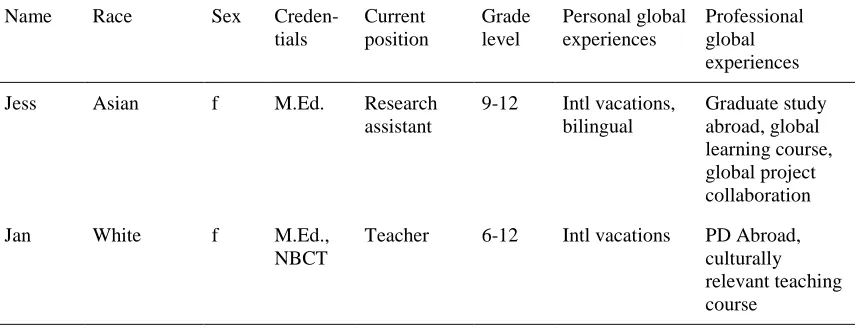
Participants. For the first part of the study, I interviewed 24 experts. Creswell (2013) recommends 20 to 30 participants for grounded theory research, the highest sample size recommendation in qualitative research. Since the exploratory phase was similar in its objective to grounded theory research, 24 was considered an acceptable sample size. Interviewing experts is an essential step to increasing content validity of instruments (Messick, 1995). Experts can be defined as researchers of the construct or members of the target population who have direct experience with the construct (Vogt, King, & King, 2004). Teachers’ voices were important to capture, for me, because one goal of my research was to empower teachers. I believed and continue to believe, as Eisner (1991) did, that the voices of teachers are powerful, are missing, and are needed in educational research. This belief led me to choose to interview current K-12 classroom teachers in addition to global education researchers who are professional teacher educators.
In order to garner diverse and credible perspectives, I used purposeful sampling (Creswell, 2013). I purposefully selected the sample for maximum variation in