Evaluating Features Extraction Techniques: A
Comparative Study on Face Recognition
Nasser S. Alamri, Yasser M. Hausawi
Assistant Professor, Dept. of I.T., Institute of Public Administration, Jeddah, Kingdom of Saudi Arabia
Assistant Professor, Dept. of I.T., Institute of Public Administration, Jeddah, Kingdom of Saudi Arabia
ABSTRACT: Biometrics technology is a field of science that investigates individuals’ verification and identification based on individuals’ biological characteristics, such as faces, fingerprints, iris, and soft biometrics. It has been getting the attention of scientists and researchers from various disciplines, due to the possibility of utilizing its features in different aspects such as authentication and forensics. Features extraction is a key successful step in Biometrics technology, and therefore the extraction algorithms used to extract biological characteristics are very important to be used in a proper way. Among the currently available algorithms, Principal Component Analysis, Linear Discriminant Analysis, Scale Invariant Feature Transformation, and Local Binary Patterns are the most well- known. However, they are not the same in terms of performance. This paper focuses on face recognition and investigates the four algorithms’ performance and compares between them based on four performance curves: ROC, PR, DET, and CMC, in three different-size sets.
KEYWORDS: Biometrics; feature extraction; face recognition; data reduction; face detection.
I. INTRODUCTION
Biometric technology is one of the current wide spread sciences that is used in many ways, such as identifying individuals, investigating criminal incidents, proving civil rights, and many others. Biometric systems are well known by their accurate and sophisticated way of recognizing and identifying individuals [11]. Hence, biometrics researchers have come up with many approaches and algorithms that are used to facilitate using such technology and make it usable in daily life activities. There are several ways of biometric traits are applied to recognize objects, in particular fingerprints, faces, iris, gaits, palm prints, voice, and many more. Among all, fingerprint is the most commonly used, where iris is believed to be the best [11]. However, choosing an appropriate biometric trait depends on many environmental and situational factors.
Face biometric is one of the most significant biometric tools that deserves more attention to study and look into somehow an optimal performance by enhancing accuracy rates of face matching. Face biometric recognition has many advantages over all other biometrics, as there are many databases available for matching. Faces can give many more indications about individuals that can be used in identification and recognition processes [11]. Therefore, this research focuses on implementing, evaluating, comparing, and enhancing four face recognition algorithms. This article is structured as follows: Section 2 provides the background information and related research work on face recognition algorithms. In section 3, we explain the concept of the research operation and the research functional block diagram and describes the methodology of the research experiment. Section 4 shows the results of applying the research methodology. Section 5 discusses the results, and finally, the article concludes with Section 6.
II. RELATED WORK
Scale Invariant Feature Transformation (SIFT), and Local Binary Patterns (LBP) [11]. After that, the extracted face features are stored in a database during the enrollment and then matched against other features to provide enough matching information for the decision makers. There are many techniques can be used to match faces features, for example, Manhattan Distance ( L1), Euclidean Distance (L2), and Cosine Similarity [14]. Based on the above description of the face recognition processes, almost each phase has several ways (algorithms, techniques, or methods) to be performed. Therefore, an evaluation of each phase is needed to find out the most appropriate way used. There are many evaluation curves can be used to compare between the different ways of each phase. One evaluation curve is called Receiver Operating Characteristics (ROC). Others are called Precision Recall (PR) and Detection Error Trade-off (DET) [11, 14].
Previously, there have been many studies and research papers written to evaluate the above mentioned algorithms and techniques. Phillips and Moon [16] used two methods to evaluate the performance of face recognition: evaluating one dataset for different algorithms, and evaluating different datasets for an individual algorithm. In addition, Phillips et. al. [17] used an updated version of FERET (Sep96FERET) to identify strengths and weaknesses of face recognition algorithms. Yambor et. al. [5] analyzed the PCA-based face recognition algorithm using the traditional distance measures City-block, Euclidean, Angle, and Mahalanobis on FERET database. They found out that Mahalanobis distance measure performs better than the other three distance measures even when they are combined together. However, when all of the four distance measures (including the Mahalanobis) are all combined together, the combination performs better than the Mahalanobis distance alone. Relatively, Givens et. al. [7] configured space of a PCA + LDA algorithm. They found out that the co-joined algorithm needs further improvement, which implies that both PCA and LDA need more evaluation studies and improvement.
Hwang et. al. [10] evaluated the performance of four face recognition algorithms on the Asian face database: PCA, Kernal PCA (KPCA), Local Feature Analysis (LFA), and Correlation Matching (CM). Their results showed that LFA got the best performance accuracy. Delac et. al. [4] compared between the appearancebased face recognition algorithms; PCA, ICA, and LDA. Their approach is based on combining each of the three algorithms with four distance measures; L1, L2, Cosine, and Mahalanobis. All of the combinations are tested under the same working conditions using the same database (FERET). They concluded that there aren’t significant performance differences between the combinations. Cho and Moon [3] compared between PCA and LDA algorithms under illumination variations based on three distance measures; L1, L2, and Cosine; to test the images of FERET database. Their result is that PCA performed better than LDA. Lone et. al. [12] developed four individual algorithms (PCA, DCT, Corr, PIFS) through combining them into one system of face recognition. They made a combination of two algorithms (PCA-DCT), three algorithms (PCA-DCT-Corr), and among all four algorithms (PCADCT- Corr-PIFS). Among those combinations, they found out that the best accuracy rate was found for the combination of (PCA-DCT-Corr-PIFS).
Yanbin et. al. [19] compared the SIFT algorithm with other algorithms( PCA, ICA, Fisher, and d-PCA) on the ORAL database. Similarly, Majumdar et. al [13] proposed a discriminative ranking of SIFT features, as their method considered the irrelevant features rather than considering the relevant. Moreover, Geng and Jiang [6] proposed two approaches; Key Point-Preserving-SIFT, and Partial-Descriptor-SIFT; to analyze and study the performance of SIFT and its deficiencies on ORL and AR databases to compare the traditional SIFT and its two proposed approaches against other three algorithms; Fisherface LDA (FLDA), the null space approach (NLDA), and Eigenfeature Regularization and Extraction (ERE). They concluded with a result that both of their proposed approaches performed better than the traditional SIFT algorithm. Bolle et. al. [2] compared between two biometric systems performance evaluation curves: ROC and CMC. They concluded that CMC could give a better performance, however, it requires the data to be sorted. Huang et. al. [9] introduced a new feature of database called Labeled Faces in theWild (LFW). As they described, this database overcomes on most serious problem that others have. The database has several features that include: First: it consists of 13,233 face images. Second: it comes with color and gray-scale with (250 x 250) pixels. Third: it uses Viola-Jones face detection algorithm.
III.EXPERIMENT DESIGN AND IMPLEMENTATION
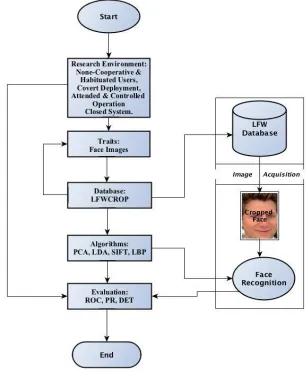
Figure 1 shows the previously described process. Any evaluation methodology has some fundamental steps that have to be followed [11]. The first step is constructing (implementing) each tool being evaluated. The second step is evaluating each tool separately in the same environment and under the same conditions. The third step is comparing all of the evaluated tools using the same evaluation measurements. The fourth step is categorizing the compared tools. Fifth step is enhancing the highest categorized tool.
Our research methodology follows the same steps describedabove. The experimental tool used in the research is MATLAB. It is worthwhile to acknowledge modifying some pre-implemented open source codes of algorithms implementation for this research’s purposes. The partial codes of the pre-implemented algorithms PCA, LDA, SIFT, and LBP are brought from [8, 15, 1] respectively.
The above methodology is applied by evaluating each algorithm in set of experiments. Each experiment has a specified number of images to be executed on each algorithm’s implementation. After the execution, the performance curves are drawn and the algorithms are compared. There are three sets of experiments (phases), that are: phase 1 conducting 20 images, phase 2 conducting 200 images, and phase 3 conducting 2000 images.
A. DATASET
A database named Labeled Faces in the Wild (LFW) is used [9]. It is publicly available for face recognition studies and research work at the University of Massachusetts. The database has a total of 13,233 face images all collected from the previously mentioned database. Among those images, 1680 are more than one distinct photo. One of the most attractive advantages of this database is that it uses Viola-Jones face detector to capture the faces features.
IV.RESULTS
Tables 1 through 3 and Figures 2 through 4 show the results of evaluating four techniques: Local Binary Patterns (LBP), Linear Discriminant Analysis (LDA), Principal Component Analysis (PCA), and Scale Invariant Feature Transformation (SIFT) corresponding to Receiver Operator Characteristics (ROC), Precision-Recall (PR), and Detection Error Trade-off (DET), by conducting the three sample sets of experiments mentioned previously in Section 3. In addition, the lowest total score represents the best performance and highest total score represents the worst performance evaluation. It appears from the figures that each algorithm extracts the image’s features in a different way from the other algorithms. Therefore, various evaluation rankings can be seen when executing the three sets on each algorithm as depicted in Figures 2, 3, and 4. The following paragraphs present the results of the execution processes that explain the figures, and summarises the results in Tables 1, 2, and 3.
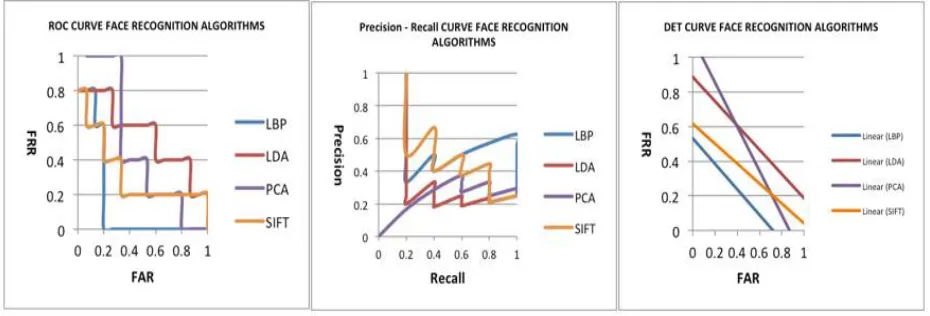
According to the given experimental results of implementing the first set of 20 images shown in Table 1 and depicted in Figure 2, ROC (on the left side of Figure 2) and DET (on the right side of Figure 2) curves performed the best performance for LBP technique while PR (on the middle of Figure 2) curve achieved the best among all others for PCA. Among all these face recognition techniques, it can be seen that LBP outperformed the best whereas LDA did not achieve better than others.
Fig.2. Results of the first milestone when the algorithms are evaluated on execution of 20 images. The left shows the ROC, the middle shows the Precision-Recall, and the right shows the DET.
Table 1: 20 images recognition performance evaluation based on three performance evaluation curves
20 Image Evaluated Algorithms
Curves LBP LDA PCA SIFT
ROC 1 4 3 2
PR 3 2 1 4
DET 1 4 3 2
Table 2 and Figure 3 show the results of implementing the second set of 200 images conducted for evaluating four techniques. It is observed that SIFT outperformed the best, specifically when plotting ROC (on the left side of Figure 3)and DET (on the right side of Figure 3). LBP attained better performance than LDA and PCA when is evaluated by ROC and DET. It should be noted that although the total score of PCA was not even close to LBP score, PR (on the middle of Figure 3) curve was outperformed the best among all other curves.
Fig.3. Results of the second milestone when the algorithms are evaluated on execution of 200 images. The left shows the ROC, the middle shows the Precision-Recall, and the right shows the DET.
Table 2: 200 images recognition performance evaluation for the four algorithms based on three performance evaluation curves
200 Image Evaluated Algorithms
Curves LBP LDA PCA SIFT
ROC 2 3 4 1
PR 3 4 1 2
DET 2 3 4 1
Total 7 10 9 4
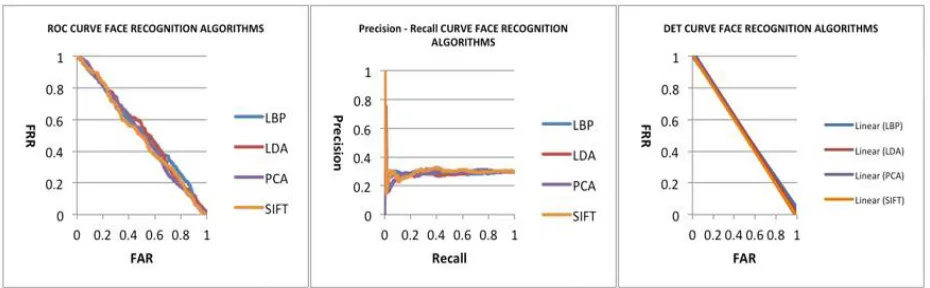
In Table 3, the results of randomly evaluating 2000 images show that SIFT was successfully achieved the best performance with the lowest total score of 3, and however, LDA was not achieved good results, with the highest total score of 10 even though the curve PR (on the middle of Figure 4) outperformed the best among other curves as depicted in Figure 4. In essence, the performance score of ROC (on the left side of Figure 4) and DET (on the right side of Figure 4) were getting the lowest score of 2 for LBP and PCA techniques respectively.
Table 3: 2000 images recognition performance evaluation for the four algorithms based on three performance evaluation curves
2000 Image Evaluated Algorithms
Curves LBP LDA PCA SIFT
ROC 2 4 3 1
PR 4 2 3 1
DET 3 4 2 1
Total 9 10 8 3
V. DISCUSSION
The above experimental results indicate that there are many discussion aspects can be adopted such as evaluating the performance measuring curves used in the research, addressing the impact of types of acquired images on feature extraction and matching algorithms, algorithms implementation runtime cost. Moreover, the results can be used for determining the best biometric fusion on feature extraction algorithms, ranking, or decision levels. However, this research focused on evaluating the accuracy performance of the selected algorithms.
From the analysis results described above, we found that the performance accuracy is directly affected by number of images used in matching process. The larger number of images used in matching process, the worse accuracy level the algorithms show. This fact can be proved by reading the plots depicted in Figures 2 through 4. Throughout all experiments, some techniques showed acceptable results (i.e. both low false accept rate (FAR) and low false reject rate (FRR)). Moreover, the differences in accuracy level between the compared face recognition techniques was obvious. It should be noted that two face recognition techniques LBP and SIFT achieved good results amongst, as shown in Table 4.
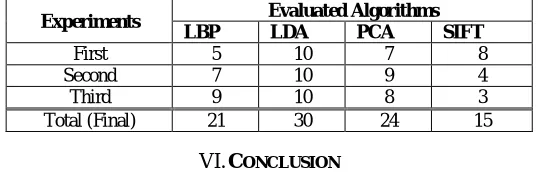
Table 4. Overall recognition performance evaluation for the four algorithms based on four-performance evaluation curves
Experiments Evaluated Algorithms
LBP LDA PCA SIFT
First 5 10 7 8
Second 7 10 9 4
Third 9 10 8 3
Total (Final) 21 30 24 15
VI.CONCLUSION
We presented the experiments for four techniques: The experimental work of our research showed that all of the evaluated algorithms worked efficiently when specific performance evaluation curves is determined. The best reasonable results produced through the experiments were LBP and SIFT. However, the experiment infers that there is a clear accuracy gap between the four algorithms. Table 4 summarizes the accuracy distance between the algorithms, as SIFT performed the lower (the best) overall score (15) among the rest all of the algorithms. LBP performed the second lower score (21). On the other hand, PCA produced the score (24) and LDA produced the score (30).
REFERENCES
1. Omri., LBP - Local Binary Patterns texture operator. algorito. [Online]: http://algorito.com/algorithm/lbp-local-binary-patterns-texture-operator. 2010.
2. Bolle, Ruud M., Jonathan H. Connell, Sharath Pankanti, Nalini K. Ratha, and Andrew W. Senior. "The relation between the ROC curve and the CMC." In Fourth IEEE Workshop on Automatic Identification Advanced Technologies (AutoID'05), pp. 15-20, 2005.
3. Cho, Hyunjong, and Seungbin Moon. "Comparison of PCA and LDA based face recognition algorithms under illumination variations." In IEEE ICCAS-SICE, 2009, pp. 4025-4030, 2009.
4. Delac, Kresimir, Mislav Grgic, and Sonja Grgic. "Independent comparative study of PCA, ICA, and LDA on the FERET data set." International Journal of Imaging Systems and Technology 15, vol.5, pp. 252-260, 2005.
6. Geng, Cong, and Xudong Jiang. "SIFT features for face recognition." In Computer Science and Information Technology, 2009. ICCSIT 2009. 2nd IEEE International Conference on, pp. 598-602, 2009.
7. Givens, Geof H., J. Ross Beveridge, Bruce A. Draper, and David Bolme. "Using a generalized linear mixed model to study the configuration space of a PCA+ LDA human face recognition algorithm." In International Conference on Articulated Motion and Deformable Objects, pp. 1-11. Springer Berlin Heidelberg, 2004.
8. Grgic, Mislav, and Kresimir Delac. "Face recognition homepage." Zagreb, Croatia (www. face-rec. org/databases) pp. 324, 2013.
9. Huang, Gary B., Manu Ramesh, Tamara Berg, and Erik Learned-Miller. Labeled faces in the wild: A database for studying face recognition in unconstrained environments. Vol. 1, Issue. 2. Technical Report 07-49, University of Massachusetts, Amherst, 2007.
10. Hwang, Bon-Woo, Myung-Cheol Roh, and Seong-Whan Lee. "Performance evaluation of face recognition algorithms on asian face database." In Automatic Face and Gesture Recognition, 2004. Proceedings. Sixth IEEE International Conference on, pp. 278-283, 2004.
11. Jain, Anil, Arun A. Ross, and Karthik Nandakumar. Introduction to biometrics. Springer Science & Business Media, 2011.
12. Lone, Manzoor Ahmad, S. M. Zakariya, and Rashid Ali. "Automatic face recognition system by combining four individual algorithms." In IEEE International Conference on Computational Intelligence and Communication Networks (CICN),, pp. 222-226, 2011.
13. Majumdar, Angshul, and Rabab Kreidieh Ward. "Discriminative SIFT features for face recognition." In IEEE Canadian Conference on Electrical and Computer Engineering, CCECE'09. pp. 27-30, 2009.
14. Mayron, Liam M. "Image retrieval using visual attention." Personality and Individual Differences 40, no. 5 pp. 873-884, 2006.
15. Vedaldi, Andrea, and Brian Fulkerson. "VLFeat: An open and portable library of computer vision algorithms." In Proceedings of the 18th ACM international conference on Multimedia, pp. 1469-1472. ACM, 2010.
16. Phillips, P. Jonathon, and Hyeonjoon Moon. "Comparison of projection-based face recognition algorithms." In Systems, Man, and Cybernetics, 1997. Computational Cybernetics and Simulation., 1997 IEEE International Conference on, Vol. 5, pp. 4057-4062, 1997.
17. Phillips, P. Jonathon, Hyeonjoon Moon, Syed A. Rizvi, and Patrick J. Rauss. "The FERET evaluation methodology for face-recognition algorithms." IEEE Transactions on pattern analysis and machine intelligence 22, no. 10, pp. 1090-1104, 2000.
18. Wolf, Lior, Tal Hassner, and Yaniv Taigman. "Similarity scores based on background samples." In Asian Conference on Computer Vision, pp. 88-97. Springer Berlin Heidelberg, 2009.