Prediction of Psychological Disorders Based on Meta-cognitive
Components in the Elderly of Tehran
Abdollah Moatamedi
1, Ahmad Borjali
1*, Faramarz Sohrabi-Asmarodi
1, Ali Delavar
1, Yalda Tangestani
21Department of Educational Psychology, Faculty of Educational Science and Psychology,
Allameh Tabataba'i University, Tehran, Iran
2PhD Student, Department of Educational Psychology, Faculty of Educational Science and
Psychology, Allameh Tabataba'i University, Tehran, Iran
Submitted: 17 September 2018
Accepted: 24 October 2018 Int J Behav Sci. 2018; 12(3): 108-113
Corresponding Author: Ahmad Borjali,
Department of Educational Psychology, Faculty of Educational Science and Psychology,
Allameh Tabataba'i University, Tehran,
Iran
E-mail: [email protected]
Abstract
Introduction: The purpose of this study was to predict disorders in the elderly with respect to psychological disorders.
Method: The method used for the research was descriptive correlational analysis. The statistical population of this study included all the Tehran's elderly during 2018, among which 300 were selected by stratified random sampling method. The measurement instruments were the psychological Symptoms Checklist (SCL-90-R) and the Meta-Cognitions Questionnaire of Wells (MCQ). Multiple regression analysis was used as the statistical method to analyze the data.
Results: Results revealed that there is a positive and significant relationship between the components of meta-cognition and psychological disorders. The components of positive beliefs, uncontrollable beliefs and cognitive beliefs were significant for all the components of psychological disorders. However, the components of negative beliefs did not have a significant effect on physical complaints and aggression, and the cognitive component had no significant effect on sensitivity in relationships and aggression.
Conclusion: According to the findings of this research, it is concluded that metacognitive beliefs play an important role in the prediction of mental disorders in the elderly.
Keywords: Elderly, Meta-Cognition, Psychological Disorders
Introduction
inability, physical is one of the main causes of suicide among the elderly. Approximately, 97% of suicide victims in the elderly have reported at least one of the diagnostic symptoms of the first axis DSM-IV-R, while this percentage was 18% in other people [7]. The role of metacognition in psychological disorders has been developed through the Wells and Matthews (1994) model of information processing [8]. In the self-regulatory executive function model, vulnerability to psychological disorders is associated with the continuation and maintenance of these disorders with cognitive-related attention syndrome, and this is a self-regulating characteristic. This model predicts the role of metacognition in vulnerability to psychological disorders and its continuity, and provides a detailed conceptualization of how metacognitive factors are involved in the progression and sustainability of mental disorders [8]. Research results indicate that metacognition is impaired in people with psychological disorders and older people [9, 10]. These beliefs are the cause for the evolution and continuation of psychological problems of individuals [11]. According to the meta-cognitive theory in psychological disorder, metacognitions are critical components in predicting and creating psychological symptoms [12]. Studies have shown that a major part of research has been carried out on patients' population with a variety of emotional disorders such as anxiety, depression, post-traumatic stress disorder, and obsessive-compulsive disorder. Since a percentage of the elderly are at risk for mental illness, including anxiety disorders and depression, and have higher levels of vulnerability, research on the relationship between meta-cognitive beliefs and psychological disorders in elderly nonclinical populations is an essential theoretical and practical aspect. The purpose of this study was to help clinicians to better understand the role of metacognition and to select effective strategies for psychological disorders. The findings of this study will be available to the managers of various elderly areas, to plan and implement programs to improve the mental health of the elderly. It will also provide researchers with an interest in this area for research activities. Given the available evidence of research on the role of meta-cognition in psychological disorders, the present study aims to investigate this issue:
Metacognitive components can predict psychological disorders in the elderly.
Methods
In the present research, the different variables have been simultaneously measured in one group, the relationships between them have been also investigated simultaneously, and suitable patterns have been studied to explain those relationships; therefore, it is considered to be a correlational research.
The statistical population of this research was a group of the elderly aged over 60 who were the members of the cultural centers for the elderly of Tehran in 2018. They were able to understand and answer the questions. From among 22 centers supervised by the main cultural center for the elderly, 7016 people were considered as the members of the aforementioned society. The centers are places for the elderly’s gatherings. They do various
cultural and social activities or play sports.
In multivariable regression analysis, the ratio of sample numbers (observations) to independent variables should not be less than 5. Otherwise, the results of the regression analysis cannot be generalized [13]. The more conservative ratio of 10 observations per independent variable is proposed by Hallinsky and Floret and Miller and Conce. In James Stevens's view, even considering 15 observations per predictor variable in multiple regression analysis with the standard method of least standard squares, is a good rule of thumb [13].
To monitor this minimum and considering that some questionnaires would be probably incomplete and the lack of interest of some elderly in participating in the research, 300 subjects were selected using stratified sampling. First, Tehran was stratified into the south, east, north and west parts. Then, two centers were selected in each part using simple random sampling. Finally, from each center, 60 subjects were randomly selected based on their files, numbering and a random number table.
The criteria for entering the research are: 1- From the age range of 60 to 80 years 2. Having no psychological disorders (dementia and Alzheimer's) 3- Physically able to participate in the research. 4. There is a desire and interest in collaborative research. 5. Not to be treated for any psychological disorders.
Symptom Checklist-90 Revised (SCL-90-R)
SCL-90-R is used to evaluate psychological symptoms and measure the current levels of psychological symptoms which appear in an interval [14]. The primary checklist of psychological symptoms (SCL-90) was developed by Lipman and Covi in 1974 to show the psychological aspects of the patients suffering from psychosomatic disorders. Derogatis et al. revised the aforementioned questionnaire and prepared the final version named the Symptom Checklist-90-Revised (SCL-90-R) [28]. It contains 90 questions which measures 9 sub-scales including:
Derogathis et al. reported the reliability of this questionnaire using satisfactory alpha coefficient [29]. Also, in a research by Modabernia et al. the nine criteria of the questionnaire were obtained as follows: Somatization 0.85, Obsession – Compulsion 0.78, interpersonal sensitivity 0.79, depression 0/86, anxiety
0.78, hostility, phobia 0.70, paranoid ideation 0.77, and
psychosis 0.75 [30]. They also showed a significant correlation between the nine questions of the questionnaire and the clinical scale of the MMPI. The construct validity of this tool in the Iranian population was confirmed by previous research [29].
The reliability of this questionnaire in the present study was investigated. The reliability coefficient was in a range of 0.77 to 0.86 for the sub-scales of psychological disorders.
Meta-cognition questionnaire (QCM-30)
specifications was used [12]. This questionnaire has a 30-item self-report scale measuring people's beliefs about their own thoughts. Answering to the questions is done according to the Likert's 4-level scale from 1-never agree to 4- strongly agree. This scale has five sub-scales including: 1- positive worrying beliefs, 2- uncontrollable beliefs, 3- cognitive competence beliefs, 4- general negative beliefs and 5- cognitive consciousness.
Conformity factor analysis shows that the 30-question questionnaire has maintained the factor structure of the 65-question questionnaire. Cronbach's alpha of the sub-scales are between 0.72 and 0.93. Test-retest coefficient between 22 to 118 days was as follows: the total score = 0.75, the scale of positive beliefs = 0.79, uncontrollability/ danger = 0.59, cognitive confidence = 0.69, necessity to control thoughts = 0.74, cognitive consciousness = 0.87 [12]. In relation to the validity of the structure, a positive correlation between the questionnaire sub-scales and related sub-scales has been theoretically observed and its factor structure has been reconfirmed the results of the short-form meta-cognitive questionnaire and long-form meta-cognitive questionnaire are coordinated. Also, the sub-scales of the short form meta-cognitive questionnaire are sensitive and responsive to meta-cognitive therapy [18]. In Iran, the coefficient of internal consistency with the Cronbach's alpha coefficient for the whole scale was 0.91, for its subscales was in the range of 0.71 to 0.87, its re-test reliability for the whole scale was 0.73 and for the subscales it ranged from 0.59 to 0.83 [19]
The reliability value for the cognitive questionnaire in the research was 0.84.
Execution method
The study was executed using quantitative method. The execution method, obtaining the information through the questionnaire, and designing the pattern were the objective function. In addition to obtaining the information by the questionnaire and face-to-face conversations with the subjects, the uncertainty about the questions was resolved. First, the researcher got the permit from the elderly center and entered the research environment. Then, the questionnaire which was developed based on the sampling method was given to the elderly subjects to be completed. The participants were completely justified and knew that participating in the research was completely optional and they would not be obligated to give their names or addresses and the confidentiality of the research would be protected and the information would be collectively analyzed. First, 300 elderly people from Tehran were selected using stratified sampling. After getting the permit from the elderly centers and going to different centers, the two questionnaires were distributed among the elderly subjects to be answered: SCL-90-R questionnaire and meta-cognitive questionnaire. When the questionnaires were examined, the data were entered into SPSS-24 software and analyzed by multivariate regression analysis.
Results
Multiple regression analysis method was used to analyze the data in the study. The results are as follows:
Table 1. Frequency distribution of sample individuals by sex
Sex Abundance Percentage
Male 184 61
Female 116 49
Total 300 100
Table 1 shows the distribution of sample population by sex. The number of men participating in the research sample is 184 (61%) and the number of women is 116 (39%).
Table 2 shows the correlation matrix between the components of metacognition and psychological disorders. The obtained values indicate that between all meta-cognitive components and psychological disorders there is significant significance at the level of p <0.05. Therefore, it can be said that there is a positive and significant relationship between the meta-cognitive components of psychological abilities.
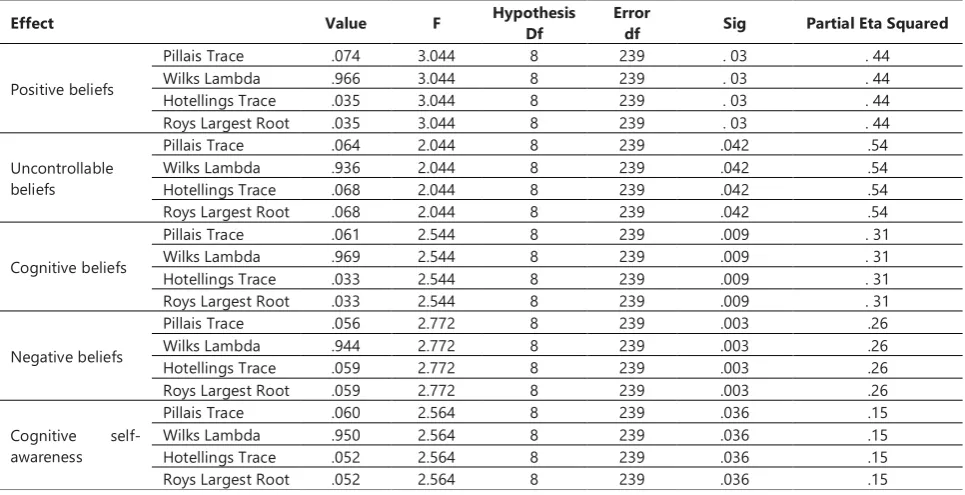
Table 3 shows the multivariate analysis of variance analysis. The results obtained in Table 3 show that all meta-cognitive components affect psychological disorders and therefore these components can predict psychological disorders. Also, the Eta squared value indicates that the component of uncontrollable beliefs predict the most variance of dependent variables of psychological disorders, which is equal to 54%.
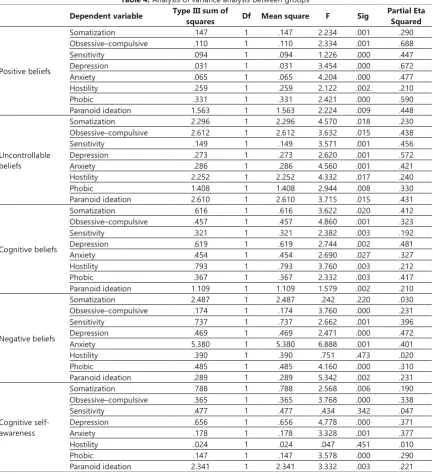
Table 4 shows an analysis of variance analysis between groups. The results show that the F value obtained for the three components of positive beliefs, uncontrollable beliefs and cognitive beliefs is meaningful for all components of psychological disorders. It can be said that these components have a direct and significant effect on all components of psychological disorders.
However, the components of negative beliefs on physical complaints and aggression have no direct and significant effect; the cognitive component has no direct and significant effect on susceptibility to relationships and aggression.
Discussion
The purpose of this study was to predict psychological disorders based on meta-cognitive components in the elderly.
The results of this research indicate that metacognitive components have a positive and significant relationship with psychological disorders. Therefore, it can be said that all meta-cognitive components affect psychological disorders and can predict psychological disorders. This finding is consistent with the results of numerous studies [24, 25, 18, 26, 3].
strategies to be adjusted we use our thoughts and feelings. In other words, people's problems are the result of an uncompromising and repetitive thinking style in response to negative thoughts, feelings and beliefs. The content of beliefs and thoughts determines the type of experienced disorder. Therefore, mental disorders are the result of meta-cognitive processes that lead to the formation of certain thinking styles, and in the long-term and retarded situations of a person, the processing of negative information involves itself. In metacognitive theory, it is assumed that metacognitive evaluations of thoughts, which are independent of conventional cognitive assessments or topological (spatial) features of thoughts, cause psychological disturbances [9]. For example, a negative interpretation of concern (fraternity) is considered more important in the cognitive syndrome than in the nature of concern. Also, it can be said that
when people feel that they do not have control over life and its events, symptoms of depression, tension and anxiety show more.
In the explanation, it can be said that when a person feels he or she does not control his or her life and the related events, symptoms of depression, tension and anxiety are seen more. Therefore, the feeling of inability and lack of control makes it difficult for a person to get rid of problems and to find solutions. As a result, mental disorders develop. Also, the results of studies have shown that when we evaluate threatening and uncontrollable potential stressful events, our lives and our mental health are negatively impacted. Therefore, if a person's assessment of his behavior leads to a pattern of ineffective thinking, that person will face mental disorders.
Bailey and Wells research results somehow confirm this issue [27].
Table 2. The correlation between metacognitive components and psychological disorders
So m at iz at io n O b s e s s iv e c o m p u ls iv e Se ns it iv it y D e p re s s io n A n x ie ty H o s ti li ty Ph o b ic a n x ie ty Pa ra n o id i d e a ti o n Po si ti ve b el ie fs U n c o n tr o ll a b le b e li e fs C o g n iti v e b e li e fs N e g a ti v e b e li e fs C o g n iti v e s e lf -a w a re n e s s
Obsessive–compulsive .231** 1
sensitivity .458** .380** 1
Depression .658** .360** .724** 1
Anxiety .590** .289** .545** .733** 1
Hostility .347** .732** .602** .610** .592** 1
Phobic .495** .652** .627** .491** .570** .490** 1
Paranoid ideation .298** .712** .624** .592** .483** .663** .629** 1
Positive beliefs .525** .292** .388** .530** .521** .387** .415** .318** 1
Uncontrollable beliefs .500** .308** .387** .520** .518** .400** .422** .329** .988** 1
Cognitive beliefs .517** .294** .385** .526** .513** .384** .409** .309** .992** .984** 1
Negative beliefs .533** .285** .395** .531** .538** .390** .420** .316** .992** .980** .984** 1
Cognitive self-awareness .524** .294** .380** .527** .508** .383** .409** .306** .995** .983** .986** .981** 1
Table 3. Multivariate Analysis of Variability Analysis
Effect Value F Hypothesis Df Error df Sig Partial Eta Squared
Positive beliefs
Pillais Trace .074 3.044 8 239 . 03 . 44
Wilks Lambda .966 3.044 8 239 . 03 . 44
Hotellings Trace .035 3.044 8 239 . 03 . 44
Roys Largest Root .035 3.044 8 239 . 03 . 44
Uncontrollable beliefs
Pillais Trace .064 2.044 8 239 .042 .54
Wilks Lambda .936 2.044 8 239 .042 .54
Hotellings Trace .068 2.044 8 239 .042 .54
Roys Largest Root .068 2.044 8 239 .042 .54
Cognitive beliefs
Pillais Trace .061 2.544 8 239 .009 . 31
Wilks Lambda .969 2.544 8 239 .009 . 31
Hotellings Trace .033 2.544 8 239 .009 . 31
Roys Largest Root .033 2.544 8 239 .009 . 31
Negative beliefs
Pillais Trace .056 2.772 8 239 .003 .26
Wilks Lambda .944 2.772 8 239 .003 .26
Hotellings Trace .059 2.772 8 239 .003 .26
Roys Largest Root .059 2.772 8 239 .003 .26
Cognitive self-awareness
Pillais Trace .060 2.564 8 239 .036 .15
Wilks Lambda .950 2.564 8 239 .036 .15
Hotellings Trace .052 2.564 8 239 .036 .15
Also, the results of this study showed that the component of negative beliefs has no direct and significant effect on physical complaints and aggression, and the cognitive component has no direct and significant effect on sensitivity in relationships and aggression.
This finding along with the results of Chelsey et al. showed that there is a significant difference between weak metacognitive skills and behavioral problems, including aggression [10]. It seems that this discrepancy is due to the heterogeneity of the research sample, and it also seems to be due to limited research in this area and the lack of access to researcher resources, so further research is needed to explain this finding.
Conclusion
To conclude, it can be said that due to the important
role of metacognitive components in predicting and its relation with psychological disorders in the elderly, it is necessary to control and to also research on finding suitable solutions regarding the age of the elderly to improve and treat the problems. Metacognition as an important cognitive feature plays an important role in the aging period. For example, having positive beliefs can solve many of the psychological problems in this period for the elderly.
As the study was conducted only in the elderly, the generalization of the results to other age groups should be done with caution. The most important application of the findings of this study is the application in the field of aging, in the hope that the findings of this study will be available to senior managers in order to be effective in planning and implementing programs to improve the mental health of the elderly.
Table 4. Analysis of variance analysis between groups
Dependent variable Type III sum of squares Df Mean square F Sig Partial Eta Squared
Positive beliefs
Somatization .147 1 .147 2.234 .001 .290
Obsessive–compulsive .110 1 .110 2.334 .001 .688
Sensitivity .094 1 .094 1.226 .000 .447
Depression .031 1 .031 3.454 .000 .672
Anxiety .065 1 .065 4.204 .000 .477
Hostility .259 1 .259 2.122 .002 .210
Phobic .331 1 .331 2.421 .000 .590
Paranoid ideation 1.563 1 1.563 2.224 .009 .448
Uncontrollable beliefs
Somatization 2.296 1 2.296 4.570 .018 .230
Obsessive–compulsive 2.612 1 2.612 3.632 .015 .438
Sensitivity .149 1 .149 3.571 .001 .456
Depression .273 1 .273 2.620 .001 .572
Anxiety .286 1 .286 4.560 .001 .421
Hostility 2.252 1 2.252 4.332 .017 .240
Phobic 1.408 1 1.408 2.944 .008 .330
Paranoid ideation 2.610 1 2.610 3.715 .015 .431
Cognitive beliefs
Somatization .616 1 .616 3.622 .020 .412
Obsessive–compulsive .457 1 .457 4.860 .001 .323
Sensitivity .321 1 .321 2.382 .003 .192
Depression .619 1 .619 2.744 .002 .481
Anxiety .454 1 .454 2.690 .027 .327
Hostility .793 1 .793 3.760 .003 .212
Phobic .367 1 .367 2.332 .003 .417
Paranoid ideation 1.109 1 1.109 1.579 .002 .210
Negative beliefs
Somatization 2.487 1 2.487 .242 .220 .030
Obsessive–compulsive .174 1 .174 3.760 .000 .231
Sensitivity .737 1 .737 2.662 .001 .396
Depression .469 1 .469 2.471 .000 .472
Anxiety 5.380 1 5.380 6.888 .001 .401
Hostility .390 1 .390 .751 .473 .020
Phobic .485 1 .485 4.160 .000 .310
Paranoid ideation .289 1 .289 5.342 .002 .231
Cognitive self-awareness
Somatization .788 1 .788 2.568 .006 .190
Obsessive–compulsive .365 1 .365 3.768 .000 .338
Sensitivity .477 1 .477 .434 .342 .047
Depression .656 1 .656 4.778 .000 .371
Anxiety .178 1 .178 3.328 .001 .377
Hostility .024 1 .024 .047 .451 .010
Phobic .147 1 .147 3.578 .000 .290
Acknowledgments
The authors would like to thank the Tehran Elderly Club and all the people who participated in this study.
References
1. Shahbazi, M., Foroghan, M., Salman Roghani, R., Rahgozar, M. (2017). Relationship of disability with depression, cognitive status and morale in the elderly. Iran's Elderly Magazine, Tehran, Iran,11 (1).
2. Sotodeh, O., Pooragha Roodbordeh, F., Kafi, S.M., Poornesaii, G.S, E. (2012). Ffectiveness of Reminiscence Group Therapy on Male Elderly’s Mental Health. Journal of Guilan University of Medical Sciences,; 85(22): 61-67.
3. Smith, R.E., Hunt, R.R. (2016). Distinctive processing in young and older adults: Metacognitive judgments and the isolation paradigm. Psychol Aging.;31(2):198-209.
4. Wells, A. (2000). Emotional disorders and metacognition: Innovative cognitive therapy. 2th ed. New York. John Wiley & Sons Ltd.
5. Papageorigiou, C., & Wells, A. (2009). Depressive Rumination. uk: chichester, wiley&sons;.Personality and Individual Differenses, 32(6), 1351-1363.
6. Wells, A. (2009). Practical Guide to Metacognitive Therapy Anxiety and Depression. Translation by Shahram Mohammad Khani (2014). Publication Varaye Danesh, Tehran.
7. Mokhtari, F., Ghasemi, N. (2011). Comparison of life quality and mental health in elderly residence and non-residence in sanatariums. Salmand Iran J Ageing.; 18: 53-63.
8. Wells, A., Matthews, G. (1994). Attention and emotion. A clinical perspective. Hove, UK: Erlbaum;119-44.
9. Spada, M.M., Mohiyeddini, C., & Wells, A. (2008). Measuring metacognitions associated with emotional distress: factor structure and predictive validity of the metacognitions questionnaire 30. Personality and individual differences, 45, 238-242.
10. Chelsey, M.W., Wilson, H.W., Woodard, J.L., Calamari, J.E. (2013). Do negative affect characteristics and subjective memory concerns increase risk for late life anxiety? J Anxiety Disord; 27: 608-18.
11. Wells, A., Carter, K. (2001). Further tests of a cognitive model of generalized anxiety disorder: Metacognitions and worry in GAD, panic disorder, social phobia, depression and non patients. Behav Ther; 32: 85-102.
12. Lobban, F., Haddock, E., Kinderman, p., & Wells, A. (2002). The role of Meta copintive beliefs in auditory hellucinetions. Personality and Individual Differences. 32: 1351-1363 13. Gabriele, M.,Claudia, C., Andrea, P., & Robin, B. (2016). The
role of metacognitive beliefs in health anxiety .Personality and Individual Differences . 89, 80–85.
14. Howitt,D.,Cramer,D.(1948).introductiontoStatisticsin Psychology, 3rd ed, 2005. (Translation: Sharifi, Hassan Pasha et al (2010). Publication of Sokhan, Tehran).
15. Derogatis, L. R., & Cleary, P. A. (1977). “Factorial invariance across gender for the primary symptom dimensions of the SCL90”. British Journal of Social Clinical Psychology, 16(4), 347-56.
16. Derogatis, L.R., Rickels, K., Rock, A.F. (1976). The SCL-90 and the MMPI: a step in the validation of a new self-report scale. Br J Psychiatry.128:280-9.
17. Modrannia M., Shojaei Tehrani H., Fallahi M., Faithful M. (2011). Standardization of SCL-90-R test in high school students, pre-university students in Gilan province. Journal of Guilan University of Medical Sciences,19 (75).
18. Cartwright-Hatton, S., Wells,A.(1997). Beliefs about worry and intrusions: the metacognitions questionnaire. J Anxiety Disord.; (11): 279- 315.
19. Spada, M.M., Mohiyeddini, C., & Wells, A. (2008). Measuring metacognitions associated with emotional distress: factor structure and predictive validity of the metacognitions questionnaire 30. Personality and individual differences, 45, 238-242.
20. Shirinzadeh Arrest, S., Goodarzi, M. A., Ghanizadeh, A.; Taghavi, S.M.R. (2008). Comparison of metacognitive beliefs and accountability in patients with obsessive-compulsive disorder, general anxiety disorder and normal people. Magazine of Thought and Behavior.14,(1), 46-55.
21. Rees, C.S., Anderson, R.A. (2014). A review of metacognition in psychological models of obsessive-compulsive disorder.Clinical Psychologist.;17(2):1-8.
22. Babapur, K.J., Poursarifi, H., Hashemi, T., Ahmadi, E. (2012). The Relationship between the Components of Metacognition and Mindfulness with Obsessive Beliefs. Journal of Psychology, School of Management, 1(4), 23-28.
23. Morrison, A.P.,French,P., Wells, A. (2007). Metacognitive beliefs across the continuum of psychosis: Comparisons between patients with psychotic disorder, patients at ultra-high risk and nonpatients. Behav Res Ther. 2007; (45): 22.
24. Wells, A. & Papageorgiou, C. (1998). Relationships between worry, obsessive–compulsive symptoms and meta-cognitive beliefs. Behaviour Research and Therapy.;36(9):899–913. 25. Matthews, G., Coyle, K., Craig, A. (1990). Multiple factors of
cognitive failure and their relationships with stress vulnerability. J Psychopathol Behav Assess; 12(1): 49–65.
26. McEvoy PM, Mahoney AEJ. Intolerance of uncertainty and negative metacognitive beliefs as trans diagnostic. (2013). Journal of Anxiety Disorders. 27: 216-224.
27. Bailey, R., Wells, A. (2015). Metacognitive beliefs moderate the relationship between catastrophic misinterpretation and health anxiety. J Anxiety Disord.;34:8-14.
28. Derogatis, L.R., Lipman, R.S., & Covi, L. (1973). SCL-90: An outpatient psychiatric rating scale—Preliminary Report. Psychopharmacol. Bull. 9, 13–28.
29. FathiAshtiani, A. Dastani, M. (2009). Psychological Tests: Personality and Mental health. Tehran:Besat publication Institute.