University of Windsor University of Windsor
Scholarship at UWindsor
Scholarship at UWindsor
Electronic Theses and Dissertations Theses, Dissertations, and Major Papers
1-1-1962
The significance of the reading factor in measuring security in
The significance of the reading factor in measuring security in
children.
children.
Lois M. Brockman University of Windsor
Follow this and additional works at: https://scholar.uwindsor.ca/etd
Recommended Citation Recommended Citation
Brockman, Lois M., "The significance of the reading factor in measuring security in children." (1962). Electronic Theses and Dissertations. 6300.
https://scholar.uwindsor.ca/etd/6300
THE SIGNIFICANCE OF THE HEADING FACT0B
IN MEASURING SECURITY
IN CHILDREN
'A T te s is
Submitted to the Faculty o f Graduate Studies through the Departm ent o f Psychology in P a rtia l F u lfillm e n t
o f the Requirem ents fo r the Degree o f M aster o f Art® a t Assum ption
U n ive rsity o f W indsor
by
LG© I f . BROCKMAN
B . A .» U n ive rsity o f Saskatchewan, 3.953
UMI Number: EC52479
INFORMATION TO USERS
The quality of this reproduction is dependent upon the quality of the copy
submitted. Broken or indistinct print, colored or poor quality illustrations and
photographs, print bleed-through, substandard margins, and improper
alignment can adversely affect reproduction.
In the unlikely event that the author did not send a complete manuscript
and there are missing pages, these will be noted. Also, if unauthorized
copyright material had to be removed, a note will indicate the deletion.
®
UMI
UMI Microform EC52479Copyright 2008 by ProQuest LLC.
All rights reserved. This microform edition is protected against
unauthorized copying under Title 17, United States Code.
ProQuest LLC 789 E. Eisenhower Parkway
APPROVED BY:
n
n
- oABSTRACT
The present study Investigated the influence o f the reading fa cto r
on the se cu rity score yielded by the In stitu te o f C hild Study S ecurity Test (ICS
S ecurity T est). F ifty hoys in re g u la r classes between grades 4 and 8 were
matched to form two groups: (a) tw enty-five boys (experim ental Ss) diagnosed
by psychologists as em otionally disturbed and in attendance at weekly therapy ses
sions; (b) tw enty-five boys (control Ss) in re g u la r school attendance and rated by
th e ir teachers as displaying above average level o f security both in the class
room and on the playground. C hildren in whose home a language other than
E nglish was spoken and/or the physically handicapped were not selected. The
groups were equated by m atching p a irs on: (a) attendance in e ith e r public o r
separate school system ; (b) grade placem ent; (c) non-language IQ determ ined
from the Non-Language M u lti-M e n tal Test o f Term an, M cC all and Loxge;
(d) socio-econom ic background measured by W. L . W arner’s "Index o f Status
C h a ra cte ristics". W ithin the same month the ICS S ecurity Test, the Dom inion
Achievem ent Test in S ilent Reading (Dom inion Reading Test), and the C a lifo rn ia
Test of M ental M a tu rity were adm inistered as group tests to a ll Ss.
Ah analysis o f variance indicated fo r the e n tire sample that the
ICS S ecurity Test distinguished sig n ifica n tly a t. 01 level between the experi
( grades 6, ? and 8) a id younger subgroup (grades 4 and 5), the difference be
tween the experim ental and control Ss in ICS S ecurity fe e t scores m s s ig n ifi
cant fo r both subgroups. . The difference m s , however, g rea te r fo r the younger
. 01 le v e l) than fo r the o ld e r subgroup ( a t. 05 le ve l). Covariance
fidjufftrftw frr o f the ICS S ecurity Tes t scores fedteeted a persistence of' significant
difference between experim ental and co n tro l Ss on the ICS S ecurity Test score®
fo r the e n tire sample (a t, 01 le ve l). However, covariance adjustm ent o f the
Dom inion Wesdbig T est scores showed no sig n ifica n t between t he
experim ental and co n tro l groups e ith e r fo r the whole sample o r w ith in subgroups.
I t was w«w«i«fWi that a fa c to r other thaw reading (as measured by
the Dom inion iRnarfing Test), designated a ’’se cu rity11 fa cto r, was measured by
the ICS S ecurity Test. The breakdown o f the to ta l t emple in to old e r and younger
subgroups yielded little fu rth e r inform ation. Each subgroup seemed to fo llo w
the pattern o f the e n tire sam ple. w ith in the tbwtm o f tM'e a-rpar’irnawtatinn we
may o a tftiA ttia i, aHhrmgh reading d i a tin g iii sihftg tjift secure fro m th# insecure
f^h iifij th** <iiffar c^i~igting thHNw a t w ork is m ore the** reading, he b e tte r
emrttmnfratd by a ’'se cu rity*1 m easure. thaw reading a b ility iwfhmnniwg the
se curity le ve l o f the ch ild , the se cu rity le ve l determ ines sig n ifica n tly the reading
a b ility . T his conclusion holds brae fo r both younger «wd older grade-school age
groups.
ACKNOWLEDGEMENTS
The author g ra te fu lly acknowledges the suggestions and assistance
o f Reverend J . A . Malone, C.S.B. and D r. A . A . Sm ith in the preparation and
w ritin g o f th is thesis. Thanks are due, also, to the o ffic ia ls and personnel
o f the W indsor School Systems and the W indsor Group Therapy P ro je ct, who
so w illin g ly co-operated in testing the children selected as subjects in the
TABLE OF CONTENTS
ABSTRACT
ACKNOWLEDGEMENTS
LIST OF TABLES
LIST OF FIGURES
CHAPTER
I SURVEY OF THE LITERATURE
T fo g A fo g a n d F m n iirn n a T K ta h tH fry
Concept o f S ecurity The ICS S ecurity T e st
The Problem . .
METHOD
Subjects » «
Tests Employed Testing
n
m
w
RESULTS
DISCUSSION AND CONCLUSION jDism stsim ,
Conclusion , « .
APPENDICES: A B C
BIBLIOGRAPHY
VITA AUGT0R3S
i l l
V
v i!
v ili
18
14
24
24 26
28 29 80
81
28
LIST OF TABLES
Taftte Page
% fTI,. h> f t ir-1 i r i j i F I ’A m > 2 m ( U A m m m *r* l A i n i r » 4 t t f i f i r f r t 4 * % *^ * . " P ^ it f - f f P 'ir tit*
T«6 M@d21S| o>8JElC*B4rol D@Vi9>M>0!l6 EQQ t rfttlOS to r »I10 D IuO l^
ences between Mapna o f the Factors o f IQ s«d
Socio-econom ic Level . 10
2 Results o f the A nalysis o f Variance end the Covariance Adjustm ents fo r ICS S ecurity Test Scores (S) and
tn T i n f fc-> jt-jft-in. T3t ja_ j i t t » t _ j mi ^T ^jW iiM A C f jti>xiLiMij*_jg| V Mm** I t t t e & k .M
D ozattiioii B iS ra ^ T©st s c o ^ s (x tj uDtamea oy t&e
E n tire Group (N»50) 17
8 Results o f the A nalysis o f Variance and the Covariance Adjustm ents fo r ICS S ecurity Test Scores (S) and Dom inion Reedfog T est Scores (R) Obtained by the
O lder Subgroup (N*30) 10
4 R esults o f the A nalysis o f Variance and the Covariance Adjustm ents fo r ICS S ecurity T est Scores (ft) and
M.— it 'T*| ■», dr ill. |-wi VTVn &tti#i II iifiiiiMm ta Si—Im nwrH liu */om sxticNDi
M$mmg
* 0 0* s»o©3r0® ^*v| CH^ it<jui6u oy tooLUT OF FIGURES
Figure
1 D istrib u tio n o f Dom inion Reading Test Scores
2 D istrib u tio n o f ICS S ecurity T est Scores
3 E ffe ct o f adjustm ent o f the ICS S ecurity Test score means
4 E ffe ct o f adjustm ent o f the Dom inion Beading Test score means
Page
. 16
IS
• 22
CHAPTER I
SURVEY OP THE LITERATURE
Reading and Em otional S ta b ility
The feeling ©f se cu rity o r em otional w ell-being and reading
achievement have long been recognized as co rre la tive fa cto rs in the develop
m ent o f the m entally healthy ch ild , Tim reading program form s the core o f
the elem entary school cu rricu lu m . P a rtic u la rly in the fir s t fiv e grades, the
emphasis is on the acquisition o f basic reading s k ills . G. M . G ilb e rt (1957)
found, in a survey o f problem s re fe rre d to a guidance centre, that the m ost
frequently cited reason fo r psychological m aladjustm ent was "academ ic d iffi
c u lty ". He pointed out that, since there exists a relationship between success
in reading and em otional s ta b ility in children, it is im possible to divorce fa ilu re
caused by d e ficie n t reading s k ills from em otional in s ta b ility .
The relationship o f reading achievement to em otional s ta b ility has been
ftvpiatnftd from d iffe re n t view points. Some investigators claim that reading d is
a b ility causes em otional in s ta b ility in the ch ild . O thers hold that the em otional
hem tififtp is the p rin cip a l cause o f retarded reading. S till others suggest fost-
reading achievem ent and em otional adjustment are mutually reinforcing.
The d s itn that reading d is a b ility causes in se cu rity seems reasonable
in today’s lite ra te society, which demands o f the individual a fa c ility in using the
symbol o f language. I t would seem th a t a person lacking th is sym bolic a b ility
would n a tu ra lly fe e l insecure in a lite ra te com m unity. C hildren re a d ily recog
nize that the m astery o f language s k ills is a highly valued objective w ith in the
school program . Bower (I960) pointed out that children unsuccessful in reading
receive little rew ard from academic a c tiv itie s , are perceived negatively by th e ir
peers, and consequently fin d school an unfriendly, often h o s tile ,in s titu tio n .
Non-to in se cu rity in the classroom
situation.
o f 78 case h isto rie s ovflw inod, B f. G. Fem ald (1943) found only fo u r
children who were em otionally disturbed before commencing grads one. Bead
ing d is a b ility , wfa* is in its e lf t he cause o f em otional disturbance.
Becently Busw ell (1983), in a study o f the in te rre la tio n sh ip o f achievement M
adjustm ent, observed tie d academic achievement preceded social acceptability.
B u rre ll (1935, p. 92) reported a confirm ation o f tills rationale when he observed
that, "(he confidence which a «Mid g»<n« thrangh a waII - planned - yaaiUng program
has an a lle via tin g effect on em otional d iffic u ltie s ."
T a lco tt Parsons (1949) considered expectations o f achievement and
conform ity to behavioral standards a m ajor dim ension o f se cu rity. Thfe c h ild ’ s
parents, teachers and peers expect he w itt compete s a tis fa c to rily and w ill
achieve prescribed standards in reading. I f the c h ild fe e ls he is incapable o f
fu lfillin g mmh expectations, he may refuse to achieve even th««ga he M s the
capacity. Thus, in se cu rity induced by fa ilu re to m eet academic AvpAntntinnsi
s k ills appears to w in lo r toe ch ild social acceptance and ensure a feeling of
se curity In a w orld to s t demands that lie be lite ra te .
A number o f investigators, on the other hard, support toe view th a t
A-mnHnnfti jn c M M m causes reading d is a b ility . M ihsildine (1946,
p, 272) the em otional backgrounds o f 30 children in whom reading d is
-fife** that "reading d is a b ility m ust be considered a
symptom o f underlying em otional Illn e ss In a great many children who* having
trouble w ith reading. do no t resnond orom otlv to SDeclfic techniaues." Recently.
H allock (1958) reported that nervous symptoms, p a rtic u la rly in fo u rth grade
hoys, affe ct reading achievement sig n ifica n tly. The lo o ts o f in s ta b ility ,
Blanchard (1986, p. 411) explains, originate In the child-parent relationship:
"C hildren learn fir s t to pare«**, a»d thw i teachers . . . * I f toe attitudes
towards parents which are tra n sfe rre d to teachers are negative ra th e r thaw posi
tiv e , in te re st In learning decreases thereby, o r refusal to le a rn re su lts. ”
I f wholesome interpersonal re la tio n s are necessary to le a rn e ffe ctive ly,
and j f em otional is an underlying fa c to r reading d is a b iiiiy ,
then disturbed children in therapy ought to show m arked im provem ent in leading
achievement. B ills (1950) found that, w ith the retarded readers, non-directive
play therapy accelerated th e ir achievement in reading. A xline (1947) designed
an approach to toe reading lesson based on toe techniques o f non-directive
therapy. A fte r to**** and on** h a lf months In the group therapy program , poor
second grade readers mad** achievement g»j«* up to fdKtoe" months in reading
W hether d e ficie n t reading s k ills cause in se cu rity, o r em otional in
s ta b ility causes reading retardation, seems to be a problem whose several solu
tions depend upon the p a rtic u la r points o f view , the experim ental techniques and
the samples tim e fa r studied, Ho general p rin cip le as ye t accounts fo r the m utual
relationship between the experiencing o f em otional s ta b ility and the acquisition o f
adequate reading s k ills . That the two are closely related seems ce rta in . C harles
Peguy (1943, p. 99) w rotet "Teaching people to read, such would be the sole and
tru e snvi o f a education: le t the reader know how to read a ll is saved."
B ut the gnawing doubt p e rsists. W ill reading s k ill brin g w ith it se cu rity and emo
tio n a l s ta b ility fo r the ch ild ? O r m ust we teach se cu rity emotio nal s ta b ility
in order that the may learn to r ead?
Concept o f S ecurity
In general, se cu rity re fe rs to that q u a lity o f em otional s ta b ility where
by the individual is able to cope w ith the specific stresses o f h is environm ent
w hile Tnafatfl tofog a state o f w ell-being. In constructing the S ecurity-'
In security Inventory, Maslow (1952) described se curity as the feeling o f being
like d , loved and accepted, the feeling o f safety and unanxiousness. B latz (1944,
P. 165) defined se cu rity as " the State O f which OftaomnanteB a w
ill-ingness to accept the consequences o f one’s own decisions and a ctio n s."
T his la tte r concept o f B latz was adopted by Grapko (1957) in the con
stru ctio n o f the In stitu te o f CUM Study S ecurity Test (ICS S ecurity Test). S ecurity,
as employed in the ICS S ecurity T est, is sp e cifica lly defined as "the a b ility to com
consequances la the perform ance o f an a c tiv ity .” (Grapko, 1957, p. 4 ), S ecurity
then requires that the individual consciously make a decision, th a t he be able to
re a lize the decision in action* and fin a lly that he be w illin g to accept the conse
quences o f the action which follow s fro m such decision* The a b ility and w illin g -
ness to accept the outcome o f the action indicate the q uality, degree o r le ve l o f
operative se cu rity o f the Individual.
S ecurity develops is the ch ild from b irth . In its e a rly development
the c h ild ’ s se cu rity is assured by the parents through th e ir decisions, actions
am, ji w.. n ■■■ -Ss „vy JLVi.... — —— ..— _ ... — _ —— 1.1^. Tfw„%,jr%a-ff a«* ■*•> «i(*4 nn-rp.i* <•*»■ *> m* *•* 3iiu handling 0 1tiifi cobsih|u®9ig6s oh h is P6ft0» « re© su©<|u&cy sjiu 6u©0tiv
of p arents a t ffof** stag© o f t i i i ch ild ’s davelopnient determ ine th&b a sic pattern
from w hich Ms se cu rity e v o lv e s. As the oM ld m atu res he i s exp ected to m ake
dactfainaiB fafiftp«»n<fe>ntiy o f M s p aren ts. The d eg ree to wMch he is w illin g and cap
a b le o f a d o p tin g ♦ho fmtrvnme* o f SU®h' riAftfptAnff, fpdfoSf* fV* indApowriAnt (hsnCC
healthy) quality o f h is secu rity .
Grapko (1953, Ch. 3) describes the q u a lity o r degree o f se cu rity in
term s o f the c h ild ’ s independence in m aking decisions and readiness in accepting
consequences. A cM ld who Is unable to decide and u n w illin g to accept the conse
quences o f M# actions* Is insecure. A obitd who can »»ak« up Ms w ind, act on Ms
decision and accept Hie outcome w illin g ly , is independently secure. Between inde
pendent se cu rity and in se cu rity, Grapko describes three other d egrees o r levels of
se cu rity. The m aturely dependent c h ild is w illin g to accept the outcome o f M s actions
provided he can share such OTa>«pao»ibfflti«s w ith a peer. The Im m a tu rity dependent
■WWfckutt ■ ' & * * & *»■ - fiHiri inifr
T ftft 1Hit T#6t
iS^SS^ 3t^p tll^ilS^ jB^^BEli ti38 ti^it 388^388888 j^f9f8^ 3^E38ft '3^8S888^83^i8IPif^ iiiiiC^8i^i!'^8^88li88^tl^^i88S^J ^^8888
tito ' dpWtitepBWW^ Iif. Mffi&3& Ht^liiSA iM flitit^ feSlilitS*
fittin g , the ch ild reveals the level o£ se cu rity a t Which he habitually acts. The
1C® S ecurity T est yie ld s two measures o f the ch ild ’s te s t perform ance: (a) a
score which is a measure o f the degree o f u n ifo rm ity the c h ild shows
in ranking the statem ents a t the same le ve l o f secu rity; (b) a se cu rity score
w hich is a measure o f the degree a c h ild ’ s behavior agrees w ith an ideal type o f
behavior. The raw consistency and se cu rity scores, ranging fro m 0 to 100, are
transform ed Into percentile scores follow ing the norm s provided in the te s t
manual. Since the mean scores o f the norm ative sample d iffe re d sig n ifica n tly
between the o ld e r children (grades 6, 7 and 8) and the younger children (grades
4 .and 5), and between beys and g irls , fo u r sets o f percentile norm s were p ro
vided. The raw consistency and se cu rity scores fo r the o ld e r and younger c h il
dren are theridOr® interpreted according to th e ir respective percentile norm s.
Tim Problem
The problem o f tM # investigation was 'to determ ine whether
the ICS S ecurity T est, published by M ichael F . Grapko fo r tie purpose o f mea
suring the se curity le ve l o f children between grades 4 and 8, tru ly yie ld # a
—a mi jr lu ilv . IT*8 .. III! h 1 Ml,t iii'i l ■ ■-—-— ■—JLU .J2 .H.- - - — —.J t
V3J.XQ IB6SISUT6 OI • T«0 Ivw T6SI |^JUm0B tw OMlu tG r6&U
extensively and s ile n tly w ithout fkean ***** te sto r. Tim te st «««rew«F
that the ha« ai'jpi<T‘id reading a»^ that h© is ngpnhla o f com
prehending the printed word* I t would «*><=*» ti« t tiw .ap*tM whose reading com pre
hension is poor, readh% vocabulary is am<|^ , is fawMfrfoapp**# a t
t e i a "s e c u rity " estim ate? Perhaps the diagnosis o f "in s e c u rity " concluded
fro m the ICS S ecurity Test score sim ply means that the subject is a Slow o r
otherw ise inadequate reader. The measure o f Ms se cu rity le ve l, te a , would
be la rg e ly determ ined by h is reading comprehension.
The problem , stated in the form o f the n u ll hypothesis, was: the
w ading fa c to r involved in t e ICS S ecurity Test does not influence the se curity
CHAPTER H
• METEOR
Subjects
The sample selected fo r tie present investigation consisted o f two
groups o f boys (Se), an experim ental group and a co n tro l group. The groups
were equated w ith respect te ce rta in relevant variables: fa) attendance in e ith e r
P ublic o r Separate School Systems; (b) grade placem ent; (c) non-language IQ
as measured by Em Non-Language M u lti-M e n tal T est o f Term an, 'M cCall and
Lorge (1942); (d) socio-econom ic background, determ ined according to tee
"Index o f Status C h a ra cte ristics" o f W illia m U oyd W arner (1957). Boys who
were physically te»dteepped and/or in whose home a language other tea** E nglish
was spoken were A iim foafw i from fhA pfimpiA,.
The experim ental group (assumed to be insecure) was composed o f
25 boys between grades 4 and 8 whom psychologists diagnosed as em otionally
disturbed. These boys, a ll o f whom were pupils in the re g u la r classroom s in
the W indsor School System were attending weekly therapy a t tee tim e ■
o f testing. Another 25 boys between grades 4 and 8 were selected from the regu
la r classroom s in the W indsor School System as co n tro l Ss (assumed to be secure).
Insecure Ss were elim inated fro m tte* co n tro l group on basis o f te** teacher's
1 0
Table 1 shows the closeness o f the m atching on IQ and socio~economlc
background.
Table 1
The Mean®, Standard D eviations and t ratio® fo r the D ifferences between toe Means o f the M atching Factors o f IQa and Socio-economic Level®
Groups
E n tire O lder Younger
Factor S ta tistic E C E C E C
n Mean 91, SO 93.16 97.07 m ,73 98.90 99.80
s .d . 14,. 94 15.15 £ . o o 13.42 14.75 15.19
t ra tio .31 >33 ,13
Socio economic
•
M a n n 46.47 46.49 48.93 49.07 42.80 42.60
S.d. 9,51 9,04 8.27 8.49 10,04 8.44
i ra tio .01 i,04 ,05
a As measured by the Hon-Language M ulti-M ental T est by Term an, M cC all and Lorge, 1942.
® As determ ined by the Index o f Status C haracteristics o f W illia m Lloyd W arner, 1957.
The t ra tio fo r toe difference between means indicated that toe means o f the
non-language IQ o f the experim ental and control groups were nonsignificant. L ike
1 1
ratings fo r tbs e n tire experim ental and control groups and fo r Hie o ld e r and
younger subgroups.
Tests Employed
The Non-language M ulti-M ental Test by E. L . Term an, W illiam A .
M cC all and Irv in g lo rg e (1041), by means a t p ic to ria l sym bols, provided an ap
p ra isa l o f intelligence w ithout re q u irin g reading a b ility on the p a rt o f the testee.
The reported re lia b ility o f the te st is . 86 fo r Form A and . 90 fo r Form B. I t has
been standardized fo r children in grades 3 through S on a sample o f 2500 children
representative o f elem entary schools, differences in socio-econom ic backgrounds,
and average intelligence.
The 'In d e x o f Status C h a ra cte ristics" o f W illia m Lloyd W arner (1957)
is p rim a rily an index o f socio-econom ic fa cto rs based an a seven-point weighted
ra tin g scale. The scale includes fo u r fa cto rs: the occupation o f the wage-earaer
in the fa m ily, the source o f income o f the wage earner, the type o f house and the
dw elling area in which Hie ratee liv e s . The present study follow ed W arner's
descriptions o f occupational categories and income brackets. The evaluation o f
house type and dw elling area were determ ined according to the q u a lity ra ting s o f
homes and liv in g areas ouUined by E . 6. F aludi and Associates, the Town Planning
Consultants Lim ited, Toronto, in th eir com prehensive survey o f the City of Windsor
in 1959.
The Dom inion Achievem ent Test in S ilent Beading (Dom inion Beading
1 2
Ss, is a diagnostic la s t in paragra ph reading "designed to measure achievement
to s ile n t re ad in g ." 1*© reported in te rn a l consistency estim ates o f re lia b ility
a re . 858 fo r Form A and . 843 fo r Form B. The Dcantoion Beading Tost has been
standardized to O ntario schools. The revised norm s o f IM S , used to tee present
investigation, were from a sample o f approxim ately 7000 pupils to
O ntario -schools. The measure obtained fro m tee Dominion ra<*»rHng- Test is to
term s o f grade norm s.
The C a lifo rn ia Test o f M ental M a tu rity, Elem entary Form , was
alar, given to ^hw>b the v a lid ity o f fb** g r i T y > ***? o f ♦be Non-Language M ulti**
m ental Test and tee Dom inion Beading T est. T his te st yie ld s tern m easures: a
non-language IQ and a language IQ which can be converted tote grade placement
The ICS S ecurity T est, previously described (supra, p. 6) , provided
an objective measure o f tee assumed se cu rity le ve l o f each S.
To ensure proper selection o f secure Ss as co n tro ls, the teache rs
were provided w ith a d e fin itio n o f the se curity concept underlying tee ICS S ecurity
Test together w ith descriptions and examples o f tee fiv e levels o f se cu rity as out-
lined to tee te st manual. On a fiv e -p o in t ra tin g scale (see Appendix C), the
♦amtfiiwf* frifiteate^ tea estim ate o f ♦♦»*> co n tro l S’s wHFpyfty as he observed
it (a> to the classroom , and (b) on tee playground. C hildren who were rated by
th e ir teachers to tee lo w e r two leve ls o f se cu rity, Deputy Agent o r In se cu rity,
were elim inated fro m tee control sam ple. Seventy per cent o f tee control Ss were
13
a verbal re-estim ate o f the se curity le ve l o f the control Ss by a d iffe re n t teacher
who m s also fa m ilia r w ith the children, confirm ed the In itia l ra ting s in allcases.
Testing
F rie r to testin g , approxim ate m atching w ith regard to P ublic o r
Separate School system s, grade placem ent, IQ , and socio-econom ic background
was possible 'Stem faforraatinn insiri in the oHnioRi file s and in the O ntario
S ite d Records. V is its to each home o f potential Ss provided inform ation neces
sary to ■enteutete t-hft socio-econom ic ra tin g .
The experim ental group was tested during two 'regular therapy sessions.
H ie fiv e therapy groups each consisted o f six to eight S i. T ie Non-Language M u lti-
M ental
Test
*»*if the ICS S ecurity T est were given during a fir s t g#aslo*»,eod theDean inion Roading Test end t he C a lifo rn ia T est o f Mumtai M ftfuvjty during a second
session.
The co n tro l group m s tested during re gu la r school hours. Those Ss
whose teachers* ra ting s in d icated any doubt o f poss ib le se curity were oH w inftim i
fro m the 'control sample. The fin a l m stehing o f co n tro l and experim ental Ss was
made on the haste o f the Non-Language M u lti-M e n tal Test IQ scores. The control
Ss fin a lly selected were adm inistered ICS S ecurity Test, tee Dom inion w<*ariing
Test and the C a lifo rn ia Test o f M ental M a tu rity.
Testing te****1* «f*An presented many d iffic u ltie s . Whenever
there was any room to doubt optim al conditions in tee testing situation, the B -
CHAPTER III
RESULTS
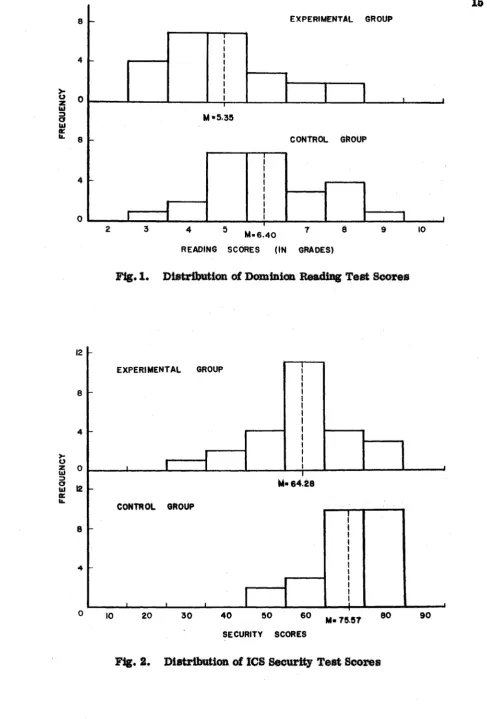
Figures 1 2 illu s tra te fly* d istrib u tio n s o f Dom inion
Test scores fo r the Ss o f the experim ental and control groups* The d is trib u
tio n o f the Dom inion Reading T est scores o f the experim ental Ss m s negatively
skewed w ith a mean score o f S. 35. Reading scores o f the co n tro l Ss were
n orm ally d istrib u te d w ith a mean o f 6.40. A difference o f 1.05 was observed
between the mean scores o f the experim ental control groups on the Dom i
nion Reading Test scores*
The d is trib u tio n o f ICS S ecurity T est scores o f ties experim ental Ss
approached n o rm a lity, whereas the se cu rity scores o f the co n tro l Ss was
p o sitive ly skewed. The mean se cu rity score o f the experim ental Ss was 64.28;
o f the co n tro l Ss, 75.57, indicating a difference o f 11.29 between the groups in
ICS S ecurity T est scores,
The re su lts o f the analysis o f variance fo r the e n tire group, and fo r
the old e r and the younger subgroups, indicated the differences between fh*
scores obtained by the experim ental and control Ss on (a) the ICS S ecurity Test
and (b) the Dom inion Reading Test. In the e n tire group, as w e ll as in the sub
groups, the experim ental and co n tro l Ss d iffe re d sig n ifica n tly in th e ir se curity
scores. A sig n ifica n t difference in the means o f the reading scores was obtained
fo r the e n tire group, but not fo r the subgroups.
F
R
E
Q
U
E
N
C
Y
FRE
QUENCY
8 EXPERIMENTAL GROUP
M *5.35
CONTROL GROUP
H J M -6 .4 0 '
READING SCORES (IN GRADES)
10
F ig . V D istrib u tio n o f Dom inion Beading Test Scores
12
EXPERIMENTAL GROUP
CONTROL GROUP
M- 6 4 .2 8
0 10 20 3 0 4 0 5 0 6 0 M„ 7 5 S 7 80 9 0
SECURITY SCORES
16
However, before tbe significance o f these differences could be
assessed, tbe possible dependence o f se cu rity scores on reading a b ility fo r
reading scores on se cu rity) m s considered. Tbe analysis o f covariance ap
peared the best way to determ ine th is dependence. Each va ria ble has been
separately adjusted fo r its lin e a r dependence ©a the other. As w ill be seen, the
ftyp flritrtftn ta i And control groups d iffe re d sig n ifica n tly in both reading and secu
r ity scores before covariance adjustm ent. A fte r adjustm ent tbe difference in
reading scores fo r the o ld e r and vouneer subgroups m s no longer significant.
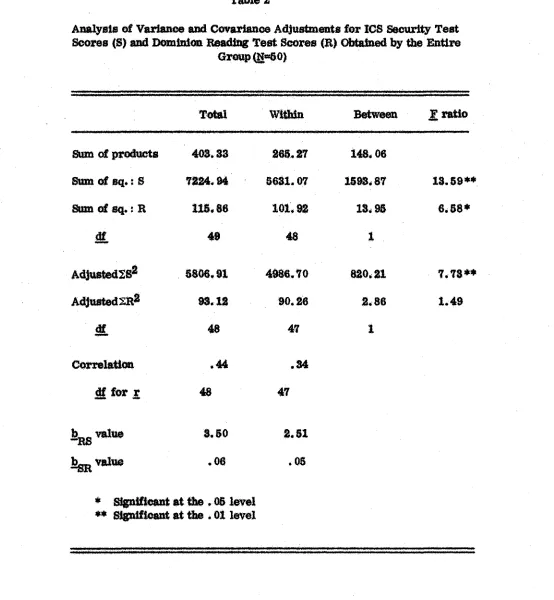
F o r tbe e n tire group (N=50) a difference sig n ifica n t a t the . 01 level
m s observed between the scores o f the experim ental and control Ss on the ICS
S ecurity Test (Table 2). The Dom inion Reading T est scores o f the experim en
ta l and co n tro l groups also d iffe re d sig n ifica n tly, although a t the low er s ig n ifi
cance le ve l o f . 05. When the observed difference in reading score m s taken
in to account, the adjusted mean se cu rity scores fo r the experim ental and control
groups s till d iffe re d sig n ifica n tly a t the . 01 le ve l. On the other hand, when
s ta tis tic a l allowance m s made fo r the difference in se curity score, the adjusted
mean reading scores no longer d iffe re d sig n ifica n tly.
F o r the norm ative sample the ICS S ecurity Test manual reports a
sig n ifica n t difference between the mean scores of grades 4 and 5 children and
grades 6, 7 and 8 children (see supra, p. 7). Consequently, the data o f the
e n tire group were considered in term s o f two subgroups: toe ’’younger*1 subgroup
(N«20) and the ’’older*’ subgroup (JJ*S6), in an attem pt to determ ine w hich sub
Table 2
Analysis of Variance and Covariance Adjustments for ICS Security Test Scores (S) ami Dominion Reading T est Scores (R) Obtained by the Entire
Group (N=5Q)
Total W ithin Between F ra tio
Sun o f products 405.33 265.27 148.06
Sum o f s q .: S 7224.94 8631.07 1593.87 1 3 .5 9 **
Sum o f s q .: R 115.36 101.32 13.95 6.88*
& 49 43 1
A djustedlS2 5306.31 4336.70 m0 .21 7 .7 8 **
Adjusted 2R2 38.12 80.26 2.86 1.49
£ 48 47 1
C orrelation .44 .84
H f© * f 43 47
Sm ™ 1* 8.80 2.81
value .06 .05
18
the experim ental and co n tro l groups o f the e n tire sample* The re s u lts o f th is
breakdown and the subsequent analyses are fo w l in Tables 3 and 4*
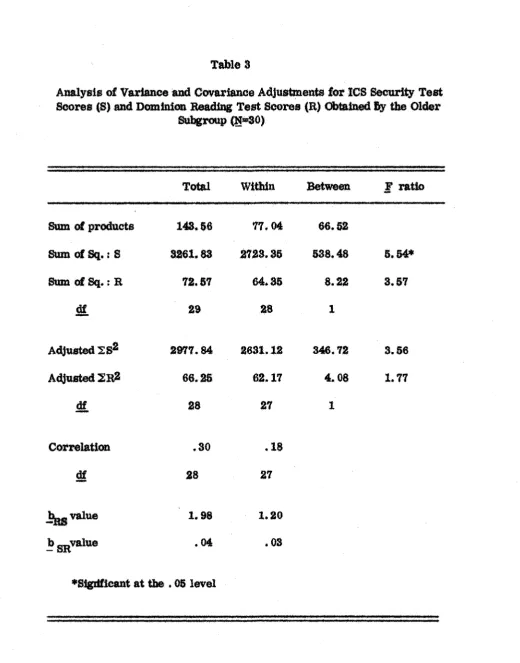
In the old e r subgroup (Table 3), the ICS S ecurity Test scores o f the
■aypftrivn i»nfa» i flnri co n tro l Ss d iffe re d g t , 06 le ve l. D ifferences
in the Dom inion Beading Test scores fo r the same Ss, however* were not sig n i
fica n t. W ith covariance adjustm ent o f the Dom inion Reading T est scores fo r
unequal se cu rity scores, the sig n ifica n t difference between the experim ental
and control Ss, in both th e ir reeding and se cu rity scores, disappeared.
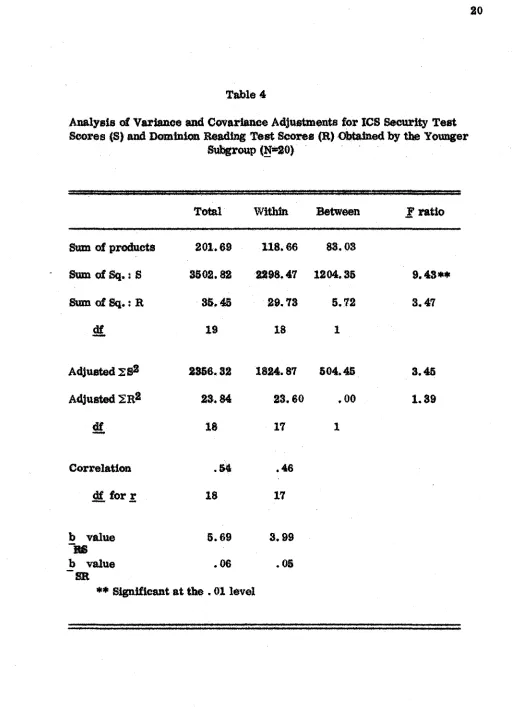
In the younger subgroup (Table 4) the ICS S ecurity Test scores o f the
experim ental and control Ss d iffe re d sig n ifica n tly a t the • 01 le ve l, but th e ir
Dom inion Reading Test score® did not d iffe r sig n ifica n tly even a t the * 06 le ve l.
Covariance adjustm ent o f tfan ICS S ecurity Test scores t he Dom inion R*»sdtng
T est scores resulted in a s h ift o f tfo* nSgnifiAant. differences peyetyd to that
observed fo r the e n tire group and fo r the old e r subgroup* The ICS S ecurity Test
scores adjusted fo r uncontrolled reading scores did not reach a t the
* 05 le ve l; the Dom inion fseedfrsg Test scores adjusted fo r unequal se curity
scores rem ained non- wtg n tftra n t.
I t was therefore observed th a t the ICS S ecurity T est distinguished
sig n ifica n tly between th e and co n tro l groups. T his conclusion per*
mined also to the o ld e r and younger subgroups where se cu rity scores sig n ifica n tly
ffiK ttngnjph between ftntat ««d Sat The Dom inion ffowdtng Test
HiaHngmtgl'uaH betw een on/* C ontrol grvwipa o f tlw e n tire ««w*p1a.
19
Table 8
Analysis of Variance and Covariance Adjustments for ICS Security Test Scores (S) and Dominion lead in g T est Scores <R) Obtained By the Older
Subgroup <N=30)
T otal W ithin Between F ra tio
Sum o f products 148,86 77.04 66.52
Sum o f S q.: S 8861,88 2723.38 538.48 5.54*
Stun of S q.: R 72,5? 64.35 8.22 3.57
<E 29 28 1
Adjusted 2 S2 2977.84 2631.12 346.72 3.56
Adjusted 2R2 66.28 62.17 4.08 1.77
& 28 27 1
C orrelation .30 .18
& 28 27
1.98 1.20
.04 .03
20
Table 4
Analysis of Variance and Covariance Adjustments for ICS Security T est Scores (S) and Dominion Beading T est Scores (R) Obtained by the Younger
Subgroup (N«20)
Total W ithin Between Jf T&tlQ
Sum o f products 201.69 118.66 83.03
Sum o f S q,: S 3502.32 2298.47 1204,35 9 ,4 3 **
Stun o f S q.: R 35.45 29.73 5.72 3,47
d f 19 18 1
Adjusted 2S2 2356.32 1824.87 504.45 3.45
Adjusted 2R2 23.84 23.60 ,00 1.39
€ 18 17 1
C orrelation .54 .46
18 17
b value 5.69 3.99
W®
b value .06 .05
SR
21
scores, Hie significance o f th is difference was not m aintained, to the o ld e r and
younger subgroups even the unadjusted Dom inion Beading Test scores did not
rilg tin g iila 'h between a n tn 1 a n d control Ss.
The effects o f the eovariance adjustm ent o f the IDS S ecurity Test
sco res and the Dominten Reading Test scores o f the experim ental groups in con**
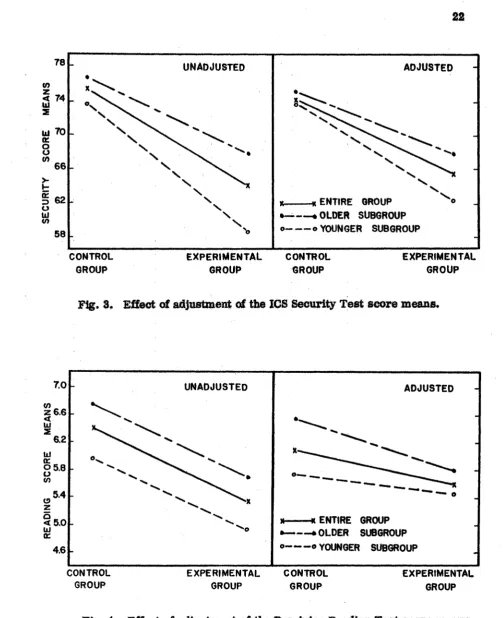
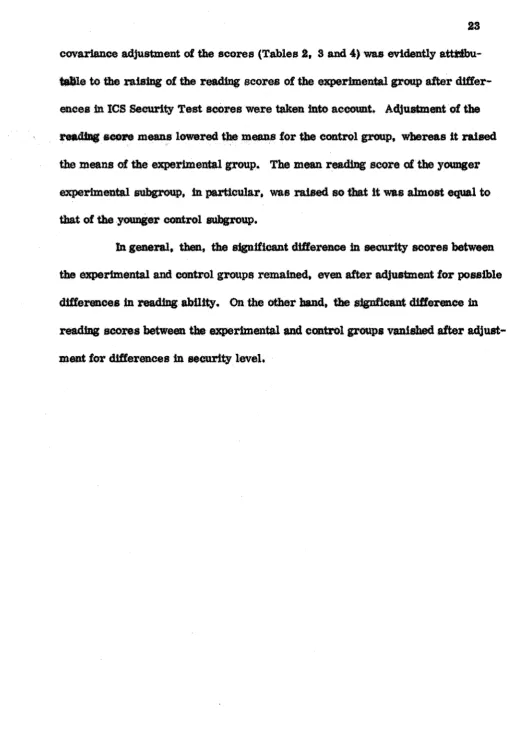
tra s t to the co n tro l group are illu s tra te d in Figures 3 and 4. The mean scores
o f the respective groups and te sts were adjusted by using the appropriate regres
sion co e fficie n t (bRSo r bgR in Tables 2, 3 and 4).
Tbs scores o f the co n tro l group were in general higher than the
mean scores o f the experim ental group. The mean scores ox the old e r subgroup
were also in general higher than the mean scores fo r the younger subgroup.
Adjustm ent o f the ICS S ecurity score means fo r in itia l differences in
reading scores decreased the difference between the se curity score means o f the
experim ental and control groups. Such lessening o f the difference was due p ri
m a rily to the ra isin g o f the experim ental security score means w ith adjustm ent.
The se curity score mean o f the younger subgroup, to p a rtic u la r, was raised by
the covariance adjustm ent. The se cu rity scores means o f the co n tro l groups
were low ered only s lig h tly by the covariance adjustm ent.
Covariance adjustm ent o f the Dom inion Reading T est score means fo r
in itia l differences in ICS S ecurity T est scores effected an appreciable decrease
to the difference between-the experim ental co n tro l groups to mean reading
'Scores.
The disappearance o f tee «ign<ftea«t difference between the experim entalR E A D IN G S C O R E M E A N S S E C U R IT Y S C O R E MEANS m UNADJUSTED • \
\ > ( \ \ \ X X 'o ADJUSTED
S \ ^ S s ' N
S \ Tt
V \
x—--- X ENTIRE GROUP Vk® --- » OLDER SUBGROUP
O--- -- y o u n g e r s u b g r o u p
CONTROL EXPERIMENTAL CONTROL EXPERIMENTAL
GROUP GROUP GROUP GROUP
1% . 3. E ffe ct o f adjustm ent o f the ICS S ecurity Test score means.
UNADJUSTED
•S.'
S S ■N.
s \
ADJUSTED
O
x---k ENTIRE GROUP •--- - * OLDER SUBGROUP
--- o YOUNGER SUBGROUP
CONTROL EXPERIMENTAL CONTROL EXPERIMENTAL
GROUP GROUP GROUP GROUP
covariance adjustm ent o f the scores (Tables 2, 3 and 4) was evidently a ttrib u
table to the ra isin g o f tbs reading scores o f the experim ental group a fte r d iffe r
ences in ICS S ecurity T est score® were taken in to account. Adjustm ent o f the
reading score means lowered the w m h b fo r t he co n tro l croup, whereas it raised
the means o f the experim ental group. The mean reading score o f the younger
experim ental subgroup, in p a rtic u la r, was raised so that it was alm ost equal to
that o f the younger co n tro l subgroup.
m general, the11, **»« «igntfir»an* diff&r'tmt'.e* in se cu rity scores between
the experim ental control group® rem ained, even a fte r f dj ufft******1* fo r possible
differences in reading a b ility . On the other hand, the signficant difference in
reading scores between the experim ental and co n tro l groups vanished a fte r adjust
CBAPTSB W
DISCUSSION AND CONCLUSION
Discussion
The hypothesis that the language fa c to r involved in the XCS S ecurity
T est does not influence the se curity m easure it yie ld s was generally supported
by the data o f th is study* The se cu rity score was a measure o f the c h ild 's inde
pendence in making Ms own decisions and o f Ms w illingness to accept the eon-
seouences o f action bv p ic ti decisions. The 'resu lts Indicated that
acquired reading s k ills did not sig n ifica n tly a ffe ct the testee's a b ility to judge
and rank the statem ents representing the fiv e leve ls of se cu rity d e s e rte d in the
JCB Security Test. A deficiency in reading s k ills andjbr reading comprehension
would not then v itia te a se cu rity measure obtained on the ICS S ecurity Test.
The co rre la tio n between se cu rity and reading scores ( j * . 34) indica
ted that the ICS S ecurity Test and the Dom inion Beading T est were to some
extent m easuring a common fa c to r. Covariance adjustm ent o f the scores in d i
cated that if the Ss were a ll reading a t the same le ve l the experim ental group
would s till d iffe r sig n ifica n tly from the co n tro l group in se cu rity scores.
The ICS S ecurity Test scores o f the experim ental Ss were d istrib u te d
d iffe re n tly fro m what was expected. ©wing to the selection Of experim ental Ss
who, on the diagnosis o f em otional disturbance, were assumed to be insecure,
S im ila rly , it would lie anticipated that the d is trib u tio n o f the se cu rity scores o f
the control Ss, judged secure by th e ir teachers, would skew p o sitive ly. The
se cu rity scores o f tie co n tro l Ss were p o sitive ly skewed as expected (F ig . 2).
Hbwever, the se cu rity scores o f the experim ental Ss were norm ally d istrib ute d .
Because the experim ental subjects were selected on the assumption that a c h ild
c lin ic a lly diagnosed as em otionally disturbed is insecure, it would seem that
what psychologists consider em otional disturbance may not be in se cu rity as de
fined by the se cu rity theory on which the ICS S ecurity Test is constructed. The
data o f th is study indicated that the ICS S ecurity Test sig n ifica n tly measured a
fa cto r other than reading as estim ated by the Dom inion Beading T est. However,
it would seem th a t th is fa c to r o f the ICS S ecurity Test is other than, o r but one
o f, the fa cto rs that c lin ic a l psychologists define as em otional disturbance.
The effectiveness o f the ICS S ecurity Test as a to o l w hich teachers
may use to discover the insecure ch ild as defined by the se cu rity concept o f
B latz and Grapko (see supra, pp. 4 f) seems to be confirm ed by the re su lts o f the
present investigation. The cle a r and sim ple instructions fo r adm inistration of
the te st and the percentile in te rp re ta tio n o f the raw scores allow even the untrained
te ste r to use it p ro fita b ly . The ICS S ecurity Test, as a group te s t, proves su it
able and p ra ctica l fo r use in large school system s. However, the long and
tedious method o f calculating the raw scores may deter a busy teacher from re a d ily
em ploying the te st.
The conclusions o f such investigators as those cited in the introduction
ICS Security Test. T his finding may be due to the fe e t th a t the concept o f secu r ity as sp e cifica lly defined in the ICS S ecurity Test does not correspond to emo
tio n a l in s ta b ility as thought o f by these investigators. The incom patible conclusions
o f these investigators may be the re s u lt o f differences in d e fin itio n o f concepts such
as em otional disturbance o r se cu rity. I t appears tru e that em otional fa cto rs im
pede the acquisition o f reading s k ills as suggested by M issildine (1946), Blanchard
(1936), H allock (1958), M ils (1950) ami A xline (1947). K also seems tru e , as
Bower (1960), Fernald (1943), Buswell (IM S ) and Parsons (1949) im p ly, that d e fi
ciency in acquired reading s k ills does seem to affe ct se cu rity. The ICS S ecurity
Test score does, however, appear to be a sig n ifica n t measure o f a fa cto r other
tha-nt at>d alm ost twdApemii^Ht o f, the reading fa c to r measured by 'the Dom inion
&6&uilk{£ 16 St*
Conclusion
The purpose o f the present investigation m s to determ ine the influence
o f the reading fa c to r involved in the ICS S ecurity Test on the se cu rity measure it
y ie ld s. F o r the e n tire sample §f?90) the ICS S ecurity Test distinguished s ig n ifi
cantly a t . 01 le ve l between fee AvpAT^Tnentai group (insecure Ss) fee con
tro l group (secure Ss), whereas the Dom inion Beading Test did not. Some co rre la
tio n was evident between se cu rity and reading scores (r * • 34). Covariance
sdtustm ent o f se cu rity scores fo r differences in the in itia l reading scores lowered
the , 001 significance le ve l to the . 01 le v e l. A s im ila r adjustm ent o f reading
scores fo r in itia l differences in se cu rity scores resulted in fee disappearance o f
27
Beading T est scores. F o r both the o ld e r and younger subgroups the ICS S ecurity
Test sig n ifica n tly between the a*p«r iwmnfoi and co n tro l Ss (. os
le ve l) but the Dom inion Tra d in g Test did not. A fte r covariance adiustm ent o f the
reading scores o f the o ld e r and younger subgroups, neither the adjusted security
scores nor the adjusted reading scores were significant..
It was therefore concluded, w ith in the lim its o f th is investigation, that
the ICS S ecurity T est yie ld s a measure o f se curity as it is defined fo r th is te st.
The in itia l hypothesis was thMi supported: the r eading fa cto r involved in the ICS
28
APPENDIX A
T « « !!■ ■ ■ > ■ !!■■■■■ 1 SH ah itm ^ m i A ^ t k # « A i k « i "It flf M -f* Ifc a j — in A *.1 rflr
m am anai scores ootainea on toe Matcned f actors
Factors
IQ a Socio-econom ic*1
Ss Grade E C .. E C
1 3 89 94 39 38
2 1 110 112 53 52
2 101 101 54 55
4 68 65 60 57
5 98 86 53 54
6 97 92 43 44
7 6 74 74 38 37
8 84 89 57 61
9 81 78 44 : 44
10 95 96 33 33
11 72* 92 51 48
I f 86 91 64 63
13 100 107 49 50
14 63 64 51 54
15 88 88 45 46
16 5 124 114 36 36
17 92 96 54 56
18 92 82 40 39
19 182 133 32 34
20 75 77 48 47
21 102 102 25 29
22 m 92 54 54
23 94 93 40 39
24 106 210 58 50
25 4 90 38 41 42
s Scor es fro m toe Non- Language M u l t i - T e s t by Teraasm* and Lorge (1942).
b « Ratings determ ined cy toe index or status c n a ra cte ristics ox w illia m n iln tiirm tnnri W Mu. fnAyg n f PirnthirtmHI mfIrn n f n r ii ii.m
APPENDIX B
Individual Scores Obtained on the ICS S ecurity Test and the Dom inion Beading Test
ICS S ecurity Test Dom inion
r n , n " . : r , m m , : ,:n ' nr, , I"' r,.rnnr:' ri ' nr, :1: ", m , r -
Consistency Security________________Test
Ss E C E ■ C E C
1 15.31 19*80 67.33 71.33 8.9 9.0
1 lia s 58.34 03*88 85.00 8.8 8.0
3 7.70 13*33 56.07 59.67 5 .2 5 .8
4 52.50 59.05 85.33 86,00 3.8 5.2
5 48.22 31.80 79,83 76.33 5.8 5 .4
6 13.73 56.06 08.00 82.67 6.9 7.3
7 10.91 5.84 61.33 59*00 5*0 5.6
8 17.60 27.19 65.07 71.83 3.8 6 .2
0 7.04 21*25 68*88 71*00 5.0 8 .0
10 57.11 85*20 83,00 77.33 7.3 6 .0
11 8.90 49*63 49,30 84.00 3.8 4.7
12 7*30 62.92 59,00 86* 00 5.0 7.7
18 39*90 58.52 79.00 81*67 5.6 8 .6
14 8*45 27.72 01*83 75*33 4*1 5.6
11 42,59 61.51 80.67 83*00 6 .2 6.9
16 9.77 43.56 50.00 81.00 7 .0 7.2
17 1.3d 23.70 45,67 71.80 4.7 6 .0
18 43.74 14.78 79.00 64.33 6 .2 3.5
19 27.78 34.50 75.00 76,50 5.8 6 .4
20 25*52 81.53 65.33 72.84 3.2 5 .2
21 8*80 13.32 36*00 08.86 4.7 4 .4
22 21.47 m u 55*70 30.38 4 .4 3,6
23 18.22 24.55 67.00 68.38 4,1 5 .6
24 11*79 42.86 88*50 80.00 4 .1 6.4
APPENDIX C
ICS S ecurity T est and Scoring Form
Dom inion Beading Test
Non-Language M u lti-M e n tal Test
S ecurity Bating Form fo r Teachers
Name
AgeBoy or Girl (circle one)
F irs t Name L a st NameSchool
Grade
Date
ELEMENTARY FORM—Grades 4 to 8
T H E
S T O R Y
OF
J I M M Y
This is a story about Jimmy. This story is similar to a game be
cause we want to find out what Jimmy is like. In a way, Jimmy is very
much like you. He lives at home with his mother and father, he goes to
school, he likes to play games, and throughout the day he has to make up
his mind about many things.
Now in this story we want to find out what you think Jimmy is most
likely to do when different things happen to him. Each time Jimmy has
to make up his mind, he will have five choices. After you read over the
five choices, pick out what you feel Jimmy is most likely to do. Then pick
out what you feel Jimmy will choose as his second, third, fourth and fifth
choice.
As you read the story about Jimmy and come to a part where Jimmy
has to make up his mind, you will stop and write in the brackets the num
bers 1, 2, 3, 4, or 5 after each of the five choices, that is in the order that
Jimmy will choose them. Therefore, you will
w rite 1 a fte r w hat you fe e l Jim m y chooses to do f ir s t ... ( 1 ) w rite 2 a fte r w hat you fe e l Jim m y chooses to do second ...( 2 ) w rite 3 a fte r w hat you fe e l Jim m y chooses to do th ird ... ( 3 ) w rite 4 a fte r w hat you fe e l Jim m y chooses to do fo u rth ... ( 4 ) w rite 5 a fte r w hat you fe e l Jim m y chooses to do la s t ... ( 5 )
Before you begin, we want to say that there are no right or wrong
answers. The only right choices are those that
youthink Jimmy will
make and the order in which Jimmy will make them from one to five. Are
you ready?
Jimmy goes to school. He gets up in the morning, gets washed and
dressed, and then greets his mother at breakfast. This morning, how
ever, Jimmy slept in and when he awoke he found that he was going to
be late for school. Since Jimmy isn’t usually late for school, he wasn’t too
sure what to do. A fter a moment it occurred to Jimmy to :
give the excuse th a t the alarm clock didn’t r i n g ...
wait for his mother to help him hurry u p ...
rush as fast as possible so as not to be too l a t e ... ...
sta rt to c r y ...
explain to the teacher when he arrived late at school ...
Jimmy was soon downstairs. His breakfast was on the table. Being
late, it seemed to Jimmy that his mother gave him more than usual to eat
this morning. Jimmy looked up at the clock and saw that it was seven
minutes to nine. Jimmy wanted to leave almost half of his breakfast.
However, Jimmy’s mother said that growing boys need to eat all their
breakfast. Jimmy decided to :
ask if she would let him leave some to d a y ...
begin to cry ...
say th at he doesn’t feel too well this morning ...
ask if she would take some a w a y ...
finish eating what was l e f t ...
Jimmy was ready for school. He said good-bye to his mother and
hurried out of the door. He was almost at school when suddenly he
remembered that he was supposed to bring his ball this morning. His
friends planned to play catch at recess, and Jimmy had promised he
would bring his ball. Jimmy was already late so he couldn’t very well
turn back. The boys were certainly going to be disappointed. Jimmy
wondered whether to :
hope th a t his friends would forget he was to bring the b a ll...
ask the teacher if he could borrow the school b a ll...
tell them th at he wasn’t interested in playing catch to d a y ...
suggest another game they could p la y ...
Jimmy arrived at school. The grounds were empty and everyone was
in class. Jimmy went quickly to his room and as he entered he found that
everyone was seated and the teacher had already started the lesson. Jim
my felt that he might have to give the teacher some explanation for being
late. He wasn’t too sure what he would say. Jimmy wondered whether to :
say th a t he w ould tr y h is best to plan n o t to be la te a g a in ... count on the teacher n o t asking fo r an explanation ... te ll the teacher th a t he slept in ... hope th a t the teacher w ouldn’t be too a n g ry a t h im ... say th a t i t wasn’t h is fa u lt he was la te ...
After Jimmy sat down in his seat, the teacher continued with the
lesson. This morning the lesson was in arithmetic. Jimmy listened very
carefully, but soon realized that he didn’t understand some of the things.
The other children seemed to know more arithmetic than he did. Jimmy
knew that the teacher was friendly and would give him extra help if nec
essary. Jimmy wasn’t sure what to do. After some thought Jimmy de
cided to :
w o rk a little h a rder a t a rith m e tic ... no t w o rry since a rith m e tic isn ’t re a lly im p o rta n t...
w a it fo r the teacher to give h im m ore h e lp ... w o rk a t a rith m e tic together w ith h is frie n d ... cover up h is a rith m e tic w o rk book so no one w ould see i t ...
ask the teacher to te ll F red to give h im the book ....:... ask F red to le t h im have th e book when he was th ro u g h w ith it
go back to h is seat and be glad th a t now he doesn’t have to read a book
s ta rt on another b o o k... ... ...
re tu rn to h is seat and ju s t s it u n til the reading period is over
Finally the recess bell rang and it was time for the children to put
their books away and get ready to go outdoors. Jimmy was thinking about
what he would like to play. He would have played catch with his friends
but of course he had forgotten to bring the ball. Soon the children were
outside running, jumping, yelling and having a lot of fun. Some of the
boys started to play “tag” and in time Jimmy was “it”. Jimmy was a good
runner and before long he had trapped Bobby in the corner of the yard and
tagged him. Bobby quickly turned around and tagged Jimmy right back
and ran away. Jimmy didn’t think that it was fair because he should be
given a “count of ten” to get away. Bobby ran away, yelling that Jimmy
was “it”. Jimmy decided to:
s ta rt to chase someone e ls e ...
go aw ay and p la y by h im s e lf...
have everyone agree on the ru le before s ta rtin g to chase someone else
q u it because th e re isn ’t m uch fu n in p la y in g ta g ...
te ll the o th e r boys n o t to le t Bobby p la y ta g w ith th e m ...
blackboard and drew a picture of a donkey, and printed JIMMY under
it, and hurried back to his seat. Jimmy didn’t think this was funny so
he
went up tothe
blackboard to rubhis
nameoff.
Just ashe
rubbed offhis name, the teacher walked into the room. Jimmy realized that it look
ed as if he were disobeying and really didn’t know what to say to the
teacher. Jimmy wondered whether to:
te ll the teacher he d id n ’t mean to be o u t o f h is s e a t...
te ll th e teacher th a t i t was a ll B illy ’s f a u lt... ...
te ll the teacher he was s o rry and w ould no t leave h is seat a g a in ... ask the teacher to le t h im o ff th is tim e ... face up to the fa c t th a t he was o u t o f h is seat...
Before Jimmy could say anything, the teacher told him to return to
his seat and he would be given some extra work to do. At Jimmy’s school
there is a rule that any boy or girl who disobeys is given extra work
which the children must do after school. Jimmy didn’t feel that it was
entirely his fault. However, he decided to :
say th a t i t wasn’t h is fa u lt a t a ll...
do the e x tra w o rk since he was ou t o f h is seat w ith o u t perm ission ...
accept the e x tra w o rk since i t is im p o rta n t to keep the ru le s ... te ll the teacher th a t she should make an exception in h is case... say the ru le isn ’t f a ir ...
listen carefully to Johnny so it would help him in his reading
practice his re a d in g ...
wait for the teacher to help him more with his re a d in g ...
wait since he wasn’t sure what to do about his re a d in g ...
give up trying to improve since he doesn’t like to read anyway
The rest of the morning went by quickly. A fter lunch the children
made plans for a Hallowe’en party and everyone was excited in prepar
ing for it. The teacher passed around coloured paper and paste and she
showed the children how they could make their own masks. This was
new for the children since they had never made masks out of paper.
Jimmy listened to the teacher’s instructions but wasn’t quite sure how
to go about it. Jimmy wanted a good mask so he decided to:
tell himself th at he wasn’t good enough to make a mask on his o w n ...
use his own ideas in making a m a sk ...
wait for the teacher to make most of it for h i m ...
buy a mask a t the store since it wasn’t worth the trouble to make o n e ...
work together with another boy on both th eir m a sk s...
ru n home to show h is m o th e r...
give th e fence a good h a rd k ic k ... s ta rt to c r y ... h u rry home to p u t some iodine on i t ...
w ipe th e blood o if w ith h is handkerchief before going o n ...
Finally Jimmy got home and after awhile he asked his mother if he
could go to the store. They had just received the new kind of gun that
Jimmy’s favourite T.V. star uses. It even had the T.V. sta r’s name on
it. Jimmy had saved enough money to be able to buy it. It cost one dollar
and thirty-nine cents. Jimmy’s mother said that he could go and buy the
gun if he wanted to spend his money that way. In a very short time
Jimmy was at the store and had bought the gun.
On his way home, Jimmy played with the gun and was really ex
cited about it. As Jimmy got closer to home, he met some of his friends.
He showed his new gun to them. They all agreed that it was really swell.
His friends then told Jimmy that they had got their mothers’ permission
to go to the show and they wondered if Jimmy could come along. Jimmy
was certainly interested since his favourite cowboy was playing in the
picture. He was sure his mother would give him permission to go. How
ever, Jimmy had already spent all his money on the gun. The boys asked
Jimmy to make up his mind. Finally Jimmy decided to :
te ll h is frie n d s th a t he d id n ’t lik e going to shows
fe e l ve ry so rry th a t he had spent a ll h is money on the gun
te ll h is frie n d s he had already spent h is money and couldn’t go w ith them
ask h is m other fo r p a rt o f n e xt week’s allow ance so he could go to the show b orrow some money fro m h is frie n d and pay h im back when he got h is allow ance
to spell some of the names. Jimmy was sure that his father would re
member and that his father was very good at spelling the names too.
Jimmy looked up from his work and saw that his father was busy read
ing the newspaper. Jimmy hesitated for a moment and wondered whether
to :
ask h is fa th e r i f he m ig h t borrow the road maps th e y used la s t sum m er ' ( ) ask h is fa th e r to help h im when he finished th e p a p e r... ( ) say n o th in g to h is fa th e r since he gets a n g ry when Jim m y can’t do h is w o rk ( )
no t bother h is fa th e r since he is alw ays too busy ( )
in te rru p t h is fa th e r since he is alw ays w illin g to help h im ...( )
When Jimmy finished his homework, he played with his toys. He
enjoys building things and likes to play with his meccano set. The eve
ning went by quickly. It was getting late and time for Jimmy to go to bed.
After Jimmy had changed into his pajamas and washed and brushed his
teeth, he was ready to say goodnight to his mother and father. At Jimmy’s
home, his mother and father have taught Jimmy to say his prayers before
going to bed. Sometimes Jimmy forgets unless he is reminded. While Jim
my remembered about his prayers to-night, he was so tired that all he
wanted to do was to get into bed. Jimmy paused for a moment and then
decided to:
say h is prayers even though he was tire d ( )
say h is prayers as fa s t as he could since no one w ould m ind ( )
say h is prayers so th a t n o th in g bad w ould h a p p e n ... ( )
say h is prayers since th e y were im p o rta n t to h im ( )
m iss h is prayers ju s t th is on ce ( )
When Jimmy was finished he jumped into bed and soon was fast
asleep. By his face it was easy to see that Jimmy hoped that there
wouldn’t be so many decisions to make tomorrow. And that is the story
of Jimmy.
Copyright, 1957
Michael F. Grapko r Institute of Child Study
Pupil’s Name Age Sex B or
1. sleeping in
DA
IDS IS
IN S MDS
2. a t breakfast
IDS IN S DA
MDS IS
3. forget ball
IN S MDS DA
IS IDS
INSTITUTE OF CHILD STUDY SECUI
T H E STORY OF JIM M Y — Score Sheet #1
6. book II* m aking a mask
IDS MDS DA IS
INS
7. playin g tag
IS
INS MDS DA
IDS
8. at blackboard
IN S DA MDS IDS IS IN S IS IDS DA MDS
12. fa ll from fence
IDS
DA IN S MDS
IS
13. m oney
D A
IN S
IS IDS
MDS
4. arrive late
MDS IDS
IS c
INS DA
5. arithm etic
is
I
DA
IDS MDS
IN S
9. consequences
DA
IS
[ T
MDS IDS
IN S
10. reading
MDS ~
IS c _
IDS INS
DA
14. homework
IS
I
MDS
INS
DA IDS
15. prayers
MDS IDS IN S IS DA RANK
SEC UR ITY CATEGORY 1 2 3 4 5 Total
Independent Security i 1 l 1 i 15
Mature Dependent Security
i
i i
; 15
Immature Dep. Security
1 i i i
School _______________________________________ Grade _____ Date o f Test
— Elem entary Form
SCORING FORM
TH E STORY OF JIMMY — Score Sheet #2
Consistency Score Security
Score
X Mean Y Y 2 Z
Security
Category
Rank
1 2 3 4 5
IS
0 1 4 9 16
45
MDS
1 0 1 4 9
45
IDS
4 1 0 1 4
45
DA
9 4 1 0 1
45
IN S
16 9 4 1 0
45
Copyright, 1957 Michael F. Grapko, Ph.D.
Institute of Child Study
225
Total Y 2
Multiply by .044
Consistency Score
Percentile
Total Z
D iv id e b y
100 minus
Security Score
Percentile
THE DOMINION TESTS
ACHIEVEMENT TESTS IN SILENT READING
Grades 5 and 6
Cat. No. 820 TYPE II— DIAGNOSTIC TEST IN PARAGRAPH READING Form
A
Name... ... ... ...
F irs t Nam e L a s t Name
Boy or Girl ... Age... Birthdate...
D ate M o nth Y ear
Teacher...G rade...Today's Date ...
School... City, Town or Municipality...
S A M P L E :
Jerry and Joan were on their holidays. Both
of them could swim well and they were playing in the water. All at once, Joan felt something catch her by the leg. Jerry had gone under the water and was pulling her down to the bottom of the lake. Then he let go and soon she and her brother Jerry came to the top again. They were out of breath, and their mouths were full of water.
1. The children were
running sailing swimming fishing rowing
2. Joan was pulled under the water by
her father her brother the weeds
a rope a big fish
3. The best name for this story is
A W a lk in the Country A Party Learning to Swim
Joan Catches a Fish Playing in the Lake
DO NOT TURN THIS PAGE UNTIL YOU ARE TOLD TO DO SO
Analysis of Responses Analysis of Errors
Number Correct ...
Number Omitted ...
No. Level General
Number Wrong ...
Grade Level ...
Inference ...