Efficient Division and Replication of Data in
Cloud with Attribute Based Encryption
Snehal Bodake1, Prof. S. A. Kahate2
M.E. Student, Dept. of Computer Engineering, SPCOE, Otur, Pune, Maharashtra, India1
Assistant Professor, Dept. of Computer Engineering, SPCOE, Otur, Pune, Maharashtra, India2
ABSTRACT:. Now a days some researchers believed on save data effectively and securely on cloud.On the other hand,
these systems are stillnot secure beside the collusion of cloud storage server as well as revoked group users during user revocation in practical cloud storage system. In previous paper we found that collusion attack an efficient public integrity auditing scheme with secure group user revocation based on vector commitment plus verifier-local revocation group signature. We invented a concrete scheme. We propose a new structure called Decrypt key, which provides efficiency and reliability assurance for convergent key management on mutually user along with cloud storage sides. The design is to apply de-duplication to the convergent keys to influence secret sharing techniques. In particular, we build secret shares for the convergent keys and share out them across multiple independent key servers. Our proposed system rigging the public checking and efficient user revocation, as well as also some fine assets, such as confidently, efficiency, countability and traceability.There is efficient use of vector commitment and verifier local revocation group signature.
KEYWORDS: Public integrity auditing, dynamic data, vector commitment, group signature, cloud computing.
I. INTRODUCTION
platform. In these software development environments, one or more than one (multiple) users in a group need to share source code as well as they needs to access, compile, modify and run the source code share by user at any time. The new model of cooperation network in cloud provides the infeasibility of data for auditing the remote data, where only the data owner can update its data. It will result in terrific communication and computation to the data owner which causes the single point of data owner. To achieve multiple data operation, Wang et al. put forth data integrity based on ring signature. In the scheme, it does not consider the user revocation problem and the cost of auditing is linear to the data size and group size. To further raise up the previous scheme and support group user revocation, Wang et al. proposed a scheme based on proxy re-signatures. However, this scheme assumes that authenticated and private channels exist between the pair of entities and there is no collusion among them. Also, cost of auditing the scheme is linear to the size of the group. Another attempt to improve the previous scheme and make the scheme scalable, efficient and collusion resistant, Yuan and Yu designed a dynamic public integrity auditing scheme with group user revocation. However, in their scheme, the authors do not consider the secrecy of data among the group users. That means, their scheme could efficiently support plain text of data update and integrity auditing, while not cipher text data. In their scheme, if data owner shares group key among the users of group, revocation of any group user allow the group users to update their shared key. Also, the owner of the data does not take part in the user revocation phase, where the user revocation phase is itself conducted by the cloud. In this case, the malicious cloud server will result in collusion of revoked user and the cloud server where the cloud server could update data number of times as designed and provide a legal data finally. Cloud Storage service are such as simple storage services in online data backup services of amazon, and practical cloud based software Google drive, drop box, mozzie, bitcasa and memo pal have been built for cloud application. There is invalid result in cloud server such as server hardware, software failure, human maintenance and malicious attack. Rabin data dispersion scheme implemented for practical application and overcome above challenges.
II. RELATEDWORK
In A large amount of researchers have committed significant concentration to the troubles on how to securely outsourcelocal pile up to remote cloud server. The problem of remote data integrity and availability auditing attacks theattestation of many researchers.
SagarikaDev Roy, et.al (2014) proposed a methodology for secure outsourcing oflinear Computations into the cloud environment. Outsourcing is a common procedure engaged in the business worldwhen the customer chooses to farm out a certain task to an agent for the benefit of the firm in terms of time and cost.They proposed methodology to detecting a malicious server, in an efficient result verification method.
YongjunRen, et.al (2012) proposed designated verifier provable data possession. This plays a major role in public clouds. Designated verifier provable data possession is a matter of crucial importance when the client cannot perform the remote data possession checking. By using the system security model and homomorphism authenticator they designed a new scheme. The scheme removed luxurious bilinear computing process. Furthermore in this proposal, the cloud storage server is stateless and independent of the verifier. This is an important secure property of any other schemes. In the course of security analysis and performance analysis, their scheme is secure and high efficiency.
Jia Yu, et.al(2015) proposedCloud storage auditing which is viewed as an imperative service to corroborate the veracity of the data in public cloud. Existing auditing protocols are all based on the supposition that the Client’s secret key for auditing is completely protected. Such assumption may not always be held, due to the probably weak sense of security and/or low security settings at the client. In most of the current auditing protocols would inevitably become unable to work when a secret key for auditing is exposed. It is investigated on how to reduce the damage of the client’s key revelation in cloud storage auditing, and provide the first handy elucidation for this new problem setting.The security proof and the performance analysis show that the projected protocol is protected and well-organized.
Jingwei Li ,et.al (2015) proposed the cloud computing technology, this technology outsourcing data to cloud service for storage becomes an attractive trend, which benefits in sparing efforts on heavy data maintenance and management. Nevertheless, since the outsourced cloud storage is not fully trustworthy, it raises security concerns on how to realize data deduplication in cloud while achieving integrity auditing .Aim is to achieve both data integrity and deduplication in cloud, they proposed two secure systems, namely SecCloud and SecCloud+. SecCloud introduces an auditing entity with a maintenance of a MapReduce cloud, which helps clients generate data tags before uploading as well as audit the integrity of data having been stored in cloud.
Jiawei Yuan, et.al (2014) proposed a new method based on some modern procedures such as based on authenticationpolynomial tags and linear authenticators. Data integrity auditing is achieved concurrently in this approach. Theproposed idea is to characterize the constant real time communication and also the computational cost on the user’s side. It supports both public auditing along with batch auditing process.Many data loss and corruption events are reported against the well-known cloud service providers, data owners, to resolve these issues they need to periodically audit the integrity of the if outsourced data. And also every cloud service providers must improve their efficiency of cloud storage. To minimizethe unnecessary redundant copies, the cloud storage servers would deduplication the data. By having only one or fewcopies for each file and making a link to the file for every user who asks the same file stored in the disk.
III.PROPOSED SYSTEM
In this paper, we study the problem of constructing public authentication inspection for shared dynamic data with group user revocation. Our contributions are:
1) For cipher text database, we explore on the secure and efficient shared data integrate auditing for multi-useroperation.
2) We intend an efficient data auditing scheme along with new features such as traceability and countability by incorporating the vector commitment primitives, asymmetric group key agreement and group signature.
3) The analysis results show that our scheme is secure and efficient as we provide the security and efficiency analysis of our scheme which will result in back-up and data storage in cloud.
4) The authorized duplicate check in the hybrid cloud architecture is supported by several de-duplication constructions and this authorized duplicate check scheme comparatively incurs minimum overhead than normal operations.
It encrypts or decrypts a data copy with the help of a convergent key. By computing cryptographic hash value of the content of the data copy we can obtain the key. After key generation process and data encryption process, users canhang on to the keys. Then the user sends the cipher text to the cloud environment. Ever since encryption is deterministic, the same data copies will generate similar convergent key and the identical cipher text. This permits the cloud to perform de-duplication over the cipher texts. Cipher texts are able to decrypt by the corresponding user’s withtheir convergent keys. Convergent encryption practical is to efficiently and reliably manage a huge number ofconvergent keys.
Fig1. System Architecture.
The unique Data block will be selected and those blocks are placed in the cloud service provider’s space. We are using crypto graphic algorithm for integrity checking. Message authentication code is the scheme of producing Message digest for input file. The integrity checking should be done by Third party auditor by checking this message digest code.Before uploading file; data owner must send the hash key to the third party auditor. Third Party Auditor receives the key and verify with cloud service provider to check whether this file is already uploaded or not. In this module, user revokes the content by getting secret key of data owner. Data owner must share the secret key for group users. User downloads the file from the cloud service provider using hash key.
IV.REQUIREMENT ANALYSIS
HARDWARE RESOURCES REQUIRED
1. CPU Speed 1 GHz Remark Required 2. RAM 2 GB Remark Required 3. Hard Disk 320 GB Required 4. Mouse 3 Buttons Required
SOFTWARE RESOURCES REQUIRED
1. Operating System: window XP or Windows 7 2. IDE: Netbeans 7.3.1
3. Programming Language : Java 4. Back End: Mysql 5.5
V. PROPOSED ALGORITHM
1. AES Algorithm:
2. Derive the set of round keys from the cipher key. 3. Initialize the state array with the block data (plaintext). 4. Add the initial round key to the starting state array. 5. Perform nine rounds of state manipulation.
6. Perform the tenth and final round of state manipulation. 7. Copy the final state array out as the encrypted data (ciphertext).
2. Data Partition Algorithm- To divide data into fragments
Algorithm for fragments replication
For each Ok in O do
Select Si that has max(Rik +Wik)
if colSi = open color and si >= ok then
SißOk
Si ßsi – ok
colSißclose color
Siß distance(Si; T) P /*returns all nodes at distance T from Si and stores in temporary set Si’*/
colSiß close color
end if
end for
VII.MATHEMATICAL MODEL
Let S be the whole System, S = (I,P,O) where,
I-input, P-procedure, O- Output I = (I0,I1,I2,I3,I4,I5)
I0= user id
I1= File to upload on cloud I2 = No of Group Members I3= Clouds Details
P2= Upload File to cloud P3=Share File to group P3= Monitor User Activities P4=File integrity Checking. P5= Revoke group user P6= Invoke group user O= (O1,O2)
O1= Data Integrity O2=Revoked Group User
VIII.EXPERIMENTAL RESULTS
Fig2. User Registration
To register user needs enter email, password, name, mobile number, select group and address. All details are valid. Details are wrong registration is fail.
User login time user enter email and password, system send security code you enter email.
Fig4. User Home Page
Fig5. File upload
You can select text file other file cannot accept here.
You can enter group key, your require file name enter and download file.
Fig7. File Update
Fig8. Transaction Details
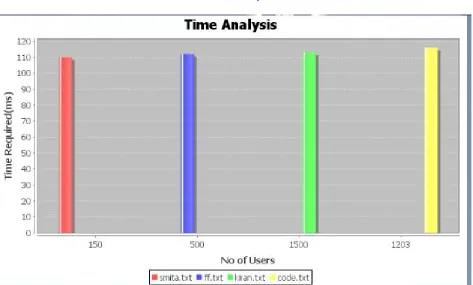
Fig. 9 Time Analysis
IX.CONCLUSION
The data file is securely shared among the dynamic groups. Member can sign the same group and share the data efficiently without revealing user’s identity. Cryptography technique is used for over all security. When AES and DES algorithms are compared, the key size of DES algorithm is very small so its possible to hack easily.AES algorithm is used for efficient user revocation without updating private keys of remaining users. The proposed system is to realize efficient and secure data integrity auditing for dynamic data. The proposed model consists of the public data auditing and group user revocation. AES and Data partition algorithm techniques provides better data confidentiality.
REFERENCES
1. T. Jiang, X. Chen, an J. Ma, “Public integrity auditing for shared dynamic cloud data with group user revocation,” in Proc. Of IEEE TRANSACTIONS ON COMPUTERS VOL: PP NO: 99 YEAR 2015
2. Jin Li, Yan Kit Li, X. Chen, Patrick P. C. Lee, Wenjing Lou, “A Hybrid Cloud Approach for Secure Authorize Deduplication,” in Proc. of IEEE TRANSACTIONS ON PARALLEL AND DISTRIBUTED SYSTEM VOL:PP NO:99 YEAR 2014.
3. Boyang Wang, Baochun Li, Member, IEEE, and Hui Li, Member, IEEE, ”Oruta: Privacy-Preserving Public Auditing for Shared Data in the Cloud” in Proc. Of IEEE TRANSACTIONS ON XXXXXX, VOL. X, NO. X, XXXX 201X.
4. C. Wang Student Member, IEEE, Sherman S.-M. Chow, Q. Wang, Student Member, IEEE, K. Ren, Member, IEEE, and W. Lou, Member, IEEE , “Privacy-Preserving Public Auditing for Secure Cloud Storage”.
5. B. Wang, B. Li, Member, IEEE, and H. Li, “Panda: Public Auditing for Shared Data with Efficient User Revocation in the Cloud” in Proc. Of IEEE TRANSACTIONS ON XXXXXX, VOL. X, NO. X, XXXX 201X
6. C. Wang, Q. Wang, K. Ren, and W. Lou, “Privacy-preserving public auditing for data storage security in cloud computing,” in Proc. of IEEE INFOCOM 2010, CA, USA, Mar. 2010, pp. 525– 533.