
Interplay between proton-neutron pairing
and deformation in self-conjugated
medium mass nuclei
Danilo Gambacurta 1 and Denis Lacroix2
1Extreme Light Infrastructure - Nuclear Physics (ELI-NP),
“Horia Hulubei” National Institute for Physics and Nuclear Engineering,
30 Reactorului Street, RO-077125 M˘agurele, Jud. Ilfov, Romania
2Institut de Physique Nucl´eaire, IN2P3-CNRS, Universit´e Paris-Sud,
F-91406 Orsay Cedex, France
Abstract
We employ a model combining self-consistent mean-field and shell-model techniques to study the competition between particle-like and proton-neutron pairing correlations in fp-shell even-even self-conjugate nuclei. Deformation effects are realistically and microscopically de-scribed. The resulting approach can give a precise description of pair-ing correlations and eventually treat the coexistence of different con-densate formed of pairs with different total spin/isospin. The standard BCS calculations are systematically compared with approaches includ-ing correlation effects beyond the independent quasi-particle picture. The competition between proton-neutron correlations in the isoscalar and isovector channels is also analyzed, as well as their dependence on the deformation properties.
1
Introduction
beams will offer new possibilities to study the interplay of the isoscalar (T = 0) and isovector (T = 1) pairing interaction between protons and neutrons in these nuclei. By analyzing the relative energies of the T=0 and T=1 states in even-even and odd-odd nuclei [1] and the T = 0 band in74Rb [2], the role of isovector proton-neutron (p-n) pairing has been recently singled out in a quite clear way. The same kind of analysis does not support the existence of the isoscalar pairing. At the same time, recent experiments seem to manifest the possibility to observe exotic structures of aligned pairs [3] that could be explained in terms of isoscalar p-n pairing correlations. For a recent review, se for example [4].
From a theoretical point of view, several frameworks have been proposed to incorporate p-n pairing correlations [5–9]. Most often, these approaches, based on a mean field-type approximation, lead to a non-coexistence of particle-like and particle unlike pairing, as a consequence of the inherent
particle number and isospin symmetries violations. Alternatively,
shell-model calculations can go beyond the independent quasi-particle picture and provide a particle/isospin number conserving framework able to solve the pairing problem including all spin/isospin channels.
The aim of the present work is to combine mean-field and shell model techniques to study of the role of deformation on particle-like and p-n pair-ing. More precisely, a microscopic mean-field is used to obtain realistic single-particle energies and two-body residual pairing interactions. Then, pairing correlations are studied in spherical and deformed nuclei through direct diagonalization of the Hamiltonian in a restricted space. This frame-work allows for a realistic description of nuclear deformation necessary to analyze its influence on the role of pairing correlations in both channels.
2
Methodology and results
The first step of our approach consists in solving the the self-consistent Hartree-Fock + BCS equations in a three-dimensional mesh by using the
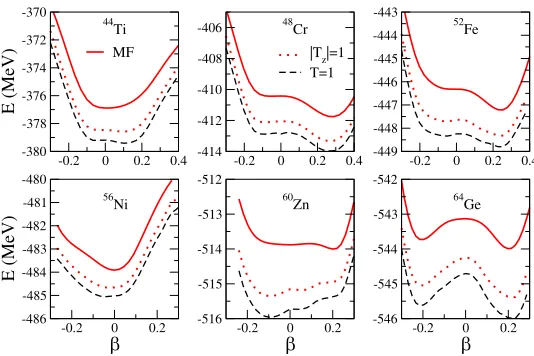
EV8 code [10, 11]. In Fig. 1 the mean-field energy for different even-even
N = Z nuclei is plotted (solid-red lines), as a function of the quadrupole
deformation parameterβ. Starting from the mean-field results, we construct
then a two-body pairing Hamiltonian written as:
H=Hs.p.+H10+H01 (1)
where Hs.p. is the independent particle contribution. H10 and H01
-0.2 0 0.2 0.4 -380 -378 -376 -374 -372 -370 E (MeV) MF
-0.2 0 0.2 0.4 -414
-412 -410 -408 -406
|Tz|=1 T=1
-0.2 0 0.2 0.4 -449 -448 -447 -446 -445 -444 -443
-0.2 0 0.2 E -486 -485 -484 -483 -482 -481 -480 E (MeV)
-0.2 0 0.2 E -516 -515 -514 -513 -512
-0.2 0 0.2 E -546 -545 -544 -543 -542 44
Ti 48Cr 52Fe
56
Ni 60Zn 64Ge
Figure 1: (Color online) Total energy as a function of the deformation parameter calculated in the mean-field (MF) approach (red-full line) is compared with different kind of SM calculations: |Tz|= 1 results (red-dotted line) where only particle like pairing is considered and T = 1 (black-dashed line) where all the components of the isovector pairing are included.
(T = 1, S = 0) and (T = 0, S = 1) channels. In our scheme, it is
pos-sible to identify pairs of time-reversed states that enters into the T = 1
channels as well as in the (T = 0, Sz = 0) channel. Due to the specific space
symmetry used in theEV8 code, the interaction matrix elements in T = 0,
Sz =±1 cannot be easily restricted to J = 0 and J = 1. For this reason,
only the Sz = 0 component is considered here. Therefore we consider the
isovector pair operators:
P1†(k) =νk†ν¯†
k P−†1(k) =π†kπ†¯k, P0†(k) = (νk†π†¯k+π†kν¯k†)/ √
2 (2)
and the isoscalar one:
D†0(k) = (νk†πk¯†−πk†νk†¯)/√2. (3)
-0.2 0 0.2 0.4 -378 -376 -374 -372 -370 E (MeV) MF Tz[x=0]
-0.2 0 0.2 0.4 -412
-410 -408 -406
Tz[x=1.0] Tz[x=1.6]
-0.2 0 0.2 0.4 -448 -447 -446 -445 -444 -443
-0.2 0 0.2 E -485 -484 -483 -482 -481 -480 E (MeV)
-0.2 0 0.2 E -515
-514 -513 -512
-0.2 0 0.2 E -545 -544 -543 -542 44
Ti 48Cr 52Fe
56
Ni 60Zn 64Ge
Figure 2: (Color online) Total energy as a function of the deformation obtained using only p-n pairing in the T=1 channel (black-dashed line,Tz[x= 0]), including also the isoscalar one with equal strength ,(thin-solid red line,Tz[x= 1]) and using the more realistic value x= 1.6 (blue dot-dashed line, Tz[x= 1.6]). The results obtained in the mean-field (MF) calculations are plotted for comparison.
• particle-like pairing: only n-n and p-p pairing are treated by
consid-ering the Hamiltonian
H = Hs.p.+
i=j,Tz=±1 V10
ij PT†z(i)PTz(j). (4)
The corresponding SM calculations will be denoted as|Tz|= 1;
• full isovector-pairing: The Hamiltonian includes the full T = 1
com-ponent
H = Hs.p.+
i=j,Tz=0,±1
Vij10PT†z(i)PTz(j) (5)
and the results will be labelled as T = 1;
competi-tion between isovector and isoscalar p-n pairing. The Hamiltonian:
H = Hs.p.+
i=j
Vij10P0†(i)P0(j)
+
i=j
Vij01D†0(i)D0(j). (6)
is employed and the corresponding calculations denoted asTz = 0.
In Fig. 1, the total energy E is shown as a function of the deformation
parameter. The results obtained in the (S = 0, T = 1) channel are shown
either including all channels or only particle like pairing. In all cases, the
results are compared with the energy landscape obtained directly fromEV8
and we see that additional correlation energy is systematically gained com-pared to the originalEV8case, due to the restoration of the particle number and isospin symmetries. In the same figure, the SM results obtained con-sidering also the p-n pairing in the T = 1 channels (black-dashed lines) are plotted. Compared with the|Tz|= 1 results (red-dotted lines), we see that the inclusion of p-n correlations provides some extra correlation energy.
In order to study the competition of the isoscalar and isovector pair-ing, we consider vis =xviv,x being a constant defining the relative weight between the isovector (viv) and isoscalar (vis) pairing strengths. In Fig. 2, the potential energy curve obtained including only isovector p-n pairing (black-dashed line), i.e. x=0, is compared with the results where isoscalar correlations also are included, for different x values. It is clear from this fig-ure that the addition of the isoscalar channel gives a gain in correlation. We also see, comparing the results withx= 1.0 andx= 1.6 that the dependence of the isoscalar correlation energy on the xvalue is rather weak.
3
Conclusions
than the isovector contribution. However, in some cases, we observed that large deformation can favor the coexistence of isoscalar and isovector p-n condensates.
Acknowledgments
D.G. acknowledges the support from the Extreme Light Infrastructure Nu-clear Physics (ELI-NP) Phase I, a project co-financed by the Romanian Government and European Union through the European Regional Develop-ment Fund.
References
[1] Macchiavelli A. O. et al. Phys. Rev.C61 (2000) 041303R
[2] O’ Leary C. D. et al. Phys. Rev.C67 (2003) 021301(R)
[3] Cederwall B.et al. 2011 Nature (London)469 (2011) 68
[4] Frauendorf S. and Macchiavelli A. O Prog. Part. Nucl. Phys.78(2014)
24
[5] Parikh J. C. Nucl. Phys. 63(1965) 214
[6] Evans J. A., Dussel G. G., Maqueda E. E., Perazzo R. P. J. Nucl. Phys.
A367(1981) 77
[7] Engel J., Pittel S., Stoitsov M., Vogel P., Dukelsky J. Phys. Rev.C55
(1997) 1781
[8] Lerma H. S., Errea B., Dukelsky J., Satula W. Phys. Rev. Lett. 99
(2007) 032501
[9] Bertsch G. F. and Luo Y. Phys. Rev.C81 (2010) 064320
[10] Bonche P., Flocard H. and Heenen P. H. Comp. Phys. Comm. 171
(2005) 49
![Figure 2: (Color online) Total energy as a function of the deformation obtainedusing only p-n pairing in the T=1 channel (black-dashed line,the more realistic value Tz[x = 0]), includingalso the isoscalar one with equal strength ,(thin-solid red line, Tz[x](https://thumb-us.123doks.com/thumbv2/123dok_us/8161637.1361735/4.482.97.361.89.267/figure-function-deformation-obtainedusing-realistic-includingalso-isoscalar-strength.webp)
