A Zero-Knowledge Proof Based on a Multivariate
Polynomial Reduction of the Graph Isomorphism
Problem
Edgar González Fernández1,3,†,*, Guillermo Morales-Luna1,†and Feliú Sagols Troncoso2,†
1 Department of Computer Science, CINVESTAV-IPN, Av. IPN 2508, Gustavo A. Madero, San Pedro
Zacatenco, 07360 Mexico City, Mexico; [email protected] (E.G.F.), [email protected] (G.M.L.)
2 Department of Mathematics, CINVESTAV-IPN, Av. IPN 2508, Gustavo A. Madero, San Pedro Zacatenco,
07360 Mexico City, Mexico; [email protected]
3 Group of Analysis, Security and Systems (GASS), Department of Software Engineering and Artificial
Intelligence (DISIA), Faculty of Computer Science and Engineering, Universidad Complutense de Madrid (UCM), Calle Profesor José García Santesmases, 9, Ciudad Universitaria, Madrid 28040, Spain;
* Correspondence: [email protected]; Tel.: +34 913 947 649 † The authors contributed equally to this work.
1
2
3
4
5
6
7
8
Abstract: Zero-Knowledge Proofs ZKP provide a reliable option to verify that a claim is true without giving detailed information other than the answer. A classical example is provided by the ZKP based in the Graph Isomorphism problem (GI), where a prover must convince the verifier that he knows an isomorphism between two isomorphic graphs without publishing the bijection. We design a novel ZKP exploiting the NP-hard problem of finding the algebraic ideal of a multivariate polynomial set, and consequently resistant to quantum computer attacks. Since this polynomial set is obtained considering instances of GI, we guarantee that the protocol is at least as secure as the GI based protocol.
Keywords: Graph Isomorphism Problem, Multivariate Polynomial System, Zero-Knowledge Proof
9
1. Introduction
10
First presented in [1] by Goldwasser, Micali and Rackoff, interactive proof systems are introduced 11
as a method that allows an entity (the prover) to prove the truth of a proposition to a second party (the 12
verifier) without releasing additional information. The parties involved interact in a challenge-response 13
process until the verifier is convinced that the prover’s claim is correct, or concludes that the claim is 14
false. This kind of proofs are commonly used in authentication and identification systems, allowing 15
an entity to prove ownership of a valid credential (ie, credit card number or password) without 16
transmitting or storing this information. 17
As for now, many of the authentication schemes used in the industry make use of protocols 18
based on PKI by means of digital certificates. A vast majority of these schemes are based on either the 19
factorization problem (RSA) or the DLP, both susceptible to quantum computer attacks. To address this 20
issue, we propose a ZKP whose security relies onMQ, known to be NP-hard, and GI, both resistant 21
against quantum computer attacks up to now. 22
Recently, suitable instances ofMQhave been used for proposing novel PKC schemes, since 23
they are considered resistant to quantum computers attacks [2], a feature that popular cryptographic 24
algorithms, such as RSA, DSA and ECDSA, do not share. Frequently, algorithms for key generation in 25
MPKC involve two major phases: 26
• Private key generation. The private key consists of a set of polynomialsF={f1, . . . ,fm}such 27
that the problem of finding a common root is easy. 28
• Public key derivation. Starting with the private key Fwe create another set of polynomials 29
F={f1, . . . ,fn}. Finding a common root of the setFmust be a computationally difficult task 30
since this set must be publicly exhibited without weakening the cryptosystem. 31
Public key is usually derived from the private key by performing compositions with affine 32
bijective transformations, sayS1,S2, by performingF=S2◦F◦S1. Consequently,S1andS2are also
33
kept secret, since they can be easily inverted, and are considered part of the private key. Many other 34
methods for public key generation are explained with detail in [3, 1.2]. 35
One of the first attempts to exploit multivariate polynomials in cryptography can be found in [4,5], 36
where a cipher system, known as theMatsumoto-Imai cryptosystem, is proposed but unfortunately 37
broken shortly after being published [6]. However, this effort set the basis for a number of other families 38
of cryptographic schemes, such as theUnbalanced Oil-Vinegar(UOV) [7], the Faugere’sHidden Field
39
Equations(HFE) [8] and theRainbowsignature schemes [9]. A list of the most promising post-quantum 40
cryptographic algorithms can be found in [10]. 41
We may distinguish cryptanalytic attacks on multivariate schemes (and in public cryptosystems 42
in general) according to two main purposes: 43
• Attacks on ciphertext, where the primary goal is to get the plaintext from the ciphertext. These 44
attacks make use of polynomial system solvers such as theBuchberger Algorithm[11] to compute 45
Groebner bases. The algorithm must be executed each time a ciphertext is gathered. 46
• Attacks to recover the private key, consisting of the private setFand the affine transformations 47
S1,S2. Example of this algorithms are: High Rank, MinRank and Separation of Oil and
48
Vinegar [12](see Section [VI.5.4]). 49
The method we define in this work produces key pairs from an associated isomorphism between 50
a pair of graphs. The public key will consist of a system of polynomial equations. The private key will 51
consist of a solution to this system. We will show that finding this solution is at least as difficult as 52
finding an isomorphism between the associated graphs. At present, the fastest algorithm for solving 53
the GI problem runs in quasi-polynomial time [13], but an authentic prover will be able to provide a 54
solution efficiently. 55
The general layout of this paper is as follows. In Section2some basic concepts as well as notation 56
necessary for the development of the zero-knowledge proof is introduced. Next, Section3is appointed 57
to the construction of the polynomial sets arising from the GI problem as a reduction exercise. The 58
construction of the ZKP will be explained in4. Finally, in Section5we exhibit evidence supporting the 59
viability of the algorithm by estimating the theoretic complexity of the polynomial set construction. 60
2. Mathematical Background
61
We recall the basic concepts needed to develop the translation from instances of the GI problem 62
in instances of theMQproblem. 63
2.1. Graphs
64
Agraphconsists of a setV={v1, . . . ,vn}, theverticesand a subsetEofV(2)={e⊂V|#e=2}, 65
theedges. The number of elements ofVandEare known as theorderand thesizeofGrespectively. 66
We say that two verticesu1,u2withu16=u2, areadjacentif they are joined by an edge. Similarly, two
67
different edgese1,e2∈Eare said to beadjacentif they are joined by a vertex. Thecomplementary graph
68
GofGis defined asG= (V0,E0)withV0=VandE0 ={vivj∈V(2)|vivj6∈E}. 69
Whenever there exist two disjoint subsetsV1,V2ofVsuch thatV1SV2=Vand every edge has
70
vertices in both setsV1andV2the graph is calledbipartite. Additionally, we sayGiscomplete bipartite
71
provided that every vertex inV1is connected to every vertex inV2and vice versa.
72
Given a pair of graphsG = (U,D)anH = (V,E)a bijectionφ:U →Vthat preserves edges
73
isomorphicand we denote itG≈H. Thus, we can define the GI problem as the task of finding one of 75
the possibly many isomorphisms betweenGandHor deciding that this bijection does not exist. 76
Finally, we define amatchingas a subsetM⊆ Ewhere no to edgese1,e2∈ Mshare a common
77
vertex. If every vertex ofGis an extreme of some edge inM, then the matching isperfect. 78
2.2. Polynomial Idelas and Algebraic Sets
79
LetFqbe the finite field ofqelements andRthe ring of polynomials innvariables overFq. An 80
idealis a subsetI ⊂ Rsuch that for every f,g ∈ Ithe sum f+g ∈ Iand for every f ∈ I,h ∈ Rthe 81
producth f ∈I. Then by considering a finite setF={f1, . . . ,fm} ⊂ Rwe can define theideal generated 82
by Fas follows 83
hFi={h1f1+. . .+hmfm|hi∈R,i=1, . . . ,m}.
It can be seen without too much effort that a common root for the polynomialsfi,i=1, . . . ,mis 84
also a root for any f ∈ hFi. Thezero-setof the idealIconsists of all the points(x1, . . . ,xn)∈Fnq such 85
that f(x1, . . . ,xn) =0 for all f ∈I, denotedVI(Fq). If we consider any algebraic extension ofFqthen 86
the zero-set is known as thealgebraic setofI. 87
We can now formalizeMQas a decision problem. Additionally, we state the related search 88
problem. 89
90
DECISION PROBLEM 91
Instance:An idealI⊂Fq[X1, . . . ,Xn] 92
Solution:
(
1 ifVI(Fq)6=∅ 0 otherwise 93
SEARCH PROBLEM 94
Instance:An idealI⊂Fq[X1, . . . ,Xn]. 95
Solution:Either a proof thatVI(Fq) =∅or a pointx∈Fnq such thatx ∈VI(Fq). 96
97
A solution of the search problem gives an immediate solution for the decision problem. If we are 98
able to find a solution for the polynomial system f1=0, . . . ,fm=0 we conclude thatVI(Fq)6=∅and 99
the value 1 is returned. On the other hand, if we can show that no solution exists then we return 0. 100
This implies that the search problem is at least as difficult as the decision problem, which is known to 101
be NP-complete. 102
We have seen that a solution of a polynomial system is also a solution for any element in 103
its generated ideal. The idea behind the most common system solvers is to provide a new set of 104
representatives (generators) of the same ideal, but with nicer properties, making it easier to find such a 105
solution. This is the case for solvers based on the problem of findingGröbner Basis. We can mention 106
improved versions of the Buchberger Algorithm, such as F4 and F5. They have been successful to 107
attack cryptographic schemes such as the HFE and the Matsumoto-Imai [14] an some variations of 108
UOV [15]. Despite this efforts, the complexity of these algorithms on random instances ofMQis fully 109
exponential [16]. 110
2.3. Zero-Knowledge Proof Systems
111
A very useful cryptographic tool to provide identification services is the zero-knowledge proofs. 112
In the most basic scenario, it consists of two parties: theverifierperforms a series of questions to the 113
prover, who has to answer correctly in each step to convince the verifier. The prover will be capable of 114
answering correctly on each trial only if he has legitimate information. 115
For this process to be implemented successfully, some characteristics are desirable. The whole 116
verification process should be computationally efficient for an authentic verifier, whereas it must be 117
permits a tricky verifier to reveal the prover’s information is gathered, though this is commonly relaxed 119
to “no statistically significant information”. Additionally, we require the following characteristics: 120
• Completeness. An authentic prover will always be accepted by an honest verifier. 121
• Soundness. If the prover is not authentic the verifier rejects with high probability. 122
This is, a verifier always accepts an authentic prover, but a malicious prover can impersonate an 123
authentic one with a very small probability. 124
3. Construction of the Polynomial System
125
We exhibit the construction of the polynomial ideal from a graph and an isomorphism between 126
them. 127
LetGandHbe two isomorphic graphs of sizeeand ordernwith vertex setsU={u1, . . . ,un} 128
andV = {v1, . . . ,vn}and edge setsDandErespectively. LetKU,V denote the complete bipartite 129
graph with bipartitionU,V. We get a perfect matchingMinKU,Vby selectinguivk,ujvlintoMif and 130
only if and only ifuiuj∈Dandvkvl ∈E. In other words: 131
(i) if uiuj is an edge in Gbutvkvl is not an edge in H, then the edgesuivk andujvl do not lie 132
simultaneously inM, 133
(ii) ifvkvl is an edge in H butuiuj is not an edge in G, then the edgesuivk andujvl do not lie 134
simultaneously inM. 135
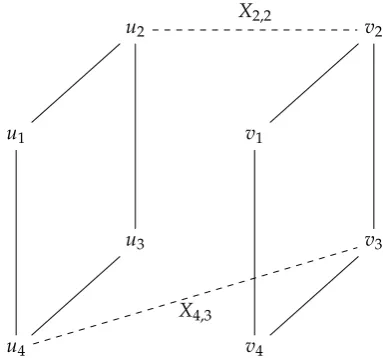
We can identify any perfect matching Mbuilt in this way with a bijectionφthat defines the isomorphism of graphs. From a set-theoretic point of view,φis treated as a collection of pairs being their first coordinate elements that belong to the domain of the function, while the second ones belong to the co-domain [17]. Conditions (i) and (ii) aforementioned constitute an alternative way to assert:
uiuj∈ D ⇐⇒ φ(ui)φ(uj)∈E. We illustrate what we just explained in figure1.
u2 v2
u1 v1
u3 v3
u4 v4
X2,2
X4,3
X4,4
(a)An isomorphism between Gand H can be seen as a perfect matching in the graphKU,V, preserving adjacencies betweenGandH.
u2 v2
u1 v1
u3 v3
u4 v4
X2,2
X4,3
(b) The edges u2v2 and u3v4 cannot belong
simultaneously toMbecauseu2u3∈D, butv2v4∈/E.
We add the equationX2,2X3,4=0 inI.
Figure 1.Process to generate the polynomials set associated to the graph isomorphism.
Now, we perform a suitable reduction from an instance of GI to an instance ofMQfollowing 137
the same ideas exposed in reductions of several other problems in graphs to Boolean quadratic 138
polynomials [18,19]. 139
First we will consider the set ofn2variables{Xi,k}fori,k =1, . . . ,n. We restrict any possible solution to the binary set{0, 1}by introducing the following polynomials:
X2i,k−Xi,kfori,k∈ {1, . . . ,n} (1) Now, the following polynomials are introduced to require that one and only one vertexvifromUis 140
connected to one vertex ofVand vice versa. This links solutions to the fact that we have a perfect 141
matching inM. 142
n
∑
j=1Xi,k−1 fori=1, . . .n (2)
n
∑
i=1Xi,k−1 forj=1, . . .n
Finally, to guarantee that the set of polynomials has a solution related to the chosen isomorphism, we introduce a third set of polynomials:
Xi,kXj,lfor anyi,j,k,lsatisfying uiuj∈ D∧vkvl ∈/E∨
uiuj∈/ D∧vkvl ∈E (3)
This completes the construction of the polynomial set related to the given GI instance. 143
4. Zero-Knowledge Protocol
144
We are ready to explain how we use the theory developed in Section 3 to perform the 145
zero-knowledge proof. 146
Let us start by generating a graphGand a random bijectionφof its vertices. We create a second
147
graphHwhich is isomorphic toGwith isomorphismφ. Now letF1be the polynomial system resulting
148
from the process of construction shown in Section3. A solutionx1for the systemF1is found by setting
149
Xi,k =1 ifuivk ∈ MandXi,k =0 otherwise. The polynomial setF1will be public and is used as the
150
public key. The private key will be the solutionx1. 151
Next, we create a second random bijectionψand the graphKisomorphic toGdefined by this
152
isomorphism. We get a chain of isomorphisms as follows: 153
G H K.
φ ψ
ψ◦φ
154
We apply the same process to generate a second setF2of polynomials and find a solution in the exact
same way as we did for the first set. We can avoid the process of graph generation by applying the permutation directly into the public system. We note that from the bijectionψ:U→Vwe can derive a permutationσψ of the set{1, . . . ,n}defined byσψ(i) =kifψ(ui) =vk. This creates a mapping of variables by sendingXi,ktoXi,σψ(k). We write the polynomials ofF2satisfying condition (3) as
Xi,σψ(k)Xj,σψ(l). (4)
A solution for the systemF2is provided by applying the permutationσψto reorderx1. A third set
155
of polynomialsF3can be obtained if we considerγ=ψ◦φ.
Authentication protocol. The following steps are performed between Alice (the prover) and Bob (the 157
verifier): 158
Key Generation: 159
• Alice picks a graph G and randomly generates a permutation of the set {1, . . . ,n}. This 160
permutation is used to create the isomorphic graphHtogether with its isomorphismψ. Then
161
the public keyF1is computed as we have established. The private key is a solution to the public
162
systemF1.
163
Authentication: 164
1. Alice generates a permutationσfor the set{1, . . . ,n}at random and computes the polynomial
165
systemF2, which is sent to Bob as acompromise.
166
2. Bob creates a challenge by selecting at randomb∈ {0, 1}. Bob sendsbto Alice. 167
3. Once Alice has receivedbshe must answer accordingly: 168
• ifb=0, she sends the solutionx2of the systemF2to Bob,
169
• ifb=1, she sendsσ.
170
4. According to the value ofbBob performs the following to authenticate Alice: 171
• ifb=0, he checks whetherx2is a solution forF2or not,
172
• ifb=1, he computes the systemF20 applyingσtoF1and checks if he obtains the systemF2.
173
4.1. Possible attacks
174
We will consider that a malicious entity (Eve) wants to play the role of Alice. Then she can try the 175
following strategy. 176
Eve flips a coin to decide which valuebwill send Bob as a challenge. If the result isb=0, then 177
she randomly generates a systemF20 with a known solution for her. Then Eve sends the systemF20
178
and waits for the challenge. If Bob selectsb=0 the Eve is able to provide an answer to the challenge. 179
Otherwise, ifb=1 she will fail to provide the permutation. Now if the result of the flip isb=1, the 180
she selects a permutation at random to transform the systemF1 intoF20. Now she will have the answer 181
for the challenge if Bob chooses to sendb=1, but she fails if this is not the case. 182
Now we suppose that Eve wants to obtain information about the secret key, so she plays the role 183
of Bob. She can try asking several times and hope that she can get the same set of polynomials twice. 184
The first time she challenges Alicia withr=0 so she can get the permutation. The second one she 185
sendsr=1 and gets the solution. Applying the inverse permutation to the solution she can get the 186
private key. However, there aren! different elements, and sincen!>2nthis strategy is not a good one, 187
since the running time will be exponential. 188
We can try to solve these problems to break the protocol with more sophisticate tools: 189
• MQ: An efficient polynomial system solver to find a solution forF1would break completely the
190
scheme by exhibiting the private key (even a different solutionx01would work). 191
• Solving the Isomorphism of Polynomials Problem (IP), which consists of finding two affine 192
transformationsS1,S2such that, for two quadratic transformationsF,F, we haveF=S2◦F◦S1.
193
In our case, the variable permutation can be regarded as a special case of IP whereS2is the
194
identity andS1a permutation matrix.
195
• Solving the GI Problem. For this approach we need to retrieve the initial isomorphic graphs from 196
the polynomial set and find an isomorphism. 197
For the time being, there is no quantum algorithm that solves efficiently any of the aforementioned 198
5. Computational complexity
200
We analyse the cost of creating the sets of polynomials, which is the main step in the key generation 201
process. For the first and second sets of polynomials given in (1) and (2) we have to consider the pairs 202
(i,k)fori,k∈ {1, . . . ,n}. The asymptotic time complexity for these isO(n2). 203
We include now the polynomials of the form (3). We need also the solution for this system, we 204
complete the construction with these steps: 205
• For every edgeuiuj ∈D, we look for every edgevkvlin the complementary graphH. We add 206
the corresponding polynomialsXi,kXj,lto the system. 207
• For every edgevkvl ∈ D, we walk over every edgevkvl in the complementG. We add the 208
corresponding polynomialsXi,kXj,lto the system. 209
• With the chosen isomorphismφ:G→Hwe create the complete bipartite graphKU,Van the 210
matchingM={uiφ(ui)|ui ∈U}. 211
These equations comprise a total number bounded byn2e, whereeis size ofG. Then we can build the 212
complete system in timeO(n2e), which is polynomial on the order ofG.
213
5.1. Toy example
214
We will show the construction of a polynomial set with a small example. Let us consider the graphG= (U,D)withU={1, 2, 3, 4},D={(1, 2),(1, 4),(2, 3),(3, 4)}and the permutation
σ= 1 2 3 4
1 3 2 4
!
By applyingσto the vertex setUwe get the isomorphic graphH={V,E}whereV =Uand
215
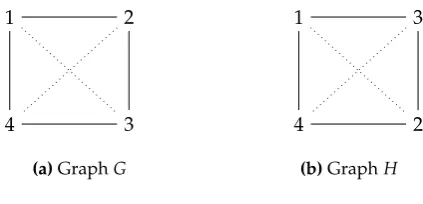
E={(1, 3),(1, 4),(2, 3),(2, 4)}. The graphsG,Hare shown in Fig.2. The dashed lines are the edges in 216
the corresponding complementary graphs. 217
1 2
4 3
(a)GraphG
1 3
4 2
(b)GraphH
Figure 2.Isomorphic graphs. Dashed lines correspond to the complementary graphs
To build the polynomial set, we start with the edges in Gand H. For instance, considering 218
(1, 2)∈Gand(3, 4)∈ H, we get the polynomialsX1,2X3,4. Once we walk over all the edges ofGin
219
this fashion, we get the polynomials 220
X1,1X2,2, X1,1X4,2, X2,1X3,2, X3,1X4,2
X1,3X2,4, X1,3X4,4, X2,3X3,4; X3,3X4,4.
Now, by considering the edgesGandH, we get another set of 8 polynomials: 221
X1,1X4,3, X1,1X4,2, X2,1X3,2, X3,1X4,2
The roots of these polynomials related to the isomorphism between these graphs can be computed 222
by lettingxi,σ(i)=1 fori=1, 2, 3, 4 and 0 in other case. Thenx1,1=x1,4=x2,3=x2,4=1 andxi,j=0 223
for the rest of the elements. 224
6. Conclusions
225
We have built an alternative zero-knowledge authentication protocol whose security relies in the 226
difficulty of solvingMQ. A solution for this set of polynomials represents an isomorphism between 227
graphs. Then we guarantee that the protocol is at least as secure as the classical ZKP based solely in 228
the GI problem. We have also shown that the construction is feasible in terms of time complexity, and 229
since only a permutation of lengthnor a binary vector of sizen2is sent in response at every step, 230
most of the information interchanged on every interaction consists of the set of polynomials, which 231
is a bit string in the order ofO(n4). We leave as a future work to verify the possibility of reducing 232
the number of polynomials in the system without weakening the proof system, as well as a complete 233
implementation of the authentication protocol. 234
Acknowledgments:The authors acknowledge the support of Mexican CONACYT. The first author has a grant 235
of Conacyt’s Scholarship Program, the last two authors have been partially supported from Conacyt’s National 236
System of Researchers. Finally, the support from ABACUS-CINVESTAV (Conacyt, EDOMEX-2011-C01-165873) is 237
gratefully acknowledged. 238
Conflicts of Interest:The authors declare no conflict of interest. 239
Abbreviations
240
The following abbreviations are used in this manuscript: 241
242
DLP Discrete Logarithm Problem DSA Digital Signature Algorithm GI Graph Isomorphism Problem
ECDSA Elliptic Curve Digital Signature Algorithm MQ Multivariate Quadratic Problem
NP Non-deterministic Polynomial Time PKI Public Key Infrastructure
PKC Public Key Cryptography
MPKC Multivariate Public Key Cryptography
RSA Rivest, Shamir and Adleman (a public key cryptographic scheme) ZKP Zero-Knowledge Proof
243
References
244
1. Goldwasser, S.; Micali, S.; Rackoff, C. The Knowledge Complexity of Interactive Proof-systems. 245
Proceedings of the Seventeenth Annual ACM Symposium on Theory of Computing, Providence, Rhode 246
Island, USA, May 6-8, 1985; ACM: New York, USA, 1985; pp. 291–304. 247
2. Sakalauskas, E. The multivariate quadratic power problem overZnis NP-complete. Inf. Tech. Control2012,
248
4, 33–39. 249
3. Ding, J.; Gower, J.E.; Schmidt, D.S.Multivariate Public Key Cryptosystems, 1 ed.; Vol. 25, Springer-Verlag: 250
Berlin, Heidelberg, 2006. 251
4. Imai, H.; Matsumoto, T. Algebraic methods for constructing asymmetric cryptosystems. Proceedings of 252
the 3rd International Conference on Applied Algebra, Algebraic Algorithms, and Error-Correcting Codes, 253
Grenoble, France, July 15-19, 1985; Springer: Berlin/Heidelberg, Germany, 1986; pp. 108–119. 254
5. Matsumoto, T.; Imai, H. Public Quadratic Polynomial-Tuples for Efficient Signature-Verification and 255
Message-Encryption. Proceedings of the Workshop on the Theory and Application of Cryptographic 256
Techniques — EUROCRYPT ’88, Davos, Switzerland, May 25–27, 1988; Springer: Berlin/Heidelberg, 257
6. Patarin, J. Cryptanalysis of the Matsumoto and Imai public key scheme of Eurocrypt’88. Proceedings of 259
the 37th Annual International Cryptology Conference — CRYPTO 1995, Santa Barbara, CA, USA, August 260
27-31, 1995; Springer: Berlin/Heidelberg, Germany, 1995; pp. 248–261. 261
7. Kipnis, A.; Patarin, J.; Goubin, L. Unbalanced Oil and Vinegar Signature Schemes. Proceedings of the 262
International Conference on the Theory and Application of Cryptographic Techniques — EUROCRYPT 263
’99, Prague, Czech Republic, May 2-May 6, 1999; Springer: Berlin/Heidelberg, Germany, 1999; pp. 206–222. 264
8. Patarin, J. Hidden Fields Equations (HFE) and Isomorphisms of Polynomials (IP): Two New Families of 265
Asymmetric Algorithms. Proceedings of the International Conference on the Theory and Application 266
of Cryptographic Techniques — EUROCRYPT ’96, Saragossa, Spain, May 12–16, 1996; Springer: 267
Berlin/Heidelberg, Germany, 1996; pp. 33–48. 268
9. Ding, J.; Schmidt, D. Rainbow, a New Multivariable Polynomial Signature Scheme. Proceedings of the 269
Third International Conference on Applied Cryptography and Network Security, New York, NY, USA, 270
June 7-10, 2005; Springer: Berlin/Heidelberg, Germany, 2005; pp. 164–175. 271
10. NIST News Service. Candidate Quantum-Resistant Cryptographic Algorithms Publicly Available, 272
December 28, 2017. https://www.nist.gov/news-events/news/2017/12/candidate-quantum-resistant-273
cryptographic-algorithms-publicly-available. 274
11. Buchberger, B., An Algorithmic Criterion for the Solvability of a System of Algebraic Equations. InGröbner
275
Bases and Applications; Number 251 in London Math. Soc. Lecture Note Ser., Cambridge University Press: 276
Cambridge, UK, 1998; pp. 535–545. 277
12. Bernstein, D.J.; Buchmann, J.; Dahmen, E.Post-Quantum Cryptography, 1 ed.; Springer: Berlin/Heidelberg, 278
Germany, 2009. 279
13. Babai, L. Graph isomorphism in quasipolynomial time. Available online:http://arxiv.org/abs/1512.03547, 280
2015,[1512.03547]. 281
14. Faugère, J.C.; Joux, A. Algebraic cryptanalysis of Hidden Field Equations (HFE) using Gröbner bases. 282
Proceedings of the 23rd Annual International Cryptology Conference — CRYPTO 2003, Santa Barbara, CA, 283
USA, August 17-21, 2003; Springer: Berlin/Heidelberg, Germany, 2003; pp. 44–60. 284
15. Braeken, A.; Wolf, C.; Preneel, B. A Study of the Security of Unbalanced Oil and Vinegar Signature Schemes. 285
Proceedings of the Cryptographers’ Track at the RSA Conference 2005 — CT-RSA 2005, San Francisco, CA, 286
USA, February 14-18, 2005; Springer: Berlin/Heidelberg, Germany, 2005; pp. 29–43. 287
16. Bard, G.Algebraic Cryptanalysis, 1 ed.; Springer: Berlin/Heidelberg, 2009. 288
17. Moschovakis, Y.Notes on Set Theory; Undergrad. Texts Math., Springer-Verlag: New York, USA, 2005. 289
18. Goldreich, O.Computational Complexity: A Conceptual Perspective; Cambridge University Press: Cambridge, 290
UK, 2008. 291
19. Nemhauser, G.L.; Wolsey, L.A.Integer and Combinatorial Optimization; Wiley-Interscience: New York, NY, 292