International Journal of Asian Social Science, 2014, 4(2): 177-186
† Corresponding author
ISSN(e): 2224-4441/ISSN(p): 2226-5139 177
ASSESSMENT OF BEEE AND BEPE PROGRAM AS PART OF CONTINUAL
QUALITY IMPROVEMENT
Farah Hani Nordin
†Center for Engineering Education, Campus Putrajaya, Jalan IKRAM-UNITEN, Kajang, Selangor
Ungku Anisa Ungku Amirulddin
Center for Engineering Education, Campus Putrajaya, Jalan IKRAM-UNITEN, Kajang, Selangor
Fazrena Azlee Hamid
Center for Engineering Education, Campus Putrajaya, Jalan IKRAM-UNITEN, Kajang, Selangor
Azrul Mohd Ariffin
Center for Engineering Education, Campus Putrajaya, Jalan IKRAM-UNITEN, Kajang, Selangor
Chau Chien Fat
Center for Engineering Education, Campus Putrajaya, Jalan IKRAM-UNITEN, Kajang, Selan
ABSTRACT
Continual Quality Improvement (CQI) involves analyzing the Program Educational Objectives
(PEO) and Program Outcomes (PO) which helps an academic institution to reflect on the quality
of the programs offered where recommendations for improvements can be made. As part of the
CQI process, this paper presents the attainments and feedbacks on the PEO and PO for the
Bachelor of Electrical and Electronics Engineering (BEEE) and Bachelor of Electrical Power
Engineering (BEPE) which are obtained through a Stakeholders Survey form. The results show
that most of the objectives are attained and most of the stakeholders agree with the objective
statements.
© 2014 AESS Publications. All Rights Reserved.
Keywords:
Stakeholders survey, Programme educational objectives (PEO), Programme outcomes (PO), Continual quality improvement (CQI), Outcome Based Education (OBE), performance criteria.1.
INTRODUCTION
Traditionally, educational programs run in largely an “open-loop” fashion where feedback from students is minimal and generally “too late” while feedback about students especially how
International Journal of Asian Social Science
ISSN(e): 2224-4441/ISSN(p): 2226-5139
Special Issue:
International Conference on Teaching and
Learning in Education, 2013
178 well they integrate knowledge is virtually nonexistent (William et al., 2000). This “open loop”
fashion affects the quality of the graduates produced and eventually the quality of the program is at stake (William et al., 2000). In universities, this may be the effect of the academicians whom besides teaching must also be able to incorporate other three fundamental areas of activities: research, training of professionals and management of their own services (Plaza and Medrano,
2007). Similar fundamentals are also being practiced in the College of Engineering (COE),
Universiti Tenaga Nasional (UNITEN), where the academicians must be able to juggle the four fundamental activities: research and publication, teaching and supervision, academic recognition and leadership and services to university and community. Thus, maintaining the quality of the educational program delivered while performing the four fundamental activities is challenging.
In order to run away from the traditional educational program, Outcome Based Education (OBE) was implemented by the COE in 2006 with the purpose of strategizing the engineering programs to achieve specific goals or objectives. The goals and objectives must be clear and measurable statements of learning outcomes that serve as the foundation to assess the effectiveness of the teaching and learning process (Nadia Rifaat et al., 2012). Program Educational Objectives (PEO) are the goals specified at program level based on the vision and mission set by an academic institution. The PEO attainments are evaluated through the graduates‟ performance after a few years of graduation. Based on the PEO statements, the Program Outcomes (PO) are defined which should describe the attributes that the students are expected to accomplish upon completing the program. On the other hand, the Course Outcomes (CO) is defined at course level which should describe what students are expected to learn from an individual course (Hashim and Din, 2009). The CO is designed based on the PO assigned for each course. For instance, the department has identified the PO that must be covered by each course of the BEEE program. The BEEE lecturers for each course then define the CO which is mapped to the assigned PO. The students‟ achievements are assessed according to the CO which is a direct measurement of the PO. From the mappings, it shows that OBE provides a link between the students and the curriculum where their performances indicate the recommended steps that should be taken in order to improve the program curriculum (Mansor et al., 2008).
By strategizing and setting out the program objectives, it does not only allow the lecturers to design more accurate teaching materials and assessments based on learning outcomes (Chan et al.,
2007) but also indirectly OBE helps an academic institution to offer a unique degree program. For
example, two academic institutions can offer the same principles or fundamentals for BEEE but the uniqueness of the program lies on the program objectives which eventually help an academic institution for branding and marketing purposes.
179 This paper presents the attainments and the feedbacks on the PEO and PO for the BEEE and BEPE which are obtained through a Stakeholders Survey form sent to the stakeholders in the academic year 2011/2012.Section 2 describes the Stakeholders Survey form. In Section 3 the results and analysis are presented. Section 4 gives suggestions on how to further improve the process of collecting the survey data while Section 5 concludes the paper.
2.
STAKEHOLDERS SURVEY FORM
Stakeholders Survey 2011/2012 was conducted as part of the departmental CQI effort to assess the achievements of the PEO and PO. Since the respondent of the form might be alumni and at the same time act as an employer/supervisor to alumni, a general survey form was created which allow stakeholders to not only evaluate the graduates‟ performance at their workplace but also evaluate themselves if they are alumni. The form also allows the stakeholders to comment on the PEO and PO statements. In short, the objectives of the BEEE/BEPE Stakeholders Survey are: (i) to rate the importance of the PEO and PO statements and (ii) to evaluate the PEO and PO attainments of BEEE and BEPE graduates.
The stakeholders were asked to evaluate the importance of the PEO and PO statements to acknowledge the Electronics and Communication (EC) Engineering and Electrical Power (EP) Engineering Departments whether the objectives and outcomes set for the BEEE and BEPE programs are sufficient in preparing the students to be a competent engineer for professional life after graduation. The evaluation of the PEO attainments is to gauge the graduates‟ performance a few years after graduation while the evaluation of the PO acts as an indirect measurement in evaluating the graduates‟ attainment upon graduation. Unlike PO where the outcomes can be measured directly through the students‟ performance from the courses taken, PEO does not have a direct measurement. Instead, the statements are made measurable through the criteria set as shown in Table 1 and the survey form was designed to accommodate these criteria.
Table-1. Programme Educational Objectives (PEO) Performance Criteria PEO Program Educational Objectives (PEO)
UNITEN produces engineering graduates who:
Performance Criteria
PEO1 Are practicing engineers in electrical engineering with the ability to venture into other related fields.
80% electrical engineers
PEO2 Hold senior engineering positions. 30% senior engineers 1% entrepreneur in
engineering or related areas PEO3 Have professional qualifications/ certifications in
electrical engineering related areas.
10% professional engineers 60% registered in
professional bodies PEO4 Are actively engaged in electrical engineering activities,
in specialized areas such as electronics design, communications, control and instrumentation, power generation, power transmission and power distribution.
60% work in specialized areas such as electronics design, communications, control and instrumentation, power generation, power transmission and power distribution.
180 information which also serves to directly evaluate the PEO based on the performance criteria set (iii) PEO: the respondents need to rate from 0 to 5 (0=not relevant while 5=strongly agree) on the importance of the PEO statements and also rate the PEO attainments of the alumni, and (iv) PO: the respondents need to rate from 0 to 5(0=not relevant while 5=strongly agree) on the importance of the PO statements and also rate the PO attainments of the alumni. At the end of the survey form, the respondents can also give suggestions by adding, changing or modifying the PEO and PO statements. There are eleven PO for BEEE and BEPE programs, as shown in the following table
Table-2. BEEE and BEPE Programme Outcomes (PO)
PO Program Outcomes (PO)
Students graduating from the Bachelor of Electrical & Electronics Engineering and Bachelor of Electrical Power Engineering programs will have the ability to :
PO1 Acquire and understand fundamental knowledge of mathematics, science and electrical engineering principles.
PO2 Apply engineering principles in solving problems relevant to electrical engineering. PO3 Analyze electrical engineering related problems.
PO4 Apply critical thinking in designing and evaluating components, processes and systems related to electrical engineering.
PO5 Comprehend the principles of sustainable development. PO6 Comprehend professional and ethical responsibilities.
PO7 Apply engineering tools and techniques to conduct engineering design/experiments as well as to analyze data.
PO8 Communicate effectively.
PO9 Function effectively as a team member as well as a leader.
PO10 Appreciate the social, cultural, global and environmental responsibilities of a professional engineer with awareness of contemporary issues.
PO11 Acknowledge the need for, and be able to engage in life-long learning.
The survey form is interactive and user friendly designed with the intention to collect as many respondents as possible. The survey was sent through emails to the industries where the respondents only need to fill and click where applicable the soft copy of the survey before clicking the „Submit‟ button for an auto reply to be sent to the department‟s Alumni Survey Committee. Even though a lot of effort was put by the department in distributing the survey form, only 77 stakeholders responded which includes 21 respondents whom are alumni or supervising alumni. For a continuous improvement, it is hoped that the survey form can be distributed at university level so that more response can be obtained and the results are justified.
3.
STAKEHOLDERS SURVEY RESULTS
This section presents the results of the Stakeholders Survey for the academic year 2011/2012 for the BEEE and BEPE programs at UNITEN. The analysis of the results is divided into two sections: (i) importance of the PEO and PO statements and (ii) PEO and PO attainments.
3.1. Importance of the PEO and PO Statements
181 can be concluded that the BEEE and BEPE programs are producing graduates with skills relevant to the needs of the stakeholders in general and in particular to the industries.
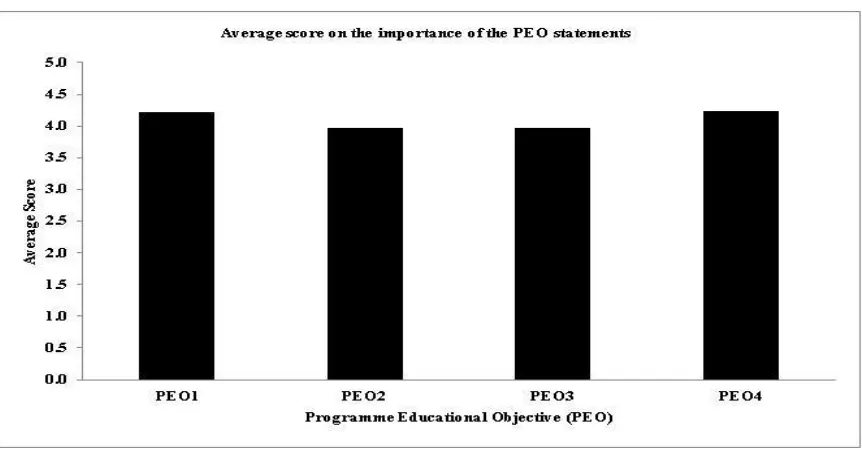
Figure 1 shows the current PEO statements are thought to be somewhat important and relevant by the stakeholders because all of the PEO obtain an average score above 3.00. From the response, it was suggested that the statement of PEO 1 should include „project management‟ as one of the skills that a graduate should have. However, after some discussion that was held during Annual Program Review 2012, the skills of managing a project also include the ability to venture into other fields which is already mentioned in PEO 1. One respondent also suggested including specialist position in PEO 2. However, the specialist position can also be regarded as senior engineering position and the data can be captured from the survey form under the Alumni Profile section. Another respondent suggested replacing the term „Senior Engineering position‟ in the PEO 2 statement with „Person in Charge/Hold Engineering Responsibility‟. This idea seems relevant since many of the alumni are already senior in their responsibility. However, due to the structure of the organization the post of Senior Engineer may be limited. This idea is forwarded to the college level for further discussion.
Figure-1. Average score of the importance of the PEO statements by stakeholders
182 Figure-2. Average score of the importance of the PO statements by stakeholders.
It is worth to note the objectives are only reviewed every four years and will only be changed if there is a need to. Thus, even though the suggestions are recorded and brought to the college level, it is expected that the suggestions will not be implemented immediately. This is necessary to make sure that the students from one cohort do not go through many changes in program objectives while studying the engineering program. By setting up the four years‟ time frame in reviewing the PEO and PO statements, it is hoped that the evaluation of the program is consistent and valid.
3.2. PEO Attainments
The BEEE and BEPE graduates are evaluated by the stakeholders based on the PEO and PO statements. Referring to Table 1, the performance criteria set for PEO 1 is that at least 80% of the alumni are expected to work as electrical engineers. Figure 3 shows that 95.24% of the alumni are practicing as electrical engineer and only 4.76% are not. The 4.76% is presented by one graduate whom is working in an oil and gas company as a project manager.
183 Two performance criteria are set for PEO 2: (i) at least 30% of the graduates are expected to be senior engineer and (ii) at least 1% of the graduates are expected to become an entrepreneur in an engineering related field. Figure 4 indicates that 40.86% of the alumni are holding position/post/responsibilities equivalent to senior engineer which is 10.86% above the target set. However, the second criterion for PEO 2 is not met since none of the alumni is an entrepreneur. The department has been made aware of the results and attention will be given to the next cycle of the survey evaluation. If the pattern is consistent then the courses which are mapped to the respective PO and indirectly the respective PEO will be observed.
Figure-4. Percentage of alumni position/post/responsibility
184 Figure-5. Attainments of PEO 3 (a) Percentage of alumni registered as professional engineers (b) Percentage of alumni registered with professional bodies
The performance target for PEO 4 is set for at least 60% of the graduates are working in specialized engineering fields. Figure 6 shows that all of the respondents are working in a specialized area where 14.29% are specialized in electronics design and communications, 4.76% are specialized in control and instrumentation, 9.52% are specialized in power generation and transmission, 33.33% are specialized in power distribution while the other 14.29% are specialized in other fields such as substation construction and automation, illumination engineering and upstream oil and gas.
Figure-6. Percentage of alumni engaged in electrical engineering fields
3.3. PO Attainments
185 are still above the target score, it indicates that these POs need to be highlighted to the current students.
Figure-7. Average score of PO attainments
4.
SUGGESTIONS AND RECOMMENDATIONS
As a continuous effort in improving the CQI process for PEO and PO attainments, it is suggested that the Stakeholders Survey form is made to be a standardized survey form that is used throughout the departments under the College of Engineering. By standardizing the form, it will increase the efficiency in terms of data management and collection. It is also suggested to request for alumni data from the UNITEN Alumni, Career and Sponsorship Centre (ARC) so that the form can be distributed to more alumni.
5.
CONCLUSION
Most of the outcomes of the BEEE/BEPE Stakeholders Survey 2011/2012 show positive results except for PEO 2 (criteria No. 2) and PEO 3. Even though the sample is not large enough to give the overall assessment of the BEEE and BEPE graduates, further observations will be done especially on the attainment of PEO 3 in the next cycle of survey report.
REFERENCES
Chan, M., F.Y. Mong and F.K.H. Chan, 2007. Towards a computer-based supporting infrastructure for
outcome-based education in advanced learning technologies, 2007. ICALT 2007. Seventh IEEE
International Conference on. IEEE. pp: 801-803.
Hashim, R. and M.M. Din, 2009. Implementing outcomes based education using project based learning at
University of Malaya. European Journal of Scientific Research, EuroJournals Publishing, Inc, 26(1):
80-86.
Mansor, W., H. Hashim, S.C. Abdullah, M.U. Kamaluddin, M. Latip, A. Yassin, T. Rahman, Z. Zakaria and
M.M. Kamal, 2008. Preliminary results on the implementation of outcome-based education on the
non-examinable computer engineering modules. In Frontiers in Education Conference, 2008. FIE
186 Nadia Rifaat, W.M.A.S., B.A. Oualid and M. Nour, 2012. Effective learning outcomes assessment: The case
of the MIS department at the UOS. Journal of Education and Vocational Research, 3(2): 58–70.
Plaza, I. and C.T. Medrano, 2007. Continuous improvement in electronic engineering education. IEEE
Transactions on Education, 50(3): 259–265.
William, E.D., V.K. George, J.E. Louis and R.A. Volz, 2000. Performance theory based outcome
measurement in engineering education and training. IEEE Transactions on Education, 43(2): 92–99.