University of South Carolina
Scholar Commons
Theses and Dissertations
2016
Exploratory Analysis Of PTSD Severity And
Objective Measures Of Physical Activity Among
Combat Veterans
Danny O. Sauceda
University of South Carolina
Follow this and additional works at:https://scholarcommons.sc.edu/etd
Part of theExercise Science Commons
This Open Access Thesis is brought to you by Scholar Commons. It has been accepted for inclusion in Theses and Dissertations by an authorized administrator of Scholar Commons. For more information, please [email protected].
Recommended Citation
E
XPLORATORYA
NALYSISO
FPTSD
S
EVERITYA
NDO
BJECTIVEM
EASURESO
FP
HYSICALA
CTIVITYA
MONGC
OMBATV
ETERANSby
Danny O. Sauceda
Bachelor of Science Stetson University, 2013
Submitted in Partial Fulfillment of the Requirements
For the Degree of Master of Science in
Exercise Science
Norman J. Arnold School of Public Health
University of South Carolina
2016
Accepted by:
Roger Newman-Norlund, Director of Thesis
Jack P. Ginsberg, Reader
Troy Herter, Reader
D
EDICATIONTo my parents for doing more than enough to prepare me for a lifetime of
A
CKNOWLEDGMENTSI would first like to thank the Department of Exercise Science here at the
University of South Carolina for their unwavering support throughout this process. I
would like to sincerely thank the members of my thesis committee; Dr. Roger
Newman-Norlund, Dr. Jack Ginsberg, and Dr. Troy Herter, for taking interest in my ideas and
volunteering their time and expertise to help me become a better researcher. Roger, your
enthusiasm, spontaneity and sense of purpose helped me pursue challenges I encountered
during this study. I am better for it and give many thanks. Dr. Ginsberg, thank you for
keeping me on track. Each day I walked out of your office I was inspired, not only by the
Einstein quotes on your walls but, by the confidence you had in me. Thank you Dr.
Herter for providing much needed guidance and having my back during this long process.
I would also like to thank Dr. Steven Blair, Dr. Clemens Drenowatz, Leanna Ross and
Sarah Schumacher for their generosity in providing activity monitors. Without these
treasured items, this study would not have been possible. Thank you Clemens for the
impromptu meetings and analytical support. I would also like to thank the following
organizations for their hand in facilitating the recruitment process and taking interest in
this initiative: William Jennings Bryan Dorn VA Medical Center, DAV 92nd Buffalo
Chapter 20, SC National Guard, Navy-Marine Corps Relief Society, USC Student
Veteran Association, and Experiment.com. To all my friends, thank you for
A
BSTRACTStrong levels of motivation, relatedness and self-determination support the
likeliness of participating in habitual exercise. Compared to nationwide estimates,
research has demonstrated fitness and performance is significantly lower among those
suffering from PTSD. Meeting established recommended daily levels of physical activity
(PA) for individuals with PTSD is critical for their physical and mental health status over
a lifetime and factors supporting or hindering adherence to habitual exercise are lacking.
Furthermore, regular PA among combat Veterans with Posttraumatic Stress Disorder
(PTSD) is a viable and substantial treatment option to improve physical health status and
cognitive well-being. The purpose of this exploratory analysis was to uncover
relationships between objectively measured PA and the severity of PTSD symptomology,
as established by DSM-V, among trauma-exposed combat Veterans. Methods: PA
among a group of combat Veterans (n=10) was monitored for a period of 7-days
concurrent to inventories of symptom severity, motives for participation in PA and
posttraumatic growth (PTG). Results: Subjects reporting greater symptom severity and
currently taking medication demonstrated inferior outcome results versus their
counterparts. Conclusion: This was the first study, to our knowledge, to objectively
explore PA among Veterans with PTSD. Mixed results suggest moderation of PTG and
motives for PA on outcomes for those with PTSD. Activity monitoring in outpatient
P
REFACESince the power to create resides in each and everyone one of us, maybe focus
should be directed toward individuals who persevere in their creativity despite the
numerous barriers we encounter in society. This would give us a better understanding of
resilient behavior and allow us to expedite progress and change we need to see in people,
T
ABLE OFC
ONTENTSDEDICATION ... iii
ACKNOWLEDGEMENTS ... iv
ABSTRACT ... v
PREFACE ... vi
LIST OF TABLES ... viii
LIST OF FIGURES ... ix
CHAPTER 1:INTRODUCTION AND AIMS ... 1
CHAPTER 2:REVIEW OF LITERATURE ... 2
2.1PTSD,SYMPTOMOLOGY AND EXERCISE ... 2
2.2DETERMINANTS OF EXERCISE MAINTENANCE ... 4
2.3OBJECTIVE MEASUREMENT OF PHYSICAL ACTIVITY ... 6
CHAPTER 3:EXPLORATORY ANALYSIS OF PTSDSEVERITY AND OBJECTIVE MEASURES OF PHYSICAL ACTIVITY AMONG COMBAT VETERANS ... 8
3.1RESEARCH QUESTION ... 8
3.2RESEARCH STRATEGY ... 9
3.3RESULTS ... 14
3.4DISCUSSION ... 23
L
IST OFT
ABLESTABLE 3.1PARTICIPANT CHARACTERISTICS ... 15
TABLE 3.2AVERAGE DAILY PHYSICAL ACTIVITY USING THE SWAUNDER FREE-LIVING
CONDITIONS ... 15
TABLE 3.3PEARSON PRODUCT-MOMENT CORRELATIONS OF SELF-RATED PA,PALMS
AND MEASURES OF SWAACTIVITY ... 17
TABLE 3.4PEARSON PRODUCT-MOMENT CORRELATIONS AND FIRST-ORDER PARTIAL
CORRELATIONS OF PCL-5SEVERITY AND SWAACTIVITY ... 19
TABLE 3.5DESCRIPTIVE STATISTICS AMONG PARTICIPANTS STRATIFIED BY SYMPTOMS
SEVERITY AND MEDICATION STATUS ... 20
TABLE 3.6PEARSON PRODUCT-MOMENT CORRELATIONS OF POSTTRAUMATIC GROWTH
L
IST OFF
IGURESFIGURE 3.1DAILY MVPA,PTSDSEVERITY AND MEDICATION STATUS ... 22
FIGURE 3.2DAILY STEP COUNT,PTSDSEVERITY AND MEDICATION STATUS ... 22
C
HAPTER1
I
NTRODUCTION ANDA
IMSThe National Comorbidity Survey estimates approximately 7% of Americans can
expected to experience at least one traumatic event during a lifespan, roughly 8 million of
which will develop a heterogeneous condition known as PTSD [1]. The highest rates of
PTSD are seen among women and are increasingly observed at higher rates among
military service members due to combat exposure with estimates greater among Vietnam
Veterans. The Diagnostic and Statistical Manual for Mental Disorders-fifth edition
(DSM-V) has set forth the distinct addition of cluster symptoms that allows this proposed
study to also satisfy calls for research into specific behavioral criteria of a four-cluster
model of PTSD and determinants of long-term exercise maintenance [2]. Now considered
a growing epidemic, recent evidence supports a heritable component of trauma-exposure
demonstrating the complexity of PTSD [3,4]. Illuminating relationships between symptoms
of PTSD and regular PA may support theories implicating heterogeneous psychiatric
conditions and mood disturbances as challenges that negatively impact regular PA [5,6].
Therefore, this study aimed for the following: 1) To collect objective and meaningful
data concurrent to PTSD symptomology, as outlined by the DSM-V, among outpatient
trauma-exposed combat Veterans, 2) To identify potential determinants of long-term
maintenance of exercise or inactivity among this high interest population, and 3) To
develop and apply reproducible practices for objectively assessing PA among populations
C
HAPTER2
R
EVIEW OFL
ITERATURE2.1
P
TSD,
S
YMPTOMOLOGY ANDE
XERCISEThe current Diagnostic and Statistical Manual of Mental Disorders (DSM-V)
recognizes PTSD by four clusters of symptoms that adversely disrupt important areas of
function due to a previous physical or psychological exposure to trauma or series of
traumatic experiences. The four clusters include avoidance, persistence of negative
moods and distorted cognitions, re-experiencing, and arousal symptomology, which
distinguish key psychological and physiological behaviors exhibited by individuals with
PTSD [7]. These behaviors guide interest to the neurobiological disruptions associated
with fear circuitry, abnormal associative learning and maladaptive stress responses.
Avoidance is a behavior in which people, places, conversations feelings or thoughts
associated with a traumatic event is avoided. Persistent and distorted cognitions and
negative emotions encompass symptoms related to diminished motivated behavior,
exaggerated negative self-expectations or significant disinterest in activities such as
social interaction. The arousal cluster of symptoms seeks aggressive or self-destructive
behaviors, hyper-vigilance and sleep disturbances. Intrusions refer to the persistent and
disruptive events that are specifically related to the exposure of the trauma.
Re-experiencing also support sleep disturbances through distressing and recurrent dreams.
Flashbacks, imagery, thoughts and/or perceptions are common and can be associated with
The clusters of symptomology identified in PTSD characterize maladaptive
neurobiology, still largely unknown, that involve learning, extinction, levels of arousal
and marked sensitization of the hypothalamic-pituitary axis in response to stressors [11].
These symptoms also identify areas that are subject to highly favorable adaptations with
regular exercise among healthy and clinical populations [12,13,14] but are scarce among
individuals with PTSD. The generalizability of findings demonstrating exercise as a
viable treatment for PTSD have limitations, primarily due to variance among sample
populations studied (i.e., inpatient, mostly women, trauma type) [15,16,17]. Those who
suffer from PTSD are characterized as having poor health status and do not participate in
sufficient levels of PA [16, 17, 18] but exercise does bring about reductions in PTSD and
depressive symptomology [19]. Reductions in PTSD and depressive symptoms, in addition
to health benefits associated with acute bouts of exercise, are short-lived and have been
seen to reescalate in severity with physical inactivity [15, 19].
Regular exercise can be characterized as engaging in volitional and habitual PA
for at least 30-minutes a day, 5-days a week equal to or above 3.3 METS of energy
expenditure [20]. Furthermore, a period greater than six months is the final criteria that
constitute an individual as achieving long-term exercise maintenance status so long as
they remain in this phase [21]. Anything short of this timeframe is considered to be the
initiation of habitual exercise and therefore not the primary challenge the U.S. has seen
regarding lifestyle behavior or adherence to exercise interventions [22]. For consistency
purposes, the term regular exercise will be align with criteria defined by the American
College of Sports Medicine (ACSM) as well as the 2008 Physical Activity Guidelines
cardiorespiratory fitness with exercise prescription, the ASCM provides specific guidance
on best practices for developing programs, framed by effective methods and theoretical
models of behavior to facilitate adherence to exercise programs [23, 24,25]. To further
support these evidence-based guidelines, the multi-organizational initiative headed by the
ACSM, Exercise is Medicine (EIM), actively encourages and supports policy and
programs that reduce physical inactivity and sedentary behavior [26]. Despite the wealth of
new knowledge and persistent efforts to increase nationwide PA levels, more than half of
adults in the U.S. still do not meet recommendations for adequate levels PA [19, 27, 28].
Regular exercise remains an unequivocal form of preventative and rehabilitative
treatment that greatly reduces the development of risks tied to metabolic syndrome,
cardiovascular disease, cancer and cognitive decline and should be objectively quantified
[29, 30, 31]. Thus, illuminating the relationship between PTSD symptomology and regular
PA could provide value for interventions that support exercise adoption and maintenance.
2.2
D
ETERMINANTS OFE
XERCISEM
AINTENANCEExercise programs not only assess an individual’s motivations and current life
circumstances but also aim to address key determinants of exercise adoption and
maintenance (e.g., social/environmental relatedness or support, efficacy and
self-monitoring) [32, 33]. Individualized theory-based cognitive-behavioral interventions are
used to support such determinants in order to enhance adoption, but most importantly,
adherence to long-term volitional exercise that meets recommended levels as described
above. One of several commonly used approaches for exercise adoption and adherence is
Social Cognitive Theory (SCT). This model equally monitors the individual, their habits
appreciation for these factors generally motivates intentions, driving the energy for
action, thereby directing an individual’s future behavior. Although an individual’s
intrinsic motivation can encourage regular exercise habits, this alone is not sustainable.
Self-regulatory strategies become essential for exercise adoption and maintenance
therefore requiring an individual to regularly display skills like planning and organizing,
while maintaining autonomy [35, 36, 37].
Central to several applied theories of behavior, is self-efficacy, which is
considered to be one of the strongest predictors of adopting and maintaining regular
exercise. Self-efficacy describes an individual’s belief in his or her own capacity to reach
a desired goal. Lacking self-efficacy contributes to stress, increases in physical and
emotional arousal as well as depression [38]. People with greater exercise self-efficacy are
most likely to engage in regular exercise, largely by the use of self-regulatory strategies
such as goal setting, self-monitoring, and problem solving to enhance motivation [39].
Those who can maintain a high level of self-efficacy are likely to be more resilient to
obstacles or inexperience allowing them to persevere on to a lifestyle that includes
regular exercise [34, 40]. Therefore, characterizing cognitive-behaviors that influence these
well-established determinants of long-term exercise maintenance may offer predictive
value for favorable changes to self-regulatory strategies, health behaviors and beliefs to
improve the likelihood of long-term volitional exercise.
Additionally, an individual’s beliefs regarding the benefits of avoiding exercising
or their susceptibility to illness are fundamental to a theory known as the Health Belief
Model [41]. These beliefs are suggested to provide some insight into a person’s readiness
lack of social support and social isolation can be detrimental to long-term exercise
maintenance [42, 43]. The risk of injury or worsening of current co-morbid conditions is
also a significant belief, not only influencing self-efficacy but also diminishing
autonomy. Habitual exercise can be seen among those with prior experience or within
structured or supervised programs utilizing reinforcers or incentives [44]. Competency,
social support and autonomy are significant theory-based components that emphasize a
person’s psychosocial needs, which ultimately favors exercise adoption and maintenance.
Studies continue to define the complexity of barriers attributed to exercise adherence,
most of which undermine key determinants of long-term exercise adherence [36, 45, 46].
2.3
O
BJECTIVEM
EASUREMENT OFP
HYSICALA
CTIVITYOne study has evaluated the use of accelerometers among participants with PTSD
in an attempt to validate assessments of PA in this population. Findings suggest
measuring levels of PA among inpatient trauma-exposed adults may be impractical due to
poor compliance, citing incomplete data, dropouts and erroneously high levels of activity
[17]. A recent finding has shown that cardiorespiratory fitness is a confounder when
estimating PA levels [47]. The use of a wearable monitor yields better results for unfit
groups because they tend to overestimate PA levels using the international physical
activity questionnaire (IPAQ) in comparison to fit participants. Furthermore, health
promotion efforts suggest walking cadence can lead to positive health outcomes but it is
unclear whether achieving this discrete criterion is critical for reducing mortality[48].
Along with this, a significant oversight in estimating PA of varying intensities in healthy
middle-aged to older adults may be attributed to initialization of actigraphy monitors to
that are better suited for sedentary or inactive populations [49]. Previous literature
indicates the SenseWear armband provides more accurate estimates of total daily energy
expenditure (TDEE), light and moderate intensities as compared to other activity
monitors [31]. Lastly, it is unclear how best practices for activity monitoring have been
applied with this sample population, therefore special attention to these guidelines was
C
HAPTER3
E
XPLORATORYA
NALYSISO
FPTSD
S
EVERITYA
NDO
BJECTIVEM
EASURESO
FP
HYSICALA
CTIVITYA
MONGC
OMBATV
ETERANS3.1
R
ESEARCHQ
UESTIONThe goal of this study was to examine associations between objective measures of
PA and PTSD symptomology among outpatient trauma-exposed combat Veterans, as
outlined by the DSM-V. Given the lack of research on correlates of PA and PTSD
severity, this pilot study aimed to serve as a platform for further investigation into the
behavior and underlying motives for exercise adherence or contradictory lifestyle
behaviors. The second goal was to demonstrate feasibility of activity monitoring among
those with PTSD. This study anticipated the advancement of three areas of interest
surrounding mental illness and adherence to long-term exercise: 1) The collection of
objective and meaningful data concurrent to symptom severity among a high interest
population. 2) The identification and evaluation of potential correlates of long-term
maintenance of exercise or inactivity among trauma-exposed combat Veterans. 3) The
development and application of reproducible practices for objectively assessing PA
among populations with psychiatric distress or illness. Each variable resides in 1 of 3
descriptive categories: criterion for PTSD (qualitative), predictors of symptom severity
(quantitative) and moderators (qualitative) that influence PA levels (i.e., posttraumatic
inversely related to most outcomes (e.g., step count, MVPA, sleep duration) in
accordance with multiple prior studies [16, 19, 50]. MVPA among this sample was
anticipated to be lower than healthy adult populations based on prior results regarding
anxiety disorders and patients with SMI [51,52]. Moderating factors were hypothesized to
explain some of the variance among positive associations between PTSD severity and
measures of PA. The assumption is if positive levels of PA are observed among
individuals showing severe PTSD, this may be an indication of elevated levels of intrinsic
motivation. This perhaps, may also be driven by or at least correlated with levels of
psychological growth experienced by individuals as a result of trauma-exposure. Lastly,
we expected to observe significant issues related to compliance, as in prior research
assessing PA in PTSD [17, 19].
It can be said that Veterans with PTSD have a set of past experiences that may be
more conducive to positive psychological changes/growth than the rest of the population
[53]. Previous research suggests at least half of U.S. Veterans, independent of PTSD
status, experience moderate levels of posttraumatic growth (PTG) [10]. Because emotions
thoughts and behaviors are interconnected, additional qualitative measures were
administered with the intent of ultimately providing useful direction for the staging of
interventions in larger scale studies and identify determinants of exercise adherence in
this population.
3.2
R
ESEARCHS
TRATEGYStudy Design. A mixed methods approach was adopted for this cross-sectional
study in order to explore relationships between objective measures of physical activity
weight (kg), demographics and diagnostic surveys were employed to classify general
characteristics and patterns of behavior among participants. Physical activity was then
objectively measured for a period of 7 days for evaluation.
Participant Characteristics.Study participants (n=10) were recruited from within
the local community of Columbia, South Carolina from September 2015 to January 2016.
Eligibility mirrored preceding studies examining populations with PTSD in conjunction
with physical performance measures and was limited to men and women between the
ages of 18-65 [16, 17, 54]. The University of South Carolina Internal Review Board
approved the study. Written informed consent was acquired from each subject prior to
data collection.
Assessments.In response to a recruitment flyers posted at William Jennings Bryan
Dorn VA Medical Center and other locations throughout the local community.
Volunteers were directed to an online pre-screening tool to establish participant eligibility
prior to their initial visit. Participants then reported to the Arnold School of Public Health
for orientation after meeting inclusion criteria. All subjects were required to have been
deployed or part of combat operations. Exclusion criteria were any history of
neurological disorders, cardiovascular disease to include the use of pacemakers, heart
surgery or transplants, depression, alcohol or substance abuse/dependence, and current
antipsychotic pharmacotherapy. After acquiring written consent, demographic
information and health history items were completed. Participants also self-reported their
level of fitness rating ranging from ‘very poor’ to ‘regular physical activity for a period
of 6 months or more’. This information was used to gauge if participants maintained
were administered in the order encountered in this report. All necessary items were
reviewed and endorsed by a licensed psychiatrist.
The Neurobehavioral Symptom Inventory (NSI), a 10-question inventory, was
administered to ensure volunteers who may have had existing concussive or traumatic
brain injury symptoms were excluded from the study [55]. Other exclusion criteria
included having a disease that limited PA.
The Psychometric Properties of PTSD Checklist For DSM-V (PCL-5) is a 20-item
self-report measure of diagnostic symptomology for PTSD. Responses indicated the
extent to which subjects had been bothered by PTSD symptom clusters within the past
month. A PCL-5 severity score of 25 or greater was set to maximize detection of
sub-threshold or partial PTSD, in addition to full PTSD symptomology [56]. For the purpose of
this study, scores greater than 25 reflected a condition worse than those without PTSD.
All subjects were identified as having experienced at least one physically or emotionally
traumatic-life event in connection with their past military deployments. A strong
correlation exists between the PCL-5 and the Clinician-administered PTSD Scale, the
gold standard for clinical diagnosis [8, 57].
The Posttraumatic Growth Inventory-Short Form (PTGI-SF) is a 10-item
self-report qualitative measure, validated to assess positive psychological changes as a result
of traumatic experiences [58]. This inventory provides insight that may account for
positive lifestyle changes or behaviors supporting exercise adherence despite potential
contradictory scores on PCL-5. In a web-based survey involving more than two thousand
US Veterans, approximately 75 percent of respondents who screened positive for PTSD,
PTSD who demonstrated PTG in this study, also mentioned having improvements in
mental clarity and well-being in comparison to those not indicating PTG. These findings
may correlate with psychosocial factors such as personal strength, social connectedness
and purpose in life, which are necessary components implicated in cognitive-behavioral
paradigms that facilitate exercise adoption and maintenance. For the purpose of this
study, only total score was used for correlation per recommendations [10] and a cut-off
score of 20 indicated moderate levels of PTG.
The Physical Activity And Leisure Motivation Scale (PALMS) is a 40-item
assessment made on a 5-point Likert scale. It examines a person’s level of intrinsic or
extrinsic motivation for participating in PA and has been determined to be a valid and
reliable application for research. The PALMS was developed to serve as a short form for
the 73-item Recreational Exercise Motivation Measure. Each of the eight motivational
sub-scales in the PALMS has implications underlying intent and behaviors related to
exercise [59]. Each sub-scale of the PALMS has five items that align with motivational
constructs of self-determination theory (SDT). Mastery and enjoyment sub-scales align
with intrinsic motivation while the psychological condition, physical condition and
appearance sub-scales align with shared intrinsic and extrinsic motives. The last three
sub-scale items, expectations, affiliation and competition/ego are representative of
extrinsic social motives.
Physical Activity.Participants were affixed with the SenseWear Armband (SWA)
(BodyMedia Inc., Pittsburgh, PA, USA) for a period of 7-days to summarize a variety of
distinct patterns in their motion, skin temperature, heat dissipation and galvanic skin
is worn on the posterior surface of the upper left extremity and records these data via a
tri-axial accelerometer, electrical conductivity of the skin and an electronic thermometer.
The SWA is a well-researched and validated method for assessing TDEE and exercise
intensity [31, 60, 61]. Other outcome measures included were wear-time, sleep duration, step
count, sedentary-time (≤ 1.5 METs) and moderate-to-vigorous physical activity (MVPA
≥ 3.0 METS). A 10,000 steps/day threshold was used in our evaluation based on criteria
that support brain health and adequate PA levels [62, 63]. Only one-prior study has
evaluated the use of accelerometers among participants with PTSD in an attempt to
validate self-reported PA assessments in this population [17]. Their findings suggest
measuring PA levels among inpatient trauma-exposed adults may be impractical due to
poor compliance, citing incomplete data, dropouts and erroneously high levels of activity.
For this pilot study, each participant was provided clear instruction on armband usage and
criteria for wear and non-wear time. Valid wear time was set to at least 7 consecutive
days, including a weekend period, for ≥ 21 hours each day. Initialization, distribution,
device tracking, epoch timing and reporting adhered to guidelines specific to the use of
the SWA in recent studies involving healthy free-living adults [49, 61]. Efforts to enhance
compliance to the study protocol followed all four strategies outlined by best practices set
forth by recent literature regarding activity monitors in research [31, 64, 65]. SWA metadata
was processed using the SenseWear Professional Software version 8.0 (algorithm v2.2.4).
Analytical Procedure.Statistical analyses were performed using SPSS (version
22.0; IBM Corp., Armonk, NY, USA). Pearson product moment correlations and first and
covariates to demonstrate associations among variables. Statistical significance was set at
p < .05 (one-sided) for all analyses.
3.3
R
ESULTSParticipant Characteristics. Table 3.1 shows characteristics of combat Veterans
that were a part of this study. Mean age of the participants was 49 ± 12 years. The
racial/ethnic make-up of this group was predominantly male (80%), female (20%). The
average height and weight of the participants were 176 ± 11 cm and 95.5 ± 17.4 kg,
respectively. The average subject BMI was 31 ± 6 for all subjects, classifying 70% of
participants as obese. Prior to enrollment, only two participants self-reported as being
‘physically inactive’ on most days of the week. Self-rated PA levels were consistent with
data retrieved from the SWA for all subjects. Only one participant in this study was
retired. This participant was heavily active with volunteer work within the community.
All other participants were employed or attending college.
Physical Activity. Outcomes of PA using the SWA were measured over a 7-day
period, including a weekend, and are summarized in Table 3.2. Average wear time for
this sample was remarkable. Approximately 22.9 hours per subject was collected from all
participants, a 100% rate of compliance based on valid wear-time criteria. Analyses
involving measures taken during weekdays had nearly identical average wear time and
compliance as weekends. Any missing metadata during transfer of SWA activity were
interpolated using predictive mean matching for the 7-day period, which comprised
6.04% of the data. The coefficient of variation (CV) was included for all outcomes of
Table 3.1 Participant characteristics.
Total (n)
Male 8
Female 2
Age (years) 49 ± 12
Body Mass Index (BMI) 31 ± 6
Healthy (18.5 – 24.9) 3
Obese Class 1 (30.0 – 34.9) 3
Obese Class 2 (35.0 – 39.9) 4
Education
< College degree 4
College degree 2
Graduate 4
Employment
Student 3
Employed 6
Retired 1
Self-rated Fitness Level
Physically Inactive 2
Occasionally active (≥ 30 min. of PA 3 days/week) 3
Regular PA for more than 6 months 5
Medication (SSRIs only) 3
PA, Physical Activity; SSRI, Selective-Serotonin Reuptake Inhibitor; Age and BMI values are mean ± SD.
Table 3.2 Average daily physical activity using the SWA under free-living conditions. Total (n=10) Weekdays Weekends Mean CV Mean CV Mean CV
Wear time 1373 .04 1374 .05 1369 .08
Sleep duration 380 .20 369 .24 405 .21
Sedentary 903 .22 1011 .20 634 .41
MVPA 95 .68 99 .64 85 .92
Step count 7284 .46 7684 .40 6282 .78
TDEE (kcal/day) 2962 .16 2980 .16 2916 .19
Mean values given in minutes unless otherwise indicated; Total activity column collected Monday through Sunday; CV, Coefficient of Variation; SWA, SenseWear Armband; MVPA, Moderate-to-Vigorous Physical Activity; TDEE, Total Daily Energy Expenditure.
nearly equivalent dispersion across all variables, despite increased variability on
weekends. As anticipated average sedentary time on weekdays was 16.9 hours (CV of
Differences in average daily step count for weekends and weekdays are most likely are
attributed to higher variability among participants (CV of 78%) on weekends. Average
MVPA was 1.6 hours (CV of 68%) for all 7 days and 1.4 hours (CV of 92%) during
weekends. Average TDEE for all participants was similar on weekdays and weekends
reaching 2980 kcal/day (CV of 16%) and 2916 kcal/day (CV of 19%), respectively. No
erroneously high values were observed among individual SWA activity.
Motives for Participation in PA. Prior to data collection, current self-report levels
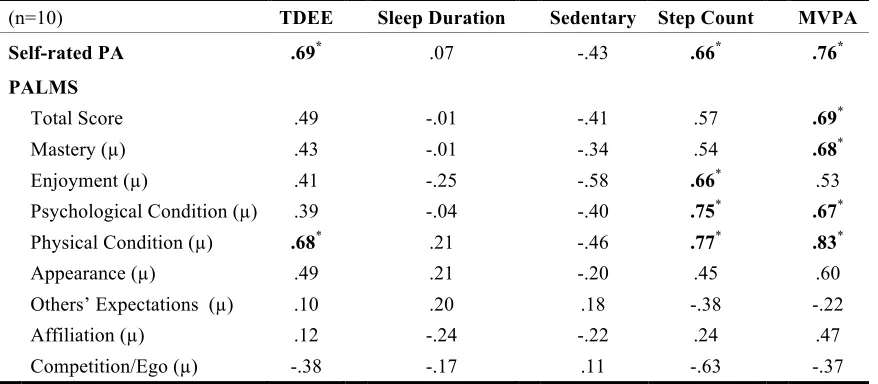
of PA and the PALMS scores were assessed. In Table 3.3, bivariate correlations between
self-rated PA responses, the PALMS and each of the eight sub-scales were evaluated for
any disagreement suggesting participants altered their exercise habits due to study
participation. PALMS total score and self-rated responses correlated well with TDEE,
sedentary-time and MVPA activity. Subject responses for self-rated PA strongly
correlated with TDEE (r = 0.80, p < .05), step count TDEE (r = 0.66, p < .05) and MVPA
(r = 0.68, p < .05). Examination of PALMS responses only indicated a significant
association with MVPA (r = 0.65, p < .05), yet moderate associations were seen with
TDEE (r = 0.49) and step count (r = .57). Additionally, MVPA was positively related to
extrinsic mind-body motives, psychological condition (r = 0.67, p < .05) and physical
condition (r = 0.81, p < .05), with similar strong associations with step count. Physical
condition was strongly associated with TDEE (r = 0.74, p < .05) and moderately
inversely related to sedentary time (r = -0.57, p < .08). MVPA and step count strongly
correlated with intrinsic motives (e.g., mastery, enjoyment) for participating in PA. These
results specifically indicated significant associations between step count and enjoyment (r
inverse relation between sedentary time and MVPA was also observed. Overall, extrinsic
social motives (e.g., others’ expectations, competition/ego) were seen to have an inverse
relation with positive outcomes associated with PA, but not with affiliation. The
affiliation PALMS sub-scale was shown to have a moderate association with MVPA (r =
0.53, p = .11). Finally, step-count demonstrated significant associations with each of the
extrinsic mind-body motives indicating physical condition and psychological well-being
as motives for participating in walking among this sample. PTSD Symptom Severity. All
study participants were combat Veterans who self-reported as experiencing at least one
previous traumatic event during a deployment, therefore each member was administered
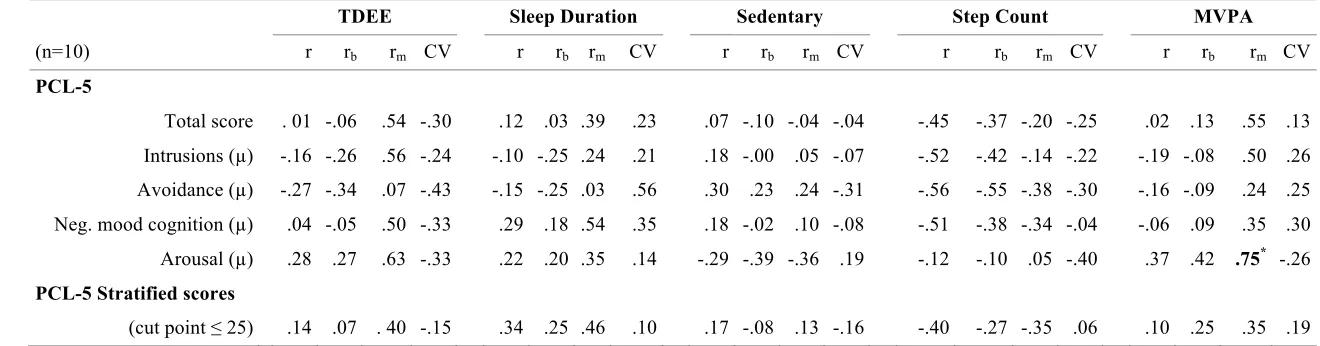
the PCL-5. Average PCL-5 score was 22 (range: 2-39). Table 3.4 summarizes PCL-5
symptom severity and SWA activity using bivariate correlations. Second and third-order
Table 3.3 Pearson product-moment correlations of self-rated PA, PALMS and measures of SWA activity.
(n=10) TDEE Sleep Duration Sedentary Step Count MVPA
Self-rated PA .69* .07 -.43 .66* .76*
PALMS
Total Score .49 -.01 -.41 .57 .69*
Mastery (µ) .43 -.01 -.34 .54 .68*
Enjoyment (µ) .41 -.25 -.58 .66* .53
Psychological Condition (µ) .39 -.04 -.40 .75* .67*
Physical Condition (µ) .68* .21 -.46 .77* .83*
Appearance (µ) .49 .21 -.20 .45 .60
Others’ Expectations (µ) .10 .20 .18 -.38 -.22
Affiliation (µ) .12 -.24 -.22 .24 .47
Competition/Ego (µ) -.38 -.17 .11 -.63 -.37
SWA, SenseWear Armband; TDEE, Total Daily Energy Expenditure; MVPA, Moderate-to-Vigorous Physical Activity; PALMS, Physical Activity and Leisure Motivation Scale
partial correlations were also performed to evaluate known covariates (i.e., body weight,
gender) and medication status as a mediator, also seen in Table 3.4.Medication status
appears to account for the relation between several criterion variables and measures of
PA. Although not statistically significant, a moderate positive association was indicated
between PCL-5 scores and TDEE (r = 0.54, p = .11), sleep duration (r = 0.39, p = .11)
and MVPA (r = 0.55, p = .10) when controlling for medication status. Intrusions
symptomology (cluster B) demonstrated an identical association with TDEE (r = 0.56, p
= .08) and MVPA (r = 0.50, p = .14) while adjusting for medication status. A moderate
inverse association was observed between avoidance symptomology (cluster C) and
TDEE variability (r = 0.43, p = .21) and sleep duration variability (r = 0.56, p = .08).
Avoidance maintained this moderate association with TDEE variability and sleep
duration variability while adjusting for sex, body weight and medication status.
Significant positive associations between arousal symptomology (cluster E) and TDEE (r
= 0.63, p < .05) and MVPA (r = 0.74, p < .01) were seen when controlling for
medication. A moderate positive association was also seen with arousal and MVPA (r =
0.42, p = .22) when controlling for body weight. Lastly, PTSD symptom severity above
and below the cut-off score of 25 was correlated with all outcomes to explore any
additional interactions. Correlations with cut-off score and TDEE (r = 0.40, p = .25),
sleep duration (r = 0.46, p = .18) and MVPA (r = 0.35, p = .32) revealed moderate
associations while controlling for medication although negatively associated with step
count (r = -0.35, p = .32).
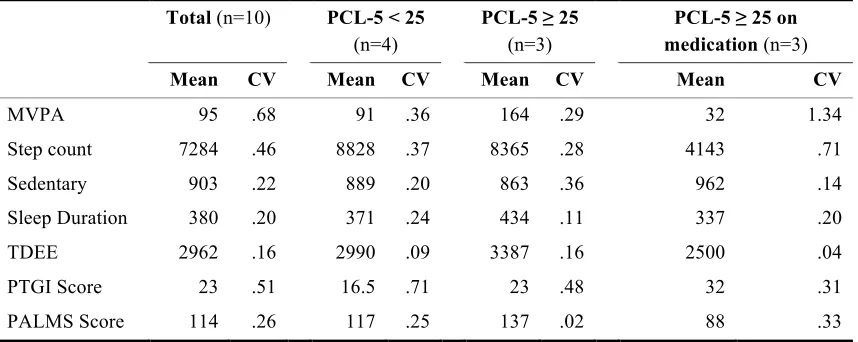
Medication Status and Physical Activity. The strong positive association of
medication, was explored further. Viewing medication as a mediator, the members of this
study were stratified into three groups. PCL-5 total scores < 25 were considered
subclinical or partial (n=4) and scores ≥ 25 with greater symptom severity were split into
two groups based on medication status (Table 3.5). Subjects currently on prescribed
medication spent 32 minutes in MVPA, 5.6 hours sleeping and 16 hours sedentary on
average each day. However, subjects off medication spent 2.7 hours in MVPA, 7.2 hours
sleeping and 14.3 hours sedentary (Figure 3.1).
Posttraumatic Growth. Bivariate correlations among PTG total scores in Table
3.6 revealed a significant and inverse association with sleep duration and a moderate
association with PCL-5 scores. Adjusting for medication, PTG was seen to have a
moderate association with MVPA after controlling for medication and step count whereas
unadjusted correlations were inversely related. Among those reporting greater symptom
severity receiving pharmacotherapy, PTG scores were highest (Range: 21-40) while
PALMS scores were the lowest (Range: 64-121). PCL-5 scores ≥ 25 and not taking
medication reported the highest PALMS scores (Range: 134-139) and lower levels of
PTG (Range: 15-36). Cronbach’s α = .90, .84 and .91 for PCL-5, PTGI-SF and PALMS
inventories respectively. Figure 3.1 shows average daily MVPA among each group as
measured by the SWA for a 5-day period. On average, those currently taking medication
did not achieve recommended levels of daily MVPA on 2-of-5 days. All other
participants achieved sufficient levels of MVPA on average during the week. Those
reporting greater symptom severity in Figure 3.2, demonstrated comparable steps/day
throughout the 5-day period with respect to those demonstrating minor to no PTSD
20
Table 3.4 Pearson product-moment correlations and first-order partial correlations of PCL-5 severity and SWA activity.
TDEE Sleep Duration Sedentary Step Count MVPA
(n=10) r rb rm CV r rb rm CV r rb rm CV r rb rm CV r rb rm CV
PCL-5
Total score . 01 -.06 .54 -.30 .12 .03 .39 .23 .07 -.10 -.04 -.04 -.45 -.37 -.20 -.25 .02 .13 .55 .13 Intrusions (µ) -.16 -.26 .56 -.24 -.10 -.25 .24 .21 .18 -.00 .05 -.07 -.52 -.42 -.14 -.22 -.19 -.08 .50 .26 Avoidance (µ) -.27 -.34 .07 -.43 -.15 -.25 .03 .56 .30 .23 .24 -.31 -.56 -.55 -.38 -.30 -.16 -.09 .24 .25 Neg. mood cognition (µ) .04 -.05 .50 -.33 .29 .18 .54 .35 .18 -.02 .10 -.08 -.51 -.38 -.34 -.04 -.06 .09 .35 .30 Arousal (µ) .28 .27 .63 -.33 .22 .20 .35 .14 -.29 -.39 -.36 .19 -.12 -.10 .05 -.40 .37 .42 .75* -.26 PCL-5 Stratified scores
(cut point ≤ 25) .14 .07 . 40 -.15 .34 .25 .46 .10 .17 -.08 .13 -.16 -.40 -.27 -.35 .06 .10 .25 .35 .19
Partial correlations rb and rm controlling for body weight and medication, respectively; PCL-5, Psychometric properties of PTSD Checklist for DSM-V;
Table 3.5 Descriptive statistics among participants stratified by symptom severity and medication status.
Total (n=10) PCL-5 < 25
(n=4)
PCL-5 ≥ 25
(n=3)
PCL-5 ≥ 25 on medication (n=3)
Mean CV Mean CV Mean CV Mean CV
MVPA 95 .68 91 .36 164 .29 32 1.34
Step count 7284 .46 8828 .37 8365 .28 4143 .71
Sedentary 903 .22 889 .20 863 .36 962 .14
Sleep Duration 380 .20 371 .24 434 .11 337 .20
TDEE 2962 .16 2990 .09 3387 .16 2500 .04
PTGI Score 23 .51 16.5 .71 23 .48 32 .31
PALMS Score 114 .26 117 .25 137 .02 88 .33
SWA, SenseWear Armband; TDEE, Total Daily Energy Expenditure (kcal); MVPA, Moderate-to-Vigorous Physical Activity; PTGI, posttraumatic growth inventory; PALMS, Physical Activity and Leisure
Motivation Scale; CV, Coefficient of Variation
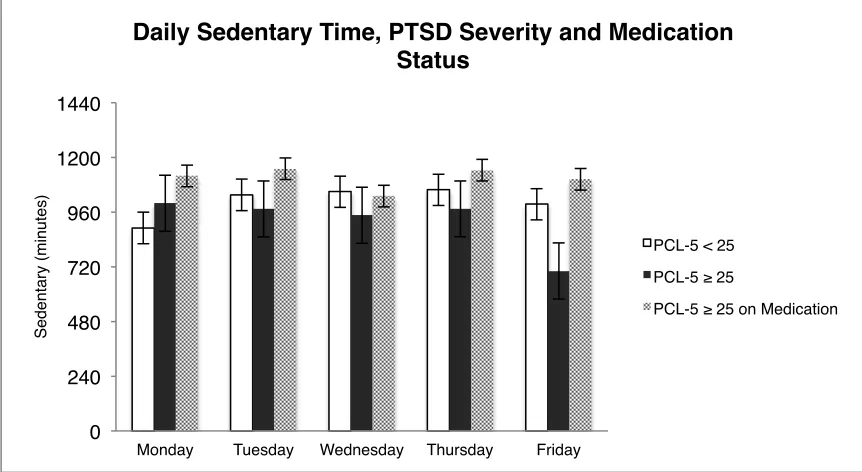
Longer durations spent in sedentary time were seen during weekdays among those
with higher PCL-5 scores, but observed to be especially high among Veterans on
medication (Figure 3.3).
Table 3.6 Pearson product-moment correlations of posttraumatic growth with measures of SWA activity and symptom severity.
(n=10) TDEE Sleep Duration Sedentary Step Count MVPA PCL-5
r rm r rm r rm r rm r rm r rm
PTGI .
Total Score -.24 16 -.69* -.62 -.14 -.29 -.12 .31 -.03 .49 .44 .25
SWA, SenseWear Armband; TDEE, Total Daily Energy Expenditure; MVPA, Moderate-to-Vigorous Physical Activity; PTGI, Posttraumatic Growth Inventory; first-order partial correlation controlling for medication (rm)
Figure 3.1 average daily times in moderate-to-vigorous physical activity (MVPA) as recorded by the SWA; Subjects contributing to these averages were stratified by PCL-5 cut-point and by current medication status.
Figure 3.2 Average daily steps as recorded by the SWA; Subjects contributing to these averages were stratified by PCL-5 cut-point and by current medication status.
0 1200 2400 3600 4800 6000 7200 8400 9600 10800 12000 13200
Monday Tuesday Wednesday Thursday Friday
St e p C o u n t
Daily Step Count, PTSD Severity and Medication Status
PCL-5 < 25
PCL-5 ≥ 25
PCL-5 ≥ 25 on Medication
0 25 50 75 100 125 150 175 200 225 250 275
Monday Tuesday Wednesday Thursday Friday
MVP A (mi n u te s)
Daily MVPA, PTSD Severity and Medication Status
PCL-5 < 25
PCL-5 ≥ 25
Figure 3.3 Average daily times spent in sedentary behavior as recorded by the SWA; Subjects contributing to these averages were stratified by PCL-5 cut-point and by current medication status.
3.4 DISCUSSION
In the present paper we have discussed the importance of employing wearable monitors to reliably appraise potential correlates of PA in individuals with PTSD. Ten trauma-exposed combat Veterans were monitored for a period of 7-days to assess voluntary activity levels during free-living conditions. Qualitative surveys regarding personal motives for participating in PA and positive psychological changes as a result of prior trauma-exposure were explored in connection with activity. Evidence from this mixed methods approach arguably provided useful direction for the staging of future study interventions regarding current pharmacotherapy status and trends in PA for this population. Assumptions regarding PTG and motives for PA may also offer significant utility in the development of strategies for adhering to a physically active lifestyle.
0 240 480 720 960 1200 1440
Monday Tuesday Wednesday Thursday Friday
Se d e n ta ry (mi n u te s)
Daily Sedentary Time, PTSD Severity and Medication Status
PCL-5 < 25
PCL-5 ≥ 25
Exceptional study compliance among this outpatient sample allowed us to underline four key findings that deserve further consideration.
Firstly, Veterans currently taking medication (i.e., antidepressants) and report greater severity of PTSD symptomology, display inferior levels of PA as compared to their counterparts in this sample. Current first line monotherapeutic strategies for PTSD include strong recommendations for the use of antidepressants such as selective serotonin reuptake inhibitors (SSRIs) [66]. The Clinical Practice Guidelines for Posttraumatic Stress Disorder recommend against atypical antipsychotic use for the monotherapeutic
a potential mediator. Again adjusting for medication, MVPA was only then observed to have a strong positive association with total PCL-5 scores. As expected, this association was seen in proportion to estimated caloric expenditure demonstrating the consistency of increased activity on TDEE (r2 =.85). Overall, this would indicate higher levels of MVPA observed among those with greater symptom severity adjusting for medication in this sample. This evidence is fittingly compatible with a set of previously proposed
hypotheses implicating SSRIs as agents that may reduce the likelihood of engaging in PA via executive dysfunction [69].
Secondly, participants of this study who were not on any pharmacological
treatments on average exceeded recommended levels of daily PA, despite displaying few steps/day on average than those indicating lesser symptom severity and significant sedentary time. Most participants of this study did not meet recommendations for 10,000 steps/day, especially participants taking medication. Among healthy populations, the relationship between steps/day and sedentary time is inverse and moderate [70]. Sedentary behavior was remarkably high in this sample. The association with steps/day was strong and inversely (r2 = .68) related for this sample and also held true for MVPA and time in sedentary behavior (r2 = .43). Risk of mortality is not lessened among those who
experience significant psychological distress and participate in high levels of MVPA (> 7 hours/wk) yet spend 7 hours/day in sedentary behavior [71]. These data underline the importance of uncovering correlates of cognitive, social and environmental barriers among this population to reduce time in sedentary activity.
correlations (Table 3.5). It was hypothesized that individuals who reported greater PTSD severity, but displayed at least moderate levels of PTG and/or higher PALMS scores, would exhibit better outcome measures of activity than those with lower PCL-5 scores. Stronger levels of intrinsic and mind-body motivation, as measured by the PALMS, were seen among those with higher levels of MVPA and step count. PTG levels also exhibited moderating characteristics, which may offer predictive value in relation to symptom severity. If PTG is interpreted as having a curvilinear relationship with symptom severity [53], levels of PA may correlate similarly using a similar model. If so, it would be
interesting to see if and how PTG influences individual perceptions about adequate levels of PA or constructs contained within the Health Belief Model.
were of normal BMI and commonly seen to sleep between 7-8 hours. PCL-5 scores and arousal symptomology demonstrated positive associations with sleep in our current study, inconsistent with previous literature demonstrating reductions in arousal symptomology among inpatients with PTSD after a cycling intervention [73]. Further attention to this distinction is worth pursuing with objective monitoring among inpatient and outpatient samples to define and interpret the therapeutic effects of exercise at various intensities.
Strengths.Study compliance to activity monitoring among this outpatient sample
was remarkably high, as opposed to unfavorable rates seen in inpatient populations [17]. Regarding study flow, validated versions of short form inventories were selected purposefully wherever possible to ensure readability and increase retention. The estimated reliability of test scores reported in this study were good to excellent as indicated by Cronbach’s α (≥ .84). Requests to adhere to pre-study routines of PA were followed as supported by PALMS and self-rated PA. There were no losses to report in terms of activity monitors. All together, future studies aiming to objectively monitor PA among outpatient trauma-exposed Veterans should be feasible using well-established protocols.
Limitations.Results from this study should be interpreted in consideration of
several limitations. The power of this study to show significant effects was low and has not sufficiently satisfied previous calls for objectively measured activity among this sample population. Future studies should be repeated with larger sample sizes to cross-validate PTG and motives for participating in PA as moderator variables. Our data are cross-sectional, so it is impossible to determine whether any observed cognitive
lack of a control group. It is important to distinguish whether prior military training could account for the high levels of MVPA and motivation seen among those with PCL-5 scores greater than 25 not on medication. Although participants were screened for conditions such as depression and musculoskeletal limitations, a formal comorbidity index is recommended to promote full disclosure and account for any overlapping symptoms.
Future studies. Prospective studies pre and post-intervention are needed to
adequately develop and stage programs for trauma-exposed combat Veterans. Given the high prevalence of walking as the only form of PA among those with SMI, parameters such as cadence should be observed. Such details would provide a more accurate reflection of activity to better understand dose-response parameters. The moderate and positive relationship between avoidance symptomology with most outcomes of activity is worth mentioning. These associations could be interpreted as potential markers of
participant reactivity or altered behavior toward demand characteristics of study participation. Therefore, extended periods of observation greater than 7 days are recommended. Moreover, because of the moderate and reciprocal associations of
wearable technologies periodically as part treatment to evaluate and encourage positive behavioral changes.
To create a formidable exercise intervention for trauma-exposed individuals experiencing psychological distress, further investigation into the neurophysiology and behavior underlying motives for regular exercise or contradictory lifestyle behaviors are needed. Although qualitative research involving psychosocial constructs, such as self-determination, have been conducted in relation to PA levels among SMI populations [33, 44, 52], the concurrent use of objective measures have been scarce. Lack of social support appears to be one of several important risk factors that hinder adherence to exercise. The affiliation sub-scale of the PALMS demonstrated a moderate correlation with MVPA among this population, as did PTG. Qualitative research may find utility for the PTGI-SF and PALMS to identify positive psychosocial factors in trauma-exposed combat
Veterans. Findings may illustrate the manner in which some individuals with PTSD desire to live their lives and how that may relate to habitual exercise.
Conclusion. This exploratory analysis was the first to examine associations
between objective measures of PA and PTSD symptomology, as outlined by the DSM-V, among outpatient trauma-exposed combat Veterans. This preliminary study has
R
EFERENCES1. Nutrition, Physical Activity and Obesity Data, Trends and Maps web site. U.S. Department of Health and Human Services, Centers for Disease Control and Prevention (CDC), National Center for Chronic Disease Prevention and Health Promotion, Division of Nutrition, Physical Activity and Obesity, Atlanta, GA, 2015.
2. Gentes, E., Dennis, P. A., Kimbrel, N. A., Kirby, A. C., Hair, L. P., Beckham, J. C., & Calhoun, P. S. Latent Factor Structure of DSM-5 Posttraumatic Stress Disorder.
Psychopathology review. 2015;2(1):17-29.
3. Skelton, K., Ressler, K., Norrholm, S., Jovanovic, T., & Bradley- Davino, B. PTSD and gene variants: new pathways and new thinking. Neuropharmacology, 2012; 62(2), 628–37.
4. Leen-Feldner, E., Feldner, M., Knapp, A., Bunaciu, L., Blumenthal, H. Amstadter, A. Offspring psychological and biological correlates of parental posttraumatic stress: Review of the literature and research agenda. Clinical Psychology Review, 2013; 33, 1106-1133.
5. Martins LCX, Lopes CS. Rank, job stress, psychological distress and physical activity among military personnel. BMC Public Health. 2013;13:716.
6. Stathopoulou G, Powers MB, Berry AC. Exercise interventions for mental health: a quantitative and qualitative review. Science and Practice. 2006.
7. Stein DJ, McLaughlin KA, Koenen KC, et al. DSM-5 And ICD-11 Definitions Of Posttraumatic Stress Disorder: Investigating “Narrow” And “Broad” Approaches.
Depression and anxiety. 2014;31(6):494-505.
8. Jeffreys, M., Reinfeld, C., Nair, P., Garcia, H., Mata-Galan, E., & Rentz, T. Evaluating treatment of posttraumatic stress disorder with cognitive processing therapy and prolonged exposure therapy in a VHA specialty clinic. Journal of anxiety
disorders, 2014; 28(1), 108–14.
9. McQuaid, J., Marx, B., Rosen, M., Bufka, L., Tenhula, W., Cook, H., & Keane, T. Mental health assessment in rehabilitation research. The Journal of Rehabilitation
Research and Development, 2012; 49(1), 121.
growth among Veterans in the USA: results from the National Health and Resilience in Veterans Study. Psychological Medicine, 2014; 45(01), 165-179.
12. Klaperski S, Dawans B, Heinrichs M, Fuchs R. Effects of a 12-week endurance training program on the physiological response to psychosocial stress in men: a randomized controlled trial. J Behav Med. 2014;37(6):1118–113313. Hyodo K, Dan I, Kyutoku Y, Suwabe K, Byun K, Ochi G, Kato M, Soya H. The association between aerobic fitness and cognitive function in older men mediated by frontal lateralization. Neuroimage. 2016;125:291–300.
14. Childs E, de Wit H. Regular exercise is associated with emotional resilience to acute stress in healthy adults. Frontiers in Physiology. 2014;5.
15. Fetzner, M., & Asmundson, G. Aerobic Exercise Reduces Symptoms of Posttraumatic Stress Disorder: A Randomized Controlled Trial. Cognitive
Behaviour Therapy, 2014;113.
16. Hall, K., Beckham, J., Bosworth, H., Sloane, R., Pieper, C., & Morey, M. PTSD is negatively associated with physical performance and physical function in older overweight military Veterans. Journal of Rehabilitation Research and
Development, 2014; 51(2).
17. Rosenbaum, S., Tiedemann, A., Sherrington, C., & Ploeg, H. Assessing physical activity in people with posttraumatic stress disorder: feasibility and concurrent validity of the International Physical Activity Questionnaire– short form and actigraph accelerometers. BMC Research Notes, 2014; 7(1), 576.
18. Powers MB, Medina JL, Burns S, Kauffman BY, Monfils M, Asmundson GJ,
Diamond A, McIntyre C, Smits JA. Exercise Augmentation of Exposure Therapy for PTSD: Rationale and Pilot Efficacy Data.Cogn Behav Ther. 2015;44(4):314– 27.
19. Harte, C., Vujanovic, A., & Potter, C. Association Between Exercise and
Posttraumatic Stress Symptoms Among Trauma-Exposed Adults. Evaluation &
the Health Professions, 2013; 38(1), 4252. doi:10.1177/0163278713494774
20. Jefferis BJ, Sartini C, Lee I-MM, Choi M, Amuzu A, Gutierrez C, Casas JP, Ash S, Lennnon LT, Wannamethee SG, Whincup PH. Adherence to physical activity guidelines in older adults, using objectively measured physical activity in a population-based study. BMC Public Health. 2014;14:382.
21. Van Poppel M, Chinapaw M, Mokkink L, van Mechelen W, Terwee C. Physical activity questionnaires for adults: a systematic review of measurement properties. Sports medicine (Auckland, NZ). 2010;40(7):565–600.
23. Jones, L., Guill, B., Keir, S., Carter, K., Friedman, H., Bigner, D., & Reardon, D. Using the theory of planned behavior to understand the determinants of exercise intention in patients diagnosed with primary brain cancer. Psycho‐Oncology, 2007; 16(3), 232–240.
24. Kerkelä ES, Jonsson L, Lindwall M, Strand J. Individual experiences following a 6-month exercise intervention: A qualitative study. Int J Qual Stud Health
Well-being. 2015;10:26376.
25. Rovniak L, Anderson E, Winett R, Stephens R. Social cognitive determinants of physical activity in young adults: A prospective structural equation analysis. Ann
Behav Med. 2002;24(2):149–156.
26. Heath GW, Kolade VO, Haynes JW. Exercise is MedicineTM: A pilot study linking primary care with community physical activity support. Preventive Medicine
Reports. 2015;2:492-497.
27. Van der Velde JHPM, Savelberg HHCM, Schaper NC, Koster A. Moderate Activity and Fitness, Not Sedentary Time, Are Independently Associated with Cardio-Metabolic Risk in U.S. Adults Aged 18–49. Davey R, ed. International Journal of
Environmental Research and Public Health. 2015;12(3):2330-2343.
28. Wang C-Y, Haskell W, Farrell S, LaMonte M, Blair S, Curtin L, Hughes J, Burt V. Cardiorespiratory Fitness Levels Among US Adults 20–49 Years of Age: Findings From the 1999–2004 National Health and Nutrition Examination Survey. Am J Epidemiol. 2010;171(4):426–435.
29. Archer, E., & Blair, S. Physical activity and the prevention of cardiovascular disease: from evolution to epidemiology. Progress in cardiovascular diseases, 2011; 53(6), 387–96.
30. Broderick, J., Ryan, J., O’Donnell, D., & Hussey, J. A guide to assessing physical activity using accelerometry in cancer patients. Supportive Care in Cancer. 2014. 31. Calabró, M., Lee, J.-M., Saint-Maurice, P., Yoo, H., & Welk, G. Validity of physical
activity monitors for assessing lower intensity activity in adults. The international
journal of behavioral nutrition and physical activity, 2014; 11(1), 119.
32. Ng JYY, Ntoumanis N, Thøgersen-Ntoumani C, Deci EL, Ryan RM, Duda JL, Williams GC. Self-Determination Theory Applied to Health Contexts: A Meta-Analysis. Perspect Psychol Sci. 2012;7(4):325–40.
33. Vancampfort D, Stubbs B, Venigalla SK, Probst M. Adopting and maintaining physical activity behaviours in people with severe mental illness: The importance of autonomous motivation. Prev Med. 2015;81:216–20.
25(1), 55–69.
35. Jones L, Guill B, Keir S, Carter K, Friedman H, Bigner D, Reardon D. Using the theory of planned behavior to understand the determinants of exercise intention in patients diagnosed with primary brain cancer. Psycho‐Oncology. 2007;16(3):232– 240.
36. Mattson, M. Energy Intake and Exercise as Determinants of Brain Health and Vulnerability to Injury and Disease. Cell Metabolism, 2012; 16(6).
37. Visek, A., Olson, E., & DiPietro, L. Factors predicting adherence to 9 months of supervised exercise in healthy older women. Journal of physical activity & health, 2011; 8(1), 104–10.
38. Salter, E.R.S., Sillice, M.A., Mitchell, K.S., Ramusson, A.M, Allsup, K., Biller, H., Rossi, J.S. Californian Journal of Health Promotion, 2014; 12(1), 27-39. 39. Teixeira, P., Carraça, E., Markland, D., Silva, M., Ryan, R., Exercise, physical
activity, and self-determination theory: A systematic review International Journal
of Behavioral Nutrition and Physical Activity, 2012; 9:78, 1-30.
40. Baratta M, Rozeske R, Maier S. Understanding stress resilience. Frontiers in
Behavioral Neuroscience. 2013;7.
41. Rosenstock, M. The health belief model: explaining health behavior through expectancies. Health behavior and health education. Theory, research, and
practice. San Francisco: Jossey-Bass Publishers, 1990:39– 62.
42. Taskforce on Community Preventative Services. Recommendations to increase physical activity in communities. American Journal of Preventive Medicine. 2002; 22(4):67-72
43. Galloway A, Henry M. Relationships between Social Connectedness and Spirituality and Depression and Perceived Health Status of Rural Residents. Online J Rural
Nurs Heal Care. 2014;14(2):43–79.
44. Göhner W, Dietsche C, Fuchs R. Increasing physical activity in patients with mental illness-A randomized controlled trial. Patient Educ Couns. 2015.
45. Vancampfort D, Madou T, Moens H, De Backer T, Vanhalst P, Helon C, Naert P, Rosenbaum S, Stubbs B, Probst M. Could autonomous motivation hold the key to successfully implementing lifestyle changes in affective disorders? A multicentre cross sectional study. Psychiatry Res. 2015;228(1):100–106
47. Shook R, Gribben N, Hand G, Paluch A, Welk G, Jakicic J, Hutto B, Burgess S, Blair S. Subjective Estimation of Physical Activity Using the International Physical Activity Questionnaire Varies by Fitness Level. J Phys Activity Heal.
2016;13(1):79–86.
48. Catrine Tudor-Locke, Corby K. Martin, Meghan M. Brashear, Jennifer C. Rood, Peter T. Katzmarzyk, William D. Johnson. Applied Physiology, Nutrition, and
Metabolism, 2012, 37:1091-1100.
49. Ayabe, M., Kumahara, H., Morimura, K., & Tanaka, H. Epoch length and the physical activity bout analysis: An accelerometry research issue. BMC Research
Notes, 2013; 6(1), 20.
50. Rosenbaum S, Vancampfort D, Tiedemann A, Stubbs B, Steel Z, Ward P, Berle D, Sherrington C. Among Inpatients, Posttraumatic Stress Disorder Symptom Severity Is Negatively Associated With Time Spent Walking. J Nerv Ment Dis. 2016;204(1):15.
51. Colpe, Freeman, Strine. Peer Reviewed: Public Health Surveillance for Mental Health. 2010.
52. Daumit G, Goldberg R, Anthony C, Dickerson F, Brown C, Kreyenbuhl J, Wohlheiter K, Dixon L. Physical activity patterns in adults with severe mental illness. J Nerv
Ment Dis. 2005;193(10):641–6
53. Shakespeare-Finch J, Lurie-Beck J. A meta-analytic clarification of the relationship between posttraumatic growth and symptoms of posttraumatic distress
disorder. Journal of Anxiety Disorders. 2014;28(2):223–229.
54. Bertram, F., Jamison, A., Slightam, C., Kim, S., Roth, H., & Roth, W. Autonomic Arousal During Actigraphically Estimated Waking and Sleep in Male Veterans With PTSD. Journal of Traumatic Stress, 2014; 27(5), 610–617.
55. King, P., Donnelly, K., Donnelly, J., Dunnam, M., Warner, G., Kittleson, C.,Meier, S. Psychometric study of the Neurobehavioral Symptom Inventory. The Journal of
Rehabilitation Research and Development, 2012; 49(6), 879.
56. Kasckow, J., Yeager, D., & Magruder, K. Levels of Symptom Severity and
Functioning in Four Different Definitions of Subthreshold Posttraumatic Stress Disorder in Primary Care Veterans. The Journal of Nervous and Mental Disease, 2015; 203(1), 43.
57. Keen, S., Kutter, C., Niles, B., & Krinsley, K. Psychometric properties of PTSD Checklist in sample of male Veterans. The Journal of Rehabilitation Research
and Development, 2008; 45(3), 465-474.
58. Cann, A., Calhoun, L., Tedeschi, R., Taku, K., Vishnevsky, T., Triplett, K., &
and coping, 2010; 23(2), 127–37.
59. Molanorouzi K, Khoo S, Morris T. Validating the Physical Activity and Leisure Motivation Scale (PALMS). Bmc Public Health. 2014;14(1):909.
60. Johannsen D, Calabro M, Stewart J, Franke W, Rood J, Welk G. Accuracy of armband monitors for measuring daily energy expenditure in healthy
adults.Medicine and science in sports and exercise. 2010;42(11):2134–2140. 61. Brazeau, A., Karelis, A., Mignault, D., Lacroix, M., Prud’homme, D., Rabasa-Lhoret,
R.. Test–retest reliability of a portable monitor to assess energy expenditure. Appl
Physiology Nutrition Metabolism. 2011;36(3):339–343.
62. Varma V, Chuang Y, Harris G, Tan E, Carlson M. Low‐intensity daily walking activity is associated with hippocampal volume in older adults. Hippocampus. 2015;25(5):605–615.
63. Tudor-Locke C, Camhi SM, Leonardi C, Johnson WD, Katzmarzyk PT, Earnest CP, Church TS. Patterns of adult stepping cadence in the 2005-2006 NHANES. Prev Med. 2011;53(3):178–81.
64. Chen KY, Janz KF, Zhu W, Brychta RJ. Re-Defining The Roles Of Sensors In Objective Physical Activity Monitoring. Medicine and science in sports and
exercise. 2012;44(1S):S13-S23.
65. Butte, N., Ekelund, U., & Westerterp, K. Assessing Physical Activity Using Wearable Monitors: Measures of Physical Activity. Medicine & Science in Sports &
Exercise, 2012; 44(1S).
66. Jeffreys M, Capehart B, Friedman MJ. Pharmacotherapy for posttraumatic stress disorder: review with clinical applications. J Rehabil Res Dev. 2012;49(5):703– 15.
67. Melkersson, K., & Dahl, M. L. Adverse metabolic effects associated with atypical antipsychotics: Literature review and clinical implications. Drugs, 2004; 64, 701– 723.
68. Scott, D., & Happell, B. The high prevalence of poor physical health and unhealthy lifestyle behaviours in individuals with severe mental illness. Issues in mental
health nursing, 2011; 32(9), 589–97.
69. Stenman E, Lilja A. Increased monoaminergic neurotransmission improves compliance with physical activity recommendations in depressed patients with fatigue. Med Hypotheses. 2013;80(1):47–9.
71. Rhodes R, Mark R, Temmel C. Adult Sedentary Behavior A Systematic Review. Am
J Prev Med. 2012;42(3):e3–e28.
72. Liang, W., & Chikritzhs, T. Sleep Duration and Its Links to Psychological Distress, Health Status, Physical Activity and Body Mass Index among a Large
Representative General Population Sample. International Journal of Clinical
Medicine, 2013; 04, 45.
73. Babson KA, Heinz AJ, Ramirez G, Puckett M, Irons JG, Bonn-Miller MO, Woodward SH. The interactive role of exercise and sleep on veteran recovery from symptoms of PTSD. Mental Health and Physical Activity. 2015;8:15–20. 74. Myers C, Vanmeenen K, Servatius R. Behavioral inhibition and PTSD symptoms in
veterans. Psychiatry research. 2012;196(2-3):271–6.
75. Miyamoto SW, Henderson S, Young HM, Pande A, Han JJ. Tracking Health Data Is Not Enough: A Qualitative Exploration of the Role of Healthcare Partnerships and mHealth Technology to Promote Physical Activity and to Sustain Behavior Change. Dias C, ed. JMIR mHealth and uHealth. 2016;4(1):e5
76. Blumenthal JA, Babyak MA, Murali Doraiswamy P, et al. Exercise and
Pharmacotherapy in the Treatment of Major Depressive Disorder. Psychosomatic