DIC – The Source for Employment Generation
Mrs. Anupama Nitin Labhe (Assistant Professor)
G. S. College of Commerce, Wardha
Jamanalal Bajaj Marg, Civil Lines, Wardha – 442 001
Abstracts
Poverty is one of the major problems facing India. An estimated 30-40 percent of the population lives in poverty. Four out of five of India's poor live in rural areas. About 70% of the people live in more than 550,000 villages, and the remainder in more than 200 towns and cities.
Rural population being highly scattered and unorganized, organizing and institutionalizing the activities of rural population and proving work on a regular basis are really challenging task. Either work is to be provided by the units to them to be done at their residence or industries are to be started in the rural areas in order to bring them into an organized entity. Some of the efforts undertaken by the Govt. in the past have not made any perceivable impact on the employment generation in rural India. Industrial co-operatives were started with the mission of rural industrialization for different crafts in pursuance of the recommendation of Karve committee 1955. These societies mobilized the scattered rural skill to a certain extent. But it failed in its re-mission. As these societies could not ensure regular employment and provide fair wages, members were withdrawing from the societies. As a result most of the societies remain currently defunct.
DIC is playing an important role to generate employment in rural areas through various schemes. It is trying to bridge the technological gap through providing training programs for entrepreneurship development which includes project preparation, market research, product development, technological knowhow financial assistance etc.
Introduction
Employment generation has been one of the important objectives of development planning in India. The problem of employment is closely interlinked with the eradication of poverty. There are three main aspects of the employment problem in India. They are the problem of proportion of labour to total population, problem of productivity of labour and problem of unemployment and underemployment of labour. These three aspects are interrelated. There is low rate participation of labour in India. Low rate of employment among women is a striking feature in India. There has almost been no change in LFPR (labour force participation rate). The dependency rate is quite high in India. Problem of unemployment and underemployment is the chronic feature of the Indian economy. It is the main cause of poverty in India. Unemployment in India is mostly structural. The rate of unemployment is different in different states. Sector wise unemployment in India is rural and urban unemployment.
Underemployment is one variant of open unemployment. It is mainly due to the defective educational system. Underemployment may be visible or invisible. The ratio between unemployed workers and total labour force is called unemployment rate. Low productivity of employment is the third aspect of the employment problem. Productivity of labour in India is low due to many factors. The essential of the employment policy is to increase production, control population growth, reform the education system, emphasize cottage and small scale industrial units to tackle the problem of seasonal, frictional, structural, technological and disguised unemployment and effectively do manpower planning etc. There have been various schemes to solve the problem of educated unemployment.
DIC is contributing in a varied ways to generate employment. The 'District Industries Centre' (DICs) programme was started by the central government in 1978 with the objective of providing a focal point for promoting small, tiny, cottage and village industries in a particular area and to make available to them all necessary services and facilities at one place. The finances for setting up DICs in a state are contributed equally by the particular state government and the central government. To facilitate the process of small enterprise development, DICs have been entrusted with most of the administrative and financial powers. For purpose of allotment of land, work sheds, raw materials etc., DICs functions under the 'Directorate of Industries'. Each DIC is headed by a General Manager who is assisted by four functional managers and three project managers to look after the following activities:
Activities of District Industries Centre (DIC): i. Economic Investigation
ii. Plant and Machinery
iii. Research, education and training iv. Raw materials
v. Credit facilities vi. Marketing assistance vii. Cottage industries
Objectives of District Industries Centre (DIC): The important objectives of DICs are as follow:
i. Accelerate the overall efforts for industrialisation of the district.
ii. Rural industrialisation and development of rural industries and handicrafts. iii. Attainment of economic equality in various regions of the district.
iv. Providing the benefit of the government schemes to the new entrepreneurs.
v. Centralisation of procedures required to start a new industrial unit and minimisation- of the efforts and time required to obtain various permissions, licenses, registrations, subsidies etc.
Importance of the study:
The numbers of the poor have declined in rural areas, and increased in urban areas over the last three decades suggests that to escape rural poverty, the poor migrate to urban areas. To restrict the rural migration it is inevitable to create more meaningful employment opportunities within the rural areas. If villages/rural areas are made self sufficient through industrial development the problem of unemployment to a greater extent is solved.
The research work is undertaken with a view to verify the viability of the functioning and the objectives framed by DIC and its impact on employment generation.
Review of literature
Nagiya (1971) in his book lndustrial Estate Programme: The Indian Experience has analyzed the working of lndustrial Estates in India. He found out that the programme of lndustrial Estate is doing well in some States and not satisfactory in some other States. He concluded that success of lndustrial Estates depended on many factors like presence of entrepreneurs with technical and managerial experience, presence of large scale industries in the neighborhood, availability of raw materials, market, power, educational and housing facilities.
Kulkarni (1973) in his study Industrial Estates in Maharashtra declares that the performance of the industrial units in Industrial Estates was inferior compared with the industrial units located outside the lndustrial Estates.
Somasekhara (1975) in his book The efficacy of Industrial Estate in India has scrutinized the efficacy of Industrial Estates in India in general and Kamataka in particular. Primary data were collected from the industries through questionnaires and secondary data were collected from the reports and records published by the Government of India, Government of Karnataka and from other States. It was found that the Industrial Estates have not been successful to any perceptible degree in the industrialization of backward areas, and ineffective in creating employment opportunities and improving the performance of industries.
DIC in Wardha
The District Industries Centre has been set up to render all assistances under one roof to the potential entrepreneurs for starting their own industries.
5.2The activities of District Industries Centres are as below.
Registration (Permanent/ Provisional) of Micro, Small and Medium manufacturing and service Enterprises
as per MSMED Act 2006. MSMED Act
BT Registration IT Registration
Rate Contract / CSPO registration.
Monitoring of implementation of Medium and Large Scale Industries in the district. Implementation of schemes for educated unemployed youths i.e.
a) Prime Minister's Rojgar Yojana. (PMRY) b) Revised Seed Money Scheme (RSMS) c) DIC Loan Scheme.
Implementation of Package Scheme of Incentives of State Government for Small manufacturing enterprises.
Distribution of Project profiles among entrepreneurs.
Training under Entrepreneurship Development Programme and its follow up. Assistance to Industrial Cooperative Societies.
Raw Material assistance to small and medium manufacturing enterprises. Allotment of plots in MIDC areas upto 2500 sq. mtr. area.
Marketing assistance through MSSIDC. Conducting motivational campaigns.
Clearance of licenses etc. through Single Window Meeting. Rehabilitation of sick SSI units.
Annual District Award distribution to best SSI units in the district. Recommendation of SSI units for State, National and other awards.
Conducting Zilla Udyog Mitra meetings to solve the problems of industries in the district. Recommendation of units for Quality Certification.
5.3 Prominent Large and Medium scale industries in Wardha district : Table 5.2: Prominent Large and Medium scale industries in Wardha district :
Unit Name Product Investment
Rs.(Crores)
Employment No.
Lioyds Steel Industries, Bhugaon, Ta.- Wardha
Rolled steel products, Galvanised
steel sheets 2110 1815
Industrial Oxygen Co. Ltd., Bhugaon,
Wardha Oxygen & Nitrogen 15.78 24
Indira Sahakari Soot Girni, MIDC,
Wardha Coton Carded or Combed 24.27 513
Pee Vee Textile Ltd., Jam, Ta.-
Samudrapur Artificial staple fibers 119.13 1332
R. S. R. Mohota Weaving Mills Ltd.,
Hinganghat Cotton yarn 105.00 1950
Bopurao Deshmukh Saha.Soot Girni,
Ltd., MIDC, Wardha Cotton yarn 23.81 669
Bapurao Deshmukh Sugar Factory
Ltd., Wela, Ta.- Hinganghat Sugar 50.00 227
SUA Explosives, Kelzar, Ta.- Seloo Detonating fuses 4.15 37 BEC Fertilizers, Pulgaon, Ta.- Deoli Fertilizers 11.10 25 Gimatex Industries Pvt. Ltd., Wani
Unit, Ta.- Hinganghat Viscous, Polyster & Cotton Yarn 77.38 1276 Gimatex Industries Pvt. Ltd.,
Hinganghat Unit Viscous, Polyster & Cotton Yarn 31.86 718
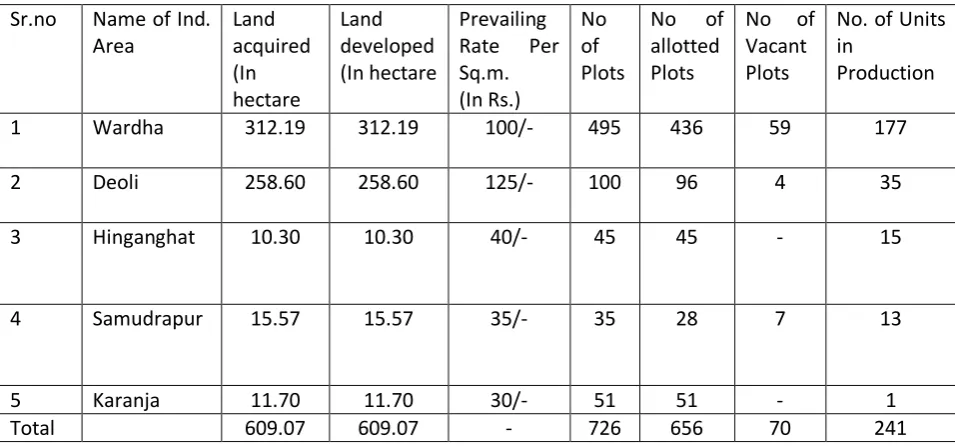
Existing Status of Industrial Areas in the District Wardha as on 30/06/2012.
Sr.no Name of Ind. Area
Land acquired (In hectare
Land developed (In hectare
Prevailing Rate Per Sq.m. (In Rs.)
No of Plots
No of allotted Plots
No of Vacant Plots
No. of Units in
Production
1 Wardha 312.19 312.19 100/- 495 436 59 177
2 Deoli 258.60 258.60 125/- 100 96 4 35
3 Hinganghat 10.30 10.30 40/- 45 45 - 15
4 Samudrapur 15.57 15.57 35/- 35 28 7 13
5 Karanja 11.70 11.70 30/- 51 51 - 1
Total 609.07 609.07 - 726 656 70 241
We can say that more industrial set up is possible in these areas. Initiative from DIC or KVIB is necessary for the development of the industrial sector in these areas. More and more awareness regarding various employment generation schemes framed by the government must be disseminated among the educated and uneducated youths of the district. U.G. and P.G. colleges should be targeted for this venture. Researcher findings show that most of the youths are unaware of the schemes framed by the Government.
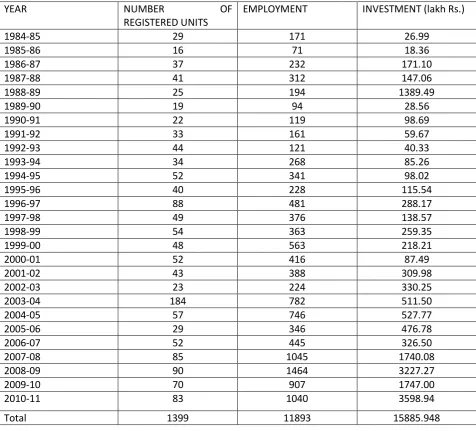
5.6YEAR WISE TREND OF UNITS REGISTERED
Table 5.5 : YEAR WISE TREND OF UNITS REGISTERED
YEAR NUMBER OF
REGISTERED UNITS
EMPLOYMENT INVESTMENT (lakh Rs.)
1984-85 29 171 26.99
1985-86 16 71 18.36
1986-87 37 232 171.10
1987-88 41 312 147.06
1988-89 25 194 1389.49
1989-90 19 94 28.56
1990-91 22 119 98.69
1991-92 33 161 59.67
1992-93 44 121 40.33
1993-94 34 268 85.26
1994-95 52 341 98.02
1995-96 40 228 115.54
1996-97 88 481 288.17
1997-98 49 376 138.57
1998-99 54 363 259.35
1999-00 48 563 218.21
2000-01 52 416 87.49
2001-02 43 388 309.98
2002-03 23 224 330.25
2003-04 184 782 511.50
2004-05 57 746 527.77
2005-06 29 346 476.78
2006-07 52 445 326.50
2007-08 85 1045 1740.08
2008-09 90 1464 3227.27
2009-10 70 907 1747.00
2010-11 83 1040 3598.94
Total 1399 11893 15885.948
to several reasons. Researcher’s informal interaction with officials and several well known personalities involved in rural industrialization reflects the reason for the same. As they are given target to registered specified number of industries in there region to achieve their target they sanctioned the projects and units as a result so many units were registered. Most of the units were closed within two months of there registration as they were established with the intention of transferring them to those who do not get the benefit of employment schemes framed by the Government. The second reason is that the same entrepreneur registered units in different name to carry on the same activity. From the table given below it is clear that 17 units were closed due to the reasons which can not be specified, 11 units were closed due to lack of demand. This means industries were established without investigating properly into the viability of projects. The third largest point which results into closure of the unit is power shortage. It indicates that just to achieve the target, industries are given permission to start production. Without providing proper infrastructural facilities units were established and closed due to shortage of power supply. Other main drawbacks are short working capital, management problem which are contributing to closure of units.
Conclusion and suggestions
The unorganised industries can face competition from organised industries only through continuous up-gradation of their products and technological improvements. Regular training by competent staff must be imparted to the artisans through a wide network of training institutions. The present study has not examined the functioning of the training institutions, but has noted that existing training methods and practices are not effective. It is felt that a comprehensive evaluation of DIC training institutions be conducted and the necessary steps be taken to revamp and reorient these so that training helps contribute to labour productivity and development of industries.
The DIC programme holds great potential for generating gainful employment opportunities for the rural poor, arresting migration of rural unskilled workers to urban areas and for promoting the strategy of sustainable development. It can also be a viable and effective social safety net to enable the poor to ward off the adverse impacts of structural adjustment and economic reforms on their wellbeing. However, this potential cannot be realised without addressing some basic weaknesses with regard to the design and implementation of the programme and without making it fiscally sustainable.
The evaluation study has brought out a number of weaknesses of the scheme in each area of operation. In fact, DIC has spread its net too wide and has got involved in areas of operations where it has very limited expertise and which can be better done by other government agencies and the private sector. Because of this imbroglio and all pervasive weaknesses in its implementation, the programme warrants major changes in policies and implementation methods.
Corrective Measures for the Village Industries Sector:
The Village Industries units encounter difficulties in obtaining the CBC financing facilities, even though their repayment record is good. The new Commission should look into the various aspects and put in place a mechanism that would ensure easy financing facilities for approved schemes.
The existing monitoring mechanism of KVIC is very weak, as it does not help generate realistic picture of employment, production, number of functional units and utilisation of government assistance. The new Commission should strengthen the monitoring system for generation of reliable information with the provision for periodic joint inspection of certain percentage of the village industries units.
Chinese products too pose a serious threat to us. Their prices are too low compared to ours. Buoyed by effective marketing and networking, they often eat into our consumer market.
The main reason related with slow growth of the industry and employment generation is that financial problem faced by the new entrants. The loan up to 1 crore is available without collateral security as per the Govt. directives. But the banks do not sanction the loan purely on personal security. So only the financially sound entrepreneurs can do the business and as a result there prevail a slow growth of the industries.
This problem is only solved with the collective activity of the people i.e through self help group. But even proper guidance related with selection of activity, project preparation, training, marketing task, R & D etc. must be provided to this group to become a successful one.
The lack of marketing experience, lack of knowledge regarding market demand, technical difficulties in producing the product, customer’s expectations, availability as well as procurement of raw material and other factors of production are some of the main hurdles to the new entrepreneurs which restrict the growth of enterprise as well as success of the unit.
References:
Kannan and Raghavan, “Report of the Task Force on the Traditional Industries (1989), Economic and Political Weekly, December 1994.
K.P.M.Sundharam, E.N.Sundharam “Economic Analysis”, 14TH Edition (1987), Sultan Chand and Sons, Publication New Delhi.
Khadi and Village Industries Commission (KVIC) – Annual Report, 1980- 81, KVIC, October 1982, (PP 1-203)
Kothari, C.R., Research Methodology, Methods and Techniques, Wiley Eastern Limited, New Delhi (2000).
Lakshmi Narasaiah.M and Deevena Margaret.B, Small Scale Industries, Discovery Publishing House, New Delhi, 1999
Mahendra Dev.S, “How to make Rural India Shine” Economic and Political Weekly, October 2004, Nanjundan.S, Robinson.H.E and Eugane Stanley, Economic Research for Small Industry Development; Illustrated by India's Experience, International Development Centre,Stanford Research Institute, Bombay, Asia, 1962, (P – 10)
Oommen. M.A, Small Industry in Indian Economic Growth – A Case Study of Kerala, 1972, (PP 1-15) WEBSITES
1. www.haryana.nic.in 2. www.goidirectory.nic.in 3. www.rbi.org
4. www.google.com 5. www.epw.org.in
6. www.govt.ofmaharashtra.directorateofindustries.in 7. msmedinagpur.gov.in