Automatic License Plate Based Smart Vehicle
Validation &Security by Gate Control &Email
Send
Rinky Sharma
Computer Science & Engineering Department, Saroj Institute of Technology, Lucknow
Abstract: With the advancement of technology, there is a different
aspect of designing and allotting number plates to the vehicle of their country. For the several respective regular administrative tasks the license number plate is used by various government offices for purposes like tracking of number plates by the traffic police in case of violation of any traffic rule by a particular vehicle, for the analysis of theft cars, for collection of toll and management of parking of vehicles etc. Unique numbers are assigned to all the motorized vehicles in India. These numbers are designated to the vehicles by district-level Regional Transport Office(RTO). In India it is essential to place the license plates in both front and back of the vehicle. Substantially, these number plates can easily be read by human-beings due to their high level of intelligence and perception. But on the contrary, for computers it is an extremely troublesome task to read the numbers. Many of the attributes will pose a problem like- illumination, blurness, background color, foreground color etc.
In Transportation, vehicles play a vital role nowadays because of population growth and human requirements the usage of vehicles is increasing. Therefore it is a very problematic task to control the vehicles and much more troublesome to solve. For reading the number plates of a car many constraints are faced like- presence of noise, blurred image, uneven illumination, dim lighting and foggy scenarios. Nowadays peoples’ lives have noteworthy influence of Intelligence Transportation System(ITS). The systems that are included in ITS are- Intelligent infrastructure systems, Intelligent vehicles systems etc. in this current era of information technology, there is unrestricted sweeping of in use of automations and intelligent systems. Vehicle number plate recognition has rig out to be an important research topic. Some of the functions of VNPR in traffic monitoring system are – controlling of traffic volume, generating tickets for vehicles with no human control, vehicle tracking, vehicle policing, vehicle security and so on. The paper categorizes various ALPR methods according to the features used for every stage and a comparative analysis is done in terms of pros and cons for recognition of accuracy and processing speed.
The report presents the algorithms for localization of yellow colored license plates using morphological operations, character segmentation using histogram and intensity projections and Optical Character recognition using Template matching.[13] Furthermore, an object enhancement method has been discussed which enhances the performance of the complete system. At the end it has also been discussed the various other approaches of implementation and proposed improvements in the used algorithm which can further improve the entire efficiency and accuracy.
There is also a feature for number plate validation using excel database to control a real time gate/buzzer with LCD display and notification on email for invalid vehicles
Keywords— Automatic license plate recognition (ALPR) system, OCR, Template Matching, Excel database, embedded control & Email sending with attachment
I. INTRODUCTION
A. Software Part
The main objective of this paper is to provide researchers an analytical inspection of existing ALPR research by assorting the existing techniques according to the attributes they used, by analyzing the pros and cons of these attributes and by corelating them in terms of recognition attainment and processing speed and to unfold some affairs for future research. The motive is to implement a security system based on number plate validation to control a gate, LCD acknowledgment and e-mail notification.
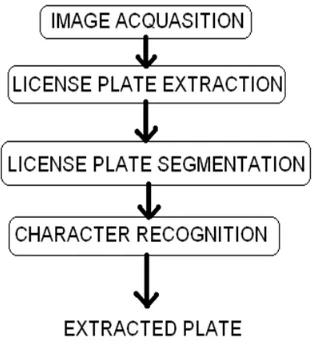
Fig.1 shows the basic block diagram of the ALPR system for above steps different approaches used by various authors that are elaborated in literature review. Fig.2 represents the extraction of the number plate, to recognise vehicles by automatically reading their number plates, Automatic License Plate Recognition (ALPR) employs image processing and character recognition technology. This system is basically divided into 4 steps:
Step (1) Image Acquisition: From where to acquire images is explained in image acquisition. Different approaches can be used to input an image to the system- analog camera or digital camera can be used. But better way of taking input can be with the help of digital cameras or by direct digital photos because digital technology has its own benefits. The captured image is shown in Fig.3
Fig. 2 An Example Implementation
Fig. 3 Captured Image
Step (2) License plate area extraction: By capturing the whole image we have the license plate that is also enclosed by the background of vehicle body. Therefore by using the area extraction technique the number plate is extracted from the whole body. Now, our mission is to determine the region containing the license plate. In order to decide whether the extracted region contains a license plate or not, two features are determined:
1) Aspect ratio: The ratio of the width to the height of the region is defined as the aspect ratio.
Aspect Ratio = width/height
We can calculate the minimum enclosing Rectangle (MER) of the object region by rotating the region. The width as well as the height of the region is considered to be the objects MER dimension.
2) Edge Density : The regions from the number license plate can be removed by applying the above feature to filter the segmented regions. We are still left with the candidate regions that take the same features of rectangularity and aspect ratio as in license plate regions. For the description of license plate region, the most significant attribute is local variance.[12] Edge density is used to quantized local variance extracted plate region example shown in Fig.4
Fig. 4 License Plate Area Extraction
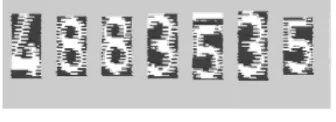
Step(3) Character segmentation: This step is used to segment the license plate and identify each fragmented particles. The further steps in license plate recognition rely on this step: it is one of the most important step. In the license plate detection algorithm it plays the major role. The factors that cause the character segmentation task difficult
are- image noise, plate frame, rivet, space mark, plate rotation and illumination variance. A quite robust algorithm is proposed by the author that gives good results on images facing the problems mentioned above. Conversion to grey scale and binarization requires segmentation preprocessing various algorithms for segmentation are explained later in literature review. Example of segmented license plate is shown in Fig.5
Fig. 5 Segmented License Plate
Step(4) License plate number recognize: Final result is obtained by number plate extraction step. Example- figure(d) shows the final extracted licence plate.
Fig.6 License Plate Number Recognize
The main challenge for the detection and recognition of license plates is the variation found in plate types or environment. Some of the variations are summarized below-
1) Location: In an image plates can exist in different locations.
2) Quantity: There can be no or many plates in images. 3) Size: Because of the factor of camera distance and the zoom plates may have different sizes.
4) Colour: Due to different plate types or capturing devices, plates may have various characters and background colors. 5) Font: Different fonts and languages can be used to write plates of different nations.
6) Occlusion: Dirt may envelope the plate. 7) Inclination: Plates may be tilted.
8) Other: besides characters there may be frames and screws on plates.
B. Environmental Variations:
1) Illumination: Due to environmental lightening and vehicle headlights the images that are input may have different types of illumination.
2) Background: In background image patterns similar to plates can be found such as bumper with vertical patterns, numbers stamped on a vehicle and textured floors.
NOTE: The numbers that are extracted are displayed on the notepad file.
C. Excel Database in Matlab
D. Email Interface in Matlab via Outlook
There is a function in MATLAB to send an e-mail. Files can be attached to an e-mail and can be mailed directly from MATLAB. To send mail, first the information about the email address and SMTP server must be set up. An acknowledgement is sent by this interface to the registered mail ID with an attached image of vehicle if the number plate is not available in the database i.e. invalid.
E. Serial Communication in Matlab
For the execution of the hardware console it is given an acknowledgement the software part running in PC is interfaced by the strong MATLAB library.
F. Algorithm for Software Part 1. Image via camera
2. License plate detection & extraction 3. Extraction of number using segmentation 4. Matching using template
5. Validation by comparing to excel entry
6. Sending acknowledgement to hardware for
valid/invalid vehicle via serial communication 7. Sending an email on invalid vehicle with attached
image.
G. Hardware Part
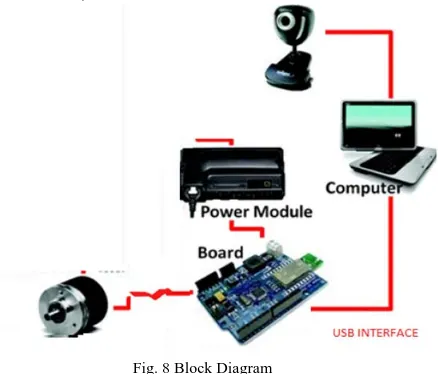
The hardware comprises of USB port connection to receive notifications, AVR controller interface to check
notification,
Fig. 8 Block Diagram
motor control to control gate as per control command, LCD interface to display & buzzer to generate alarm. The Block diagram is shown in Fig.8 and the original hardware design is shown in Fig.9
Fig. 9 Original Hardware Design
II. LITERATURE REVIEW
In the literature, various license plate detection algorithms are implemented and proposed yet license plate capturing has been studied for several years, and is a challenging task to track license plates from several angles, partial occlusion, or multipleinstances. Investigation of input image is done in license plate detection which identifies few local patches including license plates. Since a plate can exist anywhere in an image with several sizes, it is a bit tough to check every pixel to locate it. Most of the times, it is preferred to extract some features from images and concentrate only on those pixels featured by the license plate. On the basis of included features, traditional license plate detection techniques are criterion into three categories: On the basis of colour, edge-based, and based on texture. Colour-based concepts involve the conclusion that few countries follow specific colour in their license plates. Edge-based approaches are the most popular, as they give effective performance in the process of license plate detection. In this license plate is characterized by a rectangular shape with an exact aspect ratio, and can be extracted by checking all possible rectangles in the image some other approaches based on local features are being proposed in the recent times. A small description of few of the older works is demonstrated in literature introduction section.
In [1], LICENSE plate recognition methods are:(1)Image Acquisition using digital camera (2) License Plate Extraction: *vertical edge detection using sobel algorithm *filtering by seed *vertical edge matching (3) Segmentation (4) Character Recognition: * Normalization * Template matching using hamming distance technique. By referring this paper the results were like: License Plate Extraction: 587/610, 96.22% License Plate Segmentation: 574/610, 94.04% License Plate Recognition :581/610, 95.24%, and final estimated system efficiency: 95%. Detection only for white, black, red, and green color plate or numbers.
By[2], (1) Plate region extraction : Algorithms for edge detection and smearing approaches (2)segmentation of Characters: algorithms for filtering and some morphological operations (3)recognition of plate characters : template matching. Final output, it is proved to be %97.6 for the extraction of plate region, %96 for the segmentation of the characters and %98.8 for the recognition unit exact. The complete system performance has come to be %92.57 recognition rates . It has few constraints like the system implemented for the identification of Turkish license plates only.
the overall system, while the some more work is to be done to make the technique more efficient.
In[4],recognition by(1) Target recognition: by using feature-salience theory, features of license plates( include shape, symmetry , height-to-width ratio , colour, texture, and spatial frequency, Character features include lines, blobs , aspect ratio of characters, distribution of intervals between characters ,and alignment of characters) (2license plate locating by Hough transform (HT). (3) recognizing license characters by different steps like binarization, noise removal, and orientation adjustment, Optical Character Recognition. in this paper , the success rate for the identification with the set of 1144 license plates is 95.7%. Combining this rate with the location success (97.3%), the overall rate of success for our LPR algorithm is 93.1%.As pointed out in the preceding sections, although this system is intended for the recognition of Chinese license plates only .
By[5], Its main focus was on Edge Detection(Sobel Edge Detection)technique and then noise is filtered by Median Filter, Smoothing, Connector, Masking, ,and then Colour Conversation is done. It is seen that the detection is not that clear and proper, which is due to improper light segment or varying illumination effects and all over system result is not mentioned in this paper.
In the reference[6], The proposed algorithm consists of three major parts: (1) Plate region extraction: edge detection algorithm and vertical projection method are used (2) characters Segmentation: Approaches used are filtering, thinning and vertical and horizontal projection are used. (3) Plate characters recognition: Concept of chain code with different parameter is used for recognition of the characters.
The attainment of the proposed algorithm has been tested on real images. Total 150 vehicle’s Images were used for testing (tested under all the atmospheric and climatic conditions). Favourably Extracted license plates were 147 and Unsuccessful Extractions were 3 and final system EFFICIENCY: 98%. The proposed approach is mainly designed for real-time Malaysian license plate, and can be readily ellaborated to deal with license plates of other countries, such as using Latin characters.
By[7],Involve three approaches: (1)For plate localization: processes like colour space changement, modification in the Intensity dynamic range , Edge detection, Separating objects from background, Finding connected component , Candidate selection are used(2) Multistage model are used for segmentation (concept of Improvement, Rotation, Binarization are involved) (3) Artificial Feed forward neural network is used for the recognition of characters. The accuracy over 91% has been achieved for localizing plates. The accuracy of 97% and 94% has been achieved in recognition system implemented by neural networks after segmentation of characters in image plate identifying alphabets and numbers separately . Advantage of this approach is that the image of various vehicles is included in database with different backgrounds under varying illumination conditions and the disadvantage is that the detection can only be performed for English and Parisian number plate.
In[8] For the Number plate recognition (1) image is
converted to binary (2) applied to neural network, (3) mpl algorithm is applied (4) individual symbol is detected by matrix Mapping and Training . By this approach obtained 96.53% average recognition rate using double hidden layer and 94% using single hidden layer.
By[9](1) Histogram equalization was used for image Pre-processing (2)Edge detection algorithm was used for plate region extraction and Plate Area Detection by various morphological operations (3)Segmentation of characters by (i)connected component (ii)bounding box method (iii)Median filter and observed final result as Extraction :71/78 which gives 91.02% efficiency ,Segmentation 69/78 which gives 88.46%efficiency. overall accuracy of our system is 89.74%. The angle of view, physical appearance and environment conditions make this proposed method sensitive.
By[10]After the technique of Discrete wavelet Transform , the 3 process were given by 2D Haar : (1)location and extraction of the license-plate (2)train of the license-plate (3)real time scan recognition of the license-plate .By this paper results are as given: Vehicle recognition number:100, Successful Recognition number :93 , Failed Recognition number :7 ,Recognition rates (%) :93.0%. Advantage of Haar Discrete Wavelet Transform is that each time transform only needs 1/4 of the original image. Hence, this method have fast execution speed. The Disadvantage is that in this paper only specified cameras used like Using the CASIO EXILIM, 10.1 MEGA PIXELS DIGITAL CAMERA EX-S10, adjusting the resolution 480 x 640 for photography vehicle license plates.
In[11]Detection steps are :(1)From video image is acquired by capturing an image of a vehicle (2) Spectral Analysis Approach and Connected Component Analysis are used for License plate detection extraction (3)Spectral analysis is used for extracting the region of license plate (4)Connected component analysis approach and SVM feature extraction techniques are used for character segmentation. Successful recognition of a moving vehicle is the advantage of this approach.
TABLEI
TABLE OF %EFFICIENCY/MONTH OR YEAR
Year/Month % Efficiency
2003 95 2005NOV 92.57 2008JUNE 95 2009SEPT 93.1
2010 98 2011JULY 94 2011JULY 95 2011DEC 89.74 2012APRL 93
FIG.10OVER ALL SYSTEM % EFFICIENCY/YEAR
III.PROPOSED METHOD
The work is based on constructing and framing a man-machine combination with the usage of a video camera to depict a standard license plate and select the number from the license plate picture, the evidence of the number with excel database, real gate authority for valid/invalid vehicle and buzzer and email warning for invalid vehicle. The refined system uses a high resolution camera captured car plate pictures.
A. Algorithm for Software Part 1. Image capture via camera.
2. License plate detection(colored based plate
detection)and extraction(edge based extraction).
3. Number extraction using segmentation approach
(Horizontal and vertical segmentation)
4. Template matching for the comparision and
conversion of image to text.
5. Validation is done by comparing the detected
number with the excel entry.
6. MATLAB serial communication interface design. Acknowledgement is sent to the hardware for valid/invalid vehicle via serial communication.
7. Email interface in MATLAB via outlook. An
email is sent on invalid vehicle with attached image.
B. Hardware Design
1. Development ATMEGA 168 controller interface
design
2. Development of motor driver interface 3. Development of LCD interface
4. Development of USB interface on board
5. Development of controller code in Arduino
compiler
6. Interlinking the hardware with PC to interact with the MATLAB code.
IV.RESULTS
The paper focuses on the concept of embedded system and image acquisition by MATLAB has been included. With the concept of image processing the vehicle number is extracted from the vehicle image. Vehicle validity is checked and if it is valid the gate will be opened and there will be a notification display on LCD and if invalid the gate
will not be opened and corresponding message will be displayed on LCD.
The Excel Database for valid numbers is shown in Fig. 11. Image Results for valid License Plate Detection and Extraction in shown in Fig.12. The number is extracted using segmentation and stored as text in notepad. The image result is shown in Fig.13 .
Fig. 11 Excel Database for valid Numbers
Fig. 12 Image Results for Plate Detection and Extraction
Fig. 13 Image extracted and stored as text in notepad
Validation is done by comparing the extracted text to the excel entry and the acknowledgement is sent to hardware for valid/invalid vehicle via serial communication. Valid number result is shown in Fig. 14
Fig .14 Valid Number Plate result
For invalid all the image output are same except the number is invalid and the email interface as shown in Fig. 15 and Fig.16
Fig. 16 An e-mail sent for invalid vehicle number
The hardware interface is also tested for the control of gate, LCD display & buzzer system. The image is shown in Fig.9
V. CONCLUSION
The above research work implementation has used a fast algorithm for recognizing number plate for toll control application. Authors have designed an AVR based system that has ATMEL microcontroller embedded environment to receive fixed set of UART notification on a reasonably validated number plate and developed a user interactive ALPR system with validation using excel database.
In general, an ALPR system consists of four processing stages. In the image acquisition stage, while choosing the ALPR system camera some points have to be considered such as resolution of camera and its shutter speed. In the stage of license plate extraction , extraction of the license plate is done based on some features such as the color, the boundary, or the presence of the characters.In the license plate segmentation stage, the extraction of characters is done by projecting their color information, by labeling the characters, or by matching the positions of characters with template. In the final step, the recognition of characters in the character recognition stage is done by template matching technique, or by classifiers such as neural networks and fuzzy classifiers. Just because of formatting of various license plate it becomes quite a tedious task to automatically recognize license plate also backgrounds and environment increase the challenge. MATLAB based mail serial communication & email control has been developed by the author to interact with hardware & send notification on email.
In future, author finds that implementation of number plate based control system which can be utilized and functionally implemented on large scale by porting the software on small but powerful system like Raspberry Pi, it is a credit card sized computer system having its own processor, memory(SD card),VGA output, USB input etc, running on LINUX platform. It can run high level languages like Python, portable version of Mathematica and hence is very capable of implementing computer vision algorithm
REFERENCES
[1] Muhammad Sarfraz, Mohammed Jameel Ahmed, and Syed A. Ghazi ,“Saudi arebian licence plate recognition system”, International Conference on Geometric Modeling and Graphics (GMAG’03), 2003.
[2] Serkan Ozbay, and Ergun Ercelebi,” Automatic Vehicle Identification by Plate Recognition”, Processing of world academy of science engineering and technology vol9, ISSN 1307-6884, november 2005.
[3] Humayun Karim Sulehria, Ye Zhang, Danish Irfan, Atif Karim Sulehria,” Vehicle Number Plate Recognition Using Mathematical Morphology and Neural Networks”, WSEAS TRANSACTIONS on COMPUTERS, Volume 7,ISSN: 1109-2750, Issue 6, June 2008. [4] Zhen-Xue Chen, Cheng-Yun Liu, Fa-Liang Chang, and Guo-You Wang,” Automatic License-Plate Location and Recognition Based on Feature Salience”, IEEE Transaction on vehicle technology, VOL. 58, NO. 7, september 2009.
[5] Dr. P.K.Suri, Dr. Ekta Walia, Er. Amit Verma,” Vehicle Number Plate Detection using Sobel Edge Detection Technique”, International Journal of Computer Science and Technology, ISSN : 2229 – 4333, IJCST Vol. 1, Issue 2, December 2010.
[6] Kumar Parasuraman, Member, IEEE and P.Vasantha Kumar, “ An Efficient Method for Indian Vehicle License Plate Extraction and Character Segmentation”, IEEE International Conference on Computational Intelligence and Computing Research,2010.
[7] Muhammad H Dashtban, Zahra Dashtban, Hassan Bevrani, “ A Novel Approach for Vehicle License Plate Localization and Recognition”, International Journal of Computer Applications (0975 – 8887), Volume 26– No.11, July 2011.
[8] Stuti Asthana, Niresh Sharma, Rajdeep Singh, “Vehicle number plate recognition using multiple layer back propagation neural networks”, International Journal of Computer Technology and Electronics Engineering (IJCTEE), Volume 1, Issue 1, July 10, 2011.
[9] Chetan Sharma1 and Amandeep Kaur2, “ INDIAN VEHICLE LICENSE PLATE EXTRACTION AND SEGMENTATION”, International Journal of Computer Science and Communication, Vol. 2, No. 2, pp. 593-599, July-December 2011.
[10] R. T. Lee, K. C. Hung, and H. S. Wang,“Real Time Vehicle License Plate Recognition Based on 2D Haar Discrete Wavelet Transform”, International Journal of Scientific & Engineering Research, Volume 3, Issue 4, ISSN 2229-5518, April-2012.
[11] Lekhana G.C, M.Tech; R.Srikantaswamy, Professor,“Real time license plate recognition system”, International Journal of Advanced Technology & Engineering Research (IJATER) National Conference on Emerging Trends in Technology (NCET-Tech) ISSN, Volume 2, Issue 4, ISSN No: 2250-3536, July 2012.
[12] Wengang Zhou, Houqiang Li, Yijuan Lu, Member, IEEE, and Qi Tian, Senior Member, IEEE, “Principal Visual Word Discovery for Automatic License Plate Detection”, IEEE transaction on image processing ,vol21, NO. 9, September 2012.
[13] P.Sandhya Rani1, Vara Prasad,“License plate character segmentation based on pixel distribution density”, [IJESAT] International journal of engineering science and advanced technology, Volume-2, Issue-5, 1539 – 1542, Sep-Oct 2012.
S.
BISWAS, N. R. PAL* and S. K. P