REFERENCE ONLY
1~I)j
i
illjlijill~rllllllllllill"
1111119 1650961 4
UNIVERSITY OF LONDON
THE~I~Degree
,p-n
0
Name of Author ~0G-\.J\d , \
tICOPYRIGHT
This is a thesis accepted for a Higher Degree of the University of London. It is an unpublished typescript and the copyright is held by the author. All persons consulting the thesis must read and abide by the Copyright Declaration below.
COPYRIGHT DECLARATION·
I recognise that the copyright of the above-described thesis rests with the author and that no quotation from it or information derived from it may be published without the prior written consent of the author.
LOAN
Theses may not be lent to individuals, but the University Library may lend a copy to approved libraries within the United Kingdom, for consultation solely on the premises of those libraries. Application should be made to: The Theses Section, University of London Library, Senate House, Malet Street, London WC1E 7HU.
REPRODUCTON
University of London theses may not be reproduced without explicit written permission from the University of London Library. Enquiries should be addressed to the Theses Section of the Library. Regulations concerning reproduction vary according to the date of acceptance of the thesis and are listed below as guidelines.
A. Before 1962. Permission granted only upon the prior written consent of the author. (The University Library will provide addresses where possible).
B. 1962 - 1974. In many cases the author has agreed to permit copying upon completion of a Copyright Declaration.
C. 1975 - 1988. Most theses may be copied upon completion of a Copyright Declaration.
D. 1989 onwards. Most theses may be copied.
This thesis comes within category D.
This copy has been deposited in the Library of
Multigrade Teaching in Primary Schools in Nepal:
Practice and Training
Takako Suzuki
Thesis subl11itted in fulfilment of the requirements for the degree of
Doctor of Philosophy
University of London
Institute of Education
School of
Lifelong Education and International Developl11ent
Abstract
One or the 1110st significant unsolved issues in achieving Education for All is increasing the quality of education, especially among the most disadvantaged groups. In remote areas, where many of these groups live, primary schools are often organised as multigrade schools. In these schools. teachers are simultaneously responsible for two or more grades during one lesson period. However, multigrade teaching is often overlooked by both policy makers and researchers. Multigrade teachers are unsupported because mono grade teaching predominates. There is a very limited corpus of research on multigrade schools or mllltibrrade teaching.
This study aims to dra\v the attention of both policy makers and researchers to multigrade tcaching in the context of Nepal. The research is framed by five research questions: (l) What arc the contemporary and historical system characteristics of multigrade teaching? (2) What are the characteristics of multigrade primary schools? (3) What are the practices of multigrade teaching? (4) What kind of models of im10vation and change best explain current teacher training? (5) Does current training address the problems of multigrade classrooms and improve knowledge, competence and performance of teachers? The study relies on needs-based (i. e. context and input), process and output evaluations of multigrade teacher training, conducted during twenty months of fieldwork. The main sources of evidence were observations. intervie\vs, questionnaires, documentary analysis and focus group discussions.
It can be assumed that multigrade schools are prevalent in Nepal. Although no clearly stated policies on multigrade teaching have been established, special in-service training for mu Itigrade teaching is conducted. The practice of multigrade teaching in classrooms is diverse. Detailed observation identifies five different pattems of multigrade class organisation. This typology serves as a tool for both policy makers and researchers for understanding effective practice in the classroom. The evaluations trace the process of teacher training from the central to resource centre level, and eventually to the classrooms. Current training is inspired by diffusion-oriented models of innovation and change. While trainees gain knowledge and competence in 'practice teaching' during the training course, its ['inal impact of the course on teacher performance in the classrooms remains modest. Problems in the training process are identified and recommendations for future
Table of Contents
Abstract. ... 2
Table of Contents ... 3
List of Tables ... 10
List of Figures ... 14
List of Abbreviations ... 15
Ackno\vledgen1ents ... .16
Preface ... 18
Chapter One: Introduction ... 21
1.1 Rationale for the study ... 21
1.2 Previous research ... '" ... " ... 23
1.3 Approach to the study ... 24
1.4 Research questions ... 25
1.5 Organization of the study ... 27
Chapter Two: Policies, Strategies and Practices of Multigrade Teaching: A
Review of Experience in Developing Countries ... 29
2.1 Literature on policies on multigrade teaching ... 29
2.1.1 Policy diversity ... '" .... 29
2.1.2 Countries with policies directly related to multigrade teaching ... 30
2.1.3 Countries without policies directly related to multigrade teaching ... 31
2.2 Literature on strategies for multigrade teaching ... 32
2.2.1 Combined strategies ... 33
2.2.2 Single strategies ... 34
2.2.3 Two perspectives on multigrade teaching ... 36
2.2.4 Countries without strategies specially targeted multigrade teaching ... 38
2.3 Literature on context of multigrade schools ... 39
2.3.1 The location of multigrade schools ... 39
2.3.2 Disadvantaged communities ... .40
2.3.3 Physical conditions of multigrade schools ... .41
2.3.4 General characteristics of teachers in multigrade schools ... .41
2.3.5 General reputation of multigrade teaching ... .42
2.4 Literature on practice in multigrade classrooms ... .43
2.4.1 Combination of grades ... .43
2.4.2 One-room and separate rooms ... .43
2.4.3 Classroom environment. ... '" ... .44
2.4.4 Class organisation ... .44
2.4.5 Direct teaching in one class and assigned tasks for another class ... .45
2.4.6 Managing all grades simultaneously with frequent short visits ... .47
2.4.7 Teaching activities ... 47
2.5 Literature on problems relating to the classroom practices of multigrade teaching ... .49
2.5.1 Negative perceptions of multigrade teaching .. " ... " ... .49
2.5.2 Teacher-related constraints and teacher training ... 51
2.5.3 Teaching and learning materials ... 52
2.5.4 Isolation and supervision ... 53
2.6 Conclusion ... 53
2.6.1 Policies and strategies: the international context ... 54
2.6.2 Schools and classrooms: the international context ... 55
Chapter Three: The Current Situation, and Strategies for Multigrade Teaching
in Primary Schools in NepaL ... 58
3.1 Primary education in NepaL ... 58
3.1.1 A country profile ... 58
3.1.2 Education system ... 60
3.1.3 The place of primary education in education policies ... 62
3.1.4 Finance in primary education ... '" ... 63
3.1.5 National curriculum of primary education ... 64
3.1.6 Primary school teachers ... 65
3.1.7 School cluster systems ... 66
3.2 Multigrade teaching in primary schools ... 66
3.2.1 Frequency of multigrade teaching ... 66
3.2.2 Rapid expansion of primary schools and multigrade teaching ... 68
3.2.3 Low quality of education and multigrade teaching ... 70
3.2.4
r
nequity in disadvantaged populations and multigrade teaching ... 713.3 History of multigrade teaching in Nepal.. ... 73
3.3.1 The inception of a modern graded education system: 1951-1975 ... 74
3.3.2 Intention and implementation ... 76
3.3.3 Reality of multigrade schools ... 77
3.3.4 The emergence of two major projects in support of multigrade teaching in the 1980s ... 77
3.3.5 The Basic and Primary Education Project (BPEP) in the 1990s ... 80
3.4 Current strategies fot multigrade teaching ... 84
3.4.1 Basic Primary Teacher Training ... 84
3.4.2 Multigrade Teaching Training ... 85
3.5 Conclusion ... 86
Chapter Four: Research Design and Methods ... 88
4.2 Multigrade Teaching Project. ... 89
4.3 Evaluation study ... 90
4.3.1 Needs-based evaluation ... 91
4.3.2 Process evaluation ... 92
4.3.3 Output evaluation ... 93
4.4 Research Access ... 94
4.5 The role of the researcher. ... 95
4.6 Research methods for data collection ... 96
4.6.1 Observations ... 98
4.6.2 Interviev/s ... 100
4.6.3 Questionnaire ... 102
4.7 Sample selections ... 103
4.7.1 School visits ... .104
4.7.2 Training evaluation ... 105
4.8 An account of data analysis ... 106
4.8.1 Practice of multigrade teaching ... 106
4.8.2 Training policies for multigrade teaching ... 107
4.8.3 Evaluation of the training ... 107
4.8.4 Underlying causes of training results ... 108
4.9 Ethical issues ... 109
4.10 Limitations and challenges ... 110
4.10.1 Being an outsider: weakness and strength ... 11 0 4.10.2 Language issues: visual indicators, back-translation and field pre-test. ... 111
Chapter Five: Current Conditions of Multigrade Primary Schools
in
Nepal ... 113
5.1 District profile ... 113
5.1.1 Central department of the hill region ... 113
5. I .2 Nuwakot district ... .113
5. I .3 I(avre district. ... 115
5.104 Primary educational context in the two districts ... 115
5.1.5 Multigrade teaching in the two districts ... 116
5.2 Multigrade primary school characteristics ... 119
5.2.1 Location and size of schools ... 119
5.2.2 Physical facilities ... 121
5.2.3 Community support. ... 122
5.2.5 Supervision ... 125
5.2.6 School leadership ... 126
5.2.7 Teachers ... 128
5.2.8 Student attendance rates and academic achievement. ... 130
5.3 Conclusion ... 132
Chapter Six: Current Practices in Multigrade Primary Classrooms in
Nepal ... 135
6.1 Multigrade primary classrooms ... 135
6.1.1 Classroom environment ... 135
6.1.2 Combination of grades and timetables ... 135
6.2 Five patterns of multigrade class organisation ... 138
6.2.1 Pattem one: shifting from multigrade to monograde teaching in the whole school ... 139
6.2.2 Pattern two: dividing a lesson period equally into two time sections ... 142
6.2.3 Pattem three: teaching as a main teaching class and a selflearning class .... 144
6.2.4 Paitem four: visiting each different classroom frequently during a lesson period ... 145
6.2.5 Pattern five: whole class teaching for extra cUlTicular subjects ... 148
6.2.6 Revisiting the mini case studies ... 149
6.2.7 Questionnaire ... 150
6.3 Teaching activities in multigrade classrooms ... 151
6.3.1 Teaching activities ... 151
6.3.2 Use of teaching materials ... 152
6.3.3 Learning a1110unt. ... 152
6.4 Problems with multigrade class organisation ... .153
6.4.1 Diversity in teacher responsibilities for multigrade teaching ... 153
6.4.2 The ladder of multigrade teaching .. , ... 155
().5 Teacher perception of problems in relation to multigrade teaching ... 156
().5.1 Negative perception of multigrade teaching ... 156
6.5.2 Problems which the teachers take into consideration ... 157
6.6 Teacher perception of the needs of multigrade teaching ... 160
6.6.1 Teacher training ... 160
6.().2 Physical facilities and teaching materials ... 162
6.6.3 Supervision and others ... 162
Chapter Seven: The model of Multigrade Teaching Training with regard to
innovation and change ... 166
7.1 Models of innovation and change in educational practice ... '" .166 7.1.1 Equilibrium and conflict paradigms ... 167
7.1.2 Innovation-oriented models ... 168
7.1.3 Diffusion-oriented models ... 170
7.1"+ User-oriented models ... 172
7.1.5 Power-oriented models ... 174
7.1.6 The relevance of different models of innovation and change to teacher development in NepaL ... 175
7.2 Analysis of the training package of Multigrade Teaching Training ... 177
7.2.1 How the training package is developed ... .177
7.2.2 The research conveyed for development. ... 177
7.2.3 The ideal model of multigrade teaching ... 178
7.2.4 Key concepts for multigrade teaching ... 178
7.2.5 Model lessons for class demonstration ... 180
7.2.6 A model for Self Leaming Activity (SLA) ... 180
7.2.7 Analysis of training material in relation to multigrade teaching ... '" .180 7.2.8 Structure of the training materiaL ... 182
7.2.9 Style of the training materiaL ... 182
7.2.10 Quantitative volume ofsections ... 183
7.2.11 Analysis of training material in relation to local context ... 184
7.2.12 Training handbook for the trainer. ... 185
7.3 Analysis of the cascade system of Multigrade Teaching Training ... 185
7.3.1 Effectiveness of the cascade system ... 185
7.3.2 How the messages are diffused in Nepal ... 187
7.3.3 Trainers ... 188
7.3.4 Diffusion of training courses ... 189
7.4 Trainees of Multigrade Teaching Training ... , ... 190
7.4.1 Characteristics of the trainees ... 190
7.4.2 How the trainee-teachers are involved ... 192
7.4.3 The role of teachers in the implementation of the training programme ... 192
7.5 Conclusion ... 193
Chapter Eight: Input Evaluation of Multigrade Teaching Training ... 195
8.1 The linkage in the cascade system ... 195
8.2 Training plan for Master Training of Trainers (MTOT) ... 196
8.3 Structural gaps in the cascade system ... 197
8.4 Knowledge transfer by the trainers ... 198
8.S ('onclusion ... 200
Chapter Nine: Process Evaluation of Multigrade Teacher Training ... 203
(), 1 The motivation and the expectation of the trainees to participate in the training 9.1 .1 Motivation of the trainees ... '" ... 203
9.1.2 Expectation of the trainees ii'om the training ... 204
9.2 Observation of the training ... 205
9.2.1 Training conditions in Nuwakot district. ... 205
9.2.2 Training conditions in Kavre district. ... 206
9.2.3 Physical conditions for group work ... 208
9.2.4 Implementations ... 209
9.2.5 Instruction of the trainers ... 210
9.2.6 Practice teaching ... 211
9.2.7 Observation forms ... 211
9.2.8 Attitude of the trainees ... 212
9.3 Self-evaluation of the training prograllli11e by the trainees ... 212
9.3.1 Detailed evaluation of the training ... 213
9.3.2 Trainee perception of multigrade teaching after the training ... 215
9.4 Follow up support by the trainers ... 217
9.S Conclusion ... 217
Chapter Ten: Output Evaluation of Multigrade Teacher Training ... 219
10.1 Trainee lmowledge concerning multigrade teaching before the training ... 219
10.1.1 Nuwakot district. ... 219
10.1.2 Kavre district ... '" ... 220
1 O.2Knowledge on multigrade teaching acquired by the trainees during the training ... 221
10.2.1 The most 'impressive' components of the training ... 222
10.2.2 Comprehension of multigrade teaching before and after the training ... 223
10.2.3 Knowledge of multigrade teacher-trainees before and after the training ... 226
10.2.4 Competence to apply and act on newly acquired knowledge ... 238
1 O.3Performance of multigrade teaching in the classroom before and after the training ... 230
10.3.1 Class observation of five multigrade teacher-trainees ... 230
10.3.2 Trainee IZavre-12 ... '" ... 232
10.3.3 Trainee Kavre-4 ... 235
10.3.4 Trainees Nuwakot-B22 and Nuwakot-R2 ... 236
10.3.5 Trainee Nuwakot-B3 ... 237
10.3.6 Other changes in the classroom after the training ... 240
1 0.5Conclusion ... 243
Chapter Eleven: Conclusion ... 245
11 .1 Learning from findings on multigrade teaching practice and training ... 245
11.1.1 System characteristics of multigrade teaching in Nepal. ... 245
11.1.2 Practice of multigrade teaching ... 247
11.1.3 Training for multigrade teaching ... .250
11.2 The place of fIndings in the context of the international literature on multigrade teaching ... 257
11.2.1 The place of Nepalese multigrade teaching ... 257
11.2.2 The effectiveness of teacher training ... 258
11.3 Recommendations concerning innovations ... " ... 261
11 .3. I I mprovement of the diffusion-oriented model ... 262
11.3.2 Further research towards increasing awareness of the realities of multigrade Appendix 1 Appendix 2 Appendix 3 Appendix 4 Appendix 5 Appendix 6 Appendix 7 Appendix 8 Appendix 9 Appendix 10 schools ... '" ... 264
Map showing the place of the case study districts ... 266
Description of the training material for the trainees ... 267
Description of the training handbook for the trainer ... 269
Questionnaire distributed at the begilming of training ... 271
Evaluation form distributed at the end of training ... 280
Activities in Master Training for Trainers (MTOT) in Chitwan distI1Ct.. ... 288
Activities in District Training of Trainers (DTOT) in Kavre district. ... 292
Field note on Resource Centre Training (RCT) in Nuwakot district ... 298
Field note on Resource Centre Training (RCT) in Kavre district. ... 305
Focus group discussions with Resource Centre Training (RCT) trainers .... 31 0 References ... " ... " ... 313
Supplementary bibliography ... 325
List of Tables
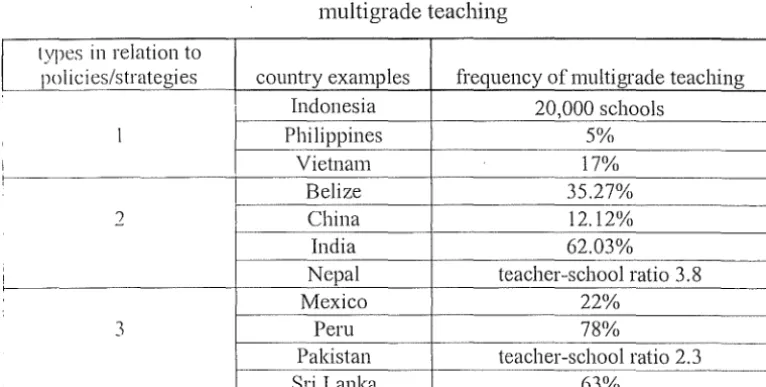
2-1 The fj"equency of multigrade teaching and the availability of specific policies in
twenty-one developing countries ... 30
2-2 Strategies and programmes for multigrade teaching ... 32
7 ..., --.. '" Teacher training and other strategies for multigrade teaching ... 35
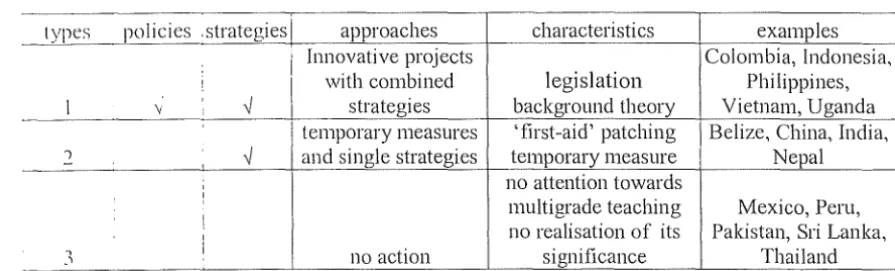
2-4 Typology of countries in relation to multigrade teaching ... 54
Three trends of class organisation ... 55
2-6 Three trends of class organisation ... 56
Status of multigrade teaching in Nepal.. ... 58
Areas and population density per square kilometre in Nepal (1991) ... " ... 59
Curriculum structure at primary level, by subject (hours/week) ... 65
Primary teacher qualification, by region (% in 1998) ... 65
Primary school teacher to school ratios in Nepal, by region (1998) ... 67
3-6 Primary school teacher to school ratios, by depaliment and region (1998) ... 68
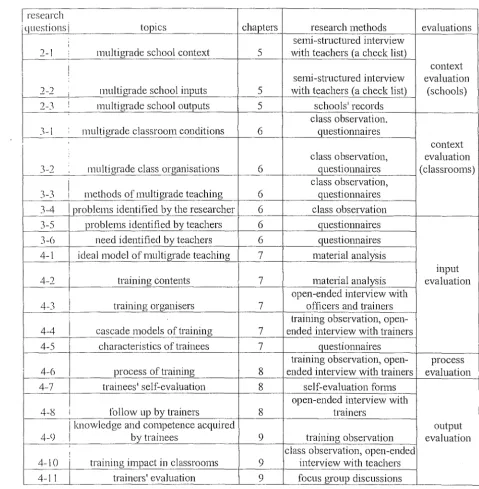
4-1 The fj"amework of evaluation of teacher training ... 90
4-2 Research methods used in the fieldwork ... 97
4-3 Number of primary multigrade schools and teachers selected for understanding of Illultigrade teaching ... 105
4-4 Multigrade training sessions observed for evaluation ... '" ... 105
4-5 Number of training trainees researched in the evaluation ... 106
5-1 Primary teacher-school ratios in Central depaliment of the hill region (1998) ... 113
5-2 Estimated crop production in 1999 (m. tons) ... 114
.5-3 Primary educational indicators in Nuwakot and Kavre districts ... 116
.5-4 Multigrade primary schools in Nuwakot and Kavre districts ... 117
.5-.5 Primary teacher qualification in Nuwakot and Kavre districts (%/1998) ... '" .. 118
5-6 Number of teachers receiving in-service multigrade teacher training ... 118
.5-7 Location and size of case study schools in Nuwakot district ... 120
5-8 Location and size of case study schools in Kavre district. ... '" ... '" ... 120
.5-l ) Physical Cacilities of the case study schools in Nuwakot district ... 121
.5-10 Physical facilities of the case study schools in Kavre district. ... 122
.5-1 I Community support for the case study schools in Nuwakot district. ... 123
5-13 Frequency of visits by Resource Persons in the case study schools in Nuwakot district ... 126
5-14 Frequency of visits by Resource Persons in the case study schools in Kavre district ... 126
5-1 5 Characteristics of the headmasters and headmistress in Nuwakot district ... '" .127 5-16 Characteristics of the headmasters and headmistress in Kavre district ... 128
5-17 Teacher characteristics in Nuwakot district.. ... 129
5-IS Teacher Characteristics in Kavre district.. ... 130
5-1 l) Repetition rates in Nuwakot district (%) ... 131
5-20 Dropout Rates in Nuwakot district CV<J) ... 131
5-21 District Common Academic Test Score for Grade 5 in Nuwakot district (1999) ... 132
(l-I Combination of grades in Nuwakot district ... , ... 136
(l-2 Combination of grades in Kavre district.. ... '" ... 136
(l-3 Formal timetable for Parvati primary school (SN5) ... 137
()-4 Formal timetable in Kartik primary school (SN7) ... 138
()-5 Theoretical morning lessons of Teachers A and B, timetable ofShakti primary school.. .... 140
6-() Actual practice of time allocation of Teacher A in Shakti primary schooL ... 140
(l-7 Formal timetable for Krishna primary schooL ... 142
(l-S An example of time allocation for two grades, actions during one lesson ... 143
(l-9 Allocation of teacher time in Kali primary schooL ... 144
(1-J () Content and amount of SLA assigned at Kali primary school ... 145
(l-J I An example of SLA assigned at Kali primary school. ... 145
{}-12 Formal timetable for Durga primary school ... 146
Cl-13 Movement of Teacher B in Durga plimm'y school ... '" .146 (l-14 IVlovement of Teacher Bin Durga primary school, later research ... 147
(l-15 Lessons with whole class teaching ... 148
(l-16 Patterns of multigrade class organisation in the 12 classrooms of the mini case studies ... 149
(l-17 Multigrade class organisation among the teachers in the two Res ... 151
(l-IS Coverage of textbooks for Grade 5 in tlu'ee schools ... 153
()-19 The characteristics and diversity of multigrade class organisation ... 154
()-20 Is multigrade teaching different from monograde teaching? ... 158
()-2l Do you have any problems when you teach multigrade classes? ... 158
(l-22 Types of'problems with multigrade teaching for the teachers ... 159
()-23 Necessary factors for solving multigrade problems, according to teachers ... 161
7 -I M appi ng 0 f' the models of educational ilU1ovation and change ... 167
7-2 Three orientations and questions to examine the innovation model of Nepal. ... 176
7-:' Relation bet\veen contents and multigrade teaching ... 181
7--1- Distribution of the training material. ... 184
7-) Structure of Multigrade Teaching Training in the cascade system ... 187
7
-c)
The expansion of the training in terms of the number of trainees ... 1907 -7 Number of trainees who had Multigrade Teaching training before ... 190
7-8 Number or headmasters and headmistress among the trainees ... 191
7-() Number of trainees and number of multigrade teachers ... 191
7-1 () Summary of orientations explaining the training model of Nepal ... 194
8-1 Background information on trainers in Multigrade Teaching Training ... 196
8-2 Training material covered by each trainers ... 197
8-:' Model teaching by the trainer and practice teaching by the trainees ... 199
8-4 Models of various types of diffusion ... 201
()-l Reasons \vhy the trainees take the training ... 204
()-2 Topics lI'om the training curriculum and expectation of the trainees ... 205
t)_:, Effective training hours in Nuwakot district ... 206
9-4 Ti me spent for training sessions in Nuwakot district. ... 206
9-5 Effective training hours in Kavre district.. ... 207
9-6 Time spent for training sessions in Kavre district ... 208
9-7 Trainee comments on the future of training in Kavre district ... 213
t)-8 Trainee comments on the future of training in Nuwakot district. ... 214
10-1 Trainee knowledge concerning multigrade teaching in Nuwakot district. ... 220
10-2 Trainee knowledge concerning multigrade teaching in Kavre district. ... 221
10-:' Most impressive components of the training in Nuwakot district. ... 222
10-4 Most impressive components of the training in Kavre district ... " ... 223
10-5 Knowledge concerning multigrade teaching before/after the training in Nuwakot district (1) ... 224
IO-() Knowledge concerning multigrade teaching before/after the training in Kavre district (I ) ... 224
10-7 Knowledge concerning multigrade teaching before/after the training in Nuwakot district (2) ... 224
IO-() Knowledge concerning multigrade teaching of 111ultif,'Tade teacher-trainees in
Nu\vakot district ... 227
10-10 Knowledge concerning multigrade teaching of multigrade teacher-trainees in Kavre district. ... 227
10-1 I Practice teaching in Nuwakot district.. ... 229
10-12 lnformation on the five trainees selected ... 231
I 0-1 ~ School information for the five trainees selected ... 231
I {)-I-l- Knowledge concerning multigrade teaching of the five trainees selected ... 232
10-15 Multigrade class organisation and adaptation of training components by Trainee l(a\Te-12 ... " ... 232
10-1 () Content and amount of SLA provided by trainee Kavre-12, pattern 2 ... 234
10-17 Multigrade class organisation and adaptation of training components by Trainee Kavre-4 ... 235
10-18 Multigrade class organisation and adaptation of training components by Trainee N u\~lakot-B22 ... 236
10-19 Multigrade class organisation and adaptation of training components by Trainee N u\vakot- R2 ... " ... " ... , ... '" ... 237
10-20 Multigrade class organisation and adaptation of training components by Trainee Nu\vakot-B3 ... 238
10-21 Content and amount of SLA provided by trainee Nuwakot-B3, pattern three ... 239
10-22 Changes in the classroom of trainee Kavre-12 after the training ... 240
10-23 Changes in the classroom of trainee Kavre-4 after the training ... 241
10-24 Changes in the classroom of trainee Nuwakot-B22 after the training ... 241
10-25 Changes in the classroom of trainee Nuwakot-R2 after the training ... 242
10-26 Changes in the classroom of trainee Nuwakot-B3 after the training ... 242
List of Figures
,\-1 Progress in the number of primary schools and teachers ... 69
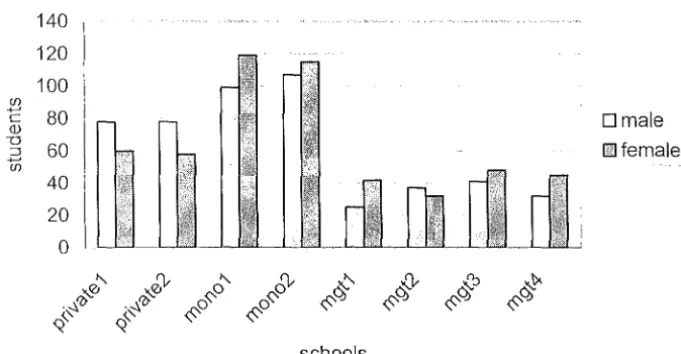
J-2 Studcnt attainment in 8 schools within a VDC in Kavre district (2001/02) ... 72
J-J Caste/ethnic groups and types of schools in a VDC in Kavre district (2001102) ... 73
,\--+
Studcnt distribution of8 schools in a VDC in Kavre district (2001102) ... 73(1-1 Pattern two to five of multigrade class organisation for one lesson period ... 139
Cl-2 Ladder of multigrade class organisation ... 156
10-1 ;Vlultigrade class organisation 'Pattem 2+SLA' ... 233
ADB 13NP
UPE
( '[RID
DANIDA
DEC DEO DOE DTOTEFA
ELl FINNJDA (jERII f'viCi
IDA
I 1"1 p.'\( ''I'
INGO JICA KG IVIGT MTOT MTP f'vIOE IVIOEC IVIOES fVIOESW
NeED
NESP NER NCjO NORAD NPA PEDPPEP
PTTC PTTU PRO/\P RC 1\(''1'S[RDP
SIDASLA
SLCSN
TOT TTC 'I'lll JNESCO
llNICEF l'SAID VDCList of Abbreviations
Asian Development Bank
Basic Needs Progranm1e (Nepal)
Basic and Primary Education Project (Nepal)
Research Centre for Educational Innovation and Development (Nepal) Danish International and Development Assistance
Distance Education Centre (Nepal) District education Office/Officer Department of Education (Nepal) District Training of Trainers Education for All
European Union
Finish International and Development Assistance Gross Enrolment Rate
His Majesty's Government (of Nepal) I nternational Development Association
I nstructional Management by parents, Community and Teachers International Non Governmental Organisation
Japan International Cooperation Agency Kindergarten
Multigrade Teaching Master Training of Trainers
Multigrade Teaching Project (UNICEF) Ministry of Education (Nepal)
Ministry of Education and Culture (Nepal) Ministry of Education and Sports (Nepal)
Ministry of Education, Culture and Social Welfare (Nepal) National Centre for Educational Development (Nepal) National Education System Plan in 1971 (Nepal) Net Enrolment Rate
Non Governmental Organisation Norwegian Agency for Development National Plan of Action (Nepal)
Primary Education Development Project (Nepal) Primary Education Project (Nepal)
Primary Teacher Training Centre (Nepal) Primary Teacher Training Unit (Nepal)
Principal Regional Office for Asia and the Pacific (UNESCO) Resource Centre
IZesource Centre Training
Scli Education for Rural Development Project (Nepal) Swedish International Development Authority
Sell'-Leaning Activity
School Leaving Certificate after completion of tenth Grade (Nepal) Serial Number
Training of Trainers
Teacher Training Centre (Nepal) Tribhuvan University (Nepal)
United Nations Educational Scientific and Cultural Organisation United Nations Children's Fund
l J nited States Agency for International Development Vi llagc Development Committee
Acknowledgements
I would like to express my infinite gratitude to Professor Angela Little. With a lot of sophisticated academic supervision, she has navigated me along a dark and long path, from
L_ondon. Sri Lanka and the Isle of Man to London, Nepal and Japan. She has given me high Ljuality academic guidance and generous academic freedom, as well as made available to me her wide ranged network of international contacts. I definitely could not have completed this study without her. I sincerely appreciate her invaluable support.
I would also like to acknowledge the support of Dr. Kevin Lillis, a specialist in the Department lor International Development (DfID) in Kathmandu and alunmi member of the Institute of Education. He has introduced me to key persons in Nepal and helped me to set up
Illy field research. I was introduced to him through the strong global network of contacts of the I nternational Development Unit of the Institute of Education.
I express my gratitude to Dr. Hridaya Ratna Bajracharya, the executive director of the Research Centre tor Educational Innovation and Development (CERID), at Tribhuvan Uni\'ersity in Kathmandu. He was my local advisor in Nepal. He made available to me his long I ist of contacts and provided me with academic advice as well. He introduced me to exactly the right persons to contact and provided me with useful fresh information. Furthermore, he encouraged me to contribute an article to his academic joumal. Work on this article helped me to sort out my accumulated data and confused thoughts, and eventually allmved me to identify the ladder of multigrade class organisation.
iVlany parts of this study owe much to the professional, and social, suppOli of various researchers at CERID. They are experienced experts of educational research in Nepal and have supported me for twenty months. Most notably, their suppOli made possible the cumbersome back-translation of my questiOlmaires and evaluation forms. I would like to express particular gratitude to Suresh Shakya who patiently typed several versions of the Nepalese-language questionnaires and evaluation forms. I am also grateful to all stafT at CERID who accepted me like a sister to the warm CERID family.
I would like to acknowledge the assistance of Neera Shakya from the Primary Teachers' Tmining Unit in Sanothimi. Without her professional and administrative support, I could not have evaluated teacher training and followed all levels of training through the cascade system. I am also grateful to the section officers who were in charge of training courses in Sanothimi. as \vell as Chitwan, Rupandehi, Nuwakot and Kavre districts, all trainers and trainees at all training levels, who accepted my presence at their training sessions and, in active discussions, inspired me with their thoughts on multigrade teaching.
(and olten climbed) \\lith me for miles and miles to take me to the multigrade schools of their area.
or
course this study would not have been possible without the support and understanding of all headmasters and headmistresses, teachers and students of the multigrade schools I have \'isited in Nuwakot, Kavre and other districts. Despite of my repeated and relatively long \isits. they always patiently v,relcomed me, and gave me important opportunities to observe thei I' classrooms.This research has been conducted within the framework of the Multigrade Teaching Project directed by Professor Angela Little. I appreciate her generosity to let me join this project. Working with a team has helped me to work more enthusiastically. The tlu'ee annual workshops or the project have systematically forced me to meet precise deadlines, and have prO\'ided opportunities to present the current stage of my research and reflect on its findings. The colleagues of the team,' coming i1-om four different countries, have greatly encouraged me. iVlanjula Vidanapathirana in particular has supported me throughout the duration of this research. both professionally and emotionally.
The project has also given me valuable opportunities to visit multigrade schools in Wales, Vietnam. Sri Lanka, Peru and Colombia. At the same time, support i1-om the Japan International Co-operation Agency (nCA) has allowed me to visit multigrade schools in Bolivia. The Graduate School of Intemational Development (GSID) at Nagoya University has given me the opportunity to visit a multigrade school in Japan. These experiences of visiting multigrade schools in both industrialised and developing countries, have inspired me to approach multigrade teaching with a holistic and broad view, bringing new insights and understanding for this study.
Fundamental field research skills were acquired during the Overseas Field Work ProgranU11e in Indonesia. organised by GSID, and the RRAJPRA Field Work Programme in Thailand, organised by the Foundation for Advanced Studies of Intemational Development of Japan (FJ\SID). I have been taught advanced English rhetoric through the .rICA Expert Training Advanced English Courses in Tokyo. Careful and patient proof reading of this thesis has heen done by Hartmut Ziche, who motivated and encouraged me to return to the academic Ilekl alter years of absence following my first degree.
Finally. this research would not have been feasible without substantial financial support i1'om .lapan. This study \vas funded mainly by nCA, with supplementary funding from Rotary International and the Moriyasu Foundation. I am grateful for all financial support which has allowec!me not to hesitate \vhen it was necessary to extend any research activities.
Preface
In March 1995, I \vas sent to inland Brazil to teach Japanese. This was my first experience of working in a developing country. When I went to the school on the first day, I was surprised, hecause there was only one teacher and one large classroom for several grades of students. Yes, it was a l11ulti brrade schoo!. It was my first contact with multigrade teaching.
/\s Illost ordinary monograde teachers, I had a negative opinion on multigrade teaching. Especially because I was supposed to teach a second language, I thought that multigrade teaching \\'as ridiculously nonsense. First of all, I did not know how to deal with multigrade students. I had never studied international development. I grew up in urban Japan. I had always been educated in a mono grade teaching system. I had trained as a primary school teacher in a teacher training college, but the pedagogical techniques I had learnt were all for Illonograde teaching. Since I did not speak Portuguese, I had been trained to teach Japanese as a foreign language using direct teaching methods. I did not know what to do in a IllU Iti I.!:rae!e classroom.
. ~
During my stay in Brazil there were two opportunities to take in-service teacher training. Twice the local Brazilian teacher and I took the bus, each time for hours, once to Sao Paulo and once to the district capital, Presidente Prudente, to attend training. We expected the training to provide us with some solutions to improve our teaching. We needed training and did appreciate the opportunity for it. Therefore, on the bus going to the training course we were excited. By contrast, on the way back home we were exhausted with disappointment. My colleague kept repeating: 'It was interesting, but does not suit our school.' It is true in ract that the training was not useful at all for multigrade teaching. It focused on linguistics and language skills, using new teaching material. It would be useful only after we had successfully managed multigrade teaching. However, we were far from the level where we coule! have adopted the sophisticated new techniques presented during training.
I was rrustrated, because I did not know how to teach multigrade classes without any theoretical knowledge on multigrade teaching. After several months of low quality teaching, I Ilnally decided to put a stop to this. If teacher shortage was the cause of multigrade teaching, I would devote all my time to teaching. I restructured the school into several small Illonograde classes, instead of the one large multigrade class. In order to teach grade-wise I conducted oral and written placement tests for all students and formed groups of students with similar abilities. Then I happily started teaching classes using monograde teaching methods.
In that small t 0\\1 11 , the choice was between multigrade teaching or nothing. In order to
maintain access to education, multigrade teaching was unavoidable. However, few people including experts are aware of the reality of multigrade teaching. No support was available 1'01' multigrade teaching. Under such conditions, something had to be done for multigrade tcaching to maintain the quality of education. No further innovations in teaching could be i ntrociuced bef'ore multigrade teaching had reached a level of sophistication and stability where it could adopt them. In the end I completely abandoned teaching.
The bitter experience in Brazil gave me a lesson to learn. If I was not prepared to wrestle with the reality of multigrade teaching, I could only abandon it. I could not understand the deep. I'unciamental significance of multigrade teaching. This experience, and consequent rcllection. motivated me to immerse myself into serious research on multigrade teaching.
A !'ter returning to Japan in 1997, I entered Nagoya University to take a MA course in education and international development. There my senior colleague Chiaki Miwa introduced me 1'01' the 1\ rst time to the Escuela Nueva, a systematic multigrade teaching progranul1e run in Colombia. She \vas a good friend of Vicky Colbert, conducting school-based research in Colombia. \Vhile our lecturer, Professor Morikazu Ushiogi, was away for some weeks, \'isiting pro fessor William Cummings gave me my very first academic lecture on multibrrade tcaching, based on his nev,rly published book 'Quality Education for All' (1997). Of course this lecture dealt with multigrade teaching from an academic point of view, but it precisely conlirmed the thoughts which had emerged from my own experience. As it happened, Pro!'essor Ushiogi had been away to visit the Escuela Nueva in Colombia. When he came back. he enthusiastically explained the system using piles of collected documents.
The experience of the first year of my MA studies increased the motivation stemming from my lkld experience. It encouraged me to want to write a dissertation on multigrade teaching. I n 1998. I handed in a proposal to work on multigrade teaching. However at that stage my professors were against it, because, they said, it would be too difficult, given the scarcity of literature. the weakness of background theories and the difficulty of selecting a precise aspect or multigrade teaching to focus on. All this was true and indeed understandable. Reluctantly I abandoned multigrade teaching as a topic and wrote my MA disseltation on something else.
In March 1999, Professor Angela Little offered me to join her Multigrade Teaching Project at the Institute of Education. I was very surprised indeed. She said that she was going to tackle this difficult topic with a project team. I could not believe it. I read her project proposal many times. I hesitated about joining her project, because I knew that it would be difficult. However. in the end I decided to come back to London, because multigrade teaching had reall y been the reason why I had statted development studies in the first place.
Today, conducting research on multigrade teaching is still a frontier. Very little research has been done so far. Multigrade teaching is often presented as second-rate teaching and negatively perceived. Thus there was no paved road and I often got lost. I cannot count how many times I have regretted not following the reasonable advice of my Japanese professors. However. ten project members were already on board, navigated by an experienced captain, Prol'cssor Angela Little, on a wide-open, undiscovered ocean, confronting the big waves of strong negative opinions, scarce literature and inaccessible information. Encouraged by our brave and energetic captain we were able to overcome these difficulties. This thesis is all about the story of our adventure - which I enjoyed all tlu·ough.
19
Dedicated to illy parents and my brother,
Akiko, Yasuo and I(oichi Suzuki,
who have been giving Ine invaluable support,
as well as to
nly grandInother, Shige Suzuki,
Chapter One
Introduction
1.1 Rationale for the study
Decades 0 f dJort tmvards universal education have brought rapid expansion of access to
primary education for large populations in developing countries. Today, one of the most
significant remaining issues is to increase the quality of education, especially for the most
disadvantaged groups including the poor, rural communities, ethnic minorities and girls. In
remote areas where these groups are living, primary schools are often organised as
multigrade schools.
Multigrade schools, in vvhich teachers are responsible for two or more grades simultaneously
during one lesson period, are often in remote areas, because there is no way for children to
gain access to other schools (Berry, 2001). Despite its significance, multigrade teaching has
been overlooked by education policy makers in the research agenda, teacher training,
curriculum, assessment, scholarships, teachers' guides and information networks (Little,
20(1). Multigrade teaching is found in most countries over the world, but in general, many
governments tend to underestimate the reality of multigrade teaching in their own countries.
Country information about multigrade teaching, including its prevalence, has not been
collected systematically (Little, 1995).
Educational administrators believe that multigrade teaching is a 'temporary aberration'
(Bcrry, 2001: 17). Thus very little attention is given to multigrade schools (Wright, 2000).
Howen~r. 'multigrade teaching will not disappear from the classroom, and its prevalence in
certain settings may even increase' (Little, 2001: 492). In China, for example, the number of
multigrade schools in rural areas is increasing, because of the decrease in the number of
children enrolling in schools. The numbers of children in rural areas are decreasing because
of family planning and popUlation movements from rural to urban areas (Xiaozhen and Sen,
PROAP. 1(89). The annual rate of increase in multigrade schools in China was 6.6°;()
between 1991 and 1992 (Lally, 1995). When the participants of the workshop on multigrade leaching in 1994 were asked whether the number of multigrade schools in their counties would increase in the future, those from China, Vietnam, Laos, Mongolia, Papua New
CJuinea and the Philippines answered with 'yes' (Lally, 1995). In Papua New Guinea, the
number of multigrade schools was expected to expand from 114 schools to 216 schools in
J ()l)) (Lally. J 995).
The needs or multigrade teachers and their students are often overlooked (Little, 2001).
Currently. monograde teaching dominates the basis of school and class organisation, as well
as curriculum structures in many education systems (Little, 1995, 2001). Teachers are
unsupported and not prepared to teach in multigrade classrooms (Rowley and Nelson, 1997).
iVlultigrade teaching within the predominance of mono grade conditions is not easy to
conducl. especially for non-suppOlied and untrained teachers. According to my own
experience 0 f multigrade teaching in Brazil, it is almost impossible to manage multigrade
classes dlectively only \vith the knowledge and skills of monograde teaching. Multigrade
teachers struggle to teach in the gap between their own multigrade reality and the universal
monograde norm without knowing what to do.
The apathy towards multigrade teaching is patily caused by the inferior status of multigrade
teaching in comparison with monograde teaching (Berry, 2001). Monograde teaching is
generally regarded as ideal and superior in academic and professional hierarchies (Little,
I ()l)). 2()OJ). However, \vhen teachers are well prepared and supported, multigrade teaching a ITords opportunities unavailable in monograde teaching. It has the potential to promote active participation, independent attitudes, social manners, flexibility, higher academic
achievement in some subjects and opportunities for students who have difficulties with
cOlllmuting to school (Rowley and Nelson, 1997). It does this through cross-tutoring and the
Il)steri ng 0 I' a strong integration between students, schools and the conu11lmity
(Psacharopoulos et al., 1993; Rowley and Nelson, 1997).
In facl. multigrade teaching produces no consistent differences in student achievement when
compared with monograde teaching in mainly industrialised countries. The most recent
review found no significant difference in student outcomes between multigrade and
mOl1ogradc teaching in nine out of 12 studies in industrialised countries, and no difference or
some cognitive advantage for multigrade teaching in six studies in developing countries
(Berry, 200 I). No net student achievement differences were found in 18 studies (Mason and
Burns. 1997). Veemnan (1995) concludes that no consistent differences exist in both student
:')() studies in 12 countries. Miller (1990) also concludes that there is no significant difference
hetween multigrade and mono grade teaching. He also concludes that in some cases
multigrade teaching leads to better academic performance among 13 quantitative studies.
Liltle (2001) insists on the need to do research on multigrade teaching, because of its high
frequcncy and the correlation of multigrade teaching with the poorest and disadvantaged
social groups, as well as its invisibility in the education system. Multigrade teaching is
problematic in its demand for more skills in class organisation, its peripheral position, the
disadvantaged student background, the availability of less resource, and its isolation (Berry,
20() 1). Despite of the prevalence of multibl1'ade teaching, policy makers have not recognised
its signi Ikance. Therefore, it is necessary to raise awareness among them of the current
situation of multigrade teaching.
1.2 Previous research
Little research on multigrade schools has been conducted in developing countries (Ben'y,
20(1). The research on multigrade teaching has been carried out mainly in industrialised
countries, including the United States, Canada, the United Kingdom, Germany, the
Netherlands. and Australia (Berry, 2001; Mason and Burns, 1997; Miller, 1990; Veenman,
1995 ).
The study of Knight (1938) seems to be one of the earliest studies on multigrade teaching.
Yet multigrade teaching gained significant interest from educational researchers only more
recently. Investigations seem to increase in the United States in the 1960s and 70s, following
the great interest attracted by team teaching, individualised instruction and student-centre
models (Bishop, 1971; Nussel et aI., 1976). Multigrade teaching has been encouraged by the
federal government as a major educational ilU1ovation (Miller, 1990).
Under these circumstances, the mission of the research is often to justify multigrade teaching
as an ellective educational measure, and to assess its effectiveness. The most conU110n
research on multigrade teaching is the inquiry into the effectiveness of multigrade teaching,
concerIlJllg student cognitive and/or effective achievements compared with those under
monograc!e teaching (Adams, 1953; Brown and Martin, 1989; Dreier, 1949; Finley and
Thompson. 1%3: Galton et a1., 1980, Galton and Patrick, 1990; Harbison and Hanushek,
19<)2: HM Inspectors of Schools, 1978; Knight, 1938; Martens, 1954; Mason and Burns,
Il)97: :v1ilburIl. 1981; Miller, 1990; Pratt, 1986; Schrankler, 1976; Veenman, 1995, 1996; and
Vcenman et aL 1(85).
I n most 0 I' these studies. the main indicators of outcome are test scores. The research design [cnds [0 lollow a pre-test-treatment-post-test pattern. Detailed descriptions of practice,
explaining what actually happens in the classroom, are largely absent. Miller (1990) suggests
that further studies using qualitative measures to understand how teachers plan, prepare and
[cach in Illultigrade classrooms are needed. Little (2001) suggests that detailed and specific
information must be generated out of rigorously conducted research based on specific
contexts.
Using a more qualitative approach, intemational agencies such as UNICEF and UNESCO
sponsor workshops and publish repOlts on multigrade teaching (Birch and Lally, 1995;
CERro. 1989a; PROAP, 1982, 1989). The reports provide theoretical frameworks and propose implementations. These repOlts are mainly based on opinions, discussions and
national statistics. An assessment of multigrade teaching in Vietnam revealed that the ideal
model of multigrade teaching in the demonstration schools was far removed from the reality
01' ordinary multigrade schools (Aikman and Pridmore, 1999).
Although few in number, some qualitative studies have been carried out, including
developing countries. Eight rural multigrade primary schools in Nepal have been studied to
understand current practice, problems, and their potential solutions (CERID, 1988). Four
primary schools in Zambia have been compared to identify the successful introduction and
operation of multigrade teaching (Lungwangwa, 1989). Some studies concerning factors
inllueneing multigrade schools have been conducted in Colombia (Benveniste and McEyvan,
20()O:fvliwa.1996).
1.3 Approach to the study
The main focus of previous research in industrialised countries has been the comparison of
cOLlntries, including the Caribbean islands, Colombia and Pakistan (Berry, 2001; McEwan,
1998: Noonan and Hallak, 1987; Psacharopoulos et aI., 1993; Rojas and Castillo, 1988, cited
in Colbert et ai., 1993; and Rowley, 1992). However, this is not always the most useful focus.
;\ 10cLls on the relative impact on achievement is not useful, when the policy choice is
hetween multigrade versus no school rather than between multigrade and monograde school
([~ittle. 2()()1) .
. -\Ithough this study focuses on multigrade teaching, it does not mean to promote multigrade
tcaching as an ideal method to replace monograde teaching. It aims to bring the reality of
lllultigrade teaching to the attention of policy makers and researchers. Little (2001) insists
that \'aluuble information for policy makers must arise from an understanding of specific
contexts. and information about the current status and condition of multigrade teaching must
he collected in order to understand the reality. Thus this study mainly focuses on a qualitative
approach through rigorous research, in order to understand CUlTent policies, strategies,
practices. perceived problems and needs in multigrade teaching, and to examine the impact
o I' the strategies desit,'11ed to improve the practice of multigrade teaching in Nepal.
Nepal has been selected for a case study firstly because its geographical and socio-economic
conditions result in a great number of multigrade schools. Secondly, previous qualitative
research exists on \vhich this study can be built and to which it contributes. Thirdly, the
government has been implementing educational projects including multigrade teaching as
one or their key features (MOE, 1999a).
[ .4 Research questions
[11 order to understand the policies and practices of multigrade teaching in Nepal, this study
poses the following five research questions and a series of sub-questions. The first research
question aims to understand the system characteristics of multigrade teaching tackled through
secondary resources. In this question, 'policies' refers to 'a set of ideas on the attitude and
actions regarding a particular issue that is used as a basis for decision making' and
'strategies' refers to 'a set of plans intended to achieve something or to gain an advantage'
(The University of Birmingham, 2001). The second and third research questions are posed in
Illultigrade schools in Nepal. The fourth and five research questions consequently emerged
from the lindings of the previolls questions and address the interaction between the policies
and the practice of multigrade teaching through evaluating Multigrade Teaching Training.
( 1 ) What arc the contemporary and historical characteristics of multigrade teaching in the
education system of Nepal'?
( 1-1) What is the current and historical extent and situation of multigrade teaching 111
primary schools'?
( 1-2) \Vhat are the graded characteristics of the contemporary National Education System
and how did they emerge'?
(l-J) What are the current teacher training strategies for multigrade teaching and how did
they emerge'?
(2) \Vhat are the characteristics of multigrade primary schools in Nepal?
(2-1) What are the school contexts of multigrade plimary schools?
(2-2) What arc the school inputs of multigrade primary schools?
(2-3) What are the school outputs of multigrade primary schools?
(J) What are the characteristics of multigrade teaching in classrooms in Nepal?
D-I) What is the condition of multigrade classrooms?
(.'1,-2) How clo teachers currently organise multigrade teaching in classrooms?
(3-3) Hovv do teachers teach in multigrade classrooms?
(3-4) What does the researcher consider to be problems in multigrade classrooms?
(3-5) What do teachers consider to be problems in multigrade classrooms?
(3-6) What do teachers consider to be needs in multigrade classrooms?
(4) What are the characteristics of current teacher training?
(..J--I ) Wi th regard to current literature: what is the orientation of training?
(..J--2) Wh ich models of innovation and change best explain current training features'?
(5) Do training policies address the problems of multigrade classrooms and improve
knoWledge. competence and performance of teachers in multigrade classrooms in Nepal?
(5-1) What arc the ideal models of multigrade teaching according to the national training
policies?
(5-2) What are the characteristics of the training package?
(:'\-~) Who are the organisers of training for multigrade teaching?
(5-4) How are the training policies transfened from central to school levels?
(5-5) Who are the trainees of training?
(5-()) What takes place during training?
(:'\-7) Ho\\' do the trainees appreciate training?
(:'\-8) Ho\\' is follov-,J-up support for the trainees?
(5-()) What knmvledge and competence have the trainees acquired though training? (5-1 ()) 'vVhat is the impact of training on teacher's performance in the classroom'?
(5-11) How do the trainers evaluate training?
1.5 Organisation of the study
This thesis consists of eleven chapters. Chapter Two reviews the literature on multigrade
teaching in developing countries. It describes national policies on multigrade teaching,
subordinate strategies adopted for multigrade teaching, the conditions of multigrade schools,
multigrade class organisation and perceived problems that multigrade teachers are facing in
the classroom in developing countries.
Chapter Three addresses the first research question, mainly based on secondary resources,
with reference to !;)'stelJl characteristics of multigrade teaching in Nepal. It describes the
national education system and primary education, the extent of multigrade teaching, the
policies on multigrade teaching, the graded characteristics of the national education system,
the current strategies for multigrade teaching, their emergence and past development, and the
current strategies for multigrade teaching in Nepal.
Chaptcr Four outlines the research design and the methods used to collect and analyse data in
the lield. This is necessary to address the second, third, fourth and fifth research questions. It
c luri lIes the theoretical, methodological, ethical and analytical concerns of the study.
Chapter Five addresses the second research question and describes the characteristics of
1111111 igrodc primm:v schools in Nepal. Accompanied by contextual information for the
selected districts, the characteristics of the visited schools are described, including the
location and size of the schools, the condition of physical facilities, conm1unity support,
curriculum and teaching materials, supervision, the characteristics of school leaders and
lcachers, as well as student attendance rates and academic achievement.
Chapter Six addresses the third research question and describes the characteristics of
Illllirigruc/c classrooms in the visited schools, After the structure of multigrade classrooms
has been described, five patterns of multigrade class organisation are identified. Alongside
the class organisation, the perceived problems and needs of multigrade classrooms are
identified.
Chapter Seven addresses the fourth research question and it explores the characteristics of
J/llirigruc/c Tcaching Training. This follows the conclusions of Chapters Two and Three, i. e.
that Nepal indeed conducts teacher training as a strategy for multigrade teaching, and of
Chapter Six which identifies teacher training as a factor potentially necessary for the
improvement of multigrade teaching. Chapter Seven describes Multigrade Teaching Training
with regard to the literature on educational in11ovation and change.
Chapters Eight to Ten address the final research question, evaluating the effectiveness of
current training policies. Chapter Eight presents the results from the input evaluation of
Multigrade Teaching Training. It explores the ideal models of multigrade teaching according
to the national training policies: who are the authors and trainers of the teacher training, how
arc the training policies transferred from central to school levels in the cascade system, and
who arc the trainees of the teacher training? Chapter Nine presents the results from the
IJ/'OCCSS ('millalion of Multigrade Teaching Training. It explores what in fact takes place
during teacher training. Chapter Ten presents the results from the output evaluation of
[Vlultigracle Teaching Training. It explores how the trainees appreciate the training, the
availability of follow-up support for the trainees, what knowledge and competence the
trainees acquire though the training and how the training influences classroom practices.
f"inally, Chapter Eleven summarises the findings of the study in the light of current literature
and makes recommendations regarding the practical implementations of teacher training and
Chapter Two
Policies, Strategies and Practice of Multigrade Teaching: A Review of
Experience in Developing Countries
The previous chapter has underlined the impOliance of the study of multigrade schools. This
chapter explores multigrade teaching in developing countries. The review of existing
literature assists the identification of the place of Nepal within the intel11ational context. The
['irst section explores national policies on multigrade teaching. The second section reviews
subordinate strategies adopted for multigrade teaching. The third, fourth and fifth sections
clarify the current practice of multigrade teaching, review the conditions of multigrade
schools. and determine hmv multigrade classrooms are organised.
2.1 Literature on policies for multigrade teaching
2.1.1 Policy diversity
There are a great number of multigrade primary schools in many countries (Little, 1995).
Table 2-1 indicates the frequency of multigrade schools in 21 developing countries, including
percentages as high as 78°;() in Peru (1998), 63% in Sri Lanka (1999) and 62.03% in India
( 19(8). Despite this significant frequency of multigrade schools, few countries have adopted clear policies indicating their position and policies for multigrade teaching. Birch and Lally's
(1995) review of the policies for multigrade teaching in seven countriesl and a workshop on
'Managing Schools for Better Quality' with nine participating countries2 reveal that some countries do not have any policy for multigrade teaching, others have unclear policies for
Illultigrade teaching, and a third group have policies for multigrade teaching which are not
i Illplemented (Lally, 1995). In fact, all of the 21 countries in Table 2-1 have a relatively high
number of multigrade schools, but only five countries have clear policies for multigrade
teaching.
I The seven countries are China. Indonesia, Malaysia, Nepal, Pakistan. the Philippines and Vietnam.
2 The nine countries arc Bangladesh. Cambodia. China. Laos, \IIongolia, Burma (Myanmar), Papua New
(iuinea. the Philippines and Vietnam.
Table 2-1 The frequency of multigrade teaching and the availability of specific policies in twenty-one d eve opmg countnes I ' .
Source: Birch and Lally, 1995; Colbert ct ai, 1993; CU1111111l1gs, 1986; Hargreaves et ai, 200 I; Lally, I ()95; Lilllc, 200 I, 1995; Lungwungwa, 1989; Migucl and Basarga, 1997; MOE, 2000; Odyek-Occn, 2000: PROAP, 1982, 1989; Rutnaike, 1987; Swarnalckha, 1999; Tatto, 1999a; Wright, 2000
2.1.2 Countries with policies directly related to multigrade teaching
Five countries have formally adopted clear policies on multigrade teaching and recognise the
role of multigrade teaching as a form of pedagogy in its own right. These are Colombia,
Indonesia. the Philippines, Uganda and Vietnam.
I n I <)() 7 the government of Colombia issued a decree promoting the Unitary School for all
schools with one teacher in sparsely populated zones (Colbert et aI, 1993). Indonesia gives a
unique status to multigrade schools and single teacher schools through the legislation.
Compatibility between multigrade schools and monograde schools in terms of evaluatio12
n IS required, and the conm1unity is required to contribute to multigrade teaching
(Birch and Lally, 1995). In the Philippines, the govemment has formulated policies for
organising more multigrade schools (Birch and Lally, 1995). In order to be included as part
01' the National Development Plan 1993-1997 of the Department of Education, Culture and
expedite complete national coverage for primary schools offering Grades 1 to 6. DECS Order
No. 38. s. 1992. The order is entitled 'Improving access to elementary education by providing
complete grade levels in all public elementary schools though combination and/or multigrade
classes' (Miguel and Basarga, 1997). In Uganda, following the findings of the Education
Policies Review Commission, set up to fonmllate new policies for education to match the
realistic needs in 1987, the Ministry of Education and Sports has included multigrade
teaching as one of the systems meant to solve the problem of mass education (Odyek-Ocen,
2()OO). Similarly in Vietnam, the government has legitimised the existence of multigrade
schools by a 1993 law. The law regulates some strategies. Teacher training for minority
people ancl extra salary for multigrade teachers were included in the law. At the same time,
Illultigrade schools are required to accept all children who wish to enter school, and
repetition and dropout of students are not allowed (Birch and Lally, 1995).
2.1.3 Countries without policies directly related to multigrade teaching
I n contrast, the other 16 countries do not have clear policies for multigrade teaching (Birch
and Lally. 1995). Although the frequency of multigrade schools is relatively significant, they
do not attract enough attention to prompt the formulation of clear policies.
Somc countries have specific policies for rural education or indigenous minorities, but there
is no explicit reference to multigrade teaching. In China, based on special policies relating to
minority groups, some innovations in multigrade teaching have been introduced (Birch and
Lally, 1995). In India, a 1986 national policy progranm1e, called Operation Blackboard,
envisaged a special scheme for improving the conditions of small schools in rural areas
(Goyal. PROAP, 1989). Tn Mexico, the National Modernisation progranm1e for the rural poor
was established in the early 1990s. It was followed by the National Agreement to modernise
education and the Education Development Programme in 1995. However, these policies are
not directly related to multigrade teaching (Tatto, 1999a). In Peru, very similarly, the Quality
or
Rural Education Improvement Project (PMCER in its Spanish abbreviation) started in 1 ()98. aiming to eliminate the administrative isolation of rural teachers through a neweducation net\vork (Hargreaves et aI, 2001). However, a clear statement on multigrade
2.2 Literature on strategies for multigrade teaching
Table 2-2 Strategies and programmes for multigrade teaching
or
the 21 countries listed in Table 2-2, five countries have a specific policy of multigrade teaching, 15 more countries are implemented some strategies for multigrade teaching. Thereare two types of strategies: combined and single strategies.