Background in the search for dark photon in
e
+e
−annihilation
Venelin Kozhuharov1,2,a
1University of Sofia “St. Kl. Ohridski”, 5 J. Bourchier Blvd., 1164 Sofia, Bulgaria 2Laboratori Nazionali di Frascati, 00044 Frascati RM, Italy
Abstract.An important ingredient in the search for new particles and rare phenomena is the correct estimation of the expected contribution from processes originating from the Standard Model. The search for a new vector degree of freedom, the Dark photon, is affected by the precise knowledge of the electromagnetic interactions. In the case of invisibly decaying Dark photon produced ine+e−annihilation the evaluation of the background should be performed with less than 1% uncertainty since the sensitivity of the proposed experiments depend lineary on it. The present status of the background estimation and the considered processes are reviewed and discussed, with a special attention devoted to the possible unresolved issues.
1 Introduction
The nature of Dark Matter (DM) and its possible interac-tion with the Standard Model (SM) particles is still one of the unresolved puzzles in nowadays physics. A framework in which a new plethora of particles almost completely decoupled from the known degrees of freedom could ex-ist gained attention with the possibility to address few of the existing “smoking guns” in particle physics simulta-neously - the muon anomalous magnetic moment [1], the excess of antimatter in cosmic rays [2–5], the annual mod-ulation observed in the DAMA/Libra data [6], and the8Be anomaly [7, 8]. This hidden sector may be connected to the SM particles through a portal - a single messenger that exhibits non-vanishing interactions with the particles both in the visible and in the hidden sector. The most exploited scenario is the case of a new vector field, a so called Dark photon (DP)A, which could be the mediator of an addi-tional gauge symmetry, U(1) in the simplest case. Some of the SM particles could be charged under the new inter-action or the coupling between them andAcould be gen-erated dynamically through the kinetic mixing ofAwith any of the neutral electroweak gauge fields. In the most simple case the interaction strengthαcould be normal-ized to the electromagnetic interaction strengthαEM, thus leaving only two new parameters -2 =α/α
EMand the
mass of the dark photonmA.
The dark sector may contain extra degrees of freedom, χs, with massmχwhich couple toAwithout suppression, with a relative strengthαD. Depending on the mass hierar-chy in the invisible sector, the phenomenology of the Dark photon events could be divided into two well distinctive scenarios:
• Visibly decayingA: Ifmχ >mAthen the dark photon decays to SM particles with a rate proportional to2. For
ae-mail: [email protected]
mA <2mμthe only allowed final state is thee+e−. The experiments addressing this scenario contain high res-olution spectrometers to measure the electron/positron momenta and to reconstruct theAdecay vertex.
•InvisibleA: IfmA>2mχthen the dominant decay pro-cess will beA→ χχsince it is not suppressed by the small factor. Since in most of the casesχs can not be detected theAexperimental signature will be events with missing mass or missing energy in the final state.
No DP has been observed so far and the present data put constrain in the DP parameter space in the range 2<10−5−10−6form
A>5MeV. However, most of the experiments have addressed only the visibly decayingA, thus leaving the parameter space for invisibleAscenario largely unexplored.
A huge variety of Dark photon models exist [9], in-cluding leptophylic, leptophobic, protophobic [10, 11] and many others may appear. The extremely rich possible phe-nomenology points towards the necessity of execution of a diverse experimental program with novel techniques, al-lowing to probe different regions in the parameter space that might even seem currently excluded in some of the simplest cases by a particular process.
2 Invisible dark photon searches
When the DP is quasi-stable (for small2) or decays into
χχthe full reconstruction of the event by measuring only the final state particles is impossible. To overcome this problem precise knowledge of the initial state is necessary. One of the most suitable processes to search for an asso-ciateAproduction in annihilation,e+e− → Aγ, where both the electron and the positron are with known parame-ters. This can be realized with the positron-on-target tech-nique where the positrons from an accelerator impinge on
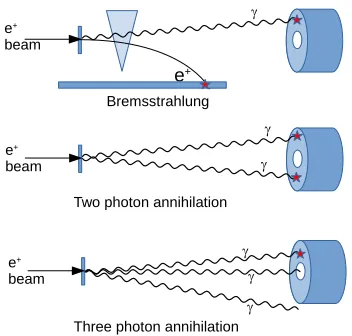
Figure 1.Dominant processes contributing to the search for in-visible dark photon production ine+e−annihilation
a thin target and have the possibility to annihilate in flight with the matter electrons. A key ingredient for such an ex-periment is an electromagnetic calorimeter which should measure the properties of the recoil photon.
The single kinematics quantity, the missing mass, is reconstructed according to
M2
miss=(Pe++Pe−+Pγ)2, (1)
wherePe+is taken from the known beam momentum,Pe− is assumed as (me,0,0,0) (electrons are taken to be at
rest, compared to the much higher beam energy) andPγ is calculated using the measured energyEγand the impact point of the accompanying photon in the electromagnetic calorimeter.
Currently three experiments, PADME [12, 13], VEPP3 [14, 15], and MMAPS [16] are planning to exploit this technique to search for possible Dark Photon production in the annihilation process. Their parameters are listed in table 1. Two of them, PADME and VEPP3, got approved and are in construction phase.
The dominant background contributions together with the possible approach to suppress them are shown in figure 1 and are:
• Radiative emission of photons. The average angle of photon emission with respect to the positron beam di-rection falls as 1/Ebeam. Most of the high energy
pho-tons are focused in the very forward direction. Since the occupancy of the central part of the electromagnetic calorimeter may reach intolerable values, usually it is made as a ring-shaped structure without any active ma-terial close to the beam axis. The only way to suppress the bremsstrahlung background is the addition of a de-tector able to measure the emitting positron and perform matching with the detected in the calorimeter photon. This could be done by implementing a magnetic field
Figure 2. Missing mass squared distribution of the dominant background events, obtained with the simulation of the PADME experiment, based on GEANT4
and a charged particle detector, which may also provide momentum measurement.
•Two photon annihilation. The missing mass distribu-tion fore+e−→γγevents, when only a single photon is detected, peaks at zero. However, due to symmetric realization of the calorimeter and its central hole, the ac-ceptance for single photon events from two photon an-nihilation is almost negligible.
•Multiphoton annihilation. The effect of the presence of additional photons in the annihilation process has to be considered when the energy of the extra photons is higher than the beam energy spread or the energy res-olution of the calorimeter. These extra photons break the symmetry of the event and decrease the vetoing ca-pability of the cluster multiplicity in the calorimeter. In addition, the missing mass distribution for such events does not peak at zero which further decreases their sup-pression.
The cross sections for each of these processes are listed in table 2
A typical missing mass distribution spectrum, obtained with a full GEANT4 [17] simulation of the PADME setup, is shown in figure 2.
The signal region is defined as
(m2A−xσm2 A)<M
2
miss<(m
2
A+xσm2
A), (2)
whereσm2
A depends onmA
and is obtained from Monte Carlo simulation of the expected signal whilexusually takes values between 1 and 2. As can be seen from figure 2, the search for DP in annihilation process is not a zero background search. For most of themA intervals the ex-pected background contribution from SM processes in the defined signal region is of the orderO(104−105) events.
The minimal accessible relative interaction strength of the DP2
minof the experiment is proportional to the the
PADME MMAPS VEPP3
Place LNF Cornell Novosibirsk
Beam energy 550 MeV 6 GeV 500 MeV
mAlimit [MeV] 23.7 74 22.6
Target thickness 2×10²²
e−/cm2 O(1023)
e−/cm2 5×10¹⁵ e−/cm2
Beam intensity [mA] 8×10⁻¹¹ 2.3×10⁻⁶ 30
e+e−→γγrate 15 2.2×10⁶ 1.5×10⁶
2limit (plateau) 10−6(10−7SES) 10−6−10−7 10−7
Time scale 2017-2018 ? 2020
Status Approved Funds identification Approved
Table 2.Dominant background contributions to the search for the production of Dark photons ine+e−annihilation. Cross sections are calculated forEbeam=550 MeV and carbon target.
Process σ[mb] Comment
e+e−→γγ 1.55
e+N→e+Nγ 4000 Eγ>1MeV
e+e−→γγγ 0.16 Eγ>1MeV e+e−→e+e−γ 188 Eγ>1MeV
efficiency and the two photon annihilation statistics, which is used to determine the total particle flux.
2
min∼σtot/(Acc(A)×N(γγ)), (3)
Acc(A) depends on the design of the experiment and (γγ) is determined from the target and beam time.
Since the number of the signal events is just the dif-ference between the expected and the observed number of events,Nsignal = Nobs−Nexp, the total uncertainty of the
potential signal is given by
σtot∼(Nobs) ⊕ (δmodel×Nexp), (4)
assuming that the number of the expected events can be de-termined with high accuracy through Monte Carlo genera-tion of large samples so that the statistics factor inσ(Nexp)
vanishes. The model uncertainty,δmodel, represents the ac-curacy of the simulation of a given background process. For large statistics experiments the termδmodel×Nexp
be-comes dominant in the total uncertainty determination. In the particular case of PADME, the relative statistical uncertainty in the number of observed events is expected to be below 1%. A short review of the current status of the precision of the simulation of the different background sources follows.
3 Bremsstrahlung background
In the positron-on-target Dark photon search the positrons do not impinge the target equally spaced in time but are rather bunched in groups with a length of picoseconds to nanoseconds. Only in the long bunch limit or infinite time resolution the experiments turn into single particle measurement. An event is defined by the time resolu-tion of the detectors and usually incorporates O(103−104)
positrons interacting in the target. Since the total cross section for bremsstrahlung emission is high (see table 2) each event contains positrons which have undergone significant energy loss in the target. These positrons could be detected and vetoed to suppress the background from bremsstrahlung events, when a single cluster in the calorimeter withEγis identified. However, when apply-ing this technique, in order to keep the acceptance forA detection at the level of O(20%), it is necessary to match the sum of the positron energyEe+and the photon energy
Eγand veto only events for which
|Ee++Eγ−Ebeam|<Ecut, (5)
whereEcutis determined by the resolution.
The total cross section for the emission of a photon with energy kby an electron or positron when passing through matter can be written as [17]
dσ dk =
dσn
dk +Z dσe
dk, (6)
where dσn/dk is the differential cross section for bremsstrahlung emission in the field of the nucleus and Zdσe/dk accounts for bremsstrahlung produced in the
field ofZatomic electrons.
A common approach for the estimation of the back-ground contribution due to bremsstrahlung is the usage of GEANT4 simulation package. Below 1 GeV electron energy, the cross section for bremsstrahlung from neutral atoms in the GEANT4 versions 9.5 and above [18] is ob-tained from the interpolation of the Seltzer and Berger tab-ulated data ofdσn/dkanddσe/dk[19]. This model shows
good agreement with the experimental data. However, the uncertainty fordσ/dkfor electrons with energy 50 MeV <Ee+<1 GeV is in the range (3-5)%. This uncertainty is few times higher than the expected statistical uncertainty in the determination of the observed number of eventsNobs
and additional tuning of the model parameters might be necessary to reproduce the observed bremsstrahlung spec-trum. For positrons with energy higher than 1 GeV, an analytic expression fordσ/dk, including also the Landau-Pomeranchuk-Migdal effect, is used in GEANT4.
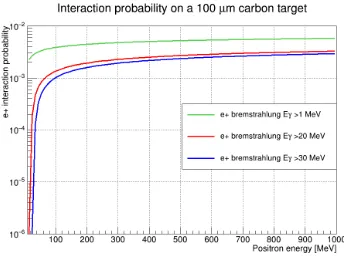
emit-Figure 3. Probability for emission of a bremsstrahlung pho-ton with energyE >Ecutas a function of the positron energy. The cross sections are calculated using the GEANT4, version 9.4 parametrized model for bremsstrahlung emission.
ted photon. Although the targets are thin, the probability for the emission of a photon with energyEγ > 20MeV for 100 μm carbon target traversed by a positron with energy 550 MeV is 0.28%, as can be seen from figure 3. Since the dependence on the beam energy for 300 MeV<Ebeam<600 MeV is weak, naively, the
probabil-ity for the emission of two photons withEγ > 20MeV would be∼10−5. Although quite low, this probability is not negligible since thee+N → e+Nγγevents may not satisfy the relation in equation (5), when a single photon is detected. Such second order effects might be treated in a dedicated way, by forcing their generation explicitly and merging them with the full sample used for background estimation, applying an appropriate normalization factor. In any case, the proper background estimation due to mul-tiple bremsstrahlung emission in the target is important.
In the positron-on-target experiments the bremsstrahlung background can be estimated with electron beam with the same geometrics and kinematics characteristics as the nominal positron beam. Ideally, the acquired statistics should be an order of magnitude higher than in the nominal running mode with positrons. In this way only the uncertainty due to the additional factor, which accounts for the difference in the interactions of positron and electrons, remains. The electron data can also be exploited to measure the bremsstrahlung cross section dσ/dk for the target materials and to tune the GEANT4 parameters.
4 Annihilation background
The cross section for in flight annihilation of the positron is described by the Heitler formula [20]
σ(E,Z)= Zπr 2
e
γ+1× ⎡
⎢⎢⎢⎢⎢ ⎣γ
2+4γ+1
γ2−1 ln
γ+γ2−1
− γ+3 γ2−1
⎤ ⎥⎥⎥⎥⎥ ⎦,
(7)
Figure 4.Comparison of the two photon annihilation probability for a positron traversing 100μm thich carbon target calculated with CalcHEP and according to the Heitler formula.
whereE is the positron energy,re is the classical
elec-tron radius and γ is the Lorentz factor. The electron is considered to be at rest. This process is included in the default GEANT4 electromagnetic library and is taken into account when propagating positrons through mat-ter. However, this is not the case with thee+e− annihi-lation into three or more photons, which are completely ignored. While the symmetric design of the calorimeters of PADME, VEPP3, and MMAPS efficiently suppresses the two photon annihilation, the production of extra pho-tons in the final state might result in the detection only of a single particle in the calorimeter. Then the invariant mass of the undetected particles will be reconstructed as missing mass for the event,M2
miss=(
Pγmiss)2. Such multiphoton events with just a single detected photon represent an irre-ducible background to the search for Dark photon, leaving the only possibility to estimate their contribution precisely. The cross section for three photon annihilation was calculated with CalcHEP - a tool allowing to calculate Feynman diagrams and to perform integration over a mul-tiparticle phase space [21]. The CalcHEP model was up-dated to account for the non-zero electron mass and the values of the interaction constants at low energy were in-troduced. The difference between the the calculated with CalcHEP cross section fore+e− → γγand the analytic expression in equation (7) is shown in figure 4. It was less than 1% for positron energy in the interval 100 MeV <Ee+ <1 GeV and proved the applicability of CalcHEP
for this low energy regime.
The divergency inσ(e+e−→3γ) whenEγ→0 is can-celled by the virtual photon corrections to theσ(e+e−→
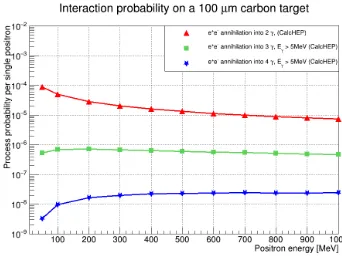
Figure 5.Probability for multiphoton production through anni-hilation of positrons on 100μm carbon target into photons with energyE >5MeV, as a function of the positron energy. The cross sections are calculated with CalcHEP.
background contribution to the dark photon search in the intermediatemAregion.
Proceeding further, the total annihilation width
Γ(e+e− → Nγ) is given by the sum of the different pos-sible final states
Γannih=Γ(e+e−→γγ)+ Γ(e+e−→γγγ)+
Γ(e+e−→4γ)+...≈1.05×Γ(e+e−→γγ). (8)
For Ee+ ≈ 500MeV the value differs from the Born
ap-proximation by as much as 5 %.
To estimate the background from three photon annihi-lation events a dedicated sample generation might be at-tempted. As in the multi bremsstrahlung case, this sample has to be merged with the full background sample, after applying a factor to account for the three photon annihi-lation cross section. However, since the four photon con-tribution to the three photon sample is of the same order as of the three photon to the two photon, currently the un-certainty of this scale factor is of the order of 5%, as seen from figure 5. This uncertainty is again few times higher than the expectedσ(Nobs).
A different approach is to use dedicated Monte Carlo event generators, which take into account the radiative cor-rections in the proper way. Two of them are currently available, BABAYGA [22, 23] and MCGPJ [24], but at least one of them has to be modified to include the mass of the electron due to the small invariant mass regime, O(10-100 MeV), of the positron-on-target experiments search-ing for Dark photons.
5 Conclusions
The correct and precise estimation of the background con-tribution is crucial for the interpretation of the results of the experiments aiming at a search for Dark photon pro-duction in positron-on-target annihilation. The required precision is of the order of 1% and below. Since the uncer-tainty in the models used to simulate the background may extend up to 5% a more detailed investigation is necessary.
electrons with low energy ( O(10 - 100 MeV) ) in the field of the nuclei and the atomic electrons is highly de-sirable and will allow to perform the tuning of the ex-isting Monte Carlo simulation tools. A possible alterna-tive for the positron-on-target annihilation experiments is to exploit also data driven methods for background esti-mation, which may include acquiring data with electron beam, keeping the conditions unchanged. In addition, the multiphoton annihilation cross section, even if pure elec-tromagnetic process, has to be known to the percent level and may also require experimental measurements for the tuning of the Monte Carlo generators.
Acknowledgements
This work has been partially supported by LNF-INFN under grant LNF-SU 70-06-497/07-10-2014 and NSF-Bulgaria under grant MON-FNI DN08-14/14.12.2016.
References
[1] G. W. Benettet al.(The g-2 Collaboration), Phys. Rev. D73, 072003 (2006).
[2] O. Adrianiet al.[PAMELA Collaboration], Nature 458, 607 (2009).
[3] M. Ackermann et al. [Fermi LAT Collaboration], Phys. Rev. Lett.108, 011103 (2012).
[4] M. Aguilaret al.[AMS Collaboration], Phys. Rev. Lett.110, 141102 (2013).
[5] M. Aguilaret al.[AMS Collaboration], Phys. Rev. Lett.117, no. 9, 091103 (2016).
[6] R. Bernabeiet al., Eur. Phys. J.C67, 39 (2010). [7] A.J. Krasznahorkay et al., Phys. Rev. Lett. 116,
042501 (2016).
[8] A.J. Krasznahorkay, talk at ADMPP, Messina, 24-27 October, Italy (2016).
[9] M. Raggi and V. Kozhuharov, Riv. Nuovo Cim. 38, no. 10, 449 (2015).
[10] J. L. Feng, B. Fornal, I. Galon, S. Gardner, J. Smolin-sky, T. M. P. Tait and P. Tanedo, Phys. Rev. Lett.117, no. 7, 071803 (2016)
[11] I. Galon, talk at ADMPP, Messina, 24-27 October, Italy (2016).
[12] M. Raggi and V. Kozhuharov, Adv. High Energy Phys.2014, 959802 (2014)
[13] M. Raggi, talk at ADMPP, Messina, 24-27 October, Italy (2016).
[14] B. Wojtsekhowski, D. Nikolenko and I. Rachek, arXiv:1207.5089 [hep-ex].
[15] I. Racheket. al, talk at ADMPP, Messina, 24-27 Oc-tober, Italy (2016).
[16] J. Alexander, talk at ADMPP, Messina, 24-27 Octo-ber, Italy (2016).
[18] V. Ivantchenko, talk at ADMPP, Messina, 24-27 Oc-tober, Italy (2016).
[19] S.M.Seltzer and M.J.Berger. Nucl.Inst.Meth. B12, 95 (1985).
[20] W. Heitler., The Quantum Theory of Radiation, Clarendon Press, Oxford (1954).
[21] A.Pukhov et al., Preprint INP MSU 98-41/542,arXiv:hep-ph/9908288
A.Pukhov, e-Print Archive: hep-ph/0412191. [22] C. M. Carloni Calame, Phys. Lett. B520, 16 (2001). [23] C. M. Carloni Calame, talk at ADMPP, Messina,
24-27 October, Italy (2016).