
Recent progress on intrinsic charm
T. J. Hobbs1,a
1Department of Physics, University of Washington; Seattle, WA USA
Abstract.Over the past∼10 years, the topic of the nucleon’s nonperturbative orintrinsic
charm (IC) content has enjoyed something of a renaissance, largely motivated by theo-retical developments involving quark modelers and PDF-fitters. In this talk I will briefly describe the importance of intrinsic charm to various issues in high-energy phenomenol-ogy, and survey recent progress in constraining its overall normalization and contribution to the momentum sum rule of the nucleon. I end with the conclusion that progress on the side of calculation has now placed the onus on experiment to unambiguously resolve the proton’s intrinsic charm component.
1 Introduction
The nucleon’s nonperturbative (i.e., intrinsic) component has been a largely unresolved issue for the past several decades following the idea’s first incarnation in the seminal paper of Brodsky et al. (BHPS) [1], which I briefly review in Sec. 2.1 below. Despite this long history, the problem of incontrovertibly establishing the existence of intrinsic charm (IC) empirically and determining an overall numerical magnitude for its contribution to the proton wave function has been something of a Gordian knot. At the time of its proposal, the BHPS framework exploited recent developments in light-front field theory [2, 3] to formulate a simple picture based upon a Fock-state expansion of the nucleon wave function to include 5-quark states|uudcc¯iinvolving charm not generated through the usual pQCD (orextrinsic) mechanism. Despite considerable variation, models of intrinsic charm (IC) unavoidably involve some expression of this fundamental idea, and in this talk I survey recent progress developing calculations of this sort, as well as numerical work to constrain the range of possibilities for the size of IC that has proceeded apace.
2 Modeling the proton’s intrinsic charm
Various theoretical approaches have proliferated in the past several decades, involving a number of as-sumed mechanisms for generating the intrinsic component of the charm PDF. Here I highlight several of these in increasing order of complexity.
2.1 Scalar frameworks
As the original scalar framework formulated in the infinite momentum frame (IMF), the above-mentioned BHPS description treats the transition probability for a proton with massMto go through a transitionp→uudcc¯(or, indirectly, to an internal 5-quark state containing any heavy quark pair) in terms of an old-fashioned perturbation theory energy denominator expressible through the massesmi
and momentum fractionsxiof the constituents of the 5-quark state,
Pp→uudcc¯ ∼
M2− 5 X
i=1 m2⊥i
xi −2 . (1)
In the expression above,m⊥iis the transverse mass of theithquark, explicitly given bym⊥2i≡k2⊥i+m2i
and the indices 4 and 5 are taken to apply to the heavy quark pair (cand ¯c, respectively).
A special merit of this scheme is its simplicity: if one assumes the energy denominator of Eq. (1) to be controlled by the charm quark mass (i.e.,m2c=m2¯c≫m
2 u/d, M
2
), the expression for the 5-quark probability can be integrated to obtain a compact form for the thexdependence of the IC PDF:
P(x) = N x
2
2
"
(1−x) 3
1+10x+x2 + 2x(1+x) ln(x)
#
, (2)
in which I have takenx5 → x, and the overall normalizationN is connected to the total intrinsic charm probability in the proton, subject to the constraintR dx c(x) = R dxc¯(x), which ensures the correct zero charm valence structure.
Building on the approach above, in a systematic model-based analysis [4] of the nucleon’s heavy-quark content and subsequent QCD global fit [5], Pumplin and (for the global analysis) collaborators considered a series of models for the Fock space wave function on the light-front for a proton to make a transition to a four quark plus one antiquark system, with the heavyqq¯pair composed of either charm or bottom quarks. This ansatz ultimately envisioned a simplified case wherein a spinless point particle of massm0 interacts with coupling strengthgto N scalar particles having massesm1,m2, . . . ,mN.
Pumplin then found the unintegrated light-front probability density to have the form [4]
dP = g
2
(16π2)N−1(N−2)! N Y
j=1 dxjδ
1− N X
j=1 xj Z ∞ s0
ds(s−s0) N−2
(s−m20)2 |F(s)| 2,
(3)
where the invariant mass iss0=PN j=1m
2
j/xj, and a vertex functionF(s) must be stipulated to control
behavior in the ultraviolet. In particular, if the transverse momenta and the factors of 1/xjappearing
in Eq. (3) are ignored and the charm mass is taken to be much larger than all other mass scales, one obtains the distribution prescribed by the BHPS model [1] after also assuming a pointlike vertex factor
F(s)=1. While this formalism is convenient and produces testable predictions for IC, a model with more physical interactions accounting for the structure of the spectrum is also desirable, and I sketch this idea in Sec. 2.2 now.
2.2 Meson-baryon models
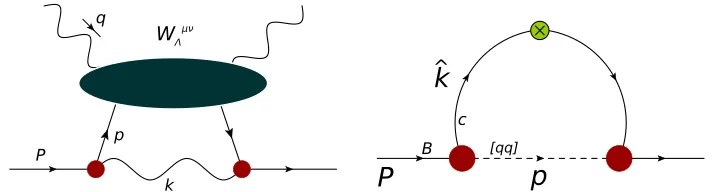
de-Figure 1. Diagrams relevant for the dominant contribution to the charm structure function in the MBM of Ref. [6]. (Left) The TOPT diagram for the contribution of the dissociatedΛcD∗state to the hadronic tensor of
the proton. (Right) An analogous diagram leading to the charm quark distribution within a spin-1/2 baryon,
cB(z), assuming a quark-diquark picture for the baryon’s constituent substructure; such processes are calculated
in detail in Ref. [6].
scribes the nucleon’s intrinsic charm content in a two-step approach formulated in terms of hadronic degrees of freedom as well as at quark level. Moreover, unlike the BHPS formalism of Sec. 2.1, MBMs can readily produce an experimentally testable asymmetry between thecand ¯cdistributions in the nucleon.
The basic goal of these models is the probability for the nucleon to spontaneously fluctuate into states involving an intermediate mesonMand baryonB, according to
|Ni = pZ2 |Ni0 + X
M,B Z
dyd2k
⊥φMB(y,k2⊥)
M(y,k⊥);B(1−y,−k⊥) ,
(4)
in which|Ni0represents the undressed three-quark nucleon state, andZ2 is an associated
renormal-ization constant. The quantityφMB(y,k2⊥) is an amplitude for the process whereby the nucleon
recon-figures into an intermediate mesonM carrying a fractionyof the proton’s longitudinal momentum and transverse momentumk
⊥, and a baryon Bwith longitudinal momentum fraction 1−y ≡y¯ and transverse momentum−k
⊥. The invariant mass squaredsMBof this intermediate state appearing in
the derivations below can then be expressed in the IMF by
sMB(y,k2⊥)=
k2⊥+m2M
y +
k2⊥+M2B
1−y , (5)
wherein the internal meson and baryon masses are respectively given bymMandMB.
Ultimately, the dominant mechanism determining the IC distribution in the MBM of Ref. [6] orig-inated with the reconfiguration of the proton into intermediate states consisting of spin-1 charmed mesons D∗ = D¯∗0 or D∗− and corresponding charm-containing baryons. The associated
prob-abilistic splitting function for this mode is related to the amplitude of Eq. (4) by fMB(y) = R∞
0 d 2k
⊥|φMB(y,k⊥2)|2and, due to the higher N-D∗-Λc spin interaction, arises from a linear
combi-nation of vector (Gv), tensor (Gt), and vector-tensor interference (Gvt) pieces.Viz.,
fD∗B(y)=TB
1 16π2
Z dk2
⊥
y(1−y)
|F(s)|2
(s−M2)2 "
g2Gv(y,k2⊥) +
gf
M Gvt(y,k 2
⊥) +
f2 M2Gt(y,k
2
⊥) #
where
Gv(y,k⊥)=−6MMB +
4(P·k)(p·k)
m2 D
+ 2P·p, (7a)
Gvt(y,k⊥)=4(M+MB)(P·p−MMB)
− m22 D
h
MB(P·k)2−(M+MB)(P·k)(p·k)+M(p·k)2 i
, (7b)
Gt(y,k⊥)=−(P·p)2 + (M+MB)2P·p − MMB(M2+M2B+MMB)
+ 1
2m2 D
h
(P·p−MMB)[(P−p)·k]2−2(M2BP·k−M 2p
·k)[(P−p)·k]
+2(P·k)(p·k)(2P·p−M2B−M2)i, (7c)
and, as depicted in the left panel of Fig. 1, prepresents the 4-momentum of the interacting baryon (e.g.,Λ+
c),TB is an isospin factor, and the productsP·p,P·k,p·kcan all be evaluated in terms of
explicit TOPT expressions defined in the IMF as in the Appendices of Ref. [6].
A standard feature of this approach is the necessity of regulating the inevitable divergences that appear at largek2
⊥ — a fact which follows from the essential status of MBMs as loop corrections or dressings to the photon-nucleon vertex. Typically, regularization is carried out phenomenologically, and implemented through a specific parametric choice for the relativistic vertex factorF(s) appearing in Eq. (6), for example. The analysis of Ref. [6] made use of a Gaussian of the form
F(s)=exp[−(s−M2)/Λ2], (8)
in whichΛis a cutoffparameter fixed across the various meson-baryon modes involved in the model and determined by fittingpp→Λc+Xhadroproduction data from ISR [7]; this yieldedΛ =(3.0±0.2)
GeV, leading to the predicted model bands plotted in Fig. 2 below.
Using this general formalism, one can compute other intermediate spin-isospin combinations for the possible charm-containing meson-baryon states of Eq. (4), and use an analogous framework em-bodied by the right panel of Fig. 1 to determine normalized distributions of (anti-)charm quarks within these hadronic states —e.g., the ¯cdistribution within theD∗meson, ¯cD∗(z), as a function of a quark
momentum fractionz. Having assembled these various ingredients, the MBM specifies the nonpertur-bative IC distribution atQ2=m2
cas an incoherent sum over various meson-baryon states:
¯
c(x) = X
M,B hZ 1
x dy
y fMB(y) ¯cM
x y
+
Z 1
x dy¯
¯
y fBM( ¯y) ¯cB
x
¯ y i
, (9a)
c(x) = X
B,M hZ 1
x dy¯
¯
y fBM( ¯y)cB
x
¯ y
+
Z 1
x dy
y fMB(y)cM
x y i
. (9b)
The expressions in Eqs. (9a) and (9b) are the culmination of the MBM of Ref. [6] and depend crucially upon assumed schemes to counter numerical poles in TOPT energy denominators that occur at infrared momenta in the quark-level amplitudes used to compute the distributions ¯cM(z) andcB(z).
0.001 0.01 0.1 1
x
0.0001 0.001 0.01 0.1 1
F 2
cc
Q2 = 60 GeV2
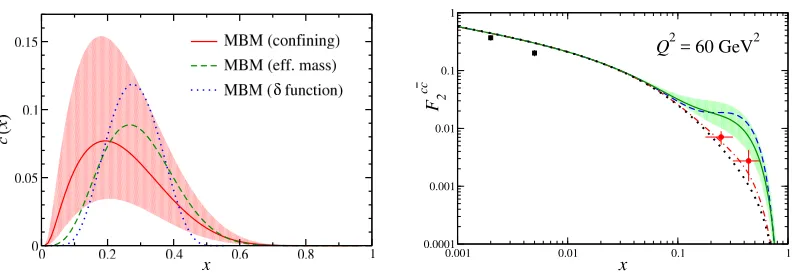
Figure 2. (Left) Intrinsic contributions to the proton’s charm PDF at the starting scale Q2 0 = m
2
c of QCD
evolution under different assumed prescriptions for the infrared behavior of the quark-hadron vertex that de-termines the distributions ¯cM(z) andcB(z). (Right) The charm sector part of the proton structure function
Fcc¯ 2 = 4x
9h
c(x,Q2)+c¯(x,Q2)i
at an evolved scale of Q2 = 60 GeV2. The two red points belong to the
highest EMC binhQ2i= 60 GeV2 [8]; while these points overhang the predictions of pQCD, they are at the
lower periphery of the range predicted by the MBM informed by hadroproduction data.
3 A QCD global analyses of the charm PDF
The model-based treatment of IC in Sec. 2.2 served the purpose of enlightening possible physical mechanisms for generating nonperturbative charm in a manner that led to direct constraints from experimental information. However, the ambiguity in the resultingmagnitude of IC in the proton as suggested by the panels of Fig. 2 demanded a more systematic numerical approach. The most comprehensive such method involves performing a QCD global analysis of the world’s data explicitly including IC as a hypothesis. This was recently undertaken in Ref. [9] using theO(αs) formalism
of Hoffmann and Moore [10] for the charm structure function and, for the DGLAP starting-scale IC itself, the parametric shapes computed in the analysis of Ref. [6]. In fact, in what follows the “confining” prescription corresponding to the central solid red curve in the LHS of Fig. 2 was used by default, and the commonly-used total momentum fraction was taken as a proxy for the overall normalization of IC in the proton:
hxiIC ≡ Z 1
0
dx x[c(x)+c¯(x)] . (10)
QCD global analyses of this quantity had been carried out by a number of groups over the years as exemplified by a recent CT14 calculation [11] that assessed several IC scenarios (IC=0, as well as BHPS and a lowx-dominated “sealike” shape); not unlike the earlier work of Ref. [5], this determina-tion found considerable levels of IC could be tolerated by a global fit — in particular, CT14 discovered that IC as large ashxiIC ∼2−3% could be accommodated within their framework, depending upon
the specific IC scenarios.
0 50 100 150 200 250 300
0 0.2 0.4 0.6 0.8 1
χ
2 -
χ
2 0
<x>IC(%) total
E605 E866 pp
E866 pd
SLAC p
E866 rat SLAC d
HERA E665 NMC BCDMS p
BCDMS d
NMC rat H1 F2
H1 FL
dimuon JLab p
JLab d
jets ZEUS jets H1 jets CDF jets D0 BCDMS F2 BCDMS FL
E140x F2
E140x FL
HERA σc
Figure 3.Aside from the EMC data which were not included in the global fit shown here, the full set of the JR14 analysis [12] was first used to study the constraints imposed by the world’s data on the total IC fractionhxiIC. As noted in
TABLE I. of Ref. [12] and tabulated in the legend here, this full set involved 4296 data points from 26 independent sets of measurements. Moreover, the JR14 fitting technology incorporates a sensitive means of parametrizing the effects of dynamical higher twist, target mass, and nuclear corrections, enabling substantially less restrictive kinematical cuts:Q2≥1 GeV2
andW2≥3.5 GeV2. As a result, our
results are constrained by important inputs from fixed-target SLAC data on proton and deuteron targets (brown circles and blue triangles, respectively), which drive the very rapid growth in theχ2of
the global fit relative toχ2 0— the
corresponding value athxiIC=0.
our QCD global analysis of IC with less restrictive kinematical cuts on the included data sets (Q2
≥1 GeV2andW2
≥3.5 GeV2). In Fig. 3, I summarize the contributions of the data sets included in the
global analysis of Ref. [9] to the total growth in theχ2 resulting from the fit. From the parabolas
of Fig. 3, it is evident that some data sets (e.g., the H1F2measurements corresponding to the blue-pentagon curve at bottom) do little to constrainhxiIC; rather, the bulk of the constraint to the proton’s
total IC (given by solid black disks) is driven by SLAC fixed-target information — on the deuteron (blue triangles) and proton (brown circles). The pronounced sensitivity of these data sets to IC can be interpreted as arising indirectly from the enhanced constraints provided by the SLAC data to the light-quark sector of the global fit, which in turn limits the flexibility of the fitting framework in tolerating larger magnitudes forhxiIC.
This point is further driven home by the left panel of Fig. 4, which separates the ‘SLAC’ contri-butions to theχ2profile from the ‘rest’ of the data set summarized in Fig. 3. In the end, this global fit
places quite stringent constraints on the magnitude of IC:hxiIC<0.1% at the 5σlevel.
An additional pointed motivation for the analysis of Ref. [9], however, was the need to evaluated the suggestive measurements of the European Muon Collaboration (EMC) [8], which measured the charm sector contribution to theF2(x,Q2) structure function of the proton viaµ-Fe DIS. As has been
pointed out numerous times in the literature, the highestQ2 bins of the EMC data seem to provide
some hint of the existence of IC, but before Ref. [9] this information had never been treated in the context of a global analysis. Ultimately, incorporating the EMC points into the data set summarized in Fig. 3 led to a slight preference for nonzero IC, with the EMC set alone preferringhxiIC =0.3−0.4%
as indicated by the minimum in the green double-dotted curve on the RHS of Fig. 4. The modest preference for nonzero IC is diluted by the presence of other mitigating data sets, however, and the full global fit results inhxiIC=0.13±0.04% — a significantly reduced magnitude relative to the results of
-50 0 50 100 150 200 250 300
0 0.2 0.4 0.6 0.8 1
χ
2 -
χ
2 0
<x>IC(%) total
SLAC rest
-50 0 50 100 150 200 250 300
0 0.2 0.4 0.6 0.8 1
χ
2 -
χ
2 0
<x>IC(%) total
SLAC rest EMC
Figure 4.Plots of theχ2growth profiles in the QCD global analysis of Ref. [9].
evaluation of the EMC set, and demand additional experimental measurement which might clarify the magnitude of IC without residual tension or ambiguity.
4 Recent developments in IC phenomenology
Following the completion of the work in Ref. [9], a number of intriguing developments in the phe-nomenology of IC have emerged, of which I highlight a couple of examples.
Partly motivated by the work of Refs. [9, 13, 14], Ballet al. of the NNPDF Collaboration recently announced [15] an independent global analysis of the charm PDF in which the possibility of intrinsic charm was explicitly allowed via separate “Perturbative” and “Fitted” distributions which were then constrained using the unique neural networks-based methodology of NNPDF. Moreover, like Refs. [9, 14] this work also incorporated the provocative EMC data, confronting them with a global fitting technology that does not presuppose a particular model-derivedshapefor the IC distribution; the relaxation of this aspect of typical QCD global fits affords the NNPDF framework greater flexibility in describing the world’s data, but can also result in distributions that are difficult to reconcile with the predictions of model-building. This fact seems evident in the especially hard shape for the “Fitted” charm distribution obtained in Ref. [15], which corresponded tohxiIC = 0.7±0.3%, and demands
further study.
Aside from direct measurements of the charm structure function, more oblique means of accessing the nucleon’s nonperturbative charm content can be constructed; an archetypal example of this sort of approach can be found in the precise observation of prompt neutrino production [16] in dedicated cosmic-ray facilities like IceCube [17]. This analysis demonstrates that IC in accord with the upper reaches of the model predictions of Ref. [6] (which allows larger IC normalizations and preceded the more systematic global analysis of Ref. [9]) might in principle be observable in the IceCube prompt neutrino spectrum; this suggest that such measurements could thus play the role of an additional avenue to either observing or constraining the proton’s nonperturbative charm.
5 Conclusion and outlook
limited in its ability to recommend a robust value for,e.g., the total IC momentum fractionhxiIC. The
present situation therefore seems to be one in which the reach of modeling and analyses of data is approaching a point of diminishing return, and additional empirical inputs would be invaluable. For this purpose, modern, direct measurements ofFc2c¯(x,Q2) — especially at largexand low/intermediate
Q2along the lines of the original EMC data — could better constrain both models and global analyses and settle some of the questions related to the interpretation of the EMC set itself as raised in Refs. [9, 13, 14]. Measurements of this type might ideally be carried out at a future electron-ion collider [18], and be complemented by work at the proposed AFTER@CERN fixed-targetppexperiment [19] which would putatively operate at √s= 115 GeV; this might similarly be the case for a suggested measurement of the forward production ofZ bosons in coincidence with charm-containing jets at LHCb [20], which could also shed light on the behavior of the charm PDF in the critical valence-region.
References
[1] S.J. Brodsky, P. Hoyer, C. Peterson, N. Sakai, Phys. Lett.B93, 451 (1980) [2] S.J. Chang, R.G. Root, T.M. Yan, Phys. Rev.D7, 1133 (1973)
[3] G.P. Lepage, S.J. Brodsky, Phys. Rev.D22, 2157 (1980) [4] J. Pumplin, Phys. Rev.D73, 114015 (2006),hep-ph/0508184
[5] J. Pumplin, H.L. Lai, W.K. Tung, Phys. Rev.D75, 054029 (2007),hep-ph/0701220 [6] T.J. Hobbs, J.T. Londergan, W. Melnitchouk, Phys. Rev.D89, 074008 (2014),1311.1578 [7] P. Chauvat et al. (R608), Phys. Lett.B199, 304 (1987)
[8] J.J. Aubert et al. (European Muon), Nucl. Phys.B213, 31 (1983)
[9] P. Jimenez-Delgado, T.J. Hobbs, J.T. Londergan, W. Melnitchouk, Phys. Rev. Lett.114, 082002 (2015),1408.1708
[10] E. Hoffmann, R. Moore, Z. Phys.C20, 71 (1983)
[11] S. Dulat, T.J. Hou, J. Gao, J. Huston, J. Pumplin, C. Schmidt, D. Stump, C.P. Yuan, Phys. Rev.
D89, 073004 (2014),1309.0025
[12] P. Jimenez-Delgado, E. Reya, Phys. Rev.D89, 074049 (2014),1403.1852 [13] S.J. Brodsky, S. Gardner, Phys. Rev. Lett.116, 019101 (2016),1504.00969
[14] P. Jimenez-Delgado, T.J. Hobbs, J.T. Londergan, W. Melnitchouk, Phys. Rev. Lett.116, 019102 (2016),1504.06304
[15] R.D. Ball, V. Bertone, M. Bonvini, S. Carrazza, S. Forte, A. Guffanti, N.P. Hartland, J. Rojo, L. Rottoli (NNPDF) (2016),1605.06515
[16] R. Enberg, M.H. Reno, I. Sarcevic, Phys. Rev.D78, 043005 (2008),0806.0418 [17] R. Laha, S.J. Brodsky (2016),1607.08240
[18] A. Accardi et al., Eur. Phys. J.A52, 268 (2016),1212.1701
[19] S.J. Brodsky, A. Kusina, F. Lyonnet, I. Schienbein, H. Spiesberger, R. Vogt, Adv. High Energy Phys.2015, 231547 (2015),1504.06287
![Figure 3. Aside from the EMC dataTABLE I. of Ref. [12] and tabulated inthe legend here, this full set involved 4296data points from 26 independent sets ofmeasurements](https://thumb-us.123doks.com/thumbv2/123dok_us/8149259.1358858/6.482.46.409.87.338/figure-aside-datatable-tabulated-legend-involved-independent-ofmeasurements.webp)
![Figure 4. Plots of the χ2 growth profiles in the QCD global analysis of Ref. [9].](https://thumb-us.123doks.com/thumbv2/123dok_us/8149259.1358858/7.482.51.434.82.215/figure-plots-growth-proles-qcd-global-analysis-ref.webp)
