Energy Conservation Techniques and Application for
Wireless Sensor Networks
M.Chithik Raja
Department of Information Technology, Salalah College of Technology , Oman
ABSTRACT-The objective of this research article is to address the
problem of energy conservationin wireless sensor networks. Since wireless sensor networks typically consist of tiny sensors witha scarce energy resource, energy conservation is a critical issue to be addressed. This article addressesthe energy conservation issue by tackling two fundamental problems: network topology construction and data delivery. Fist we addressed Many real life applications using energy harvesting system power are now practical. Wireless sensor network systems such as ZigBee systems often benefit from energy harvesting power sources. For example, when a wireless node is deployed at a remote site where a wall plug or a battery is either unreliable or unavailable, energy harvesting can augment or supply power. In another example, a remote control node running on energy harvesting can be implemented as a self-powered electronic system. And in yet other situations, multiple energy sources can be used to enhance the overall efficiency and reliability of any system .
KEYWORDS :Wireless sensor networks, ZigBee, Smart
Mesh,RF,DC, photovoltaic, WirelessHART,CSP.
1. INTRODUCTION
Energy is everywhere in the environment surrounding us available in the form of thermal energy, light (solar) energy, wind energy, and mechanical energy. However, the energy from these sources is often found in such minute quantities that it cannot supply adequate power for any viable purpose. Energy Harvesting is the process of capturing minute amounts of energy from one or more of these naturally-occurring energy sources, accumulating them and storing them for later use. Energy-harvesting devices efficiently and effectively capture, accumulate, store, condition and manage this energy and supply it in a form that can be used to perform a helpful task. Similarly, an Energy Harvesting Module is an electronic device that can perform all these functions to power a variety of sensor and control circuitry for intermittent duty applications. Advanced technical developments have increased the efficiency of devices in capturing trace amounts of energy from the environment and transforming them into electrical energy. In addition, advancements in microprocessor technology have increased power efficiency, effectively reducing power consumption requirements. In combination, these developments have sparked interest in the engineering community to develop more and more applications that utilize energy harvesting for power. Energy harvesting from a natural source where a remote application is deployed, and where such natural energy source is essentially inexhaustible, is an increasingly attractive alternative to inconvenient wall plugs and costly batteries. This essentially free energy source, when designed and installed properly, is available maintenance-free and is now available throughout the lifetime of the application.
Such systems can be more reliable than wall plugs or batteries. In addition, energy harvesting can be used as an alternative energy source to supplement a primary power source and to enhance the reliability of the overall system and prevent power interruptions.
1.1 Energy Harvesting Applications
Many real life applications using energy harvesting system power are now practical. Wireless sensor network systems such as ZigBee systems often benefit from energy harvesting power sources. For example, when a wireless node is deployed at a remote site where a wall plug or a battery is either unreliable or unavailable, energy harvesting can augment or supply power. In another example, a remote control node running on energy harvesting can be implemented as a self-powered electronic system. And in yet other situations, multiple energy sources can be used to enhance the overall efficiency and reliability of any system.
1.2.Common Sources of Energy Harvesting
Mechanical Energy – from sources such as vibration, mechanical stress and strain
Thermal Energy – waste energy from furnaces, heaters, and friction sources
Light Energy – captured from sunlight or room light via photo sensors, photo diodes, or solar panels Electromagnetic Energy – from inductors, coils and
transformers
Natural Energy – from the environment such as wind, water flow, ocean currents, and solar
Human Body – a combination of mechanical and thermal energy naturally generated from bio-organisms or through actions such as walking and sitting
Other Energy – from chemical and biological sources It is important to note, that all these energy sources are virtually unlimited and essentially free, if they can be captured at or near the system location.An energy harvesting system generally requires an energy source such as vibration, heat, light or air flow and three other key electronic components, including:An Energy conversion device such as a piezoelectric element that can translate the energy into electrical form and energy harvesting module that captures, stores and manages power for the device,An End application such as a ZigBee-enable wireless sensor network or control and monitoring devices.
2. WIRELESS SENSOR NETWORKS FOR GREEN DATA CENTERS
largest use of electricity in the US. One-third to one-half of the electricity consumed by the data center comes from air conditioners, fans, dehumidifiers, and pumps.Benefits of wireless sensor networks, (WSN) for data center energy management:Lowers data center operating costs by reducing energy consumption up to $9 per square foot ,Delivers improved availability by reducing data center downtime,Eliminates installation of cable or conduit and reduces costs association with rewiring and reconfigurationSimplifies data center reconfiguration and retrofits.SmartMesh-enabled WSNs are uniquely able to be deployed in a data center without requiring any cable or conduit—an entire temperature, pressure and humidity sensing network can be deployed without a moments disruption to data center operations, and with no construction required. The ability to get better information about the thermal condition of the data center is critical to manage this environment, and allows IT managers to operate the data center at lower overall cost and higher availability than ever before. For example, a SmartMesh-enabled sensing and control system developed by Vigilent measures temperatures at critical locations throughout the data center, and can automatically adjust the amount of cold air produced by cooling units, directing that cold air to the proper locations through variable speed fans and remote vent controls.
3.ENERGY FROM RADIO WAVES
RF energy harvesting converts radio waves into DC power. This is accomplished by receiving radio waves with an antenna, converting the signal, and conditioning the output power, as shown in Figure 1.
Figure 1. Overview of an RF energy harvesting system
There are multiple approaches to converting an RF signal to DC power, (e.g., single-stage vs. multistage) depending on the desired operating parameter, such as power, efficiency, or voltage. The amount of power available for the end device depends on several factors including the source power, distance from the source, antenna gain, and conversion efficiency. For Powercast's components, the conversion efficiency of the received RF power to DC is typically between 50%–75%, over a 100X range of input power or load resistance, and even greater for specialized applications. The harvesting activation power is currently ~100 µW and the output power is up to 250 mW.The sources for RF energy harvesting can be grouped into three general categories: intentional sources, anticipated ambient sources, and unknown ambient sources.Intentional sources (e.g., dedicated power transmitters) provide the most
control because the availability and amount of power can be controlled and engineered for the application. While specific applications may require higher power transmitters, intentional sources will generally be 4 W or less and comparable to the power of widely deployed RFID readers. Intentional sources can be deployed in a network similar to WiFi routers or mobile base stations where multiple transmitters provide coverage over a wide area. They can be operated as required for the application, such as keeping energy storage devices fully charged or providing power for device activation, and can provide power continuously, on a scheduled basis, or on demand.
Anticipated ambient sources are sources where, although there is no control, they can be relied on to act as sources of power on a regular or intermittent basis. An example of this is the concentration of mobile phones (i.e. people) expected at a given location such as bus stops or crowded sidewalks. There are estimated to be 3.5 billion GSM subscriptions globally and predicted to grow to 4 billion by 2012. Depending on transmit power, multiple phones in close proximity can provide several milliwatts of power. Additional examples of these sources include known radio, television, and mobile base station transmitters.Unknown ambient sources are sources of RF energy of which there is no control and no knowledge (e.g., microwave radio links and mobile radios such as those used by police forces), but which still provide a continual or intermittent source of power.Usable power from RF energy harvesting will typically be in the milliwatt and microwatt range based on the power limits from commercially available transmitters or the distance from sources such as radio and TV transmitters. The usable power or range can be greater for specialized military or industrial applications that use higher levels of transmission power. Comparisons are often made regarding the power density (i.e., W/cm3) of various energy harvesting technologies. While power density is a valid metric of comparison, it is also incomplete because each type of energy harvesting presents unique benefits. In the case of RF energy harvesting, for example, these are controllable and ambient power over distance, one-to-many wireless power distribution, mobility, embedded harvesting technology, and independence of weather conditions or time of day.
3.1.Harvester Requirements
output voltage. The harvester should have intelligent power management capabilities that can be controlled or used by a microcontroller to optimize system-level power. And lastly, it should be easy to implement, such as having an input impedance of 50 ohms to be compatible with a wide selection of commercially available antennas, and packaged to participate in standard PCB manufacturing processes.
ImplementationOptions Like other forms of energy
harvesting, there are multiple ways to use RF energy harvesting in implementing a power system, including Direct power (no energy storage),Battery-free energy storage (supercapacitor),Battery-recharging,Remote power with battery backup,Passive wireless switch (battery activation)These implementation options provide significant flexibility in designing power systems for wireless sensors. RF energy harvesting can provide a device with the ability to receive power or replace energy when needed, or to trigger the activation of remote sensors that are completely dormant. RF energy harvesting can be used for a number of wireless sensor applications, deployed both indoors and outdoors. Applications include ground-level agricultural sensors, HVAC and energy management, automated gauge and meter reading, structural health monitoring, location tracking, distributed pollution sensors, and rotational equipment sensors.RF energy harvesting has great potential to power systems designed for indoor usage such as temperature, motion, and light sensors. Building interiors can often have low-light conditions that make solar energy harvesting methods unreliable or have no-light areas when sensors are located inside walls or above ceilings. Suitable thermal gradients are not likely to be available indoors, and vibrations are hopefully at a minimum. Thousands of watts of energy for HVAC and lighting can be controlled by using a few watts to operate one or more power transmitters, making the potential energy ROI quite significant. By eliminating the labor and cost of battery replacement, the financial ROI for this particular application is also very attractive. Today, the most practical implementations of RF energy harvesting will require intentional sources to provide the energy.
Wirelessly networking the transmitting sources to control how they operate can maximize the overall performance of a wireless power distribution system. Turning the power sources into access points completes the functionality to create a complete infrastructure for wireless power and data while also eliminating the need for battery replacement.Ambient RF power levels will increase as more transmitting devices are put into use. A more significant factor in enabling pure ambient RF energy harvesting will be the introduction of devices that operate at lower and lower power levels. As device power consumption decreases, ambient RF energy harvesting will become more practical and available in more areas. The development of efficient multiband or wideband RF energy harvesters will also play an important role in the realization of widespread ambient harvesting over the next several years.RF energy harvesting is a unique technology that can enable controllable, wireless power over distance, and scale to provide power to thousands of wireless sensors. Devices built with this
wireless power technology can be sealed, embedded within structures, or made mobile, and battery replacement can be eliminated. With commercial RF energy harvesting components currently available, engineers can integrate this technology to provide embedded wireless power for their low-power wireless devices.
4. MANAGING THE POWER IN WIRELESS SENSOR NETWORKS POWERED BY ENERGY-HARVESTING
CIRCUITRY
Wireless sensor networks (WSNs) are becoming ubiquitous. They solve problems in many applications. In building control, WSNs use light or RF energy to power motion detectors which turn lights off if nobody is detected in a room, to dim lights depending on the light level in a room, and to sense and report temperature for air conditioning or heating. In industrial control, WSNs use vibration energy or thermal energy to monitor and report the condition of rotating machines. In location tracking, they use vibration energy to enable GPS to sense and the cellular network to report the position of containers, trucks or rail cars. All these applications harvest energy from the environment and so effectively have a limitless, battery-free energy source. They also avoid the time-consuming and environmentally-sensitive task of replacing and disposing of batteries. However, these environmental energy sources are typically very low power. Since power is the rate at which energy is delivered, the problem becomes how to power wireless transmission, which requires higher power levels, from a low-power source.
Figure 2 shows power design before supercapacitors. The entire system must be sized for the load’s peak power. In the example shown, the source must provide 2.6 A. Also, the internal impedance of the source means the voltage will drop from 3.7 V to 3.3 V during the peak load. The DC/DC converter enables this voltage drop to occur without interrupting operation of the load.
Figure 2: Power design before supercapacitors
Figure 3: Supercapacitor as a power buffer
In this example, the average load power is only 0.75 mW. A low-power energy-harvesting source only needs to supply a little more than this power level (to overcome losses) to charge the supercapacitor, which then provides the GPRS module with the power required for transmission. The supercapacitor is placed after the interface electronics, so the interface electronics and DC/DC converter can be sized for the average power of 125 μW rather than the peak power of 7 W. A discharged supercapacitor will look like a short circuit to the source, so the interface electronics must manage the inrush current when the source is first connected to a supercapacitor at 0 V. If an energy-harvesting source only provides a few μA of current, you do not want to waste a significant proportion of this on capacitor leakage current. Small supercapacitors have low leakage current, typically between 1 μA 50 μA, depending on the capacitance. However, this is the equilibrium level leakage current after the supercapacitor has been held at voltage for several days. Figure 4 shows the leakage current over time for a 150 mF CAP-XX GZ065 supercapacitor. Supercapacitors are low-voltage devices and several need to be strung in series to achieve a practical working voltage. However, different cells will have slightly different leakage currents, but since they are in series, they must have the same current flowing through them. In this case, the cells will redistribute charge between themselves, adjusting their voltage so their leakage currents will be equal. This leaves one of the cells in danger of going over voltage.
Figure 4:The leakage current over time for a 150 mF CAP-XX GZ065 supercapacitor
The balancing solution that draws minimal current is an active balance circuit using an ultra-low-current, rail-to-rail op amp. The circuit in Figure 5 is an example of this (Low current active-balance Circuit) and draws only 2 3 μA, including supercapacitor leakage current, once the supercapacitor has reached equilibrium leakage current.
Figure 5: Low-current active-balance circuit
The op amp chosen draws ~750 nA, supercapacitor leakage current is ~1 μA, and the current drawn through R12, R06 =250 nA if the supercapacitor voltage = 5 V, so total current ~2 μA. In CAP-XX dual-cell supercapacitors, the two cells are matched by C. Because their voltages are balanced when first charged, designers can use a very low current-balance circuit to maintain balance. The rate of aging depends on the supercapacitor operating voltage and temperature. The higher the voltage and/or temperature, the faster they age. Therefore, designers should size the supercapacitor so that the C is large enough and ESR low enough for successful operation at end of life, given the application’s expected operating profile
Figure 7a : Model for solving the constant power case Circuit.
5. RENEWABLE ENERGYWIRELESS SENSOR NETWORKS FOR ENERGY PLANT MONITORING Wireless sensor networks in large-scale deployments for photovoltaic or concentrating solar power are used for real-time equipment monitoring, and are critical to maintaining plant uptime. The long battery life and ability to withstand harsh conditions make this technology ideal for applications in renewable energy.Benefits of wireless sensor networks (WSN) in renewable energy:Reduces equipment downtime with real-time monitoring,Lowers cost of deployment over large areas by eliminating cabling and reducing costs of installation,Provides reliable connections even in harshest outdoor conditions,Long battery life reduces replacement effort and costs
5.1.Solar Plant Monitoring
The challenges associated with a large-scale deployment of solar energy generation systems make the use of wireless sensor networks quite compelling. For these systems, reducing installation costs while maximizing operational efficiency is paramount to success. The equipment costs, installation labor, and complexity of the network communications infrastructure can quickly become the single largest factor in the deployment as these systems scale in size. Whether photovoltaic (PV) or concentrating solar power (CSP), critical performance metrics must be monitored in real-time, and the health of equipment such as inverters, tracker motors, or heliostat targeting systems, are critical to maintaining constant uptime of the plant. The requirement for highly reliable two-way communications for monitoring and control is easily met with Dust Networks’ industry-proven WSN solutions. Large-scale environmental monitoring requires an extremely reliable, scalable and resilient wireless network solution that can be deployed densely, run on batteries for an extended length of time, and operate in the harshest of environments.
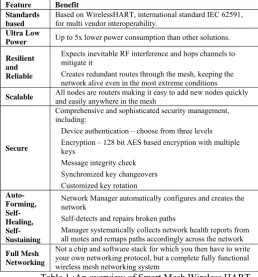
5.2.Embedded Sensor Network Solution for WirelessHART Based on WirelessHART, the IEC 62591 international standard, and fully interoperable with other WirelessHART compliant products, the SmartMeshWirelessHART product line includes motes-on-chip, mote modules and network managers. SmartMeshWirelessHART products have been deployed with most of the Fortune 500 companies that make WirelessHART compliant sensor networking products for industrial applications. Field- proven and robust even in the harshest environments, the product line is a battle tested, industrial strength full mesh networking solution. SmartMeshWirelessHART utilizes a time synchronized mesh protocol to deliver networking resilience, reliability, and scalability, while providing advanced network management and comprehensive security features. Dust Networks ultra low power technology extends battery life to up to 5x that of competing products. Table 1gives an overview of SmartMeshWirelessHART (also called SmartMesh IA-510)
Feature Benefit Standards
based
Based on WirelessHART, international standard IEC 62591, for multi vendor interoperability.
Ultra Low
Power Up to 5x lower power consumption than other solutions.
Resilient and Reliable
Expects inevitable RF interference and hops channels to mitigate it
Creates redundant routes through the mesh, keeping the network alive even in the most extreme conditions Scalable All nodes are routers making it easy to add new nodes quickly and easily anywhere in the mesh
Secure
Comprehensive and sophisticated security management, including:
Device authentication – choose from three levels Encryption – 128 bit AES based encryption with multiple keys
Message integrity check Synchronized key changeovers Customized key rotation
Auto-Forming, Self-Healing, Self-Sustaining
Network Manager automatically configures and creates the network
Self-detects and repairs broken paths
Manager systematically collects network health reports from all motes and remaps paths accordingly across the network
Full Mesh Networking
Not a chip and software stack for which you then have to write your own networking protocol, but a complete fully functional wireless mesh networking system
Table 1 :An overview of Smart Mesh Wireless HART Feature and Benefits
6. CONCLUSION
As sensor nodes are generally battery-powered devices, the critical aspects to face concern how to reduce the energy consumption of nodes, so that the network lifetime can be extended to reasonable times. In this paper we first break down the energy consumption for the components of a typical sensor node, and discuss the main directions to energy conservation in WSNs. Then, we present a systematic and comprehensive taxonomy of the energy conservation schemes, which are subsequently discussed in depth. Special attention has been devoted to promising solutions which have not yet obtained a wide attention in the literature, such as techniques for energy efficient data acquisition. Finally we conclude the paper with insights for research directions about energy conservation in WSNs.
REFERENCE
[1] .J. Kahn, R. Katz, and K. Pister. Next Century Challenges: Mobile Networking for Smart Dust. In Proceeding of ACM International Conference on Mobile Computing and Networking(MOBICOM’99),
Washington 1999; 271-278.
[2] A. Porret, T. Melly, C. C. Enz, and E. A.Vittoz.A Power Low-VoltageTransceiver Architecture Suitable for Wireless Distributed Sensors Network. In proceeding of IEEE International Symposium on Circuits and Systems’00 Geneva,2000; Volume 1: 56-59.
[3] J.M. Rabaey, M. J. Ammer, J. L. da Silva ,D.P.S.Roundy. PicoRadio Supports AdHoc Ultra-Low Power Wireless Networking. IEEE Computer Magazine July 2010;42-48
[5] A.Savvides, C Han, M.B.Stivastava. Dynamic fine-grained localization in ad hocnetworks of sensors. In Proceeding of ACM International Conference on MobileComputing and Networking(MOBICOM’01), 2001
[6] C. Alippi, G. Anastasi, C. Galperti, F. Mancini, M. Roveri, “Adaptive Sampling for Energy Conservation in Wireless Sensor Networks for Snow Monitoring Applications”, Proc. of IEEE International Workshop on Mobile Ad-hoc and Sensor Systems for Global and Homeland Security (MASS-GHS 2007), Pisa (Italy), October 8, 2007. [7] G. Anastasi, M. Conti, M. Di Francesco, “Reliable and Energy-efficient
Data Collection in Sensor Networks withData Mules: an Integrated Performance Evaluation”, Proc. of the 13th IEEE Symposium on Computers and Communications (ISCC 2008), Marrakech, Morocco, July 6-9, 2008.
[8] J. Ansari, D. Pankin, and P. Mähönen, “Radio-Triggered Wake-ups with Addressing Capabilities for Extremely Low Power Sensor Network Applications”, Proc. of the 5th European conference on Wireless Sensor Networks (EWSN2008), Bologna (Italy), Jan. 30 - Feb. 1, 2008.
Author