Understanding Gait Control Dynamics:
Ageing Effects on Falling Risks
Abstract
Background
Due to the ongoing trend of an ageing population in many developed countries, falls among older adults during walking are emerging as an important social healthcare issue due to high injury rates and associated medical costs. Unsuccessful recovery from balance loss leads to falls, and four critical swing phase gait events are toe-off, heel contact, minimum foot clearance (MFC) and minimum lateral margin (MLM). Dynamic balance at these four gait events were examined to characterise biomechanical evidence in older adults’ walking patterns to understand the frequent occurrence of falls.
Falls prevention strategies need to be effective and practical in addition to cost advantages and ease of engagement, if a measure is to be adopted as a long-term habitual intervention. This project also investigated whether a shoe insole is effective in reducing falls risks. As insoles can be applied to any shoes at lower cost, insole interventions could possibly prove an ideal approach to falls prevention during walking.
Study Designs and Aims
Gait data were collected from 26 older adults and 30 young controls, sampled by an
Optotrak® 3-D system (100Hz) with two AMTI force plates recording ground reaction forces and centre of pressure (CoP) (1000Hz). The current research increased and decreased step width (±50% relative to preferred width) as experimental conditions.
The first aim was to examine ageing effects on balance control at the four events. Based on the Safety Zone Model, ‘secured’ balance is defined when the centre of mass (CoM) projects within the Safety Zone, the area defined by two feet positions in the transverse plane.
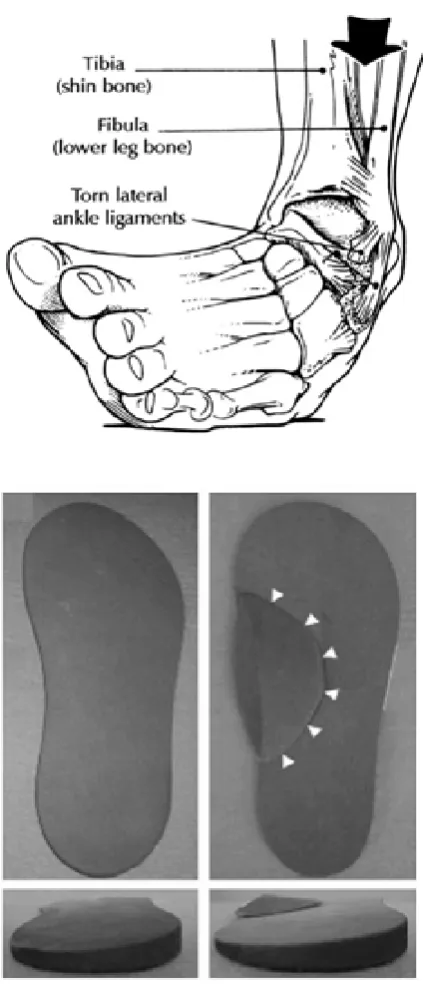
Another aim was to investigate a shoe insole’s dorsiflexion and eversion support effects on tripping and lateral balance loss prevention while reducing lower limb injuries including inversion sprain and knee joint osteoarthritis.
Findings and Implications
Zone, but walking velocity and step length were still lower than preferred walking. The shorter anterior-posterior Safety Zone due to slower gait was compensated by the non-dominant lead foot toeing-in, which extended the anterior margin when older adults walked with controlled widths. Age-specific asymmetry in toeing-in of the non-dominant foot, however, reduced the Safety Zone when the non-dominant foot was trailing. Under width controlled conditions, less variable step width and medio-lateral Safety Zone were observed but older adults also showed more variable medio-lateral CoM movement, non-dominant MLM and the foot’s CoP control, identified as further evidence of age-related impairment in medio-lateral balance.
The insole’s dorsiflexion support elevated swing foot clearance at MFC and eversion reduced lateral CoP displacement and increased the safety lateral margin at MLM, suggesting
Student Declaration
I, Hanatsu Nagano, declare that the PhD Thesis entitled “Understanding Gait Control Dynamics: Ageing Effects on Falling Risks” is no more than 100,000 words in length, including quotes, and exclusive of tables, figures and appendices, bibliography, references and footnotes. This thesis contains no material that has been submitted previously, in whole or in part, for the award of any other academic degree or diploma. All work in this thesis was conducted by me.
Hanatsu Nagano
Acknowledgments
I would like to first acknowledge my appreciation to both Professor Rezaul Begg and Dr. Tony Sparrow for guiding me through the precious PhD research journey.
I would also like to appreciate Victoria University for the opportunity and every support provided.
TABLE OF CONTENTS
Page
Abstract i
Student Declaration iii
Acknowledgments iv
Table of Contents v
List of Tables x
List of Figures xii
Abbreviations and Symbols xiii
Equations xv
Chapter 1: Introduction 1
1.1 Organisation of the Thesis 5
Chapter 2: Literature Review 6
2.1 The Epidemiology of Ageing and Falls 6
2.2 Terms and Definitions of Gait Cycle 7
2.2.1 Axis and Joint Motion 7
2.2.2 Stance and Swing Phases 8
2.3 Categorisation of Falls based on Critical Gait Events and Balance Loss Directions 11
2.4 Ageing Effects on Gait 12
2.5 Gait Adaptations to Challenging Walking Conditions among Older Adults 13
2.6 Biomechanics of Balance in Locomotion 15
2.7 Disturbances to Balance: Tripping and Slipping 21
2.7.1 Tripping Biomechanics 21
2.7.3 Slipping Biomechanics 24
2.7.4 Ageing Effects on Slipping 27
2.8 Minimum Lateral Margin (MLM) 28
Chapter 3: A Safety Zone Model of Balance When Walking 30
3.1 Modelling the Safety Zone 30
3.2 Balance during Single Support Phase 33
3.3 Inverted Pendulum Model 34
3.4 Balance Loss Simulation 36
3.4.1 Toe (Forefoot) Posterior-Slipping 39
3.4.1.1 Sagittal Plane 40
3.4.1.2 Transverse Plane 40
3.4.2 Heel Anterior Slipping 41
3.4.2.1 Sagittal Plane 42
3.4.2.2 Transverse Plane 43
3.4.3 Tripping 43
3.4.3.1 Sagittal Plane 44
3.4.3.2 Transverse Plane 45
3.4.4 Lateral Balance Loss 45
Chapter 4: Footwear Interventions to Reduce Falls Risk 48
4.1 Footwear Interventions 48
4.2 Modifications of Shoe Features 49
4.3 Modifications of Insoles and Other Orthotics 49
4.3.1 Ankle Orientation inside the Shoe 50
4.3.2 Increasing the Contact between the Foot and Insole 54
4.3.3 Stimulating Cutaneous Receptors 55
4.4 Shoe Insole Tested in the Current Project 56
Chapter 5: Research Questions and Hypotheses 59
Chapter 6: Research Methods 62
6.1 Participants 62
6.2 Apparatus and Procedure 62
6.3 Defined Gait Variable 66
6.3.1 Toe-off and Heel Contact 66
6.3.2 Spatio-temporal Gait Parameters 67
6.3.3 Minimum Foot Clearance (MFC) 68
6.3.4 Minimum Lateral Margin (MLM) 68
6.3.5 Lateral CoP Displacement and Mean Medial CoM Acceleration 69
6.3.6 RCoF1 and RCoF2 69
6.3.7 Heel Contact Dynamics 69
6.3.8 Lower Limb Joint Angles 69
6.3.9 Knee Adduction Moment 69
6.3.10 Time to Foot Flat 70
6.3.11 Recovery Rate 70
6.3.12 Safety Zone 70
6.4 Design and Analysis 72
Chapter 7: Ageing and Step Width Effects on Gait and Balance 74
7.1 Overview 74
7.2 Results 76
7.2.1 Spatio-temporal Gait Variables 76
7.2.2 Push-off GRF Kinetics Prior to Toe-off at RCoF2 79
7.2.3 GRF Kinetics Immediately Following Heel Contact at RCoF1 80
7.2.4 Heel Contact Dynamics 82
7.2.6 Minimum Lateral Margin 85
7.2.7 Lateral CoP Displacement and Mean Medial CoM Acceleration 86
7.3 Chapter Summary 87
Chapter 8: Ageing and Step Width Effects on Safety Zone Analysis 90
8.1 Overview 90
8.2 Results 91
8.2.1 Toe-off 91
8.2.2 Minimum Foot Clearance 95
8.2.3 Minimum Lateral Margin 98
8.2.4 Heel Contact 101
8.3 Chapter Summary 103
Chapter 9: Gait Data Computation for Balance Simulation 104
9.1 Overview 104
9.2 Results 104
9.2.1 Simulation of Anterior Balance Loss due to Posterior Forefoot Slipping 104
9.2.2 Simulation of Posterior Balance Loss due to Anterior Heel Slipping 105
9.2.3 Simulation of Lateral Balance Loss at MLM 106
9.2.4 Simulation of Anterior Balance Loss due to Tripping 106
9.3 Chapter Summary 107
Chapter 10: Effects of Insole on Gait and Balance 108
10.1 Overview 108
10.2 Results 109
10.2.1 Spatio-temporal Parameters 109
10.2.2 Effects of the Insole on Minimum Foot Clearance 110
10.2.3 Effects of the Insole on ML Balance 113
10.2.5 Effects of the Insole on Impact Reduction 115
10.3 Chapter Summary 118
Chapter 11: Discussion 119
11.1 Effects of Ageing and Step Width Manipulation on Gait Characteristics 119
11.2 Ageing and Step Width Effects on Balance at Four Swing Phase Events 121
11.2.1 Toe-off (RCoF2) and Heel Contact (RCoF1) 122
11.2.2 Minimum Foot Clearance and Minimum Lateral Margin 123
11.3 Safety Zone Analaysis 129
11.3.1 Non-dominant Toeing-in 129
11.3.2 Medio-lateral Safety Zone Control 130
11.3.3 Anterior-posterior Safety Zone Control 130
11.3.4 Future Research 130
11.4 Balance Loss Simulation 132
11.4.1 Simulation of Anterior and Posterior Slipping 133
11.4.2 Lateral Balance Loss Simulation 135
11.4.3 Tripping Simulation 136
11.4.4 Future Research into Balance Loss Simulation 137
11.5 Falls Prevention and Gait Rehabilitation 137
11.5.1 Shoe-insole Interventions 138
11.5.2 Gait Training Using Line Walking 140
11.5.3 Gait Diagnostics and Clinical Decision Making 142
11.6 Conclusion 143
Appendices 168
Appendix I: Advertisement for Older Participants 168
Appendix II: Ethics 169
Appendix III: Consent Form 191
Appendix IV: Information to Participants Involved in Research 195
Appendix V: General Health Survey Questionnaire 199
Appendix VI: Thank You Letter and the Report for Older Participants 202
Appendix VII: Poster 205
Appendix VIII: Candidature Proposal: Summary of Project 206
Appendix IX: Computation for ART due to Forefoot Posterior Slipping 219
Appendix X: Normality of the experimentally obtained data 224
Appendix XI: Publications 226
List of Figures
Figure Page
2.2.1 Three dimensional coordinate, axis and plane 8
2.2.2 Stance and swing phases of gait cycle 9
2.2.3 Vertical ground reaction forces 10
2.2.4 Swing foot ground clearance events 11
2.6.1 Traditional dynamic balance measurement using the BoS 16
2.6.2 Effects of fear of falling on the ML CoM motion during sit-to-walk performance 18
2.6.3 Illustration of four swing foot events 20
2.7.1 Swing foot MTP trajectory 22
2.7.2 MFC histogram of both young and older adults 24
2.7.3 RCoF measurement throughout the stance phase 25
2.7.4 Heel contact dynamics 27
2.8.1 Definition of minimum lateral margin (MLM) 29
3.1.1 Image of the Safety Zone model 31
3.1.2 Toe-heel line and typical CoP path 32
3.2.1 Safety Zone based balance assessment at right swing MFC 33
3.2.2 Safety Zone illustration at four swing phase events 34
3.3.1 Dynamic walking theory: inverted pendulum mechanics 35
3.3.2 Illustration of recovery rate 36
3.4.1 Force couple between the two ends of the IP model 37
3.4.2 Simulation of posterior forefoot slipping 39
3.4.3 Simulation of anterior heel slipping 42
3.4.4 Simulation of tripping 44
3.4.5 Simulation of lateral balance loss 46
4.3.1 Four fundamental ankle motions 50
4.3.2 Forefoot offloading orthotics with dorsiflexion support 51
4.3.3 Inversion sprain and eversion insole 53
4.4.1 Specification of the tested shoe insole 57
6.2.1 Laboratory setup and marker setup. 63
6.2.2 Lower body modelling 64
6.2.3 Step width control illustration 65
6.3.1 Toe-off and heel contact definitions 66
6.3.2 Spatio-temporal gait parameters 67
6.3.3 Minimum lateral margin 68
6.3.4 Knee and ankle angles and knee adduction moment 70
6.3.5 Illustration of the Safety Zone 71
7.2.1 Ageing and width effects on step width, velocity and length 77
7.2.2 Ageing and width effects on double support time 78
7.2.3 Ageing and width effects on RCoF and GRF at RCoF2 prior to toe-off 79
7.2.4 Ageing and width effects on RCoF and GRF at RCoF1 following heel contact 81
7.2.5 Ageing and width effects on heel contact angle and foot contact angle 82
7.2.6 Ageing and width effects on MFC characteristics: MFCd and MFCt 84
7.2.7 Ageing and width effects on MLM characteristics: MLMd and MLMt 85
7.2.8 Ageing and width effects on lateral CoP displacement and medial CoM acceleration 87
8.2.1 Safety Zone at toe-off 92
8.2.2 Safety Zone at MFC 95
8.2.3 Safety Zone at MLM 98
8.2.4 Safety Zone at heel contact 101
10.2.1 Insole effects on spatio-temporal parameters 109
10.2.2 Insole effects on MFC by histogram comparison 110
10.2.3 Insole effects on MFCt 111
10.2.4 Insole effects on knee and ankle angles at MFC 112
10.2.5 Insole effects on ML balance control 113
10.2.6 Insole effects on MLMt 114
10.2.7 Insole effects on heel contact dynamics 115
10.2.9 Insole effects on lower limb joint angles at heel contact 117
11.2.1 Variable MLMt 125
List of Tables
Table Page
2.6.1 Effects of Ageing and History of Falls on Lateral Balance. 17
9.2.1 Segment Mass of Foot and Pelvis and Lower Limb Length 104
9.2.2 Forefoot Posterior Slipping Simulation 105
9.2.3 Anterior Heel Slipping Simulation 106
Equations
𝐶𝐶𝐶 =𝐹𝐹(𝑓𝑓𝑓(𝑁)) ……… 1
𝑅𝐶𝐶𝐶= 𝐺𝐺𝐹ℎ𝑜𝑓𝐺𝐺𝐹𝐺𝐺𝑓 ……… 2
T = F(f)× sinθ× d =−F(C)× sinθ × d ……… 3
F(C) = M T
(C)×sinθ×d……… 4
A(C) = −FM((Cf))……… 5
F(f) =𝐺𝑅𝐶𝐺𝐺𝐺×𝐶𝐶𝐶 − 𝐺𝑅𝐶ℎ𝐶𝐺……… 6
A(c) = F(f)
M(c)……… 7
A(f) = F(f)
M(f)……… 8
𝑡𝑦−𝐶𝑦′
𝑡𝑥−𝐶𝑥′ =
𝐶𝑦′−𝑠𝑡𝑦′
𝐶𝑥′−𝑠𝑡𝑥′ =
𝑡𝑦−𝑠𝑡𝑦′
𝑡𝑥−𝑠𝑡𝑥′……… 9
CoM (Cx’, Cy’) = (𝑉(𝑐𝑐)× t + 0.5 ×𝐴(𝑐𝑐)× t2,𝑉(𝑐𝑐)× t + 0.5 ×𝐴(𝑐𝑐)× t2) 10
Slipping foot (stx’, sty’) = (𝑠𝑠𝑐+ 0.5 ×𝐴(𝑓𝑐)× t2,𝑠𝑠𝑐+ 0.5 ×𝐴(𝑓𝑐)× t2)… 11
𝑠 =−𝑏±√𝑏2𝑎2−4𝑎𝑐 ……… 12
𝐶(𝑓) = 𝐺𝑅𝐶𝐺𝐺𝐺×𝐶𝐶𝐶 − 𝐺𝑅𝐶ℎ𝐶𝐺 ……… 13
𝐴(𝑐) =𝑀𝐹((𝑓𝑐))……… 14
𝐴(𝑓) =𝑀𝐹(𝑓)
(𝑓)……… 15
ℎ𝑦−𝐶𝑦′
ℎ𝑥−𝐶𝑥′ =
𝐶𝑦′−𝑠ℎ𝑦′
𝐶𝑥′−𝑠ℎ𝑥′ =
ℎ𝑦−𝑠ℎ𝑦′
ℎ𝑥−𝑠ℎ𝑥′ ……… 16
(shx’, shy’) = (𝑠ℎ𝑐+ 0.5 ×𝐴(𝑓𝑐)× t2, 𝑠ℎ𝑐+�𝑉(𝑓𝑐)² +𝑉(𝑓𝑐)² × t + 0.5 ×𝐴(𝑓𝑐)× t2) 18
�(𝑠ℎ𝑐′− 𝑠ℎ𝑐)2+ (𝑠ℎ𝑐′− 𝑠ℎ𝑐)² =�𝑉(𝑓𝑐)² +𝑉(𝑓𝑐)² × t + 0.5 ×�𝐴(𝑓𝑐)² +𝐴(𝑓𝑐)² × t² 19
𝐶(𝑓) = 𝐴(𝑓) ×𝑀(𝑓)……… 20
𝐴(𝑐) =𝐴(𝑓𝑀)×(𝑐𝑀)(𝑓) ……… 21
X =�𝑅𝑐 − Rx�Ry−Ly� Rx−Lx �/� V(cy) V(cz)− Ry−Ly Rx−Lx� ……… 22
Y =V(cy) V(cz)×�Ry− Rx�Ry−Ly� Rx−Lx �/� V(cy) V(cz)− Ry−Ly Rx−Lx� ……… 23
D = √𝑿𝟐+𝒀𝟐 ……… 24
ART (t);t =−V(c)+�V(c)2+2×A(c)×D A(c) ……… 25
t =(𝑡𝑐−𝐶𝑐) 𝑉(𝑐𝑐) ……… 26
(𝑠𝑡 − 𝐶𝑡) =𝑉(𝑐𝑡) ×𝑠……… 27
𝐶(𝐺𝑡) = 0.5 ×𝑀𝐹((𝑙𝑐))×𝑠² ……… 28
Abbreviations and Symbols
AP anterior-posterior
ART available response time
BoS base of support
CoF coefficient of friction
CoM centre of mass
CoP centre of pressure
FoF fear of falling
GRF ground reaction force
HC heel contact
HO healthy older
HY healthy young
IP inverted pendulum
IQR interquartile range
RCoF required coefficient of friction
MFC minimum foot clearance
MLM minimum lateral margin
ML medio-lateral
MTP minimum toe point
SD standard deviation
Chapter 1
Introduction
Independent mobility is essential to a healthy and rewarding lifestyle because it provides the locomotor abilities for our everyday work, recreation, and home based activities. One cost, however, of the physical and psychological health benefits of mobility is the risk of sustaining a fall. Falls become an increasingly significant health risk with ageing due to declines in the neuromuscular control of walking that compromise stability and, as a consequence, increase the risk of falling. The increased incidence of falls in older adults and the associated mortality, morbidity, and disability are a major concern for the Australian healthcare system (Moller 2003). In one report falls-related expenditure in Australia was estimated to be $3billion per annum, possibly higher than for any other category of injury, including motor vehicle accidents (Commonwealth Department of Health and Aged Care, 2001; Cassell and Clapperton, 2008; SRDC 1999). As a consequence, there is in progress a worldwide research effort to better understand the causes of falls and, subsequently, devise interventions to prevent them. Consistent with this broad initiative this Thesis had two principal aims. The first was to understand how ageing changes the biomechanical characteristics of balance during walking that may cause falls. The second aim was to investigate methods of falls prevention and in this project the protective effects of a shoe insole were determined experimentally.
auditory degeneration, medications and dizziness, all of which can negatively affect gait stability (Lord and Daybew, 2001; Nicklason et al., 2002).
Previous research has documented ageing-related changes to walking that are proposed to be adaptive in securing balance. Older adults for example, walk with shorter and wider steps, slower velocity and prolonged double support time (Whittle, 2007; Winter, 1991). While balance control in ageing has been documented there remain two important limitations to previous research that form the focus of the project described below. First, while medio-lateral (ML) stability has been studied there are relatively few accounts of stability loss in the anterior-posterior (AP) direction. A more complete stability model should, therefore, encompass balance loss in both primary axes of motion, ML and AP, therefore transverse plane. Tripping and slipping, for example, would be expected to induce greater AP stability loss than ML.
The second feature of stability modelling investigated in the present experiment was the capacity to maintain stability during the swing phase of the gait cycle when only one foot maintains ground contact. Previous studies have revealed that the capacity to control the CoM within the base of support (BoS) reduces with ageing, especially for those with history of falls (Åberg et al., 2010; Lugade et al., 2011). Traditionally the effective BoS during walking has been defined during double support, when step width can be easily measured as the distance between the feet. When one foot is off the ground during the swing phase, however, the CoM position relative to the BoS is less easily modelled because the supporting base formed by feet changes shape and extent as the swing phase progresses.
of gait biomechanics may be controlled equally by the motor system to preserve balance.
While balance has, therefore, traditionally been considered essential to understanding functional, adaptive human gait control a broad range of biomechanical variables and associated concepts have been used to define “balance”. In this thesis a comprehensive, unified, model has been developed that demonstrates how all spatio-temporal gait parameters influence the capacity to maintain balance; the Safety Zone Model (hereafter also referred to as “The Model”). As implied by Drury and Wolley (1995) the fundamental proposition underlying The Model is that balance depends on step width variability that narrows or lengthens the base of support in combination with step velocity that increases or decreases the time available in which to redirect the whole body centre of mass. “Balance” is, therefore, proposed as the primary concept in understanding adaptive locomotor control.
The first research question addressed in this thesis was how ageing affects balance control during walking. To answer this question, the Safety Zone model was employed incorporating the two key features designed to overcome the limitations of previous research outlined above. Specifically the Model: (i) accommodates loss of stability in two of the principal axes of motion, AP and ML and; (ii) incorporates a stability boundary during the vulnerable swing phase, when the base of support is changing continuously and balance loss is more likely than during the relatively stable double support phase. By incorporating these features the effects on balance of tripping and slipping to the CoM were biomechanically modelled by measuring experimentally the AP and ML CoM displacement relative to a “safety zone” base of support formed by the feet at four key swing phase events (i.e. toe-off, minimum foot clearance, minimum lateral margin and heel contact).
participants were requested to walk with narrow and wide steps (±50%) were included as experimental conditions.
As discussed briefly there is a pressing need for effective and practical falls prevention interventions. Critically important in falls prevention are cost and ease of engagement, if a measure is to be adopted as a long-term habitual intervention (e.g., Yardley et al., 2008). Walking, for example, is proposed as an ideal exercise intervention for older adults due to its adequate intensity, low cost and generally easy engagement. One limitation to walking for exercise is, however, a higher risk of falling when walking in a more obstructed environment comprising irregular and varied ground surfaces. Shoe designs have previously been investigated (e.g. Menant et al., 2008) as an important safety consideration for older adults because they provide the coupling or interface between the locomotor system and the highly varied support surfaces upon which we move. This project also addresses the question of whether a shoe insole is effective in improving the balance of older adults by reducing tripping and lateral balance loss. Effects of improved shoe design are only of benefit when specifically designed shoes are worn, while insoles can be applied to any shoes at lower cost. Insole interventions could possibly prove an ideal approach to reducing balance loss during walking.
1.1 Organisation of the Thesis
Chapter 2.
Literature Review
2.1 The Epidemiology of Ageing and Falls
In Australia, 1.5 million falls are estimated among older adults every year, and depending on the study, 9-20% of falls cause severe injuries, such as hip fractures (Stevens et al., 2006). Nationwide at least 100,000 severe injuries among older adults are due to falls, ranked as the leading cause of non-fatal injury (27%) and also the third leading direct cause of injury-related death (Watson and Ozanne-Smith, 2000). The annual medical costs of falls is estimated at close to $3 billion and on an individual basis, the average cost per falls-related hospitalisation is reported to exceed $20,000 (Australian Government, 2007; Hill et al., 1999; Stalenhoef et al., 2002; National Injury Prevention Advisory Council, 1999). Medical costs are predicted to triple in the next 40 years due to the increasing proportion of older adults relative to the population as a whole from 13.5% now to 22% by 2050 (Commonwealth of Australia, 2010).
In addition to costs, falls have a negative impact on an individual’s quality of life, for example, half of the hip fractures due to falling result in permanent loss of independent lifestyles and 20-30% of those eventually result in death (Cassell and Clapperton, 2008; Hung et al., 2012; Sherrington and Menz 2003). In preparation for a demographically ageing society, a reduction in falls should be a top priority. Successful establishment of any innovative intervention has the potential to create a positive impact on the falls problem worldwide. In Australia, every 1% reduction in falls could prevent 45,000 older adults from falling and save an associated $90 million every year (Australian Government, 2007; Hill et al., 1999; Stalenhoef et al., 2002; National injury prevention advisory council, 1999).
intrinsic risk factors. According to previous studies (Berg et al., 1997; Sherrington and Menz, 2003; Koepsell et al., 2004; Li et al., 2006; Curry et al., 2003; WHO, 2007), about half of falls in older people occur while they are walking outdoors. Despite the risk of falling, maintaining mobility by walking is recommended for older adults. Further understanding of age-related effects on gait and balance is, therefore, essential for the assessment of ageing-related falls risk and developing effective prevention strategies. The conventions employed in previous gait research are summarised in the following section.
2.2 Terms and Definitions of Gait Cycle
The term ‘gait’ refers to ‘manner’ or ‘style’ of walking (Whittle, 2007). Although the word ‘walking’ is often used interchangeably, ‘gait’ is more suitable in the study of human locomotion. For analytical purpose, the minimal unit of investigation which contains all the characteristics of the normal gait cycle was first, essentially defined. One gait cycle is defined as ‘the time interval between one gait event and the next occurrence of the same gait event of the same limb’, and majority of the studies employ heel contact as the initiation and termination of one gait cycle (Begg et al., 2006; Rose et al., 2006; Whittle., 2007). Applying this common manner, an alternative definition of gait cycle can be ‘Heel contact to the next heel contact of the same foot’. Heel contact is defined as the instant when the heel of the foot or shoe makes initial contact with the ground (Winter, 1991). For abnormal or pathological gait where the heel may not be the first part to make contact with the ground, and as such the term initial contact, foot strike, and foot contact are used instead. Toe off is defined as the instant when the toe of the foot or shoe leaves the ground (Winter, 1991). The term ‘foot off’ is, in some gaits, preferred for the same reason. Heel contact and toe-off events determine two major gait phases i.e., stance and swing.
2.2.1 Axis and Joint Motions
Figure 2.2.1 Three dimension coordinate system. Forward-backward = anterior-posterior; right-left = medio-lateral (adapted from Whittle, 2007).
2.2.2 Stance and Swing Phases
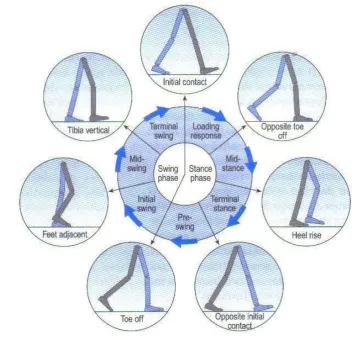
Stance phase is the time when the foot is in contact with the ground; heel contact (described as initial contact in Figure 2.2.2) to toe-off; whereas the swing phase is the time when the foot is off the ground and moving forward in the air; toe-off to the next heel contact (or initial contact) (Whittle., 2007). Rose et al. (2006) reported the proportion of the two phases for normal adults is 62% stance and 38% swing phase. Both phases have a number of subdivisions as illustrated in Figure 2.2.2.
Figure 2.2.2 Stance and swing phase of one gait cycle and their further sub-events relative to the stance limb. Heel contact is indicated as initial contact (adapted from Whittle, 2007).
While gait descriptions (Figure 2.2.2) and ground reaction forces (Figure 2.2.3) are relative to the stance limb, it is also possible to use swing phase events to divide the swing phase of gait cycle. Vertical toe-trajectory is for example, one method to define swing phase events.
Figure 2.2.4 Swing phase foot trajectory events: Mx1, MFC and Mx2: TO = toe-off and HC = heel contact (adapted from Moosabhoy et al., 2006).
As visualised in Figure 2.2.4, , the first and the second (maximum) clearance has been described as Mx1 and Mx2, while the local minimum between the two peaks has been known as minimum foot clearance (MFC) where the risk of tripping has been considered to be frequent (Begg et al., 2007). As this example shows, falls need to be categorised into several different types to analyse gait features that increase the risk of particular types of falls and identification of specific gait events for each type of fall is necessary to advance gait biomechanics for an issue of falls among older adults.
2.3 Categorisation of Falls based on Gait Events and Balance Loss Directions
(section 2.7; Begg et al., 2007; Lockhart et al., 2007). Although it has been less well explored than MFC and heel contact characteristics, Myung (2003) reported that at the event prior to toe-off, there is a risk of forefoot posterior slipping that may lead to falls.
In addition to direct cause, such as tripping or slipping, fall direction can also be used to classify a fall. Almost all falls during walking can be attributed to balance loss, either anterior, posterior or lateral, except in unusual balance loss events such as a sudden collapse of the walking surface. Tripping at MFC and posterior forefoot slipping prior to toe-off mainly induce anterior balance loss while posterior falls are most frequently caused by slipping after heel contact (Myung, 2003; Smeesters et al., 2001). Thus, for further understanding of AP balance loss, critical gait events including toe-off, MFC and heel contact should be investigated. In relation to lateral falls, it is interesting that there have been few previous investigations (Lugade et al., 2011). As detailed in Section 2.5 and Chapter 3, falls direction is determined by the support base boundary (Hof et al., 2005).
The current research explores falls biomechanics from the perspective of dynamic balance at the critical gait events. Critical gait events in relation to lateral balance loss have not however, yet been clearly identified. This limitation has hindered research on lateral balance control and accordingly, the first objective is to detect those gait events leading to lateral instability. As suggested by Perry et al. (2008) and Åberg et al. (2010), minimum lateral margin (MLM) is the mid-swing event with the shortest ML distance between CoM and the stance foot (section 2.8), and accordingly, an association between MLM and lateral balance perturbation is predicted. The four key swing phase events examined in the current study were toe-off, MFC, MLM and heel contact. Biomechanical characteristics of these events were first characterised for ageing and step width effects but independent of body balance, but later, re-examined by incorporating dynamic balance assessment method using the Safety Zone. Preceding the introduction of previous findings about the four critical swing phase events and the rationales for balance loss description by the Safety Zone Model provided, it is meaningful to review general causes of gait changes and balance impairment due to ageing.
2.4 Ageing Effects on Gait
considered the primary intrinsic cause of falls in older adults (Richardson et al., 2003). Ageing induces a systematic and progressive decline in foot sensitivity (Perry, 2006), lower limb muscle strength and power (Puthoff and Nielsen, 2007), lower limb joint flexibility (Kang and Dingwell 2008), and muscle activation (Solnik et al., 2010). Strength in the quadriceps, hamstrings, dorsiflexors and plantarflexors and reduced joint range of motion (RoM) have been identified due to decreased maximum flexion and extension of each lower limb joint (Perry et al., 2007). Motor control also declines with ageing and negatively affects reaction speed, precision of end-point control, (e.g. the foot) and movement variability (Hausdorff, 2005). Muscle activation during walking is modified in older adults, as reflected in decreased activation of some muscles and increased co-activation of others (Hortobagyi et al., 2009). For example, deficits in dorsiflexor activation have been observed in older adults and linked to changes to the foot’s trajectory during the swing phase that may increase the risk of tripping (Morse et al., 2004). With ageing, afferent sensory signals from the feet are also attenuated due to reduced plantar fat pad thickness, flattening of the longitudinal arch and the development of claw and hammer toes (Burnfield et al., 2004). Reduced foot sensitivity has, furthermore, been associated with an increased risk of falling due to balance loss (Zehr and Stein, 1999). Most important is that the sensorimotor changes with ageing identified above influence the walking pattern and impair dynamic balance.
Reduced walking speed is the most well documented ageing effect, due to shorter step length with prolonged double support time (Hollman et al., 2007; 2011; Macellari et al., 1999; Whittle, 2007; Winter, 1991). Another key adaptation in spatio-temporal gait parameters is that older adults tend to adopt wider steps to preserve balance possibly with additional mechanical energy costs (Hurt et al., 2010; Ko et al., 2007; Pandy et al., 2010). It is, however, important to note that falls are more frequent in “older” and frailer individuals who usually have increased step width, suggesting that age-related balance impairments cannot be fully compensated by larger step width (Åberg et al., 2010; Wezenberg et al., 2011). In the present experiment the gait task was manipulated by changing step width, both narrower and wider than preferred, to challenge balance and investigate how with ageing, gait is adapted to maintain stability.
In challenging walking conditions, not only do physiological and neurological factors increase the difficulty of processing unfamiliar sensory inputs, but older adults’ gait has also been described as “cautious” or “fearful” (Prince, 1997; Wass et al., 2005). The usual term to describe age-specific effects on gait adaptations due to psychological preparatory responses against potential hazards is ‘fear of falling’ (Bock and Beurskeus 2010; Dunlap et al., 2012; Hollman et al., 2007; Ko et al., 2007; Nagano et al., 2012; Nordin et al., 2010; Schrager et al., 2008). Fear of falling has been identified as a primary factor in inducing cautious gait adaptations, such as shorter step length and associated reduction in gait velocity, leading to impaired balance (Menz et al., 2007). Multiple factors, including self-awareness of decline in physical condition such as lower limb muscular strength, slower reaction speed, visual or auditory deterioration and poor balance, in addition to history of falls or activity restrictions may trigger caution-based gait adaptations (Donoghue et al., 2012; Scheffer et al., 2008; Vellas et al., 1997; Zjistra et al., 2007). Onset of fear of falling tends to initiate a cycle of negative ‘chain reactions’, for example, regulation of outdoor activities leading to loss of sociality, depression, accelerating physical decline and further escalation of fear of falling.
2.6 Biomechanics of Balance in Locomotion
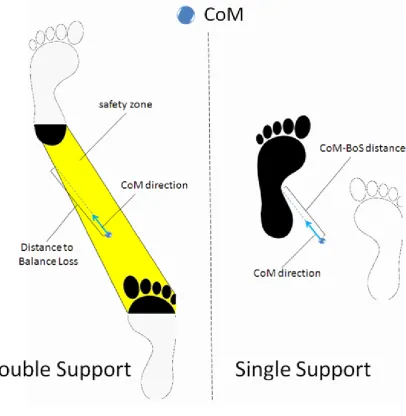
Ageing changes gait due to declines in sensorimotor function and increased fear of falling (Menz et al., 2007). Balance has been previously assessed by inspecting the whole body CoM kinematics relative to the base of support BoS during double support and single support. Position, velocity and acceleration of the CoM relative to the BoS determine dynamic balance (Hof et al., 2005; Lee and Chou, 2006; Winter et al., 1996). The CoM is the ‘point’ representation of the whole body (Lee and Chou, 2006) and the BoS is defined as the contact area formed by the feet during stance. Body balance is considered to be secured when the CoM is within the BoS but a difficulty to this model is in defining the spatial area between the stance feet (Figure 2.6.1).
Figure 2.6.1 Traditional dynamic balance measurement using the BoS during double
support (left) and single support (right). Distance to Balance Loss and the CoM-BoS distance
are based on the CoM movement. Black shaded area; foot contact area. Non-shaded area;
foot out of contact with the walking surface (adapted from Lugade et al., 2011).
At heel contact, distance from the CoM location to the BoS boundary (Distance to Balance Loss in Table 2.6.1 and Figure 2.6.1) tends to reduce with both ageing and fear of falling. The BoS area shows a similar response, in being the largest in healthy young and smallest in older adults with fear of falling. Available response time (ART) at heel contact, the temporal period from the current CoM location to the point on the BoS boundary at which the CoM will eventually cross based on the current velocity, was not differentiated between young, healthy older and older adults with fear of falling because reduction in gait velocity is accompanied with shorter “Distance to Balance Loss”.
Table 2.6.1. Effects of ageing and history of falls on lateral balance; Older FoF = older adults with fear of falling; HC = heel contact; TO = toe-off (adapted from Lugade et al.2011)
*significantly different from Healthy Young † significantly different from Healthy Older
Healthy Young Healthy Older Older FoF
Gait Velocity (m/s) 1.38 ± 0.14 1.26 ± 0.20 *†1.02 ± 0.10
Double Support (HC)
Distance to Balance Loss (cm) 23.0 ± 4.1 *18.7 ± 4.0 *17.5 ± 2.6
ART (s) 0.16 ± 0.03 0.15 ± 0.04 0.17 ± 0.03
BoS area (cm²) 475.0 ± 59.8 435.4 ± 57.2 *401.9 ± 71.7
Single Support (TO)
CoM-BoS distance (cm) 17.2 ± 3.7 15.3 ± 6.7 *11.3 ± 4.0
Time to Contact (s) 0.12 ± 0.03 0.11 ± 0.04 0.11 ± 0.04
BoS area (cm²) 218.0 ± 34.2 219.8 ± 35.7 227.7 ± 40.0
Toe-off was contrarily, investigated by Lugade et al. (2011) as the initial event of single support. Because only lead stance foot is counted as the BoS, similar foot contact area was found in all the three examined groups (Table 2.6.1). The CoM-BoS distance represents the shortest distance from the current CoM location to any part of the lead stance foot’s contact area. The trend of the reduced CoM-BoS distance due to ageing and fear of falling was thought to mirror impaired ability to separate the CoM from the BoS in the AP direction (Lugade et al., 2011).
Compared to healthy older adults, the fear of falling group took larger step width and associated increase in the ML CoM excursion, but the ML CoM velocity was not differentiated between the two groups. This implies that older adults with ‘fear of falling’ take temporarily longer step because of the greater distance to travel (Figure 2.6.2). This adaptation could effectively prolong time to redirect the CoM and consequently increase ART to lateral balance loss (Ko et al., 2007; Donelan et al., 2001). From this result again, increased step width can be considered an effective adaptation to secure balance by prolonging ML.
Another important contribution of Åberg et al. (2010) was the report of minimum lateral margin (MLM), the mid-swing event where the lateral distance from the CoM to the stance foot becomes minimum, as shown in Figure 2.6.2. As further detailed in section 2.8, MLM can be considered as the event at which there is a high risk of the CoM being laterally dislocated from the stance foot (Perry et al., 2008). MLM is, therefore, an important concept in understanding lateral balance loss. In this Thesis MLM is further explored in relation to balance control (Figure 2.8.1).
Summarising the information about medio-lateral (ML) balance, enlarged step width is typical in the population with less stable gait but it seems effective in extending ML margin of the CoM excursion, therefore improving ML balance. As implicated by Figure 2.6.2, narrower step width accompanies decreased ML distance for the CoM to travel, possibly increasing the risk of lateral balance loss. These are the rationales for the current study to employ 50% narrower and wider walking as experimental conditions. Both step width manipulations are likely to accompany unfamiliarity (Donelan et al., 2001; Wezenberg et al., 2011), possibly causing fear-associated gait adaptations (section 2.5). In addition to unfamiliarity, narrower walking seems to provide functionally more challenging walking conditions, while wider walking may advantage ML balance due to a wider BoS. Healthy older participants in the current project were not expected to reveal age-associated impairments in balance control when preferred-width walking. With decreased or increased step width they were anticipated to demonstrate impaired balance control as suggested by the previous studies (Donelan et al., 2001; Wezenberg et al., 2011).
The primary advantage of the Safety Zone approach over the traditional BoS-based balance assessment is its applicability to any part of gait cycle including previously unexplored single support. Step width manipulations change heel contact patterns and associated gait characteristics during double support, but single support phase could be more unstable and association between step kinematics and balance during single support can be investigated by applying the safety zone concept. In the current project, four key swing phase events influencing balance were investigated by the safety zone concept as further explained in the following section 2.7 and 2.8 for details about these gait events.
accompany the risk of slipping. Minimum foot clearance (MFC) is the mid-swing phase event with low vertical height of swing foot ground clearance and tripping related balance loss is attributed to MFC (Begg et al., 2007; Winter, 1991). Minimum lateral margin (MLM) is another mid-swing event usually following MFC before heel contact where the lateral CoM margin to stance foot becomes minimum (Figure 2.6.2). Unexpected lateral balance perturbation tends to result in lateral balance loss at MLM.
Figure 2.6.3 Illustration of four swing foot events from the sagittal view. Data taken from single subject.
In this sense the Safety Zone Model described here is important in being a dynamic model, changing as continuously throughout the gait cycle, rather than the entirely static concept previously investigated that define balance using variables that are a “snapshot” of gait at a single point in the cycle at double support. Before discussing the Safety Zone approach further, previous research into the four key swing phase events in Figure 2.6.3 is introduced in relation to falls.
2.7 Disturbances to Balance: Tripping and Slipping
Tripping and slipping are the two major causes of AP balance loss (Blake et al., 1988; Berg et al., 1997; Prince et al., 1997). Tripping is associated with anterior balance loss and is the leading cause of falls among older adults (Blake et al., 1988; Berg et al., 1997; Prince et al., 1997). Strategies to reduce the risk of tripping could therefore dramatically decrease falls rates. Tripping will not occur if swing foot ground clearance is greater than the height of an obstacle. Slipping is the second leading cause of falling, accounting for a quarter of falls in older adults and the primary cause of posterior balance loss (Berg et al., 1997; Leclercq, 1999; Yoon and Lockhart, 2006). Hip fracture is commonly associated with slipping falls, recognised as the most serious injury, as permanent loss of some body functions was reported in 50% of cases (Curry et al., 2003; Smeesters et al., 2001; WHO, 2007). Except for the study by Myung (2003), investigations of slipping have been limited to anterior slipping immediately after heel contact, which causes posterior and sometimes the lateral CoM displacement relative to the BoS (Smeesters et al., 2001).
2.7.1 Tripping Biomechanics at Minimum Foot Clearance
observed at around 25% of the swing phase; MFC, the lowest height between Mx1 and Mx2 at around 50% (MFCt = 50%) of the swing phase; and Mx2, the highest location throughout
the swing phase usually observed at around 90% of the swing phase (Nagano et al., 2011). Minimum toe point (MTP) is the most proximal and inferior surface of foot, most commonly used as the point of investigation for swing foot clearance (Begg et al., 2007).
Figure 2.7.1 Swing foot MTP trajectory (adapted from Nagano et al., 2011). MFCh =
vertical displacement of MTP at MFC; MFCt = timing of MFC (%) during swing time.
Vertical height of the swing foot from the walking surface at minimum foot clearance (MFCh) is generally within 1.0-2.0 cm of the ground regardless of the walking surfaces,
to the stance foot and usually provides sufficient anterior margin to prevent anterior balance loss. The swing foot at MFC is, in contrast, parallel to the stance foot, creating a smaller anterior margin to the frontal boundary of the supporting base.
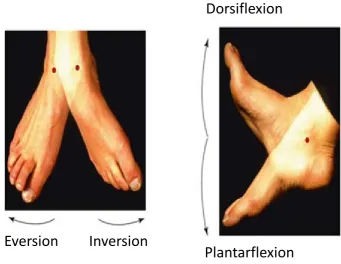
Hip flexion, knee flexion and ankle dorsiflexion are lower limb motions that increase MFCh and reduce tripping risk (McFadyen and Prince, 2002; Moosabhoy and Gard., 2006).
Dorsiflexion is most effective in raising MFCh (Moosabhoy and Gard, 2006) and compared
to knee or hip flexion, it can be speculated that ankle motion should effectively raise MFCh
without affecting the entire gait motion. Practical gait modifications to attain increased MFCh
should minimally disturb natural walking patterns and should be constantly attainable in every gait cycle without intentional control. Therefore, dorsiflexion support can be the most practical joint motion to raise MFCh and reduce tripping risk, which is applied in the shoe
insole tested in the current project (Chapter 4).
Attaining consistent MFCh throughout multiple swing phases is evidence of effective
MFC control and tripping risk is considered to be lower with reduced MFCh variability (Best
and Begg, 2008; Begg et al., 2007). Failure to adequately compensate for surface height variability by adjusting MFCh makes it the point of highest risk for a trip. Based on these
findings, non-normal distributions of foot-ground clearance have been used to determine the precise probability of tripping while recent results have identified asymmetries (between-foot differences) which were important measures for prediction (Nagano et al., 2011).
2.7.2 Ageing Effects on MFC
Previous studies have reported no significant differences in MFCh between young and
older adults. When each swing foot’s ground clearance is plotted in a histogram, however, the most informative presentation of MFC central tendency and distribution characteristics is provided (Figure 2.7.2). Greater MFC variability (IQR) and lower kurtosis are observed in older adults, suggesting less control of MFCh (Begg et al., 2007). A further indication of
inconsistency in gait control is MFCh asymmetry between the two limbs. Di Fabio et al.
(2004) have found that obstacle clearance characteristics between the two feet were more asymmetrical in the population with the higher risk of falls. For normal foot ground clearance, older adults show an age-specific response in increased asymmetry due to higher MFCh in the non-dominant swing foot (Nagano et al., 2011). This age unique adaptation can
is harder to recover (Neptune et al., 2001; Perry et al., 2007; Pijnappels et al., 2008; Winter, 1980).
Figure 2.7.2 MFC histogram of both young and older adults walking on overground walking surface (adapted from Nagano et al., 2011).
2.7.3 Slipping Biomechanics
Another description of slipping is when slip-resistance of the two interfaces (i.e. a bottom sole of a shoe and a walking surface) drops under the certain threshold. Slipperiness of a particular surface is described by coefficient of friction (CoF) and the ratio of vertical and horizontal GRF determines required coefficient of friction (RCoF) that indicates minimum CoF necessary to prevent slipping (Chang, 1999). The conventions about CoF and RCoF are described as follows.
𝐶𝐶𝐶 =𝐹𝐹(𝑓𝑓𝑓(𝑁)) ……… 1
𝑅𝐶𝐶𝐶= 𝐺𝐺𝐹ℎ𝑜𝑓𝐺𝐺𝐹𝐺𝐺𝑓 ……… 2
where CoF = coefficient of friction; F(fri) = friction force; F (N) = normal force; GRFhor = horizontal GRF component; RCoF = required coefficient of friction
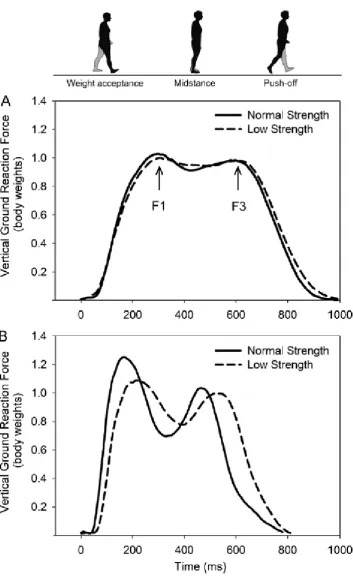
When CoF is lower than RCoF, slipping initiates but under non-slippery walking conditions, RCoF measurements can also identify the risk of slipping for a particular walking pattern when unexpectedly encountering a slippery surface. RCoF assessment of normal walking reveals the three peaks in early stance and one negative peak toward the end of the stance phase, indicating where the risk of slipping arises (Figure 2.7.3).
Positive (> 0) and negative RCoF (< 0) indicate anterior and posterior slipping potentials respectively. Assessment of anterior slipping is possible 50ms to 120ms after heel contact, approximating RCoF1. The initial positive peak indicated with arrow is probably related to micro-slipping, an insensible heel sliding movement less than 30mm that can be distinguished from hazardous slipping events (DiDomenico et al., 2005; 2007). The second negative peak reflects posterior movement of the heel prior to slip initiation, typically within 40ms of heel contact (McGorry et al., 2008). The negative peak, RCoF2 prior to toe-off is related to posterior forefoot slipping, but limited research attention has been given in this area possibly due to the assumption that forefoot posterior slipping does not cause falls. The risk of falls from this action may, however, exist (Myung et al., 2003) in older and others with impaired reaction time and muscular strength particularly if more demanding gait tasks are involved (e.g. turning).
Prevention of anterior heel slipping is possible by decreasing RCoF1. Specific heel contact adaptations including increased heel contact (shank) angle and reduced foot contact angle are effective in reducing RCoF1, characterised as flatter and more vertical foot placement (Brady et al., 2000; McGorry et al., 2008; 2010). In normal unconstrained walking heel contact kinematics can be used to estimate the likelihood of anterior slipping in the case of unexpected foot placement on a slippery surface (Figure 2.7.4).
Figure 2.7.4 Ground reaction force (GRF) kinetics at heel contact and definitions of heel contact angle and foot contact angle.
2.7.4 Ageing Effects on Slipping
floor contact angle can be expected in older adults. To achieve greater heel contact angle, the CoM should be located ideally straight above contact limb including foot, knee and hip joints.
2.8 Minimum Lateral Margin (MLM)
Toe-off and heel contact influence slipping risks when encountering a walking surface with an unexpectedly low CoF while at MFC, tripping related anterior balance loss is most likely. In contrast, the limited studies have investigated ML balance. In understanding ML balance minimum lateral margin (MLM) is critical, defined as the shortest ML distance between the CoM and the stance heel during the mid-swing phase (Figure 2.8.1). In definition, ML acceleration and velocity of the CoM should be zero at MLM because the CoM medial redirection takes place approximately at MLM. Same as MFC, MLMd (distance) and MLMt
(timing) describe MLM. Failure to provide successful medial redirection of the CoM at MLM is linked to the increased risk of lateral balance loss. In other words, unexpected ML balance perturbation at MLM is more likely to result in lateral balance loss than for any other part of swing phase. Although Åberg et al. (2010) measured MLMd between older adults with and
without fear of falling as described earlier in Figure 2.6.2, this concept has not been yet fully explored. One motivation for the current research in relation to ML balance is more advanced examination of MLM including MLMd and MLMt. Furthermore, as balance maintenance is
considered more difficult during single support, the period from toe-off to MLM (MLMt) can
Figure 2.8.1 Image of minimum lateral margin (MLM). MLMd = minimum medio-lateral
Chapter 3
A Safety Zone Model of Balance When Walking
The previous section 2.6 has illustrated the traditional model of balance loss assessment method based on the centre of mass (CoM) and the base of support (BoS), but the limitation of the model in application of balance during single support has been also clarified for balance during single support. In this chapter, the Safety Zone Model is first defined and then, its application to assess balance at the swing phase events described in section 2.7 and 2.8 is explained. Furthermore, utility of safety zone model for balance loss simulations at these four events are described.
Previous biomechanical investigations of balance control when walking were limited because they did not capture the “dynamic” or time-varying nature of balance. Stability models are restricted to a theoretically defined event at double support which provides a “snapshot” of balance rather than balance in which the time-varying the base of support (BoS) changes in shape and extent as the gait cycle progresses. To address the research questions in this project a comprehensive dynamic Safety Zone Model was developed to more thoroughly investigate ageing effects on walking balance.
3.1Modelling the Safety Zone
Figure 3.1.1 Image of the Safety Zone Model. The Safety Zone = light blue shaded area.
X+ = lateral(right), y+ = anterior-posterior, z = vertical.
First, in the Safety Zone Model, the spatial transverse area between the two toe-heel lines of both feet (Figure 3.1.2) represents conservative boundaries for lateral CoP movement. The line between two toes defines the anterior boundary of the Safety Zone while the two heels define the posterior boundary.
The typical CoP trajectory in normal gait begins approximately at the heel, passing through the plantar surface area by taking a slight lateral curve and disappearing at toe (Shanthikumar et al., 2010). Despite functional necessity in lateral CoP movement to redirect CoM medially, any excessive lateral CoP displacement can be a risk factor for lateral balance perturbation (Han et al., 1999; Rougier, 2009; Rugier, 2008; Winter et al., 1996). At heel contact, for example, as little as extra 2cm lateral deviation of CoP can cause lateral balance loss (Rietdyk et al., 1999).
minimised during single support (Hof et al., 2005) as shown in Figure 3.1.2 as the typical CoP path during normal gait. In an event of the swing foot’s unexpected placement, sudden onset of CoP in the area lateral to the typical CoP path (e.g. the very lateral edge of the foot) could raise a risk of inversion sprain and associated risk of ML balance perturbation. Typical CoP path instead of the entire contact area may be therefore more appropriate to define safety zone especially during single support. For this reason, the lateral boundaries of the Safety Zone Model are defined by toe-heel lines of both feet (Figure 3.1.2).
Figure 3.1.2 Toe-heel line and typical CoP path during stance: from heel contact to toe-off
3.2 Balance During Single Support Phase
Once the Safety Zone is defined, hazardous balance loss during single support can be distinguished from balance loss as functional requirement of gait by inspecting whether the transverse CoM location is within the safety zone. A systematic method by which to characterise dynamic balance using the Safety Zone is to analyse the CoM location relative to both feet (Figure 3.2.1). Locations of both feet relative to the CoM determine the shape of Safety Zone and represent the margin to each boundary. Based on the CoM velocity, a ‘Balance Loss Point’ can be estimated and Distance to Balance Loss calculated. Computation of ART is then possible by dividing Distance to Balance Loss by the average linear CoM velocity from the current location (0, 0) to the Balance Loss Point.
Figure 3.2.1 Safety Zone based balance assessment at right swing MFC. The Safety Zone (coloured area); defined by the transverse positions of toes and heels of the both feet relative to the CoM (0, 0). The CoM direction is based on the CoM transverse linear velocity. Distance to Balance Loss = distance to boundary of the Safety Zone based on the CoM direction.
and the three step widths walking conditions: preferred, narrow and wide. Figure 3.2.2 illustrates the typical Safety Zone characteristics at the swing phase events examined.
Figure 3.2.2 Safety Zone during the swing phase. Blue dot = CoP, yellow dot = CoM, light blue shaded area = Safety Zone.
3.3 Inverted Pendulum (IP) Model
stance foot. The Safety Zone Model incorporates the IP model illustrated below (Figure 3.3.1) to simulate balance loss due to tripping and slipping.
Figure 3.3.1 Dynamic walking theory. (A) Inverted pendulum (IP) mechanics during single support phase and step-to-step transition during double support phase. No energy required for IP movement. Energy is, however, required for step-to-step transition (adapted from Kuo, 2007); (B) mechanical energy exchange of pendulum and inverted pendulum mechanics. PE = potential energy, KE = kinetic energy.
(Cavagna et al., 1976; Collett et al., 2007; Vereecke et al., 2006; Ortega and Farley, 2003; Detremblur et al., 2005; Schepens et al., 2004), reported to be 60-70% in normal gait (Collett et al., 2007; Nagano et al., 2012; Schepens et al., 2004).
Figure 3.3.2 Illustration of recovery rate (%). Symbols: ΔKE = increase in KE during the double support phase, ΔPE = increase in PE during the double support time. Eext: input of external mechanical energy. Δ(KE+PE) = increase in the total mechanical energy (KE + PE) during the double support time. (adapted from Schepens et al., 2004)
3.4 Balance Loss Simulation based on Force Couple
Tripping simulation and anterior and posterior slipping begin with a sagittal plane description of kinetic input and its kinematic effect on the CoM (Figure 3.4.1 below). Later the changing kinematic relationship between the CoM and the Safety Zone in the transverse plane is described (Figures 3.4.2, 3.4.3, 3.4.4). Lateral balance loss simulation at MLM is undertaken only in the transverse plane, using the stance foot location and lateral force. Slipping and tripping simulation of the estimated CoM movements due to kinetic inputs to the foot are described below (Figure 3.4.1).
Figure 3.4.1 Force couple between the foot (lateral malleolus) and the pelvis CoM. (Left) during slipping (right) tripping over a fixed object. Arrows indicate forces on the foot and the CoM.
CoM. In this process, segment mass is necessary for the CoM and for that purpose too, the pelvis CoM is suitable for the current research.
Slipping can accelerate the CoM opposite to force applied by the foot, as illustrated in the left panel of Figure 3.4.1. In the sagittal plane view, using the lower limb as the axis between the greater trochanter and lateral malleolus, foot sliding transfers force to the CoM via an equal and opposite torque, causing force couple. To compute the CoM acceleration due to slipping the force has to be divided by the pelvis segment mass. As detailed in Chapter 6 the pelvis CoM is used for estimating acceleration.
Calculation of torque requires the leg length (axis in the IP model), from lateral malleolus to greater trochanter. However, as described in Figure 3.4.1 (left), the force component parallel to the walking surface can be obtained by applying the same cosine (θ) factor to the force perpendicular to the axis. Following the equations below, therefore, in the IP description, force generated on the CoM by net force on a slipping foot does not require moment arm for calculation, but the same force can be assumed at both the pelvis and foot.
T = F(f)× sinθ× d =−F(C)× sinθ × d ……… 3
F(C) = M(C)×Tsinθ×d ……… 4
A(C) = −FM((Cf)) ……… 5
where T = torque, F(f) = net horizontal force, d = lower limb length, F(c) = force working on the CoM, M(c) = mass of pelvis segment, A(c) = acceleration on the CoM due to a perturbation on a foot.
3.4.1 Toe (Forefoot) Posterior-Slipping
Posterior toe slipping occurs when push-off force outweighs the available friction force (Myung, 2003). Simulation of anterior balance loss due to toe posterior slipping begins with the GRF characteristics at RCoF2, the negative RCoF peak before toe-off. Friction force on a flat surface is determined by the vertical GRF and CoF.
Figure 3.4.2 Illustration of anterior balance loss due to posterior forefoot slipping. (A) The sagittal illustration of toe posterior slipping (B) the transverse illustration of toe posterior slipping. (Cx, Cy) = the current CoM coordinates; (Cx’, Cy’) = the CoM coordinates at
anterior balance loss initiation; (stx, sty) = the slipping foot coordinates at RCoF2; (stx’, sty’)
As long as slipping does not occur during walking, CoF is greater than RCoF, but on the assumption of CoF lower than RCoF, acceleration of slip can be computed, by dividing net posterior force by the foot segment mass. Posterior movement of the forefoot then takes place i.e., forefoot posterior slipping. The anterior border of the Safety Zone, the line between the two toes, consequently begins posterior movement, accelerating the CoM toward the Safety Zone’s anterior boundary.
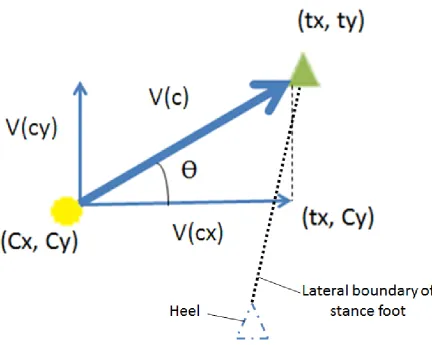
Figure 3.4.2 illustrates ART calculation for anterior balance loss due to toe posterior slipping. In the sagittal plane (top), acceleration of the slipping foot and the CoM can be estimated. In the transverse plane, obtained acceleration due to torque generated by posterior forefoot slipping creates the CoM anterior acceleration, while the anterior boundary of the Safety Zone moves posterior due to posterior forefoot slipping. Thus, the posterior movement of the anterior boundary of the Safety Zone and the anterior CoM movement are the two factors causing anterior balance loss due to posterior forefoot slipping. Computation methods for ART due to forefoot posterior slipping comprise two processes, as follows.
3.4.1.1 Sagittal plane
F(f) =𝐺𝑅𝐶𝐺𝐺𝐺×𝐶𝐶𝐶 − 𝐺𝑅𝐶ℎ𝐶𝐺 ……… 6
A(c) = F(f)
M(c) ……… 7
A(f) = F(f)
M(f) ……… 8
where F(f) = force working on a foot due to slipping, A(c) = acceleration on CoM due to slipping, M(c) = pelvis segment mass, A(f) = acceleration of foot due to slipping, M(f) = foot segment mass
3.4.2.2 Transverse plane
Anterior balance loss due to posterior toe slipping can be defined as when both toe (tx,
ty; stx̒, sty̒) and the CoM (Cx̒, Cy̒) locations are on a straight line indicated by the same slopes
of any lines drawn between these three points. 𝑡𝑦−𝐶𝑦′
𝑡𝑥−𝐶𝑥′ =
𝐶𝑦′−𝑠𝑡𝑦′
𝐶𝑥′−𝑠𝑡𝑥′ =
𝑡𝑦−𝑠𝑡𝑦′
𝑡𝑥−𝑠𝑡𝑥′ ……… 9
Using ART (t), the following equations determine the CoM and toe coordinates at anterior balance loss initiation due to forefoot posterior slipping.
Slipping foot (stx̒, sty̒) = (𝑠𝑠𝑐+ 0.5 ×𝐴(𝑓𝑐)× t2,𝑠𝑠𝑐+ 0.5 ×𝐴(𝑓𝑐)× t2) ……… 11
Solving quadratic equation (9) for the case of balance loss, using the CoM (10) and the slipped foot coordinates (11) ART (t) can be calculated as follows (detailed in Appendix IX).
𝑠 =−𝑏±√𝑏2𝑎2−4𝑎𝑐 ……… 12
where a = 0.5(A(c)−A(f), b = V(c), C = −C−st + st′
3.4.2 Heel Anterior Slipping
The fundamentals of heel anterior slipping simulation are similar to forefoot posterior slipping in that a sagittal plane analysis is first necessary to estimate the CoM acceleration due to slipping. Following this, the effect of the CoM acceleration can be calculated in the transverse plane to compute time for the CoM to reach the ‘posterior’ boundary. As for forefoot posterior slipping, posterior balance loss will occur when the heels and the CoM are in-line.
Subsequent to anterior heel slipping, the non-slipping trail foot is assumed to remain stationary while both the CoM and lead slipping foot move. For the simulation of anterior heel slipping, simulated friction force should be considered lower than horizontal GRF at RCoF peak after heel contact (RCoF1; Figure 2.7.3), which allows calculation of net force causing a foot to slip. Vertical GRF and simulated CoF determine the maximum friction force and when horizontal GRF is greater, net anterior force is produced, therefore anterior acceleration. Posterior boundary of safety zone moves in the anterior direction and if eventually reaching the location of the CoM, posterior balance loss begins.
the slipping foot travels faster than the CoM (You et al., 2001). The fundamental simulation methods are same as outlined in the section above for forefoot posterior slipping including equations 1-5. The only difference in the calculation is that the contacting foot is assumed to have heel contact velocity, in contrast the forefoot is initially stationary, prior to slipping.
Figure 3.4.3 Illustration of posterior balance loss due to anterior heel slipping. (A) The sagittal illustration of foot anterior slipping. Net anterior force causing anterior slipping and generating posterior torque on the CoM. (B) The transverse illustration of the CoM and posterior boundary of the Safety Zone.
3.4.2.1 Sagittal Plane
𝐶(𝑓) = 𝐺𝑅𝐶𝐺𝐺𝐺×𝐶𝐶𝐶 − 𝐺𝑅𝐶ℎ𝐶𝐺 ……… 13
𝐴(𝑐) =𝑀𝐹(𝑓)
(𝑐) ……… 14
𝐴(𝑓) =𝑀𝐹(𝑓)
(𝑓) ……… 15
where F(f) = force working on a foot due to slipping, A(c) = acceleration on the CoM due to slipping,
3.4.2.2 Transverse Plane
When both heels (hx, hy; shx, shy) and the CoM (Cx̒, Cy̒) locations are on a straight
line (equation 14), indicated by the same slopes of any lines drawn between these three points, coordinates of the CoM and a slipping foot can be expressed as follows (equation 15 and 16): ℎ𝑦−𝐶𝑦′
ℎ𝑥−𝐶𝑥′ =
𝐶𝑦′−𝑠ℎ𝑦′
𝐶𝑥′−𝑠ℎ𝑥′ =
ℎ𝑦−𝑠ℎ𝑦′
ℎ𝑥−𝑠ℎ𝑥′ ……… 16
CoM (Cx̒, Cy̒) = (V(cx)× t + 0.5 × A(cx)× t2, V(cy)× t + 0.5 × A(cy)× t2) ……… 17
Slipping foot
(shx̒, shy̒) = (𝑠ℎ𝑐+ 0.5 ×𝐴(𝑓𝑐)× t2, 𝑠ℎ𝑐+�𝑉(𝑓𝑐)² +𝑉(𝑓𝑐)² × t + 0.5 ×𝐴(𝑓𝑐)× t2) …… 18
Heel slipping distance to balance loss can be then described as in equation 19
�(𝑠ℎ𝑐′− 𝑠ℎ𝑐)2+ (𝑠ℎ𝑐′− 𝑠ℎ𝑐)² =�𝑉(𝑓𝑐)² +𝑉(𝑓𝑐)² × t + 0.5 ×�𝐴(𝑓𝑐)² +𝐴(𝑓𝑐)² × t² …… 19
where (Cx’, Cy’) = the CoM coordinates at posterior balance loss, V(cx) = medio-lateral CoM velocity,
V(cy) = anterior-posterior CoM velocity, A(cx) = medio-lateral CoM acceleration, A(cy) =
anterior-posterior CoM acceleration, t = available response time to anterior-posterior balance loss due to a simulated slip, (shx’, shy’) = coordinates of a slipping heel at posterior balance loss, (shx, shy) = coordinates of a
slipping heel at RCoF1, A(fx) = medio-lateral acceleration on a foot, A(fy) = anterior-posterior
acceleration on a foot, V(fx) = medio-lateral heel contact velocity, V(fy) = anterior-posterior heel contact
velocity,
3.4.3 Tripping
As illustrated in the inverted pendulum (IP) model (Figure 3.4.4) falling due to tripping tends to be anterior (Smeesters et al., 2001). Tripping reaction forces create a torque that increases the CoM angular velocity toward the Safety Zone anterior boundary. Torque working on the CoM in the IP model yields a linear acceleration component. Figure 3.4.4 illustrates that reaction forces on the tripping foot should be equivalent to anterior force on the CoM when tripping.