-389-
Aryabhatta Journal of Mathematics & Informatics Vol. 5, No. 2, July-Dec., 2013, ISSN : 0975-7139 Journal Impact Factor (2012) : 0.293
FUZZY RELIABILITY ANALYSIS FOR THE EFFECT OF
VASOPRESSIN BASED ON NORMAL DISTRIBUTION
A. Venkatesh * and S. Mohankumar**
*Assistant Professor, Department of Mathematics,Anjalai Ammal Mahalingam Engineering College, Kovilvenni, Tiruvarur (Dt).
**Assistant Professor, Department of Mathematics, Oxford Engineering College, Tiruchirappalli (Tamilnadu)
ABSTRACT:
The theoretical study of the effect of the administration of Vasopressin in abdominal vascular injury of animals was investigated. Formulae of fuzzy reliability functions, fuzzy normal distributions and its
-cut sets are presented. Using a Fuzzy reliability analysis based on normal distribution, we showed that vasopressin treatment ensured to permit at least short term survival of animals.Keywords: Fuzzy reliability function, Fuzzy normal distribution, Vasopressin. Mathematics Subject Classification 2000: 95V05, 28E10, 62Exx
1. INTRODUCTION
The most frequently used functions in lifetime data analysis are the reliability or survival function. This function
gives the probability of an item operating for a certain amount of time without failure. Many methods and models
in classical reliability theory assume that all parameters of lifetime density function are precise. But in the real
world, randomness and fuzziness are mixed up in the lifetime of the systems. In 1965, Zadeh [1] introduced fuzzy
set theory. Subsequently, the theory and the mathematics of fuzzy sets were fleshed out and applied in many
research fields [3]. The theory of Fuzzy reliability was proposed and developed by several authors [5], [4], [6].
The fuzzification process characterizes the imprecision of classes for phenomena that do not have sharply defined
boundaries. The increase of mean arterial blood pressure during the administration of vasopressin was observed by
Stadlbauer KH. et al. [7], Shelly MP. et al. [2], Krismer AC. et al. [8], and Tsuneyoshi I et al. [9].
In this paper we propose a fuzzy reliability analysis of the effect of Vasopressin on haemodynamic variables in an
abdominal vascular injury with uncontrolled haemorrhagic shock in animals based on normal distribution.
Fuzzification converts the original values of the Phenomenon to the possibility that they belong to a defined set.
The defined set can consist of being suitable or having the possibility of finding a specified manner. The original
values of the phenomenon are reclassified on this membership continuum through predefined membership
functions.
In the fuzzification process, the ideal definition for membership of the set is defined. Each value of the
A. Venkatesh and S. Mohankumar
definitely not part of the set are assigned as 0. Those values that fall between the two extremes fall in the
transitional zone of the set, the boundary. As the values move away from the ideal or the center of the set, they are
assigned a decreasing value on a continuous scale from 1 to 0. As the assigned value decreases, the original
Phenomenon value has less possibility of being a member of the set.
The fuzzification value of 0.5 is the cross over point. Any fuzzy value greater than 0.5 implies that the original
phenomenon value may be a member of the set. As the fuzzification values go below 0.5, it is likely that the original phenomenon’s value may not be the part of the set.
2. FUZZY RELIABILITY FUNCTION
Reliability or survival function
S t
( , )
is the probability a system survives beyond time t. Let the random variableX denote lifetime of a System components, also let X has a probability density function with fuzzy parameter.
( )
min max ( )
( , )
{ ( )[ ],
/
( )[ ]
[
( )[ ],
( )[ ]],
}
f x
f x
f x
f x
f x
f
x
f
x
min( )[ ] inf{ ( , )[ ]/ [ ]},
f x f x
max( )[ ] sup{ ( , )[ ]/ [ ]},
f x f x
The cumulative distribution function with fuzzy parameter of a random variable is defined as
( )
min max ( )
( , )
{ ( )[ ],
/
( )[ ]
[
( )[ ],
( )[ ]],
}
F x
F x
F x
F x
F x
F
x
F
x
min( )[ ] inf{ ( , )[ ]/ [ ]},
F x F x
max( )[ ] sup{ ( , )[ ]/ [ ]},
F x F x
Let the lifetime random variable is a fuzzy random variable with probability density function f x( , )
, then fuzzyreliability function is defined as
( )
min max ( )
( , )
{ ( )[ ],
/ ( )[ ]
[
( )[ ],
( )[ ],
},
s ts t
S t
S t
S t
S
t
S
t
min( )[ ] 1 sup{ ( , )[ ]/ ( )]
S t F t
Smax( )[ ] 1 inf{ ( , )[ ]/t
F t
( )]Let
is a triangular fuzzy number (
1,
2,
3) and then any given to; fuzzy reliability is a fuzzy number0 3 0 2 0 1
Fuzzy Reliability Analysis for the effect of Vasopressin based on Normal distribution 0 0 3
0 3 0 2
0 3 0 2
0 1
0 2 0 1
( )
0 2 0 1
{1 ( , )}
, 1 ( , ) 1 ( , )
( , ) ( , ) ,
1 ( , )}
( ) , 1 ( , ) 1 ( , )
( , ) ( , )
0 ,
s t
x F t
F t x F t F t F t
F t x
x F t x F t
F t F t
otherwise
3. FUZZY NORMAL DISTRIBUTION
The normal density N(
,
2) has density function f(x
; ,
2),x
R
, mean
and variance
2. If the meanand variance are unknown we must estimate them from a random sample and we obtain fuzzy estimator
for
and fuzzy estimator 2 2 for
.
So consider the fuzzy normal
2
( ,
)
N
for fuzzy numbers
and2
0
. We wish to complete the fuzzyprobability of obtaining a value in the interval [c, d]. We write this fuzzy probability as
P
[c, d]. We may easilyextend our results to
P
[E] for other subsets E of R.For
[0, 1], _[ ]
and2 2
[ ]
, letZ
1(
c
)
andZ
2(
d
)
.
then, 2 1 2 2[ , ][ ] { ( ;0,1) / [ ], [ ]} (1)
z
z
P c d
f x dx for0
1
The above equation gets the
-cuts ofP
[c, d]. Also, in the equation (1), f (x
; 0, 1) is the standard normal density with zero mean and unit variance.Let
P
[c, d] [
] = (P1[
], P2[
]). Then the minimum (maximum) of the expression on the right side of theabove equation is
(P1[
]; P2[
]) where_
{ ( ;0,1) / [ ], [ ]} d
1
c
P [ ]= Max
f x dx
_
( ; 0,1) / [ ], [ ]}
d
2
c
P [ ] = Min {
f x dx
We first specify the
-cuts of
from the
-cuts of
2 . If
2[ ] [
12[ ],
22[ ]]
, then
2
21 2
[ ] [
[ ],
[ ]]
=
1
,
2
similarly the
-cuts of
is
A. Venkatesh and S. Mohankumar
Let the fuzzy reliability of normal distribution be
R
[ ] [
R
1[ ],
R
2[ ]]
where
1 1
1
[ ]
[ ] 1
[ ]
t
R
and
2 2
2
[ ]
[ ] 1
[ ]
t
R
4. APPLICATION
When mean arterial blood pressure was below 20 mm Hg, and heart rate had declined progressively, experimental
therapy was initiated on the animals. At that point, animals were randomly assigned to receive vasopressin.
Vasopressin treated animals were then given a continuous infusion as 0.08 U/kg/min vasopressin. After 30min of
experimental therapy bleeding was controlled by surgical intervention, and further fluid resuscitation was
performed. Thereafter, the animals were observed for an additional hour. Mean arterial blood pressure increased in
both vasopressin-treated and fluid resuscitation animals from about 15mm Hg to about 55mm Hg within 5min, but
afterward it decreased more rapidly in the fluid resuscitation group. Seven out of seven vasopressin treated animals
survived, whereas six out of seven fluid resuscitations died. The effect of vasopressin with those of fluid
resuscitation on haemodynamic variables and short term survival in an abdominal vascular injury model of
uncontrolled haemorrhagic shock was observed.
Time(min) BP(mm Hg)
0 95
10 45
20 35
30 33
40 32
50 30
60 19
Table: 1 Mean Arterial blood pressure before the administration of 0.08 U/ kg/ per min continuous infusion vasopressin.
Here
= 41.29 are
= 4.99 and assume t = 50[40, 41.29, 42]
( ) [40 1.29 , 42 0.71 ]
[4.89, 4.99,5.12]
( ) [4.89 0.1 ,5.12 0.13 ]
(40 1.29 ) (42 0.71
[ ] [1 [t ],1 t ]
Fuzzy Reliability Analysis for the effect of Vasopressin based on Normal distribution
R
1[ ]
R
2[ ]
0 0.5203 0.5591
0.1 0.5220 0.5570
0.2 0.5236 0.5550
0.3 0.5254 0.5530
0.4 0.5272 0.5511
0.5 0.5289 0.5492
0.6 0.5312 0.5473
0.7 0.5333 0.5455
0.8 0.5356 0.5438
0.9 0.5380 0.5421
1 0.5404 0.5404
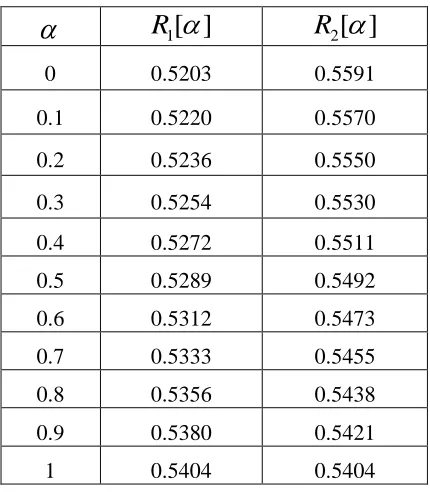
Table : 2 Alpha – cuts of the fuzzy probability.
Fig:1 Fuzzy Probability
5. CONCLUSION
As the fuzzy value is greater than 0.5, the mean arterial blood pressure value be a member of the set. By the Fuzzy
probability it was concluded that Vasopressin treatment ensured short term survival in the vascular injury model of
uncontrolled haemorrhagic shock animals.
0 0.2 0.4 0.6 0.8 1 1.2
0.5 0.52 0.54 0.56 0.58
A
lp
h
A. Venkatesh and S. Mohankumar
REFERENCES
[1]. Zadeh.L.A., “Fuzzy sets”, Information and control, 8, 338-352, 1965.
[2]. Shelly MP, Greatores R, Calne RY, Park GR : “The physiological effects of vasopressin when used to control
intra-abdominal bleeding,” Intensive Care Med., 14, 526-531, 1988.
[3]. Singer, D., “A fuzzy set approach to fault tree and reliability analysis,” Fuzzy sets and systems, 34(2),
145-155, 1990.
[4]. Cai.K.Y., Wen.C.Y, Zhang.M.L., “Fuzzy Variables as a basic for a theory of fuzzy reliability in the possibility context”, Fuzzy sets and systems, 42, 145-172, 1991.
[5]. Chen, C.H., Mon.L, “Fuzzy System reliability analysis by interval of confidence”, Fuzzy sets are systems, 56,
29-36, 1993.
[6]. Utkin.L.V and Gurov.S.V., “A general formal approach, for fuzzy reliability analysis in the possibility context”, Fuzzy sets and systems, 83, 203-213, 1995.
[7]. Stadlbauer KH, Wagner-Berger HG, Raedler C, Voelckel WG, Wenzel V, Krismer AC, Klima G,
Rheinberger K, Nussbaumer W, Pressmar D, et al. “Vasopressin, but not fluid resuscitation, enhances survival in a liver trauma model with uncontrolled and otherwise lethal hemorrhagic shock in pigs,”
Anesthesiology, 98, 699-704. 2003.
[8]. Krismer AC, Wenzel V, Voelckel WG, Innerhofer P, Stadlbauer KH, Hass T, Pavlic M, Sparr HJ, Lindner KH, Koenigsrainer A “Employing vasopressin as an adjunct vasopressor in uncontrolled traumatic hemorrhagic shock: Three cases and a brief analysis of the literature,” Anaesthesist, 54:220-224, 2005.
[9]. Tsuneyoshi I, Onomoto M, Yonetani A, Kanmura Y, “Low – Dose vasopressin infusion in patients with severe vasodilatory hypotension after prolonged hemorrhage during general anesthesia,” J Anesth, 19 :