IJEDR1603040
International Journal of Engineering Development and Research (www.ijedr.org)237
Design Efficient Distributed Key Generation For
Secure Network Applications over Cloud
Ms. Pratima Popat Gutal
M. E. StudentDepartment of Computer Engineering,
JSPM's Rajarshi Shahu College of Engineering,Tathawade,Pune,India
________________________________________________________________________________________________________
Abstract - Distributed key generation cryptosystems has a major content called distributed key generation (DKG) protocol. This protocol allows number of participants of group to generate a set of keys such as private key and public key without determining some trusted participants. Only authorized subgroups of participants are capable to regenerate or implement the private key and the public key is an output in clear. Previous analysis says that the DKG protocols determine similar authority for participants. In our analysis, we take in account the problem of the DKG protocols in groups with different hierarchical structure where the authorized subsets will be classified through a HTAS (hierarchical threshold access structure) and for the begging propose we use a VHTSS (verifiable hierarchical threshold secret sharing) protocol. By analyzing references we understand that they presented new DKG protocol with hierarchical threshold access structure for discrete-logarithm-based cryptosystems. Also analysis of HTDKG protocol says that this protocol fulfills the needed security requirements. Furthermore, we have tendency to develop our HTDKG protocol for secure in front of adaptive attackers through presenting the attacker model as well as communication model. This system additionally proposed for the decrease the processing time and enhances the memory utilization by utilizing of KDC.
Index Terms - Public key extraction, asynchronous, cryptosystems, threshold, discrete-logarithm-based cryptosystems.
________________________________________________________________________________________________________
I.INTRODUCTION
IJEDR1603040
International Journal of Engineering Development and Research (www.ijedr.org)238
II.RELATED WORKWherever Gennaro, R.,Jarecki, S.,Krawczyk, H [1] introduces the methods that ensures the security. At start, presents the normal needs to solve the issue of DKG problems. Further, introduce the suitable DLG method as well as carefully demonstrate that it satisfy the privacy requirements. Additionally, it proves the outcome achieved from the implementation of private as well as public key is as needed. Other than that it ensures the security needs of the algorithm on the basis of simulation argument.
Pedersen,T [2] unrecognized group are calculated. Commonly, this technique works over the enhancement of the threshold cryptosystem structured by Desmedt and Frankel. At the start, it demonstrate the methods for preventing the trusted party as well as who can choose and distribute the secret key. Further, it demonstrates that how to share the secret key in authenticated member group.
Kate, A., Goldberg, I [7] presented the technique as well as characterizing the resourceful showable secret sharing method. They analyzed the needs of Byzantine agreement for asynchronous DKG and additionally analyses the difficulty of implementation of a randomized method for it. Through implementing this showable sharing method designed a leader based agreement protocol.
III.MOTIVATION
Up to the date, the problem of DKG is just determined on the basis of similar authority for all of the participants. So, the determinations not possible come true and but there is different cases in that participants have various hierarchy of authority and holding the similar integrity of the specifications.
IV.PROBLEM DEFINITION
In this paper, we concentrate over the issue of generating a suitable key within a group of participants with determination of different hierarchy of authority. As a solution, DKG protocol with HTAS is presented for discrete-logarithm-based cryptosystems. On the basis of this issue of discrete logarithm problem (DLP), the guarantee of the proposed protocol is presented. The introduced protocol is implemented such as a portion of distributed cryptosystems to generate hierarchical threshold signature/ encryption methods.
V.IMPLEMENTATION DETAILS
System Overview
VSS with HTAS( VHTSS)[12]:
Let U = {P1,…, Pn} be the group of participants and D be the dealer. Then, a VSS protocol is a pair phases as follows.
1. Sharing verify
In first step, over input the secret s, D developed the share relating to every participant
Pi
U
and sends it through a secure medium to Pi. The dealer additionally generates several public data to analyze the validity of shares. At the end of this analysis, every participantPi
U
is instructed to output value verification
{
accept
,
reject
}.
.2. Reconstruction
The input of this step is the shares relating to a subset of participants. Initially, the validity of all shares is confirmed by other participants. Then, if the set of participants with valid shares is an authorized set, the secret can be calculated by implementing a reconstruction function on the given shares [4].
A Verifiable Secret Share protocol is called ensure if it accomplishes the following security need [3]:
Acceptance: If a honest participant outputs ’reject’, then each honest participants also output ’reject’ at the end of sharing verify phase. However, in the attacker model the dealer is not corrupted and then all honest participants output ’accept’.
Verifiability/reconstruct ability: All subsets of participants determining one authorized subset of participants with valid shares retain the same unique secret. With the determination of honesty of the dealer, we should have
s
, where s is the original shared secret. Privacy: Comparatively the dealer had not corrupted when no unauthorized subset of contributors is capable to secure information about the secret [9].
Existing TDKG protocols are not suitable when participants have various levels of authority .We propose new DKG protocol with HTAS (HTDKG).[1]
DKG with HTAS (HTDKG):
IJEDR1603040
International Journal of Engineering Development and Research (www.ijedr.org)239
1. Secret-key generation
In this initial step, every participant distributes random value. Finally, a secret x (mod q) is distributed among set of participants those access his shares.
2. Public-key extraction
In this second step, set of participants help to produce public key corresponding to secrets in previous phase(x),
)
(mod
q
g
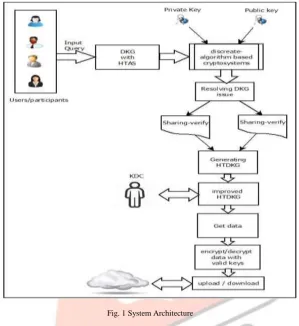
xFig. 1 System Architecture
A Distributed Key Generation protocol is called assure if it fulfills following security requirements: Correctness
(C1) The set of shares corresponding to every subset of participants, including one authorized subset of participants with valid shares define the similar unique private key x.
(C2) All truthful participants have the same value of public key y = gx (mod p), where x is the unique secret assured by (C1). (C3) x is uniformly distributed in Zq (and hence y is uniformly distributed in the subgroup generated by g).
Secrecy
Except for what is implied by the value
y
g
x(mod
p
)
, no data on x can be obtained by an opponent who is not able to corrupt all of the participants in an authorized subset.KDC (Key Distribution Center):
The Key Distribution center works on the participants request for key generation, as it takes participants request as input and check the authentication of the participants with registered participants, if user is valid then KDC runs Key Generation Algorithm and send the Key Pairs to the requested user.
Mathematical Model
Logarithms can be computed easily.
Mathematical representation for paillier algorithm is as follow,
(1 + 𝑛)𝑥= ∑ (𝑥
𝑘) 𝑛
𝑘= 1 𝑥
𝑘=0
+ 𝑛𝑥 + (𝑥
2) 𝑛
2+ ℎ𝑖𝑔ℎ𝑒𝑟 𝑝𝑜𝑤𝑒𝑟 𝑜𝑓 𝑛
This indicates that:
(1 + 𝑥)𝑛= 1 + 𝑛𝑥 (𝑚𝑜𝑑 𝑛2)
IJEDR1603040
International Journal of Engineering Development and Research (www.ijedr.org)240
𝑦 = (1 + 𝑥)2 𝑚𝑜𝑑 𝑛2Then,
𝑥 =𝑦 − 1
𝑛 (𝑚𝑜𝑑 𝑛)
Thus,
𝐿((1 + 𝑛)𝑥𝑚𝑜𝑑 𝑛2) = 𝑥 (𝑚𝑜𝑑 𝑛)
Where function L is defined as 𝐿(𝑢) =𝑢−1
𝑛 (quotient of integer division) and, 𝑥 ∈ ℤ𝑛.
Let W is the whole system which consists,
}
,
,
,
,
,
,
{
I
U
D
R
O
KDC
CS
W
Where I be the input to the system,
U be the set of Participant or registered users in system, R is the Reconstruction phase.
O be the output of proposed system CS is cloud server,
KDC is key distribution center,
1. Input (I)
Let
U
{
P
1
,
P
2
...
Pn
}
be a set of n participants which is partitioned into m + 1 levelsU
0,
U
1,...,
U
m. Suppose that the participants inU
0areP
1
,...,
P
u0 the participants inU
1areP
|u0|1,...,
P
|u0||u1| and so on, where —u1— denotes the size of the ith level for i = 0, , m. Suppose that the sequence of threshold requirementst
0,
t
1,...,
t
m(
t
)
determines the HTAS.Let p and q be two large primes such that
q
/(
p
1
)
andG
g
be a subgroup of elements of order q inZ
*p. WhereZ
*p is cyclic group of prime order p. To ensure well posedness of the interpolation problem needed in the reconstruction phase of the proposed protocol, the prime q also has to satisfy q > 2t + 2(t1) (t1)/2(t1)!n(t1)(t2)/2.Let h be an element of G such that its relative discrete logarithm with g is unknown to any entity in the system.
2. Process
The whole process is divided into parts: a) Sharing verify:
To share the secret
s
Zq
among participants P1, , Pn, Step1: The dealer (D): Constructs polynomials f1() and f2() as follows
,
1
...
2
1
0
)
(
2
,
1
...
2
1
0
)
(
1
1 2 1 2
t tx
bt
x
b
x
b
b
x
f
x
at
x
a
x
a
a
x
f
Where a0 = s and a1 at1, b0 bt1 are random values in Zq. Broadcasts
C
i
g
aih
bi(mod
p
)
fori
0
t
1
Computes the shares corresponding to Pj (j = 1,…, n) as follows
))
)(mod
(
'
),
)(mod
(
1
(
1 12 ) (
q
j
f
sh
q
j
f
sh
k tkj t
j
Where k is such that
P
j
Uk
andf
tk1(
x
)
b
is the
(
1
)
kt
th derivative off
b(
x
)
forb
0
,
1
.
Sends
(
sh
j,
sh
'j)
to Pj for j = 1 n via a secure channel. Step2: To verify the validity of his shares, each Pj U verifies the following relation)
1
)...(
)(mod
(
1 1 0 'p
j
Cg
h
g
shj shj
ti tkjWhere
g
tkj1(
j
)
is the value of(
t
k1)
th dervative ofg
i(
x
)
x
iat point x = j and k is such thatP
j
Uk
. Broadcasts a complaint against the dealer if does not hold.IJEDR1603040
International Journal of Engineering Development and Research (www.ijedr.org)241
Step3: The dealer reveals the shares(
sh
j,
sh
'j)
corresponding to each complaining participant Pi.Step4: Each participant checks the validity of the revealed shares by the dealer through and outputs reject if any of the revealed shares fails this equation. Otherwise, outputs accept. [11]
b) Reconstruction(R):
Suppose that t participants
P
1,..
P
t.fulfill all threshold requirements, pool their shares((
sh
1,
sh
'1),...,
(
sh
t,
sh
't))
to recover the secret. At first, the validity of the shares is checked. Then, if all of the shares are valid, the polynomials f1(.) and f2(.) can be reconstructed by employing Birkhoff interpolation on pairs(
t,
sh
't
),
,
1
i
t
,
respectively. The secret can be retrievedas the constant term of f1(.). c) Key Distribution Centre (KDC):
Receiving the key request from participant {P1,P2,P3,Pn} according to their level
(
U
0,
U
1,
U
m)
, KDC generate Keys and distribute to the requesting participant, if keys are already generated then it distribute according to their level of accessing the system KDC. During this processes the authentication of Participant is checked, if participant is authenticated person then he gets the required keys, which further uses those keys for encryption and decryption.d) Cloud server (CS):
The Cloud server CS stores the data or files uploaded by participant (P1, P2, …, Pn).
3. Output (O)
Generating hierarchical threshold distributed keys ((PK1, SK1), (PK2, SK2),...,(PKm, SKm)). PK: Private Key SK: Secret Key
Algorithm
Paillier Algorithm 1. Key generation
Choose two large prime numbers p and q randomly and independently of each other such that gcd (pq, (p-1) (q-1)) = 1. This property is assured if both primes are of equal length.
1.Compute n=pq and λ=lcm (p-1, q-1).
2.Select random integer g where 𝑔 ∈ ℤ𝑛∗2
3.Ensure ’n’ divides the order of ’g’ by checking the existence of the following modular multiplicative inverse:
μ = (L(gλmod n2))−1mod n
where function L is defined as .
𝐿(𝑢) =𝑢 − 1
𝑛
Note that the notation 𝑎
𝑏 does not denote the modular multiplication of ’a’ times the modular multiplicative inverse of ’b’ but rather
the quotient of ’a’ divided by ’b’, i.e., the largest integer value v ≥ 0 to satisfy the relation a ≥ vb.
The public (encryption) key is (n, g).
The private (decryption) key is (𝜆, 𝜇)
If using p,q of equivalent length, a simpler variant of the above key generation steps would be to set g = n + 1, and λ = φ(n)−1𝑚𝑜𝑑 𝑛 , where φ(n) = (p − 1)(q − 1).
2. Encryption
1. Let ’m’ be a message to be encrypted where 𝑚 ∈ ℤ𝑛
2. Select random ’r’ where 𝑟 ∈ 𝑧𝑛∗
3. Compute ciphertext as: 𝑐 = 𝑔𝑚. 𝑟𝑛𝑚𝑜𝑑 𝑛2
3. Decryption
1. Let be the ciphertext to decrypt, where 𝑐 ∈ 𝑧𝑛∗2
2. Compute the plaintext message as: 𝑚 = L(𝑐𝜆mod 𝑛2. μ mod n)
V.RESULT AND DISCUSSION
IJEDR1603040
International Journal of Engineering Development and Research (www.ijedr.org)242
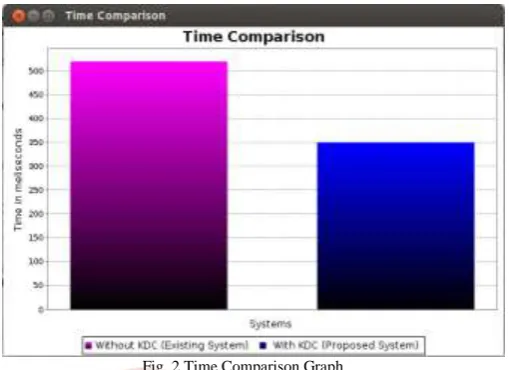
have also entire security. So, result is that when the interaction rounds are increases by implementing the hierarchical access structure the security always increases. The required number of multiplication as well as exponentiation operations in TDKGP is about half of that in TDKGG. Hence TDKGP is more effective as compared with TDKGG as well as Pakinat HTDKG model. Figure 2 demonstrates the time comparison graph. Previous system runs without KDC. Thus it implements number of processes over client side and increments in execution time over client side. Proposed system implements KDC to decrease the execution time. In Figure 2X-axis shows systems while Y-axis shows Time in milliseconds.Fig. 2 Time Comparison Graph
Figure 3 demonstrates the memory comparison graph. Previous system runs without KDC. Thus it implements number of processes over client side and increments memory overhead over client side. Proposed system implements KDC to decrease the memory overhead. In Figure 3 X-axis shows systems while Y-axis shows memory in bytes.
Figure 3: Memory Comparison Graph
VI.CONCLUSION AND FUTURE SCOPE
By the merge of DKG technique with pairing-based cryptography technique like CBE is helpful to practically whole distributed DCA as well as encryption/decryption methodology and able to provide certificate for participant recognizing and that will be implemented as keys for encryption as well as decryption. In this methodology there is no requirement of trusted entities as well as it is simple to add and eliminate the participant and also CBE certificate revocation technique. It is additionally proven that on the basis of techniques performance characteristics that until the participant number is included inside an appropriate bound (that will be matched through most present distributed network applications such as Ad Hoc networks or MANETs); a robust as well as effective security foundation will be obtained by providing flexibility, scalability and robustness. Furthermore, we has tendency to add dishonorable participant security in proposed system as well as offer a testing platform security infrastructure for distributed network applications. In future, we have strategy; in that we create our HTDKG protocol secure in front of adaptive attackers through presenting reverse attack same to the one in.
IJEDR1603040
International Journal of Engineering Development and Research (www.ijedr.org)243
VII.ACKNOWLEDGMENTI am using this opportunity to express my gratitude to everyone who supported me throughout the course of this project. I am thankful for their aspiring guidance, invaluably constructive criticism and friendly advice during the project work. I am sincerely grateful to them for sharing their truthful and illuminating views on a number of issues related to the project.
REFERENCES
[1] Gennaro, R., Jarecki, S., Krawczyk H. et al., “Secure distributed key generation for discrete-log based cryptosystems,” J. Cryptol., 2007, 20(1), pp. 51-83.
[2] Pedersen T, “A threshold cryptosystem without a trusted party,” Proc. Advances in Cryptology (Eurocrypt91), Brighton, UK, April 1991, pp. 552-526.
[3] Feldman, P., “A practical scheme for non-interactive verifiable secret sharing,” Proc. 28th Annual Symp. On Foundations of Computer Science, (FOCS 87), CA, USA, October 1987, pp. 427438.
[4] Herzberg, A., Jakobsson,M. Jarecki, S.,et al., “Proactive public key and signature systems,” Proc. Fourth ACM Conf. on Computer and Communications security(CCS 97), Zurich, Switzerland, April 1997,pp.100-110.
[5] Wang, F., Chang, C.-C., Harn, L., “Simulatable and secure certificate-based threshold signature without pairings,” Security and Communication Networks, 2013, 7, (11), pp. 20942103.
[6] Fournaris, A.P., “A distributed approach of a threshold certificate-based encryption scheme with no trusted entities,” Inf. Secure. J. Glob. Perspect., 2013, 22, (3), pp. 126139
[7] Kate, A., Goldberg, I., “Distributed key generation for the internet,” Proc. 29th IEEE Int. Conf. on Distributed Computing Systems (ICDCS 90), Montreal, Quebec, Canada, June 2009, pp.119-128.
[8] Boneh, D., Franklin, M., “Efficient generation of shared RSA keys,” Proc. Advances in Cryptology (Crypto 97), CA, USA, August 1997, pp. 425439
[9] Tassa, T., “Hierarchical threshold secret sharing,” J. Cryptol., 2007, 20, (2), pp. 237264. [10]Simmons, G.J., “How to (really) share a secret”, Proc. Advances in Cryptology
[11]Pakniat, N., Noroozi, M., Eslami, Z., “Secret image sharing scheme with hierarchical threshold access structure,” J. Vis. Commun. Image Represent., 2014, 25, (5), pp. 10931101