POTENTIAL OF IDLE LAND FOR MIXED VEGETABLE AND FRUIT
FARMING USING LINEAR PROGRAMMING
Nik Hashim Nik MUSTAPHA
1Nik Mohd Hazrul HASHIM
2Fauziah Abu HASSAN
3ABSTRACT
Idle land remains to be an issue that warrants further investigation. This study aspires to unveil
the economic potential of idle land which is cultivated with a combination of cash crops --
vegetables and fruits by young enterprising individuals. Linear programming is employed to
derive optimal solution for a combined crop harvests. The return from crop combination of corn,
cucumber, eggplant, and carrot grossed at RM 61,984. If land can be further increased because
of the availability of idle land while financial capital can be borrowed from the State Authority or
agriculture bank, with existing labor cash returns for these farms can be raised to RM 81,581 per
year. Sensitivity analysis on the corn price as an important crop shows that a fall in the corn
price from RM 5,700 to RM 5,000 per metric ton, farm’s income will be reduced to RM 56,734.
These produces could be marketed wholesale within the state. The market is assured locally and
they can be exported to other States. The major drawback of this project is that the South China
sea monsoon often brings unpredictable floods that could damage the crops.
Keywords: Idle land, Linear programming, Crops combination, Optimal return, Primal problem
1Professor;Department of Economics, Faculty of Management and Economics, University of Malaysia Terengganu 21030
Kuala Terengganu, Terengganu, Malaysia, Email: [email protected]
2
Lecturer; Graduate School of Business, National University of Malaysia 43600 Bandar Baru Bangi, Selangor, Malaysia
E-mail: [email protected]
3
Associate Professor & Dean; Department of Economics, Faculty of Management and Economics, University of Malaysia
Terengganu 21030 Kuala Terengganu, Terengganu, Malaysia,Email: [email protected]
Asian Journal of Empirical Research
INTRODUCTION
Land as an asset is riskless property that generates income and wealth to the owners. Land price continues to increase with the growth of urbanization and industrialization since its supply is limited. Originally the issue was recognized as the consequence of absentee landlords who failed to attend to the land they owned. In rural area where agriculture is the primary source of employment the Federal Land Consolidation and Rehabilitation Authority (FELCRA) was created to consolidate land for the purpose of utilization. The real problem with idle land is more than the absentee landlord case. Strategic land located in the city area is highly demanded for various economic opportunities such that it can be developed for shopping centers, housing estates and industrial sites. Land as a resource is used in the production of goods and services. It serves as the foundation for the storage buildings such as the warehouse. Land itself also functions as an essential factor of production. The agricultural land can be utilized for the production of fruits and vegetables. Because of these multifunctional uses; for productive and for ownership and accumulation of wealth, land is always in demand for fulfilling numerous economic goals of the investors and speculators. Partly due to these reasons idle land will continue to exist since the investors as landowners are not the same persons as cultivators of land. Nevertheless, this phenomenon has provided opportunity for those who wish to rent land for the cultivation of crops.
Idle land is defined as cultivable agriculture inland or farms with a minimum 0.4 hectare with contiguous or dispersed ownerships, left unattended for three years and above consecutively. Based on this agriculture department definition a total of 531.8 thousand hectares were classified as idle lands in 2009. By 2012 through concerted effort this total figure had been reduced and remained at 97.3 thousand hectares (DOA 2012). Of this total, 29.2 thousand hectares were located in Peninsular Malaysia and the rest 68.0 thousand hectares are found in Sabah and Sarawak. Statistics of idle land and farm area in Peninsular Malaysia 2012 show that the state of Pahang (6522 ha), Johor (5884 ha) and Kelantan (5,494 ha) had the highest hectares of idle land while in Terengganu the idle farm land accounted for 874 hectares. Comparing the East and West Malaysia, Sabah and Sarawak exhibit much more idle lands than any state in Peninsular Malaysia. In 2012 the Department of Agriculture statistics show that about 8,110.9 hectares of land were reported as idle while in Sarawak the figure was extremely large amounting to 59,959.6 hectares (DOA 2012).
Backgrounds of the project
unemployed individuals. They have rented the uncultivated parcels of land, cleared, leveled, and turned them into agricultural projects, growing prospective short term vegetables and fruits. These young entrepreneurs are self-trained farmers motivated by the hard-working neighboring Indonesian farmers. The community projects are needed for several reasons. First, these young entrepreneurs are local residents who started the projects on their own initiative with limited assets and mechanization. Assistance from the related agencies dealing with agriculture production and marketing is necessary in order to advise them to operate efficiently. Second, their concerted effort is economically useful as they contribute to direct uplifting of the agricultural production, the income levels of the poor and the unemployed, specifically for short term vegetables and fruits. In contrast, they attempt to raise the income level of the agricultural earners to be at par with the nonagricultural sectors of the economy. Third, this category of agricultural growers has not been exposed to direct assistance from the government agencies and they have proved themselves to be able to sustain on their own initiatives.
The Ministry of Higher Learning has recently launched a project named as, ―the knowledge transfer program (KTP)‖ to coordinate the flow of new findings to the potential entrepreneurs. The program would greatly benefit those new generations of farmers in realizing the production and marketing potentials through cooperation, advice and consultancy with various agencies such as the Department of Agriculture (DOA), the Federal Agricultural and Marketing Authority (FAMA), State Economic Planning Unit (SEPU), Entrepreneurship Development Agency (YPU), and the University of Malaysia Terengganu (UMT) expertise in crops, pests and diseases and husbandry practices. The Center for Socio-Economic Development (CSD) will be the liaison for the successful implementation of the project. Its function is to orchestrate and bring the transfer of technology while enriching their human skills to the selected community project leaders and workers. For a start this knowledge transfer program will be focused on existing vegetables and fruits growers and their particulars are shown in Table 1.
greatly in expanding the size and management of farm operations, in particular, with the sprinkler irrigation system, mechanization of land preparation and other form of farm operations that save time and man-days.
Pests and diseases of crops grown currently are under controlled but it is believed that with increase in size of crop area the problem may have to be given special attention particularly between the use of chemicals and the need to maintain clean environment. The need to learn from farm and marketing practices of the advanced countries through visits and experiences can be invaluable investment in human development for the modern farm operators.
Table 1:Farm’s characteristics of idle land vegetables and fruits entrepreneurs
No. Names of project leader
Types of Crop Grown
Area of Farm (in acre)
No. of Workers Employed
(persons)
Initial Capital Requirement
(RM/crop)
1 Rohaili Mamat Luffa, carrot,
eggplant, chilli 7 6 7000
2 Mamat Othman Watermelon, chilli,
corn 2 6
10,000
3 Zakaria Nor
Mamat Gourd, corn 1 0 2000
4 Zakaria Abdullah
cucumber, Luffa, long bean,
string bean
1 .5 2 3000
5 Salleh Ismail
cucumber, Long bean, carrot,
gourd,
1 2 3000
6 Hussin Man
carrot, Cucumber, luffa,
string bean 1 2 3500
7
Wahab Jusoh
long bean, ladies finger Eggplant, winged
bean
1 2 2000
8 Rizuan Ngah
Eggplant, cucumber, carrot,
luffa
1 2 2000
9
Minah Omar Carrot,
cucumber, 0.5 1 1000
10 Alwi Bidin
long bean, Luffa, gourd, winged bean
1 1 2000
Marketing of crop harvests is carried out by the growers themselves directly to the wholesale market and/or directly to wet market in Kuala Terengganu. The growers admitted that by doing so they can avoid paying extra cost in shipment and selling their products at relatively low price to the middle men thus able to earn higher returns from sales of their harvests.
LITERATURE REVIEW
Agricultural policy on food supply emphasizes the need to persistently review essential food crops self sufficiency level. The concern is escalating over the climate change that could cause food shortage. As a result of this awareness the National Economic Council had decided to fix self-sufficiency level for rice at 70 per cent for the next 10 years (Ministry of Agriculture and Agro-based Industry, 2011). This scenario has shed light on the prospective contribution of the agricultural sector to the future food agenda. The current study relates to the future food supply, in particular, on the prospect of increasing mixed vegetables and fruits for domestic consumption. The ultimate cause of the failure to develop the idle agricultural lands was discussed much earlier alleged to be attributed to the altitude of rural people (Amriah, 2001). The rural folks, in particular, would not be happy to allow private developers working on their lands. This refusal indicated their desire to relegate the task to younger generations. The youngsters prefer to work in the modern sectors of the economy which are somewhat booming in the cities. Thus, progress to rehabilitate idle agriculture land was rather slow despite the urgency need for sufficient food production. The burden of food import was realized in terms of a constant increase in total food imports and the sharp increase in imported fertilizer prices. Amriah et al. (1988-89) attributed the prevalence of idle land to the unfavorable physical, economic and social characteristics; (i) land topography, soil type, water supply and accessibility; (ii) lack of manpower and technical skill, and (iii) uneconomic size of holdings. Multiple-existence of ownership right to the piece of land arising inheritance could deter land from utilization. Azima and Ismail, (2011) attributed the difficulty of conversion of agricultural land for development which is responsible for the prevalence of idle land, to the institutional constraints, specifically the provision of customary laws adopted in Negeri Sembilan. According to Haniza and Dayyan, (2012) during the Ninth Malaysian Plan (2001-2005) about 163,000 hectares land remained idle despite concerted effort were taken by the land authorities. In their views agriculture lands were abandoned because of uneconomic size which is coupled with low productivity that could not generate sufficient income to the operators.
production. According to official source about 1.44 thousand hectares of agriculture lands in Peninsular Malaysia are categorized as idle agricultural land (DOA, 2009). This constitutes about 35 per cent of the total agriculture land in the country. The opportunity of idle land for immediate cultivation with high market oriented crops would directly benefit the country. Their findings show that efforts initiated by government often meet with limited success. Vaiphasa et al. (2011) realized the importance of idle agriculture land to the economy as sources of income and employment to the country. In classifying idle agricultural land for the appropriate crops the satellite images were employed and transformed the results to a time series of normalized difference vegetation index (NDVI). Remote sensing was used because of its cost effectiveness. It could shorten the time required for field survey thereby save cost on fieldwork. They claimed that the technology of remote sensing had never been used in Thailand for the purpose of crop classification and identifying idle agricultural land. The implication here is that mismanagement and underutilization of the idle land could be due to the insufficient information. Before necessary measures could take effect successfully there are prerequisite steps that should first be done.
All point to the fact that idle agricultural land in Malaysia will continue to pose as an issue in the near future. Several studies have reported the negative impact of climate change on agriculture and food production. Attempt to promote and utilize idle land for food production nationwide, referring to vegetables and fruits, is a national agenda because it will contribute to the earnings of national income, create employment opportunities because production in turn encourages domestic consumption. Any surplus production of food can be utilized for exports. The importance of cash crops grown as intercropping with the primary commodities like rubber and oil palms was discussed by Faridah, (2001). The problem with these perennial crops is that a large quantity of chemical fertilizers usually applied is imported from oversea. Official figure showed that a total of 14.5 million metric tons valued at RM 1.32 billion were imported in 2000 (Department of Statistics Malaysia, 2001). The concern for health hazards due to environmental degradation is ever-growing and the integrated farming system is instead promoted among farmers. These short term crops include, pineapples, chili, maize, livestock rearing especially sheep and poultry and mushroom cultivation with perennial crops and forest trees (Faridah, 2001).
utilization of marginal lands encountered soil erosion. In particular wheat and summer-fallow activities suffered up to 26 percent of soil erosion and thus to a large extent the sustainability of the agricultural lands. The other example is chosen from the Nile River study. The river is the main source of water supply in Egypt (Hesham and Mohamed, 2001). Of the total 55.5 billion cubic meters of the Nile water 86 percent goes to agriculture. The demand for water use is increasing due to agricultural expansion. The LP technique was applied to allocate the distribution of water in accordance with the crops’ requirement. This is a minimization problem of water use among crops. The optimal allocation consumptive use in lower, middle, and upper Egypt is related to the actual crop pattern.
METHODOLOGY
Linear programming starts with the primal problem which forms the procedure used in solving idle land for the current study. The solution uses simplex method and in this case study the excel spread sheet solver is used. The primal problem of the linear programming technique is presented as following:
Maximize Z = j
m j j
x
c
1 Subject to n j for x and m i for b x a j i j m j ij , . . . , 2 , 1 , 0 , . . . , 2 , 1 , 1
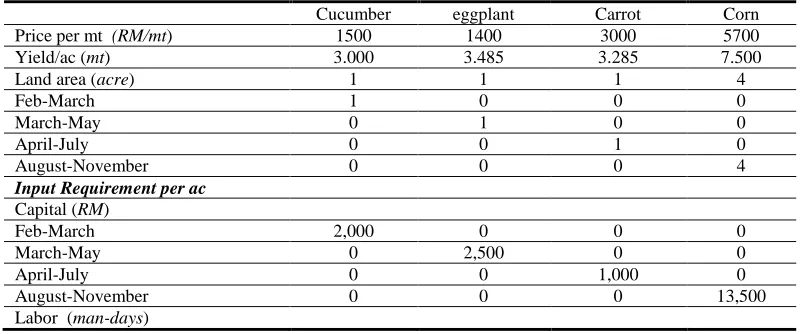
Table 2: Price, yield and cropping pattern for vegetable and fruit farm Bukit Payong Terengganu.
Cucumber eggplant Carrot Corn
Price per mt (RM/mt) 1500 1400 3000 5700
Yield/ac (mt) 3.000 3.485 3.285 7.500
Land area (acre) 1 1 1 4
Feb-March 1 0 0 0
March-May 0 1 0 0
April-July 0 0 1 0
August-November 0 0 0 4
Input Requirement per ac
Capital (RM)
Feb-March 2,000 0 0 0
March-May 0 2,500 0 0
April-July 0 0 1,000 0
August-November 0 0 0 13,500
Feb-March 304
March-May 480
April-July 304
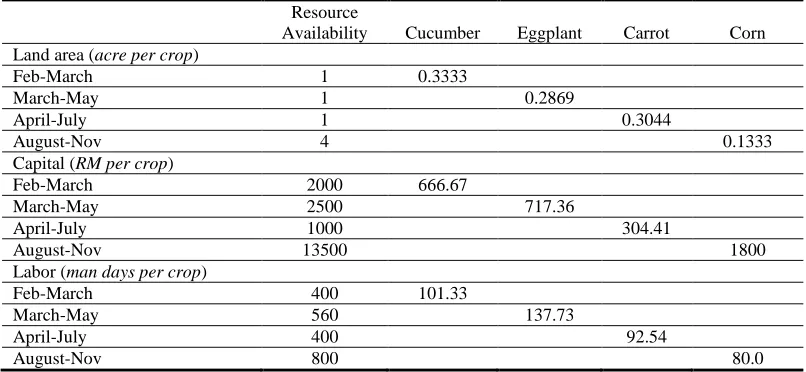
Data on vegetables and fruits were collected from the growers through face-to-face interview with the objective of obtaining the necessary information about the viability of this project in terms of profitability, sustainability, and the potential contribution to the national goal of achieving high income country by 2020. Table 2 shows price, yield and cropping pattern of vegetables and fruits. The input requirements per acre are used in this table which will be converted to input requirements per metric ton for capital (cash), labor (man-days) and land (acre) which is shown in Table 3. This final conversion of input data per metric ton requirement will be used as the linear programming maximization problem of gross return. The objective function can be further developed if data on unit cost of every output, that is, vegetables and fruits are available. Therefore, the linear programming problem when costs are available should be deducted from respective prices to obtain the net return or profit instead the gross return as in the present study.
Table 3:Input requirements per metric ton of crop grown
Resource
Availability Cucumber Eggplant Carrot Corn Land area (acre per crop)
Feb-March 1 0.3333
March-May 1 0.2869
April-July 1 0.3044
August-Nov 4 0.1333
Capital (RM per crop)
Feb-March 2000 666.67
March-May 2500 717.36
April-July 1000 304.41
August-Nov 13500 1800
Labor (man days per crop)
Feb-March 400 101.33
March-May 560 137.73
April-July 400 92.54
August-Nov 800 80.0
The foremost important feedback is how effective is the project operation with respect to the management of scarce resources. From the economic point of view the viability of project could be evaluated using the linear programming technique (LP) the objective function is to
Maximize Z = 1,500 X1 + 1,400 X2 + 3,000X3 + 5700 X4
0.33333 X1 ≤ 1 (Land Constraint for Cucumber)
0.2869 X2 ≤ 1 (Land Constraint for eggplant)
0.3044 X3 ≤ 1 (Land Constraint for Carrot)
0.1333 X4 ≤ 4 (Land Constraint for Corn)
666.67 X1 ≤ 2,000 (Capital Constraint for cucumber)
717.36 X2 ≤ 2,500 (Capital Constraint for eggplant)
304.41 X3 ≤ 1,000 (Capital Constraint for Carrot)
1800 X4 ≤ 13,500 (Capital Constraint for Corn)
101.33 X1 ≤ 400 (Labor Constraint for Cucumber)
137.73 X2 ≤ 560 (Labor Constraint for eggplant)
92.54 X3 ≤ 400 (Labor Constraint for Carrot)
80 X4 ≤ 800 (Labor Constraint for Corn)
Further assumption of the model is that all relationships between inputs and outputs are linear, divisibility of inputs used in the production process into fractional units and the non-negativity assumption of the output of vegetables and fruits. This implies that the variable values for X1, X2,
X3 and X4 are greater than and equal to zero.
RESULTS AND DISCUSSION
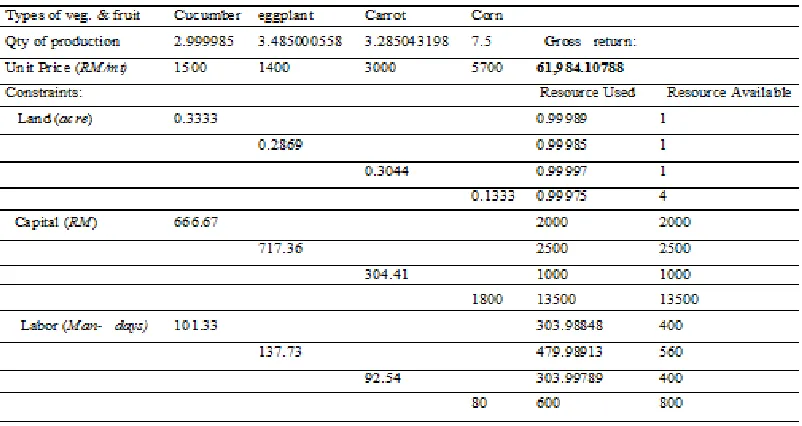
The LP technique will be used to identify whether these farms are operated at the optimal production level. If not by shifting the combination of the input-mix would enable the farm to attain higher production. The foremost important issue in the management economics is that farms are not operated at the optimal crop-combination that often resulted in resources not being fully and efficiently utilized. To overcome this management problem linear programming technique will be used so that an efficient crops-combination could be realized that would improve farm’s production and productivity. The optimal crops combination will be tried on the situation of status quo, that is, with the existing availability of resources except labor which is much easier to obtain. The result of LP optimal solution of crop-combination for vegetables and fruits is presented in Table 4. As noted from the table all resources on land area and financing capital are fully utilized as expected yielding an annual income of RM 61, 984 which amounts to an average gross return of about RM 6 thousand per month on the assumption that in December and January vegetable farming activities are laid off due to heavy rain from the South China Sea monsoon season.
major cities. This could easily amount to million or billion ringgits business activities annually depending on the number of successful individual willing to undertake this opportunity.
Table 4: Optimal solution of crop-combination of vegetables and fruits of Bukit Payong April 2011.
Table 5:New optimal solution with increased input requirements
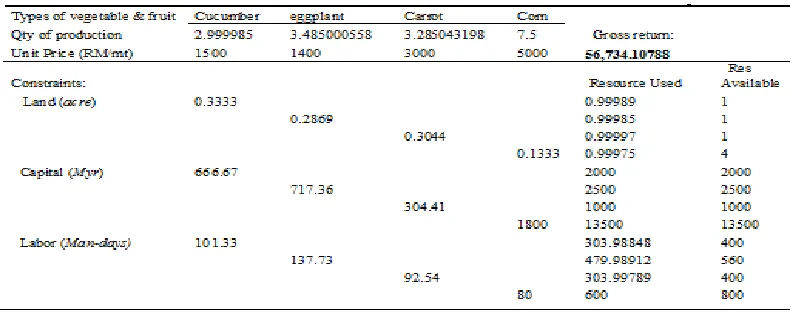
increased from RM 2,000 to RM 3,000 eggplant from RM 3,000 to RM 4,000, carrot from RM 1,000 to RM 1,500 and corn which requires a substantial operating capital from RM 13,500 to RM 20,000. Results of new optimal solution with increased input requirements per metric ton for the cultivated area of cucumber, eggplant, carrot and corn following an improvement in land size and capital are shown in Table 5. This new LP optimal solution amounts to about RM 81,581 per year which is an improvement over the initial optimal gross return of RM 61,984. With the current optimal solution the supply of labor are fully utilized. For a large scale operation sufficient supply of labor, especially skilled ones, is a precondition for growth unless effort to replace labor with farm mechanization would be very important in vegetables and fruits undertakings. However, the capital requirements as apparent from the new optimal solution are underutilized since most of the allocation exhibit excess over the actual capital resource actually utilized. Supposed that the farmers wish to know how sensitive is this cropping program to a change in price? Changes in price coefficients are known as parameterization in LP sensitivity analysis. For the effect of a fall in price on the profitability of optimal solution assume that the price of corn which is currently RM 5,700 has fallen to RM 5,000 per kilogram what will be the impact of this change? The result of price change is immediately known from the optimal solution such as in the case of the initial gross profit of RM 61,984 in Table 4 to about RM 56,734 in Table 6. Changes in coefficients of any price are immediately known from the optimal solution of the simplex tables. In practice changes in price provide an early warning to the farmers and they could also approximately realize the extent of the impact on their farm potential profitability.
Table 6:Result of optimal solution following a fall in corn price
CONCLUSION
income to the owners through price increase, especially if it is located in strategic area. This unique attribute has attracted many investors to buy land for the sake of windfall income when the demand for land is high. While urbanization is past spreading and development projects--housing and industrial sites coexist such prospect of windfall income becomes a reality. Many of these agricultural lands were converted to residential use and parceled into small housing lots and sold at much higher prices. Selling housing lots together with the house would probably be more profitable. Thus the existence of idle land becomes widespread while buying and selling of land are normal speculative practices.
The objective of this study is to assess the potential of idle land that can be utilized for mixed vegetables and fruits farming on a small scale by enterprising individuals with some experience in agriculture. They have done this on their own initiatives without assistance from the State Department of Agriculture. Using linear programming analysis the status quo economic potential was estimated at RM 61,980 per year averaging around RM 6,000 per month. The potential is much higher some 30% more if the financial assistance and land size could be increased accordingly. This success is not without problems. Changes in the price of major crop like corn might affect their potential income and the occurrence of seasonal floods can cause damage to the entire crops before they can be harvested. Their products can be sold directly to the city’s wet market at wholesale price and mostly consumed within the State of Terengganu. Surplus vegetable and fruit productions can be marketed to other towns within the State with the coming of new highways.
Following an expansion in the business, farm production might be shipped to areas outside the state of Terengganu. Production and marketing problems may change from the current scenarios. These changes which should take place due to the change in consumers’ preference, call for improved management and governance. In the shipment of vegetables and fruits there would be a certain percentage of demand for high quality products such that packaging is required. Marketing of farm products to different destinations within Malaysia requires the cost minimization program. The transportation model whose objective is to minimize cost using excel solver in order to identify optimal routes and quantities of shipment can be applied.
REFERENCES
Amriah, B., Asmah, A., Md. Rahil M. N. and Fuad, M. M. J. (1988-1991). Planning and Implementation of Idle Land Rehabilitation Programmes, Research funded by grants under Intensification of Research in Priority Areas (lRPA) , Ministry of Science & Technology. Azima, A. M. and Ismail O. (2011). Idle Agriculture Land Resources Management and
Development –An Institutional Causes: A Case Study in Malaysia. Interdisciplinary Journal of Research in Business,Vol. 1, No. 8, pp. 21-27.
Azima, A. M. and Ismail, O. (2009). Challenges on Idle Agriculture Land Management – An Institutional Perspective in Malaysia. European Journal of Social Sciences, Vol. 9, No. 1, pp. 39-47.
Borneo Post Online (2011). Ensuring sufficient food supply in the country, Agriculture and Agro-Based Industry March 29.
Department of Agriculture (2009). Statistics on Idle Lands 2009. Department of Agriculture and Agro-Based Industry Malaysia.
Department of Agriculture (2012). Statistics on Idle Lands 2012. Department of Agriculture and Agro-Based Industry Malaysia.
Department of Statistics, (2001). Malaysia. www.statistics.gov.my
Faridah, A. (2001). Sustainable Agriculture System in Malaysia. Paper presented at Regional Workshop on Integrated Plant Nutrition System (IPNS). Development in Rural Poverty Alleviation, 18-20 September 2001, Bangkok.
Haniza, K. and Dayyan, M. (2012). Resource Management: Fragmentation of Land Ownership and Its Impact on Sustainability of Agriculture. UMT 11th International Annual Symposium on Sustainability Science and Management 9–11 July 2012, Terengganu, Malaysia
Hesham, M. A. and Mahmoud, M. R. (2002). Determining Optimal Allocation and Crop Pattern by the Use of Linear Programming. Paper presented at the 7th Nile 2002 Conference, Cairo, Egypt 1999.
Majid, K. A. (1992). Effects of Government Programmes on Sustainable Agriculture in the Peace River Region of British Columbia: A Linear Programming Analysis. Unpublished Master of Science thesis-Department of Agricultural Economics, University of British Columbia, Canada.
Ministry of Agriculture and Agro-Based Industry (MOA), (2011). Malaysia.
Vaiphasa, C. Piamduaytham, S., Vaiphasa, T and Skidmore, A. K. (2011). A Normalized Difference Vegetation Index (NDVI) Time-Series Agriculture Land: A Preliminary Study.