Evaluation Metrics for Automatic Temporal Annotation of Texts
Xavier Tannier
, Philippe Muller
yLIMSI-CNRS
University Paris-Sud 11 B.P. 133 - F-91403 ORSAY Cedex
yToulouse University 118 Route de Narbonne F-31062 TOULOUSE CEDEX 9
Abstract
Recent years have seen increasing attention in temporal processing of texts as well as a lot of standardization effort of temporal informa-tion in natural language. A central part of this informainforma-tion lies in the temporal relainforma-tions between events described in a text, when their precise times or dates are not known. Reliable human annotation of such information is difficult, and automatic comparisons must follow procedures beyond mere precision-recall of local pieces of information, since a coherent picture can only be considered at a global level. We address the problem of evaluation metrics of such information, aiming at fair comparisons between systems, by proposing some measures taking into account the globality of a text.
1.
Introduction
Recent years have seen increasing attention in temporal processing of texts (see Mani et al. (2005), or the dedi-cated track at SemEval 2007 (Verhagen et al., 2007)), justi-fying the need for some standardization effort (Pustejovsky et al., 2005). Temporal information is an essential piece of knowledge for many applications like summarisation, question-answering or information extraction (Hag`ege and Tannier, 2008). Automatic temporal annotation is generally two-fold:
Events and temporal adjuncts are extracted from the text. Several definitions of what an event is can be given, but most of the state-of-the-art systems consider mainly events introduced by finite verb phrases, and sometimes by certain noun or adjectival phrases;
Ideally, a time-stamp is assigned to each event when possible, or a temporal ordering between them is computed. This is done using linguistic and extra-linguistic information such as temporal markers, verb tenses and aspects but also lexical and pragmatic knowledge.
This second task is fairly hard since temporal information is not local, but spread out in a coherent manner through-out the text. There are many equivalent ways to express the same ordering of events. As a consequence, consen-sual human annotation is difficult, and automatic evalua-tion must follow procedures beyond mere precision-recall of local pieces of information (Setzer et al., 2006). We address the problem of evaluation metrics of such in-formation, aiming at fair comparisons between systems, re-gardless of certain bias that are artificially introduced in current practices. We first address the issues of temporal annotation and problems that must be solved (Section 2.) and then describe a few original metrics and their behaviour
on a corpus of temporally annotated texts (Sections 2.2. and 3.).
2.
Temporal Processing and Evaluation
It is difficult to reach a good agreement between human an-notators on event ordering, for two reasons (Setzer et al., 2006): First, human subjects can express relations between events in different, yet equivalent, ways. For instance, they can say that an evente1happens during another onee2, and that e2 happens beforee3, leaving implicit thate1 is be-foree3too, while another might list explicitly all relations. This makes it hard to reach an exhaustive list of temporal relations, and harder to verify such relations.
The second problem is that some relations can be described in more or less precise ways (for instance “e1is beforee2” is more precise but consistent with “e1 is beforee2 ore1 overlapse2”), making necessary the handling of partial rel-evance if only a subset or a inclusive set of relations have been found in another annotation.
We have addressed this latter issue in (Muller and Tannier, 2004). Taking disjunctions into account was also part of the evaluation of a temporal task at SemEval 2007 (Verhagen et al., 2007).
The first issue implies the definition of a referent to which each annotation should be compared, and this is the focus of this paper. What is usually done (see among others (Setzer et al., 2006)) is to use inference rules capturing the formal links between relations, such as Allen’s algebra on relations (Allen, 1983), and compute a temporal closure on the graph of temporal relations on events.
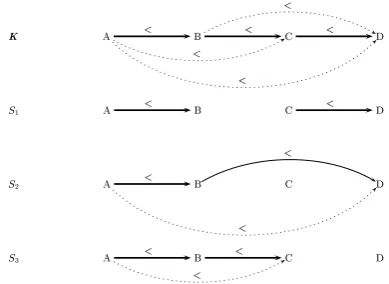
Temporal closure is a reasoning mechanism that consists in composing known pairs of temporal relations in order to obtain new relations (e.g.: if A isbeforeB and BcontainsC then A isbeforeC1). These new relations do not really bring
1A table of all composition rules can be found for example
3.
Evaluation of the evaluation
All the previous measures focus on one aspect of an evalu-ation and all seem plausible ways of estimating the similar-ities between representations. Obviously, many more could be devised, so we must ask ourselves what kind of criteria we can have to estimate what are good measures. A few commonsense criteria could include:
A measure is decreasing with the decreasing of infor-mation (in a monotonic and if possible regular way, even linearly with the level of information or correct-ness provided);
We have to deal with different number of edges in a representation (see above): we must look at how a measure behaves on texts of different sizes (in terms of events and dates; as was stated above, the number of relations grows in the order ofn2if n is the number of temporal entities).
In order to do this, we have designed a few empirical tests to see what measures seem the most useful. They are the following:
Compare an annotation with the same annotation where information is taken out one piece at a time ;
Compare an annotation with the same annotation where some noise is introduced: a relation is changed to something else ;
We are going to show a sample of what we have found among all the possible combinations from our proposal. We tested these on the TimeBank corpus5, which is a set of news article in English.
This corpus is annotated with relations similar to Allen’s relations, so it was directly usable, if not free from errors. A few texts had inconsistent temporal annotations, so they do not appear in the evaluation (since temporal closure will fail on these texts).
3.1. Consequences of removing information
In the first experiment, we try to see the behavior of a mea-sure with respect to the quantity of information contained in a text in the following way: we take a human annotation of a text, and we remove (at random) an annotated relation before saturating the graph of constraints, and then we com-pare it with the initial graph. We average this on a number of different runs. We then do the same by removing 1, 2, ... n-1 relations if there are n relations in the initial annotation. We report the behavior of different measures by putting scores in relation with the percentage of the initial anno-tation that was removed (and averaging on texts with the same amount removed), so that we can see all texts to-gether. One disadvantage of this is that text with few re-lations give an overall impression of having high scores be-cause they lack points in the low-information area. Precision on single measures is always going to be 1 given our protocol, so this experiment is only useful to observe
5
See http://corpora.dutchboy.net/timebank/.
the behaviour of “recall”-types measures: recall of all sin-gle relations, recall of relations only from the kernel of re-lations as explained above, and a gradual relation on each edge (finesse).
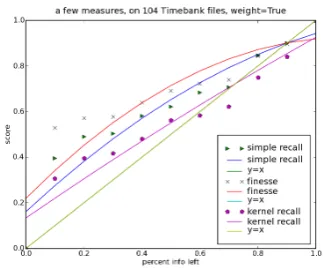
Figure 2 compares various measures with respect to the per-centage of information (the number of annotated relations) removed in the first experiment. Scores decrease quickly with the number of relations, following an inverted square root (For each measure we show the best parabolic fit). The relations include a simple measure of the recall of sin-gle (non disjunctive) relations, a measure of finesse on each informative edge, and a recall on relations that are in the kernel of the key.
It is interesting to note that the measure based on the kernel relations has a more linear fit than the other measures, as it concentrates on the relevant set of relations. That was the intended effect of focusing on a set of relations considered as more “central” to the text.
We have noticed that averaging on the number of events for each texts does not change much the results, something we expected for the kernel measure, but not for the other ones. The curves remain parabolic in nature, probably because averaging over texts while removing events at random even out the results anyway, while a measure on kernels stay sta-ble.
We have nonetheless noticed very different results on small texts (less than 10 relations) than on larger texts (some have more than 120 relations in TimeBank). We hope these mea-sures can help find annotation biases in such corpora, but obviously this needs to be investigated in more detail.
Figure 2: Behaviour of measures when removing informa-tion from annotainforma-tion
3.2. Consequences of some incorrect information
In order to be able to compare texts that had not the same number of events to begin with, we plot the scores against a ratio of undisturbed events with respect to the total number of events in a text, in a way similar to the experiment above. As we average over texts of various sizes, we smoothed the plot by putting points in bins around every 10% of infor-mation left unchanged. It has to be noted that the variance around each of this points is sometimes high.
Figure 3: Behaviour of precision measures when disturbing information (unweighted)
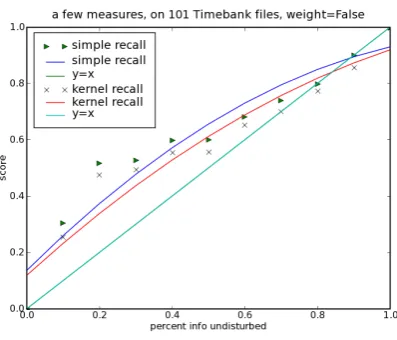
Figure 4: Behaviour of recall measures when disturbing in-formation (unweighted)
The precision-type measures that we have tested here are: the precision of single relations, a measure on coherence of each edge with information in the changed annotation (thus including disjunctive relations), and a precision on the relations that are part of the changed annotation.
The behaviour of all masures are rather far from the ideal
y = x(a linear decrease, shown also on the graph). This is
shown again by their best parabolic fit (figure 3). This time the weighting of texts is crucial to reaching a sort of bal-ance, most notably with the kernel-related measures (figure 4). This shows that considering only the kernel of rela-tions in the annotation to be compared to the key is not enough to be safe from the “parabolic” effect. Indeed, since
Figure 5: Difference of precision measures when disturbing information (weighted)
Figure 6: Difference of recall when disturbing information (weighted)
kernels are different, we must be sure that they are close enough so the degrading of information is only proportional to the number of events considered. This appears not to be the case. However, averaging each text over its number of events reinstate a better behaviour for all measures, all the more for the kernel-based one.
For recall measure when degrading annotations, we see a somewhat less dramatic but similar result (figures 5 and 6), showing this experiment is less relevant to that type of mea-sures.
4.
Conclusion
annotat-ing temporal information in texts. In short what we have found is we can have a sort of recall measure that is im-mune to the bias introduced by the size of a text in a given corpus by restricting the evaluation to a kernel of central relations, and that the precision on that same kernel can be used also as a more stable measure than the others that we tested, once we average the result on a text by the num-ber of events it contains. Our work has a numnum-ber of biases that need to be further studied: we have only experiment on news-related texts. Moreover, they vary in size in a way that can have an influence on the stability of our results: a lot of them are very short, and the longer are much longer than the small ones. It is very likely that threshold effects are hidden in our first attempt at this kind of investigation.
5.
References
James Allen. 1983. Maintaining Knowledge about Tempo-ral Intervals. Communications of the ACM, pages 832– 843.
Caroline Hag`ege and Xavier Tannier. 2008. XTM: A Ro-bust Temporal Text Processor. In Computational Lin-guistics and Intelligent Text Processing, proceedings of 9th International Conference CICLing 2008, pages 231– 240, Haifa, Israel, February. Springer Berlin / Heidel-berg.
I. Mani and G. Wilson. 2000. Robust temporal processing of news. InProceedings of ACL 2000.
Inderjeet Mani, James Pustejovsky, and Robert Gaizauskas, editors. 2005.The Language of Time: A Reader. Oxford University Press.
P. Muller and X. Tannier. 2004. Annotating and measur-ing temporal relations in texts. InProceedings of Coling 2004, volume I, pages 50–56, Gen`eve.
James Pustejovsky, Robert Ingria, Roser Sauri, Jose Cas-tano, Jessica Littman, Robert Gaizauskas, Andrea Setzer, Graham Katz, and Inderjeet Mani. 2005. The specifica-tion language TimeML. In I. Mani, J. Pustejovsky, and R Gaizauskas, editors,The Language of Time: A Reader. Oxford University Press.
Andrea Rodr´ıguez, Nico Van de Weghe, and Philippe De Maeyer. 2004. Simplifying Sets of Events by Select-ing Temporal Relations. InGeographic Information Sci-ence, Third International ConferSci-ence, GIScience 2004, volume 3234/2004 of Lecture Notes in Computer Sci-ence, pages 269–284, Adelphi, MD, USA, October. Springer Berlin / Heidelberg.
Andrea Setzer, Robert Gaizauskas, and Mark Hepple. 2006. The Role of Inference in the Temporal Annotation and Analysis of Text. Language Resources and Evalua-tion, 39:243–265.
Marc Verhagen, Robert Gaizauskas, Franck Schilder, Mark Hepple, Graham Katz, and James Pustejovsky. 2007. SemEval-2007 - 15: TempEval Temporal Relation Iden-tification. InProceedings of SemEval workshop at ACL 2007, Prague, Czech Republic, June. Association for Computational Linguistics, Morristown, NJ, USA. Marc Vilain, John Burger, John Aberdeen, Dennis
Con-nolly, and Lynette Hirschman. 1995. A model-theoretic coreference scoring scheme. InMUC6 ’95: Proceedings of the 6th conference on Message understanding, pages