SWEGRAM – A Web-Based Tool for Automatic Annotation and Analysis
of Swedish Texts
Jesper N¨asman
Linguistics and Philology Uppsala University [email protected]
Be´ata Megyesi
Linguistics and Philology Uppsala University [email protected]
Anne Palm´er
Scandinavian Languages Uppsala University [email protected]
Abstract
We present SWEGRAM, a web-based tool for the automatic linguistic annotation and quantitative analysis of Swedish text, en-abling researchers in the humanities and social sciences to annotate their own text and produce statistics on linguistic and other text-related features on the basis of this annotation. The tool allows users to upload one or several documents, which are automatically fed into a pipeline of tools for tokenization and sentence seg-mentation, spell checking, part-of-speech tagging and morpho-syntactic analysis as well as dependency parsing for syntactic annotation of sentences. The analyzer pro-vides statistics on the number of tokens, words and sentences, the number of parts of speech (PoS), readability measures, the average length of various units, and fre-quency lists of tokens, lemmas, PoS, and spelling errors. SWEGRAM allows users to create their own corpus or compare texts on various linguistic levels.
1 Introduction
Although researchers in natural language process-ing have focused for decades on the development of tools for the automatic linguistic analysis of languages and state-of-the-art systems for linguis-tic analysis have achieved a high degree of accu-racy today, these tools are still not widely used by scholars in the humanities and social sciences. The main reason is that many of the tools re-quire programming skills to prepare and process texts. Furthermore, these tools are not linked in a straightforward way to allow the annotation and analysis on different linguistic levels that could be used easily in data-driven text research.
In this paper, we present SWEGRAM, a web-based tool for the automatic linguistic annotation
and quantitative analysis of Swedish text, which allows researchers in the humanities and social sciences to annotate their own text or create their own corpus and produce statistics on linguistic and other text-related features based on the annota-tion. SWEGRAM requires no previous knowledge of text processing or any computer skills, and is available online for anyone to use.1
We start with a brief overview of some impor-tant infrastructural tools for processing language data. In Section 3 we give an introduction to SWE-GRAM along with our goals and considerations in developing the web-based tool. Following this introductory section, we present the components used for the linguistic annotation on several levels, and the format of the data representation. We then give an overview of quantitative linguistic analy-sis, providing statistics on various linguistic fea-tures for text analysis. In Section 4 we describe a linguistic study of student essays to illustrate how SWEGRAM can be used by scholars in the hu-manities. Finally, in Section 5, we conclude the paper and identify some future challenges.
2 Background
To make language technology applications avail-able and useful to scholars of all disciplines, in particular researchers in the humanities and so-cial sciences has attracted great attention in the language technology community in the past years. One aim is to create language resources and tools that are readily available for automatic linguistic analysis and can help in quantitative text analy-sis. Important resources are corpora and lexicons of various kinds. Basic tools usually include a to-kenizer for the automatic segmentation of tokens and sentences, a lemmatizer for finding the base form of words, a part-of-speech (PoS) tagger to annotate the words with their PoS and
morpholog-1http://stp.lingfil.uu.se/swegram/
ical features, and a syntactic parser to annotate the syntactic structure of the sentence.
Creating infrastructure for language analyis is not new and several projects have been focus-ing on developfocus-ing on-line services for collection, annotation and/or analysis of language data with joint effort from the LT community. One of the important projects is the European Research In-frastructure for Language Resources and Tech-nology CLARIN2 with nodes in various coun-tries, such as the Swedish SWE-CLARIN3. Dur-ing the past years, we have seen a noticable in-crease in web-services allowing storage, annota-tion and/or analysis of data for various languages. Such example include LAP: The CLARINO Lan-guage Analysis Portal that was developed to al-low large-scale processing service for many Eu-ropean languages (Kouylekov et al., 2014; Lap-poni et al., 2014); WebLicht, a web-based tool for semi-annotation and visualization of language data (Hinrichs et al., 2010; CLARIN-D/SfS-Uni. T¨ubingen, 2012); The Australian project Alveo: Above and Beyond Speech, Language and Music infrastructure, a virtual lab for human com-munication science, for easy access to language resources that can be shared with workflow tools for data processing (Estival and Cassidy, 2016).
Many language technology tools are readily available as off-the-shelf packages and achieve a high degree of accuracy, including the analysis of Swedish text. A pipeline in which standard anno-tation tools can be run on-line was recently estab-lished through SPARV (Borin et al., 2016) at the Swedish Language Bank (Spr˚akbanken),4 for the linguistic analysis of uploaded text, including tok-enization, lemmatization, word senses, compound analysis, named-entity recognition, PoS and syn-tactic analysis using dependency structures. Users can access the annotation directly online, or down-load the results as an XML document. The goal is to provide linguistic annotation and allow further analysis using Spr˚akbanken’s own corpus search tool, Korp (Borin et al., 2012).5
Many tools are available for various types of text analysis. These include search programs for analyzing specific resources or corpora. Exam-ples include Xaira,6an open source software
pack-2https://www.clarin.eu/ 3https://sweclarin.se/eng/about 4https://spraakbanken.gu.se/sparv/ 5https://spraakbanken.gu.se/korp/
6http://projects.oucs.ox.ac.uk/xaira/Doc/refman.xml
age that supports indexing and analysis of corpora using XML, which was originally developed for the British National Corpus; the BNCWeb (Hoff-mann et al., 2008), a web-based interface for the British National Corpus; or Korp (Borin et al., 2012), for searches of Swedish corpora. Other popular tools are concordance programs, such as AntConc,7 Webcorp8 and ProtAnt (Anthony and Baker, 2015), which also displays other text re-lated features such as frequencies, collocations and keywords. WordSmith Tools (Scott, 2016) is also commonly used for text analysis, allowing the creation of word lists with frequencies, concor-dance lists, clusters, collocations and keywords.
Next, we describe SWEGRAM, a publicly available on-line tool for corpus creation, annota-tion and data-driven analysis of Swedish text.
3 SWEGRAM
The main goal of SWEGRAM is to provide a simple web-based tool that allows linguistic an-notation and quantitative analysis of Swedish text without any expert knowledge in natural language processing. SWEGRAM consists of two separate web-based applications: annotation and analysis. In the web-based interface, users can upload one or several text files of their choice and receive the annotated text(s), which can be sent for further text analysis, as specified by the user.
The annotation includes tokenization and sen-tence segmentation, normalization in terms of spelling correction, PoS tagging including mor-phological features, and dependency parsing to represent the syntactic structure of the sentence. The annotation tool can be used to annotate indi-vidual texts or create a large collection of anno-tated texts, a corpus.
Once the data set is uploaded and annotated, the analyzer provides information about the number of tokens, words, and sentences; the distribution of PoS and morphological features; various read-ability measures; average length of different units (such as words, tokens, sentences); frequency lists and spelling errors.
In developing SWEGRAM, we wanted to cre-ate a tool with open source components that was freely accessible, where users can upload any text without it being saved by the system. Another important goal was to build a modular system
in which the components involved can be easily changed as better models are developed, while in-dividual components can be built on one another with a simple representation format that is easy to understand.
The pipeline handling linguistic annotation is written mainly in Python, and the user interface was developed using regular HTML, CSS and JavaScript. The backend of the web interface was developed using the Django web framework. Next, we will describe the components included for annotation and analysis in more detail.
3.1 Automatic Annotation
In order to automatically process and annotate texts, we use state-of-the-art natural language pro-cessing tools trained on Swedish standard texts with a documented high degree of performance. The annotation pipeline is illustrated in Figure 1. When a file is uploaded, the document is prepro-cessed by converting the file into a plain text for-mat. The text is segmented into sentences and tokens by a tokenizer and misspelled tokens are corrected for spelling errors by a normalizer. The corrected text is run through a PoS tagger and lem-matizer to get the base form of the words and their correct PoS and morphological annotation given the context. Finally, the sentences are syntacti-cally analyzed by a parsing module using depen-dency analysis. The following subsections contain descriptions of each of these modules.
3.1.1 Preprocessing
In many cases, SWEGRAM does not require any preprocessing of documents. Users can upload documents in formats such as DOC, DOCX and RTF and the document is automatically converted into a plain text file encoded in UTF-8, which is what the annotation pipeline requires as input. The text is converted using unoconv,9 which can han-dle any format that LibreOffice is able to import.
3.1.2 Tokenization
Tokenization is used to separate the words from punctuation marks and segment the sentences. Two tokenizers were considered for SWEGRAM: the tokenizer written in Java and used in the PoS tagger Stagger ( ¨Ostling, 2013) and the Svannotate tokenizer, originally developed for the Swedish Treebank (Nivre et al., 2008). A comparison was made between these tokenizers, and only a
9https://github.com/dagwieers/unoconv
few differences were found, since both tokenizers achieved similar results. However, while Svanno-tate is an independent, rule-based tokenizer writ-ten in Python, Stagger’s tokenizer is built into the PoS tagger. We chose to include Svannotate for modularity and consistency in the pipeline since it is written in Python, like the rest of SWEGRAM.
In evaluating Svannotate to tokenize student writings (Megyesi et al., 2016), errors that oc-curred were due in part to the inconsistent use of punctuation marks – for example, when a sentence does not always end with an appropriate punctua-tion mark, either because abbreviapunctua-tions are not al-ways spelled correctly or a new sentence does not always begin with a capital letter.
Since the annotation pipeline is modular, users have the option of tokenizing a text, manually cor-recting it and then using the corrected version for the remaining steps.
3.1.3 Normalization
After tokenization and sentence segmentation, normalization is carried out in the form of spelling correction, including correction of erroneously split compounds. Since there is no open source, state-of-the-art normalizer that is readily available for Swedish, we used a modified version of Hist-Norm (Pettersson et al., 2013) for spelling correc-tion. HistNorm was originally developed to trans-form words in historical texts that had substan-tial variation in possible spellings of their mod-ern variant using either Levenshtein-based nor-malization or nornor-malization based on statistical machine translation (SMT). When used on histori-cal data, HistNorm achieves accuracy of 92.9% on Swedish text, based on SMT. For texts written by students, however, we found that the Levenshtein-based normalization gave better results.
Figure 1: Screenshot of the web-based annotation interface.
rules for identifying split compounds for each to-ken, PoS tagging has to be performed prior to correcting compounds. The text is then tagged again using the corrected compounds. We will return to how these types of corrections are rep-resented while still keeping the original tokens in Section 3.1.6.
Further analysis and improvement are needed to adapt this normalization tool to texts written in less standard Swedish for a higher degree of accuracy.
3.1.4 Morpho-Syntactic Annotation
For the PoS and morphological annotation of the normalized texts, we use two types of annota-tion. One is based on the universal PoS tagset,10 which consists of 17 main PoS categories: ad-jective, adposition, adverb, auxiliary, coordinat-ing conjunction, determiner, interjection, noun, numeral, particle, pronoun, proper noun, punc-tuation, subordinating conjunction, symbol, verb and others with their morphological features. The other tagset used is the Stockholm-Ume˚a Corpus tagset (Gustafson-Capkov´a and Hartmann, 2006), which contains 23 main PoS categories.
We compared two commonly used PoS taggers for Swedish, HunPos (Hal´acsy et al., 2007) and Stagger ( ¨Ostling, 2013), and evaluated their per-formance on our test data. Both taggers used mod-els trained on what is normally used as a standard corpus for Swedish, the Stockholm Ume˚a Cor-pus (Gustafson-Capkov´a and Hartmann, 2006). The accuracy of these taggers when trained and evaluated on SUC 2.0 is very similar, 95.9% for HunPos (Megyesi, 2008) and 96.6% for Stag-ger ( ¨Ostling, 2013). Testing these tagStag-gers on the Uppsala Corpus of Student Writings (Megyesi et al., 2016) using SUC models, Stagger performed slightly better. Another advantage of Stagger is that it can also perform lemmatization.
However, we ultimately decided to use a re-implementation of Stagger, the tagger called Effi-cient Sequence Labeler (efselab),11 as the default tagger. This, like Stagger, uses an averaged per-ceptron learning algorithm, but Efselab has the
ad-10http://universaldependencies.org/u/pos/ 11https://github.com/robertostling/efselab
vantage that it performs PoS tagging significantly faster (about one million tokens a second) while achieving similar performance results as Stagger.
3.1.5 Syntactic Annotation
The final step in the annotation pipeline is the syn-tactic annotation in terms of dependency structure. We apply universal dependencies (UD) (Nivre et al., 2016) to mark syntactic structures and rela-tions where one word is the head of the sentence, attached to a ROOT, and all other words are depen-dent on another word in a sentence. Dependency relations are marked between content words while function words are direct dependents of the most closely related content word. Punctuation marks are attached to the head of the clause or phrase to which they belong. The UD taxonomy distin-guishes between core arguments such as subjects, direct and indirect objects, clausal complements, and other non-core or nominal dependents. For a detailed description of the dependency structure and annotation, we refer readers to the UD web-site.12
To annotate the sentences with UD, we use MaltParser 1.8.1 (Nivre et al., 2006), along with a model trained on the Swedish data with Univer-sal Dependencies (UD). Since parser input needs to be in the form of the universal tagset, the tags need to be converted. This conversion is carried out using a script that comes with efselab, which converts SUC to UD.
Since UD was developed in our field of natural language processing only recently, it has not been used widely by scholars outside our community. In the near future, we will experiment with various types of syntactic representation.
3.1.6 Format
In order to make it easy for scholars in the hu-manities to interpret the annotated texts, we chose the CoNLL-U tab-separated format13instead of an XML-based representation. Sentences consist of one or more lines of words where each line repre-sents a single word/token with a series of 11 fields
12http://universaldependencies.org/
with separate tabs for various annotation types. Table 1 describes the fields that represent the anal-ysis of each token. New sentences are preceded by a blank line, which marks sentence boundaries. Comment lines starting with hash (#) are also al-lowed and may be used for metadata information (such as sentence numbering) for the sentence fol-lowing immediately. All annotations are encoded in plain text files in UTF-8.
In Table 2 an example is provided of an anno-tated text in the CoNLL-U format. In this exam-ple, the original text contains a spelling mistake,
vekan, corrected asveckanin the column NORM, where the corrected form is analyzed. The ex-ample sentence also contains an erroneously split compound –Syd Koreawhich should be written as one word,Sydkorea. The corrected word is given the index numbers of the two original words, in this case 4-5, where the corrected version is an-alyzed linguistically while the original forms are left as they are without any further analysis.
Text containing metadata has been an important factor in the development of SWEGRAM. Meta-data containing information about the text such as the author’s age, gender, geographic area or type of text can be parsed and used during analysis, al-lowing users to filter their texts based on the meta-data provided, and produce statistics on the fea-tures of the particular text(s). The metadata should be represented in the format<feature1, feature2 ...
featureN>. Development is currently under way
to allow metadata of any type (defined by the user) to be used in annotation and analysis.
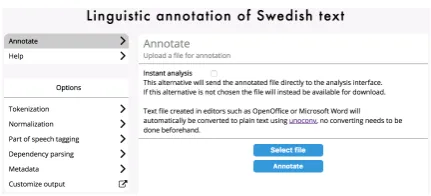
3.1.7 Web-based Annotation Tool
[image:5.595.73.289.584.682.2]The web-based annotation tool is illustrated in Figure 2. Users can upload one or several texts and annotate them.
Figure 2: Screenshot of the web-based annotation interface.
Modularity has been an important factor in de-veloping the annotation tool. Any module can be
deactivated, which enables users to exclude some part of the annotation if they wish and use their own annotation instead. For example, users can upload a text that is already tokenized in order to annotate it with PoS and syntactic features. Af-ter tokenization, normalization can also be carried out in the form of spell checking and correction of erroneously split compound words, or a text that is already corrected can be uploaded. Simi-larly, users could correct the PoS annotation given by the tool and run the syntactic analyzer on the corrected PoS tagged data. Users are thus free to decide which particular tools are needed, and the subsequent linguistic annotation is based on cor-rected, normalized forms, which could help im-prove the performance of subsequent steps since corrected data are used.
Each module may include several algorithms and models depending on the corpus data the mod-els were trained on. We include the most fre-quently used models with the highest accuracy on standard Swedish, which were evaluated and pub-lished previously.
Moreover, the pipeline is built in such a way that new, better analyzers can be plugged into the system. It is also possible to select differ-ent models for the PoS tagger and the syntac-tic parser, but currently only one model is pro-vided for each, both based on Stockholm-Ume˚a Corpus (SUC) 3.0 (Gustafson-Capkov´a and Hart-mann, 2006) and previously evaluated with a doc-umented high degree of accuracy. However, one restriction in choosing syntactic annotation (the parser and parser model) is that only the PoS model that the parser was trained on may be run during the PoS tagging module to get consistent annotation.
Another important factor was that the format should be readable and easy to understand so that users can manually examine the data annotated. The results are made available to users in the form of a downloadable plain text file encoded in UTF-8 or shown directly on the web-page. In contrast to formats like SGML or XML, the CoNLL-U for-mat, which is tab-separated with one token per line and has various linguistic fields represented in var-ious columns, is well suited for our purposes. The format with fields separated by tabs allows users to import their file in Excel or another tool of their choice to carry out further quantitative analysis.
FEATURE Description
TEXT ID Paragraph-sentence index, integer starting at 1 for each new paragraph and sentence
TOKEN ID Token index, integer starting at 1 for each new sentence; may be a range for tokens with multiple words FORM Word form or punctuation symbol
NORM Corrected/normalized token (e.g. in case of spelling error) LEMMA Lemma or stem of word form
UPOS Part-of-speech tag based on universal part-of-speech tag
XPOS Part-of-speech tag based on the Stockholm-Ume˚a Corpus; underscore if not available XFEATS List of morphological features for XPOS; underscore if not available
UFEATS List of morphological features for UPOS; underscore if not available HEAD Head of the current token, which is either a value of ID or zero (0)
DEPREL Dependency relation to the HEAD (root iff HEAD = 0) based on the Swedish Treebank annotation DEPS List of secondary dependencies (head-deprel pairs)
[image:6.595.78.519.65.227.2]MISC Any other annotation
Table 1: Annotation representation format for each token and field.
TEXT ID ID FORM NORM LEMMA UPOS XPOS XFEATS UFEATS HEAD DEPREL DEPS MISC 2.4 1 Jag Jag jag PRON PN UTR|SIN|DEF|SUB Case=Nom|Definite=Def|Gender=Com|Number=Sing 0 root I 2.4 2 var var vara VERB VB PRT|AKT Mood=Ind|Tense=Past|VerbForm=Fin|Voice=Act 1 acl was
2.4 3 i i i ADP PP 4-5 case in
2.4 4-5 Sydkorea Sydkorea PROPN PM NOM Case=Nom 2 nmod South Korea
2.4 4 Syd Syd South
2.4 5 Korea Korea Korea
2.4 6 f¨orra f¨orra f¨orra ADJ JJ POS|UTR/NEU|SIN|DEF|NOM Case=Nom|Definite=Def|Degree=Pos|Number=Sing 7 det last 2.4 7 vekan veckan vecka NOUN NN UTR|SIN|DEF|NOM Case=Nom|Definite=Def|Gender=Com|Number=Sing 4-5 nmod week
[image:6.595.77.534.241.320.2]2.4 8 . . . PUNCT MAD 1 punct .
Table 2: Example of the extended CoNLL-U shared task format for the sentenceJag var i Syd Korea f¨orra vekan (I was in South Korea last week). It contains one misspelled word,veckan, and one erroneously split compound,Syd Korea– South Korea, which should be a single compound word in Swedish. Note that theMISCcolumn here is used to provide English translations for this table.
annotation by including additional columns, users can easily choose between them based on their de-sires or choose to have all annotations available.
3.2 Automatic Quantitative Analysis
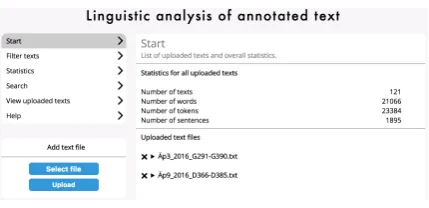
Users can upload one or several annotated texts for further quantitative analysis. Statistics are cal-culated and shown on several levels: for all texts, and if the text file is divided into several subtexts, for each of these. Figure 3 illustrates the start page of the quantitative analysis where information is given about the number of uploaded texts, words, tokens and sentences.
Figure 3: Automatic quantitative analysis.
The following features can be extracted auto-matically: number of tokens, words, sentences, texts and PoS; readability measures; average
length of words, tokens, sentences, paragraphs and texts; frequency lists of tokens, lemmas and PoS; and spelling errors.
The statistical calculations are divided into three sections: general statistics, frequencies and spelling errors. General statistics provide users with the option of including statistics for all PoS or for specific ones, readability metrics in terms of LIX, OVIX and the nominal ratio, and frequen-cies of word length above, below or at a specific threshold value.
The frequencies section can provide users with frequency lists for all texts and for individual texts. These can be based on lemmas or tokens, with or without delimiters. In addition, the frequency lists can be sorted based on frequencies or words (lemmas or tokens) in alphabetical order. The fre-quency lists can also be limited to specific parts of speech.
The spelling errors section provides a list of spelling errors sorted by frequency, for all up-loaded texts and for individual texts.
[image:6.595.74.289.581.685.2]Given each field, the texts can be filtered based on the properties of the metadata. Examples of anal-yses are provided in the next section.
Users can also specify whether the output should be delivered as a downloadable file sepa-rated by tabs, which can be imported into other programs such as Excel for further analysis, or shown directly in the browser.
Separately from the statistics, users can also view the uploaded texts in their entirety and per-form different types of searches in the annotated text. This includes searching for words, lemmas and PoS tags that either start with, end with, con-tain or exactly match a user-defined search query. The results are then printed and sorted according to what texts they appear in.
4 User Study
In this section we will demonstrate some of the possibilities of using SWEGRAM to analyze stu-dent writing as part of the national test carried out by school children in Sweden. We concentrate on two texts which are interesting to compare because they have some features in common but also differ in terms of the age of the writers, with the differ-ence being three school years. Without making use of SWEGRAMs capacity to analyze extensive data, we simply want to demonstrate some fea-tures included in the tool and what they can show about the characteristics of the two texts.
Essay D245, from the last year of compulsory school, and essay C381, from the final year of up-per secondary school, both represent the exposi-tory genre. Both essays have also been used as ex-amples, benchmarks, of essays receiving the high-est grade in the guide for assessing national thigh-ests. Therefore these two essays are both considered to be good writing for their respective school year. However, there is a three-year difference in age between the students, and the writing assignments given in the tests are different. Text D245 dis-cusses a general subject, love. The introduction of the essay, translated into English, is:Would you risk sacrificing your life for love, would you risk turning your entire existence upside down? The question is not easy to answer. Text C381 is an expository essay on the fairytaleSleeping Beauty, which makes the subject more specific. The in-troduction to this essay is translated into English as: Folk tales – anonymous stories that have been passed down from one generation to the next no
matter where humans have lived /.../ Why is this old fairytale still widely read in society today?.
We compare the documents in terms of differ-ent features that can give information relevant to text quality and writing development, such as lex-ical variation and specification, word frequencies, nominal ratio and distribution of parts-of speech.
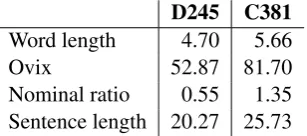
Looking at the lexical variation, the two texts are about the same length; D245 has 790 words and C381 has 713 words. But the average word length of the text from upper secondary school is higher than that of the text from compulsory school, as shown in Table 3.
D245 C381
[image:7.595.341.495.252.320.2]Word length 4.70 5.66 Ovix 52.87 81.70 Nominal ratio 0.55 1.35 Sentence length 20.27 25.73
Table 3: Some measures from SWEGRAM.
These results indicate that C381 may be more specified and lexically varied than D245, since longer words correlate with specification and vari-ation in a text (Hultman and Westman, 1977; Va-gle, 2005). Lexical variation in a text can also be measured by Ovix, a word variation index (Hult-man and West(Hult-man, 1977). This measure shows the same tendencies: more variation in the text from upper secondary school.
The lexicon can further be studied using SWE-GRAMs word frequency lists. In the list of nouns we look for long, compound nouns, since this is considered one feature of Swedish academic lan-guage. We find a number of these long words, sev-eral with more than 12 letters, in C 381. In D 245 there are a few compound nouns but none as long as this, which makes the lexicon of this text less specified and dense.
higher information load and presumably has more of a written style than the essay from compulsory school. The surprisingly high value of the nominal ratio in C381 could partly be explained by the fact that there are several references to other works in this text, and these include long nominal phrases.
D245 C381
[image:8.595.113.251.158.241.2]VB (17.38%) NN (19.82%) NN (12.33%) VB (13.34%) PN (11.66%) PP (11.27%) AB (10.87%) AB (7.12%) PP (8.30%) JJ (6.99%)
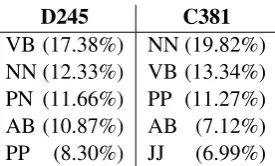
Table 4: The five most frequently occurring parts of speech.
A look at the parts of speech used most fre-quently shows that D245 is rich in verbs and pro-nouns, parts of speech that characterize a collo-quial style; see Table 4. C381, on the other hand, has high proportions of nouns and prepositions, which are important words in forming nominal phrases.
Table 3 shows that there is a difference in the average sentence length in the two essays: 20.27 words in D245 and 25.73 in C381. Since longer sentences may contain more clauses than shorter ones, this result indicates that the syntax of the essay from upper secondary school may be more complex that in D 245. The hypothesis can be controlled by a frequency list of conjunctions and subjunctions, words that connect clauses. In D245 there are six different conjunctions and three dif-ferent subjunctions, a total of nine connectives of this kind. In C381 there are eight different con-junctions and four subcon-junctions, a total of twelve different words. So the variation in connectives is more important in C381. The distribution of parts of speech also shows that conjunctions and subjunctions occur more frequently in C381 (KN + SN 7.12 %) than in D245 (KN + SN 5.54 %), which supports the hypothesis.
In summary, the analysis shows considerable differences between the two essays, as regards the lexicon, distribution of PoS and syntax. However, the result should not be interpreted in relation to the writing competence or writing development shown in the student texts. The purpose is to show the potential of analyses made with SWEGRAM without using the appropriate amount of data.
5 Conclusion
We presented a web-based interface for the au-tomatic annotation and quantitative analysis of Swedish. The web-based tool enables users to upload a file, which is then automatically fed into a pipeline of tools for tokenization and sen-tence segmentation, spell checking, PoS tagging and morpho-syntactic analysis as well as depen-dency parsing for syntactic annotation of sen-tences. Users can then send the annotated file for further quantitative analysis of the linguis-tically annotated data. The analyzer provides statistics about the number of tokens, words, sen-tences, number of PoS, readability measures, aver-age length of various units (such as words, tokens and sentences), frequency lists of tokens, lemmas and PoS, and spelling errors. Statistics can be also extracted based on metadata, given that metadata are defined by the user.
The tool can be easily used for the analysis of a single text, for the comparison of several texts, or for the creation of an entire corpus of the user’s choice by uploading a number of text doc-uments. The tool has been used succesfully in the creation of the Uppsala Corpus of Student Writ-ings (Megyesi et al., 2016). Since SWEGRAM will be used to create corpora, the possibility of customizing the content and format of metadata is something that could be beneficial to users and will be implemented in the near future.
The tools are readily available and can be used by anyone who is interested in the linguistic an-notation of Swedish text. As better models for standard Swedish are presented, our intention is to include them in the interface along with the old models to allow comparative studies. Our priority for further improvement is the normalization tool since there is no readily available open source tool for automatic spelling and grammar correction of Swedish. In addition, we would like to implement a visualization tool of the linguistic analysis, es-pecially syntax, which will also facilitate syntactic searches.
Acknowledgments
References
Laurence Anthony and Paul Baker. 2015. ProtAnt: A
tool for analysing the prototypicality of texts.
Inter-national Journal of Corpus Linguistics, 20(3):273– 292.
Lars Borin, Markus Forsberg, and Johan Roxen-dal. 2012. Korp – the corpus infrastructure of
Spr˚akbanken. In Proceedings of the 8th
Interna-tional Conference on Language Resources and Eval-uation, LREC 2012, page 474478.
Lars Borin, Markus Forsberg, Martin Hammarstedt, Dan Ros´en, Anne Schumacher, and Roland Sch¨afer.
2016. Sparv: Spr˚akbanken’s corpus annotation
pipeline infrastructure. InSLTC 2016.
CLARIN-D/SfS-Uni. T¨ubingen. 2012.
We-bLicht: Web-Based Linguistic Chaining Tool.
On-line. Date Accessed: 28 Mar 2017. URL
https://weblicht.sfs.uni-tuebingen.de/ .
Dominique Estival and Steve Cassidy. 2016. Alveo: Above and beyond speech, language and music, a virtual lab for human communication science.
Online. Date Accessed: 28 Mar 2017. URL
http://alveo.edu.au/about/.
Sofia Gustafson-Capkov´a and Britt Hartmann, 2006.
Documentation of the Stockholm - Ume˚a Corpus. Stockholm University: Department of Linguistics.
P´eter Hal´acsy, Andr´as Kornai, and Csaba Oravecz. 2007. Hunpos: An open source trigram tagger. In
Proceedings of the 45th Annual Meeting of the ACL on Interactive Poster and Demonstration Sessions, ACL ’07, pages 209–212, Stroudsburg, PA, USA. Association for Computational Linguistics.
Erhard W. Hinrichs, Marie Hinrichs, and Thomas Zas-trow. 2010. Weblicht: Web-based LRT services for
German. In Proceedings of the ACL 2010 System
Demonstrations, pages 25–29.
Sebastian Hoffmann, Stefan Evert, Nicholas Smith,
David Lee, and Ylva Berglund Prytz. 2008.
Cor-pus Linguistics with BNCweb – A Practical Guide. Frankfurt am Main: Peter Lang.
Tor G. Hultman and Margareta Westman. 1977.
Gym-nasistsvenska. LiberL¨aromedel, Lund.
Milen Kouylekov, Emanuele Lapponi, Stephan Oepen, Erik Velldal, and Nikolay Aleksandrov Vazov. 2014. LAP: The language analysis portal.
Online. Date Accessed: 28 Mar 2017. URL
http://www.mn.uio.no/ifi/english/research/projects/-clarino/.
Emanuele Lapponi, Erik Velldal, Stephan Oepen, and Rune Lain Knudsen. 2014. Off-road laf: Encoding
and processing annotations in nlp workflows. In9th
edition of the Language Resources and Evaluation Conference (LREC).
Ulrika Magnusson and Sofie Johansson Kokkinakis. 2011. Computer-Based Quantitative Methods Ap-plied to First and Second Language Student Writ-ing. In Inger K¨allstr¨om and Inger Lindberg, editors,
Young Urban Swedish. Variation and change in mul-tilingual settings, pages 105–124. G¨oteborgsstudier i nordisk spr˚akvetenskap 14. University of Gothen-burg.
Be´ata Megyesi, Jesper N¨asman, and Anne Palm´er. 2016. The Uppsala corpus of student writings: Cor-pus creation, annotation, and analysis. In Nico-letta Calzolari (Conference Chair), Khalid Choukri, Thierry Declerck, Sara Goggi, Marko Grobelnik, Bente Maegaard, Joseph Mariani, Helene Mazo, Asuncion Moreno, Jan Odijk, and Stelios Piperidis,
editors,Proceedings of the Tenth International
Con-ference on Language Resources and Evaluation (LREC 2016), pages 3192–3199, Paris, France. Eu-ropean Language Resources Association (ELRA).
Be´ata Megyesi. 2008. The Open Source Tagger
Hun-PoS for Swedish. Uppsala University: Department of Linguistics and Philology.
Joakim Nivre, Johan Hall, and Jens Nilsson. 2006.
Maltparser. InProceedings of the 5th International
Conference on Language Resources and Evaluation, LREC ’06, pages 2216–2219.
Joakim Nivre, Be´ata Megyesi, Sofia Gustafson-Capkov´a, Filip Salomonsson, and Bengt Dahlqvist. 2008. Cultivating a Swedish treebank. In Joakim Nivre, Mats Dahll¨of, and Be´ata Megyesi, editors,
Resourceful Language Technology: A Festschrift in Honor of Anna S˚agvall Hein, pages 111–120.
Missil¨a, Verginica Mititelu, Yusuke Miyao, Simon-etta Montemagni, Keiko Sophie Mori, Shunsuke Mori, Bohdan Moskalevskyi, Kadri Muischnek, Nina Mustafina, Kaili M¨u¨urisep, Lng Nguyn Th, Huyn Nguyn Th Minh, Vitaly Nikolaev, Hanna Nurmi, Petya Osenova, Robert ¨Ostling, Lilja Øvre-lid, Valeria Paiva, Elena Pascual, Marco Passarotti, Cenel-Augusto Perez, Slav Petrov, Jussi Piitulainen, Barbara Plank, Martin Popel, Lauma Pretkalnia, Prokopis Prokopidis, Tiina Puolakainen, Sampo Pyysalo, Alexandre Rademaker, Loganathan Ra-masamy, Livy Real, Laura Rituma, Rudolf Rosa, Shadi Saleh, Baiba Saul¯ite, Sebastian Schuster, Wolfgang Seeker, Mojgan Seraji, Lena Shakurova, Mo Shen, Natalia Silveira, Maria Simi, Radu Simionescu, Katalin Simk´o, M´aria ˇSimkov´a, Kiril Simov, Aaron Smith, Carolyn Spadine, Alane Suhr, Umut Sulubacak, Zsolt Sz´ant´o, Takaaki Tanaka, Reut Tsarfaty, Francis Tyers, Sumire Uematsu, Larraitz Uria, Gertjan van Noord, Viktor Varga, Veronika Vincze, Lars Wallin, Jing Xian Wang, Jonathan North Washington, Mats Wir´en, Zdenˇek ˇZabokrtsk´y, Amir Zeldes, Daniel Zeman, and Hanzhi Zhu. 2016. Universal dependencies 1.4. LINDAT/CLARIN digital library at the Institute of Formal and Applied Linguistics, Charles University in Prague.
Lena ¨Ohrman, 1998. Felaktigt s¨arskrivna
sam-mans¨attningar. Stockholm University, Department of Linguistics.
Robert ¨Ostling. 2013. Stagger: An open-source part
of speech tagger for Swedish. Northern European
Journal of Language Technology, 3:1–18.
Eva Pettersson, Be´ata Megyesi, and Joakim Nivre. 2013. Normalisation of historical text using context-sensitive weighted Levenshtein distance and
com-pound splitting. InProceedings of the 19th Nordic
Conference of Computational Linguistics, NODAL-IDA ’13.
Mike Scott, 2016.WordSmith Tools Version 7. Stroud:
Lexical Analysis Software.
Wenche Vagle. 2005. Tekstlengde + ordlengdesnitt = kvalitet? Hva kvantitative kriterier forteller om avgangselevenas skriveprestasjoner. In Kjell Lars Berge, Siegfred Evensen, Frydis Hertzberg, and
Wenche. Vagle, editors, Ungdommers