Szeged Corpus 2.5:
Morphological Modifications in a Manually POS-tagged Hungarian Corpus
Veronika Vincze
1, Viktor Varga
2, Katalin Ilona Simkó
2,
János Zsibrita
2, Ágoston Nagy
2, Richárd Farkas
2, János Csirik
11Hungarian Academy of Sciences, Research Group on Artificial Intelligence
H-6720 Szeged, Tisza Lajos krt. 103.
2University of Szeged, Department of Informatics
H-6720 Szeged, Árpád tér 2.
Email: [email protected], [email protected], [email protected],
[email protected], [email protected], [email protected], [email protected]
Abstract
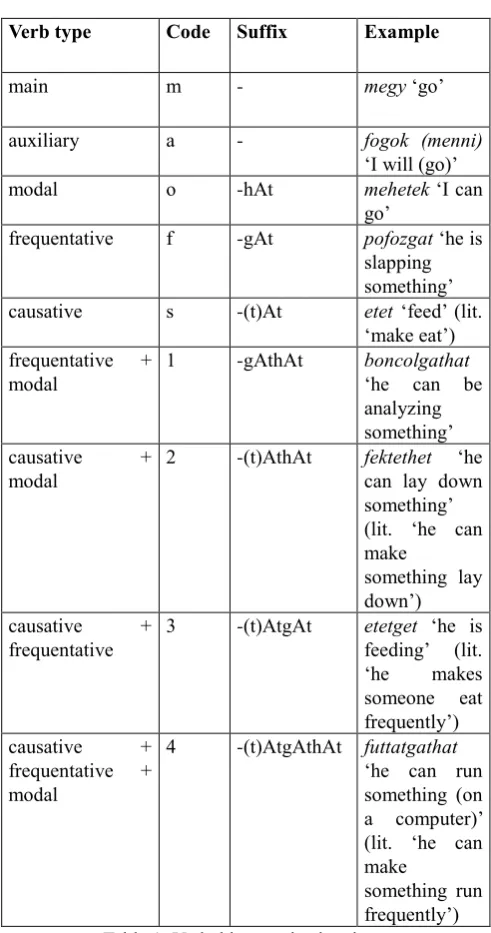
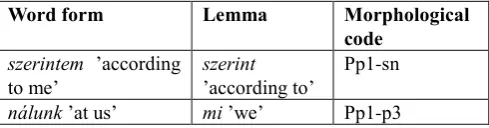
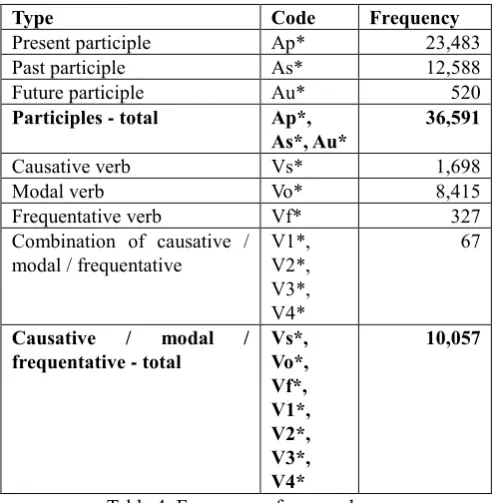
The Szeged Corpus is the largest manually annotated database containing the possible morphological analyses and lemmas for each word form. In this work, we present its latest version, Szeged Corpus 2.5, in which the new harmonized morphological coding system of Hungarian has been employed and, on the other hand, the majority of misspelled words have been corrected and tagged with the proper morphological code. New morphological codes are introduced for participles, causative / modal / frequentative verbs, adverbial pronouns and punctuation marks, moreover, the distinction between common and proper nouns is eliminated. We also report some statistical data on the frequency of the new morphological codes. The new version of the corpus made it possible to train magyarlanc, a data-driven POS-tagger of Hungarian on a dataset with the new harmonized codes. According to the results, magyarlanc is able to achieve a state-of-the-art accuracy score on the 2.5 version as well.
Keywords: corpus, morphology, POS-tagging, Hungarian
1.
Introduction
The Szeged Corpus is the largest manually annotated corpus of Hungarian in which all the possible morphological analyses and lemmas for each word form are provided, besides, texts are also POS-tagged (Csendes et al., 2005). In Szeged Corpus 2.0, the MSD morphological coding system is used (Erjavec, 2004). In this work, we present the latest version of the corpus – Szeged Corpus 2.5 – in which we applied some morphological modifications which we believe will benefit real-world NLP applications. The modifications involve the introduction of new codes in the coding system as well as the correction of some morphological codes, with special emphasis on misspelled words.
2.
Morphological Coding Systems of
Hungarian
There are three widely used morphological coding systems for Hungarian: Humor, MSD and KR. The coding system Humor is based on unification, that is, one word form can contain only morphemes that contain no contradictory morphological features (Prószéky & Tihanyi, 1993).
The MSD morphological coding system is a positional coding system developed for several languages (Erjavec, 2004). By convention, lemmas contain derivational suffixes and only inflectional morphemes are distinguished separately from the lemma.
The KR coding system was developed with respect to Hungarian (Kornai et al., 2004). Linguistic information is
encoded in hierarchical attribute value matrices: there are default values (e.g. singular or 3rd person) and only those that differ from these manifest in the code.
3.
Harmonizing Morphological Coding
Systems of Hungarian
In order to carry out any natural language processing tasks for Hungarian, a basic linguistic preprocessing toolkit is necessary. There are several morphological analyzers available, however, they are based on different morphological coding systems. Thus, a prerequisite for the merge of Hungarian morphological analyzers is the harmonization of the coding systems.
Vajda, P. (2006). Morphdb.hu: Hungarian lexical database and morphological grammar. In: Proceedings of 5th International Conference on Language Resources and Evaluation (LREC ’06).