A Quantitative View of Short Utterances in Daily Conversation: A Case
Study of
That’s right
,
That’s true
and
That’s correct
Yanjiao Li
Department of Linguistics
and Translation
City University of Hong
Kong
Hong Kong SAR
yanjiaoli2-c
@my.cityu.edu.hk
Alex C. Fang
Department of Linguistics
and Translation
City University of Hong
Kong
Hong Kong SAR
[email protected]
Jing Cao
School of Foreign Languages
Zhongnan University of
Economics and Law
Wuhan, P. R. China
cecilia_cao
@znufe.edu.cn
Abstract
Short utterances serve a multitude of different communicative functions in interactive speech and have attracted due attention in recent re-search in dialogue acts. This paper presents a quantitative description of three short utteranc-es i.e. that’s right, that’s true, that’s correct and their variations based on the Switchboard Dialogue Act Corpus. Particularly, it offers an overview to account for how they are deployed by native speakers in daily conversation. At the same time, it attempts to provide a comparative account of that’s right and that’s true, showing that while almost 75% of them are mutually exchangeable, they nonetheless exhibit prefer-ences in interactive speech. This insight is ex-pected to form a useful approach towards automatic dialogue act tagging.
1
Introduction
Dialogue act (DA), defined as “communicative activity of a dialogue participant, interpreted as having a certain communicative function and se-mantic content” (ISO 24617-2, 2012: 2), plays a key role in the interpretation of the communicative behaviour of dialogue participants and offer valua-ble insight into the design of human-machine dia-logue system (Bunt et al. 2010). With the goal of facilitating automatic DA tagging, this paper de-scribes a corpus-based investigation into that’s
right, that’s true, that’s correct and their variations in the Switchboard Dialogue Act (SWBD) Corpus, in order to answer questions about the communica-tive functions they mainly perform in daily conver-sation. These utterances deserve our particular attention in research considering that, like other brief responses (e.g. Oh, Uh huh, Mm, Okay), they serve as important feedback to the main speaker and they usually occur as overlapping speech. They are particularly problematic to interpret be-cause they demonstrate a drastically different func-tional or pragmatic meaning from the semantic meaning of the component tokens. Consider Ex-ample 1.
Example 1
sd B.54 utt1: -- {C and } I like that because [ it's a, + it's ] real easy to, {F uh, } follow for her, / sd B.54 utt2: {D you know, } {F uh, } {D gosh, } [ if, + if ] I read straight out of the Bible to her
she'd <laughter> never understand any of it. /
sd A.55 utt1: {D Well, } it's hard for me. /
ba B.56 utt1: That's right <laughter>. /
sw_0263_2226.utt
that’s right can be interpreted as serving both as-sessment/appreciation and agreement functions. The speaker B considers that what has been stated by A is right, not false, in which right is used as the evaluative adjective. Also, he implies his agreement with the interlocutor where that’s right is used as a whole. Therefore, on the one hand, the semantic meaning of that’s right makes it much closer to personal judgments and assessments, that is, the opinion is “right, not false”. On the other hand, it is often used as a whole, indicating speak-er’s agreement, which goes beyond lexical mean-ings.
However, past studies rarely specify various us-age for that’s right, that’s true and that’s correct in a systematic fashion, and just sporadically describe one or two cases to illustrate one or two facets for them, without capturing a full picture of how they are used with empirical evidence. To be more ex-act, for the studies that do discuss usage for that’s right, Gardner (2001) believes that that’s right is exactly the same as right when responding to a preceding question, the synonym for “that’s co r-rect”. This point has been further elaborated in that right is deemed “a truncated version of that’s right” when acting as “an epistemic confirmation token”, “in a sense close to one of its dictionary meanings, namely ‘correct’” (Gardner, 2004: 4). The studies indicate that that’s right, right, that’s correct, and correct are similar and can be alterna-tively used as the confirmation token oriented to a prior question. At this regard, however, Stenström (1987: 104) asserts that that’s right is much stronger than right in degree of emphasis and in-volvement when severing as a response move to the same type initiating move. In addition, when responding to a previous declarative, that’s right has been considered to realize the functions of seeking confirmation (Tui, 1994), showing agree-ment (Stenström, 1987; Tui, 1994; Gardner, 2001) as well as making assessments (Tao, 2003). There-fore, that’s right has been considered to indicate a wide variety of intentions in interaction. With re-gard to that’s true, it has received little attention, and only McCarthy (2003) makes brief description that as a syntactically independent token, true seems to prefer the clausal option (that’s true) to independent occurrence (true). In terms of that’s correct, it has been left largely unexamined and unspecified regarding the usage.
Considered semantic meanings of the three short utterances (i.e. that’s right, that’s true and that’s correct), they largely embody in their key words right, true and correct. As is shown in dictionaries, the three words have similar lexical meanings and are often used to paraphrase each other. For in-stance, Longman Dictionary of Contemporary English (2009, fifth edition) defines them as fol-lows:
Correct: having no mistakes; right (p.379) Right: true/correct (p.1504)
True: not false, based on facts and not imagined or in-vented (p.1891-1892)
Thus, this paper aims to bring together the dispar-ate findings on the uses of the three short utteranc-es as well as their variations, attempting to depict an overview of them: how they are deployed by native speakers in daily conversation. At the same time, a comparative view has been concentrated on that’s right/true, to seek to the circumstance in which they are mutually exchangeable and in which they are distinct. In this way, it is expected to form a useful approach towards automatic detec-tion of DAs.
This paper is structured as follows. Section 2 briefly introduces the SWBD DA corpus, then sec-tion 3 presents how the data has been processed before statistical analysis. Section 4 is related to general figures for the three short utterances and their variations, followed by a comparative study (section 5). Section 6 draws conclusions to this paper.
2
Corpus Resource
This study uses the Switchboard Dialogue Act Corpus1 , which comprises 1,155 transcribed
tele-phone conversations, totaling in 223,606 utterances or 1.5 million word tokens (Fang et al., 2011). In this corpus, the segmented unit for utterances is defined as “slash-unit”, which can be complete or incomplete, ranging from “a sentence” to “a small-er unit” (Metesmall-er et al., 1995: 16). Moreovsmall-er, all these segmented utterances have been annotated with DA information, such as “aa” (accept), “ba” (assessment/appreciation), etc., to denote functions of particular utterances according to the
DAMSL coding scheme (Jurafsky et al., 1997). Consider Example 22.
Example 2
sv A.9 utt12: any jury's not going to disregard the evidence, {D you know } <laughter>. /
aa B.10 utt1: {F Uh, } that's true. /
sw_0142_2145.utt
As can be seen, the first utterance has been coded with “sv”, a DA tag for statement-opinion, while the second one has been labeled as “aa”, a code for accept. In the current study, investigation of vari-ous functions will be conducted based on the DA tags which have been coded for each utterance.
3
Data Pre-processing
For the benefit of the current work, that’s right, that’s true and that’s correct, and their variations are retrieved from the corpus accordingly. Varia-tions in the current study are defined with a series of factors taken into account.
Firstly, variations of the same token share the key words and present in similar patterns, for instance, it’s true, this is true and true are all considered as variations of that’s true, since they contain the same key word true with simi-lar patterns. Consequently, the whole utteranc-es have similar semantic meanings.
Secondly, cases (e.g. it’s true) embedded with adverbs and formulaic terms are still regarded as variations, because adverbs and formulaic terms are often used to enhance or emphasize emotions or attitudes, but not to change the meaning of the whole utterance. That’s really true and I think that’s certainly true are cases in point, where really and certainly are ad-verbs, and I think is the formulaic term. They are used to emphasize the attitude of the speaker. Formulaic terms refer to expressions such as “I think” and “I believe”, which display in the form of “I + predicate”, to express the speaker’s subjectivity in spoken discourse
2 In the Switchboard Dialogue Act Corpus, restarts and non-sentence elements also have been marked within each utter-ance, such as filler ({F…}), discourse marker ({D…}) and coordinating conjunction ({C…}) (Meteer et al., 1995). In Example 2, “You know” is coded as discourse marker and “Uh” as filler.
(Baumgarten and House, 2010). Also, they have been recognized as one type of “engage-ment”, dealing with “sourcing attitudes and the play of voices around opinions in discourse” in the appraisal framework (Martin and White, 2005: 35).
Thirdly, the negative form and interrogative form, e.g. that’s not true, is that true? are ex-cluded, since their meanings and primary func-tions are apparently distinct from those of that’s true.
Fourthly, cases subsequently followed by that-clauses or prepositional phrases are excluded from the current work either, for instance
Example 3
sv B.115 utt2: {C So } I do think it's right that they're harder on themselves, # {D you know. } # /
sw_0382_4785.utt
It’s true, followed by a that-clause, is not used independently any more. Such cases are not concerned with at this moment.
Finally, it is necessary to reconsider the inde-pendent token right since it is often used as ac-knowledging token in the literature (e.g. Gardner, 2004; 2007), different from that’s right. As a consequence, right is not treated as a variant of that’s right in this stage, which will be verified by the statistical information later.
Variations of that’s right
Variations of that’s true
Variations of that’s correct
True Correct
Adverb + right Adverb + true Adverb + correct
That’s + adverb +
right
That’s + adverb +
true
Formulaic term +
that’s + right
Formulaic term +
that’s true
Formulaic term +
that’s correct Formulaic terms +
that’s + adverb +
right
Formulaic term + that’s+ adverb +
true
It’s right It’s true
It’s + adverb + true
Formulaic term + it’s true
Formulaic term + it’s + adverb + true This is true This is + adverb +
true
Thus, the final list can be identified as shown in Table 1, where similar patterns take one-to-one correspondence. Apparently, that’s true has more different types of variations than the other two.
4
Descriptive Statistics
That’s right, that’s true and that’s correct are in effect synonymous concerning the dictionary meaning, while in the corpus, they do vary regard-ing their frequency information.
(1) That’s right
and variations
(2) That’s true
and variations
(3) That’s correct
and variations
Total 911 920 21
(1), (2) and (3) in the following will be used to stand for the three sets of utterances respectively.
Table 2 Statistical information of the three sets
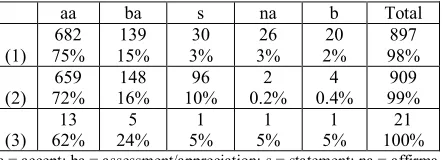
It is obvious that the total occurrence of (1) and (2) are almost the same, both of which far exceed that of (3). Beyond this, a range of functions have been identified for each of them, of which “aa”, “ba”, “s”, “na” and “b”3 are the most significant ones, all
together accounting for over 98% in each set. Ta-ble 3 sets out these functions and their relative fre-quencies in performing each of them.
aa ba s na b Total
(1) 75% 682 15% 139 3% 30 3% 26 2% 20 98% 897
(2) 72% 659 16% 148 10% 96 0.2% 2 0.4% 4 99% 909
(3) 13 62%
5 24%
1 5%
1 5%
1 5%
21 100% aa = accept; ba = assessment/appreciation; s = statement; na = affirma-tive answer; b = acknowledgement/backchannel
Table 3 Top five functions of three sets
3 In the coding scheme SWBD-DAMSL, there are very
specif-ic definitions for each of them. Accept (aa), one subtype of
agreement, indicates the speaker explicitly accepts a proposal, or makes agreements with previous opinions (Jurafsky et al., 1997: 37). Assessment/appreciation (ba) is defined as “a bac k-channel/continuer which functions to express slightly more
emotional involvement and support than just ‘uh-huh’” (Jura f-sky et al., 1997: 48). Statement (s) divides into “descrip-tive/narrative/personal” statements (sd) and “other-directed opinion statements” (sv), both with the primary purpose of making claims about the world (including answers to ques-tions) (Allen and Core, 1997: 10). Affirmative answer (na) is one subclass of answers, which indicates affirmative answers
that are not “yes” or a variant (Jurafsky et al., 1997: 50).
Acknowledgement (b) is usually “referred to in the CA liter
a-ture as a ‘continuer’” (Jurafsky et al., 1997: 42).
A glance at the table establishes that these top five functions together account for a large proportion among a series of functions performed by each particular set. In particular, accept overwhelmingly occurs in all the three sets, followed by assess-ment/appreciation. However, set (3) displays some slight distinction from (1) and (2) in the way that its proportion of assessment/appreciation is around 10% higher than that of sets (1) (2), but approxi-mately 10% lower in accept. In the description to follow, the major concern is to seek similarities and distinctions within each set.
4.1 That’s right and its variations
That’s right and its variations frequently occur in daily speech, which can be seen in Table 4.
Types Freq. Percentage
That’s right 852 93.5%
That’s + adverb + right 26 2.9%
Formulaic term + that’s + right 20 2.2% Formulaic term + that’s + adverb
+ right 5 0.6%
It’s right 4 0.4%
Adverb + right 4 0.4%
Total 911 100%
Table 4 Statistical information of set (1)
It is perceptible that the simple token that’s right
overwhelmingly occurs compared to a range of variations, which may be indicative of the signifi-cance of economy in casual talk. By contrast, for-mulaic terms and adverbs are not so often attached with that’s/it’s right, accounting for less than 3% (2.2%+0.6%) and 4% (2.9%+0.6%+0.4%) respec-tively, which implies that such additional emphasis of stance and attitudes is not common in daily con-versation. Noticeably, it’s right appears 4 times, and this is right never occurs in the corpus. Hence
that, it and this are similar lexical items but they have their own particular preference in some cir-cumstance: when prefacing “be + right”, that is
more often used than it and this.
Regarding a variety of functions they serve,
that’s right and its variation totally perform twelve different functions in the corpus, but the top five are extremely significant which can be seen in Ta-ble 5, together constituting over 60% in each row. Strikingly, that’s right does exhibit some slight distinction from its variations in that that’s right
Concerning a range of functions they perform, that’s true and its variations totally have nine dif-ferent functions in the corpus, among which the top five are displayed in Table 7. Overall, the dis-tribution here shares a large number of similarities with that of set (1) in Table 5. In particular, accept, assessment/appreciation and statement are consid-erably significant, while affirmative answer and acknowledgement are comparatively less crucial, only occurring in that’s true, that’s + adverb + true and true. When that’s true is attached with formu-laic terms, the likelihood to function as accept de-clines accompanying with greater proportion in statement. The exceptional token is it’s true, which itself prefers both accept and statement. In this sense, it’s true is distinguished from that’s true which overwhelmingly deals with accept. By con-trast, this is true is relatively consistent with that’s true in primary functions they serve. Thus, in the pattern “THAT/IT/THIS + BE + TRUE”, that, it and this indicate their particular preference as well.
4.3 That’s correct and its variations
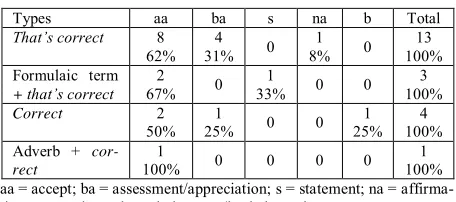
That’s correct and its variations are used infre-quently, with a total occurrence of 21 in the whole corpus. As a consequence, there are far less varia-tions in this set. Table 8 shows the basic frequency information, and Table 9 exhibits all functions per-formed by these tokens.
Types Freq. Percentage
That’s correct 13 61.9%
Formulaic term + that’s correct 3 14.3%
Correct 4 19.0%
Adverb + correct 1 4.8%
Total 21 100.0%
Table 8 Statistical information of set (3)
Types aa ba s na b Total
That’s correct 8
62% 4
31% 0
1
8% 0
13 100% Formulaic term
+ that’s correct 2
67% 0
1
33% 0 0
3 100%
Correct 2
50% 1
25% 0 0
1 25%
4 100% Adverb +
cor-rect 100% 1 0 0 0 0 100% 1
aa = accept; ba = assessment/appreciation; s = statement; na = affirma-tive answer; b = acknowledgement/backchannel
Table 9 All functions performed by set (3)
As can be seen in Table 8, that’s correct occurs more frequently than its variations, accounting for
62% in set (3), which is lower than that of that’s right (93%) and that’s true (71%). Moreover, for-mulaic terms and adverbs are not so frequent, ei-ther, which suggests bare tokens such as that’s correct and correct are preferred by native speak-ers. Considered a range of functions performed Table 9, accept and assessment/appreciation are remarkable compared to statement, affirmative an-swer and acknowledgement with one occurrence for each.
To summarize, an overview of utterances in the three sets has presented with empirical evidence. Generally, they share quite a lot of similarities in terms of primary functions they serve. In addition, two points need to be further elaborated. One is that, right is assumed to be used in a way different from that’s right in conversation, which is further confirmed by the evidence that 73% of right serve acknowledgement while that’s right prefers accept with 76% of its total occurrence in the corpus. This can be observed in Table 10, where their top five functions have been listed respectively. Also, 16% of that’s right can be used as assess-ment/appreciation, whereas the single right only occurs 11 times (0.2%) as assessment/appreciation. Hence, in general, right and that’s right are two different cases in interactive speech.
b aa na % fc Total Right 3685
73% 1154 23% 127 3% 26 0.5% 17 0.3% 5009 99% aa ba na b s Total That’s
right
642
76% 134 16% 26 3% 20 2% 19 2% 841 99% aa = accept; ba = assessment/appreciation; s = statement; na = affirma-tive answer; b = acknowledgement/backchannel; % = abandoned utterances; fc = conversational closing
Table 10 right vs. that’s right
The second point is that, that, it and this have their particular preference to the pattern “THAT/IT/THIS+BE+RIGHT/TRUE/CORRECT” , which can be summarized as follows.
That > Ø > it > this
5
A Comparative Study
According to the previous statistical analysis, it is
noted that that’s right, that’s true and that’s co
r-rect account for quite a large proportion in each particular set. The previous observation has also
shown that the total occurrence of that’s correct is
much fewer than the other two, and therefore, a
comparative study will concentrate on that’s right
and that’s true, and examine the condition where they are mutually exchangeable with each other and where they are distinct from each other. Fig-ures 1 and 2 respectively fill out their primary
functions and their preceding contexts4. By Figure
1, apparently that’s right and that’s true both
ex-hibit considerable preference to accept and
as-sessment/appreciation which together make up over 90% for both cases. It is meant that over 90% of their tokens perform the two same functions.
aa = accept; ba = assessment/appreciation; s = statement; na = affirma-tive answer; b = acknowledgement/backchannel
Figure 1Primary functions of that’s right and that’s true
However, some slight difference between them can
be perceived as well. That’s right is used to
per-form all these five functions, while that’s true cov-er four of them and cannot be not used to answcov-er a
question. At the same time, that’s true shows far
greater likelihood to serve statement compared to
that’s right. By contrast, that’s right is almost ten
times more likely than that’s true to function as
acknowledgement.
In order to see whether their previous contexts could offer useful cues to differentiate the occur-rence of that’s right and that’s true, a specific view is taken into the previous contexts when they act as
4 The previous contexts are restricted to immediately previous
utterances uttered by others.
accept and assessment/appreciation, because the
two functions together make up a large proportion of the total occurrence. Figure 2 depicts the salient previous context when they act as the two func-tions.
aa = accept; ba = assessment/appreciation; s = statement
Figure 2 Previous contexts of aa and ba
It is clear that statement is the most overwhelming
previous function, accounting for over 80%
previ-ous contexts of that’s right/true when they act as
accept and assessment/appreciation. It seems that
the previous contexts offer little cues to differenti-ate them, since both are so often preceded by statement. According to Figures 1 and 2, it is pos-sible that almost 75% of that’s right/true are mutu-ally exchangeable since over 90% of their
occurrence contributes to accept and
assess-ment/appreciation, in which over 80% of the
pre-vious contexts are statement. This can be further
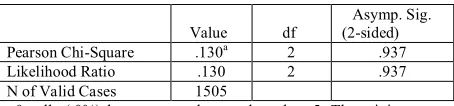
validated by the chi-square test, which aims to test if that’s right and that’s true have no difference in the distribution of different functions. Table 11
shows the frequency distribution of that’s
right/true in accept, assessment/appreciation and
other functions. Table 12 exhibits the result of the test.
Functions
Total
aa ba others
To-kens
That’s
right
Count 642 134 76 852
Expected count
639.1 135.3 77.6 852.0
That’s
true
Count 487 105 61 653
Expected
count 489.9 103.7 59.4 653.0
Total Count 1129 239 137 1505
Expected
count 1129.0 239.0 137.0 1505.0
aa = accept; ba = assessment/appreciation
Value df
Asymp. Sig. (2-sided)
Pearson Chi-Square .130a 2 .937
Likelihood Ratio .130 2 .937
N of Valid Cases 1505
a. 0 cells (.0%) have expected count less than 5. The minimum ex-pected count is 59.44.
Table 12 Chi-Square Tests
In Table 12, the value of pearson chi-square is 0.130, and the p-value is 0.937 which is larger than
0.05. It manifests that the difference between that’s
right and that’s true is not significant in the
distri-bution of primary functions according to the fre-quency information observed in the corpus.
In summary, the statistical analysis above
demonstrates that that’s right and that’s true are
used almost the same in interactive speech, in which nearly 75% of their total occurrence are in-terchangeable. This is further confirmed by the significant test which explicitly shows no signifi-cance in the distribution of primary functions, and their previous contexts supply little cues for the distinction. In some cases, however, they have their own preference and differ from each other.
For instance, that’s true has never been found to
answer a previous question in the corpus, while 3% of that’s right can perform this function.
Moreo-ver, that’s true shows much greater likelihood to
serve statement whereas that’s right is almost ten
times more likely than that’s true to be
acknowl-edgement. Specifically, when the preceding
utter-ance is a statement or a question, the current
utterance is more likely to serve statement if it is
realized by that’s true; it has greater possibility to
be acknowledgement or an affirmative answer if it
is realized by that’s right. This kind of preference
is expected to facilitate DA tagging.
6
Conclusions
This paper presented a quantitative investigation of
three short utterances (i.e. that’s right, that’s true,
that’s correct) and their variations in the Switch-board Dialogue Act Corpus. Particularly, it offered an overview to account for how they are used in daily conversation with empirical evidence. By the current investigation, it has been observed that that’s right/true and their variations much more
frequently occur than that’s correct and its
varia-tion. In terms of primary functions served in inter-active speech, they consistently exhibit great
preference to accept, assessment/appreciation,
statement, affirmative answer and
acknowledge-ment, among which, accept and
assess-ment/appreciation together account for quite a
large proportion. Regarding their variations, that, it
and this are similar lexical items but they indicate
their particular preference to this pattern
“THAT/IT/THIS+BE+RIGHT/TRUE/CORRECT”
. Moreover, formulaic terms and adverbs are not so frequently embedded. When formulaic terms are attached, the whole utterances have greater
likeli-hood to be statement.
Also, we have specified some crucial issues for
that’s right and that’s true, which are clearly use-ful to the detection of DAs. It has been discovered
that almost 75% of that’s right and that’s true are
mutually exchangeable, which has been verified by the chi-square that their difference is not signifi-cant in the distribution of primary functions. Moreover, the previous contexts offer little cues to
differentiate that’s right and that’s true. In this
sense, they are two short utterances with similar meanings and uses. But in some cases, they display
their particular preference: that’s right has fewer
variations compared to that’s true, and covers a
wide range of functions in the corpus; that’s true
has never been found to answer a previous
ques-tion in the corpus, while 3% of that’s right can do
that. Moreover, that’s true shows much greater
likelihood to serve statement whereas that’s right
is more likely to be acknowledgement. Such kind
of empirical analysis will provide the insights and bases for automatic DA tagging. In addition, we believe that it also tells second language learners how to use these three shore utterances under spe-cific contexts.
Acknowledgements
Research described in this paper was supported in part by grant received from the General Research Fund of the University Grant Council of the Hong Kong Special Administrative Region, China (Pro-ject no. CityU 142711) and City University of Hong Kong (Project nos. 6354005, 7004091, 9610283, 7002793, 9610226, 9041694, and 9610188).
References
port, Multiparty Discourse Group, Discourse Re-source Initiative, September/October 1997.
Baumgarten, N., & House, J. 2010. I think and I don’t know in English as lingua franca and native English discourse. Journal of Pragmatics, 42(5), 1184-1200. Bunt, H., Alexandersson, J., Carletta, J., Choe,
J.-W., Fang, A.C., Hasida, K., Lee, K., Petukhova, V., Popescu-Belis, A., Romary, L., Soria, C. and Traum, D. 2010. Towards an ISO standard for dia-logue act annotation. In Proceedings of the Seventh International Conference on Language Resources and Evaluation. Valletta, MALTA, 17-23 May 2010. Fang, A., H. Bunt, J. Cao, and X. Liu. 2011. Relating
the semantics of dialogue acts to linguistic properties: A machine learning perspective through lexical cues. In Proceedings 5th IEEE International Conference on Semantic Computing, Stanford University, Palo Alto. Gardner, R. 2001. When Listeners Talk: Response To-kens and Listener Stance. John Benjamins Publishing Gardner, R. 2004. Acknowledging strong ties between utterances in talk: Connections through right as a re-sponse token. In Proceedings of the 2004 Conference of the Australian Linguistic Society, pages 1–12. Gardner, R. 2007. The Right connections:
Acknowledg-ing epistemic progression in talk. Language in Socie-ty, 36(03), 319-341.
ISO Standard 24617-2. 2012. Language resource man-agement–Semantic annotation frame-work (SemAF), Part 2: Dialogue acts. ISO, Geneva, 2012.
Jurafsky, D., Shriberg, E. and Biasca, D. 1997. Switchboard SWBD-DAMSL shallow-discourse-function annotation coders manual, Draft 13. Uni-versity of Colorado, Boulder Institute of Cognitive Science Technical Report 97-02.
M. Meteer and A. Taylor. 1995. Dysfluency annotation stylebook for the Switchboard Corpus. available
online at
ftp://ftp.cis.upenn.edu/pub/treebank/swbd/doc/DFL-book.ps.
Martin, J. R., & White, P. R. 2005. The language of evaluation. Basingstoke and New York: Palgrave Macmillan.
Mayor, M. (Ed.). 2009. Longman dictionary of contem-porary English. Pearson Education India.
McCarthy, M. 2003. Talking back: “Small” interaction-al response tokens in everyday conversation. Re-search on Language and Social Interaction, 36(1), 33-63.
Stenström, A. B. 1987. Carry-on signals in English con-versation. Corpus linguistics and beyond, 87-119. Tao, H. 2003. Turn Initiators in Spoken English: A
Cor-pus-Based Approach to Interaction and Grammar. Corpus Analysis: Language Structure and Language Use, (46), 187.