Designing and Evaluating a Russian Tagset
Serge Sharoff
?, Mikhail Kopotev
∗, Tomaž Erjavec
†, Anna Feldman
‡, Dagmar Divjak
?University of Leeds,
Leeds, LS2 9JT, UK [email protected] ∗University of Helsinki,
P.O. Box 24, 00014, Helsinki, Finland [email protected]
†Jožef Stefan Institute,
Jamova cesta 39, SI-1000 Ljubljana, Slovenia [email protected]
‡Montclair State University,
Montclair, NJ 07043, USA [email protected]
University of Sheffield
Sheffield, S10 2TN, UK [email protected]
Abstract
This paper reports the principles behind designing a tagset to cover Russian morphosyntactic phenomena, modifications of the core tagset, and its evaluation. The tagset and associated morphosyntactic specifications are based on the MULTEXT-East framework, while the decisions in designing it were aimed at achieving a balance between parameters important for linguists and the possibility to detect and disambiguate them automatically. The final tagset contains about 600 tags and achieves about 95% accuracy on the disambiguated portion of the Russian National Corpus. We have also produced a test set of tagging models and corpora that can be shared with other researchers.
1.
Introduction
Historically, research on morphological analysis and dis-ambiguation of Russian can be traced back to the very be-ginning of computational linguistics. The first programs of this sort were developed in 1950s in the context of ma-chine translation, e.g., (Nikolaeva, 1958; Micklesen, 1958), see also (Hutchins, 1986). A milestone in this research was Zalizniak’s Grammatical Dictionary of Russian, (Za-lizniak, 1977), which provided a formal model of the di-verse Russian morphology and led to a large number of implemented programs for Russian analysis and synthesis, e.g., (Mikheev and Liubushkina, 1995; Segalovich, 2003; Sokirko, 2004). These applications defined a set of rules for mapping between Russian forms and a set of formal morphological categories, e.g., number, gender, animacy. However, these studies have not resulted in a tagset, i.e., a set of codes that combine the most important morpholog-ical categories describing each form into a single symbol. Some categories defined in Zalizniak (1977) are also less relevant for designing a tagset, e.g., impersonal verbs or pluralia tantum nouns, as they can lead to an unnecessary increase in the ambiguity.
Another problem is that Russian is a language with rela-tively free word order, and hence with a very rich morphol-ogy: it is morphology that plays a crucial role in signal-ing the syntactic relationships between the words in a sen-tence. This necessitates a rather extensive tagset. In ad-dition, the relatively low number of morphemes forms, in particular those expressing case and number, yields a high level of ambiguity in individual forms. For example, the
same form ‘ñòðóêòóðû’ in different contexts can be inter-preted in three different ways:
(1) àíàëèç analysis
ñòðóêòóðû structuregen,sg
‘analysis of the structure’
(2) â in
ýòè these
ñòðóêòóðû structureacc,pl
‘into these structures’
(3) ýòè these
ñòðóêòóðû structurenom,pl
ïðèâëå÷åíû
involvepart,pass,perf,past,pl
‘these structures are involved’
At the same time, morphological categories are defined on the level of individual words. The above-mentioned sys-tems did implement the mapping between word forms and categories, but they did not have a disambiguation compo-nent. Hence, for a form they listed the complete set of op-tions, e.g.,gen, sg;acc, pl;nom, pl.
tagset (Hajiˇc and Hladká, 1998) was used in (Feldman et al., 2006), while the entire set of categories from (Sokirko, 2004) was used in (Sokirko and Toldova, 2005). Also their research has not produced publicly available tagging re-sources.
In this paper we present a linguistically motivated tagset for Russian, which is compatible with tagsets produced for other languages. We also evaluate its performance, and de-scribe a publicly available resource that can be used in other experiments with tagging Russian.
2.
Tagset principles
This section explains the MULTEXT-East (MTE) formal-ism as it is being developed for MULTEXT-East version 4 (Erjavec, 2006) and its application to Russian.
The MULTEXT-East language resources, currently avail-able at version 3 (Erjavec, 2004) are a freely availavail-able mul-tilingual dataset for language engineering research and de-velopment. The resources cover a large number of mainly Central and Eastern European languages, are standardised and their encoding harmonised across languages. They in-clude the EAGLES-based morphosyntactic specifications, defining the features that describe word-level morphosyn-tactic annotations; medium scale morphosynmorphosyn-tactic lexica; and annotated (parallel, comparable, speech) corpora. The tagsets defined by the morphosyntactic specifications have become a de-facto standard for many languages (e.g., Ro-manian, Croatian, Slovenian), and have also been used for languages developing morphosyntactic resources for the first time, e.g., Macedonian.
Currently in preparation is the fourth edition of the re-sources, which moves the encoding of the morphosyntac-tic specifications from LATEX (plain text) to XML and adds several new languages, among them Russian.
The basic idea behind MULTEXT-type morphosyntactic specifications is to define, in a multilingual setting, main morphosyntactic categories (nouns, verbs, pronouns, . . . ) and their allowed attribute-value pairs, and to relate feature-structures describing morphosyntactic properties of words to compact strings, morphosyntactic descriptions (MSDs). For instance, the specifications can define that the feature structure
Noun, Type = common, Gender = masculine,
Number = singular, Case = accusative,
Animate = no
is valid, and that it corresponds to the MSDNcmsan. The new XML encoding of MULTEXT-type specifications allows for much greater flexibility in tagset design and use, such as shifting between language particular and common MTE tagsets, localisation of the tagset or feature set, etc. In this section we describe the application of these principles to Russian and the resulting resources, i.e., the specifica-tions themsleves, and several derived formats, immediatelly useful for various mappings of the MDS.
2.1. The TEI specifications
The specifications are encoded in XML and follow the Text Encoding Initiative Guidelines (TEI) P5 (Sperberg-McQueen and Burnard, 2007). This allows for formal
verification of their structure and offers a rich and well-documented XML element vocabulary, with supporting software.
The Russian specifications are encoded as a TEI document (with associated TEI P5 RelaxNG schema), which consists of the TEI header, giving the meta-data, introductory mat-ter, a section for each defined category (PoS), and appen-dices.
The formal core of the specifications are tables with a con-strained structure, one for each category, which define the attributes and their values and also give the positions of each attribute and one-letter codes for their values. The positions and codes allow for mapping between a feature-structure representation and its morphosyntactic descrip-tion (MSD). An example of the encoding is given in Fig-ure 1.
The structure of the tables is simple and largely self-explanatory in order to simplify their creation and main-tenance. The specifications lend themselves well to local-isation; in general, the accompanying text, type, attribute and value names and their codes can all be given also in other languages (say, xml:lang="ru"), allowing for in-terchangable encodings, even on the MSD level.
Another very important part of the specifications is the list of lexical MSDs, which should define all and only valid MSDs. Namely, while the feature-value tables define, to borrow XML terminology, well-formed MSDs, they do not constrain what combinations of feature-values are allowed, much less which MSD should exist for the language. The lexical MSDs are meant to give an exhaustive list of MSDs, optionally accompanying each by its expansion to a feature-structure, examples of usage and frequency information. For Russian, this information was taken from the disam-biguated portion of the Russian National Corpus.
2.2. XSLT transforms
With XML as the base it becomes simple to offer vari-ous derived formats of the specifications by using XSLT stylesheets, also a W3C standard. The MTE-type specifi-cations come with a XSLT library, offering the following outputs:
HTML As a reference, the specifications are best offered on the Web, in HTML. Producing it is done in two steps. First, the specifications — in particular the ta-bles — are converted to a simplified TEI encoding and various indexes are generated, e.g., of categories, at-tributes and values. From this “print oriented” TEI format, standard TEI stylesheets are then used to ar-rive at the actual HTML.
TEI fsLib TEI is also suitable for encoding annotated cor-pora, and allows for linking corpus tags to their defini-tions, themselves encoded as feature-structures. On the basis of the lexical list the XSLT produces a feature-structure library, which defines the MSD ID, and gives its decomposition to attribute-value pairs, and, on the basis of the tables, produces a feature li-brary, giving the names of the attributes and values.
<div>
<head xml:lang="en">Attribute-value table</head>
<table n="msd.cat" xml:id="msd.cat.N-ru" select="ru"> <head xml:lang="en">Specification for Noun</head>
<row role="type">
<cell role="position">0</cell>
<cell role="name" xml:lang="en">Noun</cell> <cell role="code" xml:lang="en">N</cell> </row>
<row role="attribute">
<cell role="position">1</cell>
<cell role="name" xml:lang="en">Type</cell> <cell role="values">
<table>
<row role="value">
<cell role="name" xml:lang="en">common</cell> <cell role="code" xml:lang="en">c</cell> </row>
<row role="value">
<cell role="name" xml:lang="en">proper</cell>
<cell role="code" xml:lang="en">p</cell> </row>
</table> </cell> </row>
...
Figure 1: The MULTEXT-East Russian morphosyntactic specifications: start of Noun.
various formats, e.g., a short and long expansion into attribute-value pairs, collating sequence, localisation into another language (if given in the specifications), various normal forms, etc. If the XSLT output method is set to XML, the result is given as TEI tables; if to text, the result is a tab separated file.
2.3. Available Resources
The MULTEXT-East morphosyntactic specifications and MSD tagset for Russian are being made available in the source XML/TEI and several derived formats:
• HTML format, suitable for browsing and reading.
• List of lexical MSDs in tabular format, with the fol-lowing structure, by column:
– MSD: the morphosyntactic description;
– collation string: sorting MSDs by this string will give them in the order in which features are de-fined in the tables. This is useful for presenting MSDs in lists, as languages have traditional or-derings of attribute values (e.g., nominative, gen-itive, dative,...);
– long expansion: a decomposition of the MSD into category and list of attribute=value pairs;
– short expansion: a decomposition of the MSD into values only, The short expansion is thus sim-ilar to just retaining values from the long expan-sion, but it additionaly decorates certain values, e.g., a Animate=no is displayed as -Animate.
This format is useful for various manipulations and further explotation of MSDs, such as sorting, processing of the MSDs as a feature-structures, or
giving a synoptic description of the MSDs; e.g., a Web concordancer displaying MSDs might return Afp as <span title="Adjective qualificative positive">Afp</span>
• List of lexical MSD in tabular format in positional no-tation:
– first column contains the MSD
– second column contains its category
– each of the following columns contains the value of one attribute, regardless of the category.
This transformation of the MSDs is useful for enabling access to individual attributes, e.g., for making queries to corpora via the Corpus Workbench (http://cwb. sf.net). For instance, to return all tokens marked as feminine genitiv regardless of the part-of-speech the CQP query would be: [gender="feminine" & case="genitive"]
3.
Properties of the tagset
The design of the Russian tagset proceeded in several steps. First, taking into account the linguistic structure of the Rus-sian language, as well as features marked in current large corpora of Russian, the appropriate features were selected or added to the MTE specifications. Then, a procedure was written that maps from representations used in several cor-pora to the MTE tagset, with the resulting MSDs validated against the specifications.
In our choices as to what attributes / values to define for Russian we tried to take into account:
Accuracy Overall Known W Unknown W TnT 95.28% 96.27% 66.64% TT 93.50% 94.33% 62.44% SVMTool 92.24% 93.26% 54.28%
Table 1: Overall accuracy of TnT, TT, and SVMTool, full tagset
phrases, by having a higher probability for a singular nom-inative feminine adjective followed by a singular nomina-tive feminine noun than it does for a singular nominanomina-tive feminine adjective followed by a plural genitive masculine noun.
Our question, both theoretical and practical, is what tagset design best serves Russian. We evaluate the tagset both qualitatively and quantitatively.
4.1. Quantitative evaluation
We started with the disambiguated portion of the Russian National Corpus (about 5 million words), converted it into the MSD representation, and trained three statistical POS taggers: TnT (Brants, 2000), TreeTagger (Schmid, 1994) and SVM Tagger (Giménez and Màrquez, 2004). 10% of the corpus was held out for testing the performance of the three taggers.
The overall accuracy is given in Table 1. The TnT tag-ger reaches the state-of-the-art performance with our cor-pus and tagset. TreeTagger (TT) is slightly behind. In spite of the promising accuracy on small tagsets (e.g., Penn Tree-bank), on our tagset SVM Tool happened to be the slowest to train (one iteration takes about 24 hours vs. less than one minute by either TT and TnT), it showed the slowest tag-ging on the test set (40 min vs. 8-10 sec) and was the least accurate. More research is needed to determine if SVM-based tagging is applicable to large tagsets.
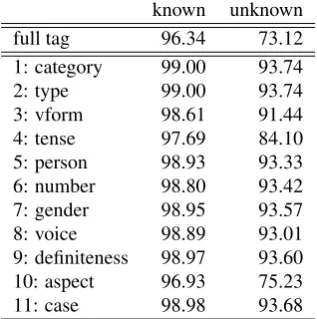
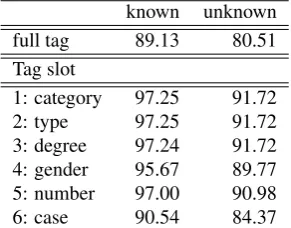
Among the three taggers, TnT was the best, so we decided to look at its performance on individual positions of the ma-jor open classes: nouns, verbs, and adjectives (see Table 2, Table 3, and Table 4, respectively). We also measured the performance of TnT on a reduced tagset of Russian, which is roughly comparable to the Penn Treebank tagset (Marcus et al., 1993). The performance of TnT reached 97.09% on the reduced Russian tagset, which is only 2% better than the performance of the tagger on the full detailed tagset we developed in this project.
The evaluation on individual categories reveals that the most difficult part of speech category is the category of nominals, which includes adjectives and nouns. The results of evaluation show that gender and case are the most chal-lenging attributes. One of the plausible explanations that we can offer here is that even though case and gender par-ticipate in syntactic agreement in Russian, these categories are more idiosyncratic than, say, person or tense. Further work should include an attempt to quantify the extent to which gender and case difficulties are due to pure lexical idiosyncrasy.
known unknown full tag 90.99 56.05
1: category 99.02 93.61 2: type 98.42 86.00 3: gender 97.51 77.23 4: number 97.89 89.26 5: case 93.03 80.23
Table 2: Accuracy of TnT on nouns in % (full tagset).
known unknown
full tag 96.34 73.12 1: category 99.00 93.74 2: type 99.00 93.74 3: vform 98.61 91.44 4: tense 97.69 84.10 5: person 98.93 93.33 6: number 98.80 93.42 7: gender 98.95 93.57 8: voice 98.89 93.01 9: definiteness 98.97 93.60 10: aspect 96.93 75.23 11: case 98.98 93.68
Table 3: Accuracy of TnT on verbs in % (full tagset).
We also varied the size of the training corpus to see how it affects the performance of TnT with our tagset. What seems to come out of our experiments is that there is a con-sistent relationship between the size of the tagset and the tagging accuracy for Russian.
The tagset we developed uses the positional tag system. There are several reasons why this scheme is preferred over the unordered compact tag. First, the morphological de-scriptions are more systematic. In each system, the attribute positions are determined by the Category. Thus, for exam-ple, knowing that a token is a noun (N) automatically pro-vides information that the gender, number, and case posi-tions should have values. This kind of description seems to be the most adequate for languages with rich morphology. Second, the fact that a tag can be decomposed into indi-vidual components has been used in various applications, e.g., (Hladká, 2000; Hana et al., 2004). Moreover, the eval-uation can be done in a more systematic way. Each category can be evaluated separately on each morphological feature. Not only is it easy to see on which POS the tagger performs the best/worst, but it is also possible to determine which in-dividual morphological features cause the most problems. Finally, the translation between various positional tagsets is easy, since the formalism states clearly what attribute oc-cupies what position in the tag.
4.2. Qualitative evaluation
known unknown full tag 89.13 80.51
Tag slot
1: category 97.25 91.72 2: type 97.25 91.72 3: degree 97.24 91.72 4: gender 95.67 89.77 5: number 97.00 90.98 6: case 90.54 84.37
Table 4: Accuracy of TnT on adjectives in % (full tagset).
that are shared across cases. Typically, the accusative sin-gular takes priority over the nominative sinsin-gular for inani-mate masculine nouns and for neuter nouns as well as for feminine nouns with the soft sign (ìÿãêèé çíàê); the same happens in the plural for feminine nouns. Also, the genitive singular takes priority over the nominative/accusative plu-ral for feminine nouns; something similar is attested for the accusative singular of animate masculine nouns. Thirdly, the genitive singular takes priority over the instrumental for feminine adjectives and sometimes an instrumental is used instead of a genitive for feminine singular adjectives, or vice versa.
Interestingly, an experiment with ten second year British students of Russian revealed that students are not able to spot the errors produced by the TT tagger: intermediate level students too seem to analyze forms in isolation. TnT performs considerably better, producing only a frac-tion of the errors outputted by TT. Only two mistakes are encountered: the genitive singular takes priority over the nominative/accusative plural for feminine nouns, and oc-casionally accusative singular is selected instead of nomi-native singular for inanimate masculine nouns, for neuter nouns and for feminine nouns in a soft sign.
5.
Conclusions and future work
This research resulted in a tagset and tagging resources for Russian. The tagset documentation and models for TnT, TT and SVM Tagger can be downloaded from http:// corpus.leeds.ac.uk/mocky/.However, RNC and Hanco corpora used in this study can-not be made freely available because of copyright restric-tions. Therefore, the lack of annotated corpora to train tag-gers can affect further research into tagging Russian and developing new resources by other groups.
To respond to this need, we selected a subset of the Rus-sian Internet corpus (Sharoff, 2006), made sure that it rep-resents a variety of text types (fiction, news, discussion fo-rums, research papers and tutorials) and tagged it with the three tools we tested. The corpus consists of 843 texts and contains about 5 mln words. As shown in the previous sec-tion the accuracy of tagging is not 100%, so the corpus can-not be compared to manually tagged resources. However, it is available to other researchers, while its accuracy can be
improved by comparing the errors made by different tag-gers on it using majority voting. It already contains three tagged versions, while if any other tagger for Russian be-comes available, the resource can be improved further. We think that our resources will become the basis for de-veloping new Russian language processing tools. Morpho-logical tags carry important information, which is essential for syntactic parsing or text-to-speech applications, for in-stance. In Russian, it is often not enough to distinguish verbs from nouns only — we need more detailed mor-phosyntactic descriptions of lexical items. For example, in order to determine which syllable of a given instance of the Russian wordñíåãàshould be stressed, one must know the morphological properties of that instance – the genitive sin-gular form of the word is stressed on the first syllable, while the nominative plural form is stressed on the second:ñíeãà (snowgen.masc.sg) vs.ñíåãa(snownom−acc.pl).
We also think that the standard morphosyntactic specifica-tions we developed for Russian make it possible to create a specification for other Slavonic languages that are less com-monly studied in corpus linguistics, such as Ukrainian and Belorussian, both closely-related to Russian. The tagset presented in this paper will also make it easier to create multilingual applications or to evaluate language technol-ogy across several languages, even if they are not closely related, such as English or Persian, since their morphology is also described in the MTE tagset. Finally, a shared tagset provides a basis for various studies in language typology.
6.
References
Brants, Thorsten. 2000. TnT - a statistical part-of-speech tagger. In Proc. of 6th Applied Natural Language Pro-cessing Conference, pages 224–231, Seattle.
Elworthy, David. 1995. Tagset design and inflected lan-guages. In 7th Conference of the European Chapter of the Association for Computational Linguistics (EACL), From Texts to Tags: Issues in Multilingual Language Analysis SIGDAT Workshop, pages 1–10, Dublin. Erjavec, Tomaž. 2004. MULTEXT-East Version 3:
Mul-tilingual Morphosyntactic Specifications, Lexicons and Corpora. In Fourth International Conference on Lan-guage Resources and Evaluation, LREC’04, pages 1535 – 1538.
Erjavec, Tomaž. 2006. Multext-east morphosyntactic specifications and xml. In Slavcheva, Milena, Simov, Kiril, and Angelova, Galia, editors,Readings in multilin-guality, pages 41–48. Bulgarian Academy of Sciences, Sofia.
Feldman, Anna, Hana, Jirka, and Brew, Chris. 2006. A cross-language approach to rapid creation of new morpho-syntactically annotated resources. In Proc. LREC 2006.
Giménez, Jesús and Màrquez, Lluís. 2004. Svmtool: A general pos tagger generator based on support vector ma-chines. InProceedings of the Forth Language Resources and Evaluation Conference, LREC 2004, Lisbon. Hajiˇc, Jan and Hladká, Barbora. 1998. Tagging inflective
Hana, Jirka, Feldman, Anna, and Brew, Chris. 2004. A Resource-light approach to Russian morphology: tag-ging Russian using Czech resources. In Proceedings of Empirical Methods for Natural Language Processing (EMNLP), pages 222–229, Barcelona, Spain.
Hladká, Barbora. 2000. Czech Language Tagging. Ph.D. thesis, Institute of Formal and Applied Linguistics (ÚFAL), Faculty of Mathematics and Physics (MFF), Charles University (UK), Prague, Czech Republic. Hutchins, W. J. 1986. Machine translation: past, present,
future. John Wiley & Sons.
Kilgarriff, Adam. 1997. Putting frequencies in the dictio-nary. International Journal of Lexicography, 10(2):135– 155.
Kopotev, Mikhail and Mustajoki, Arto. 2003. Prin-cipy sozdanija Hel’sinkskogo annotirovannogo korpusa russkih tekstov (HANCO) v seti internet. Nauˇcno-tehniˇceskaja informacija, Ser. 2, (5):33–37. In Russian. Marcus, M., Santorini, B., and Marcinkiewicz, M.A. 1993.
Building a large annotated corpus of English: The Penn Treebank. Computational Linguistics, 19(2):313–330. Micklesen, L.W. 1958. Russian-English MT. In
Ameri-can contributions to the Fourth International Congress of Slavicists, Moscow.
Mikheev, Andrei and Liubushkina, Liubov. 1995. Russian morphology: An engineering approach. Natural Lan-guage Engineering, 1(3):235–260.
Nikolaeva, T.N. 1958. Soviet developments in machine translation: Russian sentence analysis. Mechanical Translation, 5(2):51–59.
Schmid, Helmut. 1994. Probabilistic part-of-speech tag-ging using decision trees. In International Conference on New Methods in Language Processing, Manchester. Segalovich, Ilya. 2003. A fast morphological algorithm
with unknown word guessing induced by a dictionary for a web search engine. InProc. of MLMTA-2003, Las Ve-gas.
Sharoff, Serge. 2005. Methods and tools for development of the Russian Reference Corpus. In Archer, D., Wilson, A., and Rayson, P., editors, Corpus Linguistics Around the World, pages 167–180. Rodopi, Amsterdam. Sharoff, Serge. 2006. Creating general-purpose corpora
using automated search engine queries. In Baroni, Marco and Bernardini, Silvia, editors, WaCky! Work-ing papers on the Web as Corpus. Gedit, Bologna. http://wackybook.sslmit.unibo.it.
Sokirko, Alexei and Toldova, Svetlana. 2005. Srav-nenie effektivnosti dvuh metodik snyatiya lexicheskoy i morfologicheskoy neodnoznachnosti dlya russkogo yazyka. Technical report, http://www.aot.ru/ docs/RusCorporaHMM.htm. In Russian.
Sokirko, A.V. 2004. Morphologicheskie moduli na sajte
www.aot.ru. InProc. DIALOG’04. In Russian. Sperberg-McQueen, C. Michael and Burnard, Lou, editors.
2007. TEI P5: Guidelines for Electronic Text Encoding and Interchange. Oxford, 5 edition.