Building
Confidence
FOR
DUMmIES
‰About the Authors
Kate Burtonis an independent executive coach, author, and trainer who enables individuals and organisations to focus their energy with confidence. She is co-author of the best selling Neuro-linguistic Programming For Dummieswith Romilla Ready. Her business career began in corporate advertising and marketing with Hewlett-Packard. Since then she has worked with varied businesses across industries and cultures on how they can be great and confident communica-tors. What she loves most is delivering custom-built coaching and training programmes. She thrives on supporting people in boosting their motivation, self-awareness, and confidence. Her belief is that people all have unique talents, abilities, and core values. The skill is about honouring them to the full.
Authors’ Acknowledgments
From Kate:The seeds for this book were sown long ago, so I’d like to acknowledge my teachers who got me curious about this elusive concept of confidence and Margaret who asked the powerful ques-tion I wanted to answer: ‘So where do you keep your confidence?’
Writing another book is like having another baby. It seems like a great idea until you are giving birth and then a joy when it’s safely delivered. My special thanks go to my writing partner Brinley who adopted this concept with me. To all my family and friends I appre-ciate your continual love and support. Bob – you’re a star.
To my clients, colleagues and coaches, thank you for the stories, inspiration and support. To Dan, Kathleen, Sam, and Jason plus all at Wiley, thank you for your cool, calm confidence over the hurdles.
Now it’s over to you the reader to make this book really work for you. Please take the baby now and run with it!
From Brinley:After a long and relatively conventional business career it is an amazing thing to reconnect with the passions and dri-vers of my youth and find them all as fresh as they were in the 1970s and bursting for their opportunity to be fully expressed in the world. This has been my experience over the last 4–5 years and I am grateful to everyone who has played a part in my awakening.
My mission now is to be an awakener to anyone who feels there should be the opportunity for a full and rich life that integrates home and work and which doesn’t ‘cost the earth’.
My special thanks go to Kate for this opportunity to work with her, the Wiley publishing team, and to my wife Nicola, mother of our two young children. I also want to acknowledge my older children Loretta and Oliver for their wonderful inspiration and love over the last 20 years, and to my parents who raised me to think for myself.
Publisher’s Acknowledgments
We’re proud of this book; please send us your comments through our Dummies online regis-tration form located at www.dummies.com/register/.
Some of the people who helped bring this book to market include the following:
Acquisitions, Editorial, and Media Development
Project Editor: Daniel Mersey
Commissioning Editor: Samantha Clapp
Content Editor: Simon Bell
Copy Editor: Sally Lansdell
Proofreader: Sue Gilad
Technical Editor: Brenda Pugh, Achieve Greatness
Executive Editor: Jason Dunne
Executive Project Editor:
Amie Jackowski Tibble
Cover Photos: © Aflo Foto Agency / Alamy
Cartoons: Rich Tennant,
www.the5thwave.com
Composition Services
Project Coordinator: Maridee Ennis
Layout and Graphics: Karl Brandt, Carl Byers, Andrea Dahl, Mary J. Gillot, Lauren Goddard, Stephanie D. Jumper, Barry Offringa, Julie Trippetti
Proofreaders: Susan Moritz, Brian H. Walls
Indexer:TECHBOOKS Production Services
Publishing and Editorial for Consumer Dummies
Diane Graves Steele, Vice President and Publisher, Consumer Dummies
Joyce Pepple, Acquisitions Director, Consumer Dummies
Kristin A. Cocks, Product Development Director, Consumer Dummies
Michael Spring, Vice President and Publisher, Travel
Kelly Regan,Editorial Director, Travel
Publishing for Technology Dummies
Andy Cummings,Vice President and Publisher, Dummies Technology/General User
Composition Services
Gerry Fahey,Vice President of Production Services
Contents at a Glance
Introduction...1
Part I: Considering the Basics ...7
Chapter 1: Assessing Your Confidence ...9
Chapter 2: Identifying Your Sticking Points ...25
Chapter 3: Charting Your Course Ahead ...39
Part II: Gathering the Elements...49
Chapter 4: Finding Your Motivation ...51
Chapter 5: Sticking to Your Principles ...63
Chapter 6: Making Friends with Your Emotions ...75
Chapter 7: Unleashing Your Passion ...87
Part III: Building Your Confident Self ...101
Chapter 8: Using What You Already Know ...103
Chapter 9: Moving beyond Perfection ...111
Chapter 10: Stretching Yourself Mentally...125
Chapter 11: Developing Your Physical Confidence...143
Part IV: Communicating Your Confidence...151
Chapter 12: Raising Your Voice ...153
Chapter 13: Looking the Part ...163
Chapter 14: Acting with Confidence in Your Daily Life ...173
Part V: Engaging Others ...181
Chapter 15: Demonstrating Confidence in the Workplace ...183
Chapter 16: Approaching Romantic Relationships with Confidence ...205
Chapter 17: Raising Confident Children ...219
Part VI: The Part of Tens...229
Chapter 18: Ten Great Questions to Spur You into Action ...231
Chapter 19: Ten Daily Habits to Raise Your Confidence...237
Chapter 20: Ten Keys to Effective Affirmations ...243
Appendix: Resource List...247
Table of Contents
Introduction ...1
About This Book ...1
Conventions Used in This Book ...2
What You’re Not to Read...2
Foolish Assumptions ...3
How This Book Is Organised...3
Part I: Considering the Basics ...3
Part II: Gathering the Elements ...3
Part III: Building Your Confident Self...4
Part IV: Communicating Your Confidence ...4
Part V: Engaging Others ...4
Part VI: The Part of Tens...4
Icons Used in This Book...5
Where to Go from Here ...5
Part I: Considering the Basics...7
Chapter 1: Assessing Your Confidence . . . 9
Defining Confidence...9
What it is in practice ...10
How it feels ...11
Determining Where You Stand Now ...12
Looking at indicators of confidence...12
Finding your place on the scale ...13
Recognising Your Strengths...17
Celebrating your own talents first...18
Gathering feedback ...20
Picturing the Life You’d Like to Lead ...21
Paying attention to what matters ...21
Uncovering your confidence ...22
Preparing for Action ...23
Setting your intentions...23
Acknowledging the perils and perks of change ...24
Chapter 2: Identifying Your Sticking Points . . . 25
Digging Down to Root Issues ...26
Forgetting the blame mindset ...27
Rewriting your role in your family...27
Cleaning Out the Negatives ...30
Tackling unhelpful assumptions ...31
Staying busy but not overwhelmed ...32
Redirecting those inner voices ...33
Discovering What Drains Your Batteries ...34
Counting the cost of toleration...35
Trying to meet everyone’s needs except your own ...37
Chapter 3: Charting Your Course Ahead . . . 39
Knowing Where You Want to Go ...39
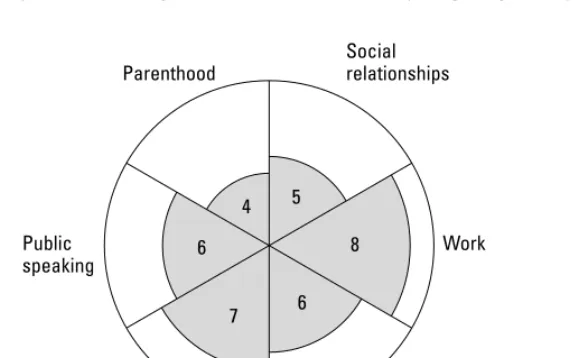
Determining your areas of focus...40
Mapping your own journey ...41
Choosing Role Models ...44
Finding reliable guides ...44
Becoming your own coach ...46
Becoming the hero in your own life ...46
Part II: Gathering the Elements...49
Chapter 4: Finding Your Motivation . . . 51
Driving Forward in Your Life ...51
Rising through Maslow’s hierarchy of needs ...52
Greeting the world with grace ...53
Taking Charge at Work ...55
Looking at usable theory ...55
Recognizing the importance of achievement...61
Going for the next promotion ...61
Chapter 5: Sticking to Your Principles . . . 63
Understanding Your Values ...63
Discovering your values ...63
Uncovering your ends values...65
Resolving values conflicts ...66
Living Your Values Every Day...69
Focusing on what’s important ...70
Sprinkling your values through your day ...70
Reviewing your day ...71
Living Authentically...71
Developing your identity ...72
Facing up to your demons ...74
Chapter 6: Making Friends with Your Emotions . . . 75
Getting a Grip on Your Emotions ...75
Accessing your emotional intelligence ...76
Connecting creativity and confidence ...78
Finding courage to voice your emotions ...79
Tracking Your Moods ...79
Staying in touch with your mood patterns ...79
Becoming more aware of your natural state ...80
Trusting Your Intuition...81
Tuning in to the gifts of intuition ...81
Listening to your inner self ...82
Harnessing Your Darker Emotions...83
Turning your anger into energy ...83
Letting go of unhelpful emotions...84
Allowing yourself to forgive and move on...85
Chapter 7: Unleashing Your Passion . . . 87
Discovering Your Passionate Self...87
Becoming more passionate ...88
Exploring your neurological levels with Dilts ...89
Tapping into your natural passion ...94
Realising your dreams...94
Putting Your Passion into Action ...95
Starting your journey ...96
Using your passion to lead ...99
Part III: Building Your Confident Self...101
Chapter 8: Using What You Already Know. . . 103
Accentuating Your Positives...103
Expecting the best ...104
Distilling the essence of positive outcomes...105
Going with the flow...105
Managing Your Fears ...106
Avoiding the trap of fear ...107
Transforming your fears into confidence...108
Chapter 9: Moving beyond Perfection. . . 111
Letting Go of Unreal Expectations ...111
Admitting that you can’t be perfect (and that you don’t want to be) ...112
Focusing on perfection distracts you from excellence ...113
Being Generous to Yourself First ...113
Acknowledging your successes ...114
Accepting help and delegating ...115
Overcoming Procrastination ...116
Breaking the gridlock ...117
Taking Time Off – for You...119
Slowing down ...119
Adopting the 80/20 principle...120
Generating Realistic Standards of Behaviour...122
Adjusting your goals to the circumstances ...122
Staying positive while keeping it real...123
Increasing your flexibility ...123
Chapter 10: Stretching Yourself Mentally . . . 125
Expanding Your Comfort Zone ...126
Understanding the limits of your zone ...126
Stretching your boundaries: Expanding your zone...128
Driving Safely in the Fast Lane ...131
Creating a haven for yourself ...131
Preparing for the future ...135
Attracting More of What You Want ...138
Getting back what you give out ...139
Finding what you’re looking for ...140
Feeling Your Power ...140
Appreciating a new way of being...140
Trusting it will be okay ...141
Listening to the voice of reason...142
Chapter 11: Developing Your Physical Confidence . . . 143
Connecting Your Mind and Body ...144
Considering What Makes You Healthy ...145
Releasing stress, staying healthy...145
Following the golden rules for a healthy diet ...148
Believing in your health ...149
Looking Forward to Your Healthy Future Self ...150
Part IV: Communicating Your Confidence...151
Chapter 12: Raising Your Voice . . . 153
Speaking Out with Confidence ...153
Listening to yourself ...154
Breathing to improve your speaking...155
Saying What You Mean and Meaning What You Say...158
Holding onto your integrity...158
Having difficult conversations ...159
Recognising that the Message Is More than Words...160
Experiencing the natural school...161
Acting out the theatrical school ...161
Chapter 13: Looking the Part. . . 163
Being Judged by Appearances ...163
Appearing confident...164
Making the best first impression ...165
Conveying the right attitude with your dress ...166
Finding Your Own Style ...167
Assessing your wardrobe ...169
Shopping smart...170
Chapter 14: Acting with Confidence in Your
Daily Life . . . 173
Dealing with Resistance to the New, Confident You ...173
Being firm with loved ones who want the old you ...174
Finding the confidence to rise above...175
Reinforcing the Assertive You ...176
Coping with external pressures ...177
Staying on top of your confidence game ...178
Living Powerfully ...179
Part V: Engaging Others ...181
Chapter 15: Demonstrating Confidence
in the Workplace . . . 183
Developing Confidence in Your Professional Life ...183
Realising that your job isn’t you...184
Defining your professional identity...185
Uncovering what you want to do...186
Finding value in what you do ...188
Becoming Assertive ...188
Showing Confidence in Specific Work Situations...189
Demonstrating power and presence in meetings...190
Shining during presentations ...191
Rejecting manipulation and bullying ...192
Managing Your Boss ...194
Dealing with feedback ...195
Getting your boss to keep her promises ...197
Telling your boss she’s wrong...199
Casting Off Your Cloak of Invisibility...200
Dealing Confidently with Corporate Change ...201
Getting through rejection ...202
Chapter 16: Approaching Romantic Relationships
with Confidence . . . 205
Relating with Romance...206
Checking in on cultural notions of romance ...206
Choosing your own view of romance...207
Realising What Really Matters ...208
Looking at Relationships with Open Eyes ...210
Making that first move ...210
Filling your partner’s needs without running dry yourself ...212
Getting by with some help from your friends ...213
Eliciting Your Love Strategy ...214
Facing Up to Changing Relationships...216
Making decisions ...216
Redesigning the way you are together...217
Chapter 17: Raising Confident Children . . . 219
Securing the Foundations ...219
Being fast to praise...221
Setting safe boundaries...222
Helping Children Develop Curiosity ...224
Providing a helpful environment ...224
Encouraging a space to play ...225
Championing Your Children ...226
Accepting the Differences Between You ...227
Part VI: The Part of Tens ...229
Chapter 18: Ten Great Questions to Spur You into
Action . . . 231
How Does Your Inner Voice Speak to You? ...231
Are You Proud of Your Name? ...232
Who Do You Hang Out With? ...232
What’s Your Confident Thought for the Day? ...232
Where Are the Tensions in Your Life? ...233
What’s Your Sticking Point? ...233
Who Are You Going to Be When You Grow Up? ...234
How Do You Experience Failures and Mistakes? ...234
How Do You Balance Time Alone and Time with Others? ...235
Chapter 19: Ten Daily Habits to Raise Your
Confidence. . . 237
Start Each Day Alert and Ready for Action ...237
Concentrate Your Mind on the Page...238
Put Your Best Sunglasses On ...238
Track Your Moods and Emotions...239
Exercise Your Body...239
Take Quiet Moments Alone...240
Go Outside and Wonder at the Beauty of the Sky...240
Operate from a Position of Generosity...240
Review Today and Create Your Tomorrow ...241
Connect with Your Life Purpose ...241
Chapter 20: Ten Keys to Effective Affirmations . . . 243
Building from the Right Structure...243
Using Affirmations Every Day ...246
Appendix: Resource List ...247
Contact the Authors ...247
Books ...247
Training and Coaching Web Sites ...248
Professional Bodies ...249
Building Confidence
FORIntroduction
C
onfidence is one of those odd things in life that turn out to be surprisingly difficult to tie down (beauty and quality belong to this strange group too). You may think you know what it is, and you may feel certain that you can recognise it when you see it, but you may struggle to define exactly what ‘it’ is. Confidence is an everyday experience, something you have quite often, except on those all important occasions when it seems to leave you and you could really use more of it – whatever ‘it’ is.In this book, you can clear up the confusion around confidence, and particularly what you may refer to as self-confidence. You dispel a lot of the mystique around how you can develop and build your self-confidence; perhaps to an extent you feared would never be possible for you.
Every chapter of this book is designed to help you understand: where your personal confidence comes from, how you can gener-ate an incredibly powerful type of confidence in your life on demand, and how you can do it more reliably with less stress. You will make the fastest progress by immediately putting what you learn into action, by trying out the advice and exercises as you go along, and achieving the deep and lasting personal confidence you were born to enjoy.
Are you up for this? Let’s go.
About This Book
Type the word ‘confidence’ into an Internet search engine and you can expect over 50 million hits. That’s a lot of published material about something so natural. It is also an indication of the breadth of the subject so, as you want to get straight to the heart of your confidence, we have been selective in Building Confidence For Dummies.
clear of more complex explorations of personal development and except where they translate into immediate practical guidance.
You should be able to dip into this book for practical and rapid support on such everyday confidence problems as:
⻬Preparing for an important presentation or job interview ⻬Asking the man or woman of your dreams to marry you ⻬Picking up the phone to make that difficult call to an
impor-tant new customer
⻬Asking for the order, if you’re in sales
⻬Picking yourself up quickly and appropriately after any setback
Conventions Used in This Book
To help you navigate through this book, we set up a few conventions:
⻬Italicsare used for emphasis and to highlight new words or defined terms.
⻬Bold facedtext indicates the key concept in a list. ⻬Monofontis used for web and e-mail addresses.
What You’re Not to Read
This book is primarily an action guide to building your confidence. In many places, this requires us to set the context you need to grasp the situation. In other places, we include material useful for your full understanding, but not essential for you to be able to take the action and get the benefit. Much as we want you to take all of it on board in time, we make it easy for you to identify those parts that you can leave for later.
⻬The text in the sidebars:The shaded boxes that appear here and there share personal stories and anecdotes, but they’re not integral to your taking action, and you can safely skip reading them if you’re not interested.
Foolish Assumptions
We make a few other assumptions about you. We assume you’re a normal human being who wants to be happy and confident. You’re probably interested in becoming more effective in various parts of your life and in becoming more comfortable when you face demanding situations and people. Although you’re probably already acting confidently in many areas, you may lack the power and skills to perform the way you want to in some others. This book is for you if you want to:
⻬Grow in the areas where you currently feel stuck ⻬Become better at your job and get acknowledged for it ⻬Feel less anxious and stressed about things you have to do ⻬Step up to become a powerful leader in your work or
community
⻬Feel confident that no matter what life throws at you, you can find a way to deal with it
How This Book Is Organised
The book is divided into seven main sections, with each of these broken into chapters. The table of contents gives you details on each chapter.
Part I: Considering the Basics
In the chapters in this part, we explain exactly what we mean by confidence and how it feels. You can evaluate how much confi-dence you have currently. You discover how to spot where your confidence is waxing or waning, in what areas of your life you need more confidence right now, and what is keeping you stuck.
Armed with all this insight, you can create your personal pro-gramme to the new super confident version of you that you want to present to the world.
Part II: Gathering the Elements
but confident requires motivation. In this part, you’re invited to connect with your main drivers in life, gain a better understanding of your deepest values, and leverage this information to get what you want.
You venture into the sometimes messy world of emotions and mood swings – including the extremes of ecstasy, anger, and despair. This part guides you to safe connection with your personal motivation.
Part III: Building Your
Confident Self
In this part, you pull up your most confident self and reconnect with how you do it. You let go of perfectionism in pursuit of effec-tiveness, let go of unreal expectations to enjoy your experiences. You find out how to extend your comfort zone and become relaxed and focused in achieving whatever you want. Finally, in this part, you forge a link between your mind and body and realise that taking better care of yourself helps you maintain your self confidence.
Part IV: Communicating
Your Confidence
You naturally want to use your increasing self-confidence to influ-ence others. In this part, you discover how to project your confi-dent self out into the world through your powerful voice and personal appearance. We help you prioritise to get more done in the world and deal with blockers and resistance. This part helps you make the most confident you the permanent you.
Part V: Engaging Others
In this part, of your journey to self-confidence, you get tips on put-ting your increased personal power to use at work and in your pri-vate life. You use what you know about building confidence to ensure that your children grow up with a natural awareness of what it is to be and to act confidently as they face their new chal-lenges every day.
Part VI: The Part of Tens
straight to some top-ten tips and lists on daily habits, affirmations to plant deep in your unconscious, and questions to spur you into action.
Icons Used in This Book
Within each chapter you find the following icons pointing you to particular types of information that you may find immediately useful. Here is an explanation of what each icon stands for:
This icon brings your attention to a personal story you may find inspiring or useful.
The bull’s-eye highlights practical advice you can use to boost your confidence immediately.
This icon indicates an exercise you can use to broaden your under-standing of yourself and your own confidence issues.
Information to take note of and keep in mind as you apply your boosted confidence in the world is indicated with the finger and string.
Text next to the Warning icon urges you to take special care of yourself in dealing with specific issues.
Where to Go from Here
After you read the book and are keen to take your levels of confi-dence and achievement to even higher levels, we recommend more personalised forms of development training and coaching. Take a look at the further guidance and resources we recommend at
Part I
In this part...
Chapter 1
Assessing Your Confidence
In This Chapter
䊳Identifying the key ingredients of confidence
䊳Rating yourself on the confidence indicators
䊳Celebrating your good points
䊳Visualising the super-confident new you
䊳Getting started on changing
W
elcome to the start of your confidence-building programme. It’s great to have you on board for what we promise will be a wonderful and transformational journey. With confidence comes more fun, freedom, and opportunities to do what really works for you.In this chapter, we lay the foundations for our travels together, starting with some definitions of confidence and a practical, nuts-and-bolts assessment of where you are today.
Here you start flexing your confidence muscles – and we know from experience that you’re probably in a much more confident shape than you may give yourself credit for. You can also celebrate what you’re already good at and imagine the new super-confident you on the horizon as your confidence-building work progresses.
Then, it’s about getting tooled up ready for action. After all, what’s the point of hiding your talents when there’s so much important work to be done in this world?
Defining Confidence
Before you dive into this book on how to be more confident, we invite you to explore the definition of confidence. A good diction-ary provides at least three definitions for confidence,and it’s important to understand each aspect as it is easy to muddle them:
⻬Self-assuredness:This relates to your confidence in your ability to perform to a certain standard.
⻬Belief in the ability of other people:This definition focuses on how you expect others to behave in a trustworthy or com-petent way.
⻬Keeping certain information secret or restricted to a few people:This definition concerns the idea of keeping a confidence.
We think an even better definition exists. One that’s more useful to you in everyday life. One that’s true no matter how tough a situa-tion you face, or how comfortable you feel about it. Our definisitua-tion:
At its heart, confidenceis the ability to take appropriate and effective action in any situation, however challenging it appears to you or others.
Confidence is not about feeling good inside, although it’s a bonus if you do.
What it is in practice
Now, how does confidence show up in daily life? Well, have you ever started something – perhaps an exercise session or presentation at work – even though you didn’t feel like doing it at that moment, only to find that once you got going, you started to feel okay about it and even glad you tackled it? This kind of shift in how you experience a situation gives you a taste of what confidence is in practice. It is your ability to reach beyond how you are feeling in the moment in order to take action that leads to the outcome you want.
Anish is an accountant turned management consultant who has travelled the world on international assignments for large corpora-tions. Now running his own partnership, he leads complex projects and presents a calm, rational, and focused image in business meet-ings. When deadlines are pressing and tempers rise in project teams, he is the one who patiently exudes confidence that delivery can and will happen on time.
many as twenty in a row. I can feel as anxious inside about what needs to be done as the next person, but I experience it as a sequence to go through patiently one by one, and it gets easier as I see the light beckoning at the end.’
Approaching challenges with confidence in Anish’s style brings clear benefits. For example:
⻬You believe that it is possible to tackle and achieve things that others consider difficult.
⻬You inspire others around you and stop them panicking. ⻬You break down a large project into smaller parts that you can
tackle one by one.
How it feels
Don’t worry about whether you feel comfortable performing a chal-lenging activity or are fully relaxed about the action you are taking. Confident people are okay with the feeling of not knowing all the answers. Phew, what a relief. Confidence is just the feeling that it’ll be okay.
The sense of feeling confident inside comes with increased practice and familiarity with what you do. You can also create it from your life experiences and bring it out when you need it. This doesn’t mean that you won’t ever feel scared. You will, but the good news is that you’ll be able to live with the fear.
Here are some ways that you can recognise confidence in yourself:
⻬You feel poised and balanced. ⻬You are breathing easily.
⻬You are moving towards a goal or action with a sense of purpose.
⻬You are being proactive rather than defensive.
⻬You know that you’ll be able to deal with whatever life throws at you, even if you can’t control it.
⻬You can laugh at yourself.
⻬You know everything will be alright in the end, however long it takes.
Determining Where
You Stand Now
Any measure of confidence is by its nature pretty subjective. Other people may form an opinion about how confident you are based on your outside appearance and actions, but only you can know for sure what you feel like on the inside – what you believe to be true, and what it’s like to be you.
In this section, we invite you to make your own assessment of where your confidence level is today.
Your confidence level is different according to the time and place. If you think back ten years to a younger you, you probably realise that your confidence has grown since then according to the experi-ences you have faced, knowing that you have lived to tell the tale. How confident you feel differs in various situations, and may well fluctuate from day to day and week to week according to what’s happening at work and at home. There may be areas where you’ve taken a risk, or suffered a loss, for example, and your confidence has dropped.
If you’ve been unwell and have taken on too much work, your con-fidence level may dip and wobble. Yet when you’re well and have a sense of completing your work, you may feel as if you can conquer the world. Think of your confidence as a pair of old-fashioned scales – it’s a delicate balancing mechanism and anything, even something feather light, may tip it either way unexpectedly.
Make change easy on yourself. Rome wasn’t built in a day. We’re not going to suggest you go hang gliding off a mountain top today if standing on a stepladder gives you the collywobbles in your stom-ach. Allow yourself time and space to improve. Lots of smaller steps are often more realistic and maintainable compared to giant leaps for mankind.
Looking at indicators of confidence
We pinpoint ten core indicators of confidence that we explore in depth throughout this book. When you act with confidence, you are likely to have a good selection of these ten qualities:
⻬Motivation:You are motivated by and enjoy what you do. In fact, you’re likely to get so engrossed in what you’re doing that nothing distracts you.
⻬Emotional stability:You have a calm and focused approach to how you are yourself and how you are with other people as you tackle challenges. You notice difficult emotions such as anger and anxiety, but you work with them rather than letting them overcome you.
⻬A positive mind-set:You have the ability to stay optimistic and see the bright side even when you encounter setbacks. You hold positive regard for yourself as well as other people. ⻬Self-awareness:You know what you are good at, how capable
you feel, and how you look and sound to others. You also acknowledge that you are a human being, and you don’t expect to be perfect.
⻬Flexibility in behaviour:You adapt your behaviour according to circumstance. You can see the bigger picture as well as paying attention to details. You take other people’s views on board in making decisions.
⻬Eagerness to develop: You enjoy stretching yourself, treating each day as a learning experience, rather than acting as if you are already an expert with nothing new to find out. You take your discoveries to new experiences.
⻬Health and energy: You’re in touch with your body, respect it, and have a sense that your energy is flowing freely. You manage stressful situations without becoming ill.
⻬A willingness to take risks:You have the ability to act in the face of uncertainty – and put yourself on the line even when you don’t have the answers or all the skills to get things right. ⻬A sense of purpose: You have an increasing sense of the
coherence of the different parts of your life. You have chosen a theme or purpose for your life.
You can use these indicators to help figure out where you are stuck in life because you lack the confidence to move on. Moving out of that feels like escaping from treading in treacle.
Finding your place on the scale
Do the evaluation now and make a note in your diary to come back and review it in, say, six months’ time and notice what you’ve learnt.
Completing this questionnaire provides you with a very simple stock take of some of the main areas of your life affecting your con-fidence right now. If you answer the questions accurately, you can use specific chapters of this book to target the areas that merit your immediate attention.
There are no right or wrong answers. If you answer as honestly as you can, you get a rounded view of how your confidence indicators stack up as you begin building your confidence through this book.
Frankl’s search for meaning
Viktor E. Frankl, the founder of Logotherapy, was one of the 20th century’s great ther-apists. He formulated his revolutionary approach to psychotherapy in four Nazi death camps, including Auschwitz, where he was captive from 1942 to 1945.
At the heart of his theory is the belief that, whatever our personal circumstance, what keeps us going most surely is the meaning we find in living. This belief helped him survive the camps against all odds when millions of others perished, and after the war it enabled him to treat many of its victims.
Frankl agreed with the philosopher Nietzsche that ‘he who has a why to live for can bear with almost any how.’ In the camps, Frankl saw that people who had hope of being reunited with loved ones, who had projects they felt a need to complete, or who had great faith tended to have a better chance at survival than those who had little to keep them going through the difficulties.
When one of Frankl’s patients faced a collapse of confidence through the loss of meaning in his or her life, Frankl would seek to bring relief through three routes:
1. To broaden the patient’s appreciation of life by making conscious the fuller value of all that person was achieving, creating, and accomplishing (and yet dis-missing).
2. To recover and re-live powerful if transient experiences of feeling most alive: the view from a mountain top, the love for another, the perfect athletic performance (what Maslow might have called ‘Peak Experiences’ see Chapter 4).
3. To find a powerful positive meaning by the reframing of apparently meaning-less situations. For example, a man surviving his wife after a long and happy union had saved her from the trauma he was having to bear of living alone.
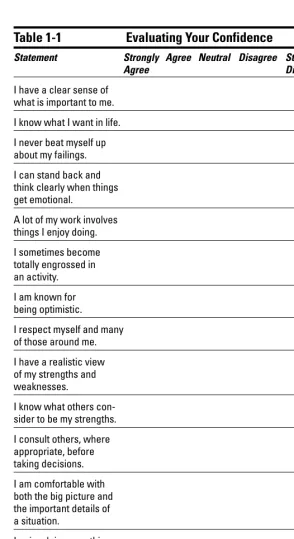
Table 1-1
Evaluating Your Confidence
Statement Strongly Agree Neutral Disagree Strongly
Agree Disagree
I have a clear sense of what is important to me.
I know what I want in life.
I never beat myself up about my failings.
I can stand back and think clearly when things get emotional.
A lot of my work involves things I enjoy doing.
I sometimes become totally engrossed in an activity.
I am known for being optimistic.
I respect myself and many of those around me.
I have a realistic view of my strengths and weaknesses.
I know what others con-sider to be my strengths.
I consult others, where appropriate, before taking decisions.
I am comfortable with both the big picture and the important details of a situation.
I enjoy doing new things and taking on fresh challenges.
I relish the opportunity to learn and to grow.
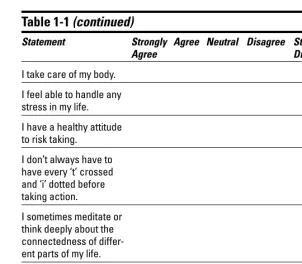
Table 1-1 (continued)
Statement Strongly Agree Neutral Disagree Strongly
Agree Disagree
I take care of my body.
I feel able to handle any stress in my life.
I have a healthy attitude to risk taking.
I don’t always have to have every ‘t’ crossed and ‘i’ dotted before taking action.
I sometimes meditate or think deeply about the connectedness of differ-ent parts of my life.
I know what I am here to do. I have a chosen mission or purpose.
Now, give yourself 5 points for every tick in the strongly agree
column, 4 for every one in the agreecolumn, 3 for neutral, 2 for
disagree, and finally 1 for strongly disagree. Add up your points and check the next section for advice related to your total score. The second stage of the scoring process – in the ‘Personal profile’ section – encourages you to determine which areas of your life and this book are worthy of your immediate attention.
Overall rating
Find your total score in one of the following categories:
⻬80–100: Congratulations!By any standards, you are what most people consider to be a confident person. You are clear on your priorities and are in positive pursuit of the life you want.
Take note of any areas where you scored below par and con-sider the advice in the ‘Personal profile’ section below. ⻬60–80: Well done!You are already pretty confident in most
⻬40–60: You are in the right place!You may be experiencing some confusion or uncertainty in your life right now, and you may wonder whether there is anything you can do about it. Give yourself time to work on the areas that need attention and you will be amazed by the progress you can make. ⻬20–40: Full marks for honesty and courage!Your confidence
may be at low ebb right now, but it doesn’t have to stay that way. You can find good advice that you can put to use on almost every page of this book. If you take our advice, and act upon it, you face the possibility of life transformation.
Personal profile
After you score your questionnaire and read the relevant advice in the preceding section, take another look at your scoring and note the areas that brought your overall score down. Look at state-ments you most strongly disagreed with. If you scored high on most questions, look at the statements with which you find your-self unable to strongly agree.
You can use your individual scores to create your personal confi-dence profile. This now gives you something specific to think about. Let’s say you are unclear about what is most important to you in life, or you beat yourself up over every little mistake. Perhaps you fail to consult others, or you feel alone and isolated. All of these things affect how confident you feel, and how prepared you are to take action.
You can find advice and action guidance on all these issues in the chapters that follow. Use the contents pages and chapter sum-maries to find those areas that can give your confidence the quick-est and biggquick-est boosts.
This is a simple exercise, designed to give you a quick start and an immediate agenda for improvement. You can use the test to monitor your growing confidence. However, if you want a more detailed analy-sis, go to our Web site at www.yourmostconfidentself.com.
Recognising Your Strengths
Mark Twain said that each one of us has the substance within to achieve whatever our goals and dreams define. What we are miss-ing are the wisdom and insight to use what we already have.
they’re good at. These realisations boost their resilience and abil-ity to take on greater challenges.
Your ability to take appropriate, effective action is affected by vari-ous things in your life that may seem to have little direct relation to the task at hand. Your values are a good example of this. Your self-confidence is likely to waver if you don’t value what you excel at doing. Research shows that if you value what you’re good at, you’re likely to be highly confident in that area. If you value what you’re not so good at, then you will not feel so confident, even though your friends may reassure you that this is not much of a problem at all.
Building confidence begins with going with your strengths. If you’re great at music, don’t beat yourself up because you’re not going to play international rugby. Pat yourself on the back, practise accept-ing compliments for everythaccept-ing you do well, and enjoy the positive reinforcement from others. Respect and honour yourself, and you’ll find that you get respect and honour from those around you.
For confidence to thrive and grow, you must concentrate your attention on what you’re good at, rather than trying to turn your-self into something that you’re not.
You also need to free yourself from unhelpful negative thoughts about your shortcomings or negative incidents in your life – more about that in Chapter 2.
Celebrating your own talents first
Everybody has different interests and skills. (Thank goodness for that!) So, your first step in developing confidence is to decide what you’re really good at, and build on it. It’s time to recognise your qual-ities and build up your talent store. Use the worksheet in Table 1-3 to list some of the things you think you’re good at both at work and in your home life. Record during what period of your life you best put those skills and talents to use.
We want you to become consciously aware of what you are good at. It’s too easy to take your talents for granted and assume every-one else is good at what you’re good at. Well, they’re not. You have your own special skills – attributes that make you stand out. When you notice what you do well, and when, in what context, then you can choose to repeat these to build your confidence.
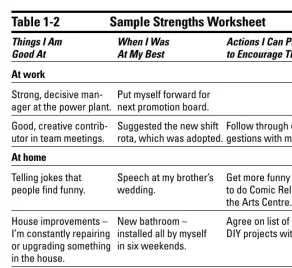
Table 1-2
Sample Strengths Worksheet
Things I Am When I Was Actions I Can Put in Place
Good At At My Best to Encourage This Talent
At work
Strong, decisive man- Put myself forward for ager at the power plant. next promotion board.
Good, creative contrib- Suggested the new shift Follow through other sug-utor in team meetings. rota, which was adopted. gestions with my boss.
At home
Telling jokes that Speech at my brother’s Get more funny material people find funny. wedding. to do Comic Relief spot at
the Arts Centre.
House improvements – New bathroom – Agree on list of creative I’m constantly repairing installed all by myself DIY projects with my wife. or upgrading something in six weekends.
in the house.
Football coaching for Best results in ten ses- Get school team to enter John’s school team. sions. Strong compe- for higher league.
tition for places.
Now, fill out Table 1-3 with your own strengths and talents.
Table 1-3
Strengths Worksheet
Things I Am When I Was Actions I Can Put in Place
Good At At My Best to Encourage This Talent
At work
At home
Decide which of these talents you’d like to make more of and what action you can take to sponsor and encourage each of your useful talents.
things you’ll do in the shorter term – next week or month – and for those to do in the longer term. Chapter 3 offers advice on setting steps to achieve your goals.
Gathering feedback
Getting feedback from others is a powerful shortcut to building your confidence. Apart from performance reviews at work, you may not be in the habit of asking people to give you feedback on how you’re doing, and you may be amazed at what you learn about yourself by doing so. Quite often people don’t recognise what they do well. ‘Isn’t everyone good at that?’ they ask. Most people are their own worst critic, and it can be a wonderful experience to receive positive feedback from your nearest and dearest. Having that outside view from another person may help you notice what you excel at and uncover some hidden talents.
Ask six people who have known you a while if they’d be prepared to give you some feedback about yourself. Choose people who rep-resent the different groups in which you mix, including family members, friends, work colleagues, and those who know you from your interests in the community, church, or a sports club. Ask each of them these questions:
⻬What am I good at?
⻬When have you seen me operate at my best? ⻬What should I do more of?
⻬What should I do less of? ⻬What can you rely on me for?
⻬Where do you think I can stretch myself?
After collecting feedback, look for the common trends and themes and think of ways to build them into your goals and development plans. If a number of people tell you similar things, it’s likely there’s some truth in the message and worth taking notice. (The odd nega-tive comment from your nearest and dearest may be less helpful and more about their needs than yours – test it out.) Your attention then needs to be on working with the good stuff, stretching yourself and letting go of the rest. For example, if you have particular talent, look for ways to tell others about it and use it more. Consider dele-gating or changing the things people suggest you should do less of.
Picturing the Life You’d
Like to Lead
Confidence is almost all about perception. Very few people are wholly confident in every area of their life. Those who appear to be so are probably good at acting – with themselves as the audience.
Imagine having a PhD in Confidence. Think about how your life would be different if you had studied the subject, taken the learn-ing on board, and were supremely confident, firlearn-ing on all cylinders.
Find yourself a quiet place to sit and contemplate for ten minutes. Picture yourself with your newfound super-confidence. Think of a real-life time coming up in your calendar where you’d like to be supremely confident in that ‘I can conquer the world’ quality. And start to notice. . .
⻬Where are you and who is with you? ⻬What are you doing?
⻬What skills and talents do you have now? ⻬What are your thoughts and feelings?
⻬What’s really important to you about this newfound confidence? ⻬What would you do if you knew you couldn’t fail?
Adjust the picture so that if feels right for you. Hold the picture for yourself and savour it so that you will be able to recall it whenever you want to.
Visualisation involves focusing your thoughts on the things you want to happen in your life and picturing them happening. Although it’s a simple mental discipline, it can have dramatic effects. It’s a powerful motivational tool that will help you take your confidence sky high.
Paying attention to what matters
Start now by answering one simple question: What really matters to you in your life right now? For example, do you want a loving partner or family around you, a successful career, or perhaps your health is your top priority. You may be working towards a very spe-cific goal such as running a marathon or getting married.
Write your answer down and make this the priority for your confidence-building muscles.
Uncovering your confidence
You may still be curious as to what kind of confident person you can be at your best. This is a question that even the most experi-enced, capable chief executives and media personalities ask them-selves regularly. Successful people stretch themthem-selves.
You have enormous potential limited only by yourself. And it’s up to you to realise it. Gandhi had to overcome acute shyness to take on injustice in the world and free his people. And the more you connect with what is important to you, the more you become true to your most confident self.
People often feel a fraud when they take a leadership role that’s new and more senior to the one they are used to. If you feel this, then remember you’ve been selected for that senior job because your company believes you will do it well. It’s not realistic to expect to have all the knowledge on day one. People invite you to join them because they know you can contribute, and they want you.
Not everyone wants or needs to be an international leader on the world stage, but you can see yourself as a leader in your own world. You can lead by your example. Look back over time to things that you may take for granted. You have learnt to ride a bike or drive a car, to operate a computer, or renovate your house. As your skills and competence grow, so you become more confident to take on bigger challenges. Something that seemed hard five years ago may be a piece of cake today.
Be your own sponsor as well as critic. You may be good at giving yourself a hard time by comparing yourself unfavourably with others: ‘I’ll never be as good as. . .’ Comparisons with others are valuable in that they can help you to excel and raise your game as a budding Tiger Woods on the golf circuit, for example. But don’t waste energy beating yourself up by not being as good as the expert who dedicates every day of their life to practice.
types can help you to be the very best you can be. Begin by assum-ing you are goassum-ing to be successful, and surround yourself with people who honour you and support your growth.
So who are you really? The ‘you’ that you want to become is up to you, as you will find out when you follow your own direction.
In the words of Gandhi: ‘You must be the change you wish to see in the world.’
Preparing for Action
When are you going to get started? You agree, we hope, that there’s no time like the present. Confidence starts here and now. Yes, that means today. Not on Monday morning after the excesses of the weekend.
Getting your confident self fired up means adopting a new, positive mind-set, and getting rid of any doubts you have. You’ll get help with this in the next few chapters by cleaning up on your doubts. So before you set off on the journey, first check inside yourself. Ask yourself:
⻬Is it okay to make this change and become a more confident me? ⻬What do I stand to lose or gain if I do?
Once you’re happy that your answers are in the positive, even if it feels a bit scary, you’re ready for the next step of the journey.
If there’s a part of you that is really unduly scared of change, it may be for a valid reason. Think about it, and if you’re worried, check with your family or even a health professional about your physical and mental well-being.
Setting your intentions
As you set out on the journey, we want to state our intentions for you, the reader, and invite you to do the same. Our commitment is:
Now, we ask that you make a declaration of your intent and speak it out loud to yourself three times with increasing commitment:
I make a commitment to build my confidence in the way that’s right for me, honouring myself as a unique and special human being. I will be honest with and kind to myself on the journey to be the very best I can be. I promise to have fun along the way.
Acknowledging the perils
and perks of change
Any kind of change has its ups and downs. You can focus on the downside and say that you may be under threat from those around you who don’t want a new confident you, you may find changing scary, and you may put yourself on the line and open yourself up to criticism and sarcasm. So what? The power of change far out-weighs the negatives. Just look around you and make your own judgement about who has the best life – the confident person or the shrinking violet. Confident people earn more money, have more fun, enjoy more freedom, and relish new experiences. They have a go, they discover, they have a zest for living. They love the power that comes from being confident to do the things that many of those around them shy away from.
A few tips then for riding the waves, the ups and downs as you change:
⻬Flex your knees over the bumpy days.Stay resolute and adapt your approach.
⻬Look at the worst scenario. Face up to it (it usually isn’t all that bad), and then expect the best to happen. It usually does. ⻬Ask yourself: What will this be like in a week’s time, a
month’s time, or this time next year?Taking a longer-term view usually strips away the anxiety.
Chapter 2
Identifying Your
Sticking Points
In This Chapter
䊳Recognising when your natural confidence comes under attack
䊳Getting familiar with what pulls you down and holds you back
䊳 Spotting new ways to break out of your inertia
E
xuding confidence is a bit like being wealthy. Confidence, like money, only becomes a problem when it disappears. You’ve probably experienced times when you suddenly become aware of your confidence because you’ve lost it. You don’t pay attention when confidence is coming at you in abundance and you have that pleasant, warm, ‘can do’ glow.Now, we’re not saying you should expect life to be 100 per cent perfect all the time. In fact, that’s unrealistic. You can expect stick-ing points on any journey – times when your plans, hopes, and dreams don’t run smoothly and you feel as if you’re wading through treacle. The art of developing your confidence lies in min-imising how long you let yourself stay mired in low-confidence land and how quickly you’re able to let the causes go.
Getting on the road less boggy is what this chapter is all about. We show you how to face an underlying sticky mess, so that you can begin to let life flow for yourself. Rest assured that you may well encounter more tough times ahead – facing them is how you learn from life.
Digging Down to Root Issues
Cleaning up means digging deep to the heart of what really holds you back. You may not be fully aware of what gets in your way, but the clues are in what you say and how you describe your experi-ence. Ever heard yourself utter things like ‘It’s impossible for me to leave my job’, or ‘I’m alwaysgoing to have problems because I never went to the right school’, or ‘They’ll neverchoose me for promo-tion because everyone knows they want someone who is younger/ slimmer/an accountant/a creative type/female/male/white/black’ and so on.
Such statements are not based on reality, but on your perception of it. In fact, they are merely stories to frighten yourself with. These generalisations limit you and drain your confidence to have a go at whatever adventures lie ahead. They have the same nega-tive effect on those around you.
The way you describe your world becomes your experience of it. As Einstein once famously pointed out: ‘The most important ques-tion to ask, is: Is the universe a hostile or friendly place?’ If you describe your world with hostile language, that is what you experi-ence. Life becomes a nightmare if that’s how you dream. Those who negatively distort reality suffer the most stress, anxiety, and depression, all of which get in the way of living confidently.
As you re-create your more confident reality, listen to your own words. Notice when your descriptions include words such as
always, never, everyone, nothing, totally, impossible.Replace them or qualify them with more liberating words such as I choose to, sometimes, possibly, almost.
Getting past your past
As a lad of eight, John’s secret dream was to be a ballet dancer, and he asked to audition for the school pantomime. When the school music teacher rejected him after a token interview, he overheard her say to a colleague: ‘I could never have a fat boy like that in any production of mine.’
Forgetting the blame mindset
You know who the whiners and blamers are around you. If you have any sense of personal protection, you probably try to steer well clear of them or limit your time with them. When you’re stuck in blaming mode, positive people begin to avoid your company and you end up building friendships with those who reinforce your blame approach so that you can double up on your whingeing and whining.
The blame mind-set is not a helpful place to be if you want to get on and succeed in this world. Blame limits your choices and your results. You find fault in others rather than taking responsibility for the results you get. You wait around for others to do things before you act.
Successful business leaders and entrepreneurs don’t hang around blaming others or making excuses, they do everything in their power to bring about change. They take it upon themselves to make a difference without expecting others to bale them out.
This Parrot on Your Shoulder exercise can help you to shift your viewpoint and be more objective about your choices and your behaviour.
For one day, imagine that you are able to observe all your own behaviour – everything you do and say. You can be like a parrot on your own shoulder. Take notice when you think that a situation is due to what others around you are doing and when you make excuses for yourself. Then hear the parrot on your shoulder say: ‘What are you choosingto do about it then?’
Your aim is to shift your blame mind-set into one in which you choose your outcome. Choosing your outcome can transform your world and open up new possibilities. You switch your focus of atten-tion from what has gone wrong to what you want to have happen instead. You adopt an active and positive position rather than wait-ing and reactwait-ing defensively to others. Two key indicators of confi-dence are self-awareness and flexibility in behaviour. With the imaginary parrot’s help, you can raise your scores on both counts.
Rewriting your role in your family
told you what to do when you were eight doesn’t give him the right to behave in the same way 20 years on. Nor does it give you the excuse to slip into an unhelpful, child-like relationship with him.
Yet you may recognise that you cling to a pattern of behaviour with your family that’s no longer appropriate to the confident you that you want to be today. Perhaps you bite your tongue rather than saying what you feel is true and right.
You can choose how you want to be with people, and the way you behave dictates the results you get.
The next exercise helps you to shift the dynamics in your family relationships by observing the current situation, then choosing how you would like it to be. It’s very empowering, particularly if you feel stuck in old habits.
Think of a person in your family, including your in-laws or step chil-dren, who you’d like to relate to in a better way. Follow these steps:
1. Write out the story of how you currently relate to this person.
Describe how you currently behave with this person. Note the situations that you find most difficult and challenging. Think about what you would like to change so that you can
Being a child at 50
At the age of 50, Bruce appears to be a mature and confident man. He holds down a responsible lecturing job at a prestigious British university and has published works of academic excellence. For most of the year, he is bright, entertaining, and fun to be with. But that all changes when his parents come to stay for Christmas.
Over the years, he has loved and lost a string of live-in girlfriends who despair at his change in behaviour when his mother and father visit. At these times, Bruce reverts to being a ‘good little boy’, trying to please his parents by adopting false modesty. Each time, the current girlfriend is ousted from the double bedroom and placed in a guest room, and treated as a casual visitor in the shared home. Bruce feels that his parents will not approve of the live-in relationship he has chosen and pretends that he lives a bachelor existence. He behaves as if he still lives in the parental home, and he lacks the emotional maturity to be his own person, not acknowledg-ing the true situation for fear of upsettacknowledg-ing his parents.
have a respectful, amicable, and mature relationship with this person.
2. Write a second version detailing how you would like this relationship to be in three years’ time.
Write in the present tense as if the change has already hap-pened. Add as much detail as you like to visualise the new story with dialogue and your new feelings.
3. Act as if you have already developed or changed this relationship.
Make a commitment to yourself that next time you have contact with this person, you will remind yourself of your new story. Visualising the future, behave as if the change you desire has already happened.
Benefiting from your life experiences
Sam has recently given up his computer sales business to teach yoga full time. He has that almost tangible inner strength of so many yogis and martial artists – a very centred kind of energy. One day at the end of a class, he commented that nothing fazes him after fleeing from atrocities in Uganda at the age of 15. He left his family and was sent off to Canada alone to meet up with one family contact who helped him to find a room to live in.
Although hopefully your tough times are not this tough, in a bizarre way, the awful times you come through provide the root source for your strongest confidence. They build your resilience and toughen you up to face the next hurdle.
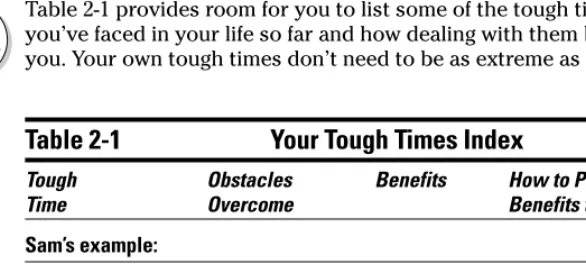
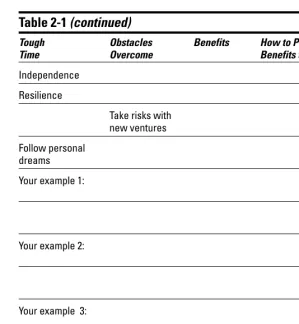
Table 2-1 provides room for you to list some of the tough times you’ve faced in your life so far and how dealing with them benefited you. Your own tough times don’t need to be as extreme as Sam’s.
Table 2-1
Your Tough Times Index
Tough Obstacles Benefits How to Put
Time Overcome Benefits to Use
Sam’s example:
Expulsion from Separation from home country family
Financial hardship
Self confidence
Table 2-1 (continued)
Tough Obstacles Benefits How to Put
Time Overcome Benefits to Use
Independence
Resilience
Take risks with new ventures
Follow personal dreams
Your example 1:
Your example 2:
Your example 3:
Cleaning Out the Negatives
It’s spring-cleaning time – time to get started on some broad-brush clean-up action. Begin by facing up to some of that negative, confidence-draining stuff. Our belief is that you were born confi-dent, and somehow along the way you let people and circum-stances get in your way.
Designing and creating your own life, as the next sections help you to do, is much more fun than spending all your energy constantly troubleshooting and problem solving.
Tackling unhelpful assumptions
You may be holding on to some unhelpful thoughts or assumptions about yourself – most people do – that prevent you from feeling fully confident. Perhaps you think that life or work has to be a huge effort and an uphill struggle all the way. Maybe you compare your-self unfavourably with others.
Some of the assumptions we hear in our jobs, which you may share, include:
⻬‘I’m not a confident person because I left school at 15.’ ⻬‘It’s easy for you to be confident at work because you have
marketable skills.’
⻬‘I won’t be confident until I can work part-time.’ ⻬‘He comes from money, so he’s bound to be confident.’ ⻬‘I’ll feel confident when I’ve lost my excess weight.’
⻬‘My boss has it in for me, so it’s no surprise I lack confidence.’ ⻬‘I don’t have the right kind of friends to build up my confidence.’
Most of these comments are loaded with judgement and unfavourable comparisons with others rather than fact.
The trouble with taking on such unhelpful assumptions is that you act as if the assumption is true until it becomes a self-fulfilling prophecy.
Take a few moments to record some of your unhelpful assumptions about your own confidence that might be holding you back. Then write down an opposing, more positive assumption.
For example, an unhelpful statement may be something like: ‘Since I’ve turned 40, I can’t ever expect to feel confident going on a date.’ Turning that around produces the more helpful: ‘Now I’m 40, I can ask anyone out for a date with supreme confidence.’
There may be an element of good fortune in any activity, but the more you practise, the luckier you get . . . as all top sports people will tell you.
Staying busy but not overwhelmed
If you love life, it’s not surprising if you work to an action-packed schedule: So many people to see, so many things to do. But to function at your truly confident best, you need a balance between busy time and rest time. If you’re constantly on the run, you start to feel off-balance, which eventually topples your internal sense of confidence.
Busyness does not equal effectiveness.
Recognising signals that you’re at your limits
The following clues indicate that you’re in danger of being over-whelmed:
⻬You run late for appointments or miss them altogether. ⻬You often forget what you were doing.
⻬You get easily distracted and start many projects without finishing any of them.
⻬You lose things like your keys, your mobile phone, and the shopping list.
⻬Your house or office paperwork is chaotic. ⻬You feel jittery inside.
⻬You snap at people you care about. ⻬You stop listening.
⻬Your eating habits are poor – you eat late at night or grab sandwiches from the local garage.
⻬You cancel dates with friends at a moment’s notice. ⻬You catch sight of yourself in a mirror and look like a
frightened rabbit.
If you ticked more than two or three, congratulations. You’ve recognised some of the signals of being overwhelmed and this is the first step necessary to making change.
Using the four Ps to take stock
The best way to cut out whatever is getting in your ways is to stop and take stock – ideally at the start of each day. Follow these steps to assign a priority to each task on your to-do list:
1. Draw up a list of everything you want to accomplish today.
(If you’re well organised, you will have done that last night.)
2. Colour code each item on the list.
• Red for panics and problems:The important, deadline-driven jobs you want to sort out quickly.
• Green indicates plans and opportunities:The important, longer-term activities you’d like to spend time on. Include recreation as well as larger projects.
• Blue for pressing items: The things other people are pushing you to do, but which are not top of your to-do list for today.
• Yellow indicates pootling issues:The chats with friends and more trivial timewasters during which you drift around aimlessly.
Your aim is to make the plans and opportunities list – the green one – largest of all and to reduce the size of the others. This area is most important because it enables you to put your energy on what’s most important to you and save you getting stressed by deadlines, or just drift around listlessly.
3. Allocate your time today so that you can clear up some problems from your red list, build in space for the plans and opportunities in your green list, and see how much of the pressing (blue) and pootling (yellow) items you can cut out.
For now, it’s important to become aware of what type of activities dominate your schedule most of the time. The colour coding is a quick visual guide to your effectiveness.
Redirecting those inner voices
can write?’ it whispered. This was despite the fact that I wrote pro-fessionally in my business career.
Over time this gremlin disappeared as I paid more attention to the voices that told me, ‘You can do this. Your work makes a difference for people.’ Part of this change happened by listening to encourag-ing feedback from various sources, and part was a personal deci-sion to acknowledge that I was more than the words I put on paper. Today, with hindsight, I can recognise that my teacher had the very best of intentions to challenge me to develop my talents, and I thank him for that.
What about your inner voices? What do you say to yourself about yourself? Those inner voices, running in your head. As coaches, we often hear these busy, chattering gremlins in clients who say: ‘The voice inside me says: Who do you think you are to take on this challenge? You’ll get found out soon enough. You’re a fraud. Are you good enough? Don’t you think you should know your place? You’re not a confident person, so what are you doing here?’
How can you tame these voices? In many creative ways, once you put your mind to it.
⻬Picture the friendly parrot on your shoulder (who flew in to the ‘Getting past the blame mind-set’ section earlier in this chapter) programmed with a positive message to repeat every time it hears a negative thought: ‘I was chosen because I’m the best.’ ‘I can do this.’ ‘I am good enough.’ ‘I’m going to show you just how good I really am.’
⻬Imagine the negative voices playing on your CD player, then turning the volume control down to a hushed whisper, and finally gently flicking the off switch. Take the CD out, cut it up, and throw it away.
⻬Look for the positive intention of the negative voice. Figure out how it’s trying to help you. Acknowledge it, thank it, and tell it to go away now that it’s served a useful purpose.
You canclear out those unwanted messages.
Discovering What Drains
Your Batteries
people can drain the energy from everyone around them. Spend time with them and you’re left feeling tired and exhausted. Ideally, you don’t have many of what we call toxic friendsbecause you wipe them out, park them elsewhere, or neutralise them before they wipe you out.
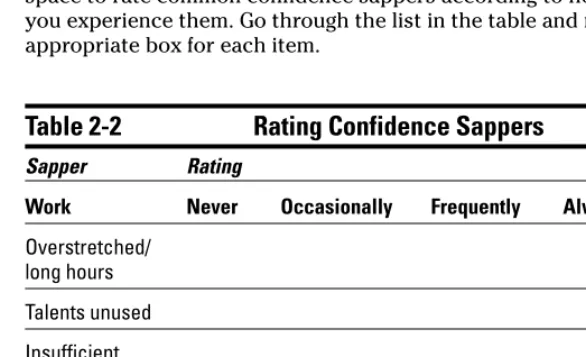
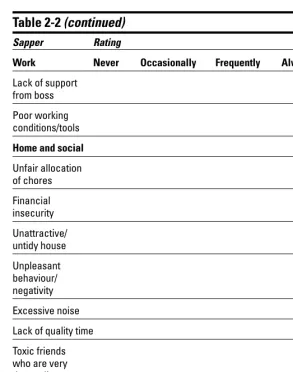
Then there are toxic situations – times and places that are just not right for you. In the following sections we invite you to line up all those damaging elements you’re sticking with, and make the deci-sion that you are no longer going to put up with them. You can get them out of your system once and for all. Freedom beckons!