Study and quantification of the declination for the Arabic
speech synthesis system PARADIS
A. Benabbou*, N. Chenfour
+, A. Mouradi
*FST Fès-Saïss,+
Faculté des Sciences Fès [email protected]
ENSIAS Rabat
Abstract
The modeling of the melody in a Text-To-Speech System is indispensable to have a good quality of synthesis and to approach the naturalness. The study of the melody generally includes the analysis of the local melody events relating to the accent and the declination of the global melody contour of an utterance.
In this paper, we will present an experimental study of the declination phenomenon concerning the Arabic language. Our observations and results are of a great contribution for the quality of synthesis in our Text-To-Speech system PARADIS (Psola ARAbic DIsyllable Synthesizer). The melodic model that we have integrated in PARADIS is based on the prediction of a declination line on which local melodic events related to stressed syllables would be superimposed.
Our study will include the description and the classification of the declination line in a context of isolated sentences. The classification will be established mainly according to the modality and the number of syllables in the sentence. We will also study the phenomenon related to the resetting of F0 value which often affect the declination.
1.
Introduction
Our speech synthesis system PARADIS is able to synthesize any completely vowelled Arabic text. It is based on concatenation of disyllables using TD-PSOLA synthesizer (Chenfour et al., 2000). In order to improve the quality of synthesis, it is imperative to incorporate the melodic processing in our system. We then studied the two principal melodic phenomena : the declination that affect the whole sentence and the melodic events generally related to the presence of stressed syllables.
In this paper we are interested only by the declination witch is a universal phenomenon in all languages (Beaugendre, 1994). Modeling the declination in a TTS system makes it possible to increase the naturalness of the synthesis which would be practically absent if no declination is made.
To perform a melodic analysis of the corpus, we realized an analysis system WinF0 based on a short-term temporal algorithm inspired from the AMDF algorithm (Doval, 1994). This system visualize the curves of the temporal signal, energy and F0. It produces the semi-automatic syllables labeling, and also extract all declination information from the signal.
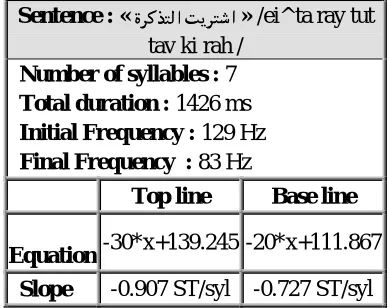
The quantification of the declination will be established by computing the slopes for the top line and the base line of the fundamental frequency. These two lines represent the dynamic of the F0 values from the beginning to the end of the sentence.
The last section in this paper is related to the analysis of another event which often accompanies the declination, namely the F0 reset. We then compute the partial top and base lines on each group of the sentence delimited by an F0 reset occurrence. Moreover, we will study F0 reset for sentences which end with a descending melodic contour and those with an ascending melodic contour.
2.
Melodic analysis system
To establish a melodic model it is necessary to have reliable tools for calculation and treatment of the F0 curve. To this end, we realized an analysis system WinF0 (figure 1).
The system gives possibilities to select a portion or the totality of the speech signal for listening and to perform a semi-automatic labeling. To refine the process of labeling, the knowledge of the signal energy curve is generally very useful. This functionality is also integrated in WinF0.
Figure 1: Analyze by the WinF0 of the declarative sentence "0Á5µ *&»" /habbati rrIHu/ : temporal signal curve,
labeling in syllables with duration (in ms), energy curve (in dB), F0 curve (in Hz), top and base lines.
2.1.
F0 computing method
sentence but the two lines have slopes steeper than those in the declarative modality.
Speaker
Base line
tendency
Top line
tendency
Speaker 1
Y=-7.29 X
-1.12Y=-23.37 X
-1.51Speaker 2
Y=-6.30X
-1.07Y=–11.83X
-1.16Speaker 3
Y=-18.22X
-1.48Y=–29.78X
-1.57Average
Y=-9.42 X
-1.22Y=-20.18 X
-1.41Table 6: Equations of the slope tendencies of the top and base lines for each speaker and their average in the case of the interrogative modality with a final descending melodic
contour.
3.5.2. Final ascending melodic contour
In the same way, we represent the equations found for the tendencies of the declination lines in table 7.
Speaker
Base line
tendency
Top line
tendency
Speaker 1
Y=-10.39 X
-1.85Y=+185.39 X
-2.63Speaker 2
Y=-4.61 X
-0.85Y=+228.35 X
-2.88Speaker 3
Y=-1.30 X
-0.24Y=+184.88 X
-2.78Average
Y=-3.43 X
-0.98Y=+198.44 X
-2.76Table 7 : Equations of the slope tendencies of the top and base lines for each speaker and their average in the case of
the interrogative modality with a final ascending melodic contour.
Comparing with the first category, we can notice that the top line presents a typical melodic rise in this category of interrogation (the coefficient is positive +198.44), while the base line always shows a descending melodic contour. However, the negative exponent in the equation (-2.76) indicates that the degree of the rise decreases depending on the number of syllables.
4.
Declination reset
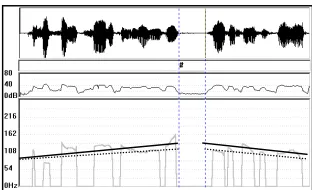
The declination for long sentences (without punctuation), generally declarative, is often accompanied by the phenomenon of F0 reset. The melodic curve then presents resetting which describe an irregular increase or reduction in the fundamental frequency, then giving a new reference for the declination.
F0 reset is generally marked by a brief pause that denotes a breathing group. But f0 reset is not systematic, it does not appear obligatorily with each pause. Thus, the localization of this phenomenon is not an easy task. However, as the synchronous F0 reset with the pause is most frequent and easiest to locate on the signal, we have focused our analysis only on this context.
Also, we studied F0 reset for two particular classes of sentences according to their final melodic contour : descending or ascending.
In figure 4 we give the analysis results for a sentence with a final descending melodic contour and its declination line slopes in table 8.
Figure 4: Presence of a F0 reset with pause (#) for the declarative sentence
"
~¾3µ 5 3¨
#DÁ5Sµ (µ *U7/
"/ taHassanat HAlatu lmarIDi # bacda ^urbiddawAe /.
Groups of
breathing
1
stgroup
2
ndgroup
Number of
syllables
10
6
Slope of the
base line
+0.640 ST/Syl
-0.456 ST/Syl
Slope of the
top line
+1.046 ST/Syl
-0.779 ST/Syl
Table 8 : Results of analysis of F0 reset for the sentence in figure 4.
Also, we present in figure 5 the analysis results for a sentence with a final ascending melodic contour and its declination line slopes in table 9.
Figure 5: F0 reset with pause for an ascending interrogative sentence : } PµU» T)U³ ·3U¦ TOµ W)Q± · T3¾ R» " / hal wajadtum mAqultuhu lakum # cindamA kuntum hunAlik? /.
Groups of
breathing
1
stgroup
2
ndgroup
Number of
syllables
10
8
Slope of the
base line
-0.313 ST/Syl
-0.145 ST/Syl
Slope of the
top line
-0.790 ST/Syl
+0.320 ST/Syl
In spite of the reduced number of studied sentences, our preliminary results are in conformity with those for other languages such as French ( Martin, 1987 ) :
• the division of a group ending with a final
descending melodic contour implies the presence of rising contours at the end of each group created. • the division of a group ending in a rising contour
involves the presence of contours going down at the end from each group created.
5.
Conclusion
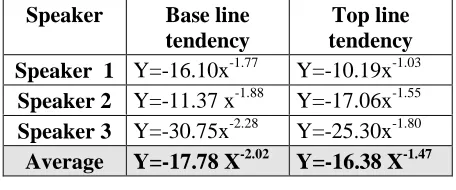
In this paper, we have confirmed the existence of the phenomenon of the declination for the Arabic language, by analyzing a multispeaker corpus of isolated sentences recorded in a reading style. We have presented the WinF0 analysis system which permits us to study the slopes of the top and base lines in function of each type of Arabic phrase modality. Results were then represented in tendency functions. Those functions allow to determine the declination line slopes of a sentence according to its modality and number of syllables.
We also studied the F0 reset phenomenon that generally accompanies the declination in the case of long sentences. We have noted that the F0 reset features are perceived differently according to the final melodic contour (descending or ascending).
6.
References
Aubergé, V. 1991. La synthèse de la parole : des règles aux lexiques. thèse de Doctorat d'informatique, Université Pierre Mendès France, Grenoble.
Beaugendre, F. 1994. Une étude perceptive de l'intonation du français, développement d'un modèle et application à la génération automatique de l'intonation pour un système de synthèse à partir du texte . Thèse de doctorat en sciences de l'Université de Paris XI.
Benabbou, A. 1997. Implémentation sur PC d’un système à formants pour la synthèse par règles de la parole arabe. Thèse de Doctorat de 3ème cycle, Univ. Mohamed V, Rabat, Juillet 1997.
Chenfour, N.; Benabbou, A.; Mouradi, A. 2000. Optimisation du synthétiseur TD-PSOLA pour le Sytème de Synthèse de la Parole Arabe PARADIS. MCSEAI’2000, Fès 2000, p.369-378.
Doval, B. 1994. Estimation de la fréquence fondamentale des signaux sonores. Thèse de Doctorat de l'Université Paris VI en informatique.