Suffix Trees as Language Models
Casey Redd Kennington
1Martin Kay
2Annemarie Friedrich
31Universit¨at Bielefeld, Bielefeld, Germany, [email protected] 2Stanford University, Stanford, California, USA, [email protected] 3Universit¨at des Saarlandes, Saarbr¨ucken, Germany, [email protected]
Abstract
Suffix trees are data structures that can be used to index a corpus. In this paper, we explore how some properties of suffix trees naturally provide the functionality of ann-gram language model with variablen. We explain how we leverage these properties of suffix trees for our Suffix Tree Language Model (STLM) implementation and explain how a suffix tree implicitly contains the data needed forn-gram language modeling. We also discuss the kinds of smoothing techniques appropriate to such a model. We then show that our STLM implementation is competitive when compared to the state-of-the-art language model SRILM (Stolcke, 2002) in statistical machine translation (SMT) experiments.
keywords: language model, suffix tree, machine translation
1.
Introduction
Suffix trees and suffix arrays can be used to index a text in such a way as to give access to a remarkable number of its properties. Not only can they be used to locate arbitrary substrings at very low cost, but they can be used, among other things, to find palindromes,n-grams of arbitrary size and long repeated substrings. Suffix trees can be used for data compression, since they make it convenient to allow the second and subsequent occurrences of repeated sub-strings to be replaced by a reference to the first. For some of these purposes, suffix arrays have sometimes been pre-ferred in natural language processing (NLP) because they require less space and are thought of as easier to implement. In this paper, we explore how some properties of suffix trees naturally provide the functionality of ann-gram language model with variablen. Specifically, the efficient construc-tion of suffix trees relies onsuffix linkswhich play a crucial role when using our STLM for evaluation.
One of the first uses of suffix trees was plagiarism detection (Monostori et al., 2000). Suffix trees provide a fast way of finding long strings which occur more than once, thus exposing parts of a text which may have been plagiarized. This is done simply by concatenating the text in question with the text that may have been plagiarized. After creat-ing a suffix tree, non-terminal nodes which represent long substrings indicate overlaps.
Parameterizedsuffix trees have been used to find code du-plication in software systems (Baker, 1997).
Suffix trees have been well used in information retrieval, more recently with Chinese documents (Huang and Pow-ers, 2008). Because the vocabulary on which a suffix tree is based can consist of words or characters, suffix trees are es-pecially useful when working with languages such as Chi-nese which do not use white-space as word boundaries. In a suffix tree, each character sequence is fully represented, unlike in other approaches which require error-prone word segmentation.
In this paper, we present an application of suffix trees as n-gram language models with variablen.n-gram language models are used to determine how probable it is for a string
to belong to the language of a training corpus. From a list of candidate text representations that possibly repre-sent an utterance, automatic speech recognition (ASR) uses language models to find the most probable text represen-tation of that list. Machine Translation (MT) can produce a large list of possible translations of a text, all of which are checked against a language model to see how probable they are. Language modeling is discussed in more detail in Section 3.1.
The implementation of the STLM relies on a compressed version of a suffix tree, which is enriched by suffix links. Suffix links are edges that are added incrementally at build-ing time to each node and that connect a node represent-ing a strrepresent-ing and the node representrepresent-ing its longest suffix. At evaluation time, we perform a tree traversal depending on the input string and leverage the suffix links for an elegant implementation of back-off. With each node, we keep the number of terminal nodes in its subtree as the node’s suf-fix count. We show that these counts naturally providen -gram counts of variable length, and add several versions of smoothing. Most language models limit the context in how the probabilities are calculated. We offer a language model that has no such limit. (Kneser, 1996) was successful in using unlimited context, but no evaluation was done in a practical domain, like ASR or MT.
We evaluate STLM within the setting of SMT and show state-of-the-art performance for some language pairs. For German to English and French to English, we achieve re-sults better than the well-known state-of-the-art language model SRILM (Stolcke, 2002) when being trained using standard SRILM settings. SRILM outperforms STLM for several other language pairs, but STLM is still competitive.
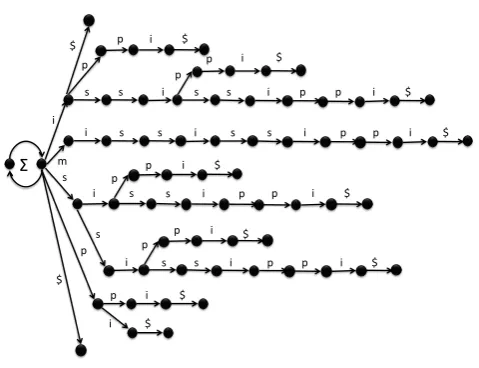
mississippi$, with$ being the sentinel character. Since the tree is compressed, the labels on the arcs are not explicit parts of the data structure but are shown only for conve-nience. The distinguished arc out of each nonterminal node is shown with a heavier line. The node labels, whichare part of the data structure, are the upper numbers in the cles representing the nodes. The lower numbers in the cir-cles are the suffix counts, which we will explain in section 3.2.. The root of the tree is shown in Figure 2 just to the right of the leftmost node, which we will refer to as thebase of the tree. It is labeled⊥and it has one arc, labeledΣand ending at the root. This arc allows a transition from the base node to the root over any word, regardless of whether it oc-curs in the corpus. One might object to the inclusion of this node on the grounds that it is not strictly necessary and that it gives rise to a structure that is no longer strictly a tree. However, as we shall see, it is a convenience, both during the construction of the tree and in our proposed application.
2.3. Linear-Time Construction and Suffix Links (Ukkonen, 1995) developed an algorithm for constructing suffix trees with a complexity that is linear in the length of the corpus. The dotted lines in Fig. 2 show explicit parts of the data structure know assuffix links. Only a few of them are shown. They play a crucial role in guaranteeing linear time bounds for the construction of the tree. In many applications, the suffix links can be discarded once the tree has been constructed. However, they are important for our application and we therefore retain them.
There is just one suffix link from each internal node in the tree. If the name of the node isaα, whereais a character, andαis a, possibly empty, string of characters, then the suffix link from that node ends at nodeα. It is easy to see that such a node must always exist; if the corpus contains a stringaαleading to an internal node, it must occur more than once in the corpus and be followed by different charac-ters. If this is true ofaα, it must also be true ofα. Explicit suffix links are stored only for explicit nodes. Note that they are defined also for implicit nodes. They can be found using suffix links in the following way. Ifi =aαβnames an implicit node ande = aα is the longest prefix of this that names an explicit node, then the suffix link from the implicit node points to the node, implicit or explicit, that is found by following the suffix link from e, and moving forward from there over arcs whose labels spellβ.
In Fig. 2 there are two paths of suffix links, both termi-nating at the root. In general, the suffix links themselves constitute a tree in which the links are oriented from the leaves towards the root.
3.
n-gram Language Modeling using Suffix
Trees
In this section, we explainn-gram language modeling and show how a suffix tree can be applied as a language model. This section ends with an explanation of smoothing, point-ing out differences between our implementation and the current standard method.
3.1. n-gram Language Modeling
Language models provide an estimate of the probability that a given string belongs to the language of a particular reference corpus. The idea is to base the estimate of the probability of each word in a new text on the number of times that it was observed in a similar context in the refer-ence corpus. In an attempt to minimize sparse data prob-lems, the context of a word is routinely taken to be just the n−1 preceding words. The probability of the string w1, ...wkis approximated by using the Markov assumption (here shown forn=2).
P(w1, ..., wk)≈P(w1)∗P(w2|w1)∗P(w3|w2)∗... ...∗P(wk|wk−2, wk−1)
The maximum-likelihood estimate of the probability of the wordwi given previous wordswi−n+1, ..., wi−1 (the his-tory) is computed as
P(wi|wi−n+1, ..., wi−1)≈
C(wi−n+1, ..., wi) C(wi−n+1, ..., wi−1)
whereC(s)is the number of occurrences of the string s in the corpus. But cutting off the history to a pre-defined length n clearly does not eliminate the data sparseness problem entirely because many texts contain sequences of nwords or less that occur nowhere in the training corpus. In these cases, aback-off to a lower-ordern-gram model can be performed. On the other hand, when a matching string is found in the training corpus that is longer thann, there is a strong intuition that it could provide very valuable additional information. This is the intuition that motivates the present investigation.
3.2. Suffix Tree Language Model
In this section, we show how properties of suffix trees can be used to estimate the probability that an arbitrary text be-longs to the language of the corpus, and how suffix links naturally provide back-off. As described in section 2., suffix trees provide the possibility to determine whether a given sequence of words occurs in a corpus. In the follow-ing, we show how probabilities for arbitrary sentences are computed from a language model based on a suffix tree. We assume that the elementary unit of the arc labels are words unless otherwise indicated.
n = root; b = e = 0 p = 1
while e < length(text) m = n.get_branch(text[e]) if m != NIL
p *= m.suffix_count / n.suffix_count e += 1; n = m
else
n = suffix_link(n); b += 1 end
end
Figure 3: Algorithm: STLM-Evaluation
other node is the sum of the suffix counts of its direct de-scendants. The count associated with a nonterminal node is simply the number of terminals encountered between the first and second times that the node is visited.
With the suffix count given, we can compute the probabil-ity of the first word on an arc as the suffix count of the destination node of the arc divided by the suffix count of the origin node. For example, the probabilities ofP(p|ssi)
andP(s|ssi)are both estimated as1/2. The probability P(p|i)is estimated as 1/4. By the same reasoning, the probability of edges starting at implicit nodes is always 1, e.g.P(i|ss) = 1.
Based on the suffix counts, our algorithm delivers the esti-mated probability of traversing an arc, given the label on the node at its origin. This estimated probability corresponds to traditionaln-gram language model probability estimates. The algorithm presented in Figure 3 for computing the probability of a sentence textassumes operating on the non-compressed tree where each node is represented ex-plicitly.
Each time the variableeis incremented, a new substring, longer then the last one, is considered. When this happens, we will say that the algorithm advances. Each time b is incremented, a shorter substring is considered and we say that the algorithmbacks off. We use the termdepthof the process to refer to the current value ofe−b, i.e the length of the current history. Notice that if the depth of the process is prevented from exceeding some fixed value,n, by forcing back-off, we have a classicaln-gram model1.
3.3. Smoothing
Discounting is easy to implement in this framework, and amounts to a simple initial smoothing approach. The model we have described is well behaved in the face of texts con-taining words that do not occur in the corpus, thanks to the base node. Failing to find the word at the root node, the algorithm repeatedly backs off until it reaches the base node, where it finds an arc that can be taken over any word whatsoever back to the root. Since the number of terminals reachable from the base and the root nodes are the same, namely|Σ|, the number of words in the corpus, the proba-bility associated with this arc will be 1. This is clearly un-satisfactory. We can, however, easily arrange to associate
1This was convenient in comparing our variable-order model
with standard fixed-order models.
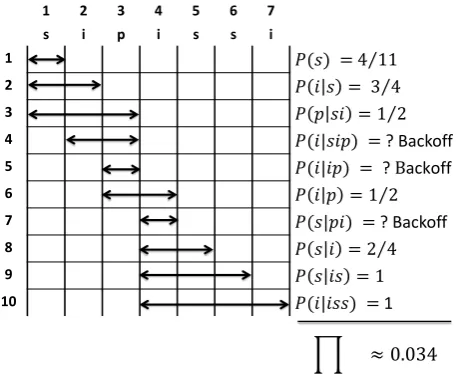
1 2 3 4 5 6 7
s i p i s s i
1 𝑃(𝑠) =4 11
2 𝑃 𝑖 𝑠 = 3 4
3 𝑃 𝑝 𝑠𝑖 = 1 2
4 𝑃(𝑖|𝑠𝑖𝑝) = ? Backoff
5 𝑃(𝑖|𝑖𝑝) = ? Backoff
6 𝑃 𝑖 𝑝 = 1 2
7 𝑃(𝑠|𝑝𝑖) = ? Backoff
8 𝑃 𝑠 𝑖 = 2 4
9 𝑃 𝑠 𝑖𝑠 = 1
10 𝑃(𝑖|𝑖𝑠𝑠) = 1
≈ 0.034
Figure 4: Matching and computation of the probability of a string
a much more reasonable probability with this arc. Sup-pose that, instead of |Σ|, we provide the base node with a suffix count of|Σ2|. This will associate a probability of
1/|Σ|with the transition. If we do this, we should, strictly speaking, adjust the computations of all other probabilities so as to normalize them properly. But, as has frequently been observed, if the corpus is large enough to be useful for the present purpose, this correction will be too small to be worth making. However, normalization can be easily achieved by subtracting1/|Σ|from the suffix count of each node in the tree. This kind of simple smoothing facilitates a model that is potentially dynamic, which is discussed in section 5.
STLMs are hospitable to most of the other variations in the basicn-gram scheme, notably Kneser-Ney smoothing (Kneser and Ney, 1995), in its original and modified vari-ants (Chen and Goodman, 1998). The structure naturally allows for raw counts and back-off information. It also pro-vides much of what is required to count histories so that they can be added to the structure along with, or in place of, the raw counts. Observe that the internal nodes of the suffix trees correspond exactly to the set of histories. It therefore suffices to walk the tree and, whenever a wordw is encountered at depthd, add the pair< w, d >to a file or list. Then sort this collection to bring all the records for a given word together and, within those, all the records for a given depth. Wordwhaskhistories at depthdiff the file containskrecords of the form< w, d >.
assigning differential weights gave dramatically improved results.
The probability of a string w1, ..., .wk is computed as P(w1)∗P(w2|h2)∗...∗P(wk|hk)wherehiis the longest history found in the suffix tree forwi, the next word in the test sequence. During the traversal of the tree, the length of historyhi plus the current word in question defines the current depth in the tree. As a modification (the boosted model), we propose the following formula, which rewards strings that were able to match longer sequences of the training corpus:
Score(w1, ..., wn) = n Y
i=1
P(wi|hi)∗(length(hi) + 1)
Our implementation also incorporates a version of Kneser-Ney smoothing with boosting. The diversity of histories is interpolated with the raw counts at all depths. It made essentially no difference whether the Chen and Goodman discount values were computed at depth 2 or 6, at least for the English Europarl corpus. Diversity of history and raw counts are given weights of 0.05 and 0.95 respectively at all depths, which is quite different from standard Kneser-Ney. Interpolation as defined in Kneser-Ney was not used because it consistently made the model perform worse.
4.
Evaluation
In this section we present our evaluation of the STLM using MT experiments. First, we show some properties of the STLM. We then determine the best settings for STLM and the SRILM, and use those in several MT experiments.
4.1. Information Represented in the STLM
In order to investigate some properties of the STLM, we trained the STLM using 100,000 lines of the English Eu-roparl corpus. Key statistics are given in Table 1.
CORPUS SUFFIXTREE
Lines 100,000 Nodes 3,533,984 Words 3,005,366 Leaf 2,806,210
% Leaf 20.6
Internal 727,774 % Internal 79.4
Table 1: Statistics for STLM instantiation using Europarl (EN).
The JRC-Acquis corpus (Steinberger et al., 2006) was used for the evaluation and the relevant statistics of this are given in Table 2.Maximum depthrefers to the depth reached be-fore any back-off was performed. Observe that there was at least one string of 15 words in the evaluation text that also occurred in the training text. The table also gives the average depth per word that the evaluation process reached. 5.2% of words led to an implicit node in the tree so that the following transition was assigned a probability of 1. Table 3 shows examples of these multi-word nodes found in Eu-roparl. The left column gives the number of occurrences of the multiword expression in the training corpus. The number of words which did not occur in the training corpus
(unseen) made up 3.4%, so they caused a transition from the base to the root node. In 91.4%, the probability of the next token was computed based on the suffix counts of the child and mother nodes.
CORPUS STLM EVALUATION
Sentences 4,108 Max. depth 15 Av. length 31.37 Av. depth 3.38 Words 128,879 Back-offs 100,688 implicit nodes 5.2%
regular 91.4%
unseen 3.4%
Table 2: Statistics for test corpus (JRC Acquis).
C String
2 Substantially Less Interference by Members 3 overstepping the
4 callous disregard 4 five-legged sheep 4 nautical miles
5 non-economically active 6 oriental carpets
6 revitalization of the 7 sportsman or woman 24 Camp David
Table 3: Multiword expressions of arcs having implicit nodes in Europarl
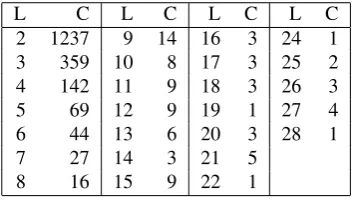
Table 4 gives a breakdown of multi-word arcs leaving the root. The columns titled ’L’ give the depth of the sequence and the columns titled ’C’ the number of such nodes. Not surprisingly, the distribution fits Zipf’s law fairly closely.
L C L C L C L C
2 1237 9 14 16 3 24 1
3 359 10 8 17 3 25 2
4 142 11 9 18 3 26 3
5 69 12 9 19 1 27 4
6 44 13 6 20 3 28 1
7 27 14 3 21 5
8 16 15 9 22 1
Table 4: Multi-word arcs
We motivated our use of suffix trees by appealing to the in-tuition that long repeated strings, even if not repeated very often, could contribute valuable information to a variable-order language model that fixed-variable-order models routinely throw away.
n BLEU Settings
7 10.40 kndiscount, interpolate, unk 5 10.37 kndiscount, interpolate, unk 4 10.45 kndiscount, interpolate, unk 4 10.51 kndiscount, interpolate 4 10.41 kndiscount
Table 5: SRILM Settings Comparison
of STLM is not. We therefore favored atask-based evalu-ation, which shows the quality of the language model in a real application setting.
We evaluated the STLM in the setting of machine transla-tion using the Moses MT System (Koehn et al., 2007) and compared it to the SRI language model (SRILM) (Stolcke, 2002). Suffix array language models such as SALM (Zhang and Vogel, 2006) and (Stehouwer and Van Zaanen, 2010) were not compared due to time constraints, though a com-parison certainly would have been interesting and informa-tive. We also didn’t compare against SALM implementa-tions because they don’t use Kneser-Ney smoothing in any variant, which is the current state of the art in smoothing for MT. SRILM and STLM both have a version of Kneser-Ney implemented. Another practical difference was that SRILM can be used directly with Moses (notably in the Experiment Management System), and we created a ver-sion of Moses that directly uses STLM in the same way as it uses SRILM. It suffices to compare STLM against the state-of-the-art SRILM to estalish its effectiveness in MT. We used the BLEU (Papineni and Et al, 2002) and ME-TEOR (Lavie and Denkowski, 2010) scoring metrics. Both metrics calculate a score which compares the MT output hypothesis with a reference text. BLEU calculates a modi-fied form of precision usingn-gram overlap, and METEOR uses the harmonic mean between precision and recall in un-igrams, as well as stemming and synonymy matching. A useful script that produces these scores given the machine translation hypotheses along with the reference target trans-lation is provided by Kenneth Heafield2.
The established standard for SRILM in MT is to use Kneser-Ney smoothing with interpolation. The training corpora used were Europarl (Koehn, 2005), an evaluation set of JRC-Acquis (Steinberger et al., 2006), and the new-stest2009 corpus. In all experiments, a phrase-based trans-lation model was trained on the parallel parts of Europarl of the two languages in question, and the language models were trained using the target language corpus.
We ran some simple small-scale tests to establish the best settings for the two language models. Tables 5 and 6 show the BLEU scores for various settings using the first 200k lines of Europarl (German to English) for training, and the newstest2009 corpus for evaluation.
It shouldn’t be surprising that the higher n-gram models don’t work as well in practice. This seems like a major blow to the concept of variable length n-grams, but it is due to data sparsity. We return to this issue in Section 5. In Table 6 the difference between the first and second lines show when boost was not used (line 1), and when boost
2
http://kheafield.com/code/mt/
BLEU Settings
9.26 kndisc, interpolate, unk, no depth limit 11.55 kndisc, interpolate, unk, no depth limit, boost 11.96 kndisc, interpolate, unk, depth limit 4, boost
Table 6: STLM Settings Comparison
was used (lines 2 and 3). This shows that our implementa-tion of Kneser-Ney did not work as well as SRILM’s. The boost, however, resulted in a remarkable performance im-provement.
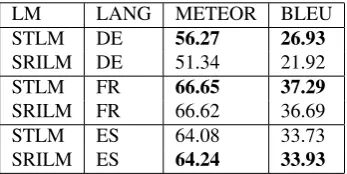
With the best setting for each model established, we per-formed experiments for various language pairs. The en-tire Europarl corpus (1,540,549 sentences) was used for training and the JRC-Acquis corpus (4,108 sentences) was used for evaluation. Table 7 shows the results for Ger-man, French, and Spanish where English was the source language, and Table 7 where English was the target lan-guage.
LM LANG METEOR BLEU
STLM DE 56.27 26.93
SRILM DE 51.34 21.92
STLM FR 66.65 37.29
SRILM FR 66.62 36.69
STLM ES 64.08 33.73
SRILM ES 64.24 33.93
Table 7: English astargetlanguage, training: full Europarl, test: JRC Acquis.
LM LANG METEOR BLEU
STLM DE 24.76 23.17
SRILM DE 25.48 23.96
STLM FR 20.45 33.61
SRILM FR 22.42 35.11
STLM ES 30.01 31.15
SRILM ES 30.32 32.35
Table 8: English as source language, training: full Eu-roparl, test: JRC Acquis.
STLM performs better in DE-EN and FR-EN in both eval-uation metrics. SRILM outperforms STLM in both met-rics for all other language pairs. These results show that STLM was perhaps over-tuned to work with DE-EN cor-pora, which was used for the intitial development, but it is still a competitive language model in our MT experiments when compared to SRILM, which is the result of many years of language modeling research and tuning.
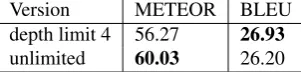
prob-Version METEOR BLEU depth limit 4 56.27 26.93 unlimited 60.03 26.20 Table 9: German to English STLM
lem.
4.3. Memory Usage
It is important to compare the memory usage of the two lan-guage models. The STLM grows linearly over time during training, peaking at 32 times the corpus size. During eval-uation it uses 21 times the corpus size. SRILM in contrast only uses 1.066 times the size of the corpus during train-ing (for a 4-gram, which is the model we used) and runtime memory usage is about one-fourth the size of the corpus. However, as the SRILM trainingn-gram order increases, it requires more memory for training. For STLM, the mem-ory usage stays constant, but for SRILM when the n-gram order is above 11, it uses more memory than STLM. Dur-ing evaluation, however, the memory necessary for SRILM is still much lower than STLM. It should also be noted that suffix array language model implementations are known to use significantly less memory than suffix trees during train-ing and evaluation.
5.
Discussion
The STLM is able to accommodate unlimited n-gram lengths, but it was shown that a 4-gram model performs better overall than an unlimited model in some MT exper-iments. This mostly due to data sparseness (see (Kneser, 1996)). Figure 9 shows that an unlimited model regains ground when more training data is used, and that using longer histories is rewarded at least when comparing the METEOR scores.
Only the boosted version of the STLM can compete with SRILM, which points to the potential weaknesses of our implementation. Ideally, without boost, it should perform reasonably well against SRILM. It would be informative to see how well SRILM performs with similar boosting, or if it is something that is uniquely helpful to this kind of struc-ture. Another criticism of the boost is that it potentially re-wards longer sentences by including more integer multipli-cations in the sentence score. While this is a valid criticism, large boosts will only occur when longer word histories are present in the training corpus, which is the very motivation of the suffix tree as a language model. A long sentence which has words represented in the tree, but where none of the sequences are represented, will have no boost at all (each word probability is multiplied by 1), despite being a long sentence.
There is another benefit to using STLM as opposed to tra-ditionaln-gram language models. The STLM differs from traditional language models in that it is inherently dynamic when using simple smoothing. This is because it allows all of the back-off pointers and node counts to be up-to-date and usable at any given moment during training. This means the tree can be trained, used for evaluation, then given more data to improve the model in a dynamic way. Imagine a virtual agent that uses a language model to aid
in utterance generation, then reads in a response from a hu-man user, which is assumed to be a well-formed represen-tation of the language. This new information can be used to improve the language model of the virtual agent by sim-ply appending onto the STLM data structure, which would result in better counts and improved generated utterances. Normaln-gram models can be made to be used dynami-cally, but that ability is again implicit in this structure. It is arguably not dynamic in that, for the tree to be complete, it requires the final sentinel character, but in a language model application neglecting to add this final character at the end does not affect the counts and branching of the model to completely and accurately represent the corpus. Only the suffix counts need to be updated, which is normally done once by a simple walk of the tree after the tree is built. It would cost a lot computationally to always need to walk the entire tree even after a small addition of information. However, count updating can also be performed in an effi-cient way by updating the counts of any branch affected by newly added data by simply following parent nodes, updat-ing each count, up to the root node.
6.
Conclusions
Suffix trees contain properties that are useful when process-ing natural languages. Evidence of this was further estab-lished in this paper by a language model implementation. The STLM offers true variable-length n-grams as a lan-guage model. It is comparable in most lanlan-guage pairs in some MT experiments, and is significantly better for DE-EN. Another useful point of the STLM is that the data struc-ture naturally holds its state such that it can be trained dy-namically, which may be useful in some applications.
7.
Future Work
In the future, we plan on improving the smoothing further and exploiting more properties of the data structure. Due to time constraints, the language model was trained on Eu-roparl and tested in the news domain. Running in-domain MT experiments would be beneficial. We also hope to test the model in other applications such as speech recognition or information retrieval. We further desire to test the lan-guage model in a dynamic environment, such as on-line di-alogue processing.
The STLM toolkit, written in C++, is available to anyone by e-mail request. We also have a version of the Moses decoder that can directly use the STLM.
Acknowledgements: This work was partially funded by the DFKI ACCURAT project. Thanks to Jia Xu for access to corpora and computing resources. Thanks also to the various reviewers.
8.
References
Brenda S Baker. 1997. Parameterized Duplication in Strings: Algorithms and an Application to Software Maintenance. SIAM J. Comput., 26(5):1343–1362, Oc-tober.
Technical Report TR-10-98, Computer Science Group Harvard University, August.
Edward Fredkin. 1960. Trie memory. Communications of the ACM, 3(9):490–499.
Jin Hu Huang and D Powers. 2008. Suffix Tree Based Approach for Chinese Information Retrieval. InEighth International Conference on Intelligent Systems Design and Applications.
Reinhard Kneser and Hermann Ney. 1995. Improved backing-off for m-gram language modeling. In In Proceedings of the IEEE International Conference on Acoustics, Speech and Signal Processing, volume I, page 181ˆa[U+0080][U+0093]184, Detroit, Michi-gan, May.
R Kneser. 1996. Statistical language modeling using a variable context length. InProceeding of Fourth Interna-tional Conference on Spoken Language Processing IC-SLP 96, volume 1, pages 494–497. Ieee.
Philipp Koehn, Hieu Hoang, Alexandra Birch, Chris Callison-Burch, Marcello Federico, Nicola Bertoldi, Brooke Cowan, Wade Shen, Christine Moran, Richard Zens, Chris Dyer, Ondrej Bojar, Alexandra Constantin, and Evan Herbst. 2007. Moses: Open Source Toolkit for Statistical Machine Translation. In Proceedings of the 45th Annual Meeting of the Association for Compu-tational Linguistics Companion Volume Proceedings of the Demo and Poster Sessions, pages 177–180, Prague, Czech Republic, June. Association for Computational Linguistics.
Philipp Koehn. 2005. Europarl: A Parallel Corpus for Statistical Machine Translation. InConference Proceed-ings: the tenth Machine Translation Summit, pages 79– 86, Phuket, Thailand. AAMT, AAMT.
Alon Lavie and Michael Denkowski. 2010. The METEOR Metric for Automatic Evaluation of Machine Transla-tion. InMachine Translation.
K Monostori, A Zaslavsky, and H Schmidt. 2000. Identi-fying Overlapping Documents in Semi-Structured Text Collections. Australasian Computer Science Confer-ence.
Kishore Papineni and Salim Roukos Et al. 2002. BLEU: A Method for Automatic Evaluation of Machine Trans-lation. InProceedings of the 20th Annual Meeting of the Association for Computational Linguistics.
H Stehouwer and M Van Zaanen. 2010. Using Suffix Ar-rays as Language Models: Scaling the n-gram. Proceed-ings of the 22nd Benelux Conference on Artificial Intel-ligence BNAIC.
Ralf Steinberger, Bruno Pouliquen, Anna Widiger, Camelia Ignat, Tomaˇz Erjavec, Dan Tufis¸, and D´aniel Varga. 2006. The JRC-Acquis: A Multilingual Aligned Parallel Corpus with 20+ Languages. InProceedings of the 5th International Conference on Language Resources and Evaluation (LREC’2006). LREC.
Andreas Stolcke. 2002. SRILM - An Extensible Language Modeling Toolkit. International Conference on Spoken Language Processing.
Esko Ukkonen. 1995. On-line construction of suffix trees. ALGORITHMICA.