University of Southampton Research Repository
ePrints Soton
Copyright © and Moral Rights for this thesis are retained by the author and/or other
copyright owners. A copy can be downloaded for personal non-commercial
research or study, without prior permission or charge. This thesis cannot be
reproduced or quoted extensively from without first obtaining permission in writing
from the copyright holder/s. The content must not be changed in any way or sold
commercially in any format or medium without the formal permission of the
copyright holders.
When referring to this work, full bibliographic details including the author, title,
awarding institution and date of the thesis must be given e.g.
AUTHOR (year of submission) "Full thesis title", University of Southampton, name
of the University School or Department, PhD Thesis, pagination
New Electronic Performance Instruments
For Electroacoustic Music
Dylan Menzies
Department of Electronics,
University of York
A dissertation submitted for
the degree of Doctor of Philosophy.
Acknowledgements
Thanks to my supervisor, David Howard, for enduring me for three years and making sure this thesis
was finished on time and understandable. I am also grateful for the patient assistance provided by
the technical support staff, particularly Ross Oliver. To room T223 and its past inhabitants I say
farewell, and fondly remember time spent talking over countless cups of tea.
Thanks to the Music Department for letting me use their facilities, and drill the occasional hole in a wall. I feel privileged to have made some good friends among the music postgraduates. May nerve8
continue to prosper!
Abstract
Musical performance is an ancient art form covering many different musical styles and instruments. Since the turn of the century the rise of electricity and then electronics has opened up opportunities
to create and control sound in fundamentally new ways. This process continues today through the
rapid development of computers.
The use of modern technology in musical performance is first examined, focusing on the
electroa-coustic style, and with reference to traditional forms of preformance. From this guidelines are
con-structed for designing new performance instruments. The characteristics of traditional instruments
play a central role in these guidelines.
Four projects are then used to demonstrate how the principles can be incorporated with contemporary
synthesis and spatialisation techniques. Considerable effort is devoted to the practical as well as
theoretical aspects. Some CD recordings are included to illustrate the work.
A broad range of practical techniques are developed, and deeper insights into the performance
prob-lem are gained. The success of the designs supports the original design principles, in particular those
based on traditional instruments. There remain practical obstacles to more widespread application of these ideas, but with time we may see the emergence of a new class of high quality electronic
Contents
1 Introduction 2
2 Technological Developments in Musical Performance 5
2.1 Aspects of Performance Pre 1900 . . . 5
2.1.1 Classical Music . . . 5
2.1.2 Folk Music and Improvisation . . . 6
2.1.3 Changing Views Towards Performance . . . 6
2.2 New Technology . . . 7
2.2.1 Electricity . . . 7
2.2.2 Early Electronic Instruments . . . 7
2.2.3 Radio Broadcasting . . . 8
2.2.4 Recording . . . 8
2.2.5 Musique Concr`ete . . . 9
2.2.6 Elektronische Musik . . . 9
2.2.7 The Growth Of Live Electronics . . . 10
2.2.8 Computer Music . . . 12
2.3 Recent Developments In Live Computer Performance . . . 15
2.3.1 Event Processing . . . 16
2.3.2 Signal Processing . . . 17
2.3.3 Hyperinstruments . . . 19
2.3.5 Non-Commercial Physical Controllers . . . 23
2.4 Popular Music . . . 27
2.4.1 Recording and Live Concerts . . . 28
2.4.2 The Electric Guitar . . . 28
2.4.3 Synthesizers, MIDI . . . 29
2.4.4 Hiphop . . . 35
2.4.5 House . . . 36
2.4.6 Electronic Music . . . 36
2.5 Summary . . . 37
3 Acoustic Instruments 41 3.1 Idiophones . . . 42
3.1.1 The Vibraphone . . . 42
3.1.2 The Blues Harp . . . 42
3.2 Membranophones . . . 42
3.2.1 The Tabla . . . 42
3.3 Chordophones . . . 43
3.3.1 The Pianoforte . . . 43
3.3.2 The Violin . . . 44
3.3.3 The Guitar . . . 45
3.4 Aerophones . . . 46
3.4.1 The Saxophone . . . 47
3.4.2 The Oboe . . . 48
3.4.3 The Trumpet . . . 49
3.4.4 The Penny Whistle . . . 49
3.5 The Acoustic . . . 49
3.6 Summary . . . 50
4.1 Abstract Algorithm Synthesis . . . 53
4.1.1 Additive Synthesis . . . 53
4.1.2 Waveshaping . . . 54
4.1.3 Amplitude Modulation (AM) . . . 54
4.1.4 Frequency Modulation (FM) . . . 55
4.1.5 FM-related Modulation . . . 56
4.2 Processed-Recording Synthesis . . . 56
4.2.1 Wavetable Synthesis . . . 56
4.2.2 Group Synthesis . . . 56
4.2.3 Granular Synthesis . . . 57
4.3 Spectral Synthesis . . . 57
4.3.1 Linear Predictive Coding . . . 57
4.3.2 FFT and The Phase Vocoder . . . 58
4.4 FOF and VOSIM . . . 58
4.5 Physical Modeling . . . 59
4.5.1 Cellular Models . . . 59
4.5.2 Waveguide Models . . . 59
4.5.3 Modal Models . . . 60
4.6 Effects Processing . . . 60
4.6.1 Delay . . . 61
4.6.2 Early Reflections and Reverberation . . . 61
4.6.3 Chorus . . . 61
4.6.4 Flange . . . 61
4.6.5 Pitch-shifting . . . 62
4.6.6 Vocoding . . . 62
4.6.7 Envelope following . . . 62
4.6.9 Compression . . . 63
4.6.10 Equalization . . . 63
4.6.11 Exciters . . . 63
4.6.12 AM and FM . . . 64
4.6.13 Granulation . . . 64
4.7 Spatialisation . . . 64
4.7.1 Live Electronic Diffusion . . . 65
4.7.2 Audio Engineering . . . 65
4.7.3 Huygens Principal . . . 65
4.7.4 Stereo . . . 66
4.7.5 Quadraphonics . . . 66
4.7.6 Dolby Surround . . . 67
4.7.7 Ambisonics . . . 67
4.7.8 Binaural Reproduction . . . 71
4.7.9 Transaural Stereo . . . 71
4.7.10 Hypersonic Sound . . . 72
4.7.11 Summary . . . 72
4.8 Real-time Signal Processing Tools . . . 72
4.8.1 Hardware . . . 72
4.8.2 C . . . 72
4.8.3 C++ . . . 73
4.8.4 Java . . . 73
4.8.5 Csound . . . 73
4.8.6 Graphical Synthesiser Design Systems . . . 74
4.8.7 Computer Aided Design Systems . . . 74
4.9 Summary . . . 75
5.1 The MIDI Keyboard as a Controller . . . 76
5.2 New Keyboard Instrument Models . . . 77
5.2.1 Instrument classes . . . 77
5.3 Spiragraph - a Csound Instrument . . . 78
5.3.1 Synthesis . . . 78
5.3.2 Control . . . 78
5.3.3 In Performance . . . 79
5.3.4 Spiragraph2.orc . . . 80
5.3.5 Spiragraph3.orc . . . 81
5.4 Summary . . . 81
6 LAmb, A System for Live Diffusion Using Ambisonics 82 6.1 Introduction . . . 82
6.1.1 Conventional Ambisonic Diffusion . . . 82
6.1.2 Digital Ambisonic Diffusion . . . 84
6.2 LAmb Development Introduction . . . 85
6.3 A New Panning Algorithm . . . 85
6.3.1 Recreating The Analog Pan-pots in DSP . . . 85
6.3.2 Distance Gain Profile . . . 86
6.3.3 First Attempt to Control the Interior Effect . . . 87
6.3.4 Object Synthesis . . . 88
6.3.5 Acoustics and Movement . . . 91
6.4 Spreading Effects . . . 91
6.4.1 Gerzon’s analog spreading pan-pot . . . 91
6.4.2 A Digital Spreading Pan-pot . . . 92
6.4.3 True Controllable Spreading . . . 93
6.5 Using B-format Recordings for Object Synthesis . . . 95
6.5.2 Performance Usage . . . 96
6.6 Soundfield Processing . . . 97
6.6.1 Rotation . . . 97
6.6.2 Dominance . . . 99
6.7 Soundfield Delay Effects . . . 100
6.7.1 A Flexible Feedback Delay Network . . . 100
6.7.2 Early Reflections . . . 100
6.8 Distance EQ . . . 102
6.9 Keyboard Control . . . 103
6.9.1 Object Movement . . . 103
6.9.2 Soundfield Sample Keys . . . 104
6.9.3 Soundfield Rotation Keys . . . 104
6.9.4 Joystick Control . . . 104
6.10 Desktop Tools . . . 105
6.10.1 Evolution . . . 105
6.10.2 Object Control Parameters . . . 105
6.10.3 Soundfield Delay . . . 106
6.10.4 Dominance . . . 106
6.10.5 Locate Listener . . . 106
6.11 Program Structure . . . 106
6.11.1 Control Filter . . . 107
6.11.2 Mixing . . . 107
6.11.3 The Graphical Interface . . . 108
6.11.4 MIDI input . . . 108
6.11.5 Efficiency Features . . . 108
6.12 The Hexagon Performance Space . . . 109
6.12.2 Decoder Electronics . . . 109
6.13 Summary . . . 111
7 SidRat - Live Electronics using Csound 113 7.1 Introduction . . . 113
7.2 Control Input . . . 114
7.3 Using a Score in Real-time . . . 115
7.4 SidRat . . . 115
7.4.1 Overview . . . 115
7.4.2 Instrument Example I . . . 117
7.4.3 Instrument Example II . . . 117
7.5 Summary . . . 119
8 The CyberWhistle - A New Integrated Instrument 121 8.1 Introduction . . . 121
8.2 The Concept . . . 122
8.2.1 The Penny Whistle . . . 122
8.2.2 Validating Usage of the Whistle Form . . . 123
8.2.3 Abstracting Whistle Control Methods . . . 123
8.2.4 Switch Feedback vs Continuous Feedback . . . 124
8.2.5 Mouth and Breath Control . . . 124
8.3 Electronic Development . . . 125
8.3.1 Finger Sensing . . . 126
8.3.2 Practical Sensing Circuit . . . 130
8.3.3 First Impressions of Using The Ambient Finger Sensor . . . 131
8.3.4 MIDI generation . . . 132
8.3.5 Breath Sensing . . . 132
8.3.6 Breath Signal Processing . . . 133
8.4 Tools For Software Synthesis . . . 136
8.4.1 Csound and Limitations . . . 136
8.4.2 Measuring Delays Within The System . . . 136
8.4.3 Improving On Csound Latency Figures . . . 138
8.4.4 Computational Efficiency . . . 140
8.4.5 Using C++ . . . 141
8.4.6 Summary : A Framework For Software Synthesis . . . 141
8.4.7 Testing The Framework . . . 142
8.5 Physical Modelling Synthesizers . . . 143
8.5.1 Hybrid Single-Reed Models . . . 144
8.5.2 Hybrid Flute Models . . . 147
8.5.3 Hybrid Bowed Models . . . 148
8.6 Abstract Dynamical Synthesis Control . . . 152
8.7 Enhancements and Modifications . . . 153
8.7.1 CyberWhistle II . . . 153
8.7.2 Capacitative Mouthpiece . . . 154
8.7.3 Wireless control . . . 155
8.8 Summary . . . 155
9 Conclusion 158 A Spiragraph Code Listing 163 A.1 spiragraph1.orc . . . 163
A.2 spiragraph2.orc . . . 164
A.3 spiragraph3.orc . . . 165
A.4 spiragraph.sco . . . 167
B LAmb Tutorial 168
D Screenshots of LAmb 170
E LAmb Code Listing 171
E.1 Makefile . . . 171
E.2 lt.h . . . 171
E.3 lt.c . . . 177
E.4 lt.decode.c . . . 206
E.5 f.h . . . 207
E.6 f.c . . . 209
E.7 f cb .c . . . 217
F SidRat Performance Instructions and Graphic Score 227 G SidRat Code Listing 234 G.1 sidrat.orc . . . 234
G.2 sidrat.sco . . . 239
G.3 mdcontrol.c . . . 247
H CyberWhistle Software Synthesis Code Listing 248 H.1 Makefile . . . 248
H.2 Operating System . . . 249
H.2.1 global.h . . . 249
H.2.2 priority.h . . . 250
H.2.3 run.c . . . 250
H.2.4 fixFPU.h . . . 252
H.2.5 fixFPU.c . . . 252
H.2.6 AudioIn.h . . . 253
H.2.7 AudioIn.c . . . 254
H.2.8 AudioOut.h . . . 255
H.2.10 MidiIn.h . . . 258
H.2.11 MidiIn.c . . . 259
H.3 Audio Processing Primitives . . . 261
H.3.1 AsyncFilt.h . . . 261
H.3.2 AsyncFilt.c . . . 261
H.3.3 Filter.h . . . 262
H.3.4 Filter.c . . . 263
H.3.5 Tone.h . . . 263
H.3.6 Tone.c . . . 264
H.3.7 Atone.h . . . 264
H.3.8 Atone.c . . . 265
H.3.9 OnePole.h . . . 266
H.3.10 OnePole.c . . . 266
H.3.11 OneZero.h . . . 267
H.3.12 OneZero.c . . . 268
H.3.13 DCBlock.h . . . 268
H.3.14 DCBlock.c . . . 269
H.3.15 Delay.h . . . 269
H.3.16 Delay.c . . . 270
H.3.17 OscWG.h . . . 271
H.3.18 OscWG.c . . . 272
H.3.19 Noise.h . . . 272
H.3.20 Noise.c . . . 273
H.4 Waveguide Operations . . . 273
H.4.1 Waveguide.h . . . 273
H.4.2 Waveguide.c . . . 274
H.4.4 Barrier.c . . . 275
H.4.5 WhistleBore.h . . . 275
H.4.6 WhistleBore.c . . . 277
H.4.7 WhistleBoreP.h . . . 278
H.4.8 WhistleBoreP.c . . . 279
H.4.9 ReedTabl.h . . . 280
H.4.10 ReedTabl.c . . . 280
H.4.11 JetTabl.h . . . 281
H.4.12 JetTabl.c . . . 282
H.4.13 FluteMouth.h . . . 282
H.4.14 FluteMouth.c . . . 283
H.4.15 WaveMass.h . . . 284
H.4.16 WaveMass.c . . . 285
H.4.17 MassBow.h . . . 285
H.4.18 MassBow.c . . . 286
H.4.19 WaveBow.h . . . 287
H.4.20 WaveBow.c . . . 287
H.5 CyberWhistle Instruments . . . 288
H.5.1 CWinstr.h . . . 288
H.5.2 CWinstr.c . . . 290
H.5.3 CWtest.h . . . 292
H.5.4 CWtest.c . . . 293
H.5.5 CWtestSine.h . . . 294
H.5.6 CWtestSine.c . . . 294
H.5.7 CWclariHol.h . . . 295
H.5.8 CWclariHol.c . . . 296
H.5.10 CWclariHolP.c . . . 298
H.5.11 CWfluHol.h . . . 300
H.5.12 CWfluHol.c . . . 301
H.5.13 CWmassBow.h . . . 303
H.5.14 CWmassBow.c . . . 303
I Details of the Microcontroller Implementation for the CyberWhistle 306 I.1 The Schematic . . . 306
I.2 The Software . . . 307
J CD Track Listing 312
List of Figures
4.1 Simplified overview of a Waveguide Instrument . . . 60
4.2 B-format W, X, Y, Z responses separately and together . . . 68
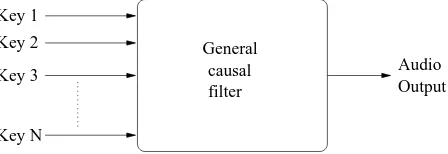
5.1 Most general keyboard controlled instrument. . . 77
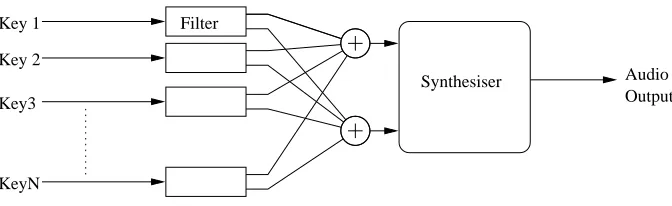
5.2 A subclass of keyboard instruments . . . 78
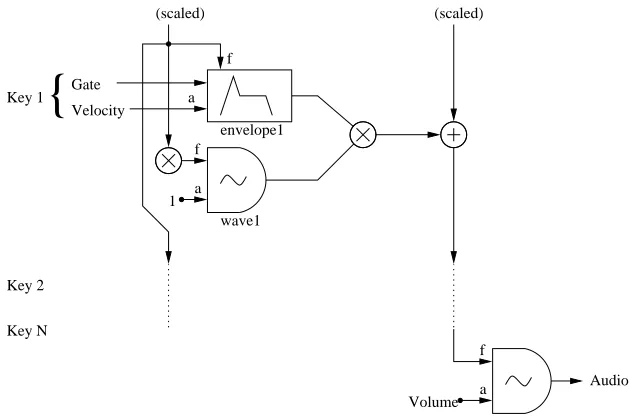
5.3 Graphical representation of Csound instrument spiragraph1.orc . . . 79
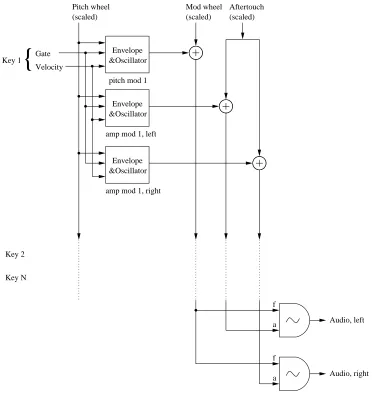
5.4 Graphical representation of Csound instrument spiragraph2.orc . . . 80
6.1 A diffuse acoustic object. . . 88
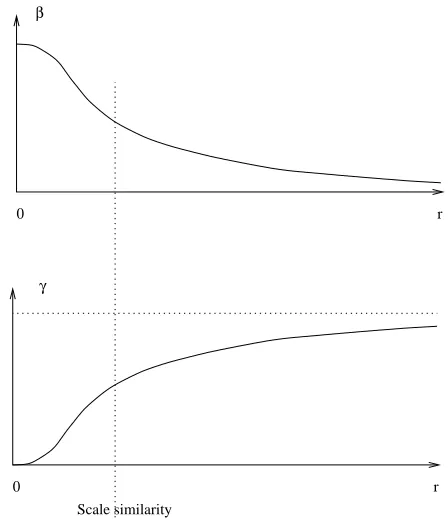
6.2 Consistentγandβdistance profiles for an object. . . 90
6.3 Effect of Gerzon’s Analog Spread Pan-Pot. . . 91
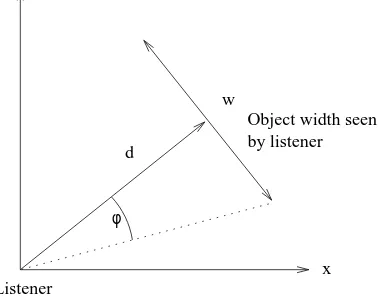
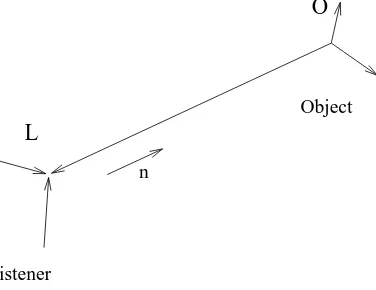
6.4 Geometry of object relative to listener. . . 93
6.5 Gerzon’s mono spreader. . . 93
6.6 True spreader using a controlled allpass filter. . . 94
6.7 True spreader using dominance. . . 94
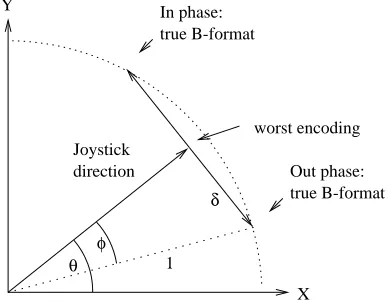
6.8 Encoding the signal from a point radiator into B-format. . . 95
6.9 Extended surface radiator using composite point radiators. . . 97
6.10 A structure for delayed feedback of B-format. . . 100
6.11 Simulating early reflections using an FIR structure. . . 101
6.12 Simulation of spatialised reflections. . . 102
6.13 LAmb software components. . . 107
7.1 Equipment layout for SidRat. . . 116
7.2 instr 30 from SidRat. . . 118
7.3 instr 40 from SidRat . . . 119
8.1 Capacitative sensing of finger proximity. . . 126
8.2 Finger proximity sensing using infrared reflection. . . 127
8.3 Finger proximity sensing using ambient light occlusion. . . 128
8.4 LDR response to rapid light decrease then increase. . . 128
8.5 Measurement of LDR light response. . . 129
8.6 The light response of two LDRs. . . 129
8.7 LDR finger sensor compensation circuit. . . 131
8.8 Performance test of light compensation circuit. . . 131
8.9 Breath sensing by noise processing. . . 133
8.10 Simple envelope extraction. . . 133
8.11 Robust envelope extraction with fast note edge response. . . 134
8.12 CyberWhistle cross-section. . . 135
8.13 Overview of delays acting in the CyberWhistle signal path. . . 137
8.14 Compensated finger voltage for finger-down and finger-up. . . 137
8.15 Waveguide bore model with 2 port scattering toneholes. . . 144
8.16 Equivalent abstract bore models. . . 145
8.17 Two abstract instrument models using a waveguide bowing interaction. . . 148
8.18 Hysteresis function used by WaveBow. . . 149
8.19 Waveguide bow structure. . . 149
8.20 The bowforce acting on a bowed mass. . . 150
8.21 Labeling of traveling velocity waves. . . 151
8.22 A model for instrument synthesis with control processing. . . 153
8.23 Mouthpiece for CyberWhistle II . . . 154
F.1 SidRat Performance Score, First Movement . . . 232
F.2 SidRat Performance Score, Second Movement . . . 233
Chapter 1
Introduction
Critical Analysis of Instrument Design
Music began as a performance art. The only way to hear music was to listen to a live performance.
This is no longer true. Music can be played back from a recording machine, broadcast onto radio
sets or generated by a computer. Technology has also directly affected the ways in which people
perform. Chapter 2 traces this process and identifies areas of electronic instrument design where
more development would be profitable. Acoustic instruments are repeatedly found to be valuable
in assessing electronic instruments, to the extent that Chapter 3 is devoted to a detailed survey of
acoustic instruments.
The Central Hypothesis
The scope of all the design guidelines created is wide, but those concerned only with acoustic
in-struments are so pervasive that they form a central theme, which may be stated as a hypothesis.
Electronic instrument design can benefit greatly from careful abstraction of high level design
princi-ples inherent in traditional acoustic instruments. This may at first seem confusing as many electronic
instruments superficially resemble acoustic instruments. The full evaluation of an instrument does,
however, require the examination of many abstract qualities besides physical appearance. A detailed
elaboration of the design principles can be found in the summary of Chapter 3. The following is an
indication of the contents:
Ergonomics and sensing - The physical interface should exploit the strengths of human
mo-tor capabilities, and the sensing technology must be carefully matched to provide adequate response and resolution where it is required.
Control-synthesis dynamics - Subtle complexities in the relationship between control and
Global integration - The components of the man-instrument system are heavily
interdepen-dent, hence an integrated design approach is paramount.
Electroacoustic Music
The observations on modern performance technology apply across a range of styles. However, for
the purposes of this thesis the focal style is electroacoustic music, which encompasses the tradition
of processed and synthesized music dating back to the early experiments in Europe in the late 1940’s,
which were partly funded by radio stations. While the setting was not in university, many of those
involved had previously received a high level of academic training in music and other disciplines,
which is reflected in the depth of analytical thinking in the work. Electroacoustic music is now firmly in the public domain. Anyone with desire and talent can create it with a minimal financial outlay. It
retains a wide following, but not on such a large scale that it is subject to commercial pressures.
Throughout its existence electroacoustic music has been associated with live performance. Recent
technological innovations have further raised interest in live performance, whereas in other
musi-cal styles live performance increasingly takes second place to studio production. Electroacoustics
provides a broad testbed for expanding the definition of performance.
Performance Technology Review
In Chapter 4 audio signal processing techniques and tools are surveyed, with particular attention
to live performance applications. Included are introductions to the waveguide and Ambisonic
tech-nologies, which are employed later.
Project Work
Four projects were undertaken to develop new performance instruments for electroacoustic music,
each of which incorporates some of the guidelines established earlier.
The MIDI keyboard is ubiquitous and therefore defines a global performance interface standard.
Chapter 5 looks at how the interface can be applied in a generalised way to electronic performance,
so that the concept of note is no longer dominant. Some examples are given in Csound. The novelty
lies in the control processing concepts and to a lesser degree the techniques used to implement
the concepts in Csound. Dispensing with the note allows some interesting acoustically inspired
behaviour to be introduced.
Ambisonics is a methodology for encoding the soundfield about a point and decoding it onto a
speaker array so that listeners perceive the original soundfield. It has been applied to the live
diffu-sion of sound, but using tools which were originally designed for studio production work rather than
performance. In Chapter 6 a new purpose built performance system is described. Novel signal
interface. The traditional point synthesis is extended with an efficient for technique for encoding object width. New algorithms are described for efficient rendering of spatialised reflections, and for
the spatial spreading of frequencies from a mono source.
The concept of an instrument has broadened within live electronics, to mean a system which
pro-cesses human performance to produce sound, and whose behaviour may change over time. Chapter
7 presents SidRat, a piece for live electronics which embraces this most general definition. It can
be viewed as a piece and an instrument. The main achievment is to show how Csound can be
used effectively for implementing instruments of this type, by assembling a number of non-standard Csound techniques. In doing so one of the principal design guidelines is adhered to, that of global
integration.
In the first three projects no new interface hardware has been built, because a conscious decision was
made to make the best use of common control devices. There is clearly much potential, however,
for designing interfaces with new properties. This approach requires an extended level of integration
discipline. Chapter 8 describes the design of the CyberWhistle, an electronic instrument based
around the Penny Whistle. The main feature of the interface is the continuous tracking of finger
movement above the fingerholes, allowing for more expressive control than switches. Synthesis is
developed in C++ using waveguides, extending on standard techniques to include efficient models for the bore. This leads to a much more open consideration of control-synthesis dynamics inspired
by acoustic instruments, which may yet play an important part in the future of instrument design.
Conclusions
The projects affirm the original arguments over design guidelines, and in their course provide a wealth of practical methods which may be of future use. Chapter 9 provides a summary of all the
Chapter 2
Technological Developments in
Musical Performance
Here we examine the developments of music technology for performance associated with the modern
industrial age, those employing powered mechanisms, electricity, electronics and finally computers.
The aim is not to provide an exhaustive history, but to instead trace the notable successes and failures, and supply some analysis for them. The main reference is [Man85]. Additional relevant material
can be found in [DJ85] and [RSA
95].
2.1
Aspects of Performance Pre 1900
2.1.1
Classical Music
In the West a strong tradition has evolved in which music is written to score by a composer and then
performed by an ensemble or orchestra in front of an audience. It is worth examining this process in
more detail before considering the changes that have occurred to it. The composer writes to a score
using expert knowledge of the sounds that can be produced by different instruments, and the kinds
of articulations and phrasing that players can produce.1
In smaller groups the details of performances by each individual become more noticeable. The term
musical interpretation describes the information which each player adds to the basic content of the
score. The extra information is implicitly required but cannot be practically codified in the score.
This is just as well because it allows for the freedom of individual expression which is a strong
motivation for players. The concept of virtuoso in western music is an indicator of the importance
of individual expression. Even in a large orchestra, where the individual players may not be heard
1In some instances the composer may envisage novel effects resulting from unusual articulations or combinations of
clearly, many elements in the overall sound give away the presence of human performers.
The listeners are passive, except that they may react positively to the performers, and encourage
them to play well. It is common for musicians recording in a studio today to complain about the lack
of a ‘live atmosphere’.
2.1.2
Folk Music and Improvisation
The other broad thread of musical practice derives from folk music, of its many kinds through out the
world. Here there is less emphasis on composition. The musicians are the composers. They take old
music, reinterpret it and write new music. More importantly, there is the element of improvisation, that is the ability of the player to compose, to some degree, while playing. The scope for composition
is more limited with improvisation, but it does allow for the creation of music with spontaneity,
surprise and unity of dynamic and melodic phrasing. This can be viewed as an extension of the
freedom of expression in the performance of classical scores. Many well known western composers
have been keen improvisers although without recordings, improvisation is not part o their musical
legacy. Mozart was known for improvising entire cadenzas when performing his piano concertos.
As we shall see later, improvisation has become a functional part of contemporary music.
2.1.3
Changing Views Towards Performance
Wagner’s Orchestra
The 19th century saw some experimentation with the notion of music performance. Wagner
intro-duced the covered orchestra pit and so gave orchestra a more abstract role. [Fre89].
The Player Piano
The application of mechanical technology in clockwork music devices led to a new complexity in
music technology. The popularity of the Player Piano at the turn of the century demonstrated a
willingness to embrace new musical devices [OH84]. The player piano developed to a stage where it
could faithfully reproduce performances recorded onto paper rolls. More surprising are the controls
that were developed so that someone sitting at the piano could ‘interpret’ the rolls. The foot operated
bellows were not used just to power the system, but also to add dynamics. The tempo lever controlled
the rate of roll advancement and other levers provided for mechanical frequency equalization. The
player piano is thus reminiscent of modern digital keyboards with one finger chord features and
built in rhythms. The idea is to allow people with little keyboard experience to become musically
involved. Judging by the high regard of the player piano amongst composers and performers of the day, it seems that it was more successful than its complex digital relatives of today. Stravinsky for
‘express his musical intentions more clearly to future conductors’.
2.2
New Technology
2.2.1
Electricity
By the end of the 19th century, the acoustic science of wood, glue, reed and brass had matured to the
point where no significant developments were being made. The harnessing of electricity at this time offered a wealth of new musical possibilities. A patent was filed in 1897 by the American, Thaddeus
Cahill for an electrically based sound generation system subsequently known as the Dynamophone
or Telharmonium. The first fully developed model was presented to the public in 1906, at a cost
of $200 000. The Telharmonium was keyboard operated and used dynamos as oscillators. The
composer Ferruccio Busoni was interested and wrote an essay Sketch of a New Aesthetic of Music
discussing the potential of the Telharmonium for novel sound and harmony. Busoni clearly foresaw
the potential of electricity to produce and control new sounds. Cahill had plans to send live music
across the telephone system, where it could be received in lounges and bars2. Unfortunately the
signals were found to interfere with other telephone signals and the venture fell, just before the outbreak of World War I.
2.2.2
Early Electronic Instruments
The thermionic valve patented by Lee De Forest in 1906, marked the start of the electronic age.
Progress was initially slow, but between the Wars a number of electronic instruments were produced,
mainly as additions to the concert orchestra. The two most remembered are the Th´er´emin (1924)
and the Ondes Martenot (1928). The first of these has an unusual method of control. The pitch and
amplitude are controlled separately by the proximity of each hand to separate metal loops (It is said
to be the result of a building a faulty radio). In skilled hands it is capable of soprano like vibrato and
tonal variation. It has been used in popular music by the Beach Boys, and today enjoys a renaissance as a commercial instrument. The Ondes Martenot has a distinctive, resonant sound and is played by
keyboard, and a ribbon controller allowing continuous glissandi. Messiaen used it to good effect in
the Turangalila symphony. Several other composers employed such devices : Hindemith, Honegger,
Koechlin, Milhaud, but it was only a brief trend. Film music established a longer lasting relationship
with the instruments. Unusual sonic material has since been common in film scores.3
2This is before recording had really caught on.
2.2.3
Radio Broadcasting
Marconi made his first successful wireless broadcast over 2 km in 1895. Wireless telegraphy
de-veloped, rapidly followed by audio broadcasting. For the first time people could listen to live
per-formances of music from their living room. This marked a major change in perception about live
performance, that it could be abstracted away from the human performers. Through broadcasting
music gained a wider audience but possibly at the cost of weakening, in some sense, the musical
listening experience.
2.2.4
Recording
The phonograph, patented by Edison and Berliner in 1877, was the first method of sound
repro-duction, beginning a long line of technical improvements which continue to this day.4 Recording
brought the second major change in the way we listen to music. Not only is the performance
repro-duced at any place, from a box, it is also reprorepro-duced at any time. Records enabled radio stations to
play much more music, which encouraged more radio listening and buying of records, fueling more
music recording. A vast new industry was created. Recording further encouraged the move away
from concert listening that began with radio.
Before recording developed, every piece of music heard was different. A recording of classical music
today may contain numerous edits in a mix taken from several microphones. Repeated listening means that imperfections can not be tolerated. The perception of a natural performance, in this case,
is an illusion. Jon Frederickson summarises the impact of recording as follows
Fre89
The performance need not be live.
The performer relates to the microphone not to an audience.
The audience relates to a machine not a performer.
Musical time is replaced by clock time.
The ‘aura’ of the musician, his sound, becomes transformed into electronic information: The
artists unique voice becomes a universal possession.
The act of making music together becomes transformed into an electronic function of a
com-puter track which coordinates all other tracks.
Technology simulates live music so well that the simulated reality often becomes a new
defi-nition of reality music.
The relationship between popular music and recording technology is discussed later. Attention is
now directed towards one of the first movements to use recording technology creatively.
2.2.5
Musique Concr`ete
A group of musicians in Paris led by Pierre Schaeffer developed methods of composing music
us-ing recordus-ings of natural sounds. A new kind of composer emerged, capable of innovatus-ing with
technology to a degree previously unknown (Schaeffer was trained as a physicist). In the winter of
1949 Schaeffer gave a live concert of musique concr`ete which involved record players, mixing units
and loudspeakers. Despite lack of rehearsal the event was well received. It wasn’t until 1951 that
Schaeffer could replace the inconvenient process of record cutting with tape recording.
The concept of a concert for tape became increasingly common as tape recorders became more
widespread. Another format that established itself early on is the concert for tape and acoustic
in-strument(s), in which the player must follow the lead set by the tape part. This creates new problems
of synchronisation. In some cases exact timing is not required and the performers can gain sufficient
cues from the tape. Otherwise a click-track may be used. Either the performers or a conductor hear
the clicks through a small earpiece. A conductor is often preferred as the clicks may be distracting
to the performers.
2.2.6
Elektronische Musik
The musique concr`ete movement was driven by the study of natural sound and its psychoacoustics.
By contrast an informal network of composers grew in Cologne in the early 50s who were motivated
by pure electronic sounds. This began when Dr Werner Meyer-Eppler at the Department of Phonetics
at Bonn University was visited by Homer Dudley of Bell Labs, USA. Dudley demonstrated the
first vocoder, which was capable of synthesizing crude speech by filtering a noise source. Those
associated with Elektonische Musik went on to develope a wealth of techniques for generating and
processing electronic sound, both for tape and live performance.
In 1955 Herbert Eimert, one the pioneers of electroacoustic music at Cologne wrote:
“Here we touch on the most widespread misconception: namely that one can make
music ‘traditionally’ with electronic means. Of course one ‘can’; but electronic concert
instruments will always remain a substitute. The fact that practically no music which
can be taken seriously, artistically , has been written for electronic concert instruments
is due precisely to the fact that its use either as soloist or ensemble instrument does not
transcend the old means of performance. New ways of generating sound stipulate new
compositional ideas and these may only be derived from sound itself which in turn must be derived from the general ‘material’.”
Of this Jon Appleton observes [App86]
“Eimert was attempting to justify the absence of the performer because thirty years ago
in the tape studio.”
Stockhausen, who later became head of the Cologne studio, produced the classic electronic piece,
Kontakte, in 1958-60. Scored for tape with live piano and percussion, Kontakte creates subtle points
of contact between the real and synthetic parts, without resorting to imitative sounds. Stockhausen
created new standards for live performance-with-electronics that are still relevant today, [Hei72].
From 1964 he produced numerous pieces in the genre. In the piece Solo (1966) the sound from a
solo performer is passed through an arrangement of delays onto four speakers. Four assistants are
required to manipulate the tapping points, switches and volume levels according to a precise
se-quence. The result is added sonic structure which correlates in a predetermined way with the scored solo performance. The volume control levels are not specified exactly, which allows an element of
performance interaction between one of the assistants and the solo performer, although the assistant
is not really ‘performing in a musically intimate way’. The arrangement is typical of many which
require an engineer to assemble a number of separate items to create a performance. This adds an
element of theatre to the work, but possibly the inconvenience of restaging work reduces the chances
for future performance. The careful use of multiple loudspeakers created new possibilities for the
control of the sound in 3-dimensional space.
Up until Ylem (1972), Stockhausen relied mainly on the signal processing of natural, performed
sound. Thereafter, he began incorporating more live synthesis. Manning, [Man85], considers that
Stockhausen has succeeded most in his older style, and has been reluctant to follow developments.
This may be the price for establishing a solid aesthetic base in a technological environment which is
rapidly changing. It may also reflect Stockhausen’s dissatisfaction with digital systems.
2.2.7
The Growth Of Live Electronics
Italy and Musical Theatre
The 60’s saw a large growth in the use of live electronics in performance. In Italy two
ensem-bles were established which took a strong interest in improvisation with electronics. Gruppo di
Improvisazione Nuova Consonanza began by producing music for acoustic instruments which had
electronic qualities, and later introduced live electronics and formal tape parts. The Musica
Elettron-ica Viva explored freer styles of improvisation using a mixture of live electronic and acoustic sound.
They promoted the use of musical theatre in electronic music. The flexibility of electricity lends
itself to unusual methods of performance interaction such as controlling aspects of someone else’s
performance. Theatre can be used to exploit this fully. By contrast Stockhausen’s performances have
Britain and The Jazz Avant-Garde
In Britain the group AMM founded in 1965 by Lou Gare, Keith Rowe and Eddie Prevost combined
jazz and contemporary music, with a strong element of live electronics. Two similar ensembles
Gen-tle Fire and Naked Software employed a range of unusual instruments constructed from inexpensive
materials with electrical pickups.
Roger Smalley and Tim Souster formed the group Intermodulation in 1969 which initially produced work similar in style to Stockhausen’s. In fact Transformation I predated Stockhausen’s similar
Mantra by a year. Souster went on to found 0 dB which incorporated yet more styles of music
outside the classical western mainstream.
John Eaton was successful in combining early synthesizers with acoustic performers in such works
as Mass (1970) for soprano, speaker, clarinet, three synkets and a Synmill-Moog synthesizer.
Japan and Environmental Music
Toshi Ichiyanagi was a pioneer of Environmental Music and Installation Music. In 1964 he
con-structed a system for an art gallery in Takamatsu where an exhibition of sculpture was accompanied
by a soundscape of photo-cell controlled oscillators, operated by the movement of passers-by. This
is live performance of a kind, but one in which the performers may be only partially aware of how
their actions affect the music.
America
In America, one name stands out in the early development of electronic and other experimental
musical forms, that of John Cage. ‘Music for Amplified Toy Pianos’ and ‘Cartridge Music’ are live
pieces employing the amplification of very quiet sounds. In ‘Variations V’ (1965), Cage includes
dancers who control audio-visual elements by breaking light beams focused on photoelectric cells.
Fluorescent Sound (1964) by David Tudor utilises the resonances of fluorescent light tubes,
ampli-fied and distributed via loudspeakers. In Rainforest (1968) Tudor has replaced loud speaker cones
with various kinds of resonator. Banks of oscillators, performed live, constitute the speaker feeds.
Wave Train (1966) by David Behrman relies on the feedback between a piano fitted with guitar
pickups and a monitor speaker to extend the decay of the strings, which are performed.
Gordan Mumma developed a cybersonic controller, a kind of effects processor that the performer
could wear around the neck, and control, whilst performing an acoustic instrument. Cybersonics
was used in Medium Size Mograph (1963) for piano and four hands, and Mesa (1966) for accordion,
in which simple melodic phrases are tranformed into complex successions of sounds rich in
Alvin Lucier was particularly interested in the theatrical possibilities of live electronics. Music for
Solo Performer (1965) included live, amplified alpha brain waves. North American Time Capsule
(1967) employed eight prototype digital vocoders to process the sounds of a chorus and various
theatrical objects. In Vespers (1968) performers carry location detectors which react sonically to
objects placed around a darkened stage.
The Minimalist movement associated with Steve Reich, Terry Riley and later Philip Glass, has had
a much simpler relationship with live electronics. Keyboard synthesizers have been used to produce
subtle contrasts of timbre to acoustic instruments, possibly with slowly varying elements within a cycle of notes. The keyboard bass in Floe by Philip Glass is an example.
2.2.8
Computer Music
When computers were first used for musical purposes they were too slow for live or real-time work,
and were only available in universities and corporations. Technology has progressed rapidly over 30
years to a stage where an affordable personal computer is capable of complex live synthesis. The
basic principles have not changed. All digital computers are finite Turing machines. They accept information, process it according to a program and output the result. The behaviour of the machine
is defined by its program, which has no physical substance. This immediately establishes a very
dif-ferent design aesthetic to acoustic instruments whose musical character is entirely dependent on the
physical construction from different materials. With the live electronics discussed previously,
instru-ments are constrained to the particular properties of the electronics available. The only theoretical
constraint on computers is speed of execution, which determines the complexity of processes that
can be sustained in real-time. In practice other important constraints arise from compromises in the
construction of the audio I/O system. These include I/O latencies, the delays incurred passing audio
data from the input to the processor and passing it to the output. The delays are usually maintained
deliberately as buffers against breaks in audio activity, to reduce the chance of the audio output being
interrupted. The faster the processor, or the simpler the real-time audio process, the smaller can the buffers be made while not increasing the chance of audio output breakage.
Non real-time environments
Max Mathews is remembered as the father of computer music. Working in the Bell Telephone
Laboratories, USA, Mathews wrote programs for synthesizing digital sound samples. MUSIC I
appeared in 1957, leading to many future developments in the MUSIC series and programs by others.
In 1963 Mathews wrote in the Science article The Digital Computer as a Musical Instrument that
‘Sound from numbers’ offered unlimited possibilities for sound creation: ‘any perceivable sound
can be so produced’ [Mat63]. However, in The Technology Of Computer Music [Mat69], he wrote:
“The two fundamental problems in sound synthesis are (1) the vast amount of data
the need for a simple, powerful language in which to describe a complex sequence of sounds”
Csound
Csound developed by Barry Vercoe of MIT is the most widespread MUSIC related program
avail-able today [Ver92]. The basic mode of operation is to supply the program with a text score and
orchestra. The orchestra contains the definition of different instruments used by the score.
Vari-ables, operators and audio processing primitives allow complex synthesis functions to be created
rapidly. The score triggers instruments and sends parameters which can be used within instruments
to modify their performance. This structure enables the composer to write in flexible manner whilst
retaining something of the style of traditional written scores. The orchestra, of course, has none of
the human musical intelligence of a real orchestra, ensemble or solo performer. As a result much
more information needs to be specified explicitly in the score to achieve a satisfactory computer
per-formance. The digital orchestra makes up for this ‘stupidity’ by giving the composer precise control
over every aspect of the performance; precision timing, dynamic phrasing and timbral control. The
last of these, timbre control, is the most challenging. The composer can synthesize sound or process
natural sound. The variety of sound produced in a human performance is largely due to subtle varia-tions in articulation. It is impractical for the composer to explicitly enter into the score such detailed
articulations. Instead, attention is usually directed towards varying the underlying sonic material, by
finding new synthesis or processing techniques.
Csound is fast to use, but a side effect of this is that it imposes a large amount of structure. Other
computer music environments such as Cmusic by Richard Moore allow the composer to use libraries
of C functions to build up an orchestra, and a score processor for accessing the orchestra. The
composer has the flexibility of working directly with C and the ability to define new base level functions. However, composers with little programming experience will find working with a Csound
script much easier initially.
Real-time environments
The first use of computers for real-time music was to control analog oscillators, since useful sampling rates for the control signals are much lower than audio rates. The first ‘hybrid’ system, known
as GROOVE, was developed by Max Mathews and was unveiled in 1970. The control interface
consisted of joysticks and knobs. A graphical editing facility was available for non real-time input
and editing. Mathews characterised GROOVE as follows (Mathew and Moore 1969).
“The desired relationship between the performer and the computer is not that between
A conductor is, at least in part, a live performer but GROOVE was used for interactive composition, not live performance. The principle of interactive composition is that the composer can quickly
experiment with different ways of generating a sound object, and also impart some ‘live performance
character’ into the sound. In the last section it was noted that human articulations are impractical to
synthesize directly into a script.
Jean Claude Risset gives the following caution regarding GROOVE [Ris94]:
“The human operator can only specify a limited amount of information in real-time, so
there must be a careful balance between the informations specified in advance and those
controlled by gestures in real-time.”
This is in contrast to traditional instruments, which can be used to sustain rich solo performances.
In this we see an important difference between interactive composition and live performance. For
interactive composition the same intense level of real-time music expression is not required, since
the music can be built by accumulating layers of less intense real-time performance. The result is
muscially satisfying in a different way. The accumulated relationships between the layers cannot
be achieved by a single solo performance. Even if several musicians are playing together live, they
don’t have the luxary of editing their performance layers. The best they can do is practice together several times before hand.
Digital Synthesizers
By the early 1970’s a number of all digital real-time synthesis systems had been developed. Cameron
Jones produced the prototype for a self-contained digital synthesizer in association with the New
England Digital Corporation, which was subsequently marketed successfully as the Synclavier. The
structure consisted of a bank of timbre generators each of which contained of 24 independently
controlled sinusoidal oscillators. As well as additive synthesis a frequency modulation function allowed the combination of 4 voices to generate complex tones. From the viewpoint of control,
the Synclavier was the first all-digital instrument targeted at live performance rather than interactive
composition. The five octave piano-style keyboard could be split for different voices and a touch
ribbon permitted continuous pitch variation in the manner of the Ondes Martenot. Access to the
system software via keyboard, and a VDU were later added enabling interactive composition.
The composer Joel Chadabe and Roger Meyers developed a special performance program PLAY.
This permits continuous variations to be superimposed on a pre-programmed sequence of events by the performer. Chadabe used capacitive field detectors to allow control by hand movements.
Commercial Digital Synthesizers
Other commercial synthesizers soon appeared, such as the Fairlight CMI, but the commercial market
value to the composer interested in interactive composition, and live performance. The MIDI (Mu-sical Instrument Digital Interface) standard arose from the practical need to control several
synthe-sizers with one keyboard. It has led to communication with computers and is responsible for many
techniques used in studios for pop music, television and film. In his Keynote Paper at the ICMC-91,
Julius Smith has this to say:
“The ease of using MIDI synthesizers has sapped momentum from synthesis-algorithm
research by composers. Many composers who once tried out their own ideas by
writ-ing their own unit generators and instruments are now settlwrit-ing for synthesis of a MIDI
command stream instead. In times such as these, John Chowning would not likely have discovered FM synthesis: a novel timbral effect obtained when an oscillator’s vibrato is
increased to audio frequencies .... MIDI was designed to mechanise performance on a
keyboard-controlled synthesizer.”
Here Smith is primarily referring to composers generating tape music, as few composers have ever
had access to powerful digital real time synthesis systems. Most composers producing live electronic
music today still rely on MIDI synthesizers. Up until very recently they had no other option. The increased power of the affordable workstation is changing this.
A more careful consideration of individual commercial synthesizers is given under the section on
popular music, where some of the promising new developments in MIDI synthesizers are discussed.
One example of a commercial system that was aimed at the serious composer is the DMX-1000. This
was produced in the USA by Digital Music Systems. A later version influenced Barry Truax’s POD program. The DMX provided a real-time interactive environment for processing and synthesizing.
This complemented the MUSIC programs of the time which were dedicated to producing complex
sounds in non real-time.
2.3
Recent Developments In Live Computer Performance
Today the situation for live performance with electronics is centred on computer workstations and
MIDI equipment. Non-computerised electronics has been relegated to sensory functions. The ease
of use and flexibility and low cost of digital electronics has encouraged composers to create their
own systems for working with, resulting in large numbers of such systems. The situation is further
complicated by the large number of more technologically minded people attracted, as is abundantly
clear from International Computer Music Conference proceedings. Simon Emmerson ‘identifies two
2.3.1
Event Processing
Event processing can be traced back to the work of Xenakis in 1956 using the computer as an
abstract compositional aid; ‘an algorithmic composer’ The output of a typical program generates
the score for acoustic players or a synthesis program such as Csound. To adapt this concept to live
performance it is natural to supply real-time event data, to an algorithm which generates real-time
score as output. The score is then ‘performed’ by a real-time synthesizer. 5 The event data can be
generated directly from physical controllers, or indirectly from the real-time analysis of an acoustic
instrument sound. Commercial synthesizers were initially the only practical method of performing
the score. It has already been noted that the attributes of these are often less than ideal. Risset has
provided an unusual solution to this problem by using only acoustic sound [Ris90]. In his Duet for
one pianist the event source is the MIDI output of a Yamaha Diskclavier keyboard and the score
output destination is the MIDI input. The Diskclavier is a modern day pianola which contains
velocity sensors and electromagnets. The algorithm adds notes to those played by the pianist. The
piece is divided into eight sketches. The computer behaves differently in each, ranging from simple
interval generation to giving the impression of a second, invisible player. There is certainly an
element of ‘live algorithmic composition’ in Risset’s work. However, the human and computer parts
are sufficiently well bound to suggest an unusual instrument rather than an algorithmic ‘animal’
being provoked by the performer.
There are many others working in the field who concentrate on developing general purpose languages
for interactive music. In Real-Time Performance via User Interfaces to Musical Structures [Pop93],
a number of graphical computer music languages are presented, each with emphasis on different
algorithmic techniques. Pope concludes:
“I believe that most of them [the systems] could effectively be applied in demanding
real-time environments to produce flexible, powerful and abstract performance
instru-ments.”
Unfortunately no reference is given to live performances using these systems, or the nature of
phys-ical interfaces that would be appropriate. Pope finishes with:
“I believe it will soon be unacceptable to offer performance tools based on the current,
low-level representations based on weak abstraction of events and signals..”
There may be truth here regarding algorithmic composition, and to some degree interactive
compo-sition, but this is not enough for live human performance. If performance on an instrument results in
sound that could be produced by non real-time computer composition, surely the worth of the
instru-ment is greatly reduced in comparison to another which produces sound which can only be produced
by live human performance? Pope’s instruments clearly fall into the former category. The question
is how to structure different levels of abstraction within a single elegant interface and instrument which exploits the uniqueness of human performance.
Score Following
Another aspect to live event processing is score following. A live performer performs a score written
beforehand, and a computer attempts to follow the performance by reference to an internal repre-sentation of the score. Events are triggered at particular points in the score. The problem is first to
find the pitch of the instrument and second to correlate the pitches to the score. Discussion on the
latter part can be found in Vercoe [Ver84] and Dannenberg [Dan84]. In one instance the first part
was resolved in the instrumented flute of Lawrence Beauregard. Switches relay the fingering. In
combination with a simple acoustic pitch detector, the pitch can be reliably tracked in real-time.
2.3.2
Signal Processing
Digital audio signal processing is necessarily a much more demanding task than event processing,
and so has a more recent history. Developments are now occuring at a rapid pace.
IRCAM and the 4X
At IRCAM the 4X workstation was developed amid increasing demand amongst composers for live
signal processing. In 1988 the 4X was fitted with a MIDI interface allowing control from an Apple
Macintosh. The ‘MAX’ graphical program was developed to ease the design of event processing
programs which interfaced with the signal processing capabilities of the 4X [Puc86]. MAX has since
been made commercially available, and been widely used for performing general event processing
with MIDI synthesizers.
The Samson Box
At Stanford University California, dedicated synthesis hardware was developed through the 70’s
leading in 1977 to the commercial release of the Samson Box. This was used successfully by many
composers over a decade. Although fast and elegant in design, implementing basic new synthesis structures such as physical models proved in many cases impossible. The discrete logic hardware
shared the same basic programming problems as the DSP chips which appeared in the early 80’s.
Another, indirect, offspring of Stanford was the Lucasfilm Digital Audio Processor capable of
pro-cessing 64 channels of sound at up to 50-kHz sampling rate. Functions included those of a mixing
RISC vs DSP
More recently IRCAM developed the successor to the 4X based on two Intel i860 RISC processors.
This marked the beginning of a new trend towards the use of fast, general purpose RISC and Super
Scalar processors, rather than DSP chips, despite DSP chips being cheaper for a given computational
speed. Because of its flexibility, RISC is used in many more applications than DSP, which means the
corresponding high-level development tools are cheaper and more widespread. Compilers for DSPs
often find it difficult to produce optimal code because the instructions have many side effects. Hand
coding is frequently necessary. By contrast, C compilers with rigorous optimisation are standard
tools for RISC chips. Using C has the usual advantage that it is portable across the many supported
processors.
Desktop Signal Processing
Today composers have access to affordable personal computers capable of real-time signal
process-ing and synthesis. The introduction of RISC and associated technologies is creatprocess-ing a renaissance
in experimentation with synthesis, where previously rigid DSP instrument design systems dictated only certain possibilities. The machines are compact enough to be transported to a live performance,
and an ever widening range of multichannel audio interface cards is available. The C programming
language can be used to directly code programs incorporating event and signal processing. While
this approach offers the greatest flexibility and efficiency, the composer may consider using some of
the following higher level systems to achieve results more quickly.
Real-time Csound
Csound developed MIDI compatability in 1991. The result is primarily a real-time synthesis and
sig-nal processing tool, with little scope for event processing. One problem with moving Csound into the
real-time interactive domain is that it was conceived precisely for non-interactive use. Nevertheless,
Csound contains a powerful and friendly signal processing structure, and with ingenuity interesting
performance instruments can be built.6As desktop computers become ever faster, so the complexity
of the instruments can be scaled upwards. The open availability of Csound for use and development
has certainly been a factor in its popularity. It may become a victim of its own success however, as
the development of several non-standard versions is overtaking the original source from MIT. This is partly because MIT have developed a commercial version for use with specialist hardware. Such
a move appears shortsighted, not least because any hardware specific development must now have a
very short life span against the background of rapid personal computer improvement. The technical
details of real-time Csound are discussed in the Chapter 4.
Real-time Graphical Signal Processing
MAX has been extended into a self-contained real-time signal processing and instrument design
system. Synthbuilder designed at CCRMA, Stanford University, is a purpose built instrument
de-sign and realisation package for the NEXT computer which includes a 56001 DSP, [Wat96]. Full
graphical editing of audio and MIDI unit generator networks, graphical editing of function curves
and test-probing of lines provide a friendly and comprehensive development environment. A
ver-sion for Windows’95 is shortly to be released commercially. Synthbuilder was the testing ground for
many of the advances in physical modelling which originated at Stanford. These advances have now
been licensed out to companies producing ‘synth design’ packages of their own, Reality Systems, for
example. A number of shareware software synthesisers have been produced, of varying flexibility, many dedicated to the simulation of analog synthesizers. The result is a rich, if somewhat chaotic,
environment for the composer of live electronics.
Physical Modelling
Over the last 20 years considerable effort has been directed towards implementing physical models
of instruments on computer. The initial intention was to compare the behaviour of models with real
instruments, but not in real-time. Waveguide implementations of reed and bowed instruments by
Smith, [Smi86], made real-time physical modelling feasible. Yamaha now own the rights to much of
the underlying technique, which was first exploited in the form of the VL1 synthesizer, released in
1993. Other manufacturers such as Korg and Technics have produced models incorporating physical
models licensed from Yamaha.
Smith has predicted that physical models will become increasingly important in comparison to more
abstract synthesis methods, because they provide a more intuitive basis for the composer to explore
new sounds. As yet physical models have not featured strongly in electroacoustic music, despite the
availability of hardware and software implementations. The main obstacle appears to be the lack of
suitable control interfaces. This applies equally to commercial synthesizers and applications such as
Synthbuilder. For example a flute like sound can be controlled from a MIDI keyboard by triggering
suitable breath envelope and embouchure information to give a stable tone. Using a breath controller
to control breath pressure gives more control, but that still leaves the many details of embouchure
and fingering which a performer of a real flute-like instrument knows must be controlled precisely
to achieve an expressive musical performance.
2.3.3
Hyperinstruments
There has been a growing tendency to combine elements of signal and event processing in live work.
The Beauregard flute was developed to enable live score following. The events generated by note
recognition were used to control aspects of signal processing applied to the flute. At MIT, work of
Hyperinstru-ment. This is an acoustic instrument which has been extended by attaching electronic sensors. The
sensor information can be processed in an event-like or signal-like way to generate electronic sound
which adds to the natural acoustic sound. As well as microphones recording the sound generated by
the cello, sensors attached to the bow and elbow of the player transmit bow position and angle
infor-mation. Machover has endeavoured to extend solo performance to orchestral levels of complexity by
generating complex electronic parts. The overall identity of the instrument remains unclear however,
as the electronic sound generation processes are subject to major variations between pieces. There
is the associated problem of reconciling synthetic or processed sounds with the natural sound of the
instrument. The natural sound of the hypercello is deliberately suppressed by modifications to the
soundboard. If this process were taken to its conclusion the player would no longer hear the acoustic sound, but the bow and string dynamics would be unchanged. The cellist Yo Yo Ma has performed
works with the hypercello, to critical acclaim. For a review see Taming the Hypercello [Lev94].
2.3.4
Commercial Physical Controllers
Although commercial controllers are subject to market pressures, they should still be considered
for use in electroacoustic music, especially as the instrument designer is free to develop his own,
non commercial, synthesis system to use with the controllers. Commercial controllers contain some
good ideas even if they are not constructed to the high standards expected from acoustic instruments.
Comparing Manufacturing Costs
The main part of the cost of a synthesizer comes from the development of its integrated circuits
and software. For a commercial acoustic instrument most of the cost is in manufacturing to a high
standard an established successful design. A large part of this is the actual physical interface with
the player. The key and hammer action of a piano, the complex key arrangement of a clarinet and
the precise dimensions of the mouthpiece. It remains to be seen whether a market for electronic
instruments can be created in which a larger part of the cost is spent on manufacturing a higher
quality physical interface.
The MIDI Keyboard
Commercially, physical controllers for electronic music have been dominated by the MIDI keyboard,
which has been strongly associated with the characteristics of MIDI synthesizers. The serious
mu-sician can choose to ignore these associations and treat the keyboard purely as an interface, as the controls generated by the keyboard are directly available at the MIDI out socket, independent of
any synthesis function the keyboard has. Keyboards with delicate physical properties such as the
Kurzweil or Fatar weighted keyboards are particularly fine. These contain a hammer mechanism
that emulates the tactile response of a piano very well in a compact form. The important aspects of
with high resolution in both time and velocity. This will be discussed more fully in Chapter 3.
Aftertouch
As well as velocity information, most MIDI keyboards can send aftertouch, the pressure variation
of fingers on depressed keys. Usually the maximum pressure over all keys is sent, but some models
can send polyphonic aftertouch, which means that independent pressure readings are sent for each
depressed key. Examples include the Ensoniq EPS and EMU Proteus series. Polyphonic aftertouch
opens up very interesting new performance possibilities, but is rarely used, partly because
commer-cial synthesizers have inadequate architectures for making use of many controllers, and also because
MIDI bandwidth restricts the number of simultaneous controllers. Menzies gives an example in Csound, [Men95], in which a live sound source is processed by a bank of band-pass filters, with
each filter controlled by the finger pressure on one key.
Expression Wheels, Joysticks and Ribbons
Other common performance features of MIDI keyboards are the expression wheels. These are
gen-erally positioned at the left end of the keyboard so the player can quickly reach with the left hand
while continuing to play with the right hand.
Moving the wheels generates MIDI controller messages which are by default assigned to pitch bend
and modulation. The pitch bend wheel usually has a spring return to the centre to help the player
return to normal pitch, while the modulation wheel is unsprung so that it can be left untouched at
any value.
The attraction of using the wheels is diminished by the strong associations with ways in which they
are normally used. The direct control of pitch with the pitchbend wheel creates crude and cliche effects, likewise for the routing of the modulation to vibrato. There is no practical reason why the
wheels cannot be used more creatively, by using the control signals as input to an external process.
Some keyboards include joysticks which may send external MIDI control messages. The quality
varies but good examples are found on the Yamaha SY series. The joystick is a convenient of way
a 2-dimensional variable with one hand. Recently there has been a trend to other forms of
multi-dimensional control. Ribbons are flat plastic surfaces on which the player moves a finger. They can
detect the position of one finger and in some cases the applied finger pressure as well. The Korg Prophecy includes a ribbon mounted on a rockable barrel so that one hand could potentially send 4
continuous control signals.
MIDI Windcontrollers
Windcontrollers mimic the control interfaces of real wind instruments, which consist of finger
to give the wind player a way of applying their skills to electronic music and second to extend the control possibilities of the keyboard. Several have been produced by different manufacturers. Their
use has been mainly restricted to modern electronic jazz. Programming a commercial synthesizer to
work successfully with a wind controller is not straight forward, as most synthesizers are only
de-signed to work with keyboards. Even with special programming effort the results are disappointing
in comparison with a real wind instrument.
A common design problem of wind controllers is how to decode fingerings. As a player moves from
one fingering to another, a number of other fingerings may be crossed on the way. The decoder must decide which fingerings will cause a note event, without generating any false notes. If the decoder
waits too long for a fingering to sta