Proceedings of Recent Advances in Natural Language Processing, pages 31–39,
Simple Open Stance Classification for Rumour Analysis
Ahmet Akera,b and Leon Derczynskia and Kalina Bontchevaa
Department of Computer Science, University of Sheffielda Department of Information Engineering, University of Duisburg-Essenb [email protected], [email protected]
Abstract
Stance classification determines the atti-tude, or stance, in a (typically short) text. The task has powerful applications, such as the detection of fake news or the au-tomatic extraction of attitudes toward en-tities or events in the media. This pa-per describes a surprisingly simple and efficient classification approach to open stance classification in Twitter, for ru-mour and veracity classification. The ap-proach profits from a novel set of automat-ically identifiable problem-specific fea-tures, which significantly boost classifier accuracy and achieve above state-of-the-art results on recent benchmark datasets. This calls into question the value of using complex sophisticated models for stance classification without first doing informed feature extraction.
1 Introduction
Stance detection is the problem of classifying the attitude taken by an author in a short piece of text. Typical stances include showing support, denying, commenting on or querying an existing claim or fact. Knowing the stance that authors hold in re-sponse to claims, e.g. in online commentary, gives useful insights. It can reveal rumours and fake news claims as the discourse around them is mon-itored (Procter et al., 2013). Stance reflects how certain authors are of a claim’s veracity (Biber, 2006), which enables the effective detection of po-tential false rumours (Lukasik et al., 2015). Stance also reveals how online populations react to busi-ness and political news.
This paper addresses the general-purpose, or
open stance classification task. This is distinct fromtarget-specificstance classification, as in
Au-genstein et al. (2016) and Mohammad et al. (2016), which focus on stances towards known, pre-determined targets. In the latter task, the tar-get has already been extracted, from e.g. conver-sational cues. Target-specific stance classification is suited to situations where the target is already known, such as analyses of a specific product or political actor. In contrast, the open stance clas-sification task is appropriate in emerging news or novel contexts, such as working with online media or streaming news analysis.
Open stance classification is often applied in rumour resolution. Since attitudes in discourse around a claim are indicative not only of the con-troversiality of the claim, but also can act as a proxy for its veracity, it is reasonable to consider the application of open stance detection for mour analysis. Indeed, many approaches to ru-mour and fake news analysis rely on this sig-nal (Derczynski et al., 2017)1. In veracity anal-ysis, the claim is already known, and the goal is to gather observations and analyse crowd reaction in order to resolve the claim. Instead of being con-cerned with specific targets, we apply non-targeted –open– stance analysis to messages replying to a claim, where the target may vary but the high-level rumour topic rumour remains the same.
Our simple approach to open stance classi-fication implements common features used in stance classification reported by related work (e.g. bag-of-words, named entities, user activity infor-mation, URL presence). We extend this with problem-specific features (which we refer to as the AF features) designed to capture how users react to tweets and express confidence in them. Our results show adding these features gives signifi-cantly higher performance on benchmark datasets, compared to recent state-of-the-art systems.
1 http://approximatelycorrect.com/2017/01/23/is-fake-news-a-machine-learning-problem/
The outline of the paper is as follows. First we describe related work (Section 2) and then in-troduce our method along with the classification techniques used and features extracted (Section 3). Next, Section 4 describes our experimental set-ups, followed by results in Section 5. We report on feature analysis in Section 6, prior to conclud-ing the paper (Section 7).
2 Related Work
The first study that tackles automatic stance clas-sification is that of Qazvinian et al. (2011). With a dataset containing 10K tweets and using a Bayesian classifier and three types of features categorised as “content”, “network” and “Twitter specific memes”, the authors achieved an accu-racy of 93.5%. Similar to them, Hamidian and Diab (2015) perform rumour stance classification by applying supervised machine learning using the dataset created by Qazvinian et al. (2011). However, instead of Bayesian classifiers, the au-thors use J48 decision tree implemented within the Weka platform (Hall et al., 2009). The fea-tures from Qazvinian et al. (2011) are adopted and extended with time-related information and the hastags themselves, instead of the content of the hashtag as used by Qazvinian et al. (2011). In ad-dition to the feature categories introduced above, Hamidian and Diab (2015) introduce another fea-ture category, namely “pragramatic”. The prag-matic features include named entity, event, senti-ment and emoticons. The evaluation of the per-formance is casted as either 1-step problem con-taining a 6 class classification task (not rumour, 4 classes of stance and not determined by the annotator) or 2-step problem containing first a 3 class classification task (non-rumour, rumour, and not determined), followed by a 4 class classifica-tion task (stance classificaclassifica-tion). The two step ap-proach achieves better performance with 82.9% F-1 measure, compared to 74% with the 1-step approach. The authors also report that the best performing features were the content based fea-tures and the worst performing ones – the network and Twitter specific features. In their most recent paper, Hamidian and Diab (2016) introduce the Tweet Latent Vector (TLV) approach that is ob-tained by applying the Semantic Textual Similar-ity model proposed by Guo and Diab (2012). The authors compare the TLV approach to their own earlier system, as well as to the original features
of Qazvinian et al. (2011) and show that the TLV approach outperforms both baselines.
Liu et al. (2015) use a rule-based method and show that it outperforms the approach reported by Qazvinian et al. (2011). Zeng et al. (2016) en-rich the feature sets investigated by earlier stud-ies by features derived from the Linguistic Inquiry and Word Count (LIWC) dictionaries (Tausczik and Pennebaker, 2010). Lukasik et al. (2016) investigate Gaussian Processes as rumour stance classifier. For the first time the authors also use Brown Clusters to extract the features for each tweet. Unlike researchers above, Lukasik et al. evalute on the rumour data released by Zubiaga et al. (2016b), where they report an accuracy of 67.7%. This result is achieved when the classi-fier is trained onn−1rumours and tested on the nthrumour. However, the authors achieve substan-tially better results when a small proportion of the in-domain data (data from the nthrumour) is also included in the training (68.6% accuracy). Perfor-mance scores differ substantially from those in the studies described above, given that Lukasik et al. (2016) tackled classification of stance in new ru-mours that differ from those in the training set.
Subsequent work has also tackled stance clas-sification for new, unseen rumours. Zubiaga et al. (Zubiaga et al., 2016a) moved away from the classification of tweets in isolation, focusing in-stead on Twitter ’conversations’ (Tolmie et al., 2015) initiated by rumours, as part of the PHEME
project (Derczynski and Bontcheva, 2014). They looked at tree-structured conversations initiated by a rumour and followed by tweets responding to it by supporting, denying, querying or commenting on the rumour.
takes into consideration the features and labels of the preceding tweets. The system by Singh et al. (2017) takes as input pairs of source and re-ply tweets, whereas Wang et al. (2017) addressed class imbalance by decomposing the problem into a two step classification task – first distinguishing between comments and non-comments and then classifying non-comment tweets as one of sup-port, deny or query. Half of the systems employed ensemble classifiers, where classification was ob-tained through majority voting (Wang et al., 2017; Garc´ıa Lozano et al., 2017; Bahuleyan and Vech-tomova, 2017; Srivastava et al., 2017). In some cases the ensembles were hybrid, consisting both of machine learning classifiers and manually cre-ated rules, with differential weighting of classi-fiers for different class labels (Wang et al., 2017; Garc´ıa Lozano et al., 2017; Srivastava et al., 2017). Three systems used deep learning, with Kochk-ina et al. (2017) employing LSTMs for sequen-tial classification, Chen et al. (2017) using convo-lutional neural networks (CNN) for obtaining the representation of each tweet, assigned a probabil-ity for a class by a softmax classifier and Garc´ıa Lozano et al. (2017) using CNN as one of the classifiers in their hybrid conglomeration. The re-maining two systems by Enayet and El-Beltagy (2017) and Singh et al. (2017) used support vec-tor machines with a linear and polynomial kernel respectively.
3 Method
3.1 Data
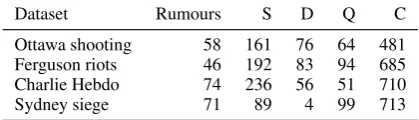
In our experiments we used two different data sets: RumourEval dataset (Derczynski et al., 2017) and the PHEME dataset (Zubiaga et al., 2016b). In the PHEME dataset the authors identify rumours asso-ciated with events, collect conversations sparked by those rumours in the form of replies and an-notate each of the tweets in the conversations for stance. These data consist of tweets from 5 differ-ent evdiffer-ents: Ottawa shooting, Ferguson riots, Ger-manwings crash, Charlie Hebdo and Sydney siege. Each dataset has a different number of rumours where each rumour contains tweets marked with stance annotations: “supporting”, “questioning”, “denying” or “commenting”. A summary of the data is given in Table 1.
The RumourEval dataset is derived from the PHEME dataset, however, for the purpose of the RumourEval shared Task A the data has a given
Dataset Rumours S D Q C
Ottawa shooting 58 161 76 64 481 Ferguson riots 46 192 83 94 685 Charlie Hebdo 74 236 56 51 710
Sydney siege 71 89 4 99 713
Table 1: PHEME Data: Counts of tweets with supporting (S), denying (D), questioning (Q) and commenting (C) labels in each event collection.
split into training and testing. This provides an es-tablished basis for evaluation. The training data draws from stories in 2014–2016, from the ear-lier PHEME dataset. The evaluation split covers two new stories, both from 2016: first, the dis-appearance of Marina Joyce, a British Youtube personality, who was rumoured to have been ab-ducted in July 2016. There was significant spec-ulation in social media, and the case was brought to a concrete resolution as the police investigated and posted an open public response. The sec-ond story was that Hillary Clinton had pneumonia during mid-September 2016. The prevalence and spread of this story could be tracked easily, and it emerged in a short space of time, though among background noise of speculative, unsubstantiated claims about her and her opponent’s health. More details about this dataset can be obtained from the SemEval website2.
In keeping with prior work (Zeng et al., 2016; Lukasik et al., 2016; Zubiaga et al., 2016a), our experiments assume that incoming tweets already belong to a particular rumour, e.g. a user is track-ing tweets related to a certain rumour. For each new tweet, features are extracted into a feature vector, which is then used to assign each tweet its stance towards the rumour.
3.2 Classifiers
We experiment with three different, well known machine learning classifiers: (1) a decision tree, J48; (2) Random Forests (Breiman, 2001); and (3) an Instance Based classifier (K-NN). For the Ran-dom Forest we use 50 trees (-I 50). Pruning is en-abled for J48. Finally we run the Instance Based classifier with-I -K 10settings.
3.3 Features
Prior work on stance classification investigated various features which can be categorized into linguistic, message-based, and topic-based
gories (Mendoza et al., 2010; Qazvinian et al., 2011; Hamidian and Diab, 2015; Liu et al., 2015; Zeng et al., 2016; Lukasik et al., 2016; Zubiaga et al., 2016a). The following list summarizes the features adopted in this work.
• BOW (Bag of words): For this feature we first create a dictionary from all the tweets in the out-of-domain dataset. Next each tweet is assigned the words in the dictionary as fea-tures. For words occurring in the tweet the feature values are set to the number of times they occur in the tweet. For all other words “0” is used.
• Brown Cluster: Brown clustering is a hard hierarchical clustering method and we use it to cluster words in hierarchies. It clus-ters words based on maximising the prob-ability of the words under the bigram lan-guage model, where words are generated based on their clusters (Liang, 2005). In pre-vious work, it has been shown that Brown clusters yield better performance than di-rectly using the BOW features (Lukasik et al., 2015). Brown clusters are obtained from a bigger tweet corpus that entails assignments of words to brown cluster ids. We used 1000 clusters, i.e. there are 1000 cluster ids. All 1000 ids are used as features however only, ids that cover words in the tweet are assigned a feature value “1”. All other cluster id fea-ture values are set to “0”.
• POS tag:The BOW feature captures the ac-tual words and is domain dependent. To cre-ate a feature that is not domain dependent, we added Part of Speech (POS) tags as ad-ditional feature. Similar to the BOW fea-ture we created a dictionary of POS tags from the entire corpus (excluding the health data) and used this dictionary to label each tweet with it – binary, i.e. whether a POS tag is present.3 However, instead of using just sin-gle POS tags, we created sequences contain-ing bi-gram, tri-gram and 4-gram POS tags. Feature values are the frequencies of POS tag sequences occurring in the tweet.
• Sentiment: This is another
domain-3We also experimented with frequencies of POS tags, i.e. counting how many times a particular POS tag occurs in the tweet. The counts then have been normalized using mean and standard deviation. However, the frequency based POS feature negatively affected classification accuracy, so it has been omitted from the feature set.
independent feature. Sentiment analysis reveals the sentimental polarity of the tweet such as whether it is positive or negative. We used the Stanford sentiment(Socher et al., 2013) tool to create this feature. The tool returns a range from 0 to 4 with 0 indicating “very negative” and 4 “very positive”. First, we used this as a categorical feature but turning it to a numeric feature gave us better performance. Thus each tweet is assigned a sentiment feature whose value varies from 0 to 4.
• NE:Named entity (NE) is also domain inde-pendent. We check for each tweet whether it containsPerson, Organization, Date, Loca-tionandMoneytags and for each tag present, “1” is added, or a “0” otherwise.
• Reply: This is a binary feature, which is as-signed “1” if the tweet is a reply to a previous one, or a “0” otherwise. Tweet reply infor-mation is extracted from the tweet metadata. Again this feature is domain independent.
• Emoticon:We created a dictionary of emoti-cons using Wikipedia4. In Wikipedia those emoticons are grouped by categories, which we use as a feature. If any emoticon from a category occurs in the tweet, we assign for that category feature the value “1” – other-wise “0”. Again similar to the previous fea-tures this feature is domain independent.
• URL:This is again domain independent. We assign the tweet “1” if it contains any URL, or “0” otherwise.
• Mood:Mood detection analyses textual con-tent using different view points or angles. Mood detection is performed using the tool from (Celli et al., 2016), which analyses tweets from five different angles: amused, disappointed, indignant, satisfied and wor-ried. For each of this angles it returns a value from -1 to +1. We use the different angles as the mood features and the returned values as the feature value.
• Originality score: This is the count of tweets the user has produced, i.e. “statuses count” in the Twitter API.
• isUserVerified(0-1): Whether the user is ver-ified or not.
• NumberOfFollowers: Number of followers the user has.
• Role score: This is the ratio between the number of followers and followees (i.e. NumberOfFollowers/NumberOfFollowees).
• Engagement score: the number of tweets di-vided by the number of days the user has been active (number of days since the user account creation till today).
• Favourites score: The “favourites count” di-vided by the number of days the user has been active.
• HasGeoEnabled(0-1): User has enabled geo-location or not.
• HasDescription(0-1): User has description or not.
• LenghtOfDescription in words: The num-ber of words in the user description.
• averageNegation: We determine using the Stanford parser (Chen and Manning, 2014) the dependency parse tree of the tweet, count the number of negation relation (“neg”) that appears between two terms and divide this by the number of total relations.
• hasNegation(0-1): Tweet has negation rela-tionship or not.
• hasSlangOrCurseWord(0-1): A dictionary of key words5 is used to determine the pres-ence of slang or curse words in the tweet.
• hasGoogleBadWord(0-1): Same as above but the dictionary of slang words is obtained from Google.6
• hasAcronyms(0-1): The tweet is checked for presence of acronyms using a acronym dic-tionary.7
• averageWordLength: Average length of words (sum of word character counts divided by number of words in each tweet).
• hasQuestionMark(0-1): The tweet has “?” or not.
• hasExclamationMark(0-1): The tweet has “!” or not.
• hasDotDotDot(0-1): Whether the tweet has “...” or not.
• numberOfQuestionMark: Count of “?” in the tweet.
• NumberOfExclamationMark: Count of “!” in the tweet.
• numberOfDotDotDot: Count of “...” in the tweet.
5www.noswearing.com/dictionary
6http://fffff.at/googles-official-list-of-bad-words 7www.netlingo.com/category/acronyms.php
• Binary regular expressions applied on each tweet: .*(rumor?—debunk?).*, .*is (that—this—it) true.*, etc. In total there are 10 features covering regular expressions. This work extends the features above, with new additional problem-specific features (AF fea-tures). AF features score the level of confidence in a tweet. We compute scores for surprise ( surpris-eScore (SS)), doubt (doubtScore (DS)), certainty (noDoubtScore (NDS)) and support (supportScore (SPS)) towards rumourous tweets. For each of these features a list of typical words is collected. We use this list to compute a cumulative vector using word2Vec (Mikolov et al., 2013). For each word in the list, we obtain its word2Vec represen-tation, add them together and finally divide the re-sulting vector by the number of words to obtain the cumulative vector. Similarly a cumulative vec-tor is computed for the words in the tweet exclud-ing acronyms, named entities and URLs. We use cosine to compute the angle between those two cu-mulative vectors to determine each of the scores. Our word embeddings comprise the vectors pub-lished by Baroni et al. (2014). The full list of tweet confidence AF features is as follows:
• surpriseScore (SS): cosine between embed-ding of tweet content and the list of surprise words, e.g. “surprise”, “wonder”, etc.
• doubtScore (DS): cosine between embed-ding of tweet content and the list of doubt words, e.g. “doubt”, “uncertain”, etc.
• noDoubtScore (NDS): cosine between em-bedding of tweet content and the list of cer-tainty words, e.g.“surely”, “sure”, etc.
• supportScore (SPS): cosine between em-bedding tweet content and the list of support words, e.g. “support”, “confirm”, etc. Furthermore, the following two AF features are included:
• initialTweetSim (ITS) captures tweets that tend to support rumours. Every rumour is initiated by a tweet. We compute the cosine similarity based on word2Vec of the tweet being classified to the first tweet in the ru-mour thread. If the tweet is just a simple re-retweet of the initial tweet, this is taken as an evidence that the tweet is supportive of that tweet.
Classifier All features w.o. AF
Decision tree 74.16 72.25 Random Forest 79.02 76.54
IBk 75.59 73.02
Baseline-Turing 78.4 –
Table 2: Accuracy scores of different stance classifiers for the RumourEval dataset. The baseline is the best performing system in the SemEval evaluationTuring.
4 Experimental Setup
4.1 Baselines
On the RumourEval dataset we run different clas-sifiers (see Section 3.2). We compare the per-formance of these classifiers against the best-performing system from the RumourEval chal-lenge, namelyTuring(Kochkina et al., 2017).
We also run all the classifiers from the Ru-mourEval dataset on the PHEME dataset. The re-sults are compared against the following baseline systems reported on the PHEME dataset:
• Gaussian Processes (GP) reported by Lukasik et al. (2015).
• Hawkes Processes (HP)reported by Lukasik et al. (2016). HPs make use of both temporal and textual information of tweets.
4.2 Training-Testing Settings
We have two different settings. In the first set-ting we use the SemEval training data to train the models and apply on the testing data. In the sec-ond setting we perform training and testing on the PHEME dataset. For the PHEME dataset, we fol-low the leave one out (LOO) strategy taken by Lukasik et al. (2016) to construct the training and testing data. In LOO n-1 rumours (all tweets within these rumours) are used for training and the resulting model is tested on the nth rumour. Fi-nally, results are macro-averaged.
5 Results
As shown in Table 2 (column two of the table) the best performing learner on the RumourEval dataset is the Random Forest classifier. It achieves the accuracy of79.02, higher than any participat-ing system in the RumourEval Task A.8
The results on the PHEME dataset are shown in Table 3. Overall the best performing classi-fier is the J48 decision tree learner. The difference
8The results are reported inhttp://alt.qcri.org/ semeval2017/task8/index.php?id=results
in accuracy scores between the classfiers is tested for significance using paired t-test (p<0.001). J48 is only significantly better than IBk and J48 for theOttawa shootingevent type. In the remaining event types, J48 performs better, but not signifi-cantly better than IBk and Random Forest.
All classifiers J48, IBk and Random Forest, however, outperform theGPandHPbaselines on all event types9.
What these results demonstrate is that simpler classifiers, such as J48 and Random Forest can outperform significantly more sophisticated ma-chine learning methods (GPs and HPs in this case, and LSTMs in the RumourEval case), thanks to the additional knowledge captured in the rich fea-ture set. In contrast, for example, the GP and HP models relied primarily on BOW and Brown clus-tering features.
6 Feature Analysis
The results described in Section 5 are based on features reported by related work, enhanced by us with AF features (Section 3.3). We repeat the ex-periments with AF features removed from the fea-ture set, in order to quantify the extent of their con-tribution.
For the RumourEval dataset the results are shown in column 3 of Table 2. The omission of the AF features leads to a performance decrease for all classifiers. The accuracy scores also fall be-low that of the SemEval winnerTuring– the state-of-the-art system on the RumourEval dataset.
The results on the PHEME dataset are shown in Table 4. The exclusion of the AF features leads to an overall drop in performance when compared to the same classifiers in Table 3. However, these differences are not significant and the classifiers with AF features removed still perform at least as well as the GP and HP baselines (for the event type
Ferguson riots), or outperform the baselines (for all other event types).
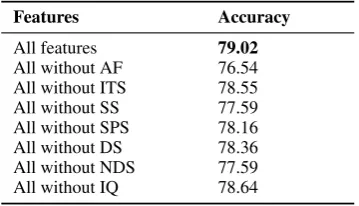
Table 5 shows the accuracy scores of the Ran-dom Forest stance classifier, the best performing system on the RumourEval dataset when each AF feature is removed in turn. The results indicate that each AF feature contributes to the accuracy boost in stance classification. The highest
classifier Ottawa shooting Ferguson riots Charlie Hebdo Sydney siege macro mean
IBk 70.31* 72.35 78.33(ref) 75.44 74.10
Decision tree 76.28(ref) 75.20(ref) 78.21 80.01(ref) 77.42
Random Forest 69.39* 69.16 74.57 74.49 71.90
Baseline - GP 62.28 64.31 70.66 65.04 65.57
Baseline - HP 67.77 68.44 72.93 68.59 69.43
Table 3: Accuracy scores for different stance classifiers on the PHEME dataset. * indicates a significant difference to (“ref”) scores for each column of the table respectively as indicated by the paired t-test withp <0.001.
classifier Ottawa shooting Ferguson riots Charlie Hebdo Sydney siege macro
mean
IBk / AF 69.26 69.54 77.09 73.28 72.29
J48 / AF 75.62 74.85 77.05 79.21 76.68
Random Forest / AF 67.87 68.31 75.40 72.57 71.03
Table 4: Accuracy scores of different stance classifiers on the PHEME dataset with AF features removed.
Features Accuracy
All features 79.02
All without AF 76.54 All without ITS 78.55 All without SS 77.59 All without SPS 78.16 All without DS 78.36 All without NDS 77.59 All without IQ 78.64
Table 5: Contribution of each AF feature. Accuracy scores are for the Random Forest classifier on RumourEval data set with each feature removed in turn.
racy loss results from removing the surprise (SS) and certainty (NDS) scores and the least – when the isQuestion(IQ) feature is removed. None of the AF feature removals cause a significant drop in accuracy. However, the loss is significant (p <
0.0001) when all AF features are removed. Both RumourEval and PHEME dataset evalu-ations show that the AF features play an impor-tant role in terms of achieving higher accuracy for tweet-based stance classification. They also show the importance of task or problem-specific feature engineering and point out that it is possi-ble with some feature engineering effort to outper-form state-of-the-art techniques that are typically considered more powerful and sophisticated than traditional learning methods.
7 Conclusion
This paper tackled the problem of stance classifi-cation of tweets towards rumours. In our approach we use a simple classification approach, combin-ing common features reported by related studies with our novel AF features, to boost overall
ac-curacy. Our results show that this approach leads to significantly better results on both RumourEval and PHEME datasets compared to current state-of-the-art systems. Furthermore, our results show that the omission of the AF features proposed in this work leads to significantly lower performance. Adding AF to the feature set causes our approach to outperform the best performing system on the RumourEval dataset. These results show the im-portance of task- or problem-oriented feature en-gineering.
The proposed features are content based and work on text level. In our future work we plan to investigate features that are able to capture com-munication behaviours between users. We also plan to apply stance information as a feature in ru-mour veracity classification.
Acknowledgments
This work was partially supported by the Euro-pean Union funded COMRADES (grant agree-ment No. 687847) and PHEME projects (grant agreement No. 611223), as well as an EPSRC ca-reer acceleration fellowship (EP/I004327/1).
References
Isabelle Augenstein, Tim Rockt¨aschel, Andreas Vla-chos, and Kalina Bontcheva. 2016. Stance detec-tion with bidirecdetec-tional condidetec-tional encoding. In Pro-ceedings of the 2016 Conference on Empirical Meth-ods in Natural Language Processing. Association for Computational Linguistics, Austin, Texas, pages 876–885. https://aclweb.org/anthology/D16-1084.
Stance towards Rumours with Topic Independent Features. InProceedings of SemEval. ACL. Marco Baroni, Georgiana Dinu, and Germ´an
Kruszewski. 2014. Don’t count, predict! a systematic comparison of context-counting vs. context-predicting semantic vectors. InProceedings of ACL. pages 238–247.
Douglas Biber. 2006. Stance in spoken and written uni-versity registers. Journal of English for Academic Purposes5(2):97–116.
Leo Breiman. 2001. Random forests. Machine learn-ing45(1):5–32.
Fabio Celli, Arindam Ghosh, Firoj Alam, and Giuseppe Riccardi. 2016. In the mood for sharing contents: Emotions, personality and interaction styles in the diffusion of news. Information Processing & Man-agement52(1):93–98.
Danqi Chen and Christopher D Manning. 2014. A fast and accurate dependency parser using neural net-works. InProceedings of EMNLP. pages 740–750. Yi-Chin Chen, Zhao-Yand Liu, and Hung-Yu Kao.
2017. IKM at SemEval-2017 Task 8: Convolutional Neural Networks for Stance Detection and Rumor Verification. InProceedings of SemEval. ACL. Leon Derczynski and Kalina Bontcheva. 2014.
PHEME: Veracity in Digital Social Networks. In Proceedings of the UMAP Workshops.
Leon Derczynski, Kalina Bontcheva, Maria Liakata, Rob Procter, Geraldine Wong Sak Hoi, and Arkaitz Zubiaga. 2017. SemEval-2017 Task 8: Ru-mourEval: Determining rumour veracity and sup-port for rumours. InProceedings of SemEval. ACL.
Omar Enayet and Samhaa R. El-Beltagy. 2017. NileTMRG at SemEval-2017 Task 8: Determining Rumour and Veracity Support for Rumours on Twit-ter. InProceedings of SemEval. ACL.
Marianela Garc´ıa Lozano, Hanna Lilja, Edward Tj¨ornhammar, and Maja Maja Karasalo. 2017. Mama Edha at SemEval-2017 Task 8: Stance Clas-sification with CNN and Rules. In Proceedings of SemEval. ACL.
Weiwei Guo and Mona Diab. 2012. Modeling sen-tences in the latent space. InProceedings of ACL. Association for Computational Linguistics, pages 864–872.
Mark Hall, Eibe Frank, Geoffrey Holmes, Bernhard Pfahringer, Peter Reutemann, and Ian H Witten. 2009. The weka data mining software: an update. ACM SIGKDD explorations newsletter11(1):10–18. Sardar Hamidian and Mona T Diab. 2015. Rumor De-tection and Classification for Twitter Data. In Pro-ceedings of SOTICS.
Sardar Hamidian and Mona T Diab. 2016. Rumor iden-tification and belief investigation on twitter. In Pro-ceedings of NAACL-HLT. pages 3–8.
Elena Kochkina, Maria Liakata, and Isabelle Augen-stein. 2017. Turing at SemEval-2017 Task 8: Se-quential Approach to Rumour Stance Classification with Branch-LSTM. InProceedings of SemEval. Percy Liang. 2005. Semi-supervised learning for
nat-ural language. Ph.D. thesis, Massachusetts Institute of Technology.
Xiaomo Liu, Armineh Nourbakhsh, Quanzhi Li, Rui Fang, and Sameena Shah. 2015. Real-time rumor debunking on twitter. In Proceedings of CIKM. ACM, pages 1867–1870.
Michal Lukasik, Trevor Cohn, and Kalina Bontcheva. 2015. Classifying tweet level judgements of rumours in social media. arXiv preprint arXiv:1506.00468.
Michal Lukasik, P. K. Srijith, Duy Vu, Kalina Bontcheva, Arkaitz Zubiaga, and Trevor Cohn. 2016. Hawkes processes for continuous time se-quence classification: an application to rumour stance classification in twitter. InProceedings of the 54th Meeting of the Association for Computational Linguistics. Association for Computer Linguistics, pages 393–398.
Marcelo Mendoza, Barbara Poblete, and Carlos Castillo. 2010. Twitter under crisis: can we trust what we rt? InProceedings of the workshop on so-cial media analytics. ACM, pages 71–79.
Tomas Mikolov, Ilya Sutskever, Kai Chen, Greg S Cor-rado, and Jeff Dean. 2013. Distributed representa-tions of words and phrases and their compositional-ity. InAdvances in neural information processing systems. pages 3111–3119.
Saif M Mohammad, Svetlana Kiritchenko, Parinaz Sobhani, Xiaodan Zhu, and Colin Cherry. 2016. Semeval-2016 task 6: Detecting stance in tweets. Proceedings of SemEval16.
Rob Procter, Jeremy Crump, Susanne Karstedt, Alex Voss, and Marta Cantijoch. 2013. Reading the riots: What were the police doing on twitter? Policing and society23(4):413–436.
Vahed Qazvinian, Emily Rosengren, Dragomir R Radev, and Qiaozhu Mei. 2011. Rumor has it: Iden-tifying misinformation in microblogs. In Proceed-ings of EMNLP. pages 1589–1599.
Vikram Singh, Sunny Narayan, Md Shad Akhtar, Asif Ekbal, and Pushpak Bhattacharya. 2017. IITP at SemEval-2017 Task 8: A Supervised Approach for Rumour Evaluation. InProceedings of SemEval.
and Christopher Potts. 2013. Recursive deep mod-els for semantic compositionality over a sentiment treebank. InProceedings of EMNLP. volume 1631, page 1642.
Ankit Srivastava, Rehm Rehm, and Julian Moreno Schneider. 2017. DFKI-DKT at SemEval-2017 Task 8: Rumour Detection and Classification using Cascading Heuristics. In Proceedings of SemEval. ACL.
Yla R Tausczik and James W Pennebaker. 2010. The psychological meaning of words: Liwc and comput-erized text analysis methods. Journal of language and social psychology29(1):24–54.
Peter Tolmie, Rob Procter, Mark Rouncefield, Maria Liakata, and Arkaitz Zubiaga. 2015. Microblog analysis as a programme of work. arXiv preprint arXiv:1511.03193.
Feixiang Wang, Man Lan, and Yuanbin Wu. 2017. ECNU at SemEval-2017 Task 8: Rumour Evalua-tion Using Effective Features and Supervised En-semble Models. InProceedings of SemEval. ACL. Li Zeng, Kate Starbird, and Emma S Spiro. 2016.
#unconfirmed: Classifying rumor stance in crisis-related social media messages. In Proceedings of ICWSM.
Arkaitz Zubiaga, Elena Kochkina, Maria Liakata, Rob Procter, and Michal Lukasik. 2016a. Stance clas-sification in rumours as a sequential task exploiting the tree structure of social media conversations. In Proceedings of COLING.