EFFECT OF SECOND ORDER SLIP ON FLOW AND HEAT
TRANSFER CHARACTERISTICS OF A VISCOUS FLUID OVER A
SHRINKING SHEET
Muneer Patel
Department of Mathematics, Dravidian University, Kuppam-517425, Andra Pradesh, India
ABSTRACT
This paper considers the study of viscous flow and heat transfer over a shrinking sheet
considering the effect of second order slip. The governing partial differential equations of the
flow and heat transfer are converted into nonlinear ordinary differential equations by using
suitable similarity transformation. The exponential form of solution for momentum equation is
assumed and governing heat transfer equation is solved analytically by power series method
and the solution is obtained in terms of Kummer’s Hypergeometric function. The effects of
various physical parameters on flow and heat transfer characteristics are investigated with
graphical illustrations.
Keywords: Shrinking sheet, Second Order Slip, Kummer’s Function, Mass suction
1.Introduction
The flow induced by a moving boundary is important in the study of extrusion processes
(Sakiadis B.C. 1961). (Sakiadis B.C.1961). (Crane L .J, 1970) and is a subject of considerable
interest in the contemporary literature (Miklavcic M, Wang CY, 2006), for both permeable and
impermeable stretching sheets. Miklavcic and Wang ( Miklavcic M, Wang C.Y.2006).have
reported an exact solution of the NS equations for flow over a shrinking sheet. The shrinking
sheet problem was also extended to power-law shrinking velocity and other fluids.
International Research Journal of Natural and Applied Sciences ISSN: (2349-4077) Impact Factor- 5.46, Volume 4, Issue 10, October 2017 Website- www.aarf.asia, Email : [email protected] , [email protected]
In the past decade, fluid flow in micro-electro-mechanical systems (MEMS) has become a hot
research topic. Because of the micro-scale dimensions of these devices, the flow behaviuor
deviates significantly from the traditional no-slip flow (Gal-el-Hak M, 1999). Rarefied gas flows
with slip boundary conditions are often encountered in micro-scale devices and low-pressure
situation (Gal-el-Hak M, 1999).
For the flow in the slip regime (Shidlovskiy VP.1967 and Pande GC, Goudas CL 1996)., the
fluid motion still obeys the Navier-Stokes (NS) equations with slip velocity boundary
conditions. In addition, partial slip over moving surface also occurs for fluids with particulate
such as emulsions, suspensions, foams, and polymer solutions (Yoshimura A, proteome
RK,1988),the slip flows under different flow configurations have been studied in recent years.
However, in these papers, only the first order Maxwell slip condition was used. Recently, (Wu
L.A, 2008) proposed a new second order slip velocity model, which matches with the
Fukui-Kaneko results based on the direct numerical simulation of the linerized Boltzmann equation
(Fukui S, Kaneko R. A, 2009.). (Tiegang Fang, Shanshan Yao, ji Zzhang, Abdul Aziz, 2009)
Studied the slip flow over a permeable shrinking surface with the newly proposed Wu’s slip
velocity model with exact solutions of the governing NS equations. In the present study we have
extended the work of (Tiegang Fang, Shanshan Yao, ji Zzhang, Abdul Aziz ,2009) considering
heat transfer and also with boundary layer approximation.
2. Mathematical formulation and discussion
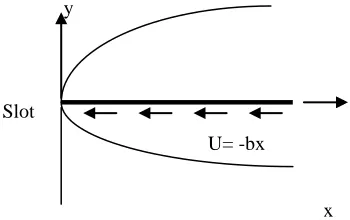
Consider a steady, two-dimensional laminar flow over a continuously shrinking sheet in a
quiescent fluid. The sheet shrinking velocity is Uw = - U0 x , with U0 being a constant and the wall
mass transfer velocity is Vw =Vw (x), which will be determined later.
Fig (1): Schematic diagram of boundary layer slip flow past a shrinking sheet
U= -bx Slot
y
x
[image:2.612.78.253.520.630.2]The x-axis runs along the shrinking surface in the direction opposite to the sheet motion
and the y-axis is perpendicular to it. The governing boundary layer equation for the proposed
problem can be expressed as
0 u v x y (1) 2 2
u u u
u v v
x y y
(2)
With the boundary conditions
U(x, 0) = U0 x+Uslip, V(x, 0) = Uw (x), and u(x,) = 0,
(3)
Where u and v are the velocity components in the x and y directions. v is the kinematic
coefficient of viscosity, is the fluid density, and Uslip is the velocity slip at the wall. The
Wu’s slip velocity model used in this paper is valid for arbitrary Knudsen numbers, Kn, and is
given as follows (Wu ,2008)
Uslip =
3 2 2 2
4 2 2
2 2 2
2 3 3 1 1 2
1 ,
3 2 n 4 n
l l u u u u
l l A B
K y K y y y
(4)
Where l = min [ 1
n
K , 1], , is the momentum accommodation coefficient with 0 1, and
is the molecular mean free path. Based on the definition of l, it is noticed that any given value of Kn, we have
0 l 1. The molecular mean free path is always positive. Thus we know that B0 and
positive. The stream function and similarity variable can be assumed in the following form,
x y, f( )x U0, U0
y
(5)
With these transformations, the velocity components are expressed as
'
0 ( )
uU xf andv U v f0 ( ) .
The wall mass transfer velocity becomesvw( )x U v f0 (0).
(7)
Using equations (5) and (6) in equations (1) and (2) we obtain the transformed form of boundary
layer equations of motion,
''' '' '2
0
f ff f (8)
Similarly, the boundary conditions equation (3) takes the form
(0) ,
f s f'(0) 1 f//(0) f///(0)0, and f'( ) 0, (9) Where s is the wall mass transfer parameter showing the strength of the mass transfer at the
surface, is the first order velocity slip parameter with 0
0 A U ,
v
and is the second
order velocity slip parameter with 0
0 BU .
v
we derive a closed form exact solution of
Eq.(8) subject to the BCs of Eq. (9). We assume a solution of the form f( ) a be. The application of boundary condition (9) gives the values for a and b as mentioned below.
2 3
1
b
,
(10)
2 3
1
a S
,
(11)
Substituting the assumed solution into Eq.(9) yields a = . The use of this relationship in Eq.
(11) leads to the following fourth order algebraic equation for ,
4 3 2
( s) ( s 1) s 1 0
.
(12)
should be least positive value.
Then the solution reads as
2 3 2 3
1 1
( )
f s e
,
2
1 ( )
1
f e
,
(14)
Based on the results in Eq. (14), it is easy to show that
// 2
2
(0) ( )
1
f s
(15)
3. Heat transfer analysis
The thermal boundary layer equation, with work done by deformation, and internal heat
generation or absorption is given by
2
2
p
T T k T
u v
x y c y
(16)
Where cp is the specific heat, is density, k is thermal conductivity
3.1 Constant surface temperature (CST)
The boundary conditions in case of CST is given by
at 0; as
w T T y
T T y
(17)
Where TW is the temperature of the sheet and T is the temperature of the fluid far away from
the sheet.
Defining the non-dimensional temperature
as
W T T T T (18)Using ( 18), Eq. (16 ) can be written in the form
'' '
Pr f 0
(19)
Where Pr Cp
k
Consequently the boundary conditions (17) take the form
1 0 0 at as (20)Introducing the new independent variable
Pre
and substituting in Eq. (19) we obtain
'' ' ' '
11 12 0
P P
(21)
Where 11 12
Pr
, Pr
a b
P P and e
The corresponding boundary conditions are
1 Pr 0 0 at e as (22)The solution of Eq. (21) subject to the boundary conditions (22) is given by
Pr1
Pr Pr
Pr 1 , ; Pr
k
a b a
C e M k k e
(23) Where 1 Pr 1 Pr Pr
Pr 1 ,
k C
a b a
e M k k
3.2 The Prescribed surface temperature (PST case)
2
0
W
x
T T T A at y l
T T at y
(24)
Where A is constant. TW is temperature at the wall. T is temperature away from the sheet.
We define non-dimensional temperature as
W T T T T (25)So that the equation (16) reduces to the form
'' ' '
Pr 2f Pr f
(26)
the corresponding boundary conditions (24) reduces to
0 1 0 (27)
Using the new independent variable defined as
2 Pre t
and substituting in equation (26) we obtain
'' '
11 12
1 2 0
t t P P t t
(28)
WhereP11 aPr , P12 b
The corresponding boundary conditions will be
1 Pr
0 0
t at t e
t as t
(29)
We obtain the solution of above equation (26) by using power series method and in terms of
Pr Pr
2
Pr Pr Pr
2 2 , 1 ,
Pr Pr Pr
2 2 , 1 ,
a a a
e M b e
a a
M b
(30)
4. Results and Discussion
In this problem, we proposed to investigate the flow and heat transfer characteristics of a
viscous fluid with second order slip. The governing equations for momentum and heat transfer
are partial differential equations which are converted into ordinary differential equations by
using suitable similarity transformations.
An analytical solution [exponential solution] for flow has been assumed, and this assumed
solution is used to solve the heat transfer equations by power series method and expressed in
terms of Kummer’s hyper geometric functions. The results are depicted graphically from graph
Fig 2 to 12.
Fig 2. Shows the effect of mass suction parameter s on considered flow. It shows that as there is
increase in the parameter value of‘s’ velocity '
f is decreases.
Fig 3. Shows the effect of first order slip parameter on velocity profile f'. It is noticed that as
first order slip parameter increases velocity profile f' decreases.
Similarly in Fig 4, we notice that the effect of second order slip parameter is to sustain velocity
profile f' in the boundary layer.
Fig (5) and (6), Shows the effect of mass suction parameter on temperature profile in CST and
PST cases. It is observed from these two graphs that as mass suction parameter s increases
temperature decreases.
Fig (7) and (8), Shows the effect of second order slip parameter in CST and PST cases. It is
observed from these two graphs that as decreases temperature increases.
Fig. (9) and (10), Shows the effect Pr in CST and PST cases. It is observed from these two
Fig (11) and (12), Shows the effect of first order slip parameter .in CST and PST cases. It is
observed from these two graphs that as increases temperature decreases.
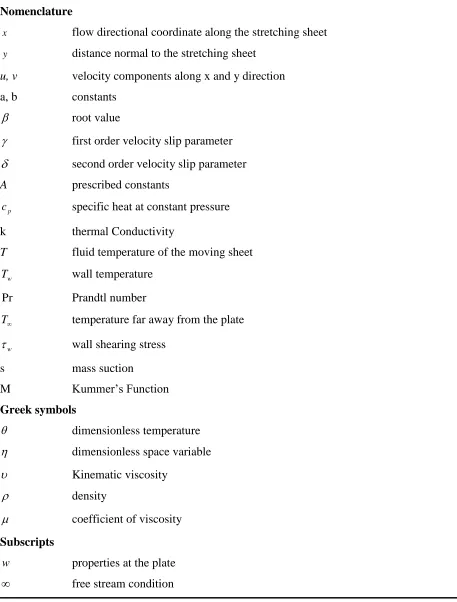
Nomenclature
x flow directional coordinate along the stretching sheet
y distance normal to the stretching sheet
u, v velocity components along x and y direction
a, b constants
root value
first order velocity slip parameter second order velocity slip parameter
A prescribed constants
p
c specific heat at constant pressure
k thermal Conductivity
T fluid temperature of the moving sheet
w
T wall temperature
Pr Prandtl number
T temperature far away from the plate
w
wall shearing stress
s mass suction
M Kummer’s Function
Greek symbols
dimensionless temperature
dimensionless space variable
Kinematic viscosity
density
coefficient of viscosity
Subscripts
w properties at the plate
[image:9.612.72.529.99.701.2]η differentiation with respect to η
References
[1] Sakiadis B.C., 1961. Boundary-layer behavior on continuous solid surface: I. Boundary-layer
equations for two-dimensional and axisymmetric flow Aiche :26-8.
[2]Sakiadis B.C.1961. Boundary-layer behavior on continuous solid surface: II. Boundary-layer
equations for two-dimensional and axisymmetric flow A .I .C .H. E :7:221-5.
[3] Crane L ,J. 1970. Flow past a stretching plate. Z Angew Maths phys .21 {4}; 645.
[4] Miklavcic M, Wang CY.2006. Viscous flow due to a shrinking sheet. Quart Appl Math
64(2); 283-90
[5] Fang T. 2008.Boundary layer flow over a shrinking sheet with power- law velocity.
Int J Heat Mass Transfer 51(25/26); 5838-43.
[6] Fang T, Zhang J. 2009.Closed-form exact solutions of MHD Viscous flow over a shrinking
Sheet. Comm.Nonlin .Sci.numer. simul ; 14(7); 2853-2857.
[7]Fang T, Zhang J, Yao S.2009. Viscous flow over an unsteady shrinking sheet with mass
transfer. Chin Phys Lett 26(1); 014703.
[8]Fang T, Liang W, Lee CF. 2008.A new solutions branch for the blasius equation – a
shrinking sheet problem. Comp Math Appl56 (12); 3088-95.
[9]Fang T, Zhang J, 2009.Heat transfer over a shrinking sheet – an analytical solution.
Acta Mech. Doi; 10.1007/s00707-009-0183-2;
[10] Hayat T, Abbas Z, Sajid M.2007. On the analytic solution of magneto hydrodynamic flow
of a second grade fluid over a shrinking sheet Appl Math Trans ASME 74(6); 1165-71.
[11] Sajid M, Hayat T, Jived T. 2008. MHD rotating flow of a viscous fluid over a shrinking
surface. Nonlinear Dyn 51(1-2); 259-65.
[12]Sajid M, Hayat T, 2007. The application of homotopy analysis method for MHD viscous
flow due to a shrinking sheet. Chaos, solutions & Fractals doi;10,1016/j.chaos.2007.06.019.
[13]Elbashbeshy EMA,1998. Heat transfer over a stretching with variable surface heat flux.
JPhys D Appl Phys31; 1951-4.
[14] Magyari E, Keller B1999. Heat and mass transfer in the boundary layers on an
exponentially stretching continuous surface. J Phys D Appl Phys 32 ;( 5); 577- 585.
[16]Magyari E, Ali ME, Keller B. 2001.Heat and mass transfer characteristics of the self-
similar boundary-layer flows induced by continuous surfaces stretched with rapidly
decreasing velocities. Heat Mass Transfer 38(1-2); 65-74.
[17]Liao S.J.2005. A new branch of solutions of boundary-layer flows over a stretching flat
plate. Int Heat Mass Transfer 49(12); 2529-39.
[18] Liao S.J, 2007. A new branch of solutions of boundary-layer flows over a permeable
stretching plate. Int J Nonlinear Mech 42; 819-30
[19]Fang T, Zhang J, 2008.Flow between two stretchable disks. Int common Heat Mass
transfer 35(8); 892-5.
[20] Fang T.2007. Flow over a stretchable disk. Phys Fluids 19; 128105.
[21]Wang C.Y.1991. Exact solutions of the steady state navier-stokes equations. Ann Rew
Fluid Mech 23:159-77.
[22]Miklavcic M, Wang C.Y.2006. Viscous flow due to a shrinking sheet. Quart Appl Math
64(2); 283-90
[23]Fang T.2008. Boundary layer flow over a shrinking sheet with power- law velocity. Int J
Heat Mass Transfer 51(25/26); 5838-43.
[24]Fang T, Zhang J. 2009. Closed-form exact solutions of MHD Viscous flow over a
shrinking sheet. Commun Nonlinear Sci numer simulate 14(7); 2853-7.
[25]Fang T, Zhang J, Yao S.2009. Viscous flow over an unsteady shrinking sheet with mass
transfer. Chin Phys Lett 26(1); 014703.
[26]Fang T, Liang W, Lee CF. 2008.A new solutions branch for the blasius equation – a
shrinking sheet problem. Comut Math Appl 56(12); 3088-95.
[27]Fang T, Zhang J, 2009.Heat transfer over a shrinking sheet – an analytical solution. Acta
Mech. Doi; 10.1007/s00707-009-0183-2.
[28]Hayat T, Abbas Z, Sajid M.2007.on the analytic solution of magneto hydrodynamic flow
of a second grade fluid over a shrinking sheet. Apple Meth Trans ASME 74(6); 1165-71.
[29]Sajid M, Hayat T, jived T. 2008.MHD rotating flow of a viscous fluid over a shrinking
surface. Nonlinear Dyn 51(1-2); 259-65.
[30]Sajid M, Hayat T, 2007.The application of homotopy analysis method for MHD viscous
flow due to a shrinking sheet. Chaos, solutions & Fractsls doi;10,1016/j.chaos.
[31] Gal-el-Hak M.1999. The fluid mechanics of micro-devices-the freeman scholar. ASME
[32] Shidlovskiy VP.1967. Introduction to the dynamics of rarefied gases. New York;
American Elsevier publishing company Inc
[33] Pande GC, Goudas CL.1996. Hydro magnetic Rayleigh problem for a porous wall in slip
flow regime. Astrophys Space Sci 243:285-9.
[34]Yoshimura A, proteome RK. 1998. Wall slips correction for coquette and parallel disc
viscometers. J Rheol 32; 53-67.
[35]Martin MJ, Boyd ID.2001. Blasius boundary layer solution with slip flow conditions. In:
AIP conference proceedings, rarefied gas dynamics: 22nd international symposium,
vol. 585, .p. 518-23.
[36]Anderson HI.2002. Slip flow past a stretching surface. Acta Mech 158:121-5.
[37]Wang CY.2002. Flow due to a stretching boundary with partial slip-an exact solution of
the Navier-stokes equations. Chem Eng Sci 57(17); 3745-7.
[38]Fang T, Lee CF.2005. A moving-wall boundary layer flow of a slightly rarefied gas free
stream over a moving flat plate. Apple Math Lett. 18 ;( 5); 487-95.
[39]Fang T, Lee CF.2006. exact solutions of incompressible coquette flow with porous walls
for slightly rarefied gases. Heat mass transfer .42(3); 255-62.
[40] Fang T, Zhang J, Yao S.2009. Slip MHD viscous flow over a stretching sheet – an exact
solution. Commum Nonlinear Sci numer simulat 14(11); 3731-7
[41]Wang CY., 2006. Stagnation slip flow and heat transfer on a moving plate. Chem. eng sci
61(23); 7668-72.
[42]Wang CY2007.stagnation flow on a cylinder with partial slip – an exact solution of the
Navier-stokes equations. IMA J Apple Math 72(3); 271-7.
[43] Wang CY.2009. Analysis of viscous flow due to a stretching sheet with surface slip and
suction. Nonlinear Anal Real world Apple, 10(1); 375-80.
[44]Aziz A. 2009.Hydrodynamic and thermal slip flow boundary layers over a flat plate with
constant heat flux boundary condition. Commun Nonlinear sci numer simulate. Doi;
10.1016/j.cnsns
[45]Wu L.A slip model for rarefied gas flows at arbitrary Knudsen number. Appl Phys
lett 2008; 93:253103.
[46]Tiegang Fang, Shanshan Yao, ji Zzhang, Abdul Aziz 2009, viscous flow over a shrinking
0 1 2 3 4 5 -0.30
-0.25 -0.20 -0.15 -0.10 -0.05 0.00
Fig(2) Variation of f'() versus for different values of s
f'()
Velocity Profile
=-1.0,
=1.0
s=3,2,1
0.0 0.5 1.0 1.5 2.0 2.5 3.0 3.5 4.0
-0.08 -0.07 -0.06 -0.05 -0.04 -0.03 -0.02 -0.01 0.00 0.01
Fig(3) Variation of f'() versus for different values of
f'()
Velocity Profile s=2.0, = -0.03
0 2 4 6 8 10 0.0
0.2 0.4 0.6 0.8 1.0
Fig(5) Variation of () versus for different values of s s=1,2,3
()
CST CASE Pr=1,=1,=-1
0 1 2 3 4
-0.05 -0.04 -0.03 -0.02 -0.01 0.00
Fig(4) Variation of f'() versus for different values of
Velocity Profile s=2, = 0.5
f'()
0 2 4 6 0.0
0.2 0.4 0.6 0.8
1.0 PST CASE
= -1.0, = 1.0, Pr= 1.0
s= 1, 2, 3, 4, 5
Fig(6) Variation of ()versus for different values of s
0 2 4 6 8 10
0.0 0.2 0.4 0.6 0.8 1.0
()
Fig(7) Variation of ()versus for different valuses of =-1,-2,-3
0 2 4 6 8 10 0.0
0.2 0.4 0.6 0.8 1.0
Fig(9) Variation of ()versus for different valuses of Pr Pr=0.7,1.0,1.5
cst case
=1.0, =1.0, s=1.0
()
0 2 4 6 8 10
0.0 0.2 0.4 0.6 0.8 1.0
Fig(8) Variation of ()versus for different valuses of
= -1,-2,-3,-4,-5
0 1 2 3 4 5 6 0.0
0.2 0.4 0.6 0.8 1.0
Fig(10) Variation of() versus for different valuses of Pr
PST CASE
= -1.0, = 1.0, s= 1.0
Pr=0.7, 1, 1.5, 2, 2.5
0 2 4
0.0 0.2 0.4 0.6 0.8 1.0
Fig(11) Variation of ()versus for different valuses of CST CASE S=1,Pr=1,=1
=3,5,7
0 2 4 6 8 10 0.0
0.2 0.4 0.6 0.8 1.0
Fig(12) Variation of()versus for different valuses of
PST CASE
S=1,Pr=1,=-1
()