Inter-domain Opinion Phrase Extraction Based on Feature Augmentation
G´abor Berend1, Istv´an Nagy T.1, Gy¨orgy M´ora1 and Veronika Vincze1,2
1Department of Informatics, University of Szeged
{berendg,nistvan,gymora}@inf.u-szeged.hu
2Hungarian Academy of Sciences, Research Group on Artificial Intelligence
Abstract
In this paper, a system for the extraction of key ar-gument phrases – which make the opinion holder feel negative or positive towards a particular prod-uct – from prodprod-uct reviews is introduced. Since the necessary amount of training examples from any ar-bitrary product type (target domain) is not always available, the possible usage of domain adaptation in the task of opinion phrase extraction is also ex-amined. Experimental results show that models re-lying on training examples mainly from a different domain can still yield results that are comparable to that of the intra-domain settings.
1 Introduction
There has been a growing interest in the NLP treat-ment of subjectivity and sentitreat-ment analysis (see e.g. Balahur et al. (2011)) and that of keyphrase extraction, e.g. Kim et al. (2010). Product re-views serve as perfect objects for the combination of the above mentioned research areas as the opion bearing phrases of a product review can be in-terpreted analogously to regular keyphrases of sci-entific documents, i.e. in both cases proper phrases have decisive role within the document where they were present. The fact that some review portals have the possibility to leave a set of pro and con phrases underlines this resemblance between opin-ion phrases and scientific keyphrases.
However, despite the somewhat common na-ture of opinion phrases and keyphrases, methods that work on the well studied field of scientific keyphrase extraction are not necessarily success-ful in the extraction of opinion phrases from prod-uct reviews. On the one hand, although proper phrases have their decisive role in both types of genres, opinion phrases are the ones that form the sentiments of the opinion holder, whereas in the case of scientific keyphrases they should be such phrases that summarize well the content of a document. Note the difference between opinion-forming phrases and those which summarize well the content of a document, i.e. one can frequently
use such phrases in a review that does not have much importance in the opinion-forming aspect, whereas in the case of scientific documents fre-quently used phrases tend to be proper keyphrases as well.
Most of the standard keyphrase extraction algo-rithms employ supervised learning, which makes the accessibility of training instances generated from reviews and the sets of opinion phrases as-signed to them prerequisite. In the case of training an opinion phrase extractor on one domain, this criterion is not easily fulfilled in every case, due to the fact that it is not necessary that one can find abundant training examples for any kind of prod-uct types. For this reason, exploiting domain adap-tation techniques during the task of opinion phrase mining among different domains might be useful. This paper examines the possible utility of domain adaptation in the inter-domain opinion phrase min-ing task.
2 Related Work
There have been many studies on opinion min-ing (Turney, 2002; Pang et al., 2002; Titov and McDonald, 2008; Liu and Seneff, 2009). Our approach relates to previous work on the extrac-tion of reasons for opinions. Most of these papers treat the task of mining reasons from product re-views as one of identifying sentences that express the author’s negative or positive feelings (Hu and Liu, 2004a; Popescu and Etzioni, 2005). This pa-per is clearly distinguishable from previous opin-ion mining systems as our goal is to find the rea-sons for opinions expressed and we aim the task of phrase extraction instead of sentence recognition.
This work differs in important aspects even from the frequent pattern mining-based approach of Hu and Liu (2004b), since they regarded the main task of mining opinion features with respect to a group of products, not individually at review-level as we did. Even if an opinion feature phrase
is feasible for a given product-type, it is not nec-essary that all of its occurrences are accompanied with sentiments expressed towards it (e.g. The phone comes in red and black colors, wherecolor
could be an appropriate product feature).
The approach presented here differs from these studies in the sense that it looks for the reason phrases themselves review by review, instead of multi-labeling some aspects. These approaches are intended for applications used by companies who would like to obtain a general overview about a product or would like to monitor the polarity relating to their products in a particular commu-nity. In contrast, we introduce here a keyphrase extraction-based approach which works at the doc-ument level as it extracts keyphrases from reviews which are handled independently of each other. This approach is more appropriate for the con-sumers, who would like to be informed before pur-chasing some product.
The work of Kim and Hovy (2006) lies proba-bly the closest to ours. They addressed the task of extracting con and pro sentences, i.e. the sentences on why the reviewers liked or disliked the product. They also note that such pro and con expressions can differ from positive and negative opinion ex-pressions as factual sentences can also be reason sentences (e.g. Video drains battery.). Here the difference is that they extracted sentences, but we targeted phrase extraction.
Most of the keyphrase extraction approaches (Witten et al., 1999; Turney, 2003; Medelyan et al., 2009; Kim et al., 2010) extract phrases from one document that are the most characteristic of its content. In these supervised approaches keyphrase extraction is regarded as a classification task, in which certain n-grams of a specific document function as keyphrase candidates, and the task is to classify them as proper or improper keyphrases. Here, our task formalization of keyphrase extrac-tion is adapted from this line of research for opin-ion mining and we focus on the extractopin-ion of ar-gument phrases from product reviews that induce sentiments in its author. As community generated pros and cons can provide training samples and our goal is to extract the users’ own words, here we also follow this supervised keyphrase extrac-tion procedure.
As stated earlier, abundant training examples are not necessarily available from a single domain (product type) in the case of opinion phrase
ex-traction, so domain adaptation techniques might be useful in the detection of opinion phrases. For-mally, in the case of domain adaptation we are given two sets of instances,S ⊆ DS ∈ Rn and
T ⊆ DT ∈ Rm, DS andDT being the feature spaces of the source and target domain andS and
T the set of source and target instances, respec-tively. Typically|S| |T|also holds for the sizes of the two distinct domains.
As a possible solution for domain adaptation Daum´e and Marcu (2006) proposes an approach which learns three separate models, one for the source specific, target specific and general infor-mation as well. They also report that the usage of EM for the training of the models can be compu-tationally costly.
Although the feature augmentation technique of Daum´e (2007) uses a similar intuition (i.e. the ex-istence of source-, target specific and general in-formation), it is much simpler as it learns one model including both source and target domain in-stances in an extended feature space, instead of learning three models at a time. Here the origi-nal feature space is mapped to a higher-dimension space, so that source and target domain and gen-eral information are incorporated. To achieve this, the mapping ΦS or ΦT is employed to every in-stancexfrom the original feature space, depend-ing on the fact whether the original vector x is representing a source or a target domain instance, respectively. The two mappings are of the forms
ΦS(x) =< x, x,0 >andΦT(x) =< x,0, x >, where0is the null vector.
3 Opinion Phrase Extraction
Experiments were inspired by the standard – mainly scientific – keyphrase extraction systems. In these systems, such in KEA (Witten et al., 1999) or Turney (2003), the extraction of such phrases (i.e. keyphrases) that circumscribe the main con-tent of individual documents is regarded as a su-pervised learning task, where the author or reader-assigned keyphrases are used as positive training examples.
extraction was regarded as a supervised learning task, where training instances are generated from consecutive n-grams of product reviews. Although the opinion phrase extraction setting shows resem-blance to scientific keyphrase extraction, the dif-ferent nature of scientific keyphrases compared to opinion phrases makes different approaches rea-sonable.
3.1 Feature Space
In our supervised learning approach, opinion phrase candidates were described by a set of fea-tures that were used in a MALLET (McCallum, 2002) implementation of the Maximum Entropy classifier. Opinionated phrases were finally deter-mined by regarding those candidate phrases that were among the (top-5, 10 and 15) highest rated phrases based on the probability,
P(Class= +|X) =
exp( n P
i
λifi(+,X))
P c∈C
exp( n P
i
λifi(c,X))
, whereXis the feature vector describing a can-didate phrase, n is the dimension of the feature space, the setC ={+,−}refers to the set of pos-sible outcome classes of an instance (i.e. proper and improper opinion phrases), λi is the weight determined by the model for the ith feature and
fi(c, X) is the feature function with respect to a class labelcand the input vectorX.
3.1.1 General Features
Since we assumed that the underlying principles of extracting opinionated phrases are similar to some extent to the extraction of standard (mostly sci-entific) keyphrases, features of the standard set-ting were applied in this task as well. The most common ones, introduced by KEA (Witten et al., 1999) are the Tf-idfvalue and therelative posi-tion of the first occurrence of a candidate phrase within a document. We should note that KEA is primarily designed for keyphrase extraction from scientific publications and whereas the position of the first occurrence might be indicative in research papers, product reviews usually do not contain a summarizing “abstract” at the beginning. For these reasons we chose these features as the ones which form our baseline system. Phrase length
is also a common feature, which was defined here as the number of the non-stopword tokens of an opinion candidate phrase.
3.1.2 Task Specific Features
Due to the differences pointed out so far, differ-ent features can attribute to opinion phrase extrac-tion compared to scientific keyphrase extracextrac-tion. This subsection is dedicated to present some of the novel features that were introduced to favor the unique characteristics of opinion phrase ex-traction.
Opinionated phrases often bear special ortho-graphic characteristics, e.g. in the case of so slooow or CHEAP. Features that represent this phenomenon were also incorporated in the feature space: the first feature is responsible for charac-ter runs (i.e. more than 2 of the same consec-utive characters), and another is responsible for
strange capitalization(i.e. the presence of upper-case characters besides the initial one).
One feature used external information on the in-dividual tokens of a candidate phrase. It relied on the sentiment scores of SentiWordNet (Bac-cianella et al., 2010), a publicly available database that contains a subset of the synsets of the Prince-ton Wordnet with positivity, negativity and neu-trality scores assigned to each one, depending on the use of its sentiment orientation (which can be regarded as the probability of a phrase belonging to a synset being mentioned in a positive, nega-tive or neutral context). These scores were utilized for the calculation of the sentiment orientations of each token of a candidate phrase. Surface-based SentiWordNet-calculated feature values for a can-didate phrase included themaximal positivity and negativity and subjectivityscores of the individual tokens and thetotal sumover all the tokens of one phrase.
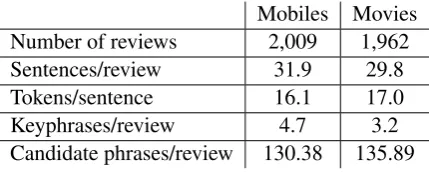
Mobiles Movies Number of reviews 2,009 1,962 Sentences/review 31.9 29.8 Tokens/sentence 16.1 17.0 Keyphrases/review 4.7 3.2 Candidate phrases/review 130.38 135.89
Table 1: Various statistics on the size of the cor-pora
given document, a true value was assigned to the SentiWordNet-derived indicator features that had at least one co-occurrence within the same sen-tence within the review of the candidate phrase.
SentiWordnet was also used to investigate the entire sentences that contained a phrase candi-date. This kind of feature calculated the sum of every sentiment score in each sentence where a given candidate phrase was present. Then the
mean and the deviation of the sum of the sen-timent scores were calculated for each token of the phrase-containing sentences and assigned to the candidate phrase. The mean of the sentiment scores of the individual sentences yielded a gen-eral score on thesentiment orientationof the sen-tences containing a candidate phrase, while higher values for the deviation was intended to capture cases when a reviewer writes both factual (i.e. uses few opinionated words) and non-factual (i.e. uses more emotional phrases and opinions) sentences about a product.
A more detailed description on the framework and evaluation results dealing with the intra-domain setting (including human evaluation as well) can be found in Berend (2011). In addition to that system, here the feature augmentation tech-nique of ) was applyed to improve inter-domain results.
4 Evaluation
Evaluation was carried out on two fairly differ-ent domains, i.e. on reviews dealing with mobile phones and movies from the site epinions. com. Section 4.1 presents the dataset of prod-uct reviews and the way the set of proper opinion phrases (which served as positive training exam-ples) were determined for its elements, and Sec-tion 4.2 describes experimental results achieved on that dataset. The evaluation procedure was strict in the sense that only perfect matches (after some normalization step) were accepted, i.e. the
normal-ized version of an opinion phrase returned from a document must be identical to at least one of the normalized versions from the set of refined author keyphrases (pros and cons) of the very document.
4.1 Dataset
In our experiments, we crawled two quite dif-ferent domains of product reviews, i.e. mobile phone and movie reviews from the review portal epinions.com. For both domains, 2000 re-views were crawled from epinions.com and an additional of 50 and 75 reviews, respectively. 1 This corpus is quite noisy (similarly to other user-generated contents); run-on sentences and im-proper punctuation were very common, as well as grammatically incorrect sentences since reviews were often written by non-native English speak-ers.
The list of pros and cons was inconsistent too in the sense that some reviewers used full sentences to express their opinions, while usually a few token-long phrases were given by others. The seg-mentation of their elements was marked in various ways among reviews (e.g. comma, semicolon, am-persand or theandtoken) and even differed some-times within the very same review. There were many general or uninformative pros and cons (like
noneoreverythingas a pro phrase) as well. In order to have a consistent gold-standard an-notation for training and evaluation, we refined the pros and cons of the reviews in the corpora. In the first step, thesegmentationof pros and cons was manually checked by human annotators. Our auto-matic segmentation method split the lines contain-ing pros and cons along the most frequent separa-tors. This segmentation was corrected by the an-notators in 7.5% of the reviews. Then the human annotators also marked the general pros and cons (11.1% of the pro and con phrases) and the reviews without any identified keyphrases were discarded. Linguistic analysis included the POS tagging (Toutanova and Manning, 2000) and syntactic parsing (Klein and Manning, 2003) of the reviews using Stanford CoreNLP.
4.2 Experimental Results
Several experiments were conducted in order to see the effect of domain adaptation in the opin-ion phrase extracting task. Where not stated dif-ferently experiments were carried out in 10-fold
Mobiles Movies
P R F P R F
Baseline 1.72 1.84 1.77 1.21 1.93 1.49
T arget 14.8 15.7 15.27 10.0 15.8 12.22
Source 3.5 3.7 3.58 3.2 5.0 3.92
M ixed 11.1 11.8 11.46 6.5 10.3 8.0
M ixedDA 12.7 13.4 13.04 7.2 11.3 8.84 Table 2: Results obtained on the mobile and movie dataset relying on the top-5 ranked phrases.
cross validation, the results of which are present in Tables 2, 3 and 4. Results are reported in the form of Precision, Recall and F-score (indicated with P, R and F, respectively) at the levels of top-5,10 and 15-ranked keyphrases for both mobile phones and movies. In the tables the row Baseline cor-responds to that intra-domain setting when only the two standard features (i.e. tf-idf and position of first occurrence) were used. As for the rows Tar-get,SourceandMixedthe extended feature space was utilized and they indicate that the training and testing domains were the same, differed and orig-inated from both source and target domains, re-spectively. The rowM ixedDArefers to the result when source and target domain documents were incorporated among the training instances (sim-ilarly to Mixed) and feature augmentation-based domain adaptation was applied as well.
First of all, before conducting experiments in-volving domain adaptation, the intra-domain per-formance of the opinion phrase extraction system was measured on the datasets. Intra-domain eval-uation refers to the fact that during these runs all the instances of the training set were derived from the very same domain as the test instances. Ob-viously, these results can serve as an upper bound on the final results which used domain adaptation, i.e. on a more noisy training set. These results are found in the rowTarget.
Secondly, that case was investigated when the weights of the Maximum Entropy model that fit-ted the training instances the best were based on the different domain compared to the domain of the evaluation, meaning that no instances originat-ing from the target domain were present duroriginat-ing the creation of a particular model. Evaluating ele-ments of the target domain based on the model that was learnt on a different source domain is present in the rows Sourceof Tables 2, 3 and 4. In this case it was not necessary to apply 10-fold cross validation, since the evaluation and the training of models took place on entirely different domains.
Mobiles Movies
P R F P R F
Baseline 1.42 3.04 1.94 0.98 3.13 1.5
T arget 10.4 22.0 14.11 7.0 21.9 10.63
Source 3.6 7.7 4.93 2.7 8.5 4.1
M ixed 8.0 16.9 10.82 4.6 14.6 7.05
M ixedDA 8.6 18.3 11.72 5.0 15.8 7.65 Table 3: Results obtained on the mobile and movie dataset relying on the top-10 ranked phrases.
Mobiles Movies
P R F P R F
Baseline 1.39 4.48 2.12 0.89 4.26 1.48
T arget 8.0 25.4 12.17 5.3 24.6 8.67
Source 3.6 11.4 5.44 2.4 11.2 3.92
M ixed 11.1 11.8 11.46 3.7 17.4 6.13
M ixedDA 6.7 21.2 10.17 4.0 18.6 6.53 Table 4: Results obtained on the mobile and movie dataset relying on the top-15 ranked phrases.
The row Mixed contains result achieved when models were created in such a manner that dur-ing 10 runs 10% of the target domain instances (choosing different elements every time) were added to the set of all the source domain instances. In these cases the evaluation took place on the re-maining 90% of the target domain that were not selected to be added to the instances for the train-ing originattrain-ing from the source domain.
In the case of the results in the rowMixed+DA
the selection of training and test instances was carried out exactly the same way as described in the case of the row Mixed, but this time the fea-ture space was augmented as described in Daum´e (2007) that is briefly outlined at the end of Section 2.
5 Discussion
Intra-domain results can be interpreted as an up-per bound for a system that is based on domain adaptation, due to the fact that in the intra-domain setting data points that make up the set of training instances are drawn from the same distribution as the test instances. Similarly, when instances orig-inating from a different source domain are added, it can easily bias the model on which predictions are based.
publi-cations, the best performing system achieved an F-score of 19.3 when evaluating it against the top-15 author keywords. Naturally, product reviews are far more noisy and heterogeneous in language than scientific publications, and the determination of keyphrase-behaving opinion reasons is far more ambiguous and difficult. It is also true that the language of product reviews is more ‘creative’, i.e. there are more possibilities to express proper and similarly functioning keyphrases compared to the scientific genre, which makes exact match-based evaluation more prone to underestimate the results in the case of opinionated texts.
The fact that the highest F-scores for keyphrases are achieved when the number of extracted phrases is around the average number of pro and con phrases per reviews (i.e. between 4.7 and 3.2 for mobiles and movies, respectively) also sug-gests that our ordering of keyphrase candidates is quite effective (since once we find the number of keyphrases a document has, performance cannot really grow anymore).
It is also unequivocal from the results of the rows Source of Tables 2, 3 and 4 that training a model solely on one source domain (without any target domain instances) and evaluating it on a dif-ferent target domain causes severe drop in perfor-mance. Despite the serious decline in the result in the latter settings, giving a small set of target do-main documents (having a size equalling only to 10% of the size of the source domain documents) yields much better results.
However, since|S| |T|, it is still true that the effect of adding elements from T to the training set is easily oppressed by the much higher mass of the element ofS. It is shown that the simple, yet efficient method of feature augmentation can still help, yielding final domain-adaptation results that are comparable to those results when the training and the testing took place within the same domain. Besides all, it can also be seen that the do-main of mobiles phones seems to be an easier task (which was confirmed by human annotator agree-ment rates as well).
6 Conclusions and Future Work
In this paper an extension of the standard scien-tific keyphrase extraction was introduced, and a possible way to overcome the absence of abun-dant tagged training examples was shown, using the simple method of feature augmentation. Using
the simple feature augmentation domain adapta-tion technique, results achieved on the target do-main were comparable to those settings when the parameters of our model were estimated on a large set of instances from the very same domain as the test instances. However, this highly idealistic as-sumption that one has access to a fair amount of training material from the domain of the target documents is not always met. In these cases do-main adaptation approaches seem to be useful.
The basic idea of treating opinion phrases sim-ilarly to scientific keyphrases raises the question whether domain adaptation methods would work in the aspect of scientific articles and product re-views as well. Although these two genres defi-nitely seem to be more distant from each other than two sets of reviews dealing with different product families, we find it as one possible way to extend this work to thoroughly examine this par-ticular question.
Acknowledgments
This work was supported by the Project “T ´ AMOP-4.2.1/B-09/1/KONV-2010-0005 – Creating the Center of Excellence at the University of Szeged”, supported by the European Union and co-financed by the European Regional Development Fund and by the project BELAMI financed by the National Innovation Office of the Hungarian government.
References
Stefano Baccianella, Andrea Esuli, and Fabrizio Sebas-tiani. 2010. Sentiwordnet 3.0: An enhanced lexi-cal resource for sentiment analysis and opinion min-ing. In Proceedings of the Seventh conference on International Language Resources and Evaluation
(LREC’10), Valletta, Malta, May. European
Lan-guage Resources Association (ELRA).
Alexandra Balahur, Ester Boldrini, Andres Montoyo, and Patricio Martinez-Barco, editors. 2011. Pro-ceedings of the 2nd Workshop on Computational Approaches to Subjectivity and Sentiment
Analy-sis (WASSA 2.011). Association for Computational
Linguistics, Portland, Oregon, June.
G´abor Berend. 2011. Opinion expression mining by exploiting keyphrase extraction. InProceedings of the 5th International Joint Conference on
Natu-ral Language Processing, IJCNLP ’11, Chiang Mai,
Thailand, November.
Hal Daum´e, III. 2007. Frustratingly Easy Domain Adaptation. In Proceedings of the 45th Annual Meeting of the Association of Computational
Lin-guistics, pages 256–263, Prague, Czech Republic,
June. Association for Computational Linguistics.
Minqing Hu and Bing Liu. 2004a. Mining and summa-rizing customer reviews. InProceedings of the tenth ACM SIGKDD international conference on
Knowl-edge discovery and data mining, KDD ’04, pages
168–177, New York, NY, USA. ACM.
Minqing Hu and Bing Liu. 2004b. Mining opinion features in customer reviews. InProceedings of the 19th national conference on Artifical intelligence, AAAI’04, pages 755–760. AAAI Press.
Soo-Min Kim and Eduard Hovy. 2006. Automatic identification of pro and con reasons in online re-views. In Proceedings of the COLING/ACL 2006
Main Conference Poster Sessions, pages 483–490,
Sydney, Australia, July. Association for Computa-tional Linguistics.
Su Nam Kim, Olena Medelyan, Min-Yen Kan, and Timothy Baldwin. 2010. Semeval-2010 task 5: Au-tomatic keyphrase extraction from scientific articles.
In Proceedings of the 5th International Workshop
on Semantic Evaluation, SemEval ’10, pages 21–
26, Morristown, NJ, USA. Association for Compu-tational Linguistics.
Dan Klein and Christopher D. Manning. 2003. Ac-curate unlexicalized parsing. InProceedings of the
41st ACL, pages 423–430.
Jingjing Liu and Stephanie Seneff. 2009. Review sen-timent scoring via a parse-and-paraphrase paradigm.
In Proceedings of the 2009 Conference on
Empiri-cal Methods in Natural Language Processing, pages
161–169, Singapore, August. Association for Com-putational Linguistics.
Andrew Kachites McCallum. 2002. Mal-let: A machine learning for language toolkit. http://mallet.cs.umass.edu.
Olena Medelyan, Eibe Frank, and Ian H. Witten. 2009. Human-competitive tagging using automatic keyphrase extraction. In Proceedings of the 2009 Conference on Empirical Methods in Natural
Lan-guage Processing, pages 1318–1327, Singapore,
August. Association for Computational Linguistics.
Bo Pang, Lillian Lee, and Shivakumar Vaithyanathan. 2002. Thumbs up?: sentiment classification us-ing machine learnus-ing techniques. In EMNLP ’02: Proceedings of the ACL-02 conference on
Empiri-cal methods in natural language processing, pages
79–86, Morristown, NJ, USA. Association for Com-putational Linguistics.
Ana-Maria Popescu and Oren Etzioni. 2005. Extract-ing product features and opinions from reviews. In
Proceedings of Human Language Technology Con-ference and ConCon-ference on Empirical Methods in
Natural Language Processing, pages 339–346,
Van-couver, British Columbia, Canada, October. Associ-ation for ComputAssoci-ational Linguistics.
Ivan Titov and Ryan McDonald. 2008. A joint model of text and aspect ratings for sentiment summariza-tion. InProceedings of ACL-08: HLT, pages 308– 316, Columbus, Ohio, June. Association for Com-putational Linguistics.
Kristina Toutanova and Christopher D. Manning. 2000. Enriching the knowledge sources used in a maximum entropy part-of-speech tagger. In Pro-ceedings of the 2000 Joint SIGDAT conference on Empirical methods in natural language processing
and very large corpora, EMNLP ’00, pages 63–70,
Stroudsburg, PA, USA. ACL.
Peter Turney. 2002. Thumbs up or thumbs down? se-mantic orientation applied to unsupervised classifi-cation of reviews. In Proceedings of the 40th An-nual Meeting of the Association for Computational Linguistics (ACL), pages 417–424.
Peter Turney. 2003. Coherent keyphrase extraction via web mining. In Proceedings of IJCAI, pages 434– 439.