Successful implementing condition specific
indicators in Dutch hospitals
An explorative research to define the critical factors for the successful
implementation of the registration and use of condition specific
performance indicators
Master thesis
Graduate: Ellen van den Berg, s0023442
1st supervisor: Prof. dr. W.H. van Harten, University of Twente 2nd supervisor: Prof. dr. M.J. IJzerman, University of Twente External supervisor: Dr. M. Kallewaard, Q-consult
School of Management and Governance
Master: Industrial Engineering and Management Track: Health Care Technology and Management
Abstract
Over the past few years, quality of health care has been a frequently discussed theme. In order to improve the quality of care it is important to establish what the current quality status is. To monitor and/or to measure quality, performance indicators can be used. Recently the associations of hospitals, medical specialists, nurses, patients and insurers and the Dutch Health Care Inspectorate signed an agreement of cooperation on the development of 80 sets of condition specific indicators over the next five years. The goal is to develop indicators which can be used for consumer choice information, contracting by insurers, and quality improvement by medical professionals and hospitals. In the past two years ten sets of indicators have been developed by the Dutch Institute for Healthcare Improvement (CBO) and the Order of Medical Specialists (OMS). Until now little attention is given to the implementation process of these indicators. The critical factors for establishing the registration and the use of performance indicators within Dutch hospitals are not clear.
The main goal of this research is to write an advise on the implementation and diffusion of registering and using condition specific performance indicators. The main question that will be used to support this goal is:
‘What are the critical factors for a successful implementation of the registration and the use of condition specific performance indicators within Dutch hospitals?’
The required data to answer this question is collected in different ways. First a literature search was done to give an outline of the research. By means of interviews on different user-levels the survey questions were verified on completeness. The second objective was to get a general idea of the interviewees’ opinion on the subject of indicator implementation. The survey was sent to 550 persons, and had a response rate of 15%. To complete this research we have chosen to translate the results of the interviews and the survey to one specific case, to see what the consequences are for the practical implementation of condition specific indicators. The implementation of the sciatica indicator set was chosen as the case. This study is divided into five subjects: Incentives, critical dynamics, barriers, interventions, and practical use of the indicators.
The possibility to improve internal processes is perceived to be a stimulating incentive for the implementation of the indicators. The medical professionals will be stimulated through their intrinsic motivation and the managers by law and regulation and publishing performances. This last incentive is far less effective according to the medical professionals. The critical dynamics, compatibility and infrastructure are related to ICT and are considered to be most important. Also trialability and communication are dynamics that have to be held into account. The main barrier according to the survey respondents is the administrative load. The interviewees pointed out that the trust in indicators is an important barrier as well. Practical support was perceived to be the most effective intervention for the implementation. The practical use of the indicators was measured by assessing the quality of the indicators and the added value of the indicators. Both scored moderately positive. The medical professionals and the managers do think that the use of indicators will lead to a better reputation of the hospital. During the case study it became clear that without support of the medical professionals the implementation will not take off. The involvement of patients registering their own measurements was perceived as a good method to suppress the administrative load for the medical professionals.
Based on the conclusions, a number of recommendations can be given with regard to the implementation of condition specific indicators:
- During the development of the indicators attention has to be paid to the feasibility of the registration and the quality of the indicators.
implementation. The realization of practical support can be accomplished by involving the right persons.
- Practice pilots on the usability of the indicators have to be conducted. This will lead to more confidence to the potential users of the indicators.
- The communication between the involved actors is crucial. An integrated approach will positively influence people’s opinion towards the implementation of the indicators. - The implementation of the sciatica indicators can be supported by conducting a pilot
study. The feasibility and validity of the measurements have to be tested; else there will be a lack of support from the scientific societies.
Table of contents
2.3 DIFFUSION OF INNOVATIONS IN HEALTH CARE... 17
2.4 IMPLEMENTING INNOVATIONS IN HEALTH CARE... 19
2.5 INTERNATIONAL INDICATOR PROJECTS... 21
4.5 USE OF CONDITION SPECIFIC INDICATORS IN PRACTICE... 37
4.6 CONCLUSION... 38
5.6 USE OF CONDITION SPECIFIC INDICATORS IN PRACTICE... 48
Acknowledgements
After six fantastic years studying at the University of Twente it is time to graduate. During the master track Health Care Technology and Management, I have been inspired by the subject: Quality of health care. For this reason I have chosen to devote my graduation thesis to this subject. In February 2007 I started at ‘Q-consult Bedrijfskundige Adviseurs’ were I preformed my research on the critical factors for successful implementing condition specific indicators within Dutch hospitals.
First and foremost, I would like to thank my coaches, dr. Marjon Kallewaard, prof. dr. Wim van Harten, and prof. dr. Maarten IJzerman. Marjon, I want to thank you for introducing me to the world of performance indicators. You have inspired and motivated me with your enthusiasm towards the subject of quality of care. Professor van Harten and Professor IJzerman I would like to thank both for their constructive criticisms and support during this research.
I also want to thank all the persons that I have interviewed. It was a privilege to speak with all these people who are, all in their own way, trying to improve the quality of care in the Netherlands. The OMS, the NVZ, and the ‘Sneller Beter’ project I would like to thank for placing my survey on their websites and sending it with their e-newsletters.
Then I want to thank all my colleagues at Q-consult, it was a great time working with all of you during my thesis project. The comforting stories of your graduation times have stimulated me to persist.
And last but certainly not least, I want to thank my family and friends that supported me during my whole study. Because of you I was able to enjoy my college days to the fullest extend.
1 Introduction
1.1 Measuring quality of health care
Over the past few years, quality of health care has been a frequently discussed theme. Not only in scientific research but the media also reports on this subject regularly. In the United States quality of care was especially stimulated by reports of the Institute of Medicine (IOM) like, ‘To err is Human’ (2000) and ‘Crossing the quality chasm’ (2001). These reports indicate that a change in the health care system of United Stated is crucial, and improving the quality of health care has priority on the political agenda. In order to improve the quality of care it is important to establish what the current quality status is. Or as Florence Nightingale pointed out many years ago:
‘The ultimate goal is to manage quality. But you cannot manage it until you have a way to measure it, and you cannot measure it until you are able to monitor it.’ (Eagle and Davies, 1993)
To monitor/measure quality, performance indicators can be used. In 2001, Klazinga et al already discussed the emerging ‘indicator hype’ and since then the number of indicators initiatives in health care have only proliferated. Examples are: indicators for the quality of care in general practitioner practices, indicators intended for the supervision of the quality of hospitals, condition specific indicators intended for choice by patients/consumers and purchasing by insurers, indicators for care purchasing, indicators for the quality of care within nursing homes, and indicators for the quality of mental health care (Wollersheim, Faber, Grol, Dondorp, and Struijs, 2006).
Performance indicators
Monitoring quality of health care is a complicated process. The ultimate purpose of all health care activities is to achieve the ideal outcome (health situation) for the patient. However, when monitoring the quality of health care, efficiency, cost-effectiveness, a patient-centered approach, etc. also need attention. Performance indicators are statistics or other units of information which reflect, directly or indirectly, the performance of the health care system in maintaining or increasing the well-being of its target population (Boyce, McNeil, Graves, and Dunt, 1997).
Characteristics of external indicators
Insight and improvement
Performance indicators can be used to give professionals and management insight into or, related to the results of the health care processes. Defining problems and tackling these, the processes can be managed in different ways, and the improvements of these processes can be evaluated (Schellekens and Berg, 2002). Publicized indicators are also important for informed consumer choice, while patients are getting more independent. Watching television and surfing on the internet gives them more information on treatments and diseases. Patients want to have more information on quality of care, and they would like to have a choice in health care (Nederlandse Patiënten Consumenten Federatie, 2005). More and more patients are comparing health institutions; this is why it is important that the comparison is based on correct data (Hoorn, Houdenhoven, Wullink, Hans, and Kazemier, 2006). Although there is little prove that patient movements are actually influenced by this information.
Transparency is needed for regulated competition
In the article ‘Redefining competition in health care’ Micheal Porter (2004) writes, among other things: “the health care system has to concentrate on the health of the patient and the outcomes of the provided care. It is important that the competition in health care between insurers and hospitals focuses on the right things, such as extra value for the patient. We have to prevent that competition concentrates too often on costs, while quality of care is a far more important factor.”
In the Netherlands the health insurance system has changed (see also Changes in the Dutch health care system). From January 1st 2006 a system of regulated competition was introduced in Dutch health care. As of then insurers and hospitals negotiate not just about the quantity, quality but also about price of a limited group of treatments. With these changes performance information is expected to become more important. The system is presumed to be a success if patients can use information to choose between hospitals, and if insurers really start to negotiate about the quality of care. Performance indicators can play a significant roll in these negotiations. In the coming years it has to be evaluated whether the quality of care and patient preferences are indeed important when contracting health care.
Monitoring quality of care
End 2003 the Dutch Inspectorate of Health Care (IGZ) developed and introduced a set of performance indicators for the purpose of general oversight on hospitals in the Netherlands. The introduction of this set was supported by the Order of Medical Specialists (OMS), the Dutch Association of Hospitals (NVZ) and the Dutch Association of University Hospitals (NFU). The reason for the cooperation was that all three organizations and their members realized that in this day and age it was no more than logical to be transparent about performances achieved and to be held accountable. In 2005 the first results of 2003 were published (Inspectie voor de Gezondheidszorg, 2005).
Points of criticism
Changes in the Dutch health care system
International changes in health care policies have caused a higher demand on efficiency, and a need for improvement in the quality and safety in health care. After years of fixed budget financing, the introduction of the diagnosis-related groups (DRG’s) as of January 1st 2005 was a step to more market-oriented hospital care in the Netherlands. DRG’s can be divided into two subcategories: There is an A-segment and a B-segment. In the A-segment the DRG’s have fixed prices, in the B-segment (10% of the total DRG’s in 2007) the prices are negotiable (Hoogervorst, 2004). Hospitals and health insurers make agreements on price, size and quality of care. For this reason it is important to have data on the performance of hospitals. By registering performance indicators, the hospitals and insurer(s) can negotiate with each other (Landa, 2004).
Since 2005 there has been a close cooperation between the organization representing the providers of health insurance in the Netherlands (ZN), the OMS, and Federation of Patients and Consumer Organizations in the Netherlands (NPCF) in the development of performance indicators for health care contracting. With a grant from the Netherlands Organization for Health Research and Development (ZONMw), ten sets of indicators for patient choice and health care contracting were developed by groups of medical specialists, insurers and patients (see annex 1). These sets were adopted by the insurers for health care contracting.
The associations of medical specialists, hospitals, patients, insurers, Ministry of Health Care, and Health Care Inspectorate have presented a plan to develop 70 additional sets of indicators to be used for patient choice and health care contracting. An agreement on the development of indicators is signed by all parties late June 2007. The goal is to develop these sets in five years time (five indicators per set) and they aim for 50-60% outcome indicators. (Stuurgroep Ziekenhuistransparantie, 2007)
1.2 Reason for this research
Gap between development and implementation
The main focus until today was to develop evidence based indicators that are accepted by the professionals. Questions about the goal of the indicators, the feasibility, actions that are needed for the registration and the question whether the costs will measure up to the benefits of collecting and processing data, are of great relevance (Schellekens, Berg and Klazinga, 2003). Up till now little attention was given to the implementation process of these indicators. The critical factors for establishing the registration and the use of performance indicators within Dutch hospitals are not clear. The indicators developed by the inspectorate are mainly enforced through social pressure and compliance is rather high. The indicators of the insurers are voluntary up till now. Because the hospitals are not obliged to register these indicators, implementation and diffusion is more difficult. When the goal is measuring quality, the registration and use of performance indicators can be used, and a good implementation plan is crucial.
Implementation problems
implementation. Another example, it is often hard to get all the involved actors in line with each other when implementing multidiscipline indicators.
Diffusion of evidence-based knowledge is limited in health care. After the implementation of new knowledge within an innovative organization, it is not evident that this knowledge will be adopted by other organizations. There is often a slow diffusion of the new knowledge or sometimes diffusion gaps appear. Therefore it is important to become aware of the existence of different adoption categories. These individual categories have to be examined and approached in their own ways when implementing knowledge. (Schuring and Harten, 2004)
Problem owners
Determining problem ownership is an important element of the problem solution. When none of the involved actors feel committed to the problem it is not likely to be solved (Wieringa and Heerkens, 2003). The definition of a “problem owner”: A person or a group of persons that have the responsibility to resolve the problem. In this paragraph we try to analyze who are the problem owners of the implementation of the condition specific indicators. In other words, who is responsible for the success of the implementation?
The arrangement of problem ownership of the IGZ indicators is an example of how this issue could be handled. The responsibility of the development and the evaluations of these indicators lay with the Inspectorate, the OMS and the societies of hospitals in the Netherlands. The responsibilities, tasks and obligations of the parties are part of an agreement of cooperation which was signed in December 2005. The IGZ indicators are part of the instruments to supervise hospitals by the Health Care Inspectorate. By law the Health Care Inspectorate has the right to ask the hospitals for information. Moreover, the IGZ indicators are part of the annual report hospitals are obliged to write. Therefore, the registration of the IGZ indicators is more or less compulsory for all hospitals. The implementation and registration of the indicators is therefore the problem of the board of directors.
For the use and registration of the condition specific indicators there is no formal basis. The first ten condition specific indicator sets were developed in a project financed by ZONMw. The OMS and Dutch Institute for Healthcare Improvement (CBO) were responsible for developing these ten sets. ZN has adopted the ten sets. The ten sets are part of the guide insurers publish annually in relation to the negotiations they have with the hospitals. If used during the negotiations there is a commercial incentive for hospitals and medical specialists to implement the indicators. As a result some hospitals are indeed implementing the indicators. However, this is not common practice. Not all insurers use the indicators from the guide during the negotiations and not all hospitals are willing to negotiate about the indicators.
An additional complicating factor is that since there is no formal legal basis for the implementation and publication of these indicators at present and since a signature by the boards of the associations of hospitals and medical specialists is not necessarily perceived as binding by the members of these associations, their cooperation will be difficult. As a result implementation of the condition specific indicators might not be easy in the short term. However, as the stated in paragraph 1.1 the availability of condition specific quality information is presumed to be an important requisite for the functioning of the system of regulated competition. The fact that this information is not available is perceived as a threat to the development of the system by the Dutch health care authority (NZA). Recently the NZA warned that if the information would not be come available on a voluntary basis in the short term, they will oblige the hospitals to publish this information. The basis of this obligation lies in the law ‘Wet Marktordening Gezondheidszorg’ (WMG). If the WMG is adapted, as to oblige hospitals to publish the information the problem ownership will shift to the hospitals.
Thus, at this moment problem-ownership is ill defined. Without a statutory basis it is hard to determine who is responsible for the successful implementation of the condition specific indicators. Up until now most initiatives were the result of ‘good will’ or of grants. Major objective of the current government is to increase the transparency of the Dutch healthcare system. To achieve this goal all involved actors have to be formally committed and the specific tasks and responsibilities have to be assigned. In conclusion, if one problem owner has to be mentioned, presently it seems to be the Dutch government.
1.3 Problem definition
The main goal of this research is to write an advise on the implementation and diffusion for registering and using condition specific performance indicators. The main question that will be used to support this goal is:
‘What are the critical factors for a successful implementation of the registration and the use of condition specific performance indicators within Dutch hospitals?’
Research questions
To give an answer to the main question, five research questions are formulated. These questions will be the guidelines for this research:
1. In what way can hospitals be stimulated to start the registration and the use of condition specific indicators?
2. What factors have influence on the diffusion of the registration and the use of condition specific performance indicators among health care institutions?
3. What are the barriers for registering and using condition specific performance indicators for the different stakeholders?
4. Which intervention methods can be used when health care institutions want to implement the registering and the use of condition specific performance indicators? 5. Will the condition specific performance indicators, in the near future, be used in
practice?
1.4 Research structure
This research concentrates on implementing performance indicators that are officially accepted by the stakeholders. All stakeholders were assumed to be involved in the development process. We will not focus on the development of performance indicators.
research focuses on the system wide implementation of condition specific performance indicators. In this part we describe the incentives that simulate the registration of the indicators, which resistances can occur, how to cope with these, and what other critical factors there are for registration and using condition specific indicators.
The lumbosacral radicular syndrome (sciatica) performance indicators are used as setting for the case specific part. The sciatica indicators are already developed within a workgroup setting and now they have to be implemented in hospitals. The complexity of the patient logistics, for example, makes this implementation process very interesting.
Thesis structure
2 Theoretical framework
This chapter contains the literature that is used as a guideline for this research. To outline this research we first discus the subject of quality measurement in the health care sector. This is followed by a description of implementation incentives that were found during the literature search. Third, diffusion theory is explained and critical dynamics related to the diffusion of innovations in health care are presented. The next paragraph contains a description of implementation theories. Then a comparison between different indicator projects is made, and at the end of this chapter a conclusion is drawn and we elaborate the focus of this research.
The theoretical literature search was conducted with help of a number search engines, most used were pubmed medline, google scholar. Keywords were: ‘performance measurements’, ‘performance indicators’, ‘incentive in health care’, ‘pay for performance’, ‘public reporting in health care’, ‘diffusion of innovation in health care’, ‘implementation in health care’. Other means that were used are IOM reports and books concerning the subjects
Dutch journals like ‘Zorgvisie’ and ‘Medisch contact’ were used for background information or expert opinions. Besides those also governmental reports, Dutch laws, and reports form branch organizations were examined.
2.1 Measuring quality of care
Quality of health care is related to the performance of health care institutions. Performance can be measured in several ways. Donabedian (1988) states a classic paradigm for assessing quality of care. The paradigm is divided into three categories: structure, process, and outcome measurement. He also states that each category has a direct influence on the next (figure 2.1). Structure refers to the attributes that are necessary to provide health care. The process of care describes what is actually done in the delivery of health care. Health outcomes are the direct result of a patient’s health status as a contact with the health care system.
Figure 2.1: three categories of quality measures
In this thesis the following definition is used for quality for health care: “The degree to which health services for individuals and populations increase the likelihood of desired health outcomes and are consistent with current professional knowledge.” It was stated by the Institute of Medicine (IOM). In ‘Crossing the Quality Chasm’ (2001) the IOM recommends the adoption of six quality aims for improving the United States health care system. They are defined as followed: safe, effective, patient-centered, timely, efficient, and equitable. When meeting these aims we can speak of good quality of health care. The balance between these aims is crucial, for example; when the focus is only on the efficiency of health care, the patient becomes less important, which will lead to less quality of health care.
Performance measurement
Performance indicators can be used to measure quality. The definition: ‘statistics or other units of information which reflect, directly or indirectly, the performance of the health care system in maintaining or increasing the well-being of its target population’ (Boyce et al, 1997).
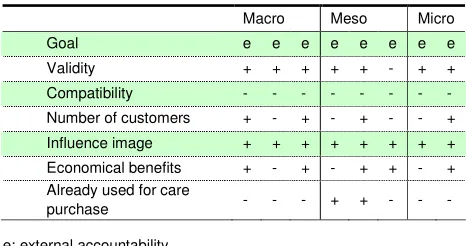
Indicators can be used for different goals; they can be used for internal quality improvements, for external accountability, or for research purposes (Grol, 2006). On professional and hospital level there is more focus on internal quality improvement. On government, inspectorate, insurer, and patient level, there is more focus on external accountability.
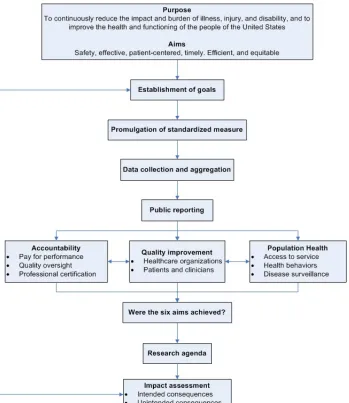
In 2006 the IOM published the report ‘Performance Measurement: Accelerating Improvement’. A special committee was formed to investigate the ongoing efforts of the IOM on health care quality in the United States. The report introduces a framework and implementation strategy for translating public and professional concerns about performance and accountability into measures of health care quality. Within this report the committee designs a model for quality measurement and reporting. The committee concluded that the following attributes (figure 2.2) should be included in a national system of performance measurement.
Additionally, the committee concluded that a national system should support the needs of stakeholders within public and private health care sectors along three dimensions. These three dimensions are more or less similar to the three goals of indicators that are defined by Grol (2006).
• “Accountability. Information should be available to assist stakeholders in making choices about providers. These stakeholders include patients identifying a clinician, hospital, or other providers form which to seek services; purchasers and health plans selecting providers to include in their health insurance networks; and quality oversight organizations making accreditation and certification decisions.
• Quality improvement. The information provided should be value to stakeholders responsible for improving the quality of care, including clinicians, and administrators and governing board members of health care organizations.
• Population health. The information should be useful for stakeholders making decisions about access to services; those involved in communitywide programs and efforts to address racial and ethnics disparities and promote healthy behaviors; and public officials responsible for disease surveillance and health protection.” (IOM, 2006)
To improve the quality of care, it is important to have insight where the possibilities are for improvement, so a correct way of measuring performance is essential. When comparing the results of one organization with another, standardization is necessary. Agreements on what to measure and how to measure it, is the base of a good performance measurement system.
The performance measurement system used in the United States corresponds to the projected Dutch system. The goals are similar, as is the way to achieve them. However Dutch hospitals nowadays only register en publish hospital wide indicators. During this research we want to look to the condition specific indicators, and see how to implement these indicators. Which incentives there are for the implementation, will be discussed in the following paragraph.
2.2 Incentives for implementing performance measurement
Incentives can be used to persuade hospitals to start implementing the condition specific indicators. In this chapter we discuss four incentives; law and regulation, public reporting, pay for performance and the intrinsic motivation of the professional. During the literature search these types of incentives were most frequently found.
Law and regulations
A prominent incentive for the registration and using performance indicators is to oblige it by law. The inspectorate indicators on hospital level are obliged by the inspectorate. The first results were released in the report ‘Het resultaat telt’ (Inspectie voor de Gezondheidszorg, 2005). All hospitals in the Netherlands have returned their results on the performance indicators, and the results are available in the public domain.
for external accountability. Some institutions perceive it as a formality; others use it as a PR instrument in favor of personal and external contact; or using it for accountability for the IGZ and insurers.
The law ‘Wet Marktordening Gezondheidszorg’ (WMG) introduced in 2006 is stricter than the KWZ. It gives shape to the regulated market competition; market competition, or regulations. The Dutch health care Authority (NZa) is the market supervisor as well as the regulator. Obligations to inform the consumers that are stated in the WMG are applicable for health care providers and insurers. These obligations can be enforced by the NZa. This means that the NZa is authorized to introduce regulations in relation with consumer information, with the focus on effectiveness, accuracy, comprehensiveness, and comparability. The NZa is also authorized to maintain these regulations and obligation by for example to give penalties or binding instructions.
Law can be an incentive for the implementation of condition specific indicators, although it is shown (Casparie et al., 2001) that when a law is not strict or feasible it does not have to be successful incentive. Other reasons for lack of success can be bureaucracy or the acceptation of the law.
Public reporting
Transparency is important for market-oriented hospital care. Transparency can be improved when data on the performance of hospitals are published. The goal of public reporting is to create a better informed consumer choice, and improvements on the quality of care (IOM, 2001). The evidence of the effect on improving the quality of care is not convincing (Marshall, 2002). There are also resistances for public reporting. Professionals are concerned of a loss of image after publishing poor performance data, and they are afraid that the published data is not correctly measured (Hibbard, Stockard and Tusler, 2003).These resistances triggers a need for evidence based performance measurement. When the registration and the use of condition specific performance indicators prove to measure the correct data, this can stimulate the implementation process.
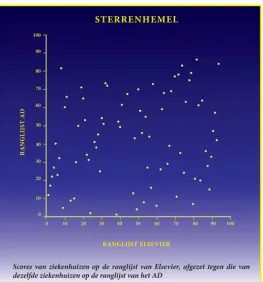
In the Netherlands, performances of hospitals are publicly reported. The Inspectorate of Health care (IGZ) publishes the basic set of indicators on hospital level. Patients are able to view the results of these ‘IGZ indicators’ on websites like ‘www.kiesbeter.nl’ or ‘www.ziekenhuizentransparant.nl’. Patients can see the scores of multiple hospitals on different indicators and can choose where they go to get the desired care. A top 100 based on selected indicators is published in the Dutch newspaper ‘AD’. A major constraint of this ranking list is that it does not take patient casemix into account. The result: specialized clinics that treat more ‘difficult’ patients will not be high on the list. Ranking lists of the Dutch consumer association focus mainly on patient experiences and on the routine of hospitals. Result: a hospital that performs 200 surgeries is ranked higher than a hospital that performs 60 surgeries. Another well known ranking list in the Netherlands is published in ‘Elsevier magazine’. Elsevier conducts a survey among hospital personal and general practitioners, what results in a list based on the reputation of the hospital. They name it however ‘The best hospitals’ and this can be misleading.
All lists claim to give the list of best hospitals, although comparing the top three’s of these lists shows that these are very different from each other (see figure 2.3). Because of the variation in focus it is hard to say which list is best. (Hoorn et al, 2006).
influence. (Abn-amro, 2005) It can be questioned why the general practitioners are not involved with the indicator development, when they have a great deal of influence on the patient choices. This data is found in a commercial news bulletin, and is not scientifically justified, but we think it represents the current reality.
Figure 2.3: Correlation between the Elsevier list and the AD list (Maarse, 2004)
Pay for performance (P4P)
Pay for performance is a method that is used to increase quality of care by means of rewarding hospitals/professionals with financial bonuses. It has already been said that public reporting is an incentive to improve quality of care, but the study of Lindenauer et al. (2007) proved that there is a more positive effect on the quality of care when P4P is combined with public reporting, opposite to only public reporting. P4P is primarily designed to improve the effectiveness and safety of health care and it can serve as a positive force in health care systems. In the United States, P4P is an incentive for improving quality of care that is rapidly diffused. More than half of the health maintenance organizations (HMOs) in the private sector started to use this method. Also the Centre of Medicare and Medicaid Services (CMS) are mandated by the congress to introduce P4P programs into Medicare. In the United Kingdom, P4P is introduced in their own version that puts 25-30% of the income of family practitioners at stake (Epstein, 2007). It is surprising that P4P is adopted so easily, because the evidence for an improvement in quality is thin.
Fair and ethical P4P programs are patient-centered and link evidence-based performance measures to financial incentives. This payment model rewards physicians, hospitals, medical groups, and other health care providers for meeting certain performance measures for quality and efficiency. There are a number of principles (American Medical Association, 2005) that have to be followed if P4P wants to be a success:
• Ensure quality of care
• Foster the patient/physician relationship
P4P programs support the patient/physician relationship and overcome obstacles to physicians treating patients.
• Offer voluntary physician participation
P4P programs offer voluntary physician participation and do not undermine the economic viability of non-participating physician practices.
• Use accurate data and fair reporting
P4P programs use accurate data and scientifically valid analytical methods. • Provide fair and equitable program incentives
P4P programs support the goal of quality improvement across all participating physicians, and give a clear explanation on the criteria for the incentives.
If these principles are not followed, some unintended consequences of P4P programs may arise (Rosenthal, Frank, 2006). Health care providers could miscode diagnoses patients for the benefits of their own. Also, providers will focus less on patients that are in great need for care, but will concentrate on the patients that will lead them to more benefits. Davis (2007) states in his article that P4P can lead to more time consuming care and it will decrease the efficiency of professionals.
P4P has a limited effect on quality of care if patients are treated by more than one specialist, because it is not clear to professionals who will get the bonus, or what part of the bonus they will get. So it is important that on forehand it is clear who is responsible for the patient care (Pham, Schrag, O’Malley, Wu and Bach, 2007). A way to solve this problem is to reward total groups of professionals or complete hospitals, in this way the discussion on responsibility can be avoided (Davis, 2007).
Another effect of P4P is the improvement of the documentation of performance measurement (Epstein, 2007). So when we want to implement the registration and the use of performance indicators, P4P can serve as an incentive for adoption.
In the Netherlands there is also interest in P4P method. In an advise to the Dutch government in 2004/2005 the Social and Economic Council of the Netherlands (SER, 2005) has written that market-oriented hospital care can lead to more efficiency and more quality of care, but there have to be incentives to be more competitive. Suggested incentives are public reporting and financial incentives like P4P. They state that the government has to be responsible for conditions that have to be set for introducing P4P.
Intrinsic motivation of the professional
When taking the oath of Hippocrates the medical specialist promises to do everything within his means to make patients better. The delivery of good health care is defined as the primary process for the professional. Secondary processes, like policies, and administration, are often considered more important. The professionals want to protect the patient care; they see an emphasis on organizational and financial considerations as a threat for the medical quality (Maassen, 2006).
The basic assumption, the ‘contract’ between care provider and community, where by the first has got a (job) commitment to deliver qualitative and safe care, obligates that more transparency in health care will be offered, than is done currently.
directly held accountable for his medical decisions. So when professionals will be held accountable by means of performance measurement, it is important to involve them within the process. They are the persons who can judge the delivered performance on medical outcomes best (KNMG Manifest, 2007).
When performance indicators are implemented in hospitals it is important to involve the professionals with this process. With the development of the condition specific indicators the professionals have been involved to deliver the medical content for the indicators. Currently most professionals see the registration of indicators as an obligation. For this reason it is important that the intrinsic motivation of the professional is appealed. To achieve this, it is necessary to involve the professionals and make them accountable for their actions. When professionals see the added value of registering indicators they can function as opinion leaders for other professionals. It is known that professionals will adopt innovations from other professionals more easily than from management (Greenhalgh, Robert, Macfarlane, Bate and Kyriakido, 2004).
In the Danish model for indicators (The Danish National Indicator Project) for instance, it is shown that with involvement of professionals, a good multidisciplinary quality project can be set up. Professionals have developed evidence based clinical indicators. These clinical indicators are registered, analyzed and outcomes are sent to the hospitals. They also perform regional audits when the outcome will be discussed. The system is nation wide implemented (Grol and Wollersheim, 2005). In paragraph 2.5 a comparison is made between different indicator projects.
2.3 Diffusion of innovations in health care
After determining what incentives could be used to start the implementation, it is important to see what theories there are on the diffusion of innovations in health care.
The definition for innovation: “An innovation is an idea, practice, or object that is perceived as new by an individual or some other unit of adoption.”(Rogers, 1995) We can use the term innovation for the registration and the use of condition specific performance indicators, because it is new in the Dutch health care system. The condition specific indicators that are developed are not yet system wide implemented and hospitals perceive this practice as new.
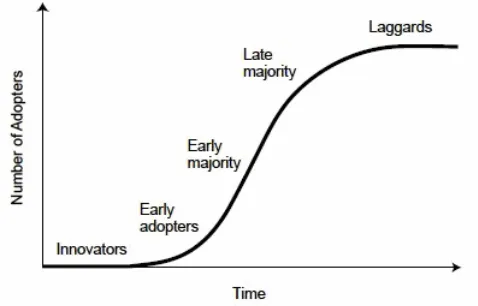
“Diffusion is the process by which an innovation is communicated through certain channels over time among members of a social system.” This definition of diffusion was given by Rogers (1995), he describes a well know theory on the diffusion of innovations. According to Rogers the spread of technologies and other innovations can be covered in an S-curve model. The S-curve model imposes that any innovation is first adopted by a few people. When the innovation seems an improvement on the current state, more and more people will adopt the innovation. After a while the diffusion proceeds rapidly, although at some point the innovation reaches a part of the population that is less likely to adopt, and the diffusion will saturate (see figure 2.4).
the socially constructed interpretation of the evidence. Network memberships are of influence on the distribution of innovations (Rye and Kimberly, 2005).
Figure 2.4: The diffusion S-curve of Rogers (1995)
Critical dynamics for diffusion
A successful diffusion of innovations in health care can be related to a number of critical dynamics. The California Health care Foundation has written a report on the diffusion of innovation in health care (Cain and Mittman,2002). In this report they describe ten critical dynamics that are essential for the diffusion of innovations in health care.
1. Relative advantage
The more benefit anticipated form adoption of innovation relative to current practice, the more rapidly it will diffuse.
2. Trialability
The ability to try out an innovation without total commitment and with minimal investment improves the prospects for diffusion.
3. Observability
The extent to which potential adopters can witness the adoption of an innovation by others improves the prospects for diffusion.
4. Communication channels
The paths through which opinion leaders and others communicate about an innovation affect the pace and pattern of the diffusion.
5. Homogeneous groups
Innovations spread faster among groups with similar characteristics than among groups that differ in important ways.
6. Pace of innovation/reinvention
Some innovations are relatively stable and do not evolve much while they diffuse. Others evolve much more rapidly and are altered by users along the way. 7. Norms, roles, and social networks
Innovations are shaped by rules, formal hierarchies, and informal mechanisms of communication operative in the social systems in which they diffuse.
8. Opinion leaders
Individuals whose opinions are respected by others in a population affect the pace of diffusion.
9. Compatibility
The ability of an innovation to coexist with technologies and social patterns already in place improves the prospects for diffusion.
10. Infrastructure
Adoption of innovations in health care
From an organizational point of view, adoption is perceived as a positive attitude and the decision to change the current situation. The adoption of an innovation can only take place when the organization is ready for this change. There are a number of elements that are important for assimilation (Greenhalgh et al, 2004):
• Tension for change
The current situation is intolerable. • Innovation system fit
The innovation fits into the current values, ways of working and norms of the organization.
• Assessment of implications
The expectations of the innovation are clear. • Support and advocacy
There are more supporters of the innovation than people that oppose to the innovation.
• Dedicated time and resources
There is time and budget available for the innovation. • Capacity to evaluate the innovation
The innovation impact is monitored and evaluated.
Although Rye and Kimberly (2005) state in their article that adoption theories are better fit for discrete product or programs, it is wise to recognize these elements, while they can give an explanation for the success of one innovation and the failing of another.
2.4 Implementing innovations in health care
The definition of implementation we will use in this thesis is the English translation of the Dutch definition of implementation stated by ZON (Zorg Onderzoek Nederland, 1997) 'A planned introduction of evidence based innovations and/or quality improvement, aimed at structurally changing medical treatment, professional practice, organization or the structure of health care.'
When an innovation is developed the goal is to establish it in an organization. This can be done in different ways; there are a lot of implementation strategies. This also applies to the implementation of the registration and use of performance indicators. Gross et al (2001) gives a short summary on change theories in the study they have done to investigate optimal methods for guideline implementation.
Change theories (Gross et al, 2001)
• Educational theories emphasize that change is driven by the desire to learn and be professionally competent.
• Epidemiologic theories promote change based on the theory that we are rational beings and will arrive at rational decision based on the available evidence.
• Marketing theories propose that behavioral change will occur when exposed to an attractive marketing package.
• Behaviorist theories propose that change occurs under the influence of external factors that are applied before, during, or after the targeted change objective.
• Organizational theories promote change by altering the system of care.
• Coercive theories proponents think that exerting pressure and control will achieve the necessary change.
Barriers
Before choosing a change theory it is important to recognize the different barriers that are present is the organization. In the review of Fleuren, Wiefferink, and Paulussen (2006), 50 determinants are discussed that influence the implementation process in a positive or negative way. Summarizing these determinants, the main items are:
• The innovation has to be able to create a positive advantage for the user • There has to be capacity and resources available
• The users have to be willing to use the innovation • Availability of clear rules and guidelines are necessary
Other barriers are public reporting, the financing, and administrative load.(Wollersheim, 2006) As said earlier professionals are skeptical about publishing performance data, because they do not trust the validity. Still underexposed are the effects of public reporting on costs and administrative load. It is expected that a fair investment is needed to cover all costs that performance measurement brings along. It is also predicted that administrative load will increase, because of the extra registration offsets that are to be developed.
Interventions
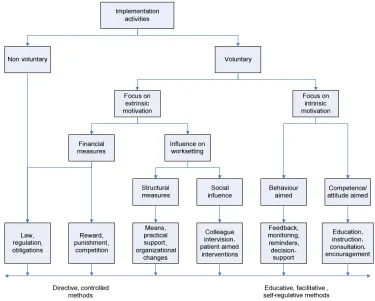
Interventions are methods used by an organization for informing or supporting a newly introduced procedure. Grol (2006) describe a number of inventions in an adjusted model of Van Woerkum (1990), shown in figure 2.5.
The model can form a directory for choosing the right forms of intervention. The effectiveness of an intervention depends on the nature of approach to implement a guideline. There are controlled intervention methods and there are educative intervention methods. When for example the implementation activities are imposed from outside the organization, the more controlled interventions are more effective. When the implementation activities are undertaken voluntary, the educative interventions are more effective.
Maintaining the changes
When an innovation is implemented within an organization it is important that the change is maintained. In order to prevent a fallback into the old system, the replacement of new routines in old routines has to be done structurally. It is important that the whole organization adapts to the new situation, it can be necessary to change protocols and to revise the norms and rule within the organization (Grol, 2006).
Another important aspect after the implementation of an innovation is the evaluation; not only has the effectiveness of the innovation but also the process of implementation to be taken into account. If the effectiveness of the innovation is not meeting the expectations, some adjustments can be made in the process. Other departments that want to implement the innovation the evaluation on the process can be very useful, because they do not have to overcome the same barriers as the first department. Evaluations are also important for continuous improvement. The health care sector is a dynamic market where it is important to stay up to date with the latest changes in technology, policies and management. Frequent evaluation on the use of condition specific indicators assures that these indicators stay up to date. This can be accomplished with incremental adjustments. However when the system changes frequently, resistance can arise with the users.
2.5 International indicator projects
Internationally many different indicator projects are established. To get insight in the features of these projects we compared the indicator projects of various countries. The choice was made to concentrate on the countries that have near similar performance measurement systems: Denmark, Great Brittan, United States of America, and Germany. The information we used for this paragraph was derived from different internet sites (see table 2.1).
In all projects that are described below, the medical professionals take an important place. Or they initiated the project or they cooperated close with the parties that set up the projects. In many countries the extra workload is a central issue. Some indicator sets are therefore merged with each other to meet these resistances. Most also try to use existing data files whenever it is possible.
Denmark
The government of Denmark has initiated in cooperation with the working field the National Indicator Project. In this project, six indicator sets are developed that exist approximately out of 96 indicators in total. The hospitals are obliged by law to provide the performance data. Monthly feedback is given about the hospital performances and a comparison is made with other hospitals. Besides this a two-annual audit takes place, the hospitals can elaborate unusual outcomes. The hospital performances are published, and the goal is to create choice information for patients, medical specialist, and other care providers.
are active in the project both regarding the economical framework, prioritizing, of practical back-up, when the project is ready to be implemented locally.
Great Britain
Since the nineties the British government pays attention to the development of indicators to track the performances of the NHS. The Healthcare Commission is the most important and independent institute in Great Brittan on the area of performance indicators. They mostly cover England, but they also have activities in Wales and Scotland. The goal of the commission is to monitor the health care and to create consumer choice information. The NHS hospitals take part in the performance measurement; private hospitals are inspected annually, but did not register the indicators until April 2007. Currently private hospitals also have to comply with national minimum standards. The commission describes annually, in the State of Healthcare Report, the status of the effectiveness, patient-centeredness, and accessibility. Also once a year a performance rating is handed out to the NHS hospitals. The indicator development is done in cooperation with medical specialists and NHS managers. The performances and ratings of the hospitals are published on the internet.
United States
In the United States numerous of organization are active in indicator projects. In this subparagraph we will discuss three. The Hospital Quality Alliance (HQA) aims making all hospitals accountable for the quality of care. Medicare and Medicaid hospitals are obliged to provide a limited set of performance data. If they do not meet this objective the hospitals get paid les by the Centre of Medicare and Medicaid Services (CMS). The reaming indicators can provided voluntarily. The private hospitals and Health Maintenance Organizations (HMO) also register indicators but these are not used national level. The HMO’s stimulate hospitals to have a high quality of care by P4P (see paragraph 2.2). The Joint Commission on Accreditation of Healthcare Organization (JCAHO) has developed most indicators that are used by the HQA. The JCAHO uses performance indicators for the accreditation of American hospitals. This is compulsory, and because of that the information can be used for comparisons as well. The Agency for Healthcare Research and Quality uses quality indicators to give managers and researchers information on the quality of care. The performances can be compared on State level and are published in an annual quality report.
Germany
The development of the performance indicators in Germany is done by the ‘Bundesgeschäfststelle Qualitätssicherung’ (BQS). This organization is established by the German government. The development takes place in ‘fachgruppen’, with representatives of medical specialist, hospitals, health insurers and patients. The BSQ collects performance data on all hospitals and publishes this anonymous on their website. Hospitals are obliged by law to provide their performance data, and they can compare their results with other hospitals. The goal of the indicators is to let hospitals be accountable for their performances. The BQS had developed 330 indicators in 2003; this amount caused resistance with the medical specialist. Their argument: the system is inefficient and increases the workload substantial. Although the data that is derived from this many indicators is very valuable, as a consequence the BQS has reduced the amount of indicators to 180.
Netherlands
- 24 -
Table 2.1 Overview of international external indicator projects
Organization Goal Actor(s) Compulsory Public Anonymous # Indicators1 Web link
Netherlands
National Indicator Project Accountability and consumer choice information Government Yes Yes No 96 http://www.nip.dk/nipUK.htm
Great Britain
Health care Commission Accountability Government Yes Yes No 40
http://ratings2007.healthcarecommission.org.uk/Indicators_2
Accountability Government Yes Yes Yes 180 http://www.bqs-outcome.de
1 Numbers are indicated
2.6 Conclusion
The theories discussed in this chapter conceptualize the guideline for this research. This paragraph describes what has to be explored further in this research and what elements are considered to be known. This is discussed per research question.
1. In what way can hospitals be stimulated to start the registration and the use of condition specific indicators?
Paragraph 2.2 described four possible incentives: Law and regulations, public reporting, P4P, and intrinsic motivation of the professional. It is interesting to see if these incentives are recognized by the involved actors, and what other incentives have influence on the implementation of condition specific indicators. And which incentive is found to be the most effective.
2. What factors have influence on the diffusion of the registration and the use of condition specific performance indicators among health care institutions?
In paragraph 2.3 the theory of Rogers was discussed, in this research we try to recognize the differing factors between the various adoption categories. In what extent are the ten critical dynamics, stated by Cain and Mittman (2002), suitable to the diffusion of condition specific indicators.
3. What are the barriers for registering and using condition specific performance indicators for the different stakeholders?
Before implementing the registration of condition specific indicators, the main barriers have to be recognized. In paragraph 2.4 a number of barriers are described. During this research we aim to find out how these barriers can be overcome and which theory of change is most appropriate to establish the registration and the use of condition specific indicators in the organization.
4. Which intervention methods can be used when health care institutions want to implement the registering and the use of condition specific performance indicators?
Every hospital is different, for this reason it is hard to describe which method is best to use. However it is explored which general intervention will have the most effect. This research will concentrate on five interventions: financial rewards, practical support, feedback on performance, registration reminders, and educational support.
5. Will the condition specific performance indicators, in the near future, be used in practice?
3 Research methodology
In order to answer the research questions, we made use of different research methods. In this chapter these methods for collecting the research data are discussed. In paragraph 3.1 we describe the interview methods, paragraph 3.2 the survey method, and in paragraph 3.3 the case study. First is explained what type of research we have performed, and what methods were used to collect the relevant research data. The book of Verschuren en Doorewaard (1999) was used as background information for this paragraph.
Type of research
For the questions identified in chapter 2 we use a mix of qualitative and quantitative methods. The research has an exploratory character, because we want to explore what the critical factors are for a successful implementation of the condition specific indicators. The objectives of exploration may be accomplished with different techniques. We have chosen for a combination of qualitative and quantitative research. (Cooper and Schindler, 2003)
Given that the subject of implementing condition specific indicators is not widely explored, a small preliminary investigation on the subject is done by means of interviews (qualitative). In this way we can determine, test, and adjust the relevant issues. After performing the interviews, a survey (quantitative) was spread under a larger population. In the next subparagraphs these data collecting methods are described and the choices concerning these methods are illustrated.
3.1 Interviews
The main objective of the interviews was to verify the completeness of survey questionnaire. The questions are based on the literature found during the literature search. The interviews are use to replenish the missing answer options. The second objective was to get a general idea of the interviewee opinions on the subject of indicator implementation. The interviews were semi structured. This method was chosen, because this benefits the comparability of the results. The interview questions were divided in five subjects: Incentives, critical dynamics of division, barriers, interventions, and practical use (see annex 2). Every subject began with open-end questions, then we checked the elements that were found in the literature, and the interviewee was asked to give a response on these elements.
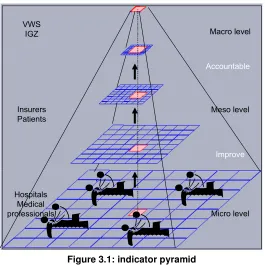
With the implementation of condition specific indicators, a number of different parties are involved. Figure 3.1 visualizes their positions in the indicator pyramid, and can be found across all three levels: micro, meso and macro. Between the levels there are different purposes for the indicators, accountability and improvement.
On micro level medical professionals and hospital staff members can be found. They are responsible for the registration of the condition specific indicators. Hospital board members, insurers, and patients are on meso level, because their choices can be influenced by the performance indicators. On macro level the government and the collective organizations give general guiding on the use performance indicators.
of the IGZ, who all were closely related to the development of the indicators and who coordinate the national use.
Accountable
Improve
Meso level
Micro level VWS
IGZ
Insurers Patients
Hospitals Medical professionals
Macro level
Figure 3.1: indicator pyramid
Interviewing was done face-to-face; this choice gave the possibility to interact with the interviewee. For example, the interviewee could be asked to elaborate on the answer; on the other hand the interviewee was able to ask a more detailed explanation when the question was not clear. Another advantage of face-to-face interviews is the opportunity to obverse the face expression and body language of the interviewee, which may be important for a correct interpretation of the answers.
After the interviews the answers were summarized with help of written notes and voice recording. These were sent to the interviewees to check if the whether there was no inaccuracy in the interpretation. This method contributes to the internal validity of the research. Three interviewees made minor adjustments to the summaries.
The analysis of the interviews was done in a structured way. The questionnaire subjects were formed put into tables, the answers of the interviewees were shortly formulated in to these tables. This allows us to compare the results. We have described the general outcomes; they were admitted anonymously in this thesis and can be found in chapter four.
3.2 Survey
The main objective of a survey is to gain an overall picture of a comprehensive phenomenon. Characteristics of a survey are: large number of respondents, more broad than depth, random sample, and quantitative data analysis. Often the aim of a survey is to generalize the data to the whole population.
between strongly agree and strongly disagree (see annex 4). The multiple choice options and the Likert Scaled statements were based on the interview results.
Additional questions to the survey questionnaire were included. Since the interviews it did not gave any insight on how the opinions of the medical specialist are referred to the use of condition specific indicators. These extra questions were based on the article that Meterko (2006) has written about providers’ attitudes. He tested six subjects: impact, clinical relevance, awareness, cooperation, unintended consequences, and control. The respondents had to score a statement for each subject on a Likert Scale.
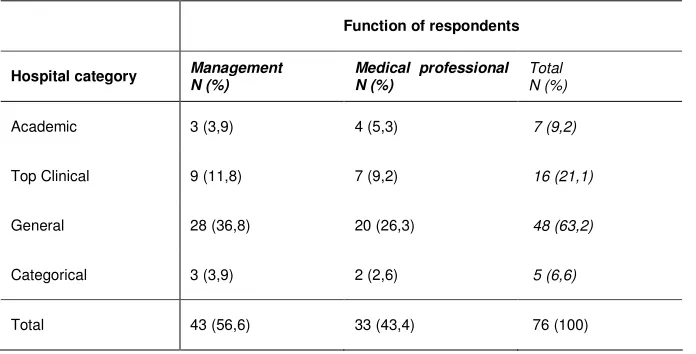
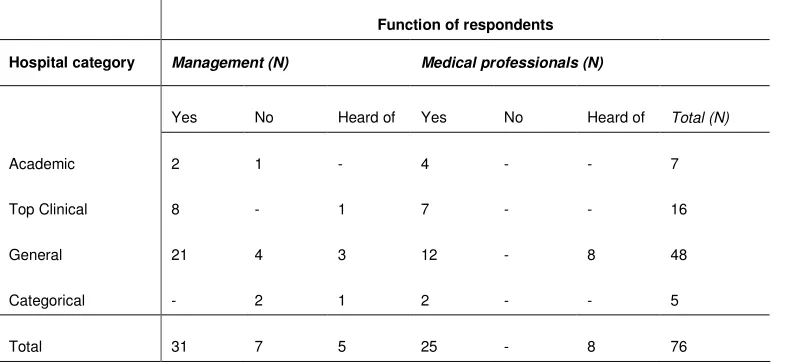
A web based survey was chosen as format for the questionnaire. The advantage of this method has relative low costs and quick response compared to written surveys. The survey was spread with two newsletters of the OMS and the ‘Sneller Beter’ project. These e-newsletters were sent to approximately 450 persons. The survey was also published on the websites of the OMS and the NVZ. In order to create a more random sample of the indicators we have asked an additional 100 people to fill in the survey. A total of 16 surveys were filled in properly. We assume a 50-50 distribution of management and medical specialists. The data (N=82) was analyzed with the analytical software program SPSS.
Data analysis
A descriptive analysis was conducted to test the hypothesis:
“It is expected that different critical factors are considered to be important by management and medical professionals.”
Average scores on the Likert Scale are presented in a table as well as the specific classes: strongly disagree (1), disagree (2), not disagree/not agree (3), agree (4), and strongly agree (5). The outcomes of management and medical staff are presented in separate bar diagrams. For every subject the bar presents the percentage of agreement with the variable. We have chosen to dichotomize the variable outcomes:
3.3 Case study
A case study is a method to gain a profound insight into one or several subjects. It is characterized by research depth, whereas surveys are broader. It is a qualitative research method. To complete this research we have chosen to translate the results of the interviews and the survey to one specific case, to see what the consequences are for the practical implementation of condition specific indicators.
The implementation of the sciatica indicator set (annex 5) was chosen as the case. During the development of these indicators the scientific associations had the specific request for an implementation plan. Besides this, the sciatica indicators are interesting because of the multiple disciplinary nature of the set; this causes a complex patient logistic.
The sciatica indicators were developed in a workgroup setting that included three neurologists, three neurosurgeons, two orthopedists, one representative of the patient association, and one representative of ZN. Primary data collection was done by means of attending workgroup meetings, observing dialogues between workgroup members, and analyzing documents concerning the development of the indicators. After analyzing the survey results we have formulated an advise on the implementation of the sciatica indicators.
4 Interview results
As described in chapter three, eight interviews have been conducted within different levels of the health care sector. In this chapter, the general outcomes of these interviews are being reviewed.
4.1 Incentives for implementing performance measurement
In paragraph 2.2 four incentives for the registration of performance measurement are reviewed. These incentives are discussed in the first paragraphs, the last paragraph deals with possible incentives that came forward during the interviews.
Law and regulations
The general opinion of five interviewees is that law and regulations are an incentive for registration of performance measurement. Three interviewees said it will not stimulate the implementation of the condition specific indicators.
Law and regulations are not seen as positive oriented incentives, because of the mandatory character of this incentive. The IGZ indicators have shown that regulations can lead to a national implementation. One interviewee was not satisfied with the way IGZ indicators were introduced, due to the external pressure on the subject.
However one interviewee said law and regulations are the only way that all Dutch hospitals will implement the registration and use of condition specific indicators. He made a distinction between innovative hospitals that automatically implement the indicators, and more ‘critical’ hospitals that will wait adopting the indicators until they are forced to do so.
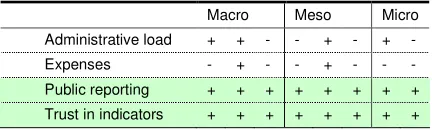
The opinions about law and regulations differ among user levels. At macro level the interviewees agree that law and regulations is an incentive. On meso and micro level there is no consensus.
Public reporting
All interviewees acknowledged public reporting as an incentive for the registration of performance measurement. Three interviewees think it is not wise to start with publishing performances without a check on the validity and responsiveness of the indicators. Two interviewees do not agree with this restriction. They believe that the check of validity and responsiveness are part of the development phase. And assume that when the indicators are recognized by the scientific associations they are ready to use. The other three interviewees did not elaborate on this subject.
It can be stated that public reporting in general is regarded as an incentive on all user levels. However, there is no consensus on the need of a check on validity and responsiveness during the implementation phase.
Pay for performance
In the interviews the term P4P was avoided, and we addressed this subject as financial rewarding. This was deliberately done, because not all interviewees