Defining Health Information Technology-related Errors: New Developments Since To Err is Human *
Dean F. Sittig, PhD1 and Hardeep Singh, MD, MPH2 1
University of Texas – Memorial Hermann Center for Healthcare Quality & Safety, National Center for Cognitive Informatics and Decision Making,
School of Biomedical Informatics, University of Texas Health Sciences Center, Houston, TX
2
Houston VA Health Services Research and Development Center of Excellence and The Center of Inquiry to Improve Outpatient Safety Through Effective Electronic Communication, Michael E. DeBakey Veterans Affairs Medical Center and Section of Health Services Research,
Department of Medicine, Baylor College of Medicine, Houston, TX
The views expressed in this article are those of the authors and do not necessarily represent the views of the Department of Veterans Affairs or any of the other funding agencies.
Address for Correspondence: Dean F. Sittig, Ph.D.
UT - Memorial Hermann Center for Healthcare Quality & Safety University of Texas School of Biomedical Informatics at Houston 6410 Fannin St. UTPB 1100.43 Houston, TX 77030 Work: 713-500-7977 Fax: 713-500-0766 Email: [email protected] Keywords:
Electronic Health Records; Health Information Technology, Patient Safety; Errors Word count:
Manuscript: 1111 words
*
Portions of this manuscript were presented to the United States’ Institute of Medicine Committee on Patient Safety and Health Information Technology held December 14, 2010 in Washington, DC
Introduction
Two Institute of Medicine (IOM) reports have recommended the use of information
technologies to improve patient safety and reduce errors in health care1,2. Broadly speaking, health information technology (HIT) is the overarching term applied to various information and communication technologies to collect, transmit, display, or store patient data.
Despite HIT’s promise in improving safety, recent literature has revealed potential safety hazards associated with its use, often referred to as e-iatrogenesis3,4. For example, Koppel et al. described 22 types of errors facilitated by a commercially-available EHR system’s
computerized provider order entry (CPOE) application5. In response to similar emerging
concerns , the Office of the National Coordinator for HIT recently sponsored an IOM committee to “review the available evidence and the experience from the field” on how HIT use affects patient safety. Given the national impact of HIT, this initiative is a major step forward in ensuring safety and well-being of our patients. However, the field currently lacks acceptable definitions of HIT-related errors and it’s unclear how best to measure or analyze “HIT errors”.
The goal of this manuscript is to advance the understanding of HIT-related errors and explain how adverse events, near misses, and patient harm can result from problems with HIT itself or from interactions between HIT, its users, and the work system. HIT errors almost always jeopardize patient outcomes and have high potential for harm6. This is because many of these errors are latent errors that occur at the “blunt end” of the healthcare system7, with potential to affect large numbers of patients if not corrected. Furthermore, if important structural or process-related HIT problems are not addressed proactively, care of millions of patients may be affected due to impending widespread adoption and implementation of EHRs8. We thus focus this manuscript heavily on errors related to the use of EHR systems.
General Criteria for a HIT Error
We define the “HIT work system” as the combination of all the hardware and software required to implement the HIT, as well as the social environment in which it is implemented. We thus propose that HIT errors should be defined from the socio-technical viewpoint of end users (including patients, when applicable), rather than the purely technical view of manufacturers, developers, vendors, and personnel responsible for implementation. HIT-related error occurs anytime the HIT system is unavailable for use, malfunctions during use, is used by someone incorrectly, or when HIT interacts with another system component incorrectly, resulting in data being lost or incorrectly entered, displayed, or transmitted9,10. HIT errors may involve failures of either structures or processes and can occur in the design and development, implementation and use, or evaluation and optimization phases of the IT lifecycle11. This approach is consistent with the currently recommended systems and human factors approaches used to understand and reduce error1.
The HIT system is considered to be unavailable for use if for any reason the user cannot enter, review, transmit or print data (e.g., patient’s medication allergies or most recent laboratory test
results). Reasons could include unavailable computer hardware (e.g., missing keyboard, or problems with the computer’s monitor, the network routers that connect the computer to the data servers and printers, or the server where data is stored), software (e.g., problems with the operating system that manages either the computer applications such as the internet browser and EHR, or the interface between an EHR and the information system of an ancillary service such as radiology or lab), and power sources (e.g., a power outage that results in hospital-wide computer failure)4.
The HIT system is considered to be malfunctioning (i.e., available, but not working correctly) whenever a user cannot accomplish the desired task despite using the HIT system as designed. In this situation, error results from any hardware or software defect (or “bug”) that prohibits a user from entering or reviewing data, or any defect that causes the data to be entered,
displayed, transmitted, or stored incorrectly. For example, the clinician enters the patient’s weight in pounds and the weight-based dosing algorithm fails to convert it to kilograms before calculating the appropriate dose, resulting in a 2-fold overdose.
Finally, errors can occur even when hardware and software are functioning as designed. For instance, errors may result when users do not use the hardware or software as intended. For example, users might enter free-text comments (e.g., take 7.5mg Mon-Fri only) that contradict information contained in the structured section of the medication order (e.g., Warfarin tabs 10mg QD)12. Errors may also arise when two or more parts of the HIT system (e.g., CPOE application and the pharmacy’s medication dispensing system) interact in an unpredicted manner, resulting in inaccurate, incomplete, or loss of data during entry, display, transmission or storage13.
Origin-Specific Typology for an HIT Error
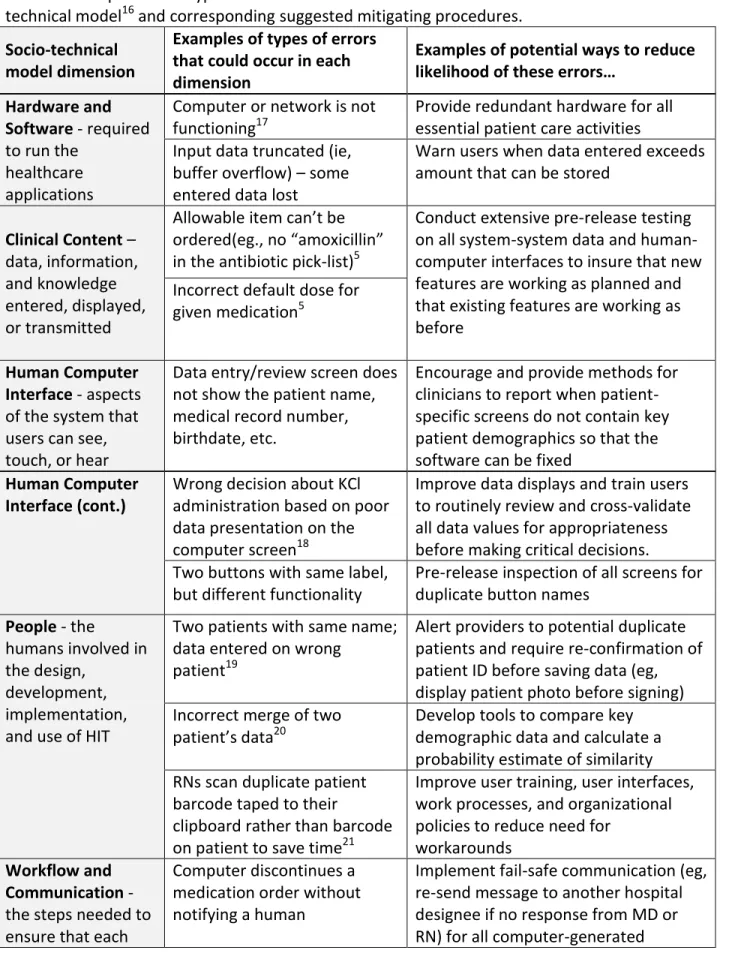
Leveson14 proposes that new technologies have fundamentally altered the nature of errors and asserts that these changes necessitate new models and methods for investigating technology-related errors. Thus, technological advances could potentially give rise to increasingly complex and multifaceted errors in healthcare. In view of the resultant expanding and evolving context of safe HIT implementation and use, we illustrate how a new socio-technical model for HIT evaluation and use can provide an origin-specific typology for HIT errors15. The model’s 8 dimensions (Table 1) comprehensively account for the technology, its users and their respective workflow processes and how these two elements interface with the technology, the work system context including organizational and policy factors that affect HIT, and notably, the interactions between all of these factors16. Table 1 provides examples of specific EHR-related errors that can occur within each of the 8 dimensions of the socio-technical model, along with examples of potential ways that the likelihood of each error could be reduced. Thus, the model not only illustrates the complex relationships between active and latent errors but also lays a foundation for error analysis.
Table 1. Examples of the types of errors that can occur within each dimension of the socio-technical model16 and corresponding suggested mitigating procedures.
Socio-technical model dimension
Examples of types of errors that could occur in each dimension
Examples of potential ways to reduce likelihood of these errors…
Hardware and Software -required to run the
healthcare applications
Computer or network is not functioning17
Provide redundant hardware for all essential patient care activities Input data truncated (ie,
buffer overflow) – some entered data lost
Warn users when data entered exceeds amount that can be stored
Clinical Content – data, information, and knowledge entered, displayed, or transmitted
Allowable item can’t be ordered(eg., no “amoxicillin” in the antibiotic pick-list)5
Conduct extensive pre-release testing on all system-system data and human-computer interfaces to insure that new features are working as planned and that existing features are working as before
Incorrect default dose for given medication5
Human Computer Interface - aspects of the system that users can see, touch, or hear
Data entry/review screen does not show the patient name, medical record number, birthdate, etc.
Encourage and provide methods for clinicians to report when patient-specific screens do not contain key patient demographics so that the software can be fixed
Human Computer Interface (cont.)
Wrong decision about KCl administration based on poor data presentation on the computer screen18
Improve data displays and train users to routinely review and cross-validate all data values for appropriateness before making critical decisions. Two buttons with same label,
but different functionality
Pre-release inspection of all screens for duplicate button names
People - the
humans involved in the design,
development, implementation, and use of HIT
Two patients with same name; data entered on wrong
patient19
Alert providers to potential duplicate patients and require re-confirmation of patient ID before saving data (eg, display patient photo before signing) Incorrect merge of two
patient’s data20
Develop tools to compare key demographic data and calculate a probability estimate of similarity RNs scan duplicate patient
barcode taped to their
clipboard rather than barcode on patient to save time21
Improve user training, user interfaces, work processes, and organizational policies to reduce need for
workarounds Workflow and
Communication - the steps needed to ensure that each
Computer discontinues a medication order without notifying a human
Implement fail-safe communication (eg, re-send message to another hospital designee if no response from MD or RN) for all computer-generated
5 patient receives the
care they need at the time they need it
actions22, Critical abnormal test result
alerts not followed up23
Implement robust quality assurance systems to monitor critical alert follow-up rates24; use “dual notification” for alerts judiciously25 Organizational Policies and Procedures - internal culture, structures, policies, and procedures that affect all aspects of HIT management and healthcare
Policy contradicts physical reality (eg, required Barcode med administration readers not available in all patient locations)21
Conduct pre- and post-implementation inspections, interviews, and monitor feedback from users in all physical locations
Policy contradicts personnel capability (eg, 1 pharmacist to verify all orders entered via CPOE in large hospital)
Conduct pre- and post-implementation interviews with all affected users to better gauge workload
Incorrect policy allows “hard-stops” on clinical alerts causing delays in needed therapy26
Disallow “hard-stops” on alerts; users should be able to override the
computer in all but the most egregious cases (eg, ordering promethazine as IV push by peripheral vein27)
External Rules, Regulations, and Pressures - external forces that facilitate or place constraints on the design, development, implementation, use, and evaluation of HIT in the clinical setting
Billing requirements lead to inaccurate documentation in EHR (eg, inappropriate copy & paste)
Highlight all “pasted” material and include reference to source of material
Joint Commission required medication reconciliation processes28 causing rushed development of new medication reconciliation applications that were difficult to use and caused errors29; rescinded safety goal30 only to reinstate it 7/1/201131
Carefully consider potential adverse unintended consequences before making new rules or regulations; conduct interviews and observations of users to gauge effects of rules and regulations on patient safety, quality of care, and clinician work-life
System
Measurement and Monitoring - of system availability,
Incomplete or inappropriate (eg, combining disparate data) data aggregation leads to
6 use, effectiveness, and unintended consequences of system use Incorrect interpretation of results
transparency by providing involved stakeholders with access to raw data, analytical methods, and reports
Conclusion
Rapid advances in HIT development, implementation, and regulation have complicated the landscape of HIT-related safety issues. Erroneous or missing data, or the decisions based on them, increase the risk of an adverse event and unnecessary costs. Because these errors can and frequently do occur post-implementation, simply increasing oversight of HIT vendors’ development processes will not address all HIT–related errors. Comprehensive efforts to reduce HIT errors must start with clear definitions and an origin-focused understanding of HIT errors that addresses important socio-technical aspects of HIT use and implementation. To this end, we believe this commentary provides a much needed foundation for coordinating safety initiatives of HIT designers, developers, implementers, users, and policy-makers, who must continue to work together to achieve a high-reliability HIT work system for safe patient care.
Acknowledgements
Dr. Sittig is supported in part by a grant from the National Library of Medicine R01- LM006942 and by a SHARP contract from the Office of the National Coordinator for Health Information Technology (ONC #10510592).
Dr. Singh is supported by an NIH K23 career development award (K23CA125585), the VA National Center of Patient Safety, Agency for Health Care Research and Quality, a SHARP contract from the Office of the National Coordinator for Health Information Technology (ONC #10510592), and in part by the Houston VA HSR&D Center of Excellence (HFP90-020). These sources had no role in the preparation, review, or approval of the manuscript.
We thank Laura A. Petersen, MD, MPH, VAHSR&D Center of Excellence, Michael E. DeBakey Veterans Affairs Medical Center, and Baylor College of Medicine, and Eric J. Thomas, MD, MPH, University of Texas, Houston-Memorial Hermann Center for Healthcare Quality and Safety and Department of Medicine, University of Texas Medical School, Houston, for their guidance in this work and Annie Bradford, PhD, for assistance with medical editing, for which they received no compensation.
7 References
1. Institute of Medicine. To err is human: Building a safer health system. [Report by the Committee on Quality of HealthCare in America] Washington, DC: National Academy Press; 1999.
2. Institute of Medicine. Patient Safety: Achieving a new standard for care. [Report by the Committee on Data Standards for Patient Safety] Washington, DC: National Academy Press; 2004.
3. Weiner JP, Kfuri T, Chan K, Fowles JB. "e-Iatrogenesis:" The most critical unintended consequence of CPOE and other HIT. J Am Med Inform Assoc. 2007 Feb 28;
4. Myers RB, Jones SL, Sittig DF. Reported Clinical Information System Adverse Events in US Food and Drug Administration Databases. Applied Clinical Informatics, 2011; 2: 63–74. doi: 10.4338/ACI-2010-11-RA-0064.
5. Koppel R, Metlay JP, Cohen A, Abaluck B, Localio AR, Kimmel SE, Strom BL.Role of
computerized physician order entry systems in facilitating medication errors. JAMA. 2005 Mar 9;293(10):1197-203.
6. Hofer TP, Kerr EA, Hayward RA. What is an error? Eff Clin Pract. 2000 Nov-Dec;3(6):261-9. 7. Reason J. Human error: models and management. BMJ. 2000 Mar 18;320(7237):768-70. 8. Stead W, Lin H, eds. Computational technology for effective health care: immediate steps and strategic directions. Washington, DC: National Academies Press, 2009.
9. Mangalmurti SS, Murtagh L, Mello MM. Medical malpractice liability in the age of electronic health records. N Engl J Med. 2010 Nov 18;363(21):2060-7.
10. Perrow C. “Normal Accidents: Living with High-Risk Technologies”, Princeton University Press. Princeton, New Jersey, 1999.
11. Walker JM, Carayon P, Leveson N, Paulus RA, Tooker J, Chin H, Bothe A Jr, Stewart WF. EHR safety: the way forward to safe and effective systems. J Am Med Inform Assoc. 2008 May-Jun;15(3):272-7.
12. Singh H, Mani S, Espadas D, Petersen N, Franklin V, Petersen LA. Prescription errors and outcomes related to inconsistent information transmitted through computerized order entry: a prospective study. Arch Intern Med. 2009 May 25;169(10):982-9.
8
13. Kleiner B. Sociotechnical System Design in Health Care. In: Carayon P, editor. Handbook of Human Factors and Ergonomics in Health Care and Patient Safety. Mahwah, NJ: Lawrence Erlbaum; 2007.
14. Leveson N. A New Accident Model for Engineering Safer Systems. Safety Science, April 2004; 42(4): 237-270.
15. Sittig DF, Singh H. Eight rights of safe electronic health record use. JAMA. 2009 Sep 9;302(10):1111-3.
16. Sittig DF, Singh H. A new sociotechnical model for studying health information technology in complex adaptive healthcare systems. Qual Saf Health Care. 2010 Oct;19 Suppl 3:i68-74.
17. Kilbridge P. Computer crash--lessons from a system failure. N Engl J Med. 2003 Mar 6;348(10):881-2.
18. Horsky J, Kuperman GJ, Patel VL. Comprehensive analysis of a medication dosing error related to CPOE. J Am Med Inform Assoc. 2005 Jul-Aug;12(4):377-82.
19. Shojania KG. Patient Mix-Up. AHRQ WebM&M [serial online]. February 2003. Available at: http://www.webmm.ahrq.gov/case.aspx?caseID=1
20. AHIMA MPI Task Force. “Merging Master Patient Indexes.” September 1997. Available at: http://www.cstp.umkc.edu/~leeyu/Mahi/medical-data6.pdf
21. Koppel R, Wetterneck T, Telles JL, Karsh BT. Workarounds to barcode medication administration systems: their occurrences, causes, and threats to patient safety. J Am Med Inform Assoc. 2008 Jul- Aug;15(4):408-23.
22. Kuperman GJ, Teich JM, Tanasijevic MJ, Ma'Luf N, Rittenberg E, Jha A, Fiskio J, Winkelman J, Bates DW.Improving response to critical laboratory results with automation: results of a
randomized controlled trial. J Am Med Inform Assoc. 1999 Nov-Dec;6(6):512-22.
23. Singh H, Wilson L, Petersen LA, Sawhney MK, Reis B, Espadas D, Sittig DF. Improving follow-up of abnormal cancer screens using electronic health records: trust but verify test result communication. BMC Med Inform Decis Mak. 2009 Dec 9;9:49.
24. Singh H, Thomas EJ, Sittig DF, Wilson L, Espadas D, Khan MM, Petersen LA. Notification of abnormal lab test results in an electronic medical record: do any safety concerns remain? Am J Med. 2010 Mar;123(3):238-44.
9
Timely follow-up of abnormal diagnostic imaging test results in an outpatient setting: are
electronic medical records achieving their potential? Arch Intern Med. 2009 Sep 28;169(17):1578-86.
26. Strom BL, Schinnar R, Aberra F, Bilker W, Hennessy S, Leonard CE, Pifer E. Unintended effects of a computerized physician order entry nearly hard-stop alert to prevent a drug interaction: a randomized controlled trial. Arch Intern Med. 2010 Sep 27;170(17):1578-83.
27. Grissinger M. Preventing serious tissue injury with intravenous promethazine (phenergan). Pharmacy & Therapeutics. 2009 Apr;34(4):175-6.
28. Medication reconciliation. 2005 National Patient Safety Goal #8 by the Joint Commission. 29. Poon EG, Blumenfeld B, Hamann C, Turchin A, Graydon-Baker E, McCarthy PC, Poikonen J, Mar P, Schnipper JL, Hallisey RK, Smith S, McCormack C, Paterno M, Coley CM, Karson A, Chueh HC, Van Putten C, Millar SG, Clapp M, Bhan I, Meyer GS, Gandhi TK, Broverman CA. Design and implementation of an application and associated services to support interdisciplinary
medication reconciliation efforts at an integrated healthcare delivery network. J Am Med Inform Assoc. 2006 Nov-Dec;13(6):581-92.
30. APPROVED: Will Not Score Medication Reconciliation in 2009. Joint Commission. Available at: http://www.jcrinc.com/common/PDFs/fpdfs/pubs/pdfs/JCReqs/JCP-03-09-S1.pdf
31. Revised National Patient Safety Goal on medication reconciliation is approved. Joint Commission Online - December 8, 2010.