Using Inquiry Biomedical Engineering Cases to
Increase Middle and High School Student Interest in
Science and Engineering
Jason Weaver
1, Michael Ryan
2, and Marion Usselman
3Abstract – The Georgia Tech Center for Education Integrating Science, Mathematics, and Computing (CEISMC)
hosts programs every summer for K-12 students. One popular program, co-led by two high school teachers and a graduate student in biomedical engineering (BME), uses problem-based learning methods to teach students about forensics. These forensics activities can be combined with BME cases in order to enrich the student experience and expose them to engineering. CEISMC is looking to implement its programs in local schools in order to increase student participation and interest in science and engineering through an initiative dubbed “Tech in Your Town”. This paper presents the forensics curriculum from the summer program, methods to link BME to forensics,initiatives to disseminate through Tech in Your Town camps and after school clubs, and program evaluation results. The ongoing expansion of CEISMC programs serves to support the growth and incubation of future scientists and engineers.
Keywords: forensics, biomedical engineering, inquiry learning
I
NTRODUCTIONEducating young people about engineering and raising their interest in the field are vital to the future of this country. As Jacquelyn F. Sullivan from the University of Colorado at Boulder writes,
“Consider the potential contributions today’s young people – as tomorrow’s engineers – could make toward closing our record $726 billion trade gap, if only we could interest them in our profession!…It’s up to us [engineers] to make engineering visible and relevant in the lives of K-12 students, teachers, counselors, and parents.” [6]
While many venues exist for generating interest in engineering among young people, one of these is through the use of forensics. The popularity of forensic science has reached new levels in the United States today and one need only count the number of television programs centered on crime scene investigation (CSI) and forensics to recognize this. Forensics classes are now being offered in some Atlanta-area public schools as science electives. CSI GT: The Science to Solve the Crime, a week long summer program at Georgia Tech, has become wildly popular in recent years receiving 65 applications for only 20 openings in 2008. Biomedical engineering, one of the fastest growing engineering fields today [5], is in a unique place to harness the popularity of forensics to increase student interest.
1 Wallace H. Coulter Department of Biomedical Engineering (BME), Georgia Institute of
Technology, 315 Ferst Dr., IBB Bldg. Rm. 2119, Atlanta, GA 30332, [email protected]
2 Center for Education Integrating Science, Mathematics and Computing (CEISMC), Georgia
Institute of Technology, 760 Spring St., Atlanta, GA 30308, [email protected]
3 Center for Education Integrating Science, Mathematics and Computing (CEISMC), Georgia
By integrating biomedical engineering cases into forensics activities, young people are exposed to engineering in an engaging context which may increase their interest in the topic.
This paper describes the effort to utilize an existing forensics curriculum to increase student interest in science and engineering. This is being done with the Georgia Tech Student and Teacher Enhancement Partnership (STEP) in conjunction with CEISMC. Descriptions of both the forensics curriculum and links to biomedical engineering are given. This paper also discusses the efforts of CEISMC to reach a larger audience and disseminate its programs throughout Georgia in an initiative entitled, “Tech in Your Town.” Specific examples of the dissemination initiative, already underway, are provided.
CEISMC,
STEP,
ANDCSI
GT
Georgia Tech’s Center for Education Integrating Science, Mathematics, and Computing (CEISMC), as a part of its mission, seeks to partner with Georgia Tech departments, higher-ed organizations and institutions, K-12 schools, businesses, and other entities working to make Georgia a leader in science, technology, engineering, and math (STEM) education. During the past 20 years, CEISMC has been instrumental in facilitating opportunities for many STEM stakeholders to achieve their goals. These activities include summer academic enrichment programs for elementary, middle, and high school students which frequently highlight cutting edge research and STEM frontiers. CEISMC currently sponsors up to 25 Summer Enrichment Programs at the Georgia Tech campus. Each summer, approximately 500 students (ages 10-17) participate in weeklong programs in STEM domains. Georgia Tech faculty and students, along with area teachers, provide camp-like experiences geared toward 1) motivating student interest in STEM, and 2) providing content knowledge supporting the instruction they learn during the school year.
“CSI GT: The Science to Solve the Crime” is a week-long forensic science program, open to rising 8th and 9th grade students, that is run by CEISMC in conjunction with the Wallace H. Coulter Department of Biomedical Engineering (BME) at Georgia Tech, and financially supported by gifts from Shell Oil and The Society for Science and the Public. BME provides both classroom and laboratory facilities for the entire week. The program is led by two high school instructors and a graduate student in BME who is familiar with the laboratory space and available equipment. Additionally, CEISMC provides an assistant who meets the students in the morning, takes them to lunch, assists with classroom control, and takes the students to the pickup location at the end of the day. Graduate students who have participated in Georgia Tech’s Student and Teacher Enhancement Partnership (STEP) GK-12 program are critical to CEISMC programs and often serve as graduate assistants. In 2008, lead author Jason Weaver, a BME graduate student and former STEP fellow, was chosen to co-lead CSI GT.
Student and Teacher Enhancement Partnership (STEP)
Supported by the National Science Foundation’s GK-12 initiative and Georgia Tech, STEP partners advanced undergraduate and graduate students from Georgia Tech with metro-Atlanta area high schools in teams led by master teachers. The program seeks to improve the communication and leadership skills of Georgia Tech students and at the same time use the scholarly expertise from Georgia Tech to assist in increasing the mathematics and science performance of the Atlanta-area high schools in which the students are placed. The program began in 2001 when Georgia Tech received three years of funding from the National Science Foundation to develop a program that provided graduate students with the opportunity to build their leadership, teaching, and presentation skills while using their science content knowledge to assist local high schools improve student learning. Since its inception, the program has made strides towards institutionalization and currently the program consists of approximately 20 students (undergraduate and graduate) working at seven local high schools [4]. Weaver participated in the STEP program in the 2007-08 academic year at Miller Grove High School in DeKalb County where he assisted in physics, calculus, and pre-calculus classes in addition to forming and leading an after-school engineering club.
CSI GT Curriculum
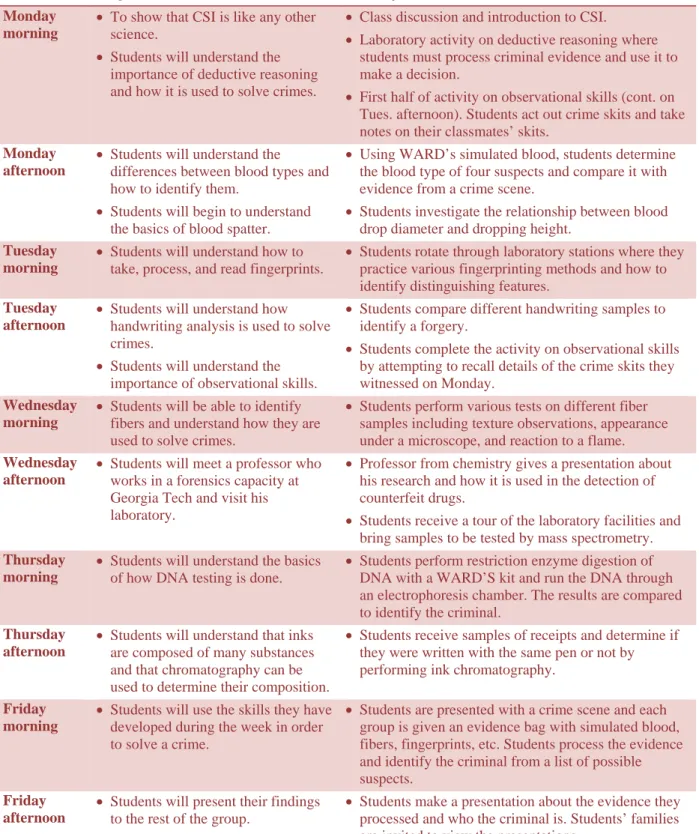
The curriculum of the week-long forensic science program is activity-based and uses problem-based learning (PBL) methods to give students the tools they need to think critically and solve problems. The students participate in a number of activities throughout the week that are designed to prepare them to solve a simulated murder mystery on their own. Each day is split into morning and afternoon modules (2-3 hours in length) during which the students learn about and practice a specific forensics skill, e.g. ink chromatography. On the final day of the program, the
students are presented with a crime scene and evidence and must employ the skills they learned throughout the week to determine who the murderer was. See Table 1 for a more detailed description of the full curriculum.
Table 1: Detailed Description of CSI GT Curriculum
Objective Activity
Monday morning
• To show that CSI is like any other science.
• Students will understand the importance of deductive reasoning and how it is used to solve crimes.
• Class discussion and introduction to CSI. • Laboratory activity on deductive reasoning where
students must process criminal evidence and use it to make a decision.
• First half of activity on observational skills (cont. on Tues. afternoon). Students act out crime skits and take notes on their classmates’ skits.
Monday afternoon
• Students will understand the differences between blood types and how to identify them.
• Students will begin to understand the basics of blood spatter.
• Using WARD’s simulated blood, students determine the blood type of four suspects and compare it with evidence from a crime scene.
• Students investigate the relationship between blood drop diameter and dropping height.
Tuesday morning
• Students will understand how to take, process, and read fingerprints.
• Students rotate through laboratory stations where they practice various fingerprinting methods and how to identify distinguishing features.
Tuesday afternoon
• Students will understand how handwriting analysis is used to solve crimes.
• Students will understand the importance of observational skills.
• Students compare different handwriting samples to identify a forgery.
• Students complete the activity on observational skills by attempting to recall details of the crime skits they witnessed on Monday.
Wednesday morning
• Students will be able to identify fibers and understand how they are used to solve crimes.
• Students perform various tests on different fiber samples including texture observations, appearance under a microscope, and reaction to a flame. Wednesday
afternoon
• Students will meet a professor who works in a forensics capacity at Georgia Tech and visit his laboratory.
• Professor from chemistry gives a presentation about his research and how it is used in the detection of counterfeit drugs.
• Students receive a tour of the laboratory facilities and bring samples to be tested by mass spectrometry. Thursday
morning
• Students will understand the basics of how DNA testing is done.
• Students perform restriction enzyme digestion of DNA with a WARD’S kit and run the DNA through an electrophoresis chamber. The results are compared to identify the criminal.
Thursday afternoon
• Students will understand that inks are composed of many substances and that chromatography can be used to determine their composition.
• Students receive samples of receipts and determine if they were written with the same pen or not by performing ink chromatography.
Friday morning
• Students will use the skills they have developed during the week in order to solve a crime.
• Students are presented with a crime scene and each group is given an evidence bag with simulated blood, fibers, fingerprints, etc. Students process the evidence and identify the criminal from a list of possible suspects.
Friday afternoon
• Students will present their findings to the rest of the group.
• Students make a presentation about the evidence they processed and who the criminal is. Students’ families are invited to view the presentations.
CSI GT Program Evaluation Results
CEISMC administered a survey to the parents and students involved in their summer programs. Analysis of this survey provided feedback on the program, its affordances, and possible changes to the curriculum. Of the responses to the forensics program, all of the attending students said that they thought that the program made STEM learning more interesting. Of note is that all responding students indicated that they found STEM concepts interesting most of the time, but a third of those same students indicated that they find STEM boring a majority of the time. Anecdotally, this suggests that while students find STEM topics interesting, the actual learning of STEM does not interest them. This presents a great challenge to the educator – STEM learning experiences should be designed for and target student engagement and interest.
Parent feedback indicated overwhelmingly that CSI GT made STEM learning more interesting to their student and that CEISMC programs motivate their student to seek STEM opportunities in other settings. In fact, 100% of parents from the forensics program (and 94.6% of all parents with students attending a CEISMC summer program) said they would like to see CEISMC programs take place in their community rather than only being held at Georgia Tech’s campus. Taken together, these survey responses point to the conclusion that 1) STEM concepts must be presented in an interesting context to keep students from becoming bored and 2) parents are overwhelmingly interested in seeing these programs developed in their communities. The latter point is one that CEISMC has explored in the past few years through its Tech in Your Town initiative and is discussed later in this paper.
L
INKS TOB
IOMEDICALE
NGINEERINGThrough his experiences in the summer program, Weaver realized that forensics could be used as a means to convey engineering ideas and principles to students. Forensics offers an explicit connection to biomedical engineering and can be used as a vehicle to generate interest in engineering among young people. Nearly every activity used in the summer program can be related to an aspect of engineering and in particular of BME. In addition to exposing the students to engineering at a young age, these activities add to the breadth and enhance the experience for all the students. These suggested activities could be done as supplements to the forensics curriculum or as stand-alone activities. While the BME cases can be done immediately after the corresponding forensics activities, performing the BME cases first forces students to think critically and question how to design a better way from the outset. In that way, how the forensics tests work can be emphasized as much as the actual act of doing the tests. Students can begin to appreciate engineering and view its applications in their lives as something interesting and worth exploring. Inquiry Biomedical Engineering Cases
Engineering Problem Solving Method: Engineers are required to solve problems using their knowledge of science, mathematics, and related fields similar to how criminal investigators must use their knowledge of forensics and deductive reasoning to solve a crime. Biomedical engineers can use the engineering problem solving method to determine why a prosthetic limb failed by analyzing the forces involved and how the prosthetic limb failed. In the form of a group discussion or individually, students should come up with examples of problems that biomedical engineers solve to help keep people healthy. Additionally, students can propose new solutions for biomedical engineering problems.
Electrophoresis Chamber: Engineers are responsible for designing objects that we use on a daily basis including cars, computers, and even buildings. Biomedical engineers work with objects that have to do with medicine. The forensics program provides the opportunity for students to learn how medical equipment, like gel electrophoresis chambers, work, and that engineers are the people who design them. After an activity on gel electrophoresis, ask the students to think of how they could make an electrophoresis chamber cheaper, better, or faster. Students should attempt to weigh the advantages and disadvantages of their design changes. For example, using a less expensive material could result in safety issues and potential lawsuits for the company.
Machine to Automate Blood Typing: Engineers design many objects which serve to make our lives run smoother. After the students complete an activity on blood typing, have them imagine that they are a biomedical engineer at a company that makes laboratory equipment. Their boss has just come to their desk and is asking them to design a machine that is capable of determining blood type in half the time that it takes a laboratory technician to do it and for one third of the cost. Ask the students to make a list of design specifications for their machine and how it could
be done. Furthermore, ask the students to complete an estimated cost analysis which compares the cost of hiring a technician with the cost of buying and maintaining a machine to do blood typing.
Computer Program for Fingerprint Recognition: Process improvement is an area where many different types of engineers work. After a laboratory on fingerprint analysis, tell the students to imagine that they work for a company that makes forensics equipment. Many of their customers are asking for a machine to help them automate their fingerprint recognition process because of the long time and human error associated with a technician performing all of the analysis. Ask the students to come up with a plan for a machine to recognize and compare fingerprints identifying all of the major components. In addition to their technical plan, the students may generate an approximate time table and budget for their new machine.
T
ECH INY
OURT
OWNWhile CEISMC has been successful in creating enrichment programs on campus, CEISMC’s role is statewide and its reputation national. CEISMC strives to reach more students and teachers by disseminating some of its most successful STEM summer enrichment programs throughout communities in Georgia via its new initiative, Tech in Your Town (TYT). Schools, centers, or communities would send individuals to a TYT training workshop (on Georgia Tech’s campus or at sites around Georgia) in a particular STEM concept, e.g. forensics. Besides acquiring content understanding in the topic, participants would receive curriculum materials on how to run a successful version of the TYT program in their community. Each attendee would learn about the program logistics and formats that best fit the goals, needs, and constraints facing their community. Following the workshop, each participant would return home to run their own Georgia Tech-endorsed TYT student program. CEISMC would continue to work with participants to coach their implementation. Over time, CEISMC will produce new and updated modules to keep programming fresh and relevant for our partners. In addition to the forensics program described in this paper, CEISMC has TYT programs in robotics, animation, and space science. CEISMC trained nearly 30 teachers at TYT workshops in 2008, and they intend to expand the TYT program to more communities in Georgia in 2009. Early Tech in Your Town Programs
SciQuest is an early Tech in Your Town-type program that demonstrates the potential of these types of programs. CEISMC began SciQuest in three DeKalb County elementary schools in 1998 as a school-based version of a 1-week summer program for elementary school students (grades 3 – 6) that was run at Georgia Tech. Georgia Tech provided the curriculum and the professional development for the teachers, but it was the teachers who planned the logistical details of the camp and conducted it. In the early years of the program, it was funded through the Eisenhower Professional Development Program and other small grants, but has since become completely self-supporting through student fees of approximately $250. CEISMC helped the schools develop a 3-year rotating SciQuest curriculum (covering electricity, aeronautics, and recycling) that could realistically be accomplished by elementary school teachers. At one DeKalb elementary school, the core teaching staff has returned year after year, and there is now school-wide knowledge about how to conduct the activities and run the camp. Because of this, new teachers are now trained by their peers during the week before the camp. The program has been highly successful—at this school SciQuest and SciQuest Jr. (a camp for students in grades K-2 designed by the teachers) each accepts 50 students and all spots are filled within the first hour after applications are available in the spring.
Another similar program was initiated in Westlake High School through the TYT initiative. Westlake High School is located in southwest Atlanta and has an enrollment of 2,065 students, 45% of whom are eligible for free or reduced lunch [1]. Westlake did not make Adequate Yearly Progress (AYP) in 2008 [3]. The Georgia Tech forensics summer program was first offered in June 2006. In the summer of 2007, Westlake High School implemented the same program as a camp for students from their feeder middle schools, with financial support from NASA. In summer 2008, forensics was included in Westlake’s civil and transportation engineering camp for middle school students, to increase the attractiveness to students. Thirty seven students, all African American, enrolled in the program. The goal of Westlake’s program is to stimulate interest in science, technology, engineering, and mathematics as well as to recruit students into the math and science magnet program at Westlake High School.
Tech in Your Town with CSI GT
During 2008, with financial support from The Society for People and Science, CEISMC piloted additional TYT programs. For CSI GT, CEISMC recruited an experienced high school biology teacher who served as an instructor during previous summer programs. This teacher and co-author Michael Ryan, a CEISMC Program Director with experience in curriculum design, paired to craft the one-week summer program described above. The classroom teacher had taught many of the activities and concepts in her high school classroom, and this pair’s intention was to create a standards-based and problem-based experience for summer program attendees that could one day be exported to Georgia communities. Following the summer program, the teacher drafted a final version of the curriculum, incorporating lessons learned from the summer experience. CEISMC's summer program curricula are typically formatted into 90-minutes modules. This formatting allows the program to run not only in a summer camp setting, but also in after-school or Saturday school programs.
Critical to this TYT program moving beyond Georgia Tech's borders has been the involvement of a Georgia Tech graduate student (Jason Weaver, lead author) and an additional high school teacher. These three co-planned the one-week program and served as co-instructors for the one-week. The second teacher teaches biology at a predominantly low-SES school in the Atlanta area where the student population is underrepresented and underserved in STEM fields and learning opportunities. He intends to run the CSI GT summer program at his school in 2009 to get students excited about STEM classes and post-graduation paths.
During the 2008-09 school year, Weaver and two other STEP Fellows are using the curriculum in an after-school program at Miller Grove High School. Miller Grove High School is a Title I high school located in Lithonia, GA. It supports students in 9th through 12th grade with an enrollment of 1,757 students, 65% of whom are eligible for free or reduced lunch [1]. Miller Grove did not make AYP in 2008 [3]. In 2007-08, Weaver formed an engineering club at the school which consisted of approximately 10 students. During the year, the club designed and constructed two separate, working solar ovens. The students presented their work at the 2008 Young Engineer’s Day, which was a one-day event hosted by the College of Engineering at Georgia Tech for local students to showcase engineering work which they had done for socially relevant problems. The STEP after-school club at Miller Grove has continued into 2008-09 as two graduate students are leading a forensics club there with an average weekly attendance of 15 students. This club, which has morphed from engineering to forensics, can be used to inform students about BME by adding the engineering links described above to the curriculum. Many of these activities could be adapted to fit the hour long timeframe of an after-school club in order to teach students about BME. Given the connection between STEP and CEISMC, the Miller Grove after-school club is an ideal place to implement the BME activities in a local community.
Limitations and Possible Solutions
While the resources of a large university like Georgia Tech lend itself to summer programs and outreach of this scale, infrastructure, content knowledge, equipment, funding, and the facilities to do high-tech activities are not available in many locations. As such, activities that are being developed for TYT must be planned carefully with the facilities of the end-user in mind. Professional development or training classes could be offered to teachers who are interested in implementing a forensics program in their own school. Alternatively, interviews with instructors or videos could be used as a method of explaining activities to teachers interested in starting a forensics or other TYT program.
In addition to training personnel, obtaining appropriate equipment may be difficult in some areas. Low-tech options should be developed for use in schools that do not have access to laboratory facilities like those at Georgia Tech. In place of microscopes, representative photos of what a student would see in a microscope can be presented on an overhead projector. Whereas ink chromatography and handwriting analysis can be performed at a low cost, activities like the restriction enzyme digestion of DNA can not. Videos could be used to give students an idea of how the process works and some websites even offer virtual laboratories where students can “run” an electrophoresis gel online [2].
S
UMMARYIn conclusion, the popularity of forensic science today can be harnessed to expose young students to BME and potentially increase their interest in the subject. With this in mind, the activities used in CEISMC’s forensic science summer program can be broken into modules and paired with BME activities. Georgia Tech, through STEP, is in a unique position to deliver these BME cases to local schools. Through TYT, CEISMC is looking to disseminate its programs to a larger audience. These efforts are underway with the forensics program and have already had success in Westlake High School and in the SciQuest programs.Overall, the ongoing expansion of CEISMC camps serves to support the growth and development of future scientists and engineers.
R
EFERENCES[1] Atlanta Schools – Atlanta, Georgia – School Finder – Education.com. [cited Nov. 16, 2008]; Available from: http://www.education.com/schoolfinder/us/georgia/atlanta/.
[2] Gel Electrophoresis Virtual Lab. [cited Nov. 25, 2008]; Available from: http://learn.genetics.utah.edu/content/labs/gel/.
[3] Georgia Department of Education – Adequate Yearly Progress (AYP) 2008. [cited Nov. 16, 2008]; Available from http://www.doe.k12.ga.us/ayp2008.aspx.
[4] STEP Program. [cited Oct. 13, 2008]; Available from: http://www.cetl.gatech.edu/step.
[5] Gibbons, M., “On the Rise,” PRISM, American Society for Engineering Education, October 2008: p. 26-27 [6] Sullivan, J.F., “A Call for K-16 Engineering Education,” The Bridge, 2006. 36(2): p. 17-24.
Jason Weaver
Jason Weaver received his B.S. in mechanical engineering (highest honors) from Purdue University in 2005. Upon graduation, he participated in a one year volunteer program in Durán, Ecuador where he taught English as a second language, physics, and reading. In August of 2006, he entered the Ph.D. program in BME at Georgia Tech and was the recipient of both a President’s Fellowship and an NSF Graduate Research Fellowship Honorable Mention. He participated in the STEP program at Georgia Tech where he taught in high school physics, calculus, and pre-calculus classes in addition to leading an after-school engineering club. He is currently a graduate research assistant and his main research interest is the design of novel stents for the treatment of atherosclerosis.
Michael Ryan
Mike Ryan is a Program Director for the Center for Education Integrating Science, Mathematics, and Computing (CEISMC) at the Georgia Institute of Technology. Mike completed his graduate work in science education at the University of Kansas (M.S. Ed.) and his undergraduate studies at the University of Michigan. His expertise is in the use of project-based inquiry learning environment and strategies to target standards-based science learning. Mike has taught physics, physical science, earth science, and life science at the secondary level. Mike joined CEISMC in 2007 as a Program Director. Mike annually oversees the design and delivery of 30 K-12 academic enrichment programs at GT's campus. Mike works with faculty and students at Georgia Tech to provide quality STEM education experiences for K12 audiences on campus and around the state.
Marion Usselman
Dr. Marion C. Usselman is a Senior Research Scientist at the Center for Education Integrating Science, Mathematics and Computing (CEISMC) at the Georgia Institute of Technology. Marion received her B.A. in biophysics from the University of California, San Diego, and her Ph.D. in biophysics from Johns Hopkins University. She focuses on K-12 educational reform, university-K-K-12 partnerships, and equity issues in education.